A nurse-led chronic disease management clinic in the urology department of a tertiary hospital recorded 14,013 outpatient registrations between July 2024 and September 2026, according to a single-center retrospective descriptive study using routinely collected service records. The clinic primarily supported long-term management of patients with prostate and bladder cancer while also providing specialty nursing services for other urological conditions. Its follow-up system marked 3,547 of 3,553 assigned tasks as successful, a task-level success rate of 99.83%. These figures describe service activity and record completion; the study did not measure whether the clinic improved clinical outcomes or economic performance.
The clinic was established in July 2024 within the hospital’s existing specialty nursing outpatient service framework. Its operating model included staffing and qualification requirements, professional training, clearly defined nursing responsibilities, physician–nurse collaboration, standardized procedures, information-system support and quality management. Nurses worked within their authorized scope of practice, while urologists participated in medical assessment and treatment decisions when required. The service had four reported components: patient assessment and follow-up planning; treatment follow-up and adverse-event monitoring; rehabilitation guidance and health promotion; and assistance with healthcare policies and basic nursing care.
Monthly registrations increased from 147 in July 2024 to a peak of 710 in August 2026, with fluctuations during the reporting period. Total registration fees were CNY 152,758. The clinic delivered 14,246 prostate cancer-related injections, 3,523 urinary catheterizations, 2,777 intravesical instillation procedures and 2,142 urinary catheter removals. It also assisted patients with prostate or bladder cancer in applying for outpatient chronic and special disease insurance benefits. The study reports these counts as routine service activities, but it did not compare the procedures with those delivered elsewhere or evaluate their individual clinical effects.
Follow-up management was integrated into the clinic’s information system, which contained records for 1,111 patients. Of these, 953 patients had been followed up and 951 had successful follow-up records. Nurses also executed 3,553 follow-up tasks, of which 3,547 were successful, corresponding to the reported 99.83% task-level rate. The descriptive data do not specify the duration or effectiveness of patient follow-up, assess whether missed contacts influenced treatment adherence or health outcomes, or establish how the results would compare with another care model.
Because the research covered one tertiary hospital and relied on routinely collected records, it cannot establish how the clinic would operate in smaller facilities, under different staffing arrangements or in other health systems. The findings offer a documented example of a nurse-led outpatient service with defined responsibilities, standardized workflows, follow-up documentation and collaboration with urologists. The authors stated that further research is needed to evaluate the model’s clinical outcomes and economic implications. Accordingly, the registration growth, procedural workload and high proportion of completed follow-up tasks should be interpreted as descriptions of implementation and recorded service delivery, not as evidence of improved survival, fewer complications, lower costs or other patient benefits.
Subject of Research: Operation and service activity of a nurse-led chronic disease management clinic in hospital urology
Article Title: Development and implementation of a nurse-led chronic disease management clinic in the urology department of a tertiary hospital: a descriptive study
Article References: Liu, C., Xia, Y., Jia, X., Wang, R., Li, T., Ma, Y., & Long, H. (2026). Development and implementation of a nurse-led chronic disease management clinic in the urology department of a tertiary hospital: a descriptive study. BMC Nursing. https://doi.org/10.1186/s12912-026-05566-z
A survey-based study of 246 village-level social welfare data operators found that business architecture, cross-organizational collaboration and technological readiness were positively and statistically significantly associated with perceived e-government integration impact in two Indonesian regencies. The research, focused on Gunung Kidul and Bangkalan, examined organizational, institutional, relational and technological capabilities associated with social welfare data integration. Governance and leadership and information policy did not show statistically significant direct relationships with perceived integration impact in the pooled sample.
The authors analyzed the survey with partial least squares structural equation modeling. In their framework, e-government integration impact, or EGII, represents perceived improvements in information, system and service quality, responsiveness and public trust. E-government integration scope, or EGIS, describes the breadth of integration across data, applications, electronic communication and knowledge-sharing processes.
EGII was strongly associated with EGIS, meaning that operators reporting more favorable perceived integration outcomes also tended to report broader integration. Because this was an observational analysis of survey responses, the results establish statistical relationships rather than causal effects. The findings identify three capabilities with significant direct relationships to EGII in the pooled model: business architecture, cross-organizational collaboration and technological readiness.
The evidence does not provide operational definitions for these constructs, but the results show that their measured levels were associated with respondents’ assessments of e-government integration outcomes. By contrast, governance and leadership and information policy had no statistically significant direct relationships with EGII in that analysis. This absence of a detected direct relationship does not establish that the two factors are unimportant or that they operate only through indirect pathways, because the supplied findings do not report such indirect effects.
A regency-based robustness analysis found that some relationships were sensitive to local implementation conditions. Significant differences between Gunung Kidul and Bangkan were reported for the technological-readiness-to-EGII relationship and the EGII-to-EGIS relationship. The geographic comparison therefore cautions against assuming that the same capability relationships apply uniformly across the two regencies, although it does not identify the specific local practices responsible for those differences.
Its direct contribution is to show which measured interoperability capabilities were associated with perceived integration impact in the surveyed population, alongside evidence that some relationships varied between the two regencies.
Subject of Research: Survey-based analysis of interoperability capabilities for social welfare data integration in two Indonesian regencies
Article Title: Determinants of E-government interoperability capabilities for social welfare data integration in Gunung Kidul and Bangkalan Regencies, Indonesia
Article References: Fikri, R., Purnomo, E. P., Pribadi, U., Mohamed, A. M., & Mohammad, N. B. (2026). Determinants of E-government interoperability capabilities for social welfare data integration in Gunung Kidul and Bangkalan Regencies, Indonesia. Discover Sustainability. https://doi.org/10.1007/s43621-026-04608-5
Keywords: social welfare data, e-government, interoperability, Indonesia, PLS-SEM, technological readiness, cross-organizational collaboration, business architecture, digital governance, public services, Determinants, capabilities
It’s never been easier to get to know your neighbors: a new database introduces open star clusters, stellar associations, and substellar objects within 500 parsecs (1,630 light-years) of the Sun.
Too Much of a Good Thing
Astronomers today must contend with a difficult but delightful problem — there’s just so much data available. As a researcher attempting to study a particular slice of the universe, it can be challenging to pinpoint the correct data and to know whether you’ve collected all the data relevant to your science. This prospect is already daunting, and the deluge of data from surveys like the Vera C. Rubin Observatory’s Legacy Survey of Space and Time will make the situation even harder to manage.
This is where specialized databases can help. Often crafted with specific science goals in mind, database creators do the work for you by compiling objects within a well-defined parameter space. Today’s article describes a new database that takes a census of the solar neighborhood, with applications for studies of stellar evolution, exoplanets, and more.
Compiling Clusters
Jonathan Gagné (Montreal Planetarium; University of Montreal) and collaborators have compiled the Montreal Open Clusters and Associations (MOCA) database, which contains detailed information on nearby star clusters, stellar associations, and substellar objects.
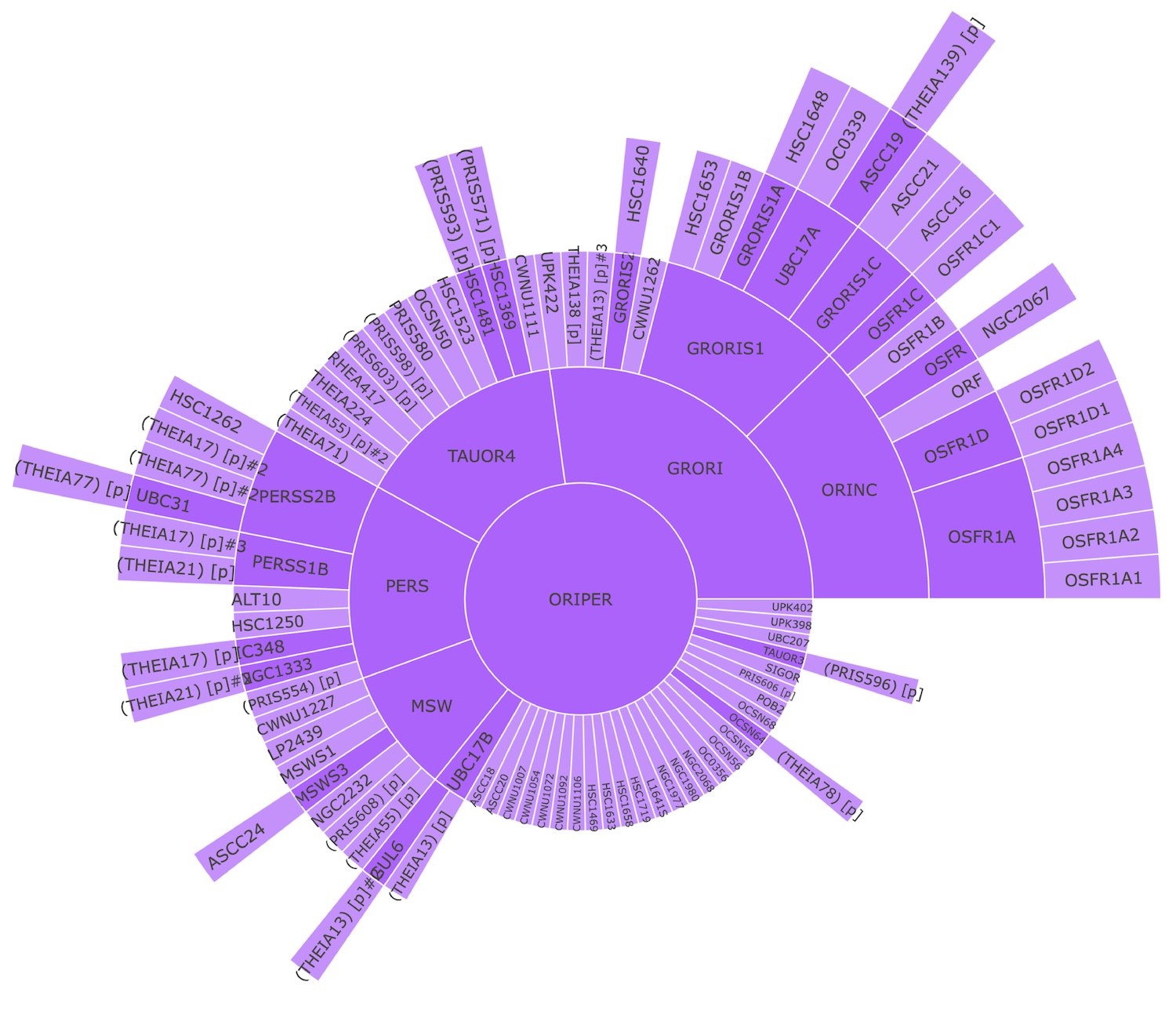
Visualization of the hierarchy of young stellar associations within the Orion–Perseus branch of the database. Click to enlarge. [Gagné et al. 2026]
Gagné’s team began the monumental task of constructing the database by amassing a list of nearby groups of stars from the literature, drawing on recent searches using data from the Gaia mission and other sources. This task required reconciling cluster names and memberships from multiple sources and detailing a cluster hierarchy that places subgroups within larger cluster structures.
In total, the complete database contains information about 10,259 star clusters and stellar associations and their individual members. The authors identified more than 11,000 new candidate cluster and association members, most of which are M dwarfs. The database also contains 1,620 substellar objects, 196 of which are newly identified through this work, and 101 candidate isolated planetary-mass objects.
Science with MOCA
For each star, the team compiled the available measurements from the literature and, from these core measurements, derived quantities like distance and spectral type. They then used empirical methods to estimate further properties like age, mass, and effective temperature.
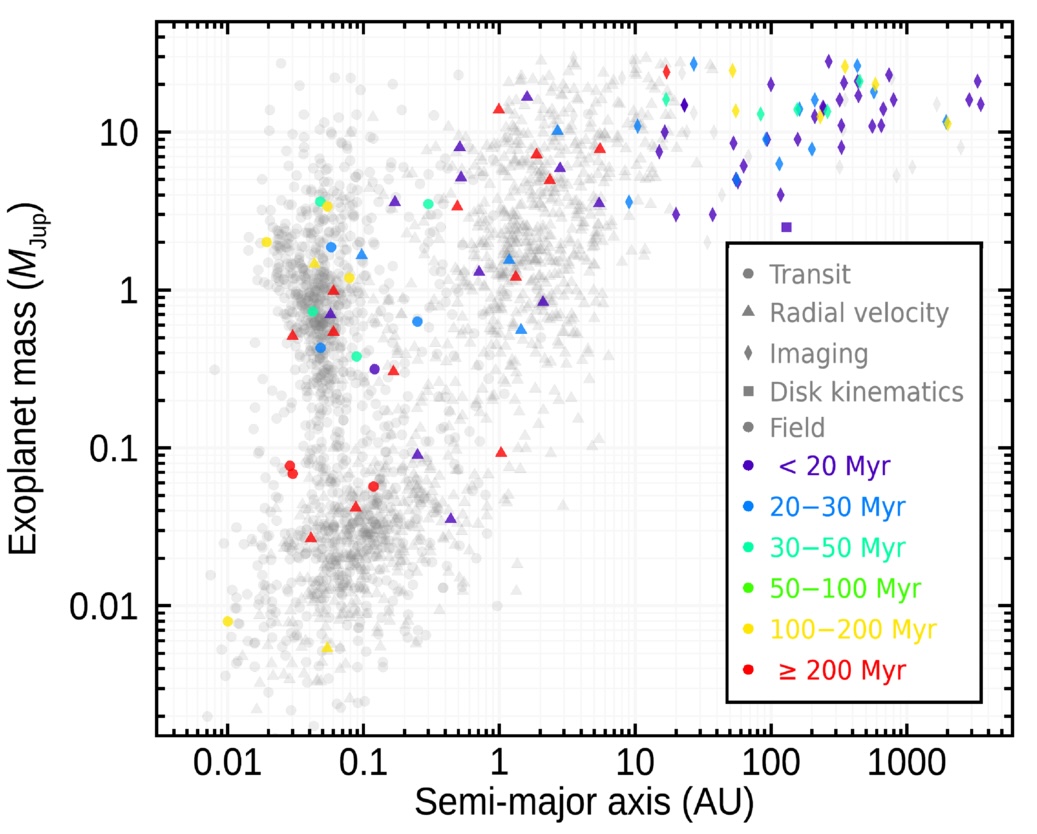
Masses and semi-major axes for confirmed exoplanets from the NASA Exoplanet Archive (gray symbols). Colored symbols indicate planets belonging to a young stellar association, with the color denoting the age of the association. Click to enlarge. [Adapted from Gagné et al. 2026]
Assigning ages to star clusters and stellar associations enhances the scientific value of the database, making it broadly accessible to studies of stellar and planetary evolution. For exoplanet science, the team identified 134 confirmed exoplanet systems and 121 planet candidates in young stellar associations with well-determined ages. This includes 46 confirmed and 53 candidate planets that appear to be assigned to an age-dated association for the first time.
MOCA already offers an impressive census of our patch of the Milky Way, but this isn’t its final iteration. As new data become available — including future Gaia data releases that will improve our understanding of cluster membership and reveal a population of astrometrically detected exoplanets — they will be incorporated into the existing database.
“The Montreal Open Clusters and Associations (MOCA) Database: A Census of Nearby Associations, Open Clusters, and Young Substellar Objects Within 500 pc of the Sun,” Jonathan Gagné et al 2026 ApJS287 8. doi:10.3847/1538-4365/ae9b09
China's five-part GEO standard offers Western SEOs a practical framework for measuring AI visibility, evaluating vendors, and separating optimization from manipulation.
A 518-million-year-old ambulacrarian fossil from China suggests that the common ancestor of starfish and their relatives was not a burrowing worm; it was probably a tentacled animal that fed from the water around it.
SpamSieve 3.3.2 is an update of my Mac e-mail spam filter that improves remote training, can export more rule information, and improves uninstallation, help, and more. The most significant news is that Microsoft has changed plans again. They will no longer be preventing users from continuing to use Legacy Outlook and in fact will keep it available for download as part of the combined Outlook app. This gives more time to adapt to their change in plans for AppleScript. Exchange (EWS) support remains an issue. Microsoft is still planning to cut off Legacy Outlook users, and Apple has yet to announce when Mail will support Graph. So far, I’ve not heard that it’s enabled in the macOS 27.2 beta.
We’re participating in a seasonal festival of artisanal software called SummerFest. For a limited time, you can get a 25% discount on new purchases of SpamSieve, EagleFiler, and other top Mac apps from our indie developer friends.
Some interesting engineering issues were:
Updating NSWorkspace APIs introduced a problem because with the old launchApplication(at:options:), the .withErrorPresentation option is off by default, whereas with the newer openApplication(at:configuration:completionHandler:), the promptsUserIfNeeded option is on by default.
Previously, Core Data would strip leading BOMs from NSStrings when saving to a SQLite database. With macOS 27, this happens for Swift Strings, too.
I have lots of unit tests that check for memory leaks. These caught a change where addPersistentStore(type:configuration:at:options:) now seems to return an autoreleased store. Without adding a pool, it looked like there was a leak.
Also, the tests were finding lots of “leaks” because KVO was retaining NSTabView, which retains a controller. Previously, XCTestCase.waitForExpectations(timeout:) would spin the run loop, and everything would get cleaned up. With Xcode 27 and macOS 27, I need to manually spin the run loop before waiting for the expectations.
During a software update, macOS may decide to reload the Dock icon. The application package no longer exists because it’s been replaced with a new version. This wasn’t a problem before because SpamSieve had been drawing to an image in memory and setting that as the Dock icon. Now, with the Liquid Glass–imposed removal of custom Dock icons, macOS tries to load the icon from disk, and rather than handling errors gracefully it will crash. I fixed this by setting an image with a memory representation before starting a software update.
SpamSieve 3.3.1 introduced a crash affecting a small but significant number of users when doing a Core Data fetch of a large number of objects. The private [_PFManagedObjectReferenceQueue _processReferenceQueue:] method was seemingly releasing an object that had already been released. What’s odd is that, as far as I can tell, none of the related app code had changed since the previous version, yet suddenly crashes started happening all the way from macOS 12 through macOS 27. If I had to guess, this was triggered by upgrading from Xcode 26.2 to Xcode 26.6. Maybe Swift’s ARC optimizations are doing something subtly different?
The crash was triggered by an autorelease pool that I had inserted to promptly clean up any temporary objects after a fetch. (The actual fetched objects were returned and used outside of the pool.) Interestingly, both Gemini and ChatGPT were convinced that this is a well-known exception to standard memory management rules. They said it’s never safe to use managed objects outside of a pool they were fetched in because they depend on internal Core Data objects that the pool will have released. I was not able to find any basis for this “belief,” but it was easy enough to test. As expected, removing the pools (during the beta cycle) just made the same crashes happen slightly later.
I think there’s probably something wrong in Core Data’s internal bookkeeping, but this does not seem to be a popular crash (and I’ve never seen it on any of my Macs), so my code must be doing something uncommon to trigger it. My current best guess is that it was related to calling refreshAllObjects() after saving. (I bet there’s some fancy bookkeeping to make that efficient.) I was doing this throughout the app to break retain cycles so that unused objects could be deallocated. But it wasn’t necessary in this particular case because the entity being fetched has no relationships. So far, removing the refresh seems to have stopped the crashes, but I won’t know for sure until more people have been using this version for a while.
Depois de indicar prazos de até três meses para quem comprou oiPhone Duo na pré-venda, a Apple começou a reduzir o tempo estimado de entrega para os seus consumidores nos Estados Unidos e no Japão.
Para alguns usuários, as datas de entrega passaram de dezembro para a terceira semana de novembro e, em outros casos, para a próxima sexta-feira (23/10), data do lançamento oficial do produto — a depender, claro, da cor e da capacidade de armazenamento escolhidas.
Nossa! Meu pedido do iPhone Duo foi antecipado. Antes era em dezembro.
Além disso, para novos pedidos, a Apple limitou a aquisição do aparelho a até duas unidades por pessoa no Japão, no Reino Unido, nos Estados Unidos, na Espanha e, como verificado pela equipe do MacMagazine, também no Brasil.
Ao tentar adicionar mais do que duas unidades, a Apple exibe o seguinte aviso:
É possível comprar no máximo 2 iPhone Duo por cliente. Ajuste a quantidade total de iPhone Duo em seu pedido antes de finalizar a compra.
Não se sabe exatamente quando a empresa implementou essa limitação, já que era possível adquirir três unidades ou mais do iPhone Duo na sexta-feira passada (16/10), quando a pré-venda começou. A medida, muito provavelmente, foi a alternativa encontrada pela Apple para lidar com a escassez do produto.
iPhone Duo
Cores: branco-estrela ou céu noturno Armazenamento: 256GB, 512GB, 1TB ou 2TB
NOTA DE TRANSPARÊNCIA: O MacMagazine recebe uma pequena comissão sobre vendas concluídas por meio de links deste post, mas você, como consumidor, não paga nada a mais pelos produtos/serviços ao usar os nossos links de afiliado.
In one of the most comprehensive investigations of its kind, researchers have taken a major step toward untangling the biology underlying suicide risk, moving the field beyond long-standing debates about whether suicidal behavior is simply a consequence of psychiatric illness. By integrating large-scale genetic data with cutting-edge approaches that map how genes act in specific brain cells and circuits, an international team has identified shared genetic liability that cuts across psychiatric diagnoses while also pinpointing druggable biological pathways that could one day inform prevention strategies. The study, published in Translational Psychiatry, offers a sweeping synthesis of how inherited risk factors may translate into molecular vulnerabilities, and it does so with a level of resolution that previous candidate-gene approaches could never achieve.
Suicide remains one of the leading causes of death worldwide, claiming more than 700,000 lives each year according to global health estimates. Despite decades of research, clinical prediction remains stubbornly imprecise, and biological models of suicidal behavior have historically been hampered by small sample sizes, inconsistent findings, and a tendency to conflate suicide risk with the psychiatric disorders with which it so often co-occurs. Major depression, bipolar disorder, schizophrenia, and substance use disorders all carry elevated suicide risk, yet most people with these conditions never attempt suicide, while some individuals who die by suicide have no diagnosed psychiatric illness at all. This paradox has long suggested to researchers that suicidal behavior may possess partially distinct biological underpinnings, and the new study set out to test that hypothesis with unprecedented statistical power.
At the heart of the work lies genome-wide association study methodology, or GWAS, which scans hundreds of thousands to millions of genetic variants spread across the entire genome in very large groups of people, comparing individuals who have experienced suicidal thoughts or behaviors with those who have not. Each variant is tested for statistical association with the outcome, and the results can be combined into polygenic risk scores, numerical summaries of a person’s inherited liability based on the cumulative small effects of thousands of variants. Because no single common variant exerts a large effect, the field depends on aggregating data across massive biobanks and cohorts, a strategy that has only become feasible in the past decade as datasets containing hundreds of thousands of individuals became available.
The research team took particular care to address a central confound: psychiatric disorders themselves are highly heritable, and any genetic signal linked to suicide could simply reflect inherited liability to depression or schizophrenia rather than to suicide specifically. To disentangle this, the investigators applied sophisticated statistical techniques, including genetic correlation analysis and conditional modeling, which allow researchers to ask how much genetic overlap remains between suicidal behavior and psychiatric conditions after accounting for their shared heritability. Their findings revealed a complex architecture. Substantial genetic correlations confirmed that suicide risk shares a meaningful fraction of its inherited basis with major psychiatric disorders, supporting the idea of a common pool of genetic liability. Yet the analyses also uncovered signals that persisted beyond what could be explained by those disorders, pointing to biological mechanisms that may be more specific to the emergence of suicidal thoughts and actions.
A key conceptual innovation of the study is its framing of “shared genetic liability” as a bridge between diagnoses. Rather than treating suicide as an epiphenomenon of any single disorder, the researchers modeled it as a transdiagnostic phenomenon, one whose risk emerges partly from inherited vulnerabilities that cut across diagnostic categories. This perspective aligns with a growing movement in biological psychiatry that emphasizes symptom dimensions and mechanisms over traditional diagnostic boundaries. From this vantage point, the genetic variants that raise risk for depression, PTSD, and schizophrenia may do so partly because they converge on shared molecular pathways, and those same pathways may govern an individual’s threshold for suicidal crises regardless of which diagnosis they carry.
Identifying genetic variants, however, is only the first step. A GWAS signal typically points to a genomic region rather than a specific causal gene or mechanism, since many associated variants fall in non-coding stretches of DNA that regulate gene activity from a distance. To translate statistical associations into biological insight, the team deployed a battery of functional genomics approaches. Transcriptome-wide association studies, known as TWAS, integrate gene expression data to identify genes whose genetically predicted expression levels are linked to suicide risk. Tissue and cell-type enrichment analyses then ask whether the implicated genes are unusually active in particular organs or cell populations. The results converged strikingly on brain tissue, and more specifically on neuronal populations, providing support for the idea that inherited suicide risk is mediated largely through gene regulation within the central nervous system.
The study’s most clinically provocative findings concern druggable biology. Using databases that catalog the protein targets of approved and investigational medications, the researchers examined whether genes implicated in suicide risk were over-represented among known drug targets. The analysis identified several classes of candidate targets, including components of neurotransmitter signaling systems, ion channels, and intracellular signaling cascades that are already the focus of pharmacological development for other conditions. This “druggable genome” approach, which has gained traction in genetics research across many diseases, offers a pragmatic shortcut for translational science: rather than waiting decades for entirely new therapeutic classes to be invented, researchers can prioritize existing or in-development compounds whose molecular targets intersect with genetically implicated pathways.
Among the pathways receiving attention in the analysis were those involving glutamatergic and GABAergic neurotransmission, the primary excitatory and inhibitory systems of the brain, which have repeatedly surfaced in studies of mood disorders and stress response. The endocannabinoid system and inflammatory signaling pathways also appeared in the convergent analyses, consistent with a broader literature linking immune dysregulation and allostatic load to suicidal ideation. Importantly, the authors emphasize that these findings identify hypotheses rather than ready-made treatments. Genetic association with a drug target does not guarantee that modulating that target will reduce suicide risk, and any therapeutic application would require extensive preclinical validation and carefully designed clinical trials. Nevertheless, the work provides a principled, data-driven map for where to look, replacing decades of largely failed candidate-gene speculation with a genome-wide evidence base.
The methodological rigor underpinning the study deserves emphasis, because the genetics of suicidal behavior has a troubled history. Early candidate-gene studies, which typically examined a handful of variants in genes related to serotonin signaling, produced findings that largely failed to replicate and in some cases were later shown to reflect statistical artifacts, small samples, and publication bias. The field has since undergone a reckoning, and modern efforts adhere to far stricter standards: preregistered analyses, very large and ancestrally diverse cohorts, replication in independent samples, and conservative multiple-testing corrections that demand genome-wide significance thresholds on the order of five times ten to the negative eighth power. The new study reflects these lessons, applying sensitivity analyses to guard against confounding from psychiatric comorbidity and examining whether findings generalize across ancestral groups, an issue of considerable importance given that most genetic discovery to date has been conducted in populations of European ancestry.
The implications for clinical practice, while still distant, are worth considering. Polygenic risk scores for suicide-related outcomes currently explain only a small fraction of individual differences in risk, far too little to be used as stand-alone screening tools, and their predictive performance is degraded in populations not represented in the discovery data. Researchers in the field are careful to stress that genetic risk is not destiny: suicidal behavior arises from an intricate interplay of inherited vulnerability, mental illness, trauma, substance use, social isolation, access to lethal means, and the availability of support. What genetics offers is not a crystal ball but a window into mechanism, and mechanistic knowledge is the raw material from which better biomarkers, risk stratification tools, and ultimately targeted interventions are built. In the near term, the druggable pathway findings are most valuable as a guide for laboratory science, directing neurobiologists toward molecular systems whose manipulation might alter suicide-relevant phenotypes in animal models and cellular assays.
Looking forward, the study signals where the field must go next. Sample sizes for suicide-specific genetic analyses remain smaller than those for major psychiatric disorders, and expanding representation across ancestries is essential if the benefits of this research are to be shared equitably. Integrating genetic data with longitudinal measures of life stress, neural imaging, and digital phenotyping may eventually allow researchers to model how inherited liability interacts with environmental triggers across the lifespan. Functional experiments in induced pluripotent stem cell-derived neurons and brain organoids could test whether the implicated genes genuinely alter stress-response circuitry or resilience. And randomized trials in patients carrying high genetic liability, though ethically and logistically complex, represent the logical endpoint of the druggable-target approach.
What the study ultimately delivers is a reframe. Suicide risk, in this analysis, is not an amorphous clinical outcome but a measurable, partly heritable trait whose genetic architecture is now being resolved with the same tools that have transformed our understanding of heart disease, diabetes, and schizophrenia. By demonstrating that shared genetic liability links suicide risk across diagnostic boundaries and by mapping that liability onto specific, pharmacologically tractable biology, the researchers have converted a long-standing clinical puzzle into a concrete research agenda. The path from genetic correlation to effective prevention is long, and no genetic finding will soon replace the human work of crisis intervention, connection, and care. But for a problem that has defied biological explanation for generations, the identification of shared, druggable mechanisms represents a genuine and hard-won advance, one that may shape suicide research for years to come.
Subject of Research: Shared genetic liability and druggable biological pathways underlying suicide risk across psychiatric disorders
Article Title: From shared genetic liability to druggable biology in suicide risk
Article References: Yao, K., Zhuo, C., Chen, X., Li, C., Song, H., Zou, J., & Tian, H. (2026). From shared genetic liability to druggable biology in suicide risk. Translational Psychiatry. https://doi.org/10.1038/s41398-026-04428-1
Trump has touted a recent Census report. WIRED found grave flaws in its analysis and the process behind it, and confirmed the identity of several of its authors—among them a one-time DOGE affiliate.
Trump has touted a recent Census report. WIRED found grave flaws in its analysis and the process behind it, and confirmed the identity of several of its authors—among them a one-time DOGE affiliate.
Google is adding a pre-trained foundation model for tabular data to BigQuery, allowing enterprise teams to generate predictions from structured data without having to train and deploy a machine learning model from scratch.
The TabFM model, which has been developed by Google Research and is now available in preview, can perform classification and regression, two common types of predictive machine learning.
While classification is used to predict a category or outcome, for example, whether a customer is likely to churn or whether a transaction may be fraudulent, regression is typically used to predict a numerical value, such as the expected value of a customer or the amount of a future claim.
Traditionally, enterprise teams in a typical machine learning workflow would need to train and deploy a separate ML model for each use case they want to pursue. In contrast, TabFM uses historical data as in-context examples to make predictions, the company wrote in a blog post.
That means teams can provide labeled historical data, where the outcome is already known, along with the new data they want to make predictions about, and use BigQuery’s AI.PREDICT function to generate those predictions.
The function uses the historical data as examples to identify patterns and then applies what it has learned to the new data, without requiring teams to separately train and deploy a machine learning model.
TabFM, according to Google, can also automatically work with data expressed as categories, such as customer type or product category, as well as datasets with missing values, reducing the preparation required before making predictions.
Further, the company is providing an AI.EVALUATE function to assess the model’s performance on the prediction task. Teams can use it to compare TabFM’s predictions with the known outcomes in their data and measure how accurately the model performed, Google wrote, adding that this gives teams a way to evaluate whether the predictions are useful for a particular use case.
Productivity, cost, and governance benefits
For enterprises, the addition of TabFM could make predictive analytics more accessible to teams that do not have extensive ML expertise, while reducing some of the engineering and infrastructure work involved in developing and maintaining conventional models, said Amit Kumar Jena, AI development head at IT consulting firm Kanerika.
“Someone who knows SQL can now generate a classification or regression prediction directly against tables already in BigQuery, using the two new functions, without training, tuning, or deploying a model first, and without moving data out to a separate ML platform, which also simplifies governance and cuts the infrastructure cost of running a parallel platform,” Jena explained.
That, according to Manoj Chandra Jha, principal analyst at Nord-IQ Research, translates to TabFM collapsing the traditional multi-persona workflow, stretching from an analyst, a data scientist, and a ML engineer, into a single SQL call, thereby potentially reducing headcount requirements.
But benefits may vary by workload
However, the new model has limitations that enterprises should be aware of before replacing conventional ML workflows.
Google’s own guidance and documentation still point to XGBoost, which is a widely used machine-learning algorithm for making predictions from structured or tabular data, and custom models for very large datasets, datasets with more features than TabFM’s current limit of 20 feature columns.
“Use traditional models like XGBoost when you have very large historical datasets, require complete control over custom hyperparameter tuning, have a high number of features that exceed current limits of TabFM, or need feature-importance explainability, i.e., which of the input features contributed most to the prediction,” the company wrote.
More so because, in large datasets and high-frequency workloads, the cost advantage can diminish, analysts pointed out.
While TabFM can reduce the cost of setting up a model-training pipeline, Google’s plans to move TabFM to token-based pricing on top of standard BigQuery charges starting October 30, 2026, could result in higher costs for workloads that generate predictions at scale compared with a trained and cached model, Jena said.
Enterprises should therefore pilot TabFM on their own workloads, run the numbers based on their actual query volumes, and compare the costs with their existing ML infrastructure before shifting significant parts of their ML budgets to the service, Jha advised.
In other words, that makes TabFM more of a workload-specific tool than a wholesale replacement for traditional ML models, Jha said, adding that it is better suited to workloads such as ad hoc analysis, experimentation and lower-frequency business use cases.
An analysis of dozens of strange objects captured in official U.S. government videos has revealed new insights—and challenges—involving the study ofunidentified anomalous phenomena (UAP).
The researchers, both of whom serve on the UAP Science Advisory Council to the U.S. government, say their study highlights significant limitations on analysis of the purported UAP videos due to missing or redacted sensor data, which prevents civilian researchers from having enough of the tools necessary to determine whether seemingly fast-moving objects in the videos actually display anomalous velocities.
In an email to The Debrief, Haqq-Misra explained that while the new study is among the first to explore the limitations on what can be discerned about these objects based on analysis of the current batch of PURSUE releases, the underlying problem is not a new one for researchers tackling the UAP problem.
“I think our conclusion will come as no surprise to people in the aviation, aerospace, and intelligence communities who have already been closely following UAP disclosure,” Haqq-Misra told The Debrief, though expressing that the conclusions he and Kopparapu present “may not be fully appreciated in the broader public discussion.”
“I get lots of questions from friends, family, and other scientists about my opinion of the government ‘UAP disclosure’ data,” Haqq-Misra said. “A lot of people haven’t even looked at the data and may assume that there is more available than we really are getting.”
In terms of what data has been made available to the public since May, Haqq-Misra says the limitations are obvious.
“Most of the useful quantities are redacted,” he said. “It is also not immediately obvious that what appears to be a fast-moving object in an infrared sensor video might be a mundane object (like a bird) much closer to the camera.”
Analyzing the DOW’s ‘PURSUE’ UAP Videos
The videos Haqq-Misra and Kopparapu analyzed, all of which are currently available at the U.S. Department of War website, were acquired by targeting pods and other turret-mounted camera systems aboard military aircraft or similar government platforms. The collection includes infrared and electro-optical imagery, much of it showing unidentified objects either crossing the camera’s field of view or being actively tracked by the sensor.
Haqq-Misra and Kopparapu reviewed all 112 videos to determine what kinematic information could be extracted from them. At its simplest, analysts can measure how quickly an object moves across a video in pixels per frame. However, the problem arises when it comes to converting that apparent motion into an actual velocity—a process that requires several additional pieces of information.
In an email to The Debrief, Kopparapu, who expressed that his views are based on his own independent analysis and do not reflect those of NASA, said there was one primary form of data that, if it were to accompany future video releases, could make them far more useful to scientists working to understand the performance characteristics of the objects they convey.
“Based on our preliminary mathematical analysis, perhaps the single most important missing quantity is the range; the distance between the object and the observing platform, ideally measured over time,” Kopparapu told The Debrief. “Without range, something moving rapidly across the image could be a small nearby object moving relatively slowly or a much larger, distant object moving extremely fast.”
Additional information Kopparapu says would be very useful would include details about the camera’s field of view, as well as “the motion of the observing platform and viewing geometry.”
In their recent paper, Kopparapu and Haqq-Misra detail the specific measurements that would be required to determine an object’s velocity. However, Kopparapu expressed to The Debrief that “Some apparent anomalies could even arise from sensor or imaging effects,” adding that without the additional data outlined above, “there is simply not much more that can be concluded scientifically.”
Haqq-Misra told The Debrief that one of the goals of the UAP Science Advisory Council is to make recommendations about what kinds of data future PURSUE releases might be able to include that would enable independent scientists to conduct more accurate and meaningful kinematic analyses.
“We are hopeful that our recommendations based on analyses of sensor videos like these will lead to additional release of data that may even help us resolve some cases,” Haqq-Misra told The Debrief, echoing Kopparapu’s sentiments about the importance of having access to information about the object’s range from the camera system at the time the video was captured.
“Knowing the distance from the camera to the object is essential,” Haqq-Misra said. “This information might be under the redacted black boxes of some of the videos, so unredacted videos would be best.”
UAP Transparency vs National Security
The question of whether information currently redacted from government UAP videos can be safely released to scientists without compromising U.S. national security—as well as how much of that data should be released—remains a sticking point between Pentagon officials and the broader scientific community.
For researchers like Haqq-Misra, one solution might involve having some form of verifiable U.S. government record that certifies certain portions of the redacted information, without necessarily conveying that in the videos themselves in ways that could compromise sensitive information about the systems used to obtain the footage.
“Even just telling us the distance on an official government document would help!” Haqq-Misra told The Debrief.
“The flight trajectory of the aircraft with the observing camera is another important piece of data,” Haqq-Misra added. “In some cases, this data may simply be lost, but if flight logs exist for any of these cases, that would also help.
Although Haqq-Misra adds that technical information about the specific cameras used to capture a given video would “make the data even more useful,” the U.S. Department of War regulates much of this technical data under strict security classification, export control, and Controlled Unclassified Information (CUI) policies. Such restrictions are imposed to protect critical capabilities like sensor resolution, focal lengths, tracking algorithms, and other capabilities or technical properties that might potentially be exploited by foreign adversaries if they were revealed publicly.
While U.S. military concerns over the release of such information is often warranted, without access to it, the nature of how some military systems operate can make it difficult—if not impossible—to make meaningful determinations about the objects detected.
One example includes objects that are being actively tracked while they are filmed. By its design, a targeting system can move its camera to keep an object near the center of the frame, making the subject’s apparent movement approach zero, even if it is traveling rapidly through the environment. The resulting imagery can create the illusion of a stationary object and becomes unhelpful without access to additional information about the object’s movement.
GOFAST: A Case Study in Transparency?
Another example where the appearance of an object’s movement on video can differ significantly from its actual speed appears in the well-known Navy “GOFAST” video. Haqq-Misra and Kopparapu note that this footage was once widely interpreted as evidence of an object moving at extraordinary speed near the ocean surface. However, subsequent analysis using available telemetry showed that much of its apparent motion resulted from parallax generated by the observing aircraft, with its calculated motion ultimately being consistent with wind-borne drift—in other words, the object was most likely a balloon.
The important difference between the GOFAST video and those included in recent PURSUE releases, the researchers note, comes down to the amount of additional information that was available.
“In the GOFAST case, sufficient information was available to constrain the object’s motion relative to the observer and assess it in relation to reported wind conditions,” Haqq-Misra and Kopparapu write in their recent study. Notably, following its initial unauthorized release in 2017 along with two other historical U.S. Navy videos of alleged UAP, the Pentagon eventually determined that GOFAST did not reveal any sensitive information that compromised U.S. national security.
“After a thorough review, the department has determined that the authorized release of these unclassified videos does not reveal any sensitive capabilities or systems, and does not impinge on any subsequent investigations of military air space incursions by unidentified aerial phenomena,” an April 2020 Pentagon statement read. Seemingly, this case would appear to demonstrate that in at least some cases, enough additional information could remain unredacted in future UAP video releases to allow similar technical determinations to be made.
DOW-UAP-PR113: Anomalous Appearance, but Limited Information
Another example Kopparapu and Haqq-Misra look at in their paper involves a video in the recent PURSUE releases designated DOW-UAP-PR113, which features an infrared video reportedly recorded over the western United States in 1996.
The footage depicts what appears to be a compact dark object (or possibly two moving in very close proximity) rapidly crossing the camera’s field of view. Based on Kopparapu and Haqq-Misra’s measurements, the object travels approximately 142 pixels per frame, equivalent to roughly 2.2 frame widths per second, and remains directly visible for only about one-tenth of a second.
Still frame from the PURSUE “DOW-UAP-PR113” video, featuring an enlarged view of the camera field where the UAP appears, as conveyed in the original footage (Image Credit: U.S. Department of War)
One thing that makes the video unique among the PURSUE releases is the presence of markings in the imagery, which the researchers say allows them at least a limited ability to reconstruct an approximate angular scale and horizontal field of view. However, like in other cases, too little information is present to be able to make a complete determination about the object’s motion and capabilities.
For Kopparapu, circumstances like these demonstrate why he advises against drawing conclusions based on what can often appear to be remarkable speed or other capabilities in the PURSUE videos, yet without ruling them out necessarily as being mundane.
“With such limited data, I would urge people to avoid both extraordinary conclusions and outright dismissal,” Kopparapu told The Debrief. “Something can look extremely anomalous when we are seeing only a small part of the information needed to understand it.”
What the PURSUE Videos Can—and Cannot—Tell Scientists
Fundamentally, Haqq-Misra and Kopparapu believe that the videos currently made available under the PURSUE initiative cannot demonstrate—nor can they necessarily be used to exclude—the presence of anomalous kinematics displayed by the alleged UAP they contain.
This issue extends beyond just the PURSUE releases, however, since similar limitations can arise even with imagery captured by conventional cameras, whose technical capabilities are easily discernible. For instance, a single camera primarily measures angles, meaning some aspects of an object’s three-dimensional motion simply cannot be reconstructed based on that imagery alone.
To overcome such problems, Haqq-Misra and Kopparapu point to the use of multi-sensor approaches by independent research efforts.
In terms of what kinds of scientific observations might constitute a “genuine” UAP in future detections, Haqq-Misra says he and his colleagues with the UAP Science Advisory Council are already providing recommendations for the kinds of sensor platforms that could be leveraged to capture better UAP imagery and other data in the future.
“We have already provided recommendations for sensors that could be deployed to collect better quality data for understanding these objects,” Haqq-Misra told The Debrief. “An ideal observatory would be a multi-modal and multi-site observatory, leveraging video observations from infrared to visible and including other modalities such as radio, radar, and audio data collection.”
“The Galileo Project at Harvard is an example of a privately funded effort following this experimental design,” he adds.
Overall, the researchers say that while based on their analysis “the PURSUE sensor videos in their present form cannot fully resolve unidentified cases or conclusively indicate anomalous velocities,” the new research presents a meaningful early step toward identifying future strategies that may help researchers obtain better, more useful data.
“Reality takes time,” Kopparapu told The Debrief, “but fallacy does not.”
“Careful scientific investigation, accompanied by access to the underlying data, is the only reliable way to make progress on these cases,” he adds.
Micah Hanks is the Editor-in-Chief and Co-Founder of The Debrief. A longtime reporter on science, defense, and technology with a focus on space and astronomy, he can be reached atmicah@thedebrief.org. Follow him on X @MicahHanks, and at micahhanks.com.
Cameras in airline seatback screens and increasingly sophisticated driver-monitoring systems spark a debate over safety, privacy, data access, and surveillance. The MacVoices Live! panel examines EU vehicle requirements, Tesla interior cameras, dash cams, accident evidence, connected devices, and whether consumers receive enough disclosure and control over technologies designed to watch them. Panel members include: Chuck […]
Several tech stories kick off this session, including RAID software compatibility warnings, Bending Spoons’ IPO, foreign influence campaigns around data centers, and Fox’s reported Roku purchase. Chuck Joiner, David Ginsburg, Jim Rea, Marty Jencius, Web Bixby, Jeff Gamet, and Eric Bolden focus heavily on streaming control, smart TV data collection, Apple TV’s future, Spotify’s removal of fake drug-related podcasts, and the rapid growth of AI majors in higher education.
The MacVoices Live! panel explores Pope Leo’s comments on AI ethics, technology regulation, environmental costs, labor disruption, and the need for moral guardrails without stopping innovation. Chuck Joiner, David Giinsburg, Jeff Gamet, Brian Flanigan-Arthurs, Jim Rea, Eric Bolden, Marty Jencius, and Web Bixby compare today’s AI concerns to earlier industrial upheaval, then shifts to Kansas City’s school technology plan involving MacBook Neo systems and iPads, with debate over deployment, education value, and implementation challenges.

 Login