 Login

Scientists Found a Spider That Pretends to Be Killed by a Zombie Fungus
 Naturalists thought they'd found a spider killed by a parasitic fungus. Then it moved.
 Naturalists thought they'd found a spider killed by a parasitic fungus. Then it moved.
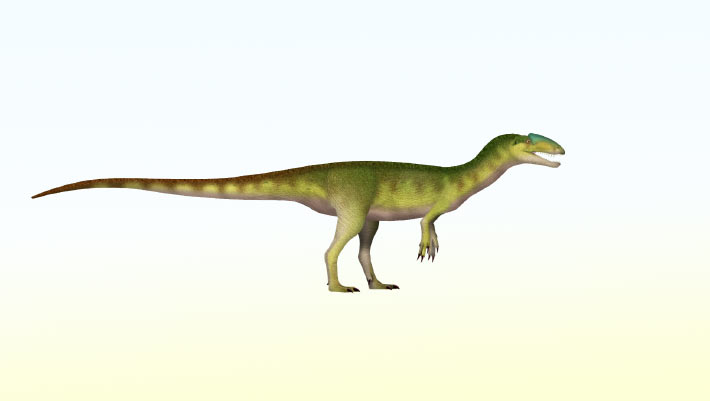
A fossil theropod vertebra about the length of a thumb, found in the Algarve region in southern Portugal, may be the oldest dinosaur remains ever discovered on the Iberian Peninsula.
The post Single Vertebra Hints at Oldest Known Iberian Dinosaur appeared first on Sci.News: Breaking Science News.

Comprar um novo iPhone é sempre uma experiência especial — principalmente quando estamos falando dos recém-lançados iPhones 18 Pro, 18 Pro Max e do novíssimo iPhone Duo! Mas, junto com a empolgação de conhecer os novos recursos, surge também uma preocupação inevitável: como proteger um aparelho tão valioso sem esconder seu design ou comprometer a experiência de uso?
Pensando nisso, os nossos parceiros da Shokan Premium apresentam sua nova linha de capas desenvolvida especialmente para os novos modelos profissionais da Apple.
Mais do que um acessório, a capa representa a primeira linha de defesa do iPhone contra quedas, impactos, riscos e pequenos acidentes do dia a dia. Afinal, basta um único descuido para transformar a empolgação com o aparelho novo em uma grande dor de cabeça.
As novas capas Shokan Premium foram desenvolvidas para proporcionar proteção, conforto e um acabamento à altura dos iPhones 18 Pro, 18 Pro Max e do novíssimo iPhone Duo, garantindo uma experiência realmente premium.

Com encaixe preciso, construção resistente e design cuidadosamente elaborado, elas ajudam a proteger as laterais, a traseira, os botões e o conjunto de câmeras, preservando a aparência premium do iPhone sem deixá-lo pesado ou exageradamente volumoso.
É proteção para a rotina real: dentro da bolsa, sobre a mesa, durante o trabalho, em viagens ou naquele momento inesperado em que o iPhone escapa das mãos.
Para uma proteção ainda mais completa, a Shokan oferece uma condição especial que combina a capa premium com a película de proteção avançada da marca.
Além de ajudar a proteger a tela contra riscos, arranhões e impactos, a película Shokan conta com um grande diferencial: a sua garantia exclusiva de tela.

Depois da compra e da ativação da garantia, caso ocorra um dano acidental coberto pelo programa, a tela do iPhone poderá ser substituída por outra original em um Centro de Serviço Autorizado Apple, conforme os termos e condições da garantia Shokan.
Enquanto a capa protege as laterais, a traseira e o conjunto de câmeras, a película cuida justamente da parte mais sensível e utilizada do aparelho.
É uma combinação pensada para quem deseja aproveitar o novo iPhone com muito mais segurança e tranquilidade desde o primeiro dia.
A Shokan Premium é uma marca brasileira com produtos desenvolvidos nos Estados Unidos, então se você conhece as cases premium de verdade (como Incipio, OtterBox, Tech21, Speck, Balkin, Griffin e Prodigee), precisa conhecer a Shokan Premium. É uma marca pensada para quem realmente sabe o que quer em termos de qualidade e proteção — produtos com acabamento completamente diferente do que encontramos aqui no Brasil.
A proposta da marca é trazer produtos de qualidade superior com uma relação ótima de custo-benefício. Se compararmos, por exemplo, o preço de um case premium em uma Apple Store ou na Best Buy (que vai de US$69 a US$199), vale muito mais a pena comprar a proteção completa da Shokan e receber em casa.

Ah, e se você estiver nos EUA, a Shokan também entrega em todo o território pelos mesmos preços daqui.
Além da nova linha de proteção, a Shokan também oferece uma alternativa versátil para quem deseja ampliar as possibilidades de uso dos seus dispositivos Apple.
A Shokan Pencil é uma caneta capacitiva ativa e passiva, com bateria interna recarregável, ponta de alta precisão e excelente desempenho para atividades domésticas e profissionais.

Ela pode ser utilizada para fazer anotações, desenhar, assinar documentos, editar imagens, navegar por aplicativos e executar tarefas que exigem mais controle e precisão do que o toque dos dedos.
Entre seus principais diferenciais estão:
Com preço normal de R$499, a Shokan Pencil estará disponível por apenas R$399 para os leitores do MacMagazine, oferecendo uma excelente relação entre qualidade, desempenho e custo-benefício!
Para celebrar a chegada da nova geração, os leitores do MM terão acesso a condições especiais para adquirir os produtos Shokan. Ao utilizar o cupom exclusivo SHKMM, o cliente garante:
SHKMMBasta acessar a oferta, selecionar os produtos e o modelo correspondente ao seu iPhone e aplicar o cupom antes de concluir a compra.
Se você investiu em um novo iPhone 18 Pro ou 18 Pro Max, não espere a primeira queda para começar a pensar em proteção. Afinal de contas, quanto vale a sua tranquilidade?
E, se deseja mais precisão para trabalhar, estudar ou criar, aproveite também a condição especial da Shokan Pencil.
➡️ Capas e películas Premium de Verdade a partir de R$99
➡️ Shokan Pencil por R$399
➡️ Loja Oficial da Shokan no Mercado Livre com entrega grátis e FULL pro Brasil inteiro
Ofertas válidas por tempo limitado e sujeitas à disponibilidade de estoque. A garantia de tela está vinculada à película Shokan elegível, exige ativação e está sujeita aos termos, prazos, limites e demais condições do programa. Benefícios de frete e entrega são aplicados conforme as regras da campanha e do Mercado Envios.
Quer revender produtos Shokan na sua loja?
Se você é lojista do mercado mobile e tem interesse em revender a linha da Shokan, o distribuidor autorizado da marca no Brasil é a AllCell, que fica no DF. Entre em contato (+55 61 98354-0125; Alexandre) e tenha as melhores opções em acessórios premium para a sua loja!


Por meio de um documento regulatório enviado à União Europeia, a Apple revelou as capacidades reais das baterias do iPhone Duo: 4.883mAh, a soma de duas células (uma de 2.962mAh e a outra de 1.921mAh).
O material parece confirmar um vazamento de julho, posicionando o dobrável da Apple entre os 4.288mAh do iPhone 18 Pro e os 5.567mAh do iPhone 18 Pro Max — ambos, vale notar, em suas versões sem bandeja para chip.
O dobrável da Apple tem capacidade ligeiramente superior à do Samsung Galaxy Z Fold8, que utiliza silício-carbono no bateria e conta com 4.800mAh, além de ser 36% maior do que o iPhone Air, o modelo mais fino lançado pela Apple até então (com 3.149mAh).
Embora não tenha a maior bateria entre os iPhones, o dobrável apresenta autonomia semelhante à do iPhone 18 Pro Max: pela métrica de reprodução de vídeo divulgada pela Apple, são até 44 horas na tela externa, contra até 45 horas do iPhone 18 Pro Max.
Já a tela interna do iPhone Duo tem uma autonomia de 31 horas, um pouco abaixo das 34 horas possíveis no 18 Pro.


NOTA DE TRANSPARÊNCIA: O MacMagazine recebe uma pequena comissão sobre vendas concluídas por meio de links deste post, mas você, como consumidor, não paga nada a mais pelos produtos/serviços ao usar os nossos links de afiliado.
via MacRumors



Paleontologists from Fundación Dinópolis have identified the first confirmed fossils of the genus Diplodocus found outside North America.
The post Diplodocus, Long Thought Exclusively American, Turns Up in Spain appeared first on Sci.News: Breaking Science News.
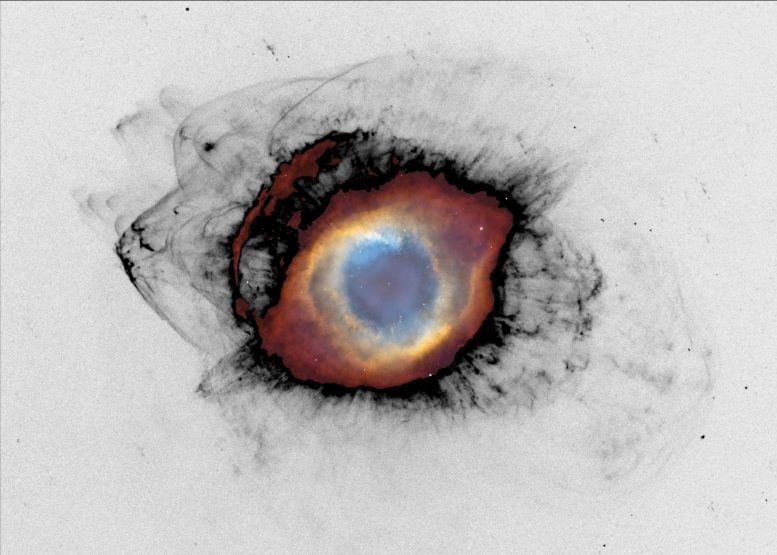 A new image of the Helix Nebula reveals how dying stars return material to the galaxy. The Helix Nebula offers a rare look at what happens after a dying star releases its outer layers into space. New observations show fragments of that material colliding with surrounding gas, breaking apart, and beginning their return to the [...]
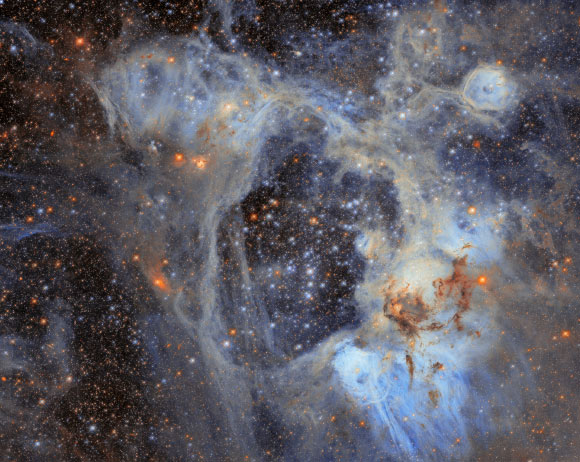
A new images from the NASA/ESA Hubble Space Telescope reveals LHA 120-N44, a striking nebula located roughly 160,000 light-years away in the Large Magellanic Cloud, a satellite galaxy of the Milky Way.
The post Hubble Spots ‘Superbubble’ in Large Magellanic Cloud appeared first on Sci.News: Breaking Science News.
 Archaeologists reidentify a room once thought to be a shrine as a rare Roman library.
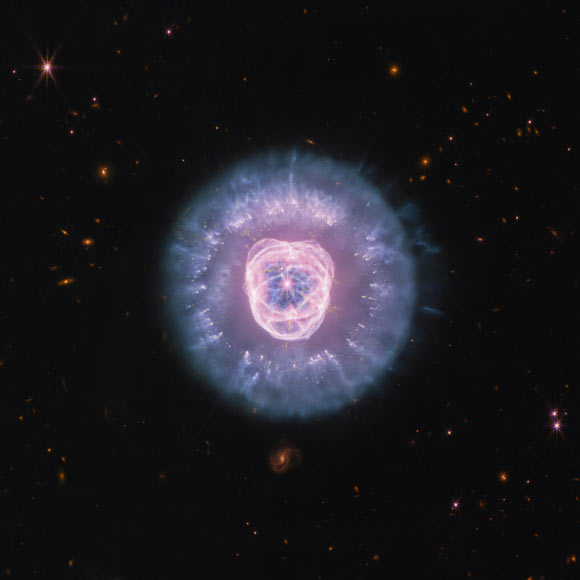
New infrared observations of the Eskimo Nebula, a bipolar double-shell planetary nebula in the constellation of Gemini, reveal clumps of dust, ionized gas and expanding shells surrounding a central star.
The post Webb Captures Stunning Infrared View of Eskimo Nebula appeared first on Sci.News: Breaking Science News.
Stunning new imagery of the distant celestial object NGC 2392, better known as the “Lion Nebula,” has been obtained by NASA’s James Webb Space Telescope.
The cosmic vista captured by Webb reveals a colorful view of the ancient nebula, whose characteristic appearance resembles one of nature’s most respected apex predators, complete with a bushy-looking “mane” composed of hazy stellar gases and objects similar to comets.
The new high-resolution imagery offers one of the clearest and most detailed views of the Lion Nebula ever seen. Previous images captured by Webb’s predecessor, the Hubble Space Telescope, were obtained in 2000, featuring the same celestial feature in visible light.
With the added spectral ranges Webb’s Near Infrared Camera (NIRCam) and Mid-Infrared Instrument (MIRI) can capture, the Lion Nebula now appears in colorful pinks and indigo hues, surrounded by distant galaxies blazing in brilliant orange from across vast cosmic distances, whose light has traveled billions of years to reach our Solar System.
A particularly striking feature about the new imagery is the way cosmic dust and regions of ionized gas are showcased in the new Webb imagery.
“It’s taken several thousand years for this collection of gas and dust to reach its current shape, and the nebula’s components continue to be altered,” read a portion of a statement released by the European Space Agency (ESA) that accompanied the new images.

One reason that helps account for the changing appearance of the Lion Nebula over time can be found at its center, where the remnants of a slowly dying white dwarf star (which effectively forms the nose in the lion’s face after which the nebula is named) continues to supercharge the surrounding cosmic structures made visible in the new Webb imagery.
The rest of the lion’s face is composed of an expanding bubble of ionized gas, the nature of which remains somewhat mysterious. Presently, astronomers are uncertain about what exact mechanisms give rise to the complex appearance of this gassy bubble and its internal structures, which are a recurring element in ancient nebulae such as this.
NGC 2392 isn’t the only celestial feature known as the “Lion Nebula.” An entirely separate diffuse nebula located in the Cepheus constellation, known as Sharpless 2-132, also shares this nickname due to its shape, which resembles a lion’s body seen from the side.
For now, the Lion Nebula is captured in the Webb imagery, which, despite its almost serene beauty, represents a highly active area of the cosmos, undergoing constant change as material is continually ripped away from the stellar central core.
Sometime in the next 10,000 years or so, this striking celestial feature will eventually be destroyed, once the white dwarf powering the nebula completely dies and the remnants of stellar material are completely dispersed into the surrounding space.
Until then, this remarkable cosmic feature will remain a target of study by astronomers, whose inquiries are helped significantly by the unprecedented clarity offered in the latest Webb images.
Additional information about the Lion Nebula (NGC 2392) can be found on NASA’s official page documenting the Webb MIRI imagery.
Micah Hanks is the Editor-in-Chief and Co-Founder of The Debrief. A longtime reporter on science, defense, and technology with a focus on space and astronomy, he can be reached at micah@thedebrief.org. Follow him on X @MicahHanks, and at micahhanks.com.
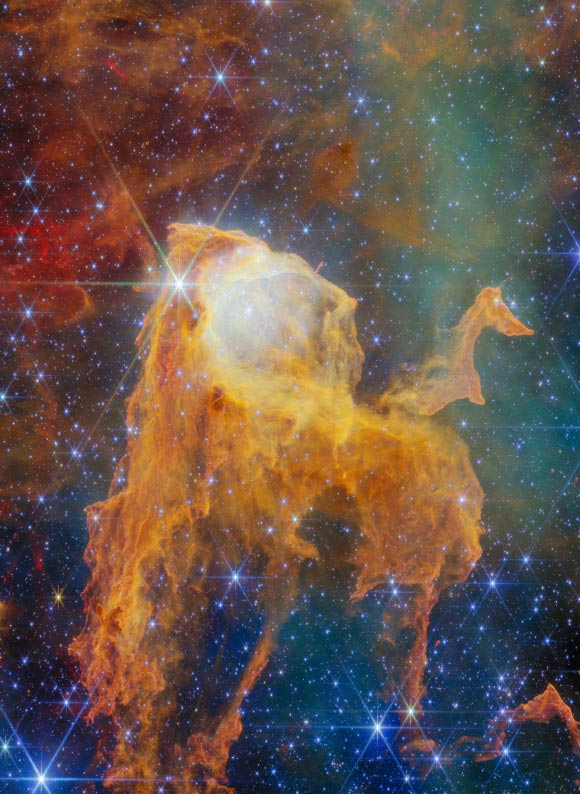
A stunning new image from the NASA/ESA/CSA James Webb Space Telescope reveals a comet-shaped cloud in the Carina Nebula hiding a cluster of about 70 young stars, including a rare giant of O-type nearly 19 times as massive as the Sun.
The post Webb Finds Stellar ‘Treasure Chest’ in Carina Nebula appeared first on Sci.News: Breaking Science News.

Blue Origin has traced the explosion of its New Glenn rocket during a static-fire test in May to a valve in the rocket’s BE-4 engine.
The post New Glenn explosion linked to rocket engine valve appeared first on SpaceNews.
Two dormant volcanoes in the Andes are shown “connected” by the glowing ribbon of a distant cosmic feature stretching across the sky between them, in a rare cosmic alignment echoing ancient legends about these neighboring peaks—and all of it was captured in one of the most breathtaking astronomy images in recent memory.
The photo (seen below) was captured by astrophotographer Gonzalo Laserna Vargas and showcased by the American space agency this week. In it, we see Parinacota and Pomerape, a pair of ancient stratovolcanoes that form an unmistakable part of the landscape along the border between Bolivia and Chile.
In local folklore, these two prominences represent a prince and princess whose forbidden romance forever linked them in myth. Although no geological evidence exists for any physical links between them, astronomy recently helped fulfil that mythic connection in an unprecedented night sky display. The unique conditions that made this image possible, as well as the planning and preparation that went into it, were described by Vargas in a recent post on his Instagram account.
In the new imagery, recently featured as NASA’s Astronomy Picture of the Day, Barnard’s Loop—a vast arc of glowing hydrogen gas surrounding part of the constellation Orion—is showcased in a long-exposure photograph as it appears behind the two volcanoes.
The image was captured coinciding with the appearance of the nebula directly behind the volcanoes, and from an angle that causes the visible portion of the celestial object to appear as though it is rising from the mouths of the ancient volcanic peaks, uniting them through what resembles a colorful, luminous aerial display.
Despite the awe-inspiring appearance of the imagery, as part of the larger Orion Molecular Cloud, Barnard’s Loop remains at a distance of around 440 parsecs from these dormant volcanic peaks—in other words, close to 1,400 light-years away.
Capturing a cosmic convergence at this scale required careful planning by Vargas, who took a sequence of exposures from the same location in Bolivia in mid-April, at a time when the nebula appeared perfectly in between the two mountain summits.
One thing that helped with this is the fact that Barnard’s Loop is one of the largest emission nebulae visible from Earth. Although it is far too faint to be seen easily with the naked eye, the nebula’s vibrant pink and orange colors appear in long-exposure photography, revealing its eerie halo fueled by the presence of hydrogen gas.
Along with Barnard’s Loop, several of the night sky’s most recognizable objects also make an appearance in Vargas’s photo. Near the center of the image is the Orion Nebula, which happens to be one of the nearest stellar nurseries to Earth. Such areas of the cosmos are places where new star formation occurs within vast clouds of cosmic dust and gas.
To the nebula’s right, Betelgeuse is also visible, the reddish supergiant which was recently confirmed to have a stellar companion after more than a century of speculation about what might cause unusual variances in its brightness.
Higher in the image, another striking feature—the Rosette Nebula—can also be seen, revealed as a massive cloud of glowing gas around a small group of young stars.
Although each of these features is separated by hundreds or even thousands of light-years from Vargas’s imagery, they all appear in a singular frame, producing a dramatic cosmic backdrop for the ancient volcanic landscape they appear above.
Hence, for reasons that are easy to see, Vargas’s photo was named NASA’s Astronomy Picture of the Day for July 28, 2026, revealing another artful view of the cosmos that relies on far more than just advanced equipment—it also showcases the necessity for astronomical knowledge, careful preparation, and, of course, impeccable timing.
The result in this case is a moment captured in time, where mythology, an ancient volcanic landscape, and the cosmos all converge within a single frame.
You can learn more about this image at NASA’s website, and follow Vargas and his cosmic photography on Instagram.
Micah Hanks is the Editor-in-Chief and Co-Founder of The Debrief. A longtime reporter on science, defense, and technology with a focus on space and astronomy, he can be reached at micah@thedebrief.org. Follow him on X @MicahHanks, and at micahhanks.com.

Boeing is still working with NASA to determine when to fly its CST-100 Starliner commercial crew vehicle on a cargo mission to the International Space Station.
The post Boeing still working with NASA to schedule next Starliner flight appeared first on SpaceNews.

United Launch Alliance’s corporate parents have guaranteed a loan to the company as it addresses “financial challenges” caused by the grounding of its Vulcan Centaur rocket.
The post ULA deals with financial challenges caused by Vulcan grounding appeared first on SpaceNews.
A key component of the Orion Nebula had escaped detection by astronomers until now, according to a new study in Astronomy & Astrophysics.
An international team led by Juan Diego Soler at the University of Vienna used two of the world’s most advanced radio telescopes to map neutral atomic hydrogen gas across the nebula’s outer shell at unprecedented resolution. The new maps provide a clearer view of the celestial feature, and reveal a previously uncatalogued second bubble—a shell with much less mass than earlier estimates—and a four-light-year filament of gas extending from the structure.
Neutral hydrogen emits a faint radio signal at a wavelength of 21 centimeters, making it possible to trace otherwise invisible gas between the stars. Soler’s team solved this by combining data from the Karl G. Jansky Very Large Array in New Mexico and the FAST telescope in China. The VLA provided high resolution, while FAST picked up faint, widespread signals. Together, they produced the first detailed hydrogen map of the extended Orion Nebula, at the same scale as earlier ionized carbon maps.
Earlier calculations based on ionized carbon estimated that the front half of the shell was about 1,100 times the mass of our Sun. The hydrogen observations paint a different picture, suggesting the shell actually weighs in at closer to 100 solar masses. “Measuring mass is fundamental,” Soler said, “because it tells us about the efficiency of these newly formed stars shaping their environment with wind and radiation.”
A shell with only a tenth of the previously assumed mass significantly alters calculations of how efficiently newly formed stars shape their environment. The researchers note that molecular hydrogen, which is not detected in either the hydrogen or carbon data, may account for some of the missing mass.
The hydrogen maps also revealed an uneven distribution of gas, indicating a second, smaller cavity within the main shell. The team searched catalogs of known stars and young stellar objects in the region but found no candidate at the bubble’s center. The source responsible for creating the cavity may not be the type of object included in current catalogs.
Daniel Seifried at the University of Cologne, a co-author on the study, pointed to what that means for the models astronomers build to explain regions like this one. “These stunning observations serve as a reference for many modern astrophysical simulations investigating the evolution of gas and stars in the Milky Way. These are the kind of images that challenge the theoretical models and numerical simulations that we use to understand how massive stars affect their immediate surroundings.”
Previous models generally treated Orion’s shell as the product of a single expanding bubble. The discovery of a second cavity, with no obvious source at its center, instead suggests the nebula was shaped by multiple episodes of stellar feedback.
The new maps also uncovered a filament of hydrogen extending about four light-years from the shell’s western edge. Previous carbon-based observations saw only the base of this structure. The filament contains about 80 solar masses of hydrogen and does not appear to be associated with any known group of young stars. Its origin is unclear; it could be gas leaking through a weak spot in the shell or a leftover from the original cloud that existed before the bubble formed.
Claire Murray of the Space Telescope Science Institute, another co-author, framed the discovery within the broader push behind the observations. “This study is an exciting demonstration of the power of the latest-generation radio telescopes to uncover new pieces to the star formation puzzle.” Despite being one of the galaxy’s most extensively studied star-forming regions, the Orion Nebula continues to reveal discoveries.
This survey is the first scientific result from the NeAtHood project, which aims to map atomic hydrogen across nearby star-forming regions accessible to the VLA and FAST telescopes. Soler and his colleagues now plan to apply the same approach to additional targets. “Orion is only the beginning. Our newly developed methods show how future interferometers will reveal the hidden structure and dynamics of the interstellar medium—even in regions that astronomers already believed they understood well,” Soler explained.
If one of the sky’s best-studied star-forming regions still contains hidden structures, other nearby nebulae may prove equally surprising as the NeAtHood survey expands.
Austin Burgess is a writer and researcher with a background in sales, marketing, and data analytics. He holds an MBA, a Bachelor of Science in Business Administration, and a data analytics certification. His work focuses on breaking scientific developments, with an emphasis on emerging biology, cognitive neuroscience, and archaeological discoveries.

For as long as readers have pored over Homer’s Odyssey they have pictured Ithaca, the homeland Odysseus fights for ten years to reach, as an island unto itself.
The post Was Odysseus’ Ithaca Never an Island? Scholars Challenge Centuries-Old Assumption appeared first on Sci.News: Breaking Science News.

 °•Gon Laserna•°