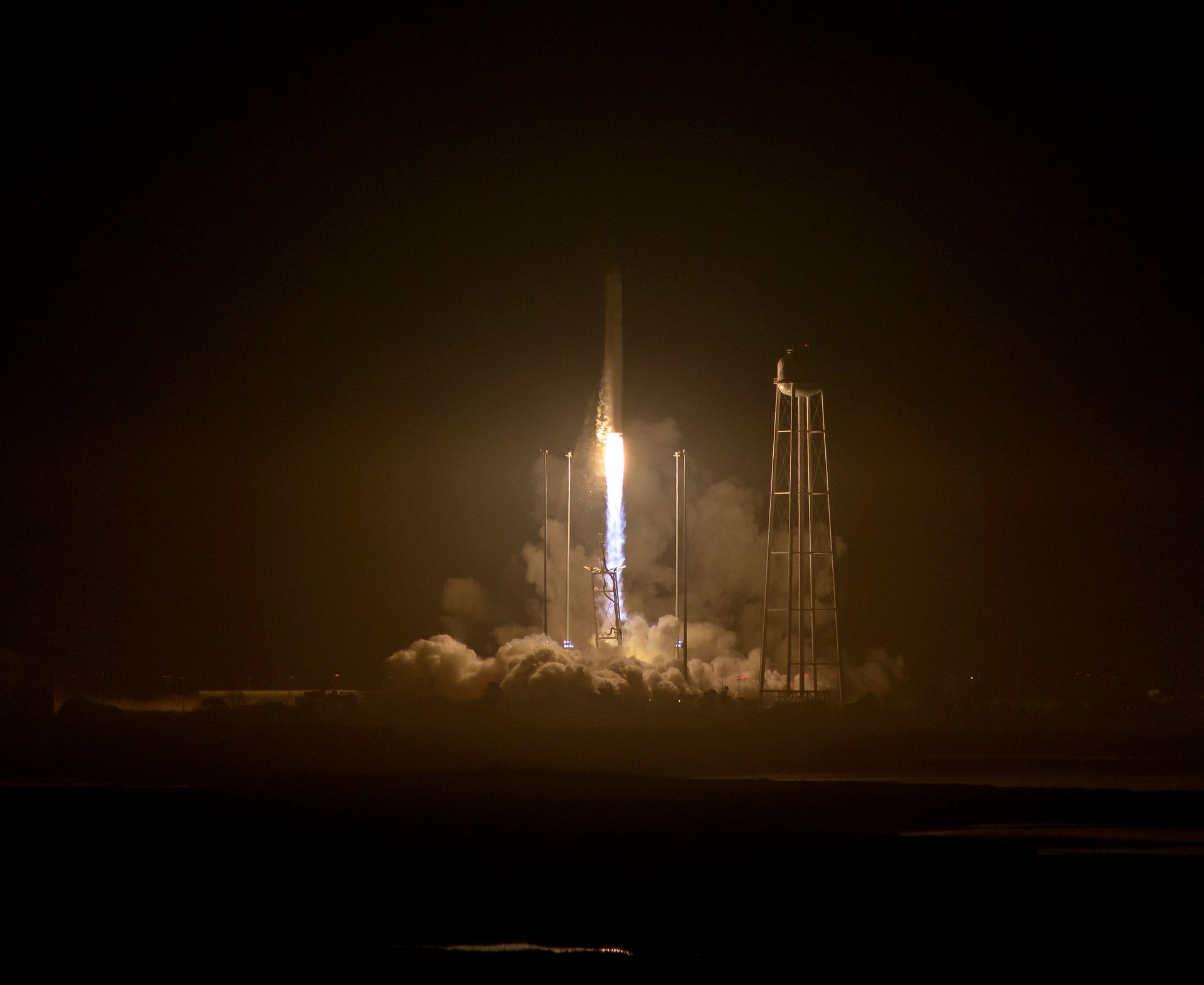
On Oct. 21, 2008, the Indian Space Research Organization launched its first mission to the moon. The mission was named Chandrayaan-1, and it consisted of both an orbiter and an impactor.
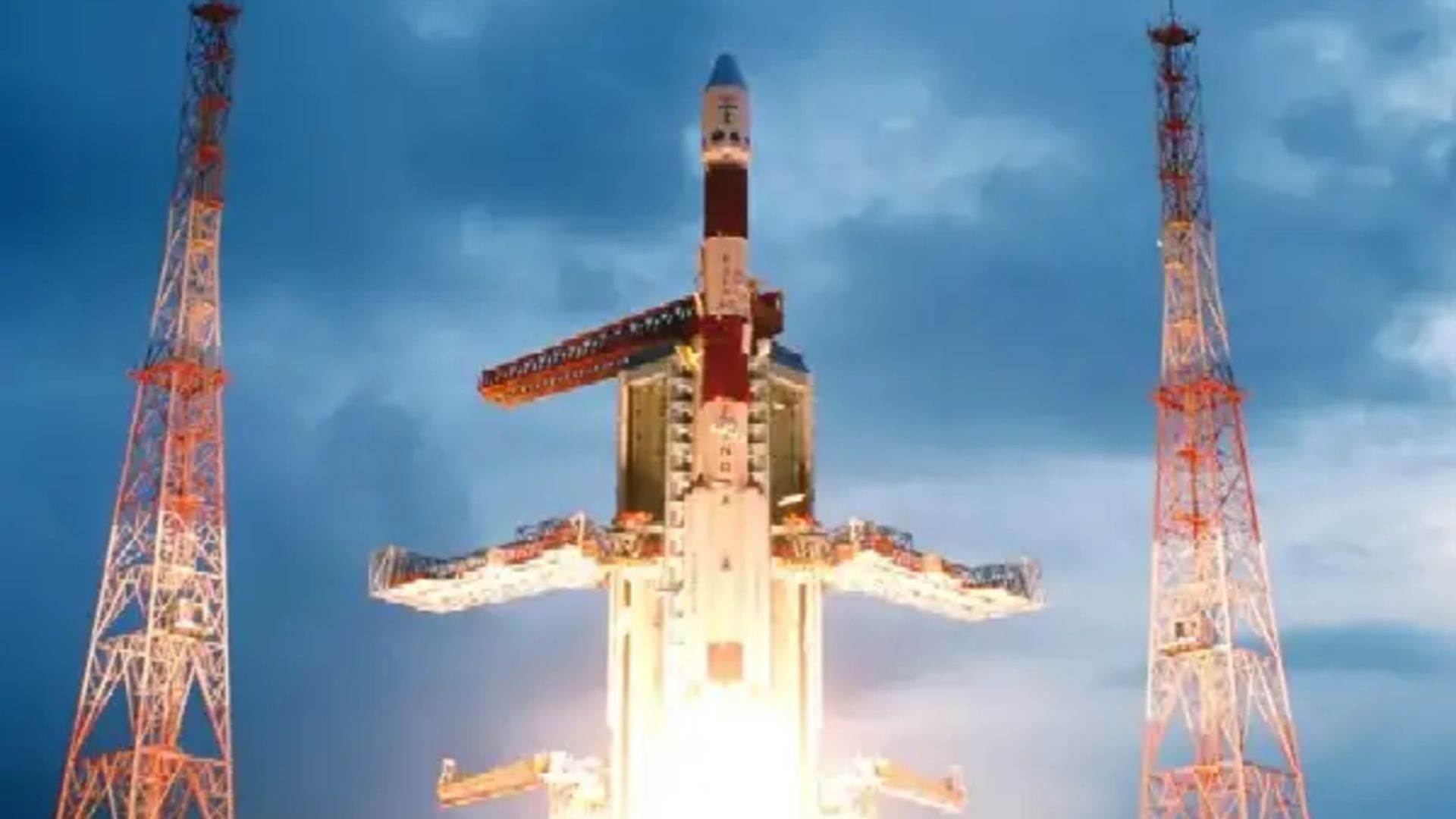
Chandrayaan-1 launched from the Satish Dhawan Space Center on an Indian rocket called the Polar Satellite Launch Vehicle, or PSLV-XL. (Launch occurred at 8:52 p.m. EDT, though it was about 6:22 a.m. local time at the launch site on Oct. 22.)
It arrived in lunar orbit about three weeks later and dropped off the Moon Impact Probe, which crashed into the moon on Nov. 14. The rest of the Chandrayaan-1 spacecraft stayed in orbit, where it collected and transmitted data from the moon to Earth for about a year. The mission ended abruptly 14 months ahead of its planned end date when scientists lost contact with the probe.
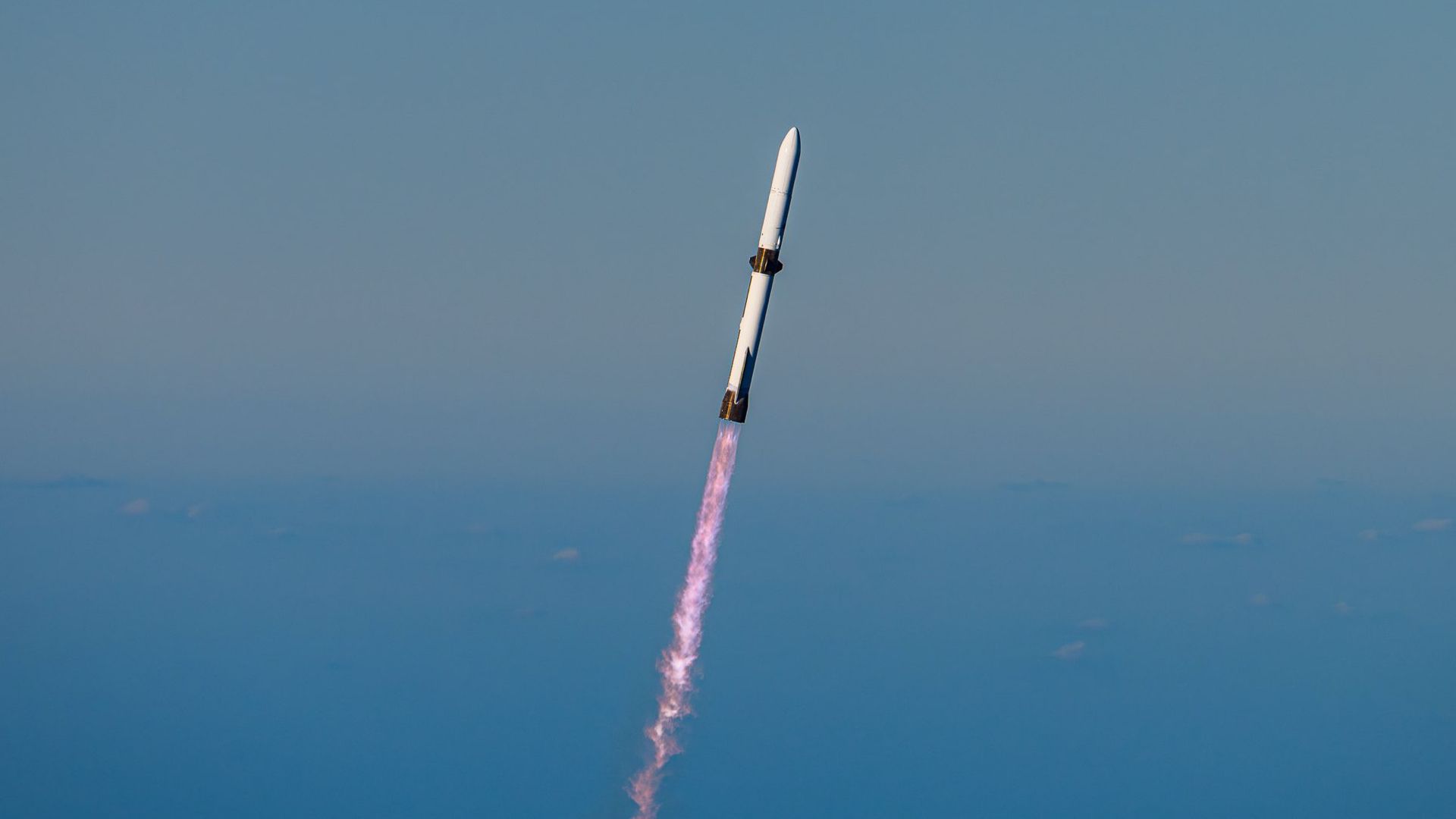
An Indian PSLV rocket launches the Chandrayaan-1 moon mission on Oct. 21, 2008 EDT (Oct. 22 local time in India). (Image credit: ISRO)
Why it mattered
The Indian Space Research Organisation, or ISRO, had a lot riding on the success of Chandrayaan-1 moon mission, which marked the first-ever deep space mission by the Indian space agency. It was also the first mission to the moon for India, a country that hopes to launch its own crewed spacecraft and build a space station.
Chandrayaan-1 did more than just demonstrate that India's space program was capable of launching missions to the moon; it also returned some amazing science results, like evidence of water ice on the moon.
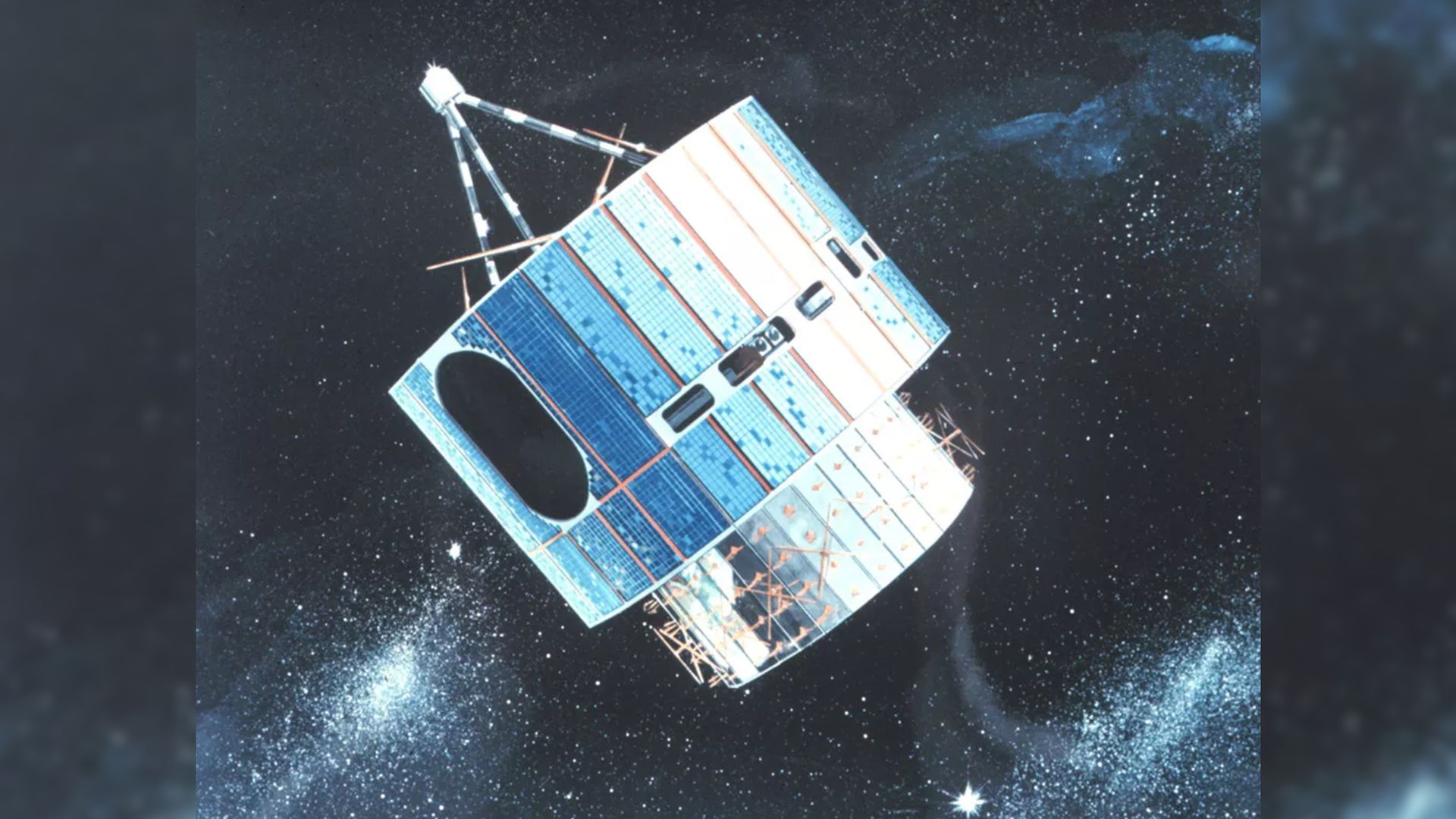
"In September 2009, scientists published results of datacollected by the American M3 instrument which had detected absorption features on the polar regions of the surface of the Moon usually linked to hydroxyl- and/ or water-bearing molecules," NASA said in a mission overview.
The spacecraft carried 11 instruments to study the moon, five of them built by ISRO. The rest were experiments for the European Space Agnecy and NASA.
"In addition to the five Indian instruments, the spacecraft carried scientific equipment from the United States, the United Kingdom, Germany, Sweden, and Bulgaria," NASA said.
It took until Nov. 8, 2008 for Chandrayaan-1 to enter lunar orbit, where it stayed until contact was lost in August 2009, most likely due to a power supply failure caused by overheating.
"This was short of the spacecraft’s planned two-year lifetime, although ISRO noted that at least 95% of its mission objectives had been accomplished by then," NASA wrote.
NASA's Mini-SAR instrument, which flew aboard India's Chandrayaan-1 spacecraft, found more than 40 small craters with water ice. The craters range in size from 1 to 9 miles (2 to 15 km) in diameter. (Image credit: NASA)
India did not stop at the moon with Chandrayaan-1. In 2019, the country launched the Chandrayaan-2 orbiter, which carried the Vikram lander and Pragyan rover. Chandrayaan-2 reached lunar orbit successfully, but the Vikram landing failed.
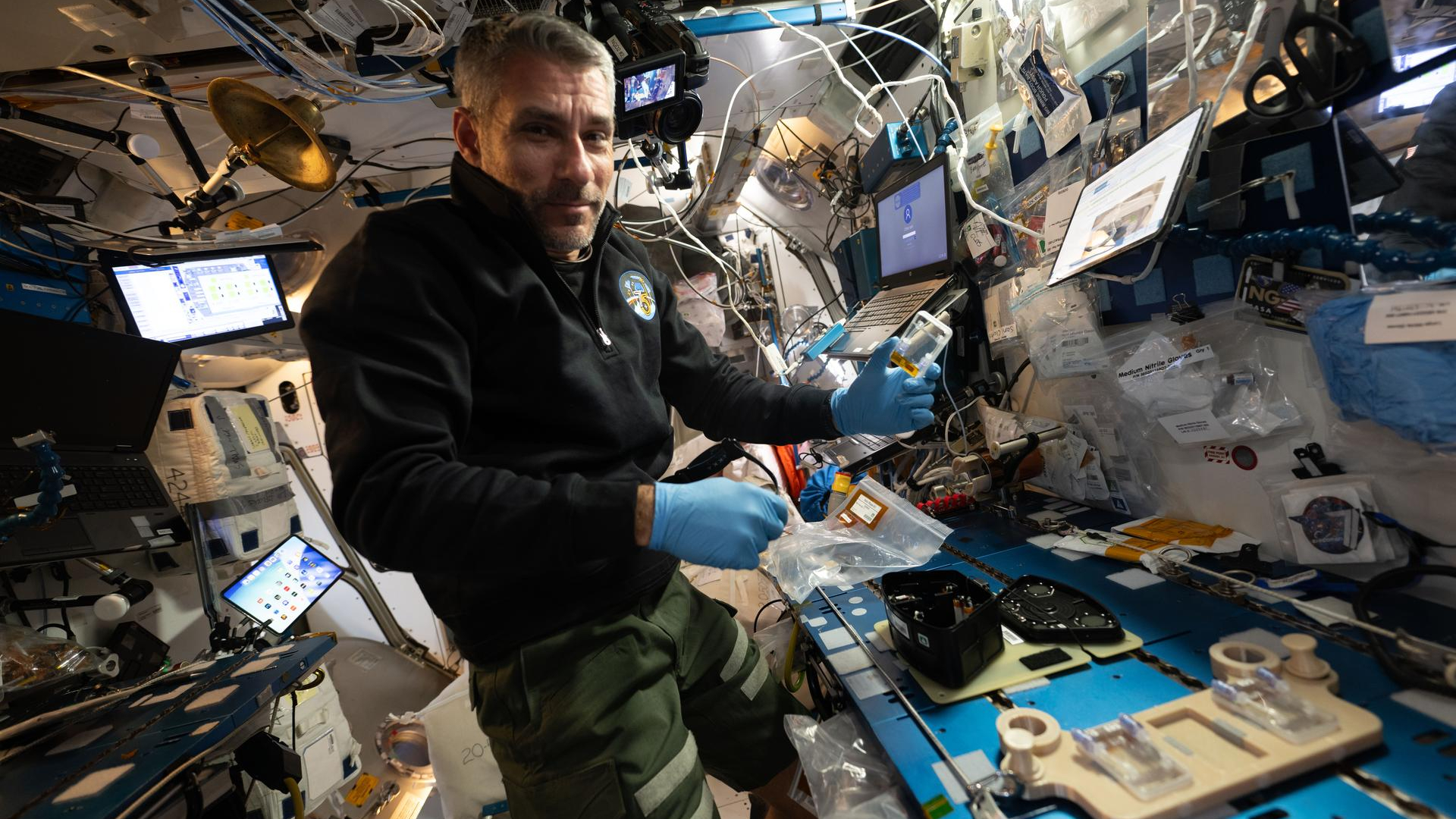
NASA astronaut Luke Delaney conducts botany experiments on the ISS. (Image credit: NASA/Jessica Watkins)
Growing plants in space? Yes indeed! NASA astronauts are conducting botany experiments aboard the International Space Station (ISS).
What is it?
In this snapshot — captured by NASA astronaut Jessica Watkins, commander of SpaceX's Crew-13 mission to the ISS — we can see fellow NASA spaceflyer Luke Delaney hard at work aboard the ISS. And while he's orbiting around our planet aboard a laboratory in the vacuum of space, he's also growing plants.
In the photo, Delaney is working petri dishes and experiment modules that support our growing understanding of how plants grow in the microgravity environment aboard the station. Specifically, the experiments Delaney is working on will investigate the genetic responses of plants in this environment.
This is not the first time that researchers have studied plants in space. In fact, ISS astronauts have conducted a wide variety of plant experiments and investigations over the years. They've grown peppers and other edible produce and even proved that moss can survive outside the station, in the harsh environment of space.
Why is it incredible?
When you picture the inside of an orbiting space station, you might imagine the white and gray walls with computers, buttons, switches and other such tech speckling the scene. But the space station is also full of (non-astronaut) life, thanks to the incredible variety of biological experiments onboard.
While space is "the final frontier," and we look outward to study everything from black holes to exploding stars, outer space can also help teach us about own planet. Satellites look back at Earth, studying its changing landforms, migrating wildlife, diminishing glaciers and natural disasters. Onboard the ISS, astronauts conduct experiments with plants, animals, microscopic organisms and an incredible amount of studies supporting human health and medical care. While space might be the final frontier, so much of the work done in space is designed to benefit us back here on Earth.
NASA has revealed new details about its plans to return astronauts to the surface of the moon, outlining a series of upcoming milestones for SpaceX and Blue Origin as both companies race to ready their lunar landers for the agency's Artemis program.
During an Oct. 5 presentation at the Astronautical Congress (IAC) in Antalya, Türkiye, Steve Creech, acting manager of NASA's Human Landing System (HLS) Program, laid out development timelines for both spacecraft, with key demonstrations planned through early 2028 that include orbital refueling and uncrewed lunar landing tests to qualify the vehicles to fly astronauts to the surface of the moon.
A more pressing deadline, however, is NASA's Artemis III mission, which is targeted for the third quarter (Q3) of 2027. Artemis III will launch four astronauts aboard NASA's Orion spacecraft to low Earth orbit (LEO), where they will rendezvous and dock with test versions of both companies' landers for interoperability checkouts. Those demonstrations will help inform NASA's determination about which lander the agency will choose to carry astronauts to the moon's surface on Artemis IV, targeted for early 2028.
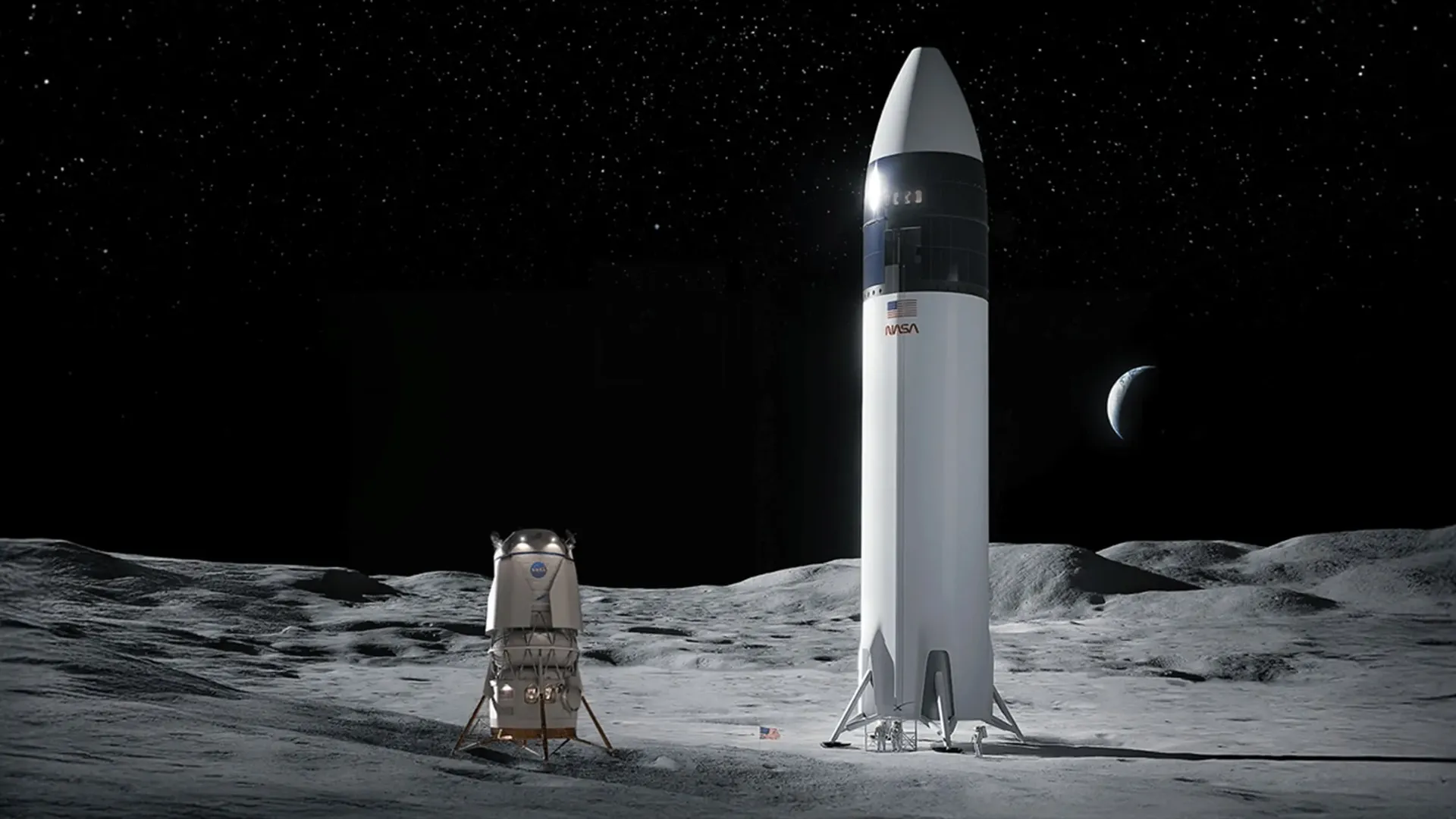
SpaceX and Blue Origin were both awarded NASA contracts to develop HLS vehicles — Starship and Blue Moon, respectively — and have spent the past several years refining their respective lunar lander designs and dealing with various delays along the way. In the face of those delays, and in an effort to better structure its mission progression for success, NASA overhauled its Artemis program architecture in February to maintain its goal of landing astronauts on the moon by the end of 2028 and establish a more regular cadence of uncrewed landings in the meantime.
As part of that shakeup, Artemis III, previously the program's first crewed lunar landing mission, was moved up a year and repurposed for the lunar lander vehicle tests the agency is preparing to fly to LEO next year. The program's first moon landing remains scheduled for 2028, but was shifted to the manifest for Artemis IV.
Between now and then, both SpaceX and Blue Origin have more than a dozen test demonstrations and vehicle milestones to achieve, including success during Artemis III and flights afterward. This will all lead up to a key decision NASA must make: Which vehicle will carry out the first crewed landing on the surface of the moon since the Apollo program ended in 1972?
Starship reached for the first time on its most recent test flight, which occurred on Sept. 28 from SpaceX's Starbase site in South Texas. NASA lists several other important goals for the vehicle to achieve in 2026, including (in the order listed during the IAC presentation) the first return and catch of the rocket's upgraded Version 3 (V3) booster at its launch pad; the first-ever return and catch of a Ship upper stage; the first Starship launch from one of SpaceX's launch pads still under construction on Florida's Space Coast; and, possibly, the first V3 booster reflight.
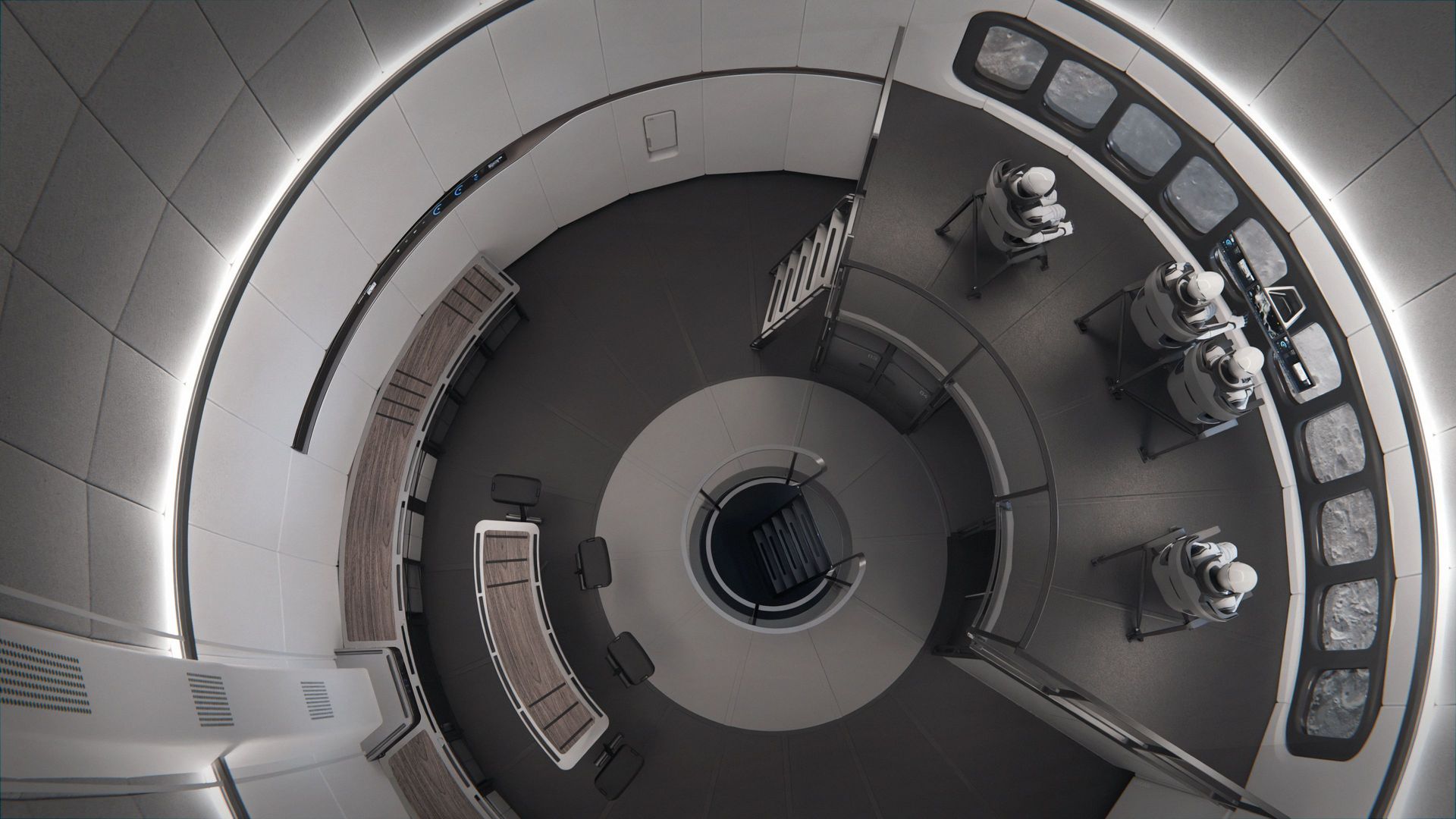
NASA also expects SpaceX to complete the initial build of the crew cabin for its lunar lander Starship variant. SpaceX released renders of Starship's interior last year, as well as images of the test elevator astronauts are using to train for Starship egress on the lunar surface, but little else has been made public about the progress the company has made on the cabin's design.
Artist's rendering of the cabin of SpaceX's Starship vehicle during an Artemis moon mission for NASA. (Image credit: SpaceX)
Should the cabin's initial build wrap up by the end of the year, as NASA's presentation suggested, SpaceX will use Q1 2027 to complete integration of the systems that Starship will need to communicate with Orion during Artemis III, and deliver a cabin simulator for astronauts to train on leading up to the mission. SpaceX plans to continue Starship test flights through Q2 of next year, complete a landing leg demonstration and begin crew cabin airlock tests.
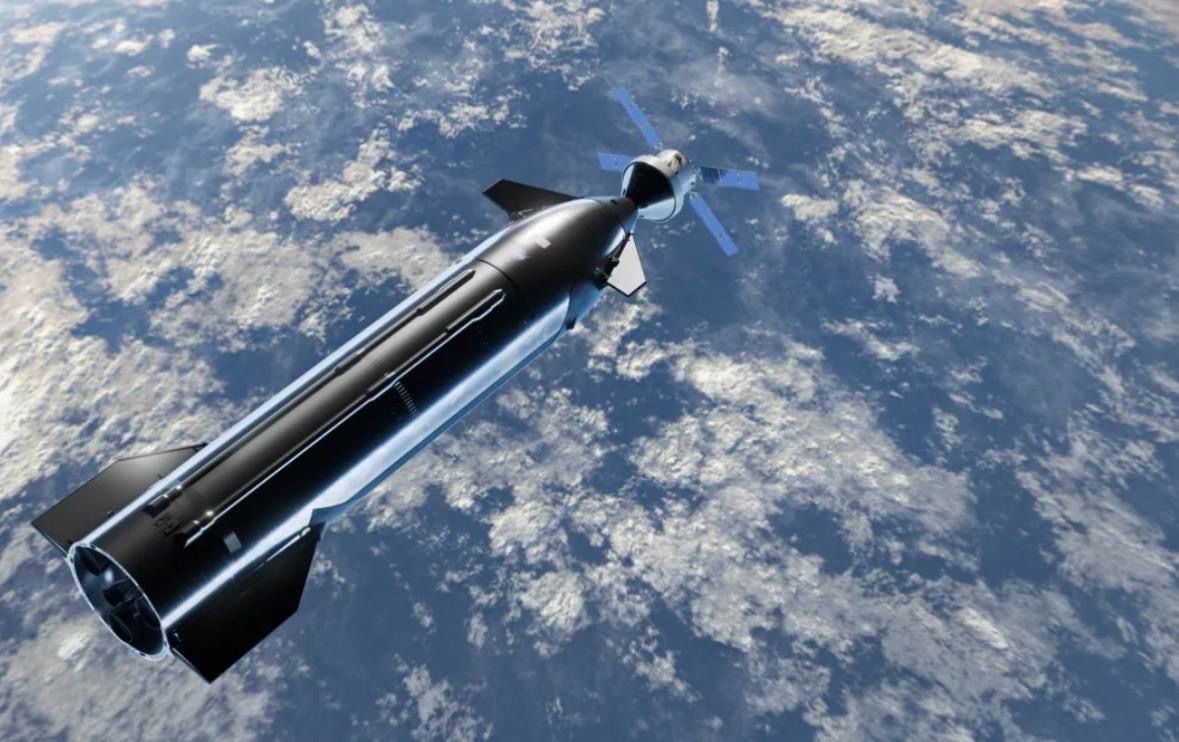
For Artemis III, SpaceX plans to fly one of its existing V3 Starship upper stages, with some slight modifications. Starship and Orion will dock as part of Artemis III but the SpaceX vehicle won't be equipped with a crew cabin for the mission's astronauts to enter. Between the end of this year and the beginning of the next, SpaceX is expected to complete the addition of a docking system and nosecone cover to the Artemis III Starship vehicle, which, NASA documents suggest, has already completed its mechanical fit checks.
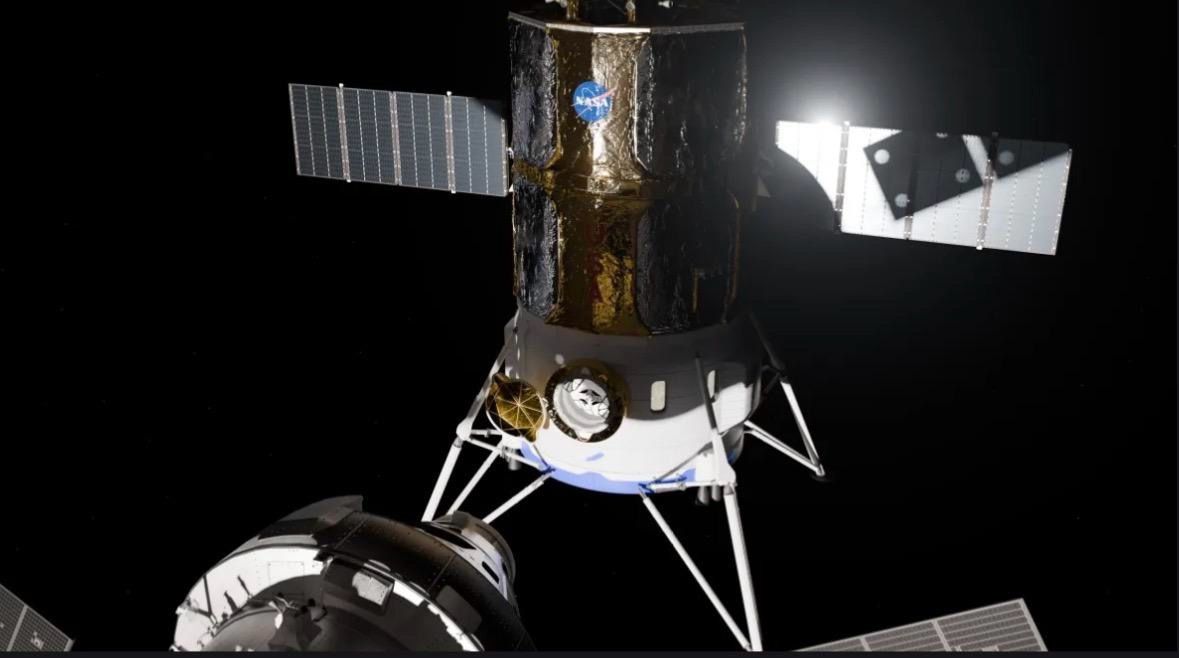
Render of SpaceX Starship and Orion docked in low Earth orbit. (Image credit: SpaceX)
Other notches on SpaceX's checklist leading up to Artemis III include the first propellant transfer demonstration with Starship in orbit. As the first-ever launch vehicle and spacecraft designed for full reusability, Starship's fuel constraints require that its tanks be topped off in order to fly beyond LEO. For a moon landing mission, this could mean up to a dozen launches of SpaceX's Starship "tanker" spacecraft to an orbiting fuel depot, which the moon-bound Starship will visit. To pull that off, though, SpaceX has to show it can successfully transfer those cryogenic fuels on orbit, and also store them effectively enough to prevent too much boil-off.
Starship won't require any refueling flights to complete its objectives for Artemis III, but SpaceX is expected to launch its first Starship tanker vehicle within a few months of that mission as it gears up for the Artemis IV moon landing mission. To that end, a launch of an uncrewed Starship lunar lander variant is targeted sometime toward the end of Q3/beginning of Q4, with an uncrewed lunar landing mission carried out before the end of 2027.
Blue Origin, meanwhile, has its own set of milestones to meet as it develops its Blue Moon Mark 2 (MK2) lander — a 52-foot-tall (16 meters) spacecraft powered by three BE-7 engines. Unlike the bare-bones V3 Starship that SpaceX will launch on Artemis III, Blue Origin plans to fly a completed test vehicle, incorporating the crew cabin, partial life-support, flight software and other systems needed to allow astronauts to enter the lander from Orion during their time docked in LEO. Astronauts will be able to enter Blue Moon from Orion to get a feel for the lander in zero-g and test some of its systems.
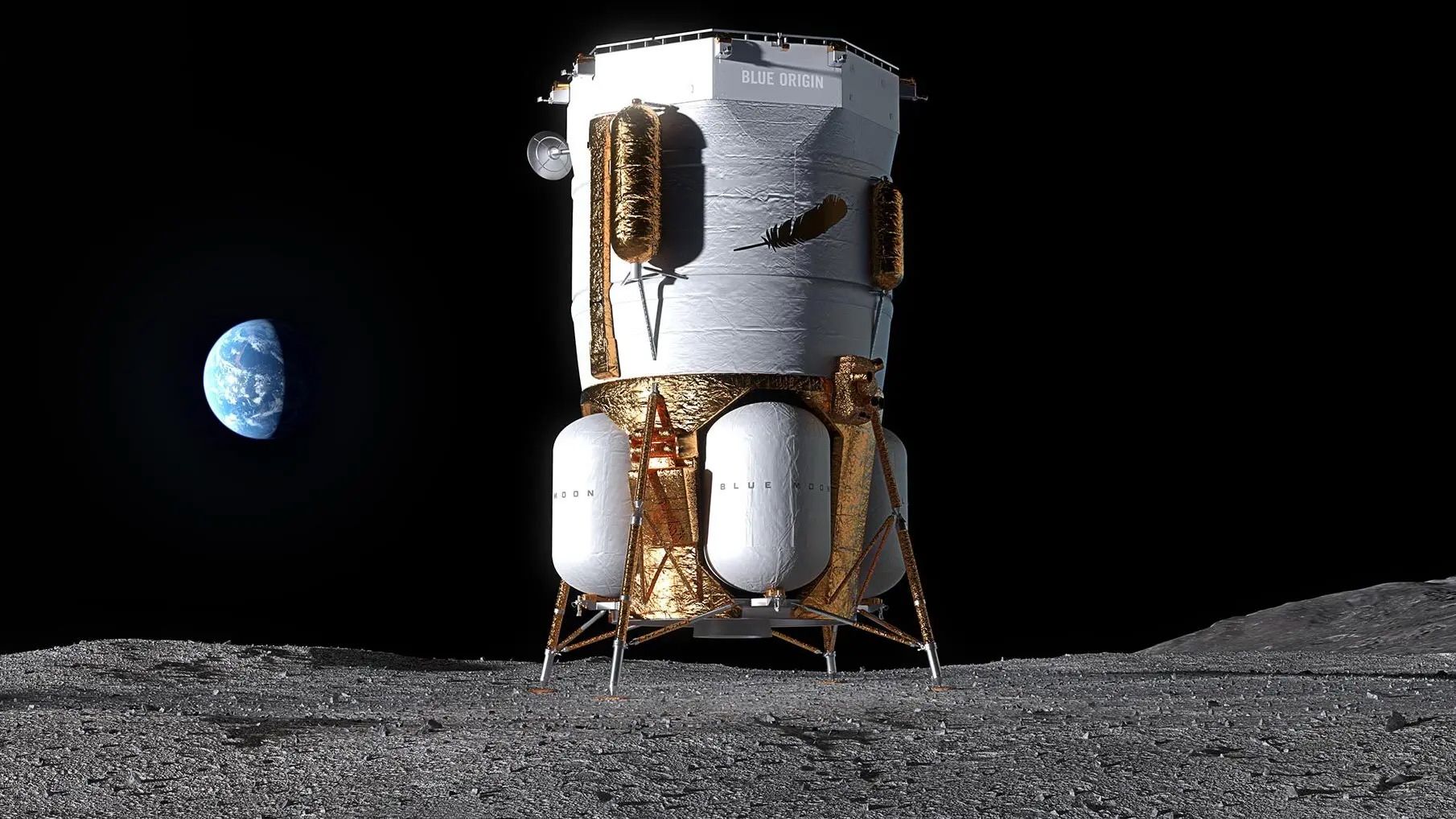
Render of Blue Origin's Blue Moon lander and Orion prior to docking in low Earth orbit. (Image credit: Blue Moon)
NASA's timeline shows the company working to complete a series of manufacturing and testing milestones in the last few months of 2026, including continued BE-7 testing and qualification of Blue Moon's BT-7 maneuvering thrusters. The company also faces its Artemis III interim design review and a critical design review for an upcoming landing demonstration mission in 2028.
Blue Origin is also working to restore its pad at Cape Canaveral Space Force Station's Launch Complex-36 (LC-36) to operation and return its New Glenn rocket to flight, following an explosion of the rocket in May that caused extensive damage to the facility. NASA's presentation places that milestone in Q4 2026, a timeline the company has also been very vocal about maintaining. A recent Reuters report, however, suggests that may not happen until early 2027.
By early 2027, the company expects to complete the spacecraft's communications systems and finalize its flight software, with assembly, integration and testing continuing into Q2. Q1 2027 is also when Blue Origin's Blue Moon MK1 lander (a smaller, uncrewed version of its MK2 successor) will launch to the lunar surface as a part of NASA's Commercial Lunar Payload Services (CLPS) program of robotic moon missions.
During Q2 2027, as the Artemis III mission approaches, Blue Origin is expected to complete integration of its test lander with New Glenn and conclude qualification of its BE-7 engine. Throughout next year, the company plans to continue construction and refurbishments at its launch facilities and hopes to have a new launch pad ready to support the upgraded, more powerful New Glenn 9x4 rocket l by the end of Q3. The first flight of that rocket variant is scheduled for Q4 2027, alongside a second MK1 lunar mission and the launch of an uncrewed MK2 demonstration lander.
That spacecraft is expected to attempt its own uncrewed lunar landing in Q1 2028, around the same time Blue Origin has scheduled a third MK1 flight. Like SpaceX, Blue Origin will need to demonstrate that its lander can safely reach the moon's surface,operate there and return to lunar orbit before NASA clears it to carry astronauts on a future Artemis mission.
NASA's overall timeline remains the same as it has been since the February revamp, with Artemis III expected to launch in mid-2027, followed by a crewed lunar landing on Artemis IV in 2028, and possibly another on Artemis V that same year. There may be changes on the horizon, though. NASA will host a press conference on Friday (Oct. 23) with Administrator Jared Isaacman and Associate Administrator Amit Kshatriya, as well as Artemis program director Jeremy Parsons. During the event, which you'll be able to watch here at Space.com, they will discuss the status of the upcoming moon missions and an "Artemis acceleration."
SpaceX and Blue Origin still face tight schedules to complete their respective uncrewed landing demonstrations before Artemis IV. With SpaceX targeting Q4 2027 and Blue Origin Q1 2028, both are pushing the margins against NASA's hopes to return astronauts to the lunar surface that same year. Which company ultimately gets the green light for that first landing mission will depend on the progress each makes between now and then, and whether their landers can demonstrate the readiness that NASA requires to safely carry astronauts to the surface of the moon and back again.
A Russian satellite just took a very close look at an American spacecraft in low Earth orbit.
A few days ago, the snooping satellite Kosmos 2612 rendezvoused with ICEYE-X36, a commercial craft that observes our planet using synthetic aperture radar (SAR).
The close encounter, which occurred between Oct. 15 and Oct. 19, was reported by Marco Langbroek and other satellite trackers, with Langbroek calling it "a worrisome cat-and-mouse game" in orbit. The rendezvous has garnered a lot of attention in space circles, because it was non-consensual and startlingly close; at one point, the two spacecraft may have been separated by just a few meters. What did Russia hope to gain from it?
1/2New blogpost:"KOSMOS 2612 and ICEYE-X36: a worrisome cat-and-mouse-game in Space"(link to blogpost in next tweet) https://t.co/bzNtADpIrAOctober 17, 2026
Not an isolated incident
A worrisome cat-and-mouse-game in Space
Dr, Marco Langbroek, satellite tracker
Before tackling that question, we need to set the stage a bit. For example, it's important to note that inspections aren't unheard of in the final frontier. Russia, the United States and China have all maneuvered satellites into close proximity of other nations' hardware in recent years.
Most of this activity has taken place in geostationary orbit, which lies 22,236 miles (35,786 kilometers) above Earth. At this altitude, orbital velocity matches our planet's rotational speed, allowing spacecraft to "hover" over one patch of Earth continuously. GEO is therefore a popular destination for spy, communications and weather satellites — and for spacecraft designed to shadow and assess them.
Kosmos 2612 is operating in low Earth orbit (LEO), which is part of the reason its activities have created such a stir. Neither China nor the U.S. has conducted an uncooperative rendezvous in LEO, as far as we know. But Russia has, according to Victoria Samson, chief director of space security and stability for the nonprofit Secure World Foundation.
"They've done a few," she told Space.com. "Kosmos 2543 got within about 30 kilometers [19 miles] of USA 245 in January 2020, and then Kosmos 2558 got within about 70 kilometers [43 miles] of USA 326 in August 2022. And they've done repeated approaches to 326."
Kosmos 2612 got much closer to its target than those other inspectors did, of course. And there's another big difference: USA 245 and USA 326 are classified spy satellites managed by the U.S. National Reconnaissance Office, while ICEYE-X36 is a private Earth-observing craft.
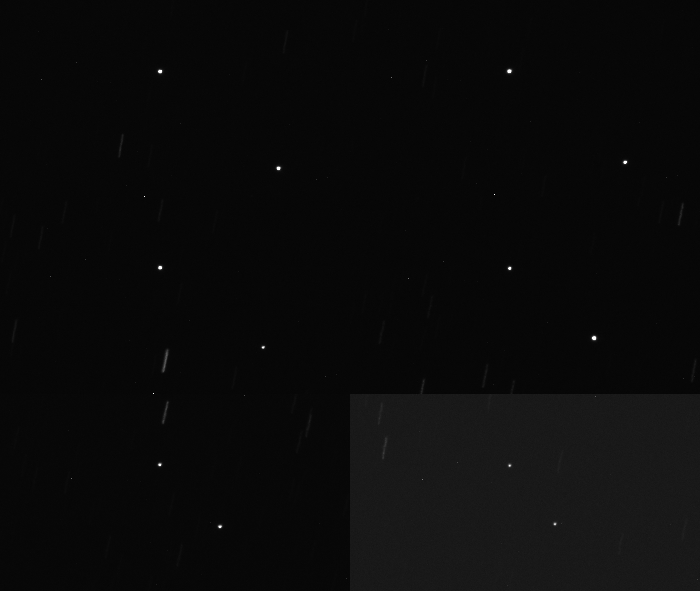
Russia's Luch-2 satellite approaches another geostationary satellite on April 12, 2024, as tracked by the French company Aldoria's observation stations. (Image credit: Aldoria)
Eyes in the sky
There are about 80 ICEYE spacecraft in LEO at the moment. They image our planet using SAR, which can peer through clouds and gather data both day and night. Some of these satellites are operated by ICEYE, a company based in Finland, while others are managed by its American subsidiary, ICEYE US. ICEYE-X36 is one of the latter.
At least some ICEYE satellites provide imagery to Ukraine, which Russia invaded in February 2022 and continues to assault with ground troops and missile and drone attacks. Indeed, ICEYE signed a contract this past January firming up this data-sharing relationship with Ukraine.
"The agreement ensures that the Ministry of Defence continues to receive a high volume of high-resolution satellite imagery through ICEYE's world-leading SAR constellation, supporting the Ukrainian Armed Forces with persistent situational awareness on tactical timelines," ICEYE representatives said in a January statement.
That likely explains Russia's interest in ICEYE satellites, which is extensive and longstanding. For example, Kosmos 2612 launched in April of this year with five other spacecraft. In May, four members of this fleet, including Kosmos 2612, conducted maneuvers to get into a co-planar orbit with ICEYE-X36. Such maneuvers use a lot of fuel and are therefore not performed lightly. (It's unclear if ICEYE-X36 is dedicated to capturing imagery of Ukraine or Russia, but Russia certainly seems to think it is.)
However, we still don't know the purpose of Kosmos 2612's close approach (which is apparently over, at least for now), Samson stressed.
There are a few possibilities. For example, Russia may want to get a better idea of ICEYE satellites' capabilities, and/or figure out what exactly they're studying on Earth below. Or maybe Kosmos 2612 was actively interfering with ICEYE-X36 in some way — messing with its sensors, perhaps, or blocking or intercepting its communications with the ground.
However, Samson leans toward another explanation.
"I think they're getting frustrated," she said of the Russians.
"They've been kind of in a stalemate, particularly for the past six months or so. And so I think it's just more a matter of demonstrating military prowess in a manner that the Ukrainians cannot respond to," she added. "The Ukrainians are just as good, perhaps even better than, the Russians on drones. But when it comes to space stuff, they're not peers, and this is just a way to remind everyone that that's the case."
As Kosmos 2612's activities show, space is becoming an increasingly competitive and contested domain. The U.S. has long held the advantage above Earth, fielding the most capable reconnaissance and communications craft, but Russia and China are challenging that dominance.
This drama is unfolding above our heads now, and it affects everyone on the planet. Samson therefore wishes that governments around the world were more forthcoming about their space activities — for example, that we learned about Kosmos 2612's shenanigans from the U.S .Space Force rather than from private companies and civilians who pore over government tracking data.
"I think it just speaks to the importance of transparency, and sharing information about these sort of things," she said. "As much as you may want to, you cannot keep the existence of satellites classified, because people can see them."
SpaceX will soon notch a huge spaceflight milestone, if all goes according to plan.
The company will try to catch both stages of its Starship megarocket during the vehicle's next test flight, which is targeted for next month, founder and CEO Elon Musk announced during SpaceX's quarter 3 (Q3) earnings call today (Oct. 20).
If SpaceX succeeds, this "will be the first time that an orbital launch vehicle has been fully recovered," Musk said. "The only way that we can extend consciousness beyond Earth on a sustained basis is with a fully reusable orbital launch vehicle. So this is, I think, a profound technology milestone in the history of civilization and consciousness."
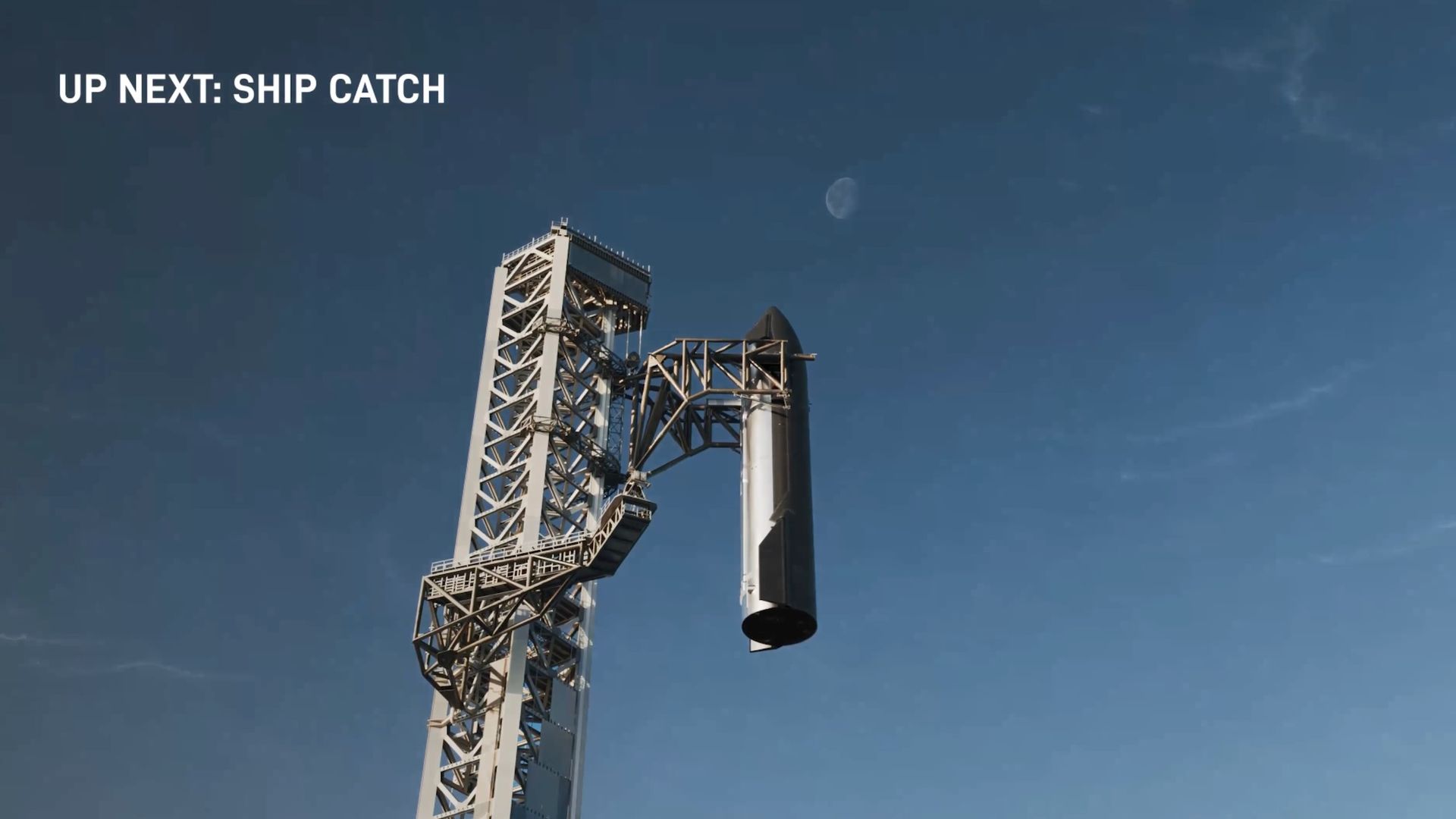
Artist's illustration of SpaceX catching the upper stage of its Starship megarocket, something the company expects to do on the vehicle's 15th test flight. (Image credit: SpaceX)
Starship is the biggest and most powerful rocket ever built, standing more than 400 feet (122 meters) tall when fully stacked.
As Musk noted, both of its stages — the Super Heavy booster and Ship spacecraft — are designed to be fully and rapidly reusable, a breakthrough that SpaceX thinks will make Mars settlement and other grand exploration feats economically feasible.
Starship's recovery strategy is different than that for SpaceX's Falcon 9 and Falcon Heavy rockets, which are partially reusable. (The latter two rockets have expendable upper stages). Falcon 9 and Falcon Heavy boosters come back to Earth on landing pads near the launch site or on ships at sea downrange. Super Heavy and Ship, however, will steer themselves directly back to their launch tower, which will capture each vehicle with its "chopstick" arms.
This will allow SpaceX to inspect, refurbish and refly Starship at an accelerated rate, which is a priority for the company: Musk has said he envisions launching Starship more than 10,000 times per year by 2030.
Starship has conducted 14 test flights to date, and SpaceX has pulled off chopstick catches with Super Heavy on three of them. The company has not yet tried to catch Ship, which is a more difficult proposition, as the upper stage travels higher, farther and faster than the booster does.
Still, Musk is confident that SpaceX will pull off a Ship catch on the first try. (He did not give a specific target date for Flight 15, saying only that it was expected next month.)
"I'd say it's more likely than not that this succeeds next flight," he said. "And if not, we have a steady stream of Starship flight attempts through the end of this year, and and then accelerating next year."
Success would mean back-to-back Starship flights with huge milestones. On Flight 14, which occurred on Sept. 28, Ship reached orbit for the first time ever. It also deployed 26 of SpaceX's Starlink Version 3 satellites — the first 26 members of a next-gen broadband constellation in low Earth orbit that will eventually consist of about 100,000 spacecraft.
The Starship Flight 15 preview was something of an aside during today's call. The event primarily served to announce SpaceX's financial performance during Q3, the three-month stretch that ended on Sept. 30.
And that performance was strong, company representatives said. SpaceX recorded revenues of $14.6 billion during Q3, an increase of 161% from the $5.6 billion earned during Q3 of 2025. The company had a net income of $4.4 billion during Q3, $5.5 billion better than the result from the same stretch last year, when SpaceX lost $1.1 billion.
Just $1.8 billion of 2026 Q3 revenue came from SpaceX's launch division. The vast majority was generated by two other segments — connectivity (services provided by its Starlink megaconstellation) and artificial intelligence (or, as the Trump administration has recently rebranded it, "superintelligence").
SpaceX thinks these latter two segments will continue to boom. That's why it's building the infrastructure to support thousands of Starship launches per year — to loft lots of Starlink satellites and AI data centers to Earth orbit. And the company believes that it's positioned to really start raking in the cash, starting as soon as next year.
"In a nutshell, what this implies for SpaceX annual recurring revenue by the end of '27 is somewhere between 500 billion [dollars] and a trillion," Musk said.
On Oct. 20, 1970, the Soviet Union launched the Zond 8 spacecraft on a mission to the moon. This was the last mission in the Zond program.
After the first three Zond missions explored Venus and Mars, the next ones were circumlunar missions that flew around the moon before returning to Earth. Although there was no crew on board, the Zond spacecraft was designed with cosmonauts in mind.
The Zond missions served as test flights for the Soviet Union's plans to send cosmonauts to the moon. But those plans for crewed flights never came to fruition. This was partly because the U.S. had already put astronauts on the moon, but also because the Zond missions had a lot of technical problems.
Zond 8 was considered a success — even though its guidance system malfunctioned on the way back to Earth. The spacecraft still returned to Earth safely and splashed down in the Indian Ocean one week after it launched.
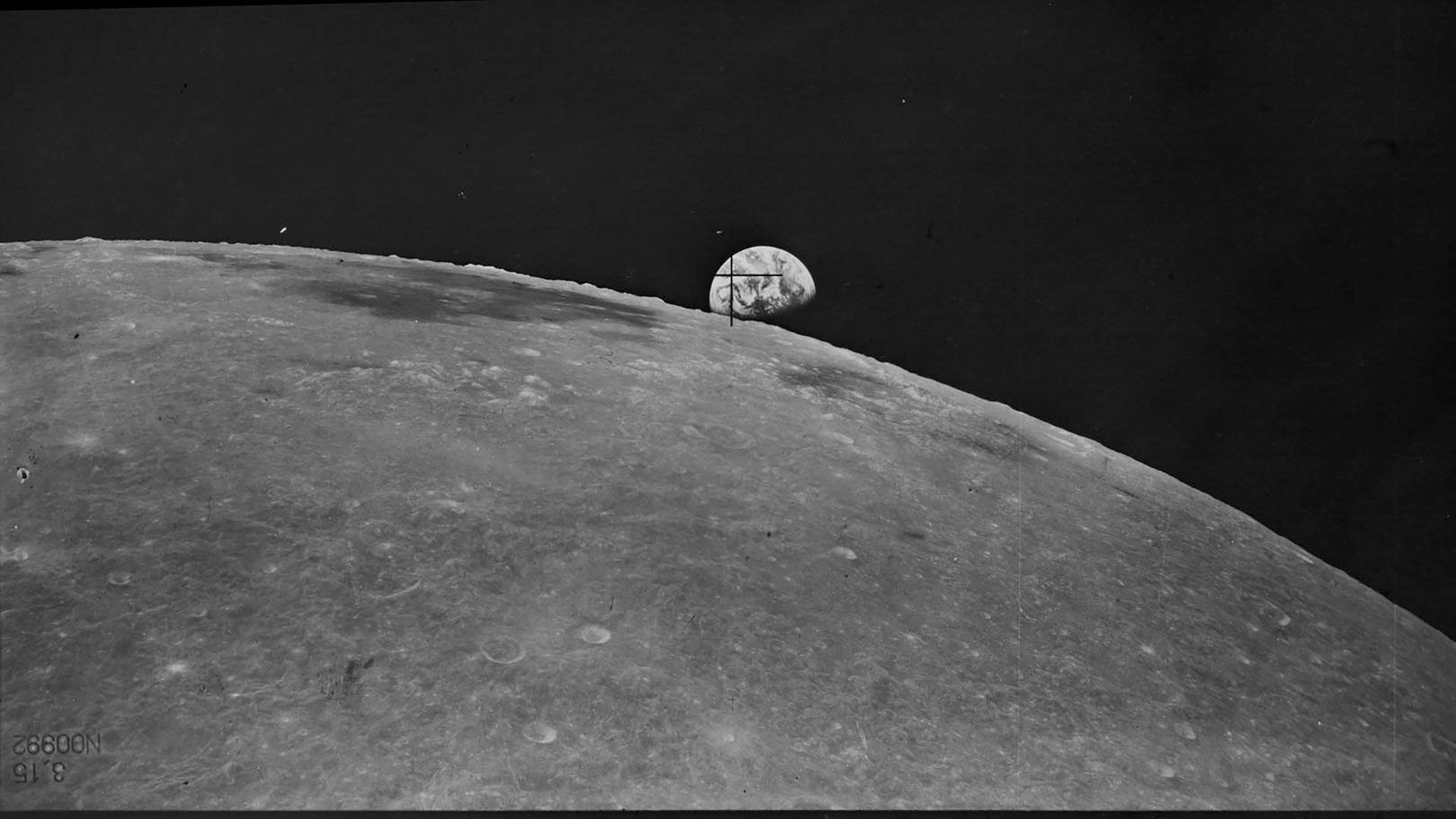
The Soviet Union's Zond 8 spacecraft, the last in a series of lunar spacecraft, captured this image of Earthrise on Oct. 24, 1970. (Image credit: Moscow State University of Geodesy and Cartography)
Why it mattered
While the Zond 1 and Zond 2 missions were launched toward Venus and Mars, respectively, the primary target of most Zond missions was the moon. At the time, the Soviet Union was embroiled in an ongoing space race with the United States to be the first on the moon with a human crew.
By the time Zond 8 launched on Oct. 20, 1970, that space race was lost to the Soviet Union. NASA and the U.S. had already landed astronauts on the moon twice with Apollo 11 and Apollo 12 (in July and November of 1969, respectively), and even peformed the first space rescue fo the Apollo 13 astronauts in April 1970.
While Zond 8 was uncrewed, it was a test flight of the Soviet Union's L1 spacecraft that was designed to fly a cosmonaut around the moon. It looped around the moon in a lunar flyby, approaching within 1,120 kilometers of the moon's surface at its closest point, according to RussianSpaceWeb.com.
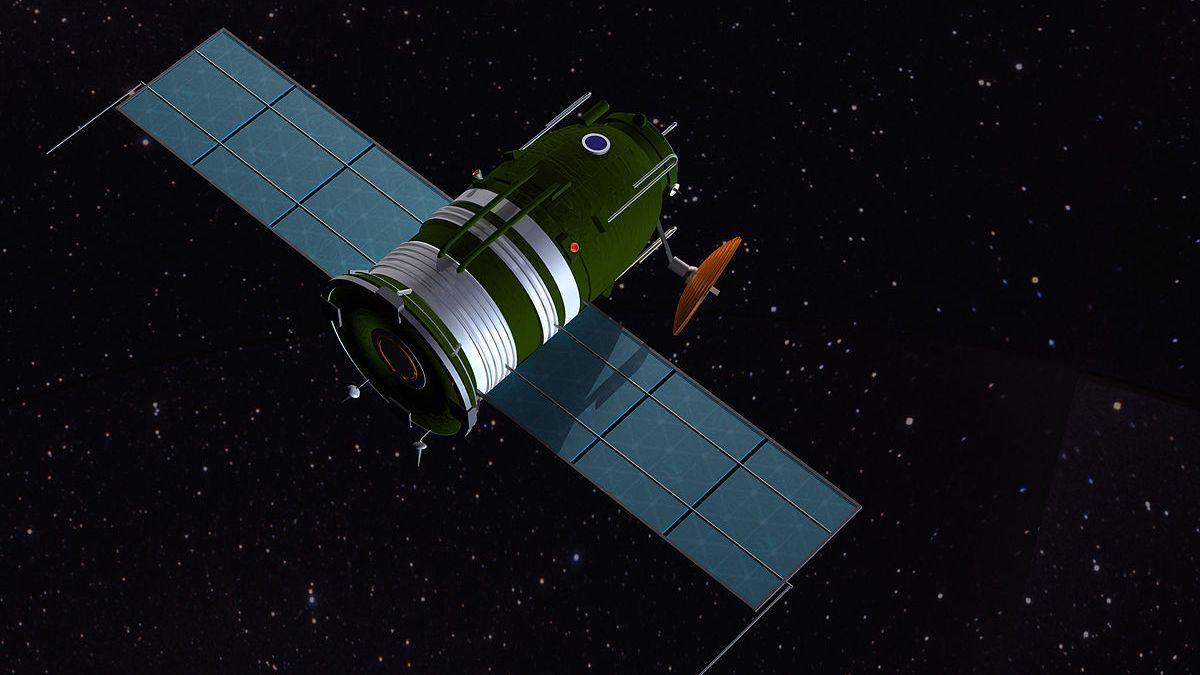
An artist's illustration of a Zond spacecraft. (Image credit: Future)
Zond 8 ultimately splashed down in the Indian Ocean on Oct. 27, 1970 after a solar attitude sensor failed, sending it on a shorter, steeper reentry path during landing, according to RussianSpaceWeb.com. It was retrieved by a recovery ship, marking the end of the Soviet moon landing program. Russian would go on to develop a series of Salyut space stations, culminating in the long-lived Mir space station.
After decades without a moon probe, Russia did launch a new uncrewed moon lander in 2023. That Luna 25 mission failed and crashed into the lunar surface after an onboard engine controller malfunctioned. The country has pledged a return to the moon in 2027.
Daniel Biedermann is a partner at NewSpace Capital. He contributed this article to Space.com's Expert Voices: Op-Ed & Insights.
Jeff Bezos, the founder and former CEO of Amazon, recently said that Blue Origin, his space technology company, is likely to go public in the coming years. The announcement has (unsurprisingly) attracted considerable attention, not least because Bezos has spent more than two decades financing the company largely from his personal wealth. He has invested billions of dollars in developing rockets, spacecraft and other forms of technology, often with very little prospect of an immediate return. But although Bezos has now raised the possibility of an initial public offering, he has given no firm indication of when one might happen. He may be right to keep his options open.
Bezos founded Blue Origin in 2000. Because he has financed so much of its development by himself, the company has been able to pursue ambitious engineering projects without the financial pressures that publicly listed businesses typically face. But developing reusable rockets, manufacturing spacecraft and building the infrastructure needed for future lunar missions requires extraordinary amounts of capital: These projects can take decades to complete, and even the wealthiest investors must think hard about how best to finance them over the long term. Bezos, then, has good reasons to seek additional sources of investment — particularly as Blue Origin prepares to expand its commercial operations.
An IPO would give Blue Origin the means to raise substantial capital from public investors and reduce its dependence on Bezos's personal wealth. The company could then use that money to expand manufacturing, develop new technology and compete for a greater share of the growing space market. Public ownership would also give existing investors the power to sell some of their holdings and could make it easier for Blue Origin to finance acquisitions. But the company would also have to meet the expectations of shareholders, who would expect to see regular evidence of commercial progress. This, I suspect, is why Bezos wants to establish a stronger business before committing to a listing.
It might have much to prove commercially, but Blue Origin’s technical progress has been remarkable. In January 2025, its New Glenn rocket reached orbit for the first time — a significant achievement for a vehicle built to compete in the heavy-lift launch market. The company has also secured government and commercial contracts and continued developing its lunar capabilities. But it will eventually have to demonstrate that it can launch New Glenn frequently, reliably and at a commercially competitive cost, and it is still some way away from that point.
Some will be asking whether Bezos wants to raise money to accelerate growth or simply to reduce the amount he himself must invest. Such doubts could affect the company's valuation and make it harder to attract investors who share its long-term ambitions. But again, this suggests Bezos is playing the long game. And given the enthusiasm that has surrounded some billionaire-led space ventures, this is sensible. Investors have sometimes attached extraordinary valuations to companies with ambitious plans but limited commercial experience. Space businesses certainly require ambition: engineers will often spend years developing technology before they can sell it. But investors have to distinguish between technical achievement and commercial performance. At the end of the day, they are seeking a strong rate of return.
Blue Origin's New Glenn rocket launches NASA's ESCAPADE Mars mission on Nov. 13, 2025. (Image credit: Blue Origin)
What’s also worth considering is how Blue Origin's progress could benefit the wider space industry, particularly the specialist companies that supply technology to larger manufacturers and operators. SpaceX has achieved remarkable success in part by developing and manufacturing much of its technology internally. This includes its rockets, spacecraft and satellites. Blue Origin also does something similar, undertaking substantial engineering and manufacturing work itself, but it is not quite so vertically integrated, and thus may have greater scope to work with external suppliers as it expands. It already buys parts, equipment and services from hundreds of businesses. If it can successfully increase its production and launch activity, these suppliers could receive more orders and gain opportunities to develop new technologies. That’s to the good of the sector as a whole.
Why? Because a successful space industry needs more than a handful of large launch providers. It needs companies specializing in satellite communications, propulsion, electronics, software and other areas. Such businesses may have developed highly sophisticated products, but they need bigger customers and predictable demand to expand and produce more. Blue Origin could become an important customer for some of these, particularly if it chooses to buy specialist technology rather than make everything internally. Greater competition between the bigger space companies could translate to more potential customers for suppliers and fewer dependent commercial relationships.
Investors would benefit. There’s real potential in businesses that provide the technology and services on which larger space companies depend — the ‘picks and shovels.’ These can sometimes serve several customers and markets, making them less dependent on the success of a single program. A growing Blue Origin would create more opportunities for companies like these — although, of course, much will depend on how Bezos chooses to organize its supply chain. We shouldn’t assume that Blue Origin will become more open to external suppliers than its competitors, but the possibility is at least worth entertaining.
As it is, Bezos still faces substantial challenges. Blue Origin is not yet a commercially mature business. The company must increase its launch activity; it must demonstrate its reliability; and it must compete for customers in the public and private sectors. It must also decide how much technology to manufacture internally and whether and where third parties can provide better products or products at a lower cost. Bezos has the resources to give the company time to answer these questions, and he appears to be willing to use them. If he continues to prioritize commercial performance before pursuing an IPO, then Blue Origin could eventually enter the public markets in a much stronger position.
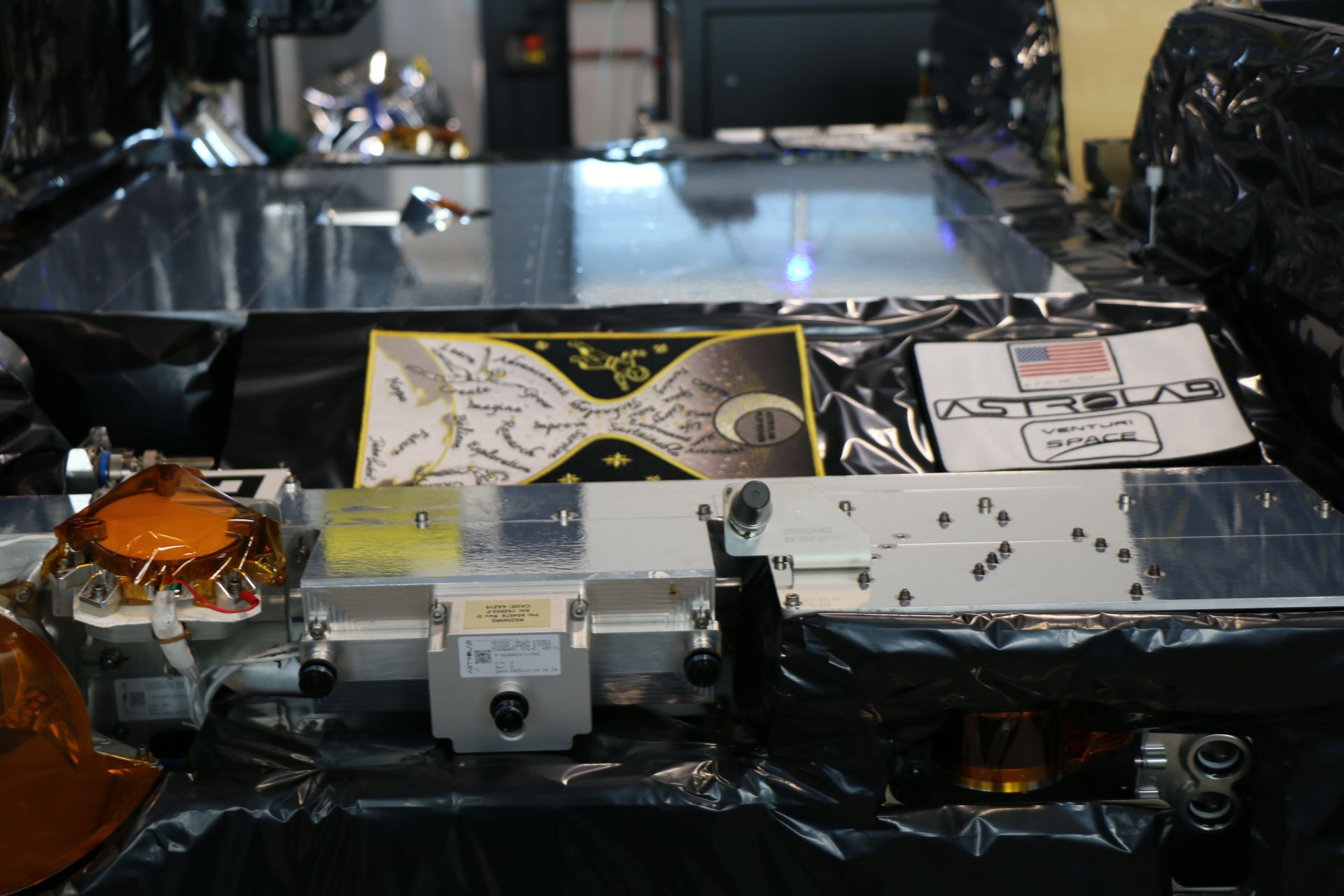
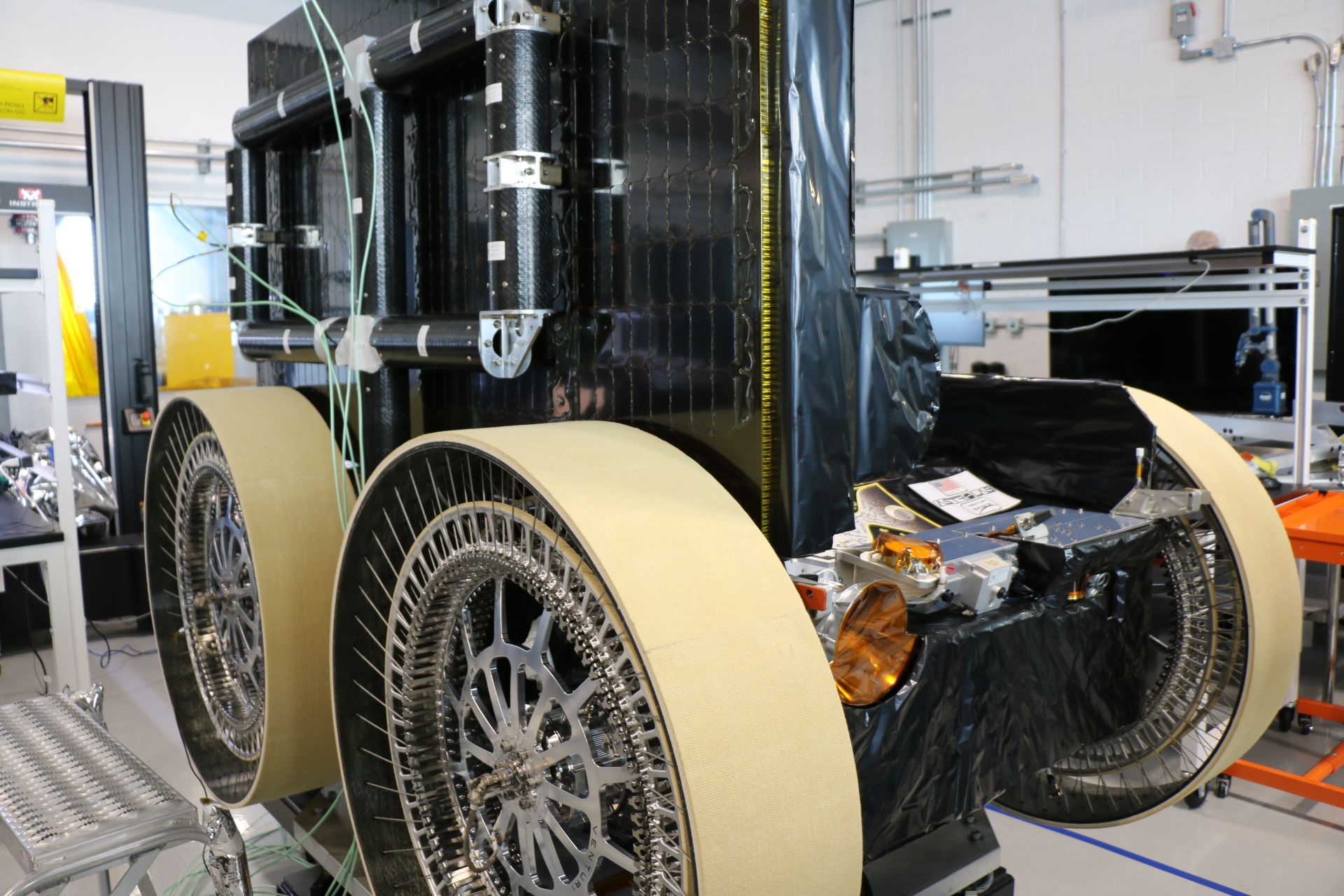
HAWTHORNE, Calif. — A moon buggy carrying a history-making supercomputer is ready to launch to the lunar surface. And it's taking some inspiration from Mars.
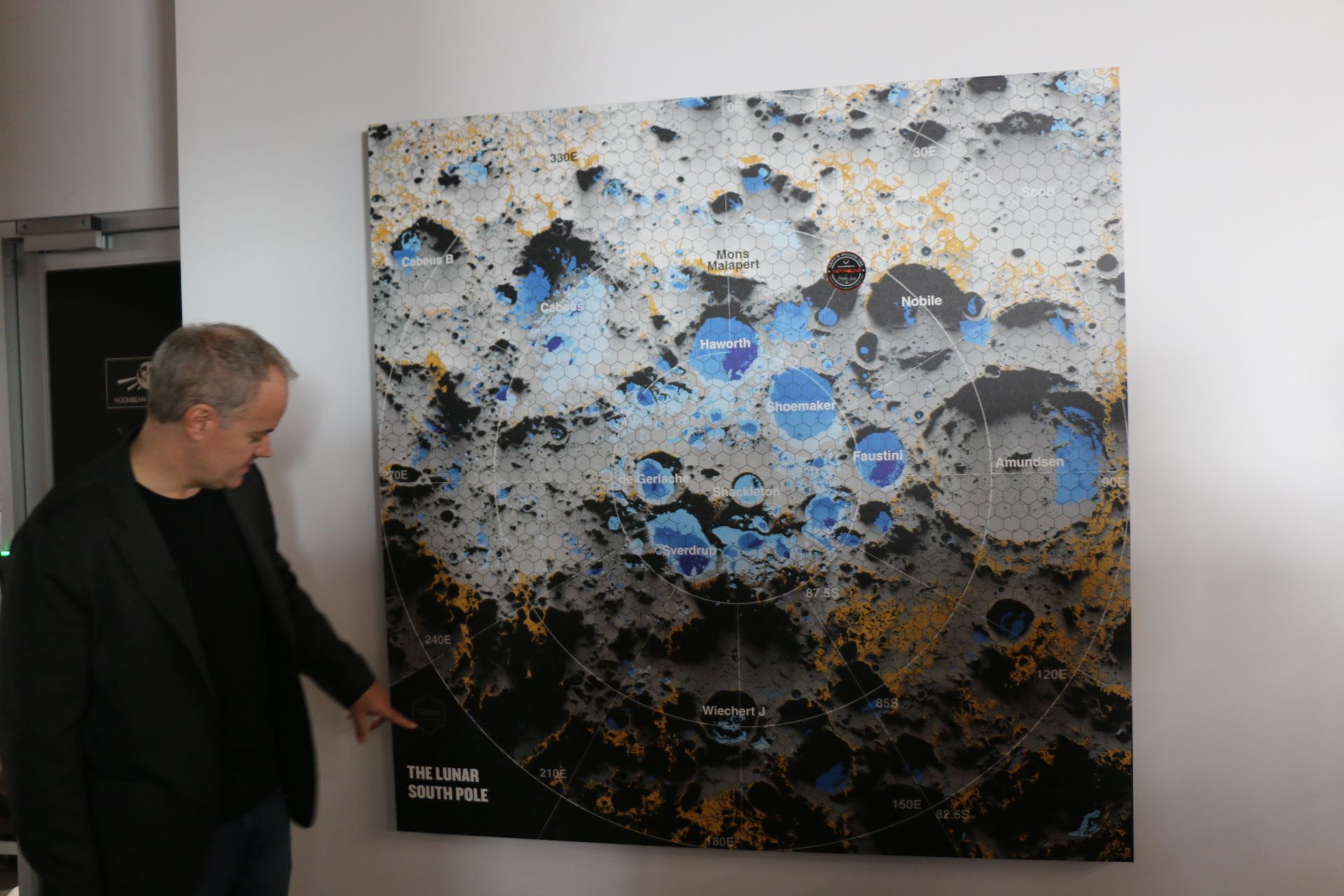
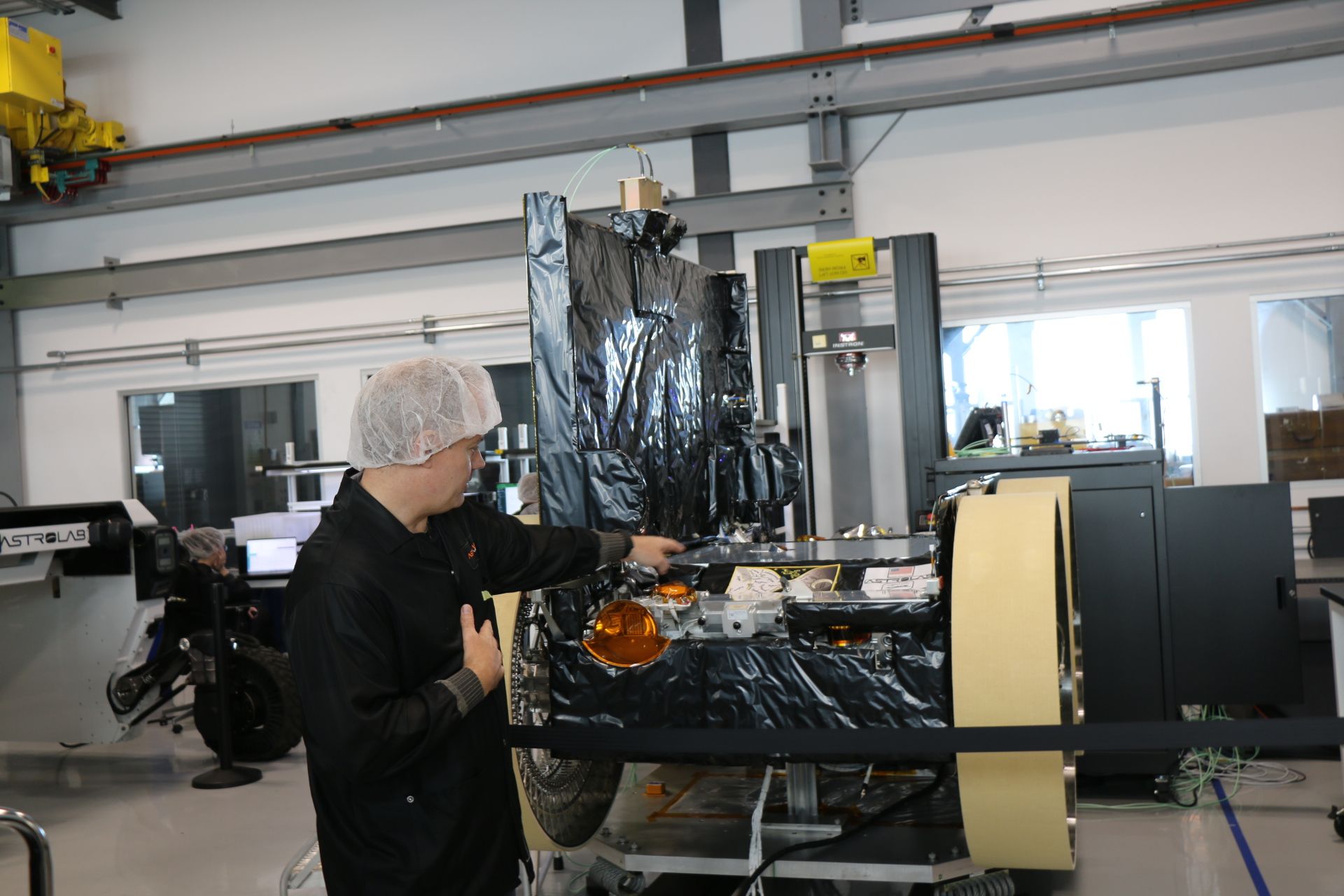
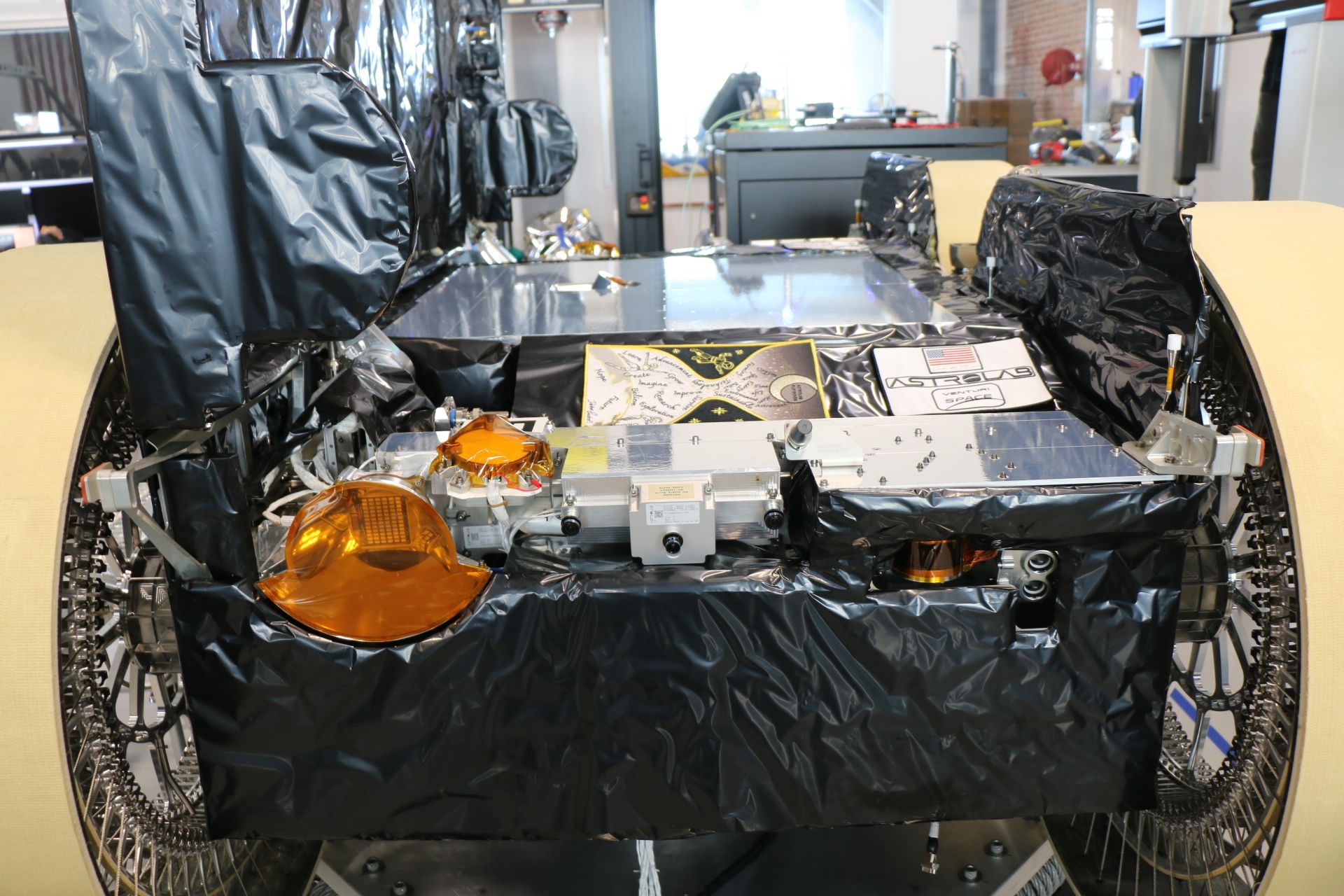
Later this year, Astrolab will launch its uncrewed moon rover FLIP to the lunar south pole as part of the Griffin Mission 1, or Griffin-1. The California company is one of two that NASA has selected to develop a drivable rover for the agency's Artemis program. On board FLIP will be Hewlett Packard Enterprise's (HPE) Spaceborne Computer-4, an advanced computer module built to be used in space.
This will be the first time that high-performance computing and artificial intelligence will be tested on the lunar surface. As NASA gets closer to landing humans back on the moon with Artemis, advancements like this aim to support future human habitation as well as economic activity on and around the moon.
"We're sending the first supercomputer from HPE to the lunar surface later this year, doing the first GPU [graphics processing unit] on the moon [and the] first AI experiments on the moon," Jaret Matthews, founder and CEO of Astrolab, said during an Oct. 14 media event here at Astrolab's headquarters. "They're breaking new ground, and they're ahead of the curve."
The computer is designed to be lightweight, compact, self-contained and fanless. It has a low-power 64-bit CPU (central processing unit) with a GPU. The computer will be attached to FLIP's cooling system and will be powered by a system supported by both batteries and solar cells on the rover. The computer will also be paired with solid state drives from the company KIOXIA that will allow for memory storage.
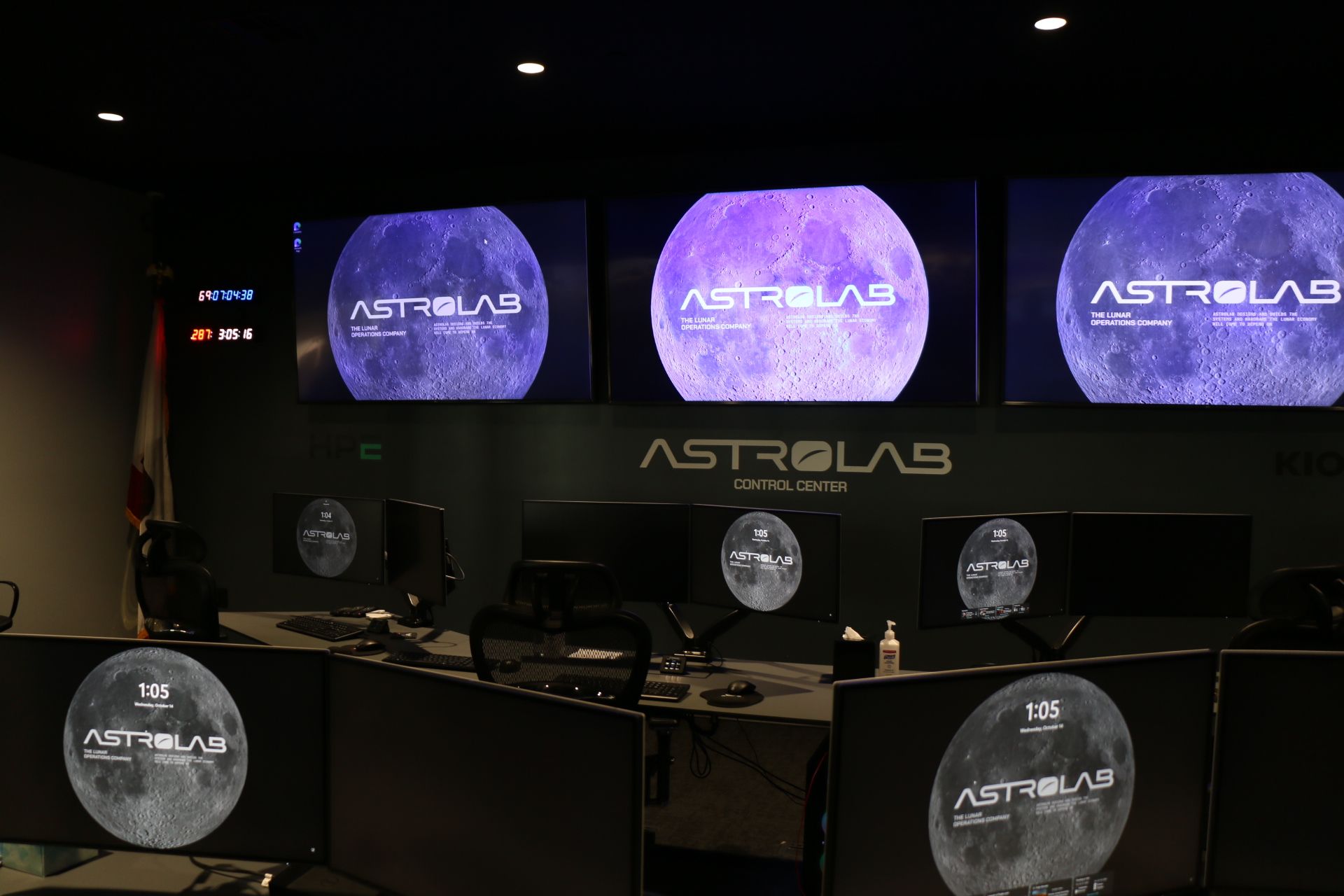
Mission Control at Astrolab.Chelsea GohdAstrolab CEO and founder Jaret Matthews points out the Astrolab landing site among other locations at the lunar south pole. Chelsea GohdJaret Matthews presents Astrolab's FLIP rover. Chelsea GohdThe FLIP rover's headlights and attached artwork. Chelsea GohdA close-up of the attached artwork on the FLIP rover. Chelsea Gohd
So, what will a supercomputer and AI accomplish on this uncrewed mission? First and foremost, the flightwill test how the computer works in this extreme environment. The computer is built with heat-conductive aluminum and is designed with the specific conditions of the lunar south pole in mind. But while it was designed and tested to be able to withstand the extreme temperatures and conditions on the moon's surface, the upcoming mission seeks to show that this advanced technology can actually work in this environment.
"NASA's given us a real challenge," Matthews told Space.com at the media event. "We have to design for a full year on the lunar surface. So that means surviving multiple lunar nights, upwards of 150 hours of complete darkness where we're not receiving energy or warmth from the sun. And then, also, there's going to be a long period [in] which we're operating semi-autonomously for [when] the astronauts are not there … and so we're having to develop a semi-autonomous platform that will spend many months [and] travel hundreds of kilometers [on the moon]."
But the computer will more than just prove its durability, if all goes to plan. It will also analyze visual data captured on the mission and enable autonomous observations, process navigation, mapping and terrain analysis. The mission also promises to test AI capabilities, though it's unclear what exact applications we'll see with this lunar AI. HPE shared in a statement that "an AI services container will demonstrate reliable deployment of scalable AI service applications on the moon."
It is also to be determined exactly how, once tested, these capabilities might be used with future crewed missions. Astronauts aboard the International Space Station already use computers for communications, science experiments and other daily tasks while living in space, but we can't say yet exactly how future astronauts might use these capabilities, especially with the addition of AI, on the moon.
From Mars to the moon
One interesting aspect of this new development is where it came from. While HPE has provided computing power to NASA for decades, Matthews is also bringing his previous experience working at NASA's Jet Propulsion Laboratory (JPL) into this new venture.
"One of the experiments [that will be] running on the spaceborne computer on the moon is a localization software experiment from JPL. It has been used on Mars, and this will be the first time it's used on the moon," Matthews said.
"The challenge with the moon and Mars is that there's no GPS, so locating yourself and knowing where you are on the surface [can be difficult]," he added. "So we're going to be running what is essentially a machine learning algorithm that JPL developed to take a map that's stored in memory … and compare it to the local terrain we see around us, and then do a match. So essentially, match features of the local terrain to the map that's stored in memory to help find ourselves on the map and keep ourselves away from dangerous craters."
As its name suggests, Griffin-1 will be the first mission for the robotic Griffin moon lander, which was developed by Astrobotic. The Pittsburgh company is flying Griffin-1 for NASA, under the agency's CLPS (Commercial Lunar Payload Services) program. In addition to FLIP, the mission will carry Astrobiotic's CubeRover, a small, uncrewed rover; LandCam-X, an optical navigation system; and Nanofiche GLPH (Galactic Library to Preserve Humanity), a tiny archive of human history, to the moon's surface.
"The moon presents a challenging environment for advanced computing, and we’re pleased to provide HPE with an opportunity to demonstrate its technology on the lunar surface," Matthews added in a statement. "Our FLIP rover is designed to accommodate a variety of payloads, and this mission will demonstrate how commercial lunar mobility platforms can support technology development and scientific research."
The space around Earth is turning into a junkyard. Researchers think a refundable deposit scheme could force satellite operators to clean up their act before a tipping point is reached.
For years, space sustainability experts have warned that the growing number of satellites in orbit and the quantity of dead metal left behind threatens to trigger a dangerous cascade of collisions known as the Kessler Syndrome. Predicted in the 1970s by NASA physicist Donald Kessler, this chain of orbital smashups could make the space around Earth unusable and unsafe.
The dangerous tipping might be nearer than some think. Humankind's utilization of space is at an inflection point, as companies such as SpaceX, Blue Origin and Amazon plan to launch constellations of hundreds of thousands of telecommunication satellites and orbiting data centers in the coming years.
"Low Earth orbit looks like lots of other resources that we have trashed as economic actors," Daniel Kaffine, a professor of environmental and resource economics at University of Colorado Boulder, told Space.com.
"Waiting until it gets really, really bad to start implementing any of these types of policy interventions has historically been what we have done," Kaffine added. "But maybe we can think about things we can do right now."
In a paper published last month in the journal Nature Communications, Kaffine and his collaborators propose a scheme that would require satellite operators to post a bond of $200,000 before launch, refundable with interest upon the completion of a successful deorbit. Companies that fail to remove their junk would lose the money, which could go toward a shared pool funding active debris-removal missions, the researchers said.
"You could possibly raise billions of dollars by that," said Kaffine. "We think it's a very neat policy that doesn't require international coordination."
International bodies, such as the Inter-Agency Space Debris Coordination Committee, ask satellite operators to remove their spacecraft from orbit within 25 years after the mission's end. The American Federal Communications Commission (FCC) imposes an even stricter standard — a five-year requirement for satellites in low Earth orbit. Still, a staggering 60% of satellites remain in place when their propellant runs out, the researchers say, as no consequences ensue if they fail to deorbit.
Solving the problem on the international level would be difficult, as international bodies have no powers to enforce compliance. Moreover, the United Nations Committee on the Peaceful Uses of Outer Space (COPUOS), which sets down rules for the peaceful exploration of outer space, requires the unanimous support of every member state to pass new regulations, which is nearly impossible to achieve.
"The policy we propose could be implemented on a national level, which is why we think it's interesting," Indigo Brownhall, a space sustainability researcher at University College London and the paper's lead author, told Space.com. "Any country in Europe can request satellites registered with them to follow this bond policy."
To put it simply, no satellite registered in a given country gets to space before putting the money into the kitty. The researchers acknowledge that it might be hard to persuade major players historically averse to regulations, such as the U.S., to roll out such a scheme. But they say a more environmentally conscious block, like the European Union (EU), could enforce compliance by limiting market access to those who observe their rules.
"The consumer market in Europe is massive, like 300 to 400 million people," Brownhall said. "And the EU can request anyone who wants to sell space data or any products in the EU to follow their rules. They did this with GDPR [General Data Protection Regulation]. And you can imagine that somebody like Starlink [SpaceX's satellite-internet subsidiary] surely wants to sell Starlink terminals to Europeans."
The authors estimate that, even if the scheme only covered 20% of global satellite launches, it would reduce the number of derelict satellites careening around the planet by 18%.
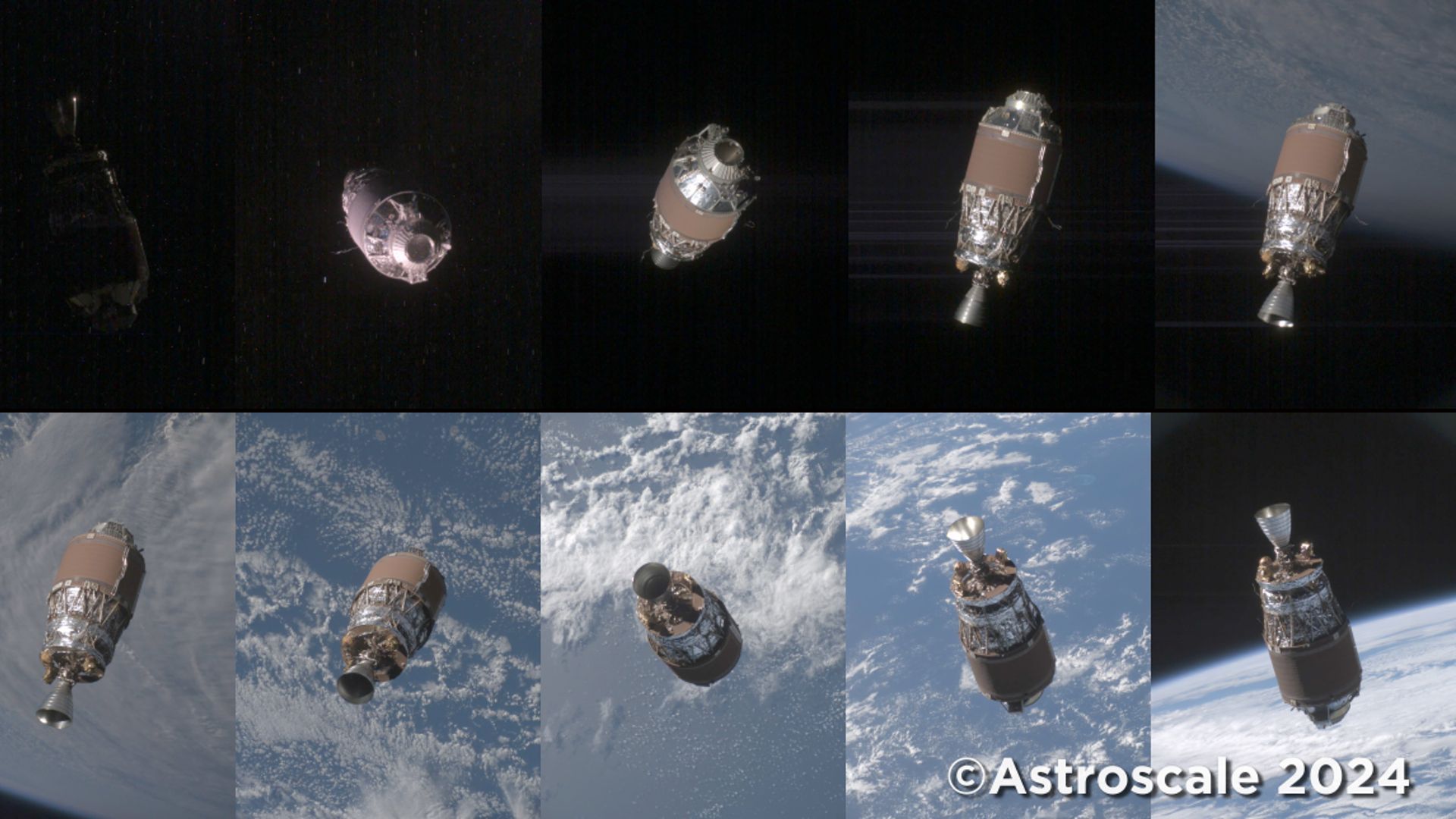
An old rocket body tumbles in space above Earth as seen from Japan's Astroscale ADRAS-J satellite. (Image credit: Astroscale)
Currently, more than 57,000 pieces of space debris larger than 4 inches (10 centimeters) hurtle around Earth completely out of control, according to estimates by the European Space Agency. That's double the figure from less than 10 years ago. Most of these fragments were generated by explosions and orbital collisions that shattered satellites and used rocket stages into clouds of dangerous debris.
"Leaving big satellites that no longer work up there is like a ticking time bomb," Brownhall said. "Active satellites can move out of the way, but when two derelict satellites are going to hit each other, there is nothing you can do but watch it."
Kaffine said the policy could be modelled on U.S. oil operators' bond scheme, in place since the 1960s, which ensures that oil giants plug used oil wells after ceasing extraction.
"If the oil operators clean up after completing the oil production job, they get the money back," said Kaffine. "If they don't, the money goes into a fund, which the government then uses to clean up orphan wells. It's quite an analogous situation to what we see in space."
In the meantime, evidence of the worsening orbital situation is coming thick and fast. Space situational awareness companies such as U.S.-based LeoLabs, which use networks of ground-based radars and telescopes to monitor traffic in space, report increasing numbers of disintegration events — incidents involving either an explosion or a collision between old satellites, fragments and rocket bodies. In the past six months, LeoLabs has reported at least four fragmentation events in space, which together created hundreds of new pieces of space debris.
SpaceX just launched its mysterious "Starfall" return capsule for the second time ever.
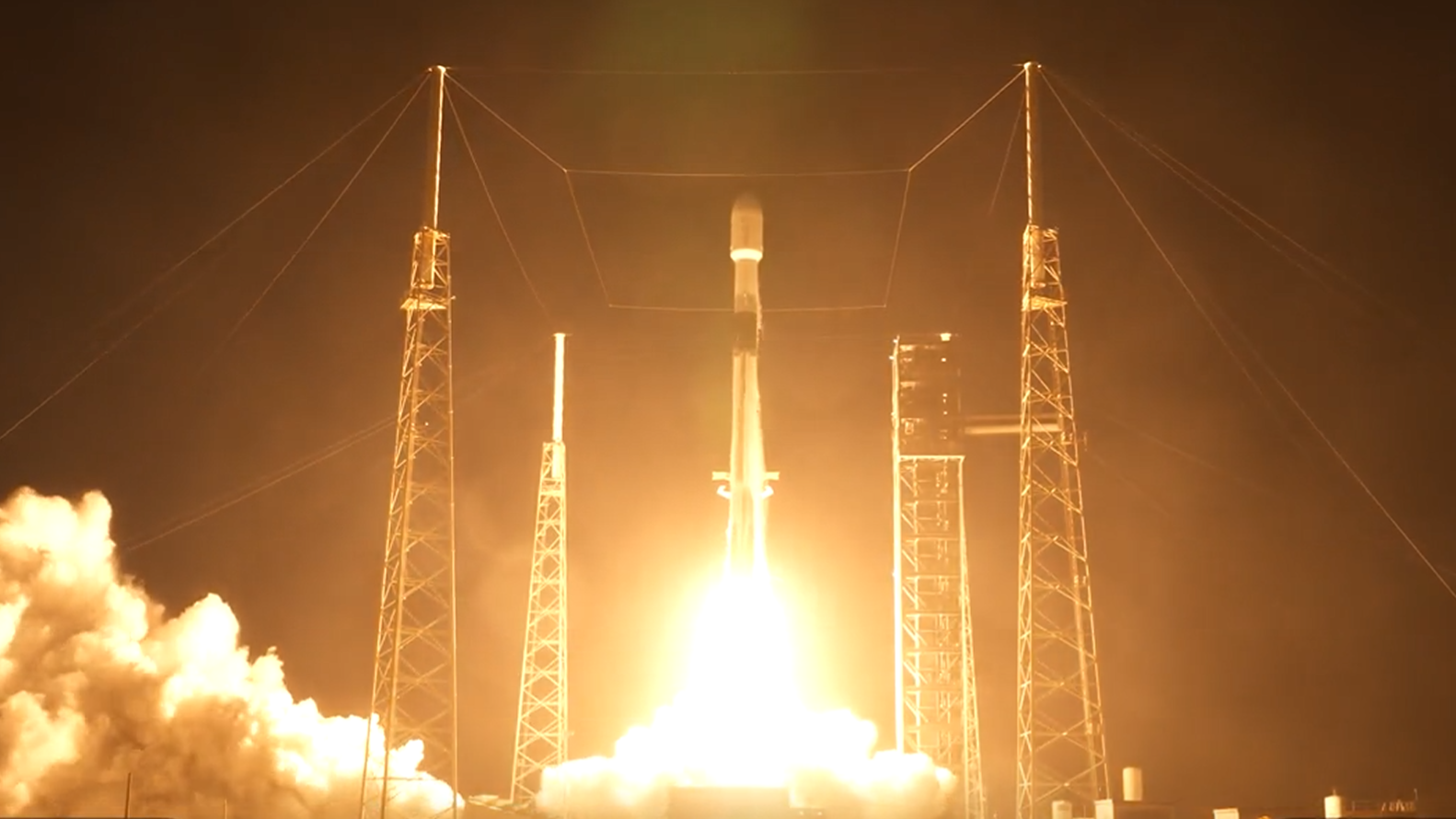
Starfall was one of 32 payloads on the company's Bandwagon-5 rideshare mission, which launched atop a Falcon 9 rocket at 7:04 a.m. EDT (1104 GMT) today (Oct. 20) from Cape Canaveral Space Force Station in Florida.
SpaceX has been relatively quiet about Starfall, which debuted this past June on a Falcon 9 launch from the Cape.
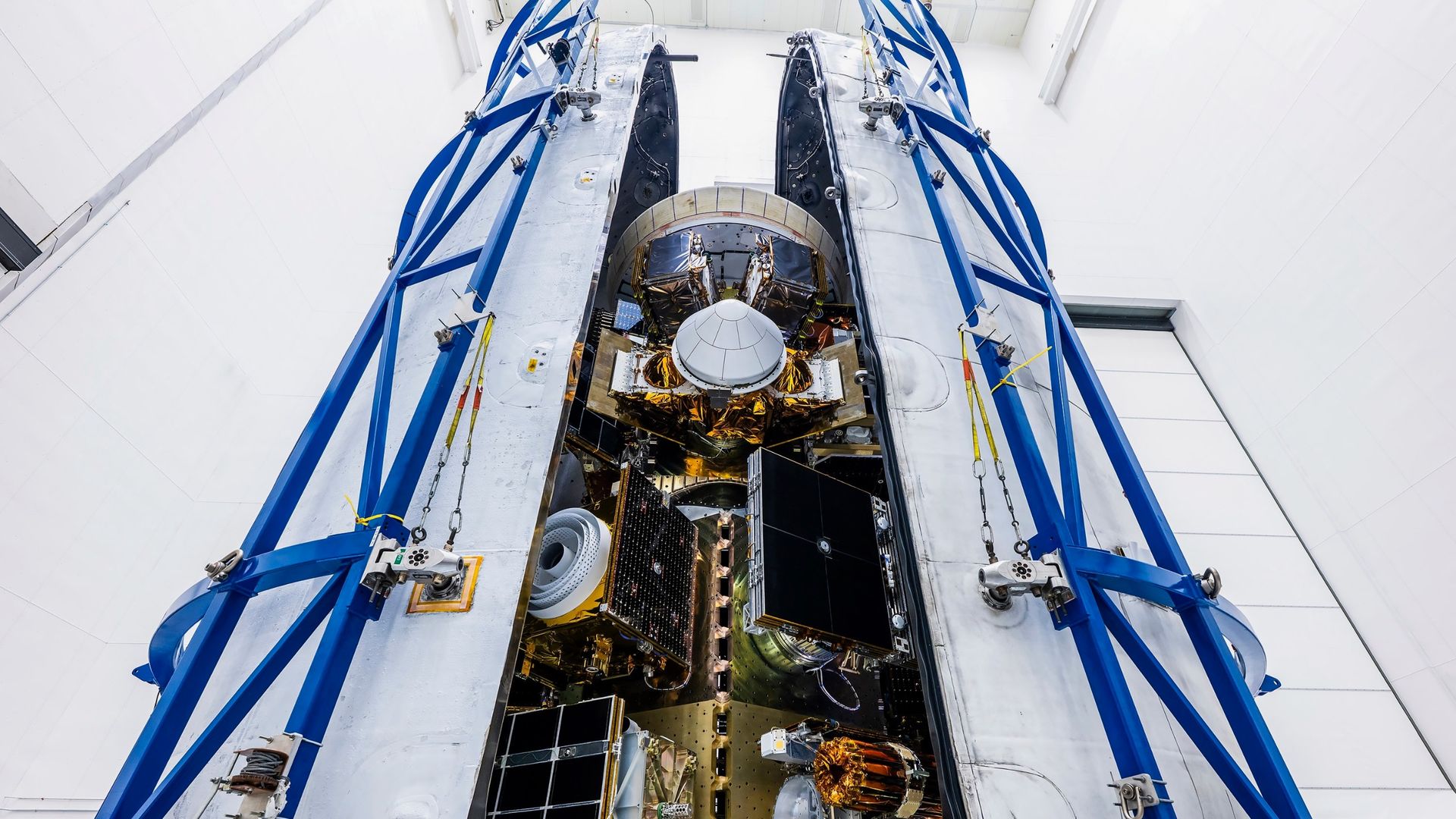
The payloads of SpaceX's Bandwagon-5 rideshare mission, seen in a prelaunch photo. The company's Starfall capsule sits at the very top of the stack. (Image credit: SpaceX)
That June 23 flight was a dedicated demonstration mission for Starfall, designed to show that the capsule can fly in a controlled fashion and survive the harrowing downward trip through Earth's atmosphere.
And those will be Starfall's main jobs. The vehicle "will enable affordable, routine access to the microgravity environment for scientific research and in-space manufacturing," SpaceX in a June 23 X post, one of the few public statements the company has made about Starfall.
Indeed, most of the details that we have about the capsule come from an environmental assessment that was published by the U.S. Federal Aviation Administration in May.
According to that document, the disk-shaped Starfall is roughly 2.5 feet (0.75 meters) tall and 10.2 feet (3.1 m) wide. It weighs about 4,600 pounds (2,100 kilograms) and can bring 2,200 pounds (1,000 kg) of payload back down to Earth.
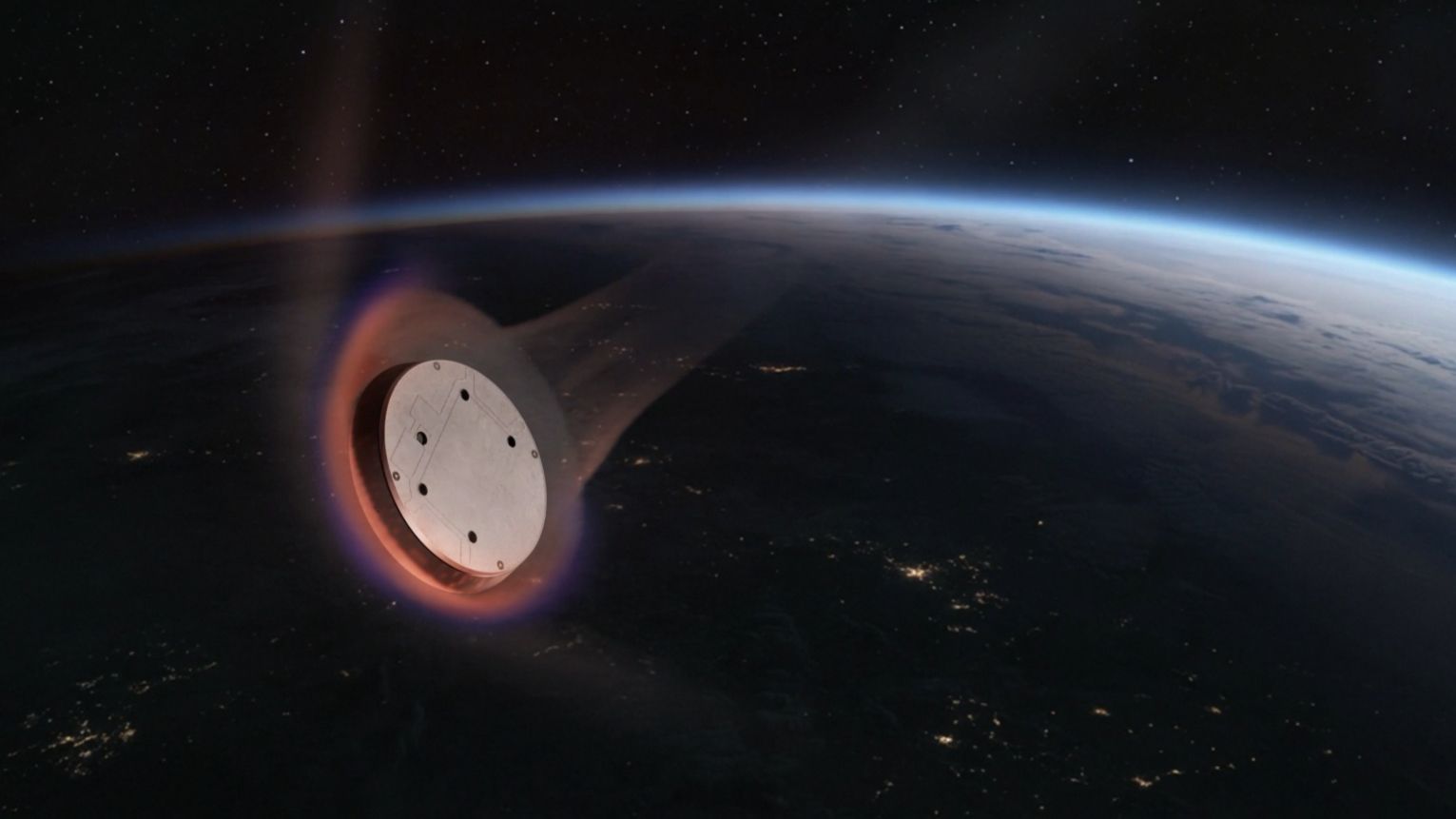
Artist's illustration of a SpaceX Starfall capsule reentering Earth's atmosphere. (Image credit: SpaceX)
Starfall wasn't the only return capsule that went up on Bandwagon-5. Among the other 31 payloads on the flight was W-Series 7, the latest orbital "mini-factory" built and operated by the California company Varda Space Industries.
The W-Series capsules are designed to both host the production of valuable goods such as pharmaceuticals and bring them safely down to Earth, Varda has said.
The other payloads on Bandwagon-5 are a mix of "cubesats and microsats," according to SpaceX's mission description. Among the latter is Pelican-12, a sharp-eyed Earth-observation satellite built by the San Francisco company Planet.
The 32 payloads were deployed over a two-hour span beginning about 57 minutes after launch. Starfall will be the last to separate, releasing from the Falcon 9's upper stage two hours and 48 minutes post-liftoff.
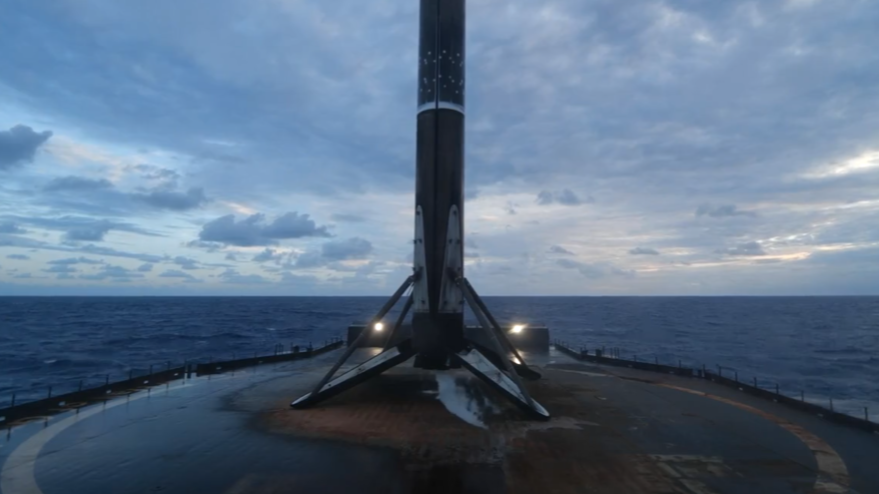
The Falcon 9's first stage, meanwhile, came back to Earth as planned on Bandwagon-5. It touched down about nine minutes after launch, coming down in the Atlantic Ocean atop the SpaceX drone ship "A Shortfall of Gravitas." It was the 19th mission for this particular booster, according to the company.
(Image credit: SpaceX)
Bandwagon is one of two SpaceX rideshare programs. The other, known as Transporter, has been busier, flying 18 missions to date.
Japan's groundbreaking mission to Mars is officially underway, headed to the Red Planet's mysterious moons Phobos and Deimos for a historic sample-return attempt.
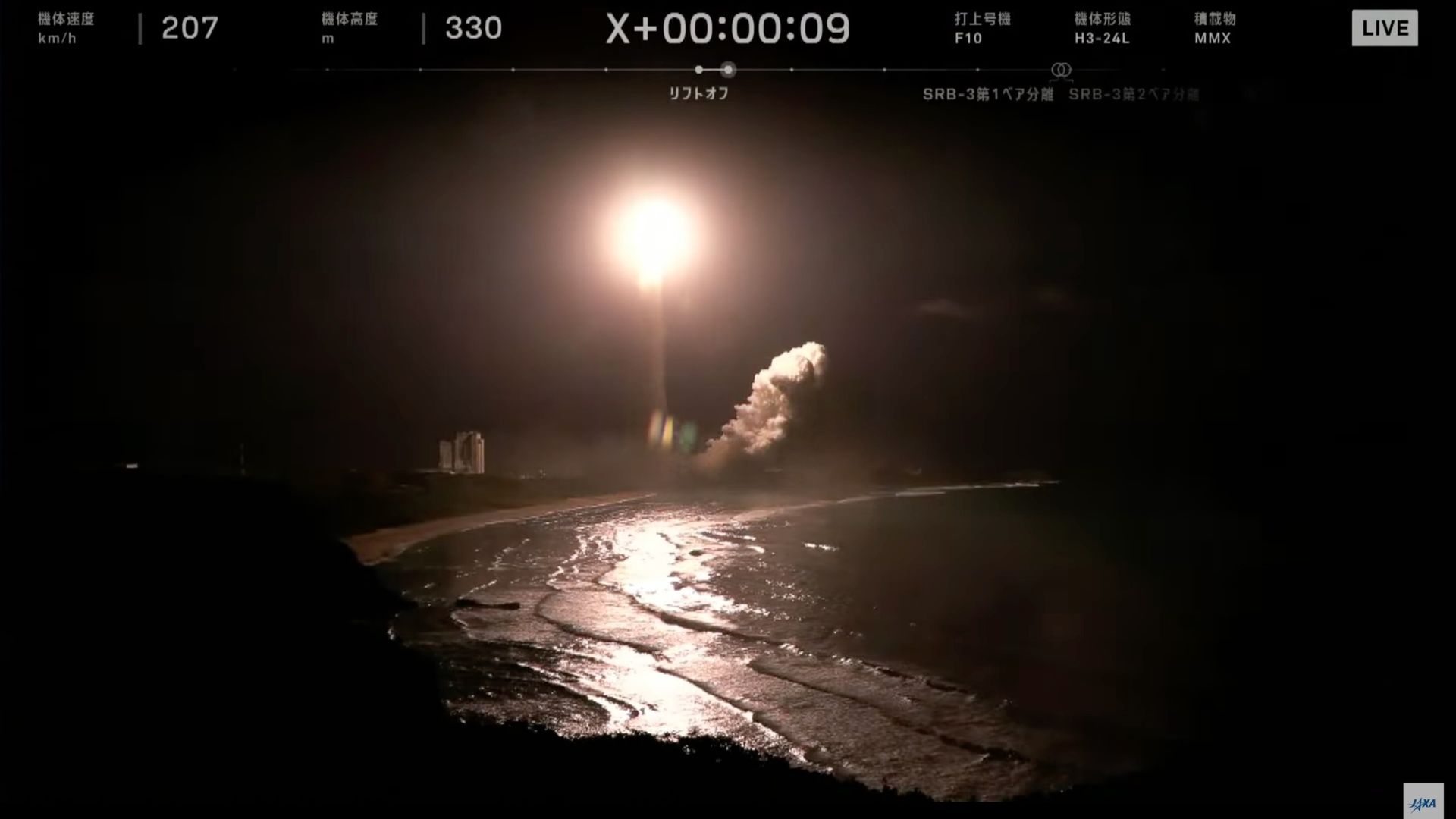
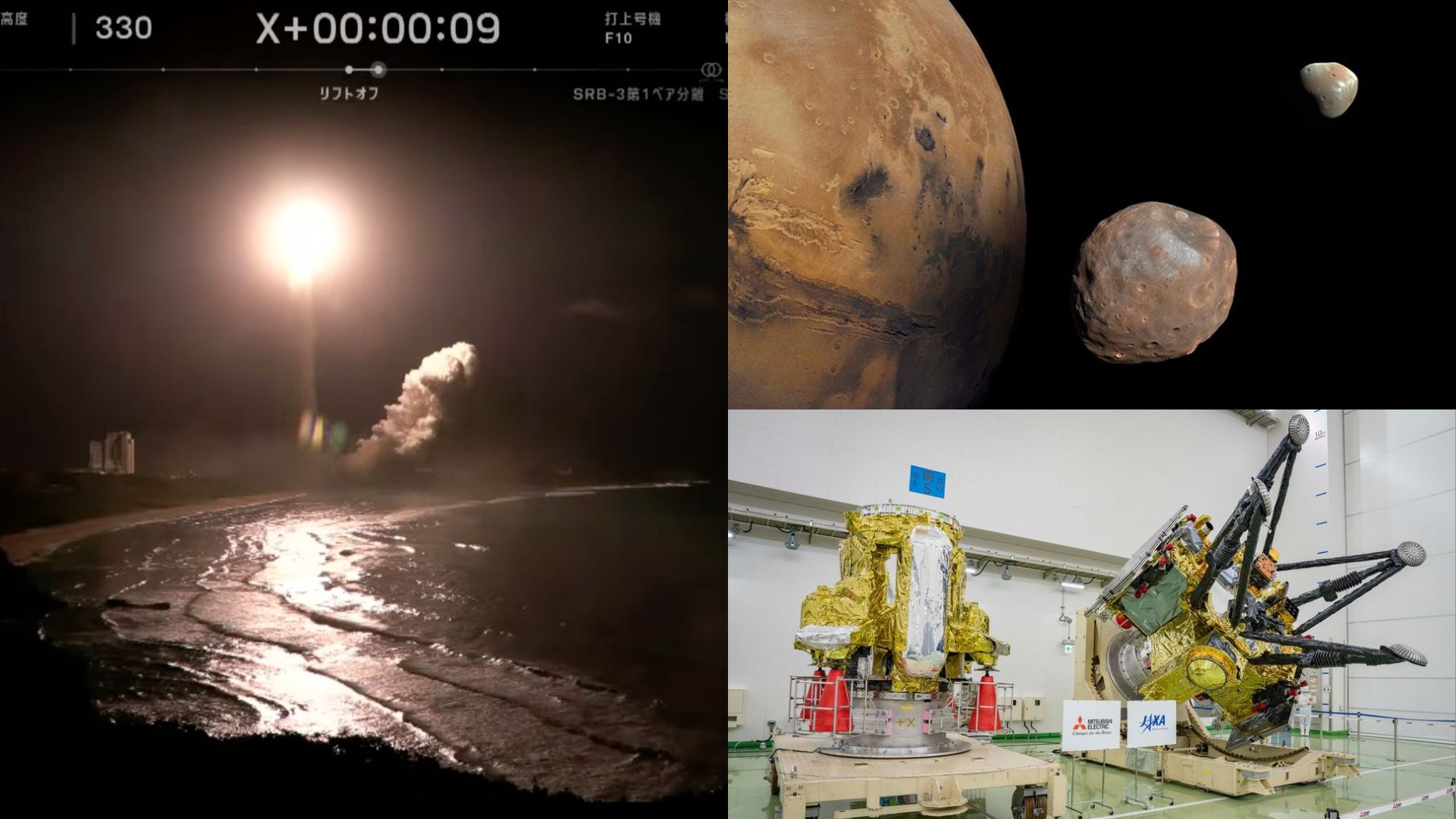
The Martian Moons eXploration (MMX) mission launched today (Oct. 19) from Tanegashima Space Center in Japan, riding an H3 rocket that lifted off from Pad-2 at Tanegashima's Yoshinobu Launch Complex at 3:41 p.m. EDT (1941 GMT; 4:41 a.m. local time in Japan on Oct. 20).
The JAXA (Japan Aerospace Exploration Agency)-led MMX mission is bound for Mars orbit, where it will study the planet's two moons, Phobos and Deimos. If everything goes according to plan, MMX will become the first spacecraft to land on and return samples from Phobos for study back on Earth, which scientists think could shed light on a decades-old mystery about the moons' origins and reveal clues about the formation of the early solar system.
a rocket launches into a night sky from a seaside pad (Image credit: JAXA)
It was the 10th liftoff of Japan's expendable, two-stage H3 rocket, which was jointly developed by JAXA and Mitsubishi Heavy Industries. After clearing its launch pad today, the 207-foot-tall (63 meters) launch vehicle flew a nominal trajectory through its ascent corridor over the Pacific Ocean, jettisoning its four solid boosters in pairs just before the flight clock reached two minutes. The rocket shed its payload fairings about one minute and 20 seconds later, exposing MMX to the vacuum of space for the first time.
H3's first stage, powered by two LE-9 rocket engines, channels a mixture of liquid hydrogen and liquid oxygen to produce a combined thrust of 331,000 pounds (1,471 kN), according to Mitsubishi Heavy Industries. As the mission clock approached T+5 minutes, H3 executed its main engine cutoff procedure and separated from the second stage, which ignited its engines for a 5.5-minute burn about 10 seconds later.
All continued to go to plan after that. The H3's upper stage ignited its engine for a second time for a trans-Mars injection burn about one hour and four minutes after liftoff, a maneuver that lasted roughly six minutes and 25 seconds and took MMX to a maximum velocity of about 24,145 mph (38,858 kph).
MMX was released from the rocket's upper stage right on schedule, about one minute after the completion of that burn and roughly 71 minutes after liftoff. The success elicited loud cheers in mission control, which viewers saw and heard on JAXA's launch webcast.
MMX is now under its own power, and on course for Mars. The interplanetary transit will last about 10 months, with the spacecraft scheduled to arrive at the Red Planet in August 2027. When it does, MMX's propulsion module will execute an orbital insertion burn to place itself in a quasi-satellite orbit (QSO) around Phobos, which places MMX within the space around the moon as both circle Mars.
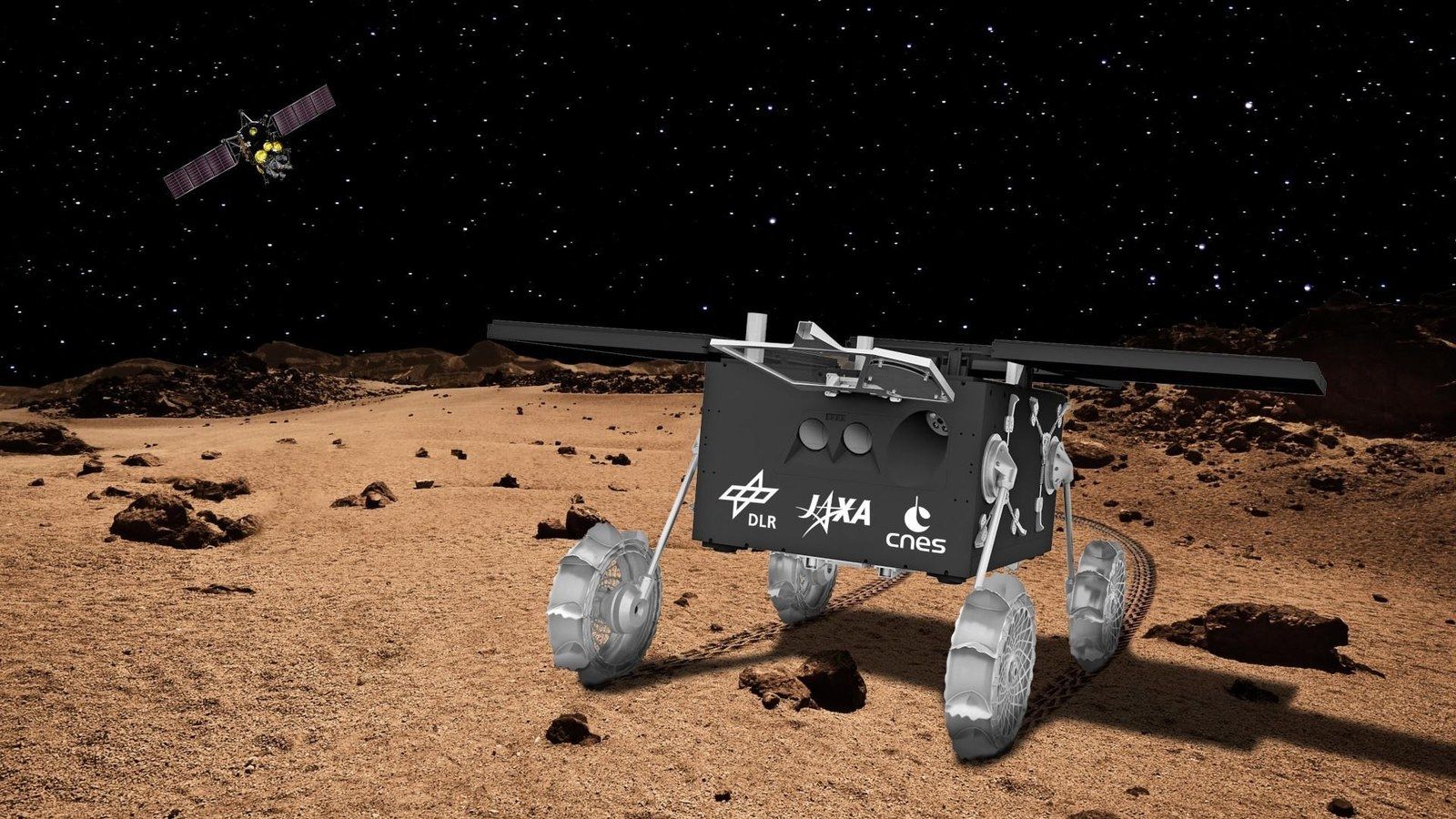
MMX will spend about three years in the Martian system, devoting much of that time to studying the 14-mile-wide (22 km) Phobos with its science instruments. The spacecraft also carries the IDEFIX rover, a joint effort of the space agencies of France and Germany, which is scheduled to deploy to the surface of Phobos in late 2028 or early 2029.
After a mapping campaign to select suitable landing sites, MMX will perform two separate touchdowns on Phobos to collect and stow samples in the spacecraft's return capsule. Following its second landing and sample collection, MMX will briefly return to QSO with Phobos before transferring to a more elongated orbit around Mars that intersects with the planet's smaller moon, Deimos, which is just 8 miles (14 km) in diameter.
During the last several months of its time around Mars, MMX will perform a series of Deimos flybys before departing for Earth in November 2030. If all goes according to plan, the MMX sample-return capsule will land in Australia in 2031.
Scientists are counting on those samples, and other data collected during MMX's time around Mars, to answer a decades-old question surrounding the Martian moons' origins. Competing theories and conflicting evidence point to two possibilities for how Mars got its moons.
Their near-circular, equatorial orbits suggest a narrative similar to how Earth's moon is thought to have formed — as a result of a massive planetary impact between Mars and some other giant space rock, which broke off pieces of the planet that eventually coalesced to form the natural satellites that orbit there today.
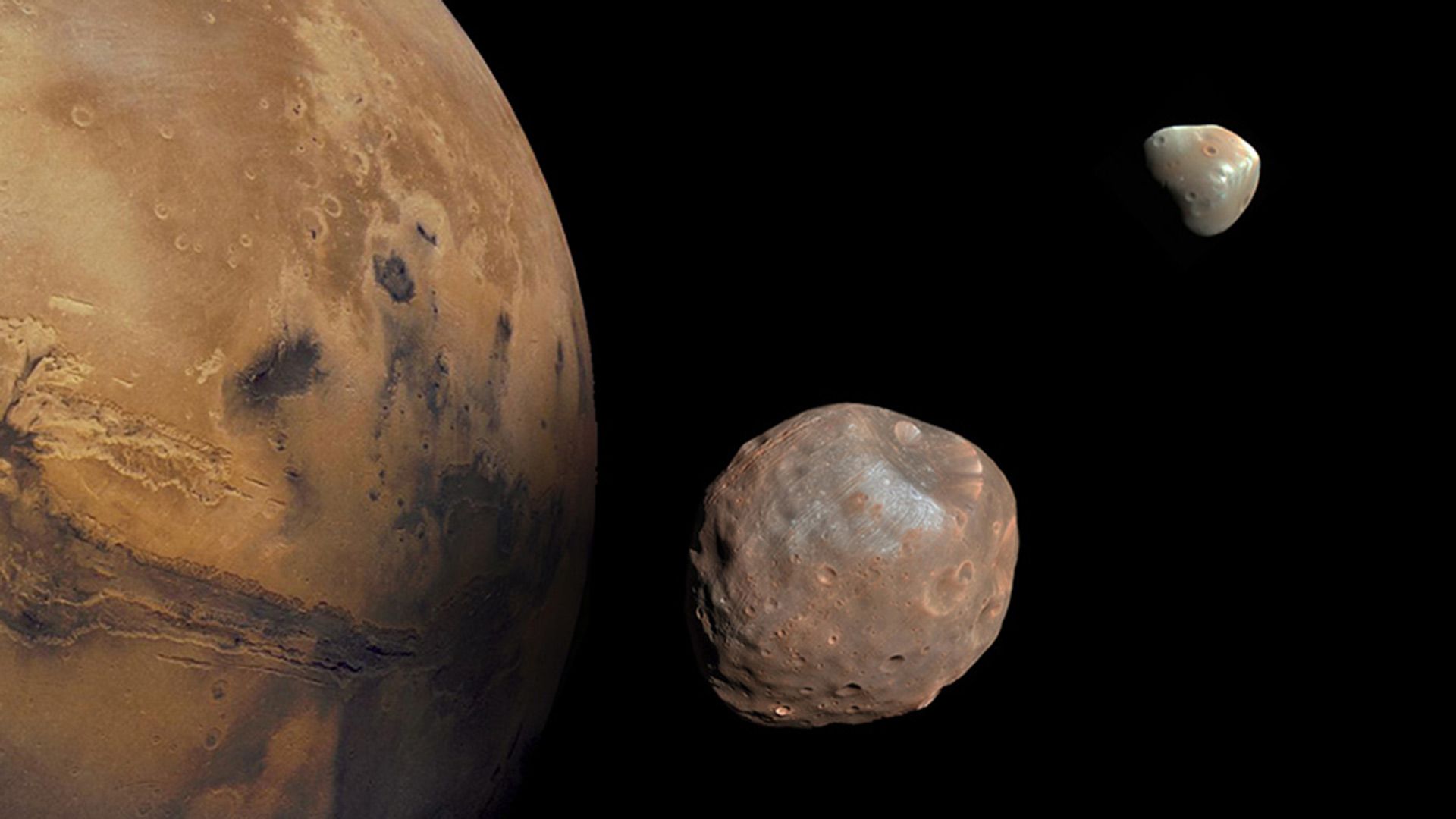
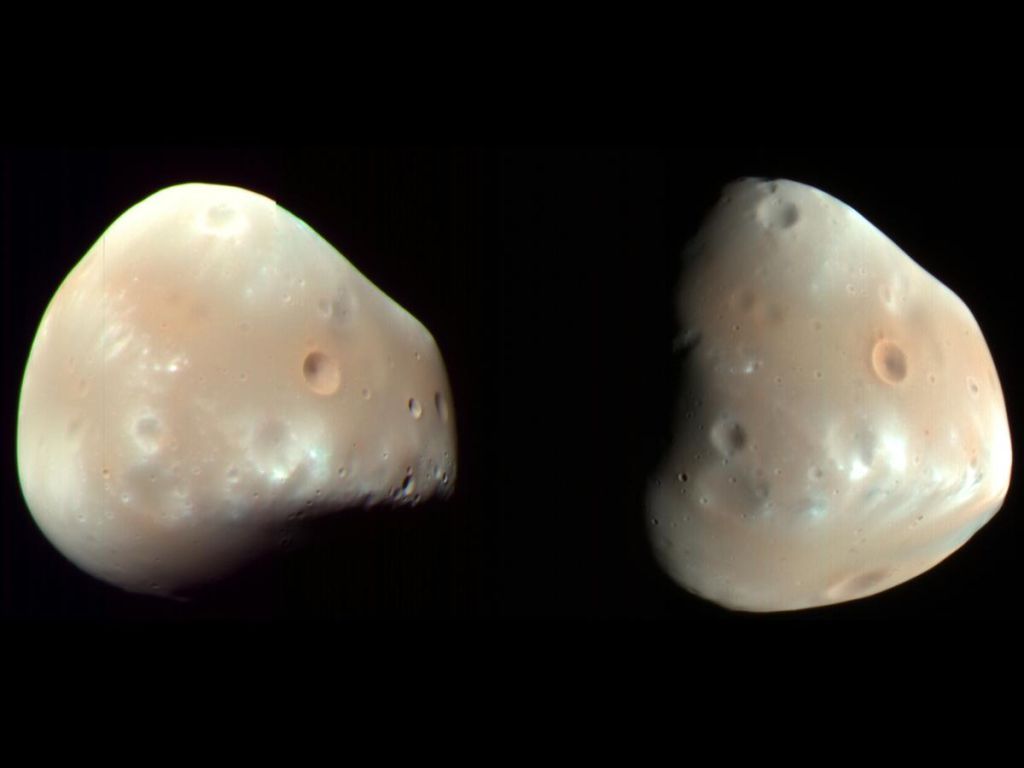
A composite image with Mars and its two moons, Phobos and Deimos. (Image credit: NASA/JPL/University of Arizona)
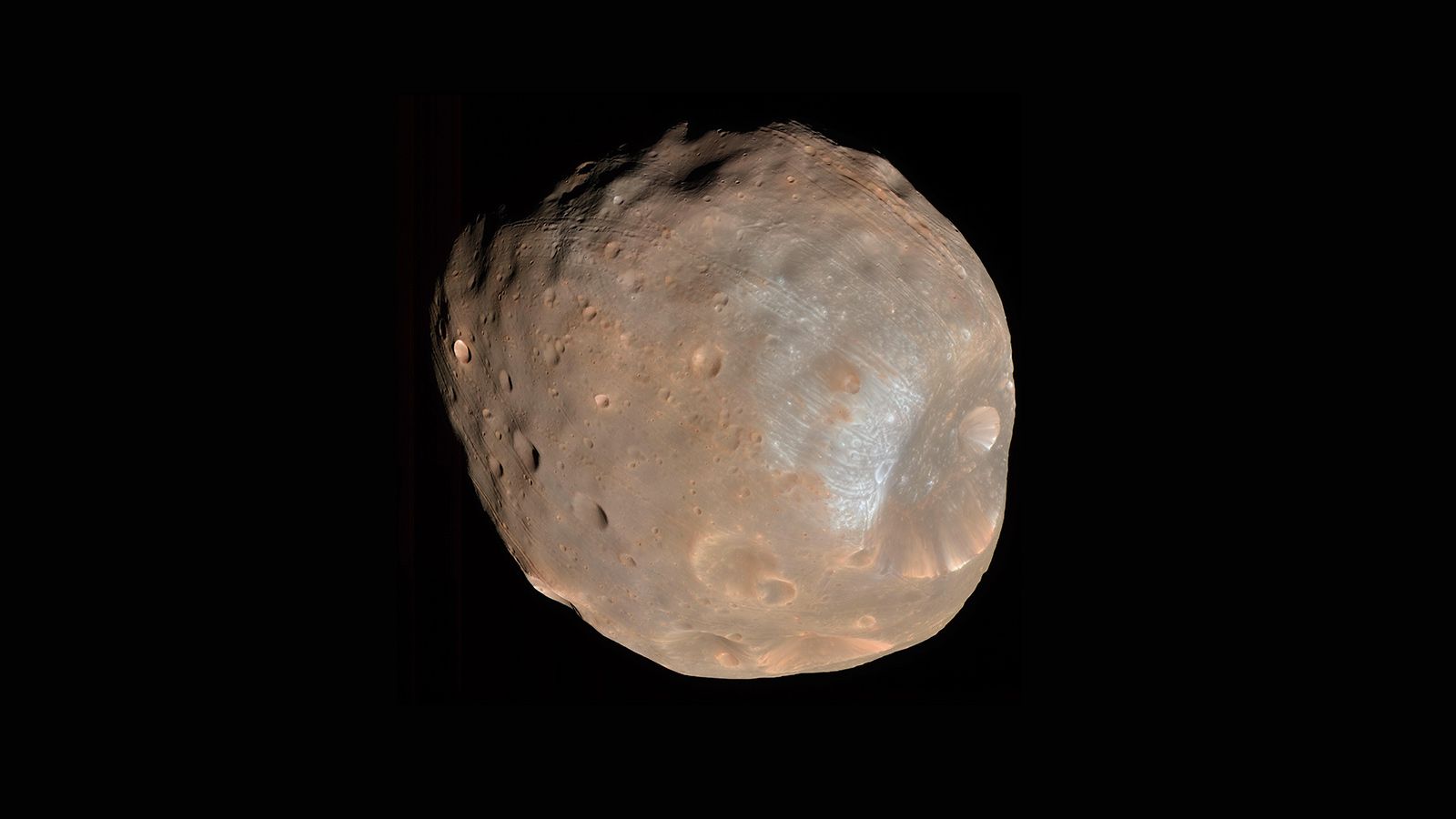
Neither Phobos nor Deimos is spherical, isntead; both are oblong and lumpy, like potatoes. That fact — along with their chemical composition, as far as we have been able to tell using telescopic spectroscopy — point to the possibility that Phobos and Deimos were asteroids from the early solar system that were captured by Mars' gravitational pull. Figuring out the moons' true origin story would provide key clues about Mars' geological past, the solar system's early history and the formation of the inner planets, mission team members have said.
Once the MMX samples are safely returned to Earth, scientists will study their composition and mineralogy, then compare such chemical fingerprints with those of Martian rocks and asteroid material. These analyses, combined with data collected by MMX during its mission, will help nail down the origin of Phobos — and by extension, Deimos. — by
While JAXA leads MMX, the mission is an international effort, with interagency partnerships between JAXA, NASA and the European Space Agency (ESA), as well as U.S. and European companies, which supplied a handful of the spacecraft's scientific hardware and communications equipment.
NASA's contributions to MMX include the Mars-moon Exploration with Gamma rays and Neutrons (MEGANE, pronounced "meh-gah-nay") device, which is a gamma-ray and neutron spectrometer built by the Johns Hopkins Applied Physics Laboratory (APL); a Honeybee Robotics-built pneumatic sampler; and communications support using the agency's Deep Space Network.
NASA has also invested approximately $87 million through the end of the mission, which includes funding for United States scientists and astromaterials experts on the MMX team. The agency is getting something concrete for such contributions: At least 15% of the planned 10-gram (0.35 ounces) returned Phobos sample will be reserved for NASA's study. Those materials will be transferred and maintained at the agency's Johnson Space Center in Houston for analysis and long-term preservation.
MMX is not the first Phobos sample-return project to take flight, by the way. That distinction goes to Russia's Phobos-Grunt ("Phobos-Soil") mission, which launched in November 2011 but failed to get out of Earth orbit due to a rocket glitch. The 14.5-ton spacecraft eventually crashed back to Earth over the Pacific Ocean in January 2012.
Editor's note: This story was updated at 5 p.m. ET on Oct. 19 with news of MMX's successful separation from the H3 rocket's upper stage.
On Oct. 19, 2016, the European Space Agency's ExoMars mission arrived at Mars!
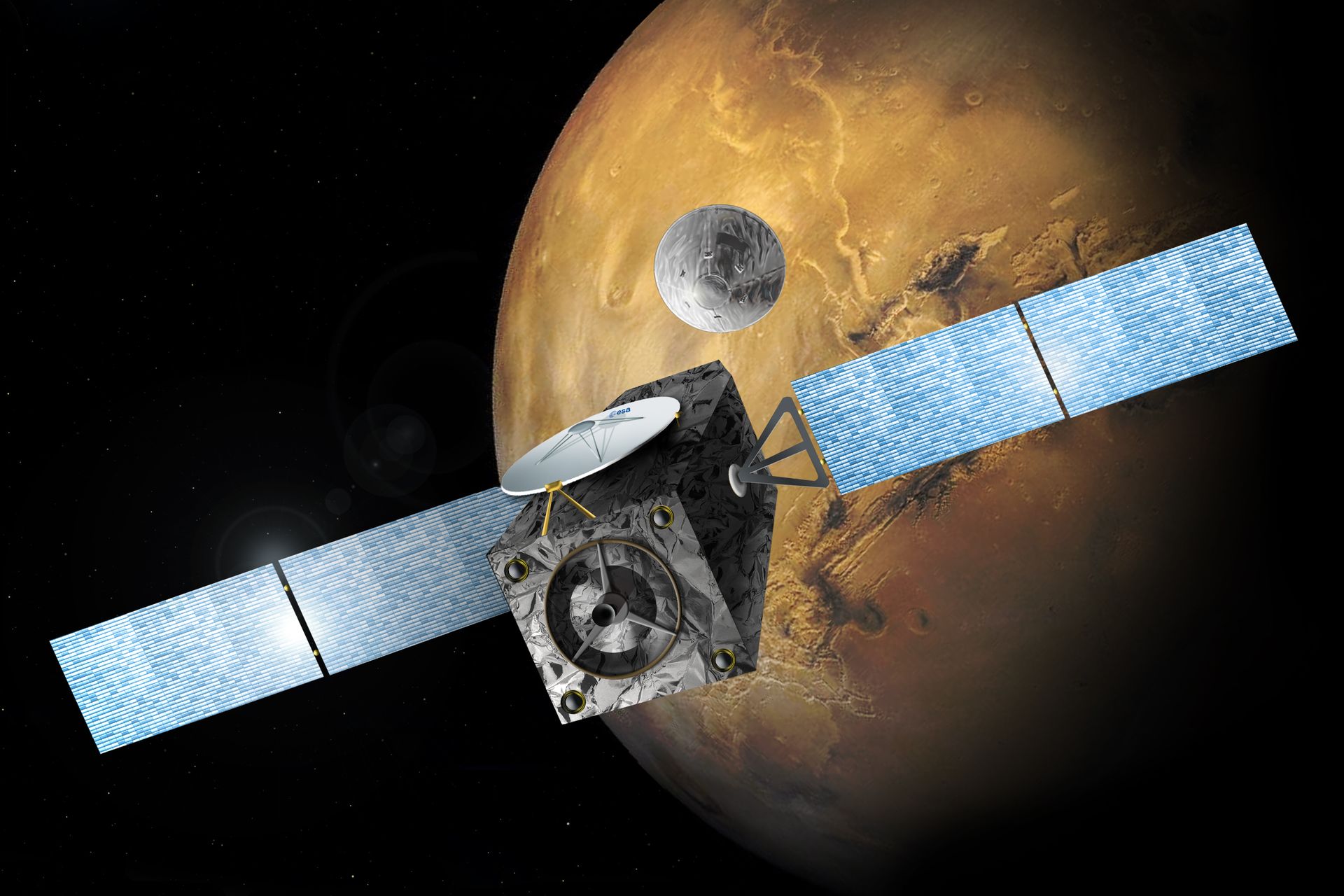
ExoMars 2016consists of the Trace Gas Orbiter and the Schiaparelli lander. The orbiter and lander traveled there together and separated on Oct. 16, three days before the orbiter entered orbit around Mars, and the lander touched down on the planet's surface. But something went wrong during the lander's descent, and it crashed into the ground.
Schiaparelli did not survive the accident, but the Trace Gas Orbiter is still functional. It is currently circling the planet, looking for methane and other gases in the Martian atmosphere that could be evidence for possible biological activity.
Artist’s illustration showing the separation of the ExoMars 2016 entry, descent and landing demonstrator module, named Schiaparelli, from the Trace Gas Orbiter, and heading for Mars. (Image credit: ESA)
Why it mattered
ExoMars 2016 was a landmark mission for the European Space Agency and designed to be the vanguard of a two-flight ExoMars program to send an orbiter, lander and rover to Mars.
Launched in March 2016, ExoMars 2016 aimed to achieve two goals for ESA and Russia. First, the mission aimed to use the Schiaparelli lander to test landing techniques that would be vital on a planned ExoMars 2018 rover. Second, the mission would deliver a critical orbiter around Mars to study the planet's atmosphere and serve as a communications link for that future Mars rover.
While Schiaparelli separated smoothly from the ExoMars Trace Gas Orbiter spacecraft, it stopped communicating with Earth just 1 minute before its planned landing on Oct. 19. Photos from NASA's Mars Reconnaissance Orbiter at Mars later revealed what appeared to be its crash site and, nearby, its jettisoned parachute. Officials suspect Schiaparelli did not fire its descent thrusters as designed in order to slow itself enough for a safe landing. A data glitch was cited as its cause.
The Trace Gas Orbiter, meanwhile, continues to study Mars to this day and has spent 10 years and counting studying the Martian atmosphere.
The launch of ExoMars 2018, which includes the Mars rover Rosalind Franklin, was delayed by the Schiaparelli failure, as well as the loss of its Russian Proton rocket when ESA severed its partnership with Russia over that country's war on Ukraine.
The ExoMars rover is now expected to launch no earlier than 2028, with a landing on Mars expected in 2030.
In 2026, another country took aim at Mars on this day.
Planetary researchers at the University of Sydney have proposed a new way to classify the soils of Mars, along with a new word for them: areth (the name comes from Ares, the Greek name for Mars).
Japan's mission to Mars is one of the most ambitious in spaceflight history. It aims to become the first spacecraft to return to Earth from Mars orbit, carrying with it the first-ever samples from the Red Planet system.
The mission, known as Martian Moons eXploration (MMX), is a first-of-its-kind endeavor to study the origin of Mars' moons Phobos and Deimos. The robust undertaking includes a landing on Phobos to collect the samples — which will likely be the first from the Mars system to return to Earth — and a search for evidence that could shed light on events during the formation of the solar system billions of years ago.
MMX launched on an H3 rocket from Japan's Tanegashima Space Center on Monday (Oct. 19) at 3:41 p.m. EDT (1941 GMT; 4:41 a.m. local time in Japan, Oct. 20). After a 10-month journey to reach Mars, the spacecraft will spend about three years studying Phobos, deploying a rover and landing to collect its samples. The mission will then shift its focus to Deimos for a series of flybys before departing for Earth in November 2030. If all goes according to plan, the MMX sample-return capsule is scheduled to land in Australia in 2031.
The spacecraft
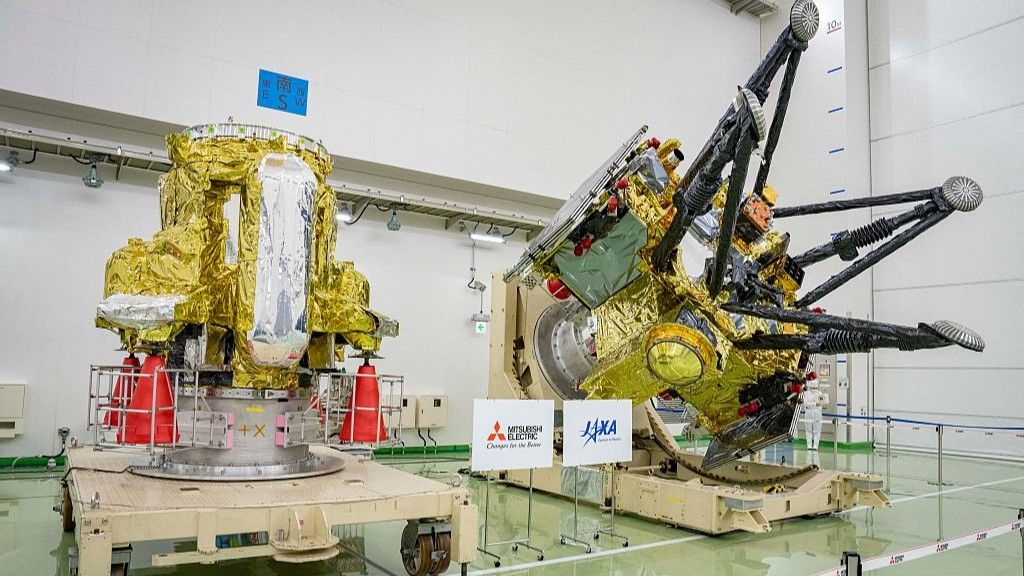
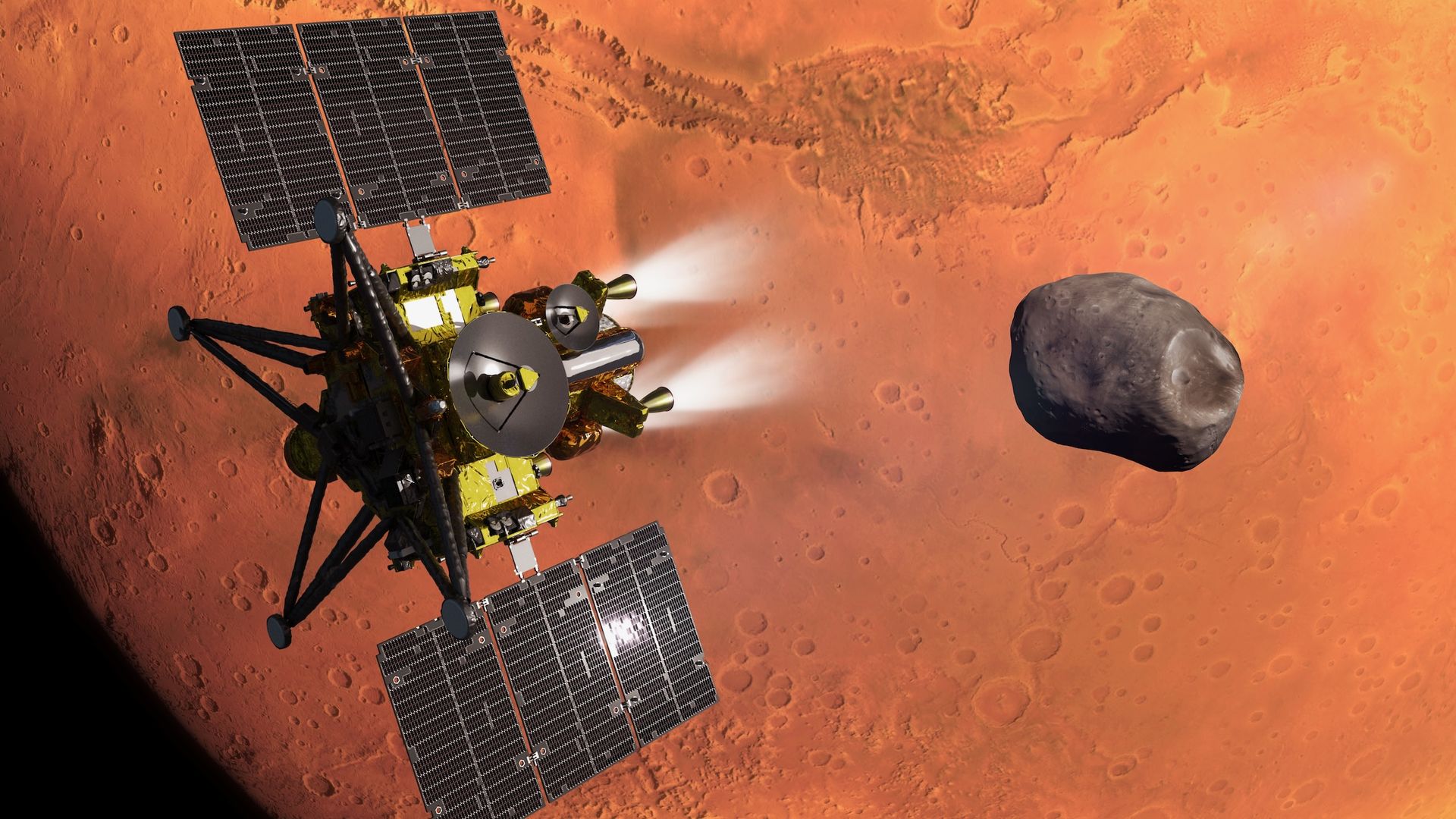
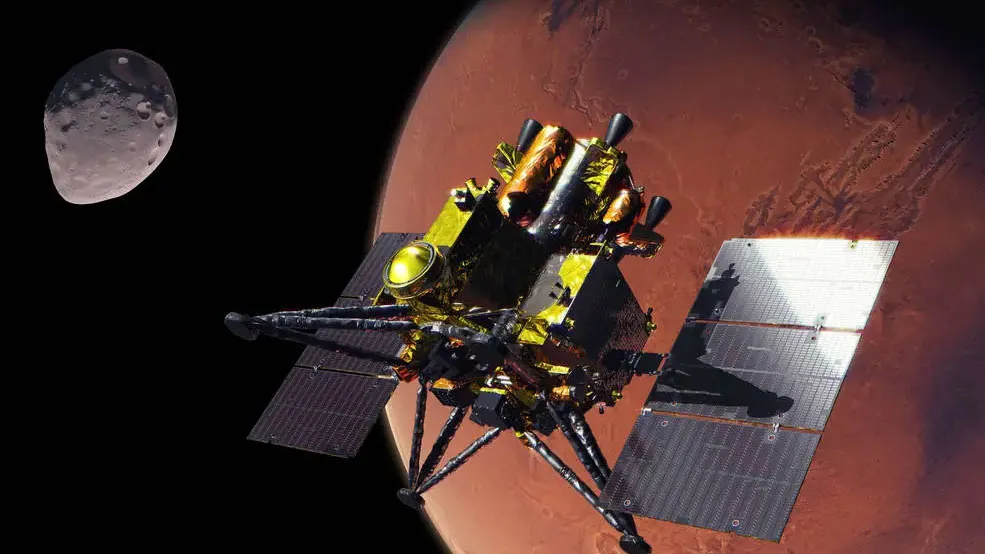
The MMX spacecraft is comprised of three main parts, as well as a small rover. After release from its H3 launch vehicle, a propulsion module will provide the boost to put MMX on course for Mars. MMX's main exploration module carries the microwave-size IDEFIX rover and most of the mission's scientific instruments, while the return module houses the sample-return capsule.
Japan's Mitsubishi Electric built MMX's three main modules, with the French space agency CNES (Centre National d'Études Spatiales) and Germany's DLR (Deutsches Zentrum für Luft-und Raumfahrt) jointly developing IDEFIX. The little rover is named for a dog in the 1960s French comic "Asterix," in a nod to the country's first satellite, Astérix, which launched in 1965.
IDEFIX carries a suite of cameras, as well as the Raman Spectrometer for MMX (RAX) and miniaturized radiometer (miniRAD) instruments to analyze Phobos' surface composition and temperature.
The Propulsion Module (left) and Exploration and Return Modules (right), which together make up Japan’s Martian Moons eXploration (MMX) spacecraft, are seen at the Tanegashima Space Center in Minamitane, Kagoshima prefecture on Aug. 13, 2026. (Image credit: Yuichi YAMAZAKI / AFP via Getty Images))
Most of MMX's scientific instruments are housed on the exploration module, like NASA's Mars-moon Exploration with Gamma rays and Neutrons (MEGANE, pronounced "meh-gah-nay") device, a gamma-ray and neutron spectrometer built by the Johns Hopkins Applied Physics Laboratory (APL), and France's MIRS (MMX InfraRed Spectrometer) instrument.
The exploration module also houses the Japanese-built TENGOO (TElescopic Nadir imager for GeOmOrphology) tight-zoom camera, wide-angle OROCHI (Optical RadiOmeter composed of CHromatic Imagers) multispectral camera, laser altimeter (LIDAR) and Mass Spectrum Analyzer (MSA). The return module, meanwhile, carries Japan's Circum-Martian Dust Monitor (CMDM) and Interplanetary Radiation Environment Monitor (IREM).
The mission
MMX will arrive in orbit around Mars in August 2027, at which point it will shed its propulsion module and transition into a quasi-satellite orbit (QSO) around Phobos that allows the probe to fly in a sort of formation with the small, asteroid-sized moon as they both circle the Red Planet.
The spacecraft will spend its first few months in the Martian system observing Phobos from different altitudes, using its TENGOO and OROCHI cameras, LIDAR and MSA to map the moon's surface, study its composition and select potential landing sites.
IDEFIX will be released in late 2028 or early 2029, during the first of two MMX landing rehearsals, at about 130 feet (40 meters) above Phobos. Due to the 14-mile-wide (22 kilometers) moon's extremely low gravity, the rover will be able free-fall to the surface damage-free (hopefully), right itself after a few bounces and begin exploring to gather data on the terrain and surface conditions.
MMX sample collection could begin as early as December 2028, the acting director of NASA's Planetary Science Division, Lindsay Hays, said during a mission briefing on Oct. 15. The spacecraft will attempt two collection landings, with its exploration and return modules descending and returning to orbit as one vehicle.
On Phobos' surface, two different sampling mechanisms — the Corer Sampling Mechanism (C-sampler) and Pneumatic Sampling Mechanism (P-sampler) — will extract and collect at least 10 grams (0.35 ounces) of material for stowage inside the spacecraft's return capsule before MMX lifts off again for orbit. After its first touchdown and sample collection, MMX will return to QSO near Phobos before descending to a second landing site for a similar attempt and subsequent return to orbit.
An artist’s concept of JAXA’s MMX spacecraft during its Mars’ orbit insertion. (Image credit: JAXA)
MMX will end its observations of Phobos after about three years focused on the Martian moon, and will transition into a higher, resonant orbit around Mars in 2030. That course will repeatedly intersect Deimos' path for a series of flybys to collect and compare data with those from Phobos observations as scientists aim to investigate the moons' origins.
Near the end of 2030, the exploration module will separate, leaving the return module to fire its engine out of Mars' gravitational influence and begin an eight-month journey back to Earth with the collected samples. As MMX closes the last stretch of void during its approach to Earth in 2031, the sample-return capsule will separate and enter the atmosphere for a targeted parachute landing in Australia's Woomera region, where its contents will be recovered for laboratory analysis by Japan and its mission partners.
Phobos and Deimos
Those samples, and the data collected by MMX, could tell scientists a lot — about the moons' composition, geography and, perhaps most importantly, how they came to exist in the first place. There are two leading theories for Phobos and Deimos' origins, both of which point to very different versions of ancient Martian history.
"Phobos and Deimos are interesting, but not just in their own right. Their presence is a key piece of the larger story of the Mars system," said Tom Statler, MMX program executive and scientist in NASA's Planetary Science Division, during the Oct. 15 mission briefing. "By uncovering the moons' origin, we'll gain new insights into the history of both Mars and Earth, especially those events that shaped both planets billions of years ago and helped create the worlds we see today."
Both Phobos and Deimos are relatively small and irregularly shaped, and bear several resemblances and spectral characteristics to primitive D-type asteroids — ancient bodies thought to preserve material dating back to the solar system's formation about 4.6 billion years ago. Those similarities suggest Phobos and Deimos may have formed elsewhere in the solar system and were later captured by Mars' gravity.
Phobos is the larger of Mars' two small moons and bears the scars of millennia of small impacts. (Image credit: NASA/JPL-Caltech/University of Arizona)
Their near-circular, equatorially-aligned orbits around the Red Planet, however, somewhat complicate that theory. For example, a captured asteroid would be much more likely to have entered an elongated and tilted orbit akin to the direction and velocity of its original approach, scientists say. A competing hypothesis, therefore, offers a much more violent, but somewhat familiar, narrative for the moons' origins.
An enormous collision with ancient Mars could have blasted material into orbit to form a debris disk from which the two moons eventually coalesced. Such a process, which would be similar to the formation of Earth's moon, could explain their circular, equatorial orbits.
The contradicting geological and orbital observations for Phobos and Deimos collected to date have prevented scientists from definitively establishing one hypothesis over the other. MMX aims to provide an answer.
Images captured by NASA's Mars Reconnaissance Orbiter reveal that the surface of Deimos is mostly smooth, marred only by recent impact craters. (Image credit: NASA/JPL/University of Arizona)
"It's two totally different lines of evidence that point in two different directions. That's what makes it an interesting puzzle," Statler said. Several theories have also been presented for hybrid scenarios combining the two, he added.
"There's all kinds of different ways, all kinds of different combinations of those two basic scenarios," Statler explained. "But that's the puzzle from the start, the two seemingly contradictory lines of evidence that are pointing us to what … the real history was, but we don't know what it is yet."
The science
Each theory for where Mars' moons came from predicts different chemical characteristics for their surfaces. Presumably, captured asteroids would preserve chemical signatures of material originating elsewhere in the solar system, potentially rich in volatile elements like hydrogen. Moons formed through a planetary impact, however, would contain a mixture of Mars and impact material, altered by the intense heat of such a violent collision.
Determining which scenario is more likely could reveal whether Mars experienced a massive moon-forming collision or acquired its moons from elsewhere in the early solar system. Either answer could offer new insights into the planet's evolution and the events that shaped the terrestrial planets like Earth billions of years ago, mission team members say.
"At this point, we know nothing about the composition of Phobos," David Lawrence, MEGANE principal investigator at APL, said during the Oct. 15 briefing. "We have information about mineralogy, but no elemental composition. And so, elements are really a key way to get at some of these foundational questions."
MMX's scientific suite has been carefully calibrated to make those determinations. The cameras and sensors on the MMX exploration module's TENGOO, OROCHI and LIDARinstruments will map Phobos' terrain, geological features and variations in surface materials from orbit, to provide clues about the moon's formation and evolution. Complementing those measurements, MIRSis designed to detect and classify Phobos' surface minerals and search for organic compounds to further differentiate its possible origin as an asteroid or ancient chunk of Mars.
The RAXspectrometer and miniRADinstrument aboard IDEFIX will add localized context to those observations by examining surface mineralogy and their thermal properties up close.
Back in orbit, NASA's MEGANEinstrument will measure Phobos' elemental composition through gamma-ray and neutron spectroscopy that can scan tens of centimeters beneath the moon's surface for signs of volatile elements. Higher abundances of hydrogen, chlorine, sodium and potassium, for instance, would favor the asteroid-capture hypothesis, while lower abundances of those compounds could point to the heat and chemical deterioration associated with a planetary impact.
"In Japanese, 'megane' means eyeglasses," Lawrence said. "So we like to think of MEGANE as being an instrument that will look at Phobos with gamma ray and neutron glasses."
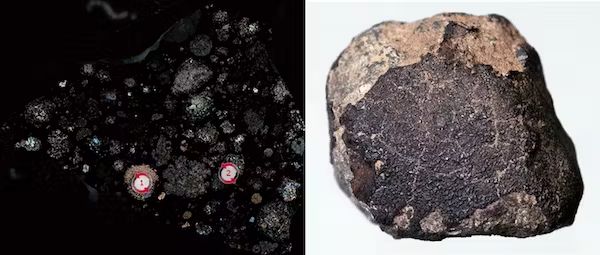
A martian meteorite under the microscope and hand specimen. (Image credit: Open University, CC BY-NC-SA)
When compared to the samples MMX will return to Earth, MEGANE's findings could help scientists determine if volatile depletion found on Phobos reflects the intense heat of a post-impact formation or billions of years of subsequent erosion from the natural effects of space exposure.
MSA, meanwhile, will measure charged particles around Phobos, searching for evidence of subsurface ice and investigating how solar wind exposure has altered the moon's surface. It will also study atmospheric particles escaping from Mars. CMDMwill measure dust around Mars, including particles potentially ejected from its moons by impacts.
Comparative observations of Deimos after MMX's final departure from Phobos will help establish whether the moons share similar compositions and, potentially, a common origin.
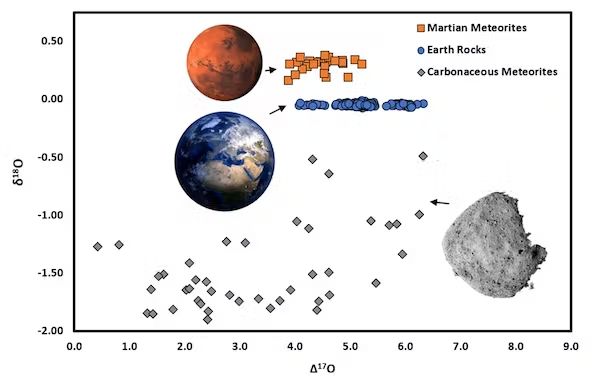
Once safely returned to Earth, laboratory analysis of the Phobos samples will allow scientists to examine chemical composition and mineralogy with a precision beyond that of MMX's onboard instruments. Tests like isotopic analyses — measuring subtle differences in the atomic makeup of elements — can help identify the samples' origins by comparing their chemical fingerprints with those of Martian rocks and asteroid material.
JAXA (Japan Aerospace Exploration Agency) scientists think some returned material could even originate from Mars itself, deposited on Phobos after ancient asteroid impacts blasted rocks off the Red Planet's surface, potentially holding evidence of its geological past.
Oxygen isotope plot showing the stark differences in oxygen between the Earth, Mars and asteroids. If Phobos does indeed represent an ancient fragment of Mars, it could comprise the most primitive of Martian material. (Image credit: Open University, CC BY-NC-SA)
International effort
The JAXA-led mission represents interagency partnerships with NASA and the European Space Agency (ESA), which are providing hardware and communications support through the Deep Space and Estrack networks.
NASA's contributions to MMX also include MEGANE, the Honeybee Robotics-built P-sampler, and an approximately $87 million investment through the end of the mission. NASA is funding the United States scientists on the MMX team, who will, alongside NASA's astromaterials experts, "be fully involved in the examination and scientific analysis of the Phobos samples when they are delivered to Earth," Hays said during the mission briefing. "We get all of the value and all of the scientific participation at a lower cost total [than funding the entire mission]."
For its role, NASA will receive at least 15% of the returned samples, with materials to be maintained at the agency's Johnson Space Center in Houston for analysis and long-term preservation. To that end, MMX's scientific impact could extend far beyond the mission's conclusion.
"The Phobos samples will be historic," Statler said, with the potential "for future research to answer the questions we don't even know yet how to ask."
Dean Robbins is a journalist and children's author. He contributed this article to Space.com's Expert Voices: Op-Ed & Insights.
The pioneering computer scientist Margaret Hamilton, who died on Sept. 30 at age 90, played a key role in putting astronauts on the moon. She was a problem-solver extraordinaire, and it all started in early childhood.
Considering the name "daddy longlegs" unfair to female arachnids, young Margaret decided to call half of them "mommy longlegs." Wondering why the neighborhood baseball players were all boys, she determined to join the team herself.
As she grew up in the 1940s and '50s, Margaret noticed a similar problem with various professions. Why were doctors, judges and scientists almost always men? The solution: she would study hard in school and prepare herself for any job she might care to do.
It's no surprise that a born problem-solver would gravitate to computers. In the late 1950s, the new technology offered mind-bending possibilities, and this college math major saw a chance to put her skills to use on a cosmic scale.
Hamilton had long been a stargazer, thanks to a philosophical father who taught her to love the night sky. In 1965, after stints in meteorology and satellite tracking, she became interested in a Massachusetts Institute of Technology project that designed in-flight computers for NASA's moon mission.
The team, of course, consisted solely of men. But, just as with her neighborhood baseball team, Hamilton refused to accept limitations for herself or anybody else. She kicked open the door and quickly rose to director of software engineering.
With her knack for devising novel solutions to seemingly insoluble problems, no one was better suited for the job. Working with the era's primitive technology, Margaret thought through the various mishaps that could occur on a spaceflight and designed the software to handle every contingency.
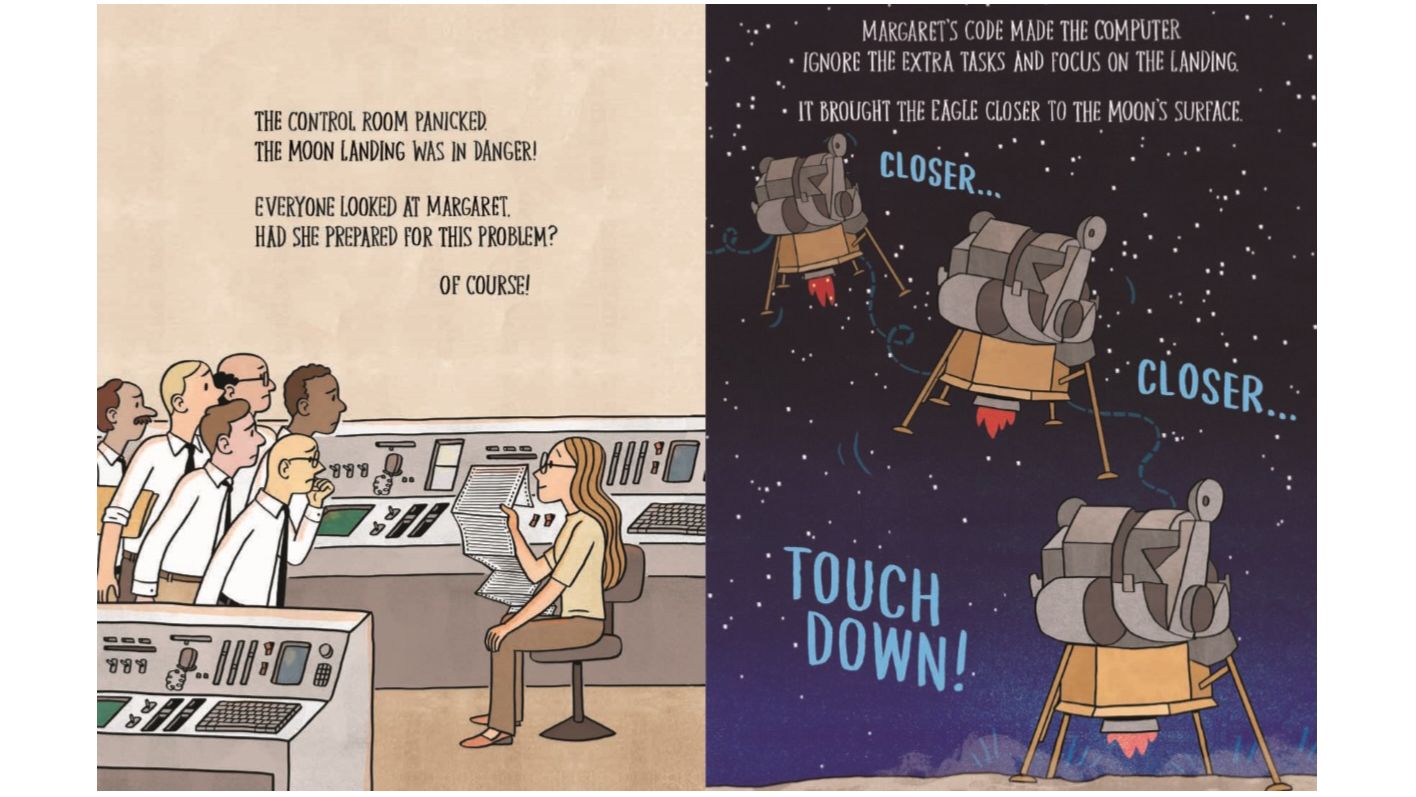
The epochal Apollo 11 moon mission of 1969 put her planning to the test. As astronauts Neil Armstrong and Buzz Aldrin neared the moon's surface in their lunar module, an error overloaded the onboard computer's processing unit. Mission Control faced the prospect of aborting the landing, but Margaret's ingenious programming allowed the system to prioritize essential tasks while canceling the inessential ones. The lunar module touched down without a hitch, and Armstrong and Aldrin became famous.
Sadly, Margaret Hamilton did not. She continued to work behind the scenes, contributing to the five additional lunar landings as well as Skylab and the space shuttle. In 1976, she struck off on her own to start a software company. She might have lived the rest of her life in obscurity if not for a fateful black-and-white photograph from 1969.
This image began to attract attention on the internet in the 2010s. It showed Margaret wedged between a coatrack and a blackboard at MIT, standing beside a towering stack of her printed code from the Apollo missions. Bespectacled and smiling, she radiates the confidence of a scientist who had stormed the boys' club and conquered the universe.
I was one of those fascinated by the photograph, and I contacted Margaret about the possibility of profiling her in a children's book. She initially resisted, uncomfortable with being the center of attention. But she came to see the appeal of a book about herself that she could read to her great-grandchildren, so that they might be inspired to break barriers themselves one day. She warmed to the task of telling her life story and even sent me examples of her Apollo code, which Lucy Knisley incorporated in the illustrations for "Margaret and the Moon: How Margaret Hamilton Saved the First Lunar Landing."
With the 2016 book and movie "Hidden Figures" calling attention to women's overlooked contributions to the space program, Hamilton soon had to get used to being the center of attention. She received a Presidential Medal of Freedom and achieved LEGO immortality in the "Women of NASA" set. In 2019, to mark the 50th anniversary of the first moon landing, Google used reflected moonlight to create a massive portrait of Margaret in the Mojave Desert. Rarely has so humble a soul received so grand a tribute.
The world will miss Margaret Hamilton, but, just like her great-grandchildren, we will always have her example to inspire us. She showed that, no matter how daunting the obstacles, there are few problems we can't solve.
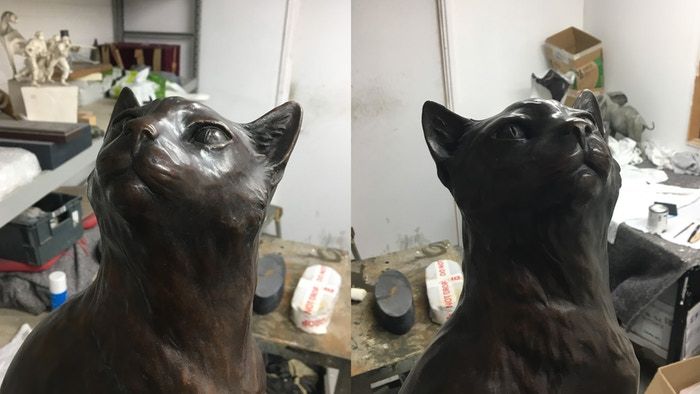
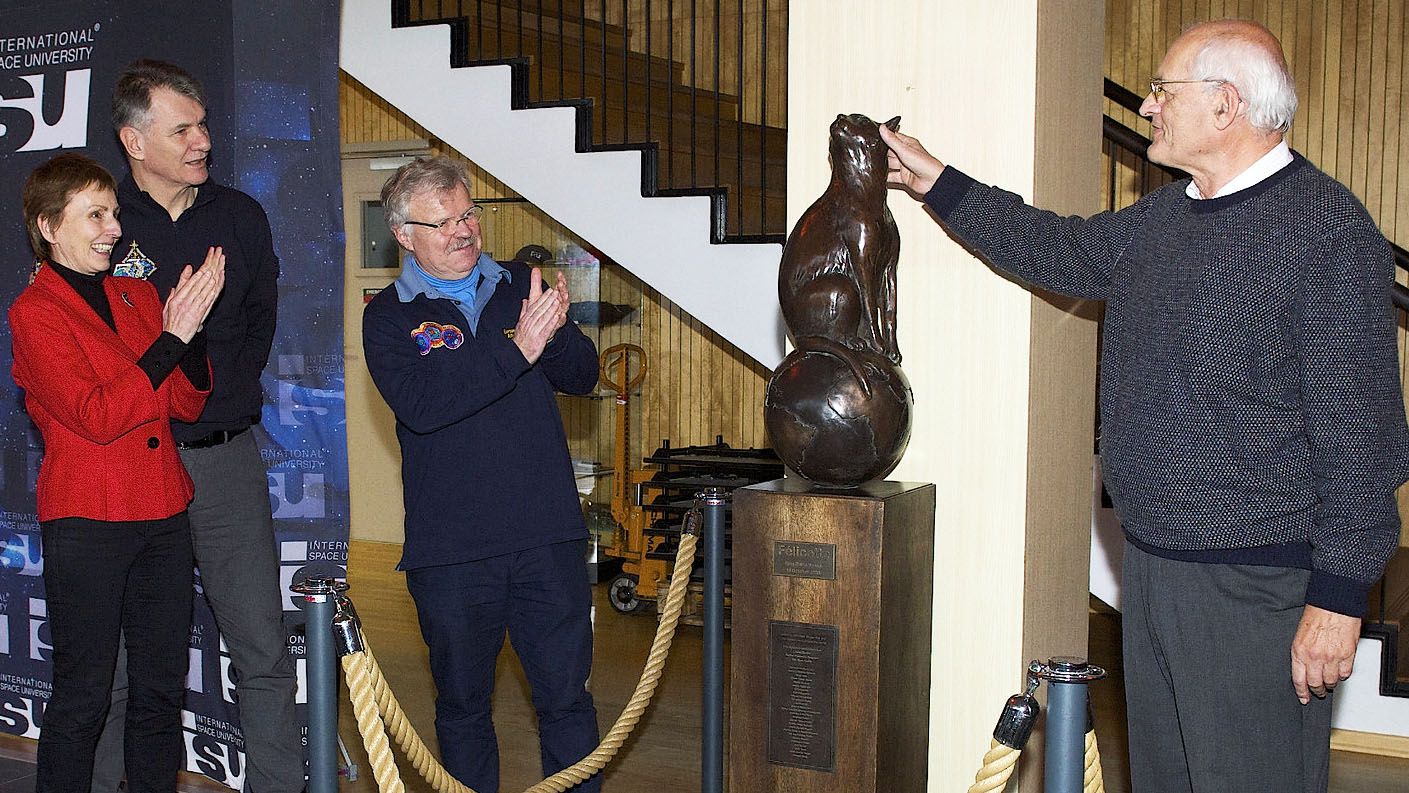
On Oct. 18, 1963, a cat went to space! Félicette was a French "catstronaut" who became the first and only feline to fly to space.
While the U.S. and Soviet Union were busy launching primates, dogs and humans, the French decided to join the space race by launching a cat. Félicette, a stray tuxedo cat from the streets of Paris, was a substitute for another cat named Felix, who somehow escaped on launch day.
So Félicette went where no cat had ever gone before. She boarded a French Véronique AG1 rocket and soared 130 miles above the Earth before safely parachuting back down.
Luckily Félicette made it home alive and well, unlike many of the other animal astronauts that flew during the space race.
Félicette, the first cat to fly into space in October 1963, is seen her carrier pre-flight. (Image credit: Wikimedia Commons )
Why it mattered
Félicette survived spaceflight, but was short of this world. She was euthanized two months after her recovery so scientists could study her brain.
A second cat was launched by the French on Oct. 24, but its flight did not go so well, veering off course. When the cat was found a day later, it was discovered it have died as a result of the journey. From there on, CERMA (Centre d'Enseignement et de Recherches de Médecine Aéronautique) changed its research to flying monkeys.
Félicette may have become a footnote to history had it not been for a crowdfunded effort to raise a statue in her memory nearly 60 years later. The sculpture was unveiled in 2019 at the International Space University in Strasbourg, France. European astronauts Helen Sharman, Paolo Nespoli and Reinhold Ewald were on hand for its reveal.
Félicette, the first cat in space (seen here at right), immortalized as a bronze sculpture at the International Space University in Strasbourg. On the left here is one of the first photos of the artwork while in progress, and at the center is a small scale model.Gill Parker/Kickstarter/CNESA closer view of Félicette's face in bronze.Courtesy of Matthew Serge GuyThe unveiling of the Félicette statue honoring the first cat in space.Courtesy of ISU/Photo Expression
In addition to the memorial statue, Félicette has been memorialized on postage stamps issued by Chad and Comoros, both former French colonies.
TENERIFE, CANARY ISLANDS — The Artemis II astronauts may have traveled hundreds of thousands of miles away from Earth to the moon, but they made sure the rest of us didn't miss out on the adventure.
Now, their efforts to bring the wonders of space exploration back down to Earth have earned them one of science communication's most prestigious honors: the Stephen Hawking Medal.
NASA astronauts Reid Wiseman and Victor Glover, alongside Canadian Space Agency astronaut Jeremy Hansen, accepted the award on Saturday (Oct. 17), during the opening ceremony of the Starmus VIII festival. The honor recognizes all four crew members, including NASA astronaut Christina Koch, who wasn't in attendance.
For Wiseman, the experience of seeing our home planet from the vicinity of the moon carried a powerful message.
"If we could take each of you 250,000 miles away from this planet, 400,000 kilometers away from planet Earth, and you would see Earth the size of your thumb. It's tiny," Wiseman told the audience.
"When you're there looking through the moon, back at this tiny Earth, the only thing you feel is love, peace, hope, unity", he continued. "Those aren't the right words, but that is all you feel."
Reid Wiseman delivered a powerful message during the awards ceremony. (Image credit: Daisy Dobrijevic/Future)
During their historic Artemis II mission, the astronauts did far more than put NASA's Orion spacecraft through its paces. Through live communications, interviews and glimpses into life aboard the spacecraft, not to mention the jaw-dropping photos that just keep on coming, they helped turn an extraordinarily complex mission into something people worldwide could experience and connect with.
And that's exactly what the Stephen Hawking Medal is designed to celebrate.
Established in 2016 by physicist Stephen Hawking and Starmus, the award honors those who have gone above and beyond to make science accessible, engaging and inspiring.
The Artemis II crew joins some pretty impressive company. Previous recipients include Apollo 11 moonwalker Buzz Aldrin, naturalist David Attenborough, primatologist Jane Goodall and astrophysicist Neil DeGrasse Tyson.
This year's ceremony marks the medal's 10th anniversary, with filmmaker Ridley Scott also among the 2026 honourees.
"It's a special thrill for us at Starmus to be able to honor the intrepid Artemis II crew members in the same way that we honored the Apollo astronauts who paved the way to the moon over 50 years ago," Starmus co-founder and Queen guitarist Brian May said in a statement ahead of the ceremony.
Wiseman left the audience with one final thought.
"When you come home to this beautiful planet, you realise that it's in every single one of us to choose to make tomorrow better," he said. "So let's all choose to make tomorrow better".
Starmus VIIIruns from Oct. 17-22 across Tenerife and La Palma in the Canary Islands. This year's festival, themed "The Search for Truth", brings together leading scientists, astronauts, musicians and artists to celebrate scientific discovery and explore the importance of evidence and scientific thinking.
Starmus VIII's opening ceremony gave us the mashup we didn't know we needed... Andrea Bocelli, Brian May and Ron 'Bumblefoot' Thal. (Image credit: Daisy Dobrijevic/Future)
On Oct. 17, 2016, Orbital ATK (now Northrop Grumman Space Systems) returned to flight, successfully launching a cargo shipment to the International Space Station (ISS) after its previous cargo mission failed to launch.
The private spaceflight company was contracted by NASA to fly cargo to the ISS, and stakes were high for this launch. Orbital ATK's last attempt nearly two years earlier ended in a catastrophic explosion a few seconds after liftoff.
Despite some delays, the newly upgraded Antares rocket flawlessly blasted off into the night sky from NASA's Wallops Flight Facility in Virginia. Six days later, the Cygnus cargo spacecraft arrived at the ISS to deliver food, supplies and science experiments to the crew.
An upgraded Orbital ATK Antares rocket soars into the night sky over NASA's Wallops Flight Facility on Wallops Island, Virginia on Oct. 17, 2016. (Image credit: NASA/Bill Ingalls)
Why it mattered
For the International Space Station to be able to sustain a continuous human occupancy, periodic cargo deliveries are needed. Russia fulfills part of this requirement with its Progress spacecraft, and both ESA (European Space Agency) and JAXA (Japan Aerospace Exploration Agency) have contributed with their Automated Transfer Vehicle (ATV) and H-II Transfer Vehicle (HTV), respectively.
For its part, NASA contracted with Orbital (today, Northrop Grumman) and SpaceX to fly commercial resupply service missions. Both were needed to keep the U.S. operating segment of the station well supplied and with the science and research materials needed for the crew's work.
Below is a video of the explosion
Though adjustments can be made to go without one or more of these vehicles for a short period of time, the Progress, Cygnus and Dragon are key components of the ISS's continuous operation. So returning a vehicle to flight after a catastrophic exploration is important to well-being of the International Space Station program.
As it happened, Antares would fly another 12 times before having to stand down again to be redesigned, but that is for a different This Day in Space entry.
The astronauts of SpaceX's Crew-12 mission to the International Space Station wish that we could all see Earth as they just did.
An orbital view reveals the immense beauty of our blue planet, the only world we know of that hosts life. But it also highlights how fragile that life is, tethered to our lonely Earth in the vast void of space, according to Crew-12 commander Jessica Meir of NASA.
"You see this very thin, tenuous band of an atmosphere, and you know that that is all that is supporting life, and we really need to do our best to protect it," Meir said on Thursday afternoon (Oct. 15), during a press conference that discussed the recently concluded Crew-12 mission.
"I wish that I could bring all the eyes of all the humans to look back at the Earth in this extraordinary way that we are so privileged to have," she added. "I think it really does change you philosophically and [in] how you see each other, how you see yourself, how you see the human race when you look on it down from the vantage point that we have from above — you know, [it] gives everybody this understanding that we need to protect our planet, that it's not only so beautiful, but it's so precious."
From the International Space Station (ISS), Meir said, it's clear that everything on Earth is connected — and that the borders we've laid down between states and nations are artificial constructs.
"You realize that we really are one human when you are in space," she said. "I wish I could share that perspective with all the eyes of all the humans. I think it would be a very healthy thing for everyone to understand.
Crew-12 mission specialist Andrey Fedyaev, of the Russian space agency Roscosmos, voiced similar sentiments, though he would turn an ISS visitor's eyes inward, to focus on the crew.
"I always say that the life of crewmembers on board the space station is the best example of how people need to live on Earth," Fedyaev said during Thursday's briefing (in Russian; in interpreter translated his words into English in real time)."
"We don't have borders. We are all friendly. We're just one crew, and the safety of the crew, the safety of the station, depends on the actions of the entire crew," he added. "So, if humankind does arrive at the same conclusion — that our Earth, our planet, is one and the same space vessel that flies through space — we need to take care of it and not to destroy it. So, that's what I would like to show to everyone on Earth."
Meir and Fedyaev are far from the only ones to have their perpsectives shifted by a space mission. Pretty much every astronaut experiences this phenomenon, which is known as the overview effect, a term coined in 1987 by space philosopher Frank White.
Crew-12 consisted of Meir, Fedyaev, NASA astronaut Jack Hathaway (the mission's pilot) and the European Space Agency's Sophie Adenot (mission specialist). It was the second spaceflight for Meir and Fedyaev and the first for Hathaway and Adenot.
The quartet launched toward the ISS on Feb. 13 atop a SpaceX Falcon 9 rocket. Their Crew Dragon capsule, named Freedom, arrived at the orbiting lab a day later.
Crew-12 spent nearly eight months aboard the ISS, finally returning to Earth on Oct. 8. They conducted a wide range of scientific experiments and maintenance work during that time and set a few records as well.
For example, Adenot became the first French woman ever to perform a spacewalk, and she broke the mark for longest continuous spaceflight by a European at 237 days. The previous record, 201 days, was set by Luca Parmitano in 2019-2020.
On Oct. 16, 1975, NASA launched the first operational GOES satellite!
GOES-A was the first in a series of weather satellites that NASA jointly operated with the National Oceanic and Atmospheric Administration (NOAA).
The name is short for Geostationary Operational Environmental Satellite. GOES-A launched on a Delta rocket from Cape Canaveral, Florida. GOES satellites all have a geostationary orbit, which means they always face the same part of Earth — in this case, the Indian Ocean. Once GOES-A became operational, it was renamed GOES-1.
The GOES satellite fleet has grown over the years, and is a critical link in the chain of satellites tracking Earth's weather from space. In 2016, NASA and NOAA launched GOES-R, the first in a new next-generation series of GOES weather satellites, with more to follow in ensuing years.
An artist's illustration of the GOES-1 weather satellite. (Image credit: NOAA)
Why it mattered
With weather forecasts so prevalent (you can literally find them in the palm of your hand with a smartphone), it may be hard to think that such daily information wasn't always readily available. But that was the case when NOAA began building what has become an essential part of the U.S. weather monitoring fleet of satellites.
GOES-A, or GOES-1 as it was later called, "gave forecasters their first near-real time look at atmospheric conditions from a fixed location," NOAA officials said in an overview.
The satellite launched from Pad 17A at what is now the Cape Canaveral Space Force Station and returned its first photo just nine days after liftoff, on Oct. 25, 1975. The satellite was equipped with a Visible/Infrared Spin Scan Radiometer (VISSR) to capture Earth observations in daylight and nighttime to track clouds and surface temperature.
GOES-1 was active until March 7, 1985, when it was ultimately decommissioned. But during that time, NASA and NOAA launched five more successors, GOES 2, 3, 4, 5 and 6.
"For 50 years, GOES data has been the backbone of short-term forecasts and warnings of severe weather and environmental hazards in the Western Hemisphere and forecasts and warnings of space weather hazards," NOAA wrote while celebrating 50 years of GOES satellites. "Each successive generation of GOES has brought improvements and new capabilities to monitor our part of the world."
Since the first next-generation GOES satellite, GOES-R, launched in 2016, NOAA has flown another three satellites, most recently with GOES-U weather satellite launch in 2024.

 Login