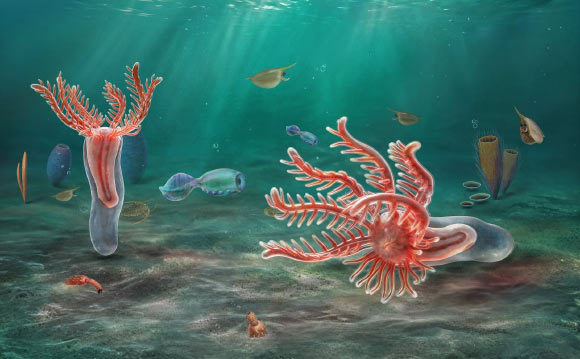
A 518-million-year-old ambulacrarian fossil from China suggests that the common ancestor of starfish and their relatives was not a burrowing worm; it was probably a tentacled animal that fed from the water around it.
A fossil theropod vertebra about the length of a thumb, found in the Algarve region in southern Portugal, may be the oldest dinosaur remains ever discovered on the Iberian Peninsula.
Where did it start? How did it grow complex? Why did it get big? Three moments in Earth’s early history when evolution suddenly, inexplicably turned up the dial.
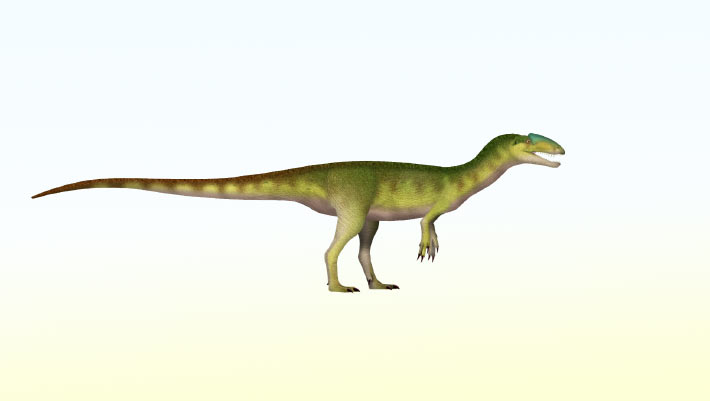
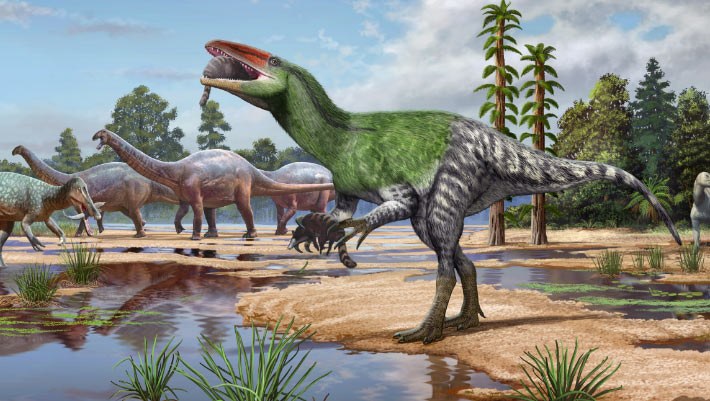
A fossilized braincase that sat in in the collection of the Natural History Museum in London for a century has been identified as Europe’s first megaraptoran dinosaur, a lineage once thought to have flourished mainly in the southern hemisphere.
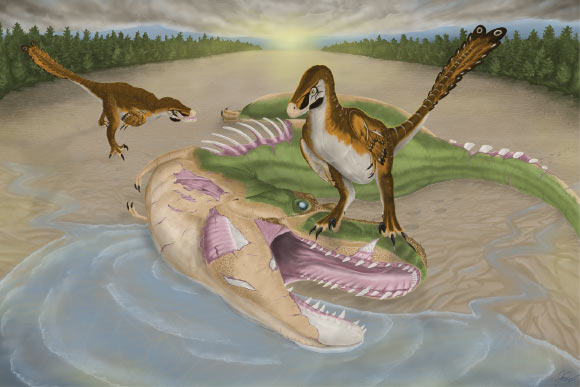
Tyrannosaurs sit at the top of the food chain in the popular imagination, but a newly described fossil from Alberta, Canada, suggests that a much smaller predator may have fed on the carcass of Albertosaurus sarcophagus, a tyrannosaur relative.
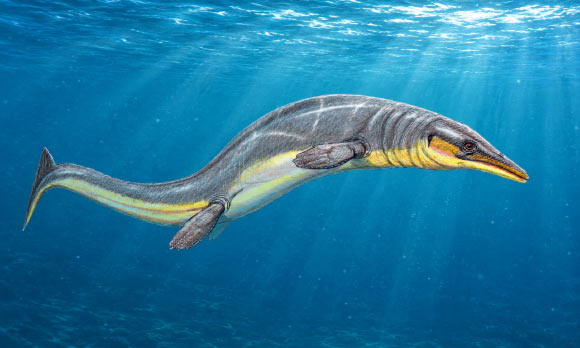
Paleontologists have described a previously unknown species of mosasaur -- a group of extinct marine reptiles that patrolled Cretaceous seas alongside dinosaurs on land -- based on fossils unearthed in Egypt’s Dakhla Oasis.
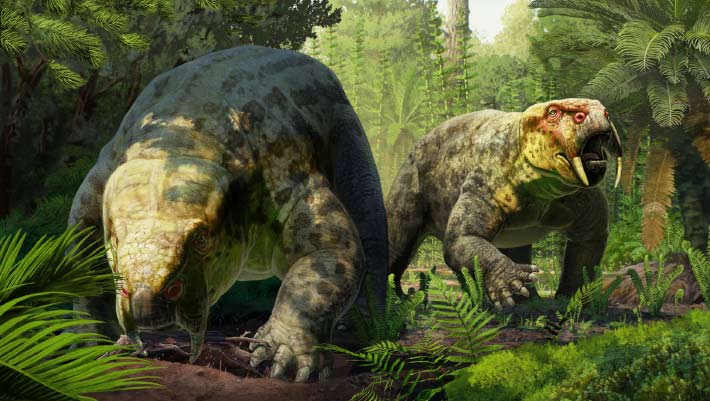
Paleontologists have identified a new species of ancient, distant mammal relative from two fossil specimens found decades apart in the Manda Beds of Tanzania.
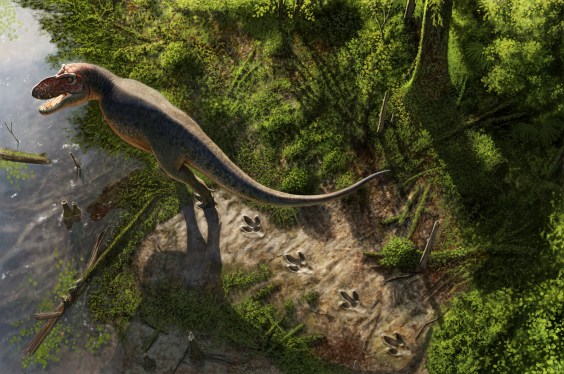
Kent Hups, a high school science teacher in Colorado, discovered a 23-foot trackway of fossilized dinosaur footprints, which offer a glimpse of how the apex predator moved 66 million years ago.
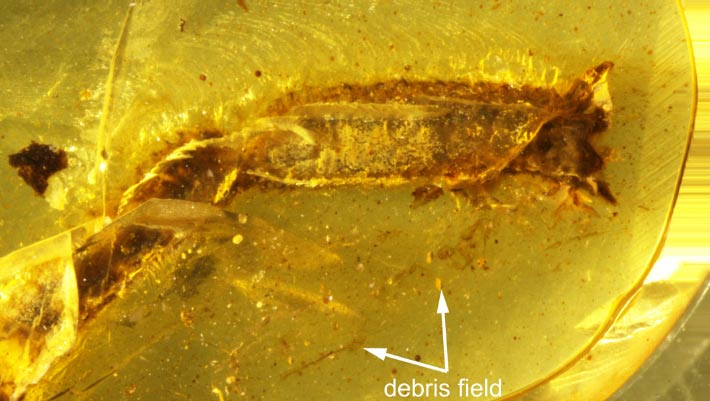
El Soplao, a fossil site tucked into the hills of Cantabria in northern Spain, stands out for yielding amber pieces with a blue-violet hue and abundant bioinclusions, according to a new review paper.
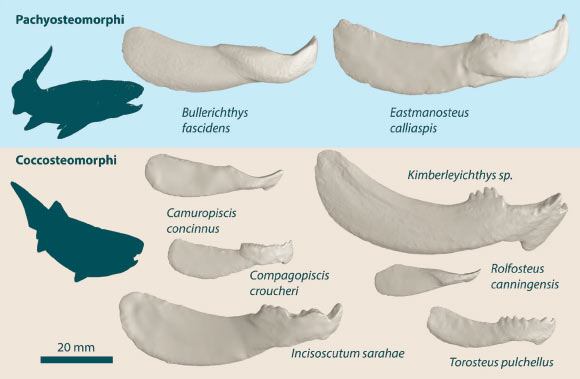
Long before sharks or reptiles ruled the seas, armor-plated fish called placoderms were already experimenting with different jaw designs to crush hard-shelled prey.
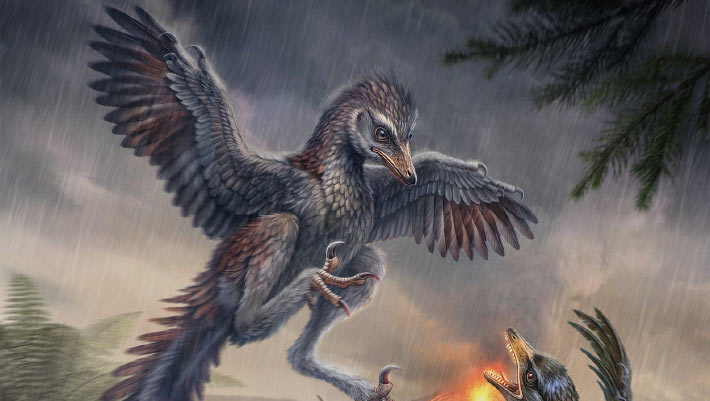
The newly analyzed bird feather fossil that provided the missing clues comes from an extinct bird group called Hesperornithiforms and not from the ancestor of modern birds, Neornithes.
However, the team said subtle differences between the species suggest previous theories crediting adaptation to water diving as the key to Neornithes’ survival were likely on the right track.
Survival of Modern Bird Ancestors Posed a 66-Million-Year-Old Mystery
When a huge piece of space rock slammed into Earth, killing off virtually all dinosaur species save the ancestors of modern birds, the event also left behind a 66-million-year-old mystery. How did these ancient avians survive this apocalyptic event, resulting in every bird species we see today?
Jingmai O’Connor, the associate curator of fossil reptiles at the Field Museum in Chicago, said her career has been spent analyzing fossils to try to answer this single, critical question. However, unlike the new poop-encased bird feathers, most were not so ‘naturally’ protected from the ravages of time.
“It’s such a beautiful, well-preserved feather, from such an unexpected source, and it’s exciting that it could help us answer this huge question in paleontology,” explained the lead author of a study detailing the new analysis. “As far as I know, no one has ever thought to look for feathers or to study feathers in coprolites, so this project was really exciting.”
Dinosaur Dropping Provided Effective Preservation Medium
Researchers discovered the ancient bird feather in 2016 in Montana. Although she initially suspected it could be a coprolite rock (fossilized feces), O’Connor said she couldn’t confirm the theory for a decade.
David DeMar, Jr., holding the exposed fossil feather in the coprolite fragment on the day of its discovery in 2016. Image Credit: David DeMar, Jr.
The situation changed when O’Connor and Nate Carroll, a co-author of the paper and paleontologist at the Carter County Museum in Ekalaka, Montana, gained access to the micro-CT scanner at USC’s medical campus in Los Angeles, California. According to O’Connor, that’s when “the full feathery fabric of this fossil feces” started to finally reveal itself.
“Every hour processing the data revealed another feather, another scale, another bone—in stunning 3D,” Carrol also recalled.
The fossil feather preserved in dinosaur poop. Image Credit: O’Connor et al.
Along with multiple feathers and tiny fish scales, the ancient dinosaur poop, which may have come from a Tyrannosaurus Rex, also contained legs from a hesperonithiform bird.
O’Connor said hesperonithiforms were ancient aquatic birds with similarities to modern loons. Critically, these cousins of the modern bird ancestor group had evolved specialized feet to hunt for fish by diving deep into the water.
“The feathers showed adaptations for being underwater that we see in living aquatic birds,” O’Connor explained.
Notably, the team said this evolution likely cost ancient hesperonithiforms like the one that was consumed by a dinosaur the ability to fly.
Connection to Modern Birds Offers a Solution
Although the bird group represented by the fossilized feather did not survive the dinosaur-killing asteroid, its connection to the ancestor of modern birds appears to support a previously proposed theory that adaptation to water may have helped Neornithes survive. O’Connor said she thinks that small differences in the feathers of the two ancient bird species hold the answer to a 66-million-year-old mystery.
“We think the types of feathers that these birds had, and/or the way they molted those feathers, may have been one of the underlying causes of the selectivity of the end-Cretaceous mass extinction,” the researcher explained, adding that this is “essentially why some birds died out and why others survived.”
Specifically, O’Connor pointed to the “smaller, fuzzy, primitive body feathers” found on the extinct bird “that we associate with dinosaurs and enantiornithines” alongside more modern-looking waterproof adaptations.
The team said that these evolutionary relics suggest that hesperornithiforms like the one that left behind its feathers were an evolutionary bridge between older bird groups and the Neornithes that survived the cosmic collision. Even more critically, the team said these earlier feather structures may not have retained heat as effectively as Neornithes feathers, allowing one species to survive the asteroid and another to die in the extreme cold that followed.
“The hesperornithiforms retain primitive feather types that may not have been as efficient for insulation as modern plumaceous feathers, and that could explain why they went extinct along with the enantiornithines,” O’Connor explained.
Christopher Plain has spent the last six years as Associate News Editor and Head Science Reporter at The Debrief. Follow and connect with him on X, learn about his novels at plainfiction.com, or email him at christopher@thedebrief.org.
Paleontologists have identified a new species of extinct alligatorid that lived in what is now Colorado just a few hundred thousand years after the asteroid impact that wiped out the non-avian dinosaurs.

 Login