Everyone loves the MacBook Neo. Apple’s fresh-squeezed laptop was a not-too-surprising hit with computer buyers, and presumably sales have continued to be good despite a $100 mid-stream price increase elevating its original $599 price tag to a still-good-but-not-astounding $699.
The Neo proved that Apple’s iPhone-class processor, the A18 Pro, was powerful enough to drive a Mac and the Mac’s wide-open software platform. With performance roughly in between an M1 and M2 processor, the Neo is completely capable of even somewhat difficult tasks like audio and video editing. Obviously, RAM and processor limitations prevent it from tackling the toughest jobs, but that’s why Apple makes numerous other, more expensive Macs.
A friend’s kid is moving into her college dorm—the same one both of my kids lived in!—as I write this. I have no idea what computer she’s bringing to school, but it certainly could be a MacBook Neo, and I’d wager a bunch of her classmates will have them, too.
So, hooray for the Neo, but what’s next? With the arrival of the iPhone 18 Pro and the A20 processor, the question is, will Apple release a Neo based on last year’s A19 Pro processor, or jump to the A20? I fear that the answer is the less-exciting A19 Pro, but what if it’s the A20 Pro? (And if it’s not the A20 Pro in 2027, it’ll be the A20 Pro in 2028, you could almost bank on it.)
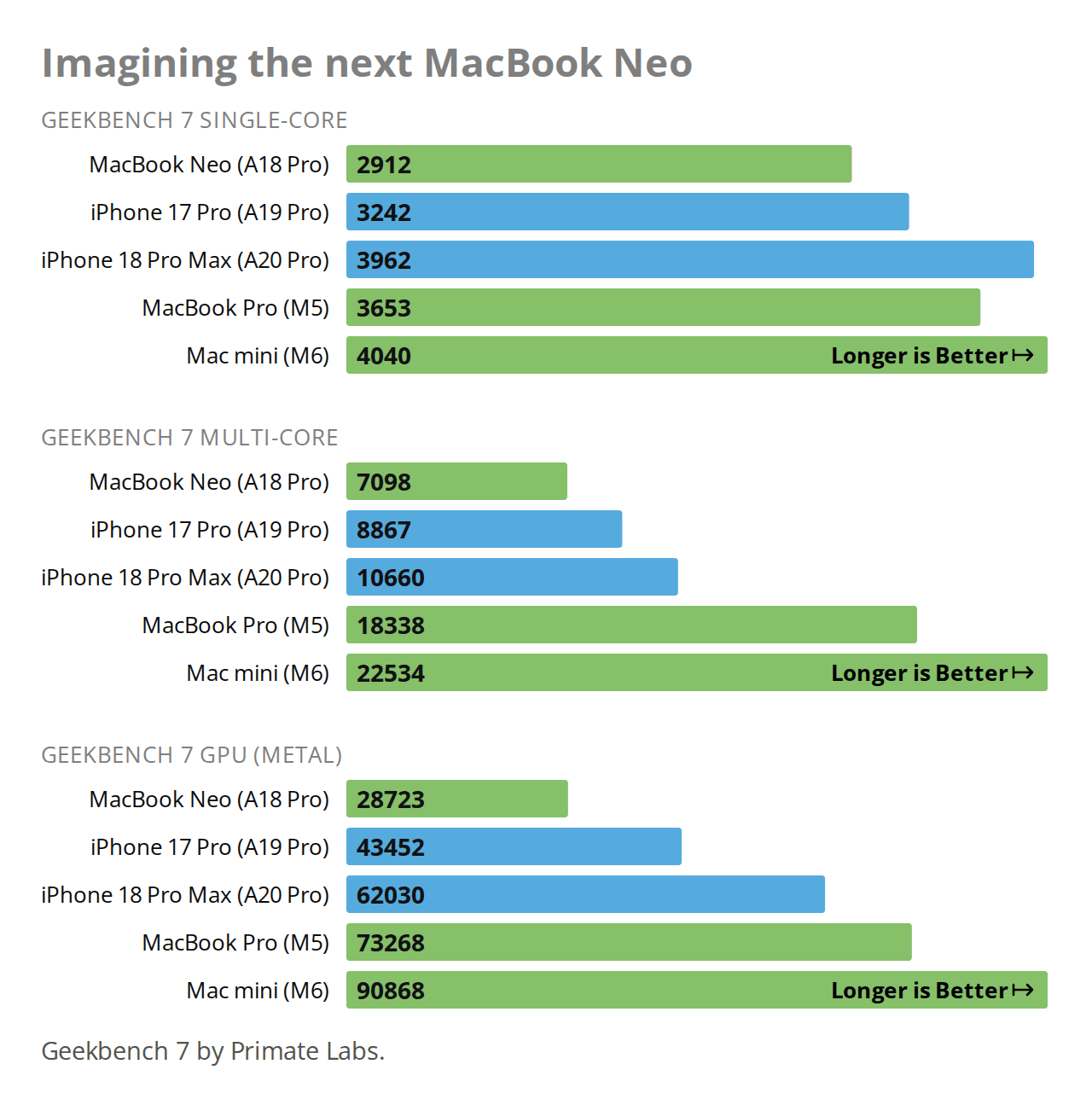
So what’s in store for the MacBook Neo in the future? Let’s go to the charts:
In short, the A19 Pro would be an incremental update to the Neo, keeping it roughly in the ballpark of M1 CPU performance and M2 or M3 GPU performance. The A20 Pro, on the other hand, would elevate the Neo to M2-level CPU and M4-level GPU performance.
Also, in terms of differentiating the product line, next year the MacBook Air will presumably get the M6 chip just unveiled for the Mac mini. But regardless, both the M5 and M6 chips are still well ahead of the A20 Pro in everything that really matters for Mac performance.
I’m sure Apple could get away with releasing a MacBook Neo with an A19 Pro chip, and given the pressures on its margins caused by the RAM crisis, that’s probably what it will do. (It would presumably bring the Neo up to 12GB of RAM, which would be a nice boost—while raising the price, of course.)
But now that we’ve seen it in action in an iPhone, the prospect of the A20 Pro in a MacBook Neo is even more tantalizing. The question is how long we’ll need to wait to see it.
Apple has barely finished unveiling the iPhone Duo, iPhone 18 Pro lineup, AirPods 5, and new Apple Watches, but the company already has a much larger pipeline queued up for late 2026 and the first half of 2027, according to Bloomberg News‘ Mark Gurman.
The coming products are part of what new CEO John Ternus has internally described as Apple’s most ambitious product road map yet. Many of the devices are designed to spread Siri AI more widely across the lineup and close some of the gap with rivals in artificial intelligence. As always, dates can slip and products can be delayed or canceled.
Later this yearGurman reports that Apple is preparing several updates before year-end:
• HomePod mini with Siri AI — Same familiar design as the 2020 model, but with a new chip to power the overhauled assistant.
• Apple TV with Siri AI — Another look-alike refresh, this time with a faster chip for navigation and the new Siri experience.
• Smart-home hub — A square display that can sit on a speaker base or mount on a wall. It will run a new operating system, support video calls, and use facial recognition to personalize what it shows. Apple had considered showing it at last week’s event and is now aiming as early as October, though the timeline remains fluid after repeated delays.
• Touch-screen MacBooks — The biggest MacBook Pro change since 2021, adding OLED panels and touch screens for the first time, with M5 Pro and M5 Max chips.
• Entry-level 14-inch MacBook Pro — Current design, updated with the M6 chip.
• iMac — New colors and an M6 processor.
• iPad mini — One of the line’s biggest upgrades, adding an OLED display.
The HomePod mini and Apple TV are already being tested with iOS 27. The new Macs are running macOS 27.1 internally, and the iPad mini is on iPadOS 27.1. Both of those software updates are expected late next month.
First half of 2027
The spring and early summer slate is heavier on refresh cycles than radical redesigns:
• MacBook Air — Same 13-inch and 15-inch designs, moving to the M6 chip.
• MacBook Neo — Follow-up model with an A19 Pro chip and more memory.
• Entry-level iPad — Faster chip so the cheaper tablet can run Apple Intelligence and Siri AI.
• iPad Pro — Chip upgrade plus vapor-chamber cooling similar to the iPhone 18 Pro.
• iPad Air — First OLED screens in that line, plus a new chip.
• iPhone 18 — Largely an A20 chip upgrade, with the notable change that the standard model is shifting from fall to spring.
• iPhone 18e — Another chip-focused update; Apple will need to make clear how it differs from the regular iPhone 18.
• iPhone Air 2 — More substantial: a 2-nanometer A20 Pro chip, better battery life, and a second rear camera for ultrawide shots.
• Apple Pencils — New Pencil Pro and USB-C models timed with the iPads; the iPhone Duo will support the stylus as well.
Looking further ahead
The second half of 2027 is expected to get more ambitious still, Gurman writes, with M7 updates to MacBooks, smart glasses, camera-equipped AirPods, a home security system, a redesigned Apple Watch, Twentieth Anniversary iPhones, and a second-generation foldable iPhone Duo.
MacDailyNews Take: Taken together, the road map suggests Apple is trying to do two things at once: push Siri AI onto more affordable and living-room devices, and finally refresh categories that have languished for years. Whether October brings a full event or quieter waves of launches, the next 12 months look unusually crowded with product launces!
Please help support MacDailyNews — and enjoy subscriber-only articles, comments, chat, and more — by subscribing to our Substack: macdailynews.substack.com. Thank you!
Apple finally shipped a foldable phone, and the most interesting thing about it is not the hinge. It is what happens when you stop treating the iPhone Duo like a book and start treating it like a laptop.
Bend the device partway, rest the bottom half on a table, and iOS 27 splits the 7.6-inch inner display into two jobs. The top half becomes a landscape screen for the app, document, or video you are actually using. The bottom half turns into a touch keyboard and control deck. That is the mode that makes the $1,999 iPhone Duo feel less like a foldable smrtphone and more like a pocket computer.
Apple has spent years insisting that foldables should not feel like two phones glued together. The Duo is its answer: a passport-shaped handset with a 5.4-inch outer display that opens into a 7.6-inch inner panel, both sharing the same 1:1.4 aspect ratio so content does not warp when you unfold it. The software is the real product. iOS 27 watches the hinge, not just the open/closed state. Content slides away from the crease. Speakers retune as the halves move. And the keyboard follows the posture of your hands.
The laptop pose is the feature people will actually use
Apple and reviewers keep circling the same demo. Set the Duo down half-open, like a tiny clamshell. Video, Mail, Notes, or Safari stay on the upper pane. Playback controls and a full or split on-screen keyboard occupy the lower pane. Slightly more fold and the keyboard splits left and right, so thumbs can type while you hold the device like a book. No settings menu. The crease becomes the dividing line.
That is why the Duo suddenly looks like an argument for a larger sibling. A 7.6-inch inner screen is close to an iPad mini, which is enough for email, messages, and a movie on a tray table. It is not enough for a spreadsheet, a long draft, or two serious windows without feeling cramped. Once you have tasted laptop posture on a phone, a 12- or 13-inch foldable iPad that does the same thing stops sounding like a rumor and starts sounding like the obvious next product.
Apple already designed the Duo to feel “as natural and intuitive as iPad.” Split View finally arrives on iPhone. You can park two apps side by side, or two windows of the same app. Saved app pairs come back later. Controls migrate to the vertical edge so the content column stays tall. StandBy works without a charger: tent the phone on a nightstand and it becomes a clock, photo frame, or widget slab. Those are iPad ideas squeezed into a pocket. They work. They also expose the size ceiling.
Why a foldable iPad now feels inevitable
A foldable iPad has been in the rumor mill for years: first as a ~20-inch board that folds to something closer to a 13-inch slate, later as a delayed 2028 or 2029 project after cost and weight problems. The Duo changes the brief. Apple no longer has to invent hinge software from scratch. It already has angle-aware layouts, a crease-aware keyboard, tent mode, table-top sensors in each half, and developer APIs for reserved fold regions. Scaling that system to a tablet is relatively easy.
Imagine the same half-fold grammar on a larger canvas. Top half: a proper landscape document, timeline, or browser. Bottom half: a real-size software keyboard, or a trackpad zone, or a palette of tools. Apple Pencil on the Duo already hints at the tablet version of that idea. On a phone, Pencil is a nice extra. On a foldable iPad, it is the point: sketch on the upper pane, keep reference material or a keyboard on the lower one, then flatten the device into a single drawing board.
The Duo also proves Apple will move iOS elements when the hardware demands it. Dock and navigation sit on the side. The status bar collapses into a corner puck. Dynamic Island runs vertically. Third-party apps that are not ready get a safe area; apps built for iOS 27.1 can use the full inner panel. That same discipline would make a foldable iPad less of a novelty and more of a second computer.
The iPhone Duo makes an iPad Duo feel necessary rather than greedy. The phone version is a proof of concept. It shows that Apple can make a hinge feel like an input device: slightly open for thumb typing, tented for widgets, laptop-angled for media and mail. The missing piece is area. Give that same software a screen that can hold a full page of text above a usable keyboard, and the “pocket laptop” pitch stops being a clever demo and becomes a category.
Apple did not announce an iPad Duo this week. It did something more useful. It shipped the interaction model first, on the device people actually carry every day. After a few weeks of using the Duo half-folded on a café table, a lot of people will not want a bigger phone. They will want the same trick, at iPad scale.
MacDailyNews Take: An iPad Duo that folds into a laptop pose would steal the exact jobs for which a lot of people already use a MacBook Neo or even MacBook Air: email, docs, browsing, video, light travel work. The iPhone Duo already shows the posture: screen on top, keyboard/controls below. Scale that to iPad size and the “why did I bring a laptop?” question gets louder.
An iPad Duo would not wipe out MacBooks, for the same reasons the iPad Pro never did:
• Software ceiling. iPadOS is still app-and-touch first. Serious windowing, files, terminals, IDEs, and pro apps still live more comfortably on macOS.
• Input. A software keyboard on glass is fine in a pinch. All-day typing still favors a real keyboard and trackpad. People who need that will keep buying Airs and Pros.
• Apple’s own mix. Apple has long accepted overlap: iPad Pro vs. MacBook Air, iPhone vs. iPad mini. A foldable tablet would shift the mix, not collapse it. Some MacBook Neo and Air buyers become Duo buyers; some Duo buyers still want a Mac at the desk or on the go.
Net effect of an iPad Duo: partial cannibalization of entry-level MacBook sales, plus some new demand from people who would never haul a laptop, but would fold a tablet. The Macs most at risk would be mostly MacBook Neo with some MacBook Air.
Please help support MacDailyNews — and enjoy subscriber-only articles, comments, chat, and more — by subscribing to our Substack: macdailynews.substack.com. Thank you!
The MacBook Neo has been a huge success since it first arrived earlier this year. Now, early reports suggest that the company is already preparing to launch its successor. According to recent supply chain leaks, the new MacBook Neo 2 is reportedly coming out in 2027. It will feature several big hardware upgrades, including a […]
La arqueología subacuática está viviendo una revolución silenciosa. Durante décadas, los investigadores han medido la importancia de los puertos antiguos atendiendo casi exclusivamente a lo que podían ver: muelles, diques y la extensión de las cuencas interiores. Pero un equipo internacional de investigadores ha demostrado que esta aproximación es incompleta. Los barcos no solo atracaban […]
Apple is, of course, already working on the next MacBook Neo, a follow-up to the budget laptop that became one of its surprise hits this year. According to Bloomberg News‘ Mark Gurman, the company is testing an updated model with an A19 Pro processor, more memory, and additional color options as part of a broader Mac refresh stretching through 2026 and 2027.
The current MacBook Neo launched in March with a 13-inch Liquid Retina display, an aluminum chassis, and Apple’s A18 Pro chip. It ships with 8GB of unified memory and either 256GB or 512GB of storage. Apple introduced it at $599, or $499 with education pricing, in blush, indigo, silver, and citrus. The starting price later rose to $699 during an industrywide memory squeeze.
That 8GB memory ceiling is the machine’s most cited limit. Everyday browsing and documents are fine. Heavy tab stacks, several apps at once, and on-device Apple Intelligence features run tighter. Gurman has reported that the next Neo is being built around the A19 Pro and a larger memory configuration. Prior reporting around that same pipeline has pointed to 12GB as the likely step up, which would give the laptop more headroom for multitasking and local AI workloads.
Color remains part of the plan. Gurman has said Apple intends to keep refreshing the Neo’s finishes. That fits how the product was sold: as a cheaper Mac that still looks like a statement.
The next Neo is not expected to jump to M-series chips, MagSafe, or a touch display. Those upgrades sit on other MacBook lines in the same multi-year overhaul Gurman has outlined, including redesigned Pro models with touch and OLED. The Neo’s job stays the same: a lower-priced aluminum notebook that uses A-series Apple Silicon to undercut Windows laptops and Chromebooks.
A spring 2027 window has been the working assumption in coverage of Gurman’s reporting, alongside other consumer hardware. Pricing is the open question. Component costs already forced Apple to lift the first Neo’s sticker. A faster chip and more RAM could make another increase likely, even if the company keeps the model clearly below the MacBook Air.
MacDailyNews Take: Until Apple confirms the specs, the next MacBook Neo sounds like a targeted refresh: A19 Pro, more memory, new colors, and the same basic idea that made the first one sell: macOS in a machine more people can afford.
Please help support MacDailyNews — and enjoy subscriber-only articles, comments, chat, and more — by subscribing to our Substack: macdailynews.substack.com. Thank you!
If you’re a MacBook Air or MacBook Neo owner, there’s one accessory that I consider an absolute must-have; a USB-C hub. Why? Because it considerably expands the port options available to you, it’s not cumbersome, and the good news is that they’re also pretty cheap at around $25. What’s not to like? A good USB-C ... Read More
In another time, the MacBook Neo could have caused a substantial realignment of the lowish-end laptop business. Sure, it has shortcomings compared to the MacBook Air, but it could have at least encouraged PC makers to start shipping consistently decent keyboards, screens, and build quality in the Neo's $599 price window.
The PC makers did start responding, thanks in part to Intel's actually new non-Ultra Core Series 3 processors (codenamed Wildcat Lake). Intel has resisted its usual compunction to serve the budget market with aging, re-labeled silicon and has created a lower-end, lower-performance processor with the same building blocks (and the same manufacturing processes) as this year's high-end, high-performance models.
The likes of Dell, Acer, Asus, and Lenovo began hopping on the Wildcat Lake train fairly quickly, announcing would-be Neo competitors. But it felt like most of them were having trouble matching the Neo's barebones specs, let alone undercutting them. Dell's XPS 13 started at $599, but only for students. It would be $699 for everyone else. Acer's Swift Air 14 was announced at $699, too. Sure, sometimes these offered features the Neo didn't have. But the point of the Neo is that it eschews frills and frippery in favor of nailing the basics.
The MacVoices Live! panel dives deep into Apple’s across-the-board price increases, weighing rising RAM, storage, inflation, shareholder obligations, and product value. Chuck Joiner, David Ginsburg, Brian Flanigan-Arthurs, Ben Roethig, Eric Bolden, Marty Jencius, Jeff Gamet, Norbert Frassa, Jim Rea, and Web Bixby debate whether higher prices are a short-term reset or the new normal, how buyers may react, why the MacBook Neo increase stings, and whether refurbished or education pricing may become more important.
The MacVoices Live! panel explores Pope Leo’s comments on AI ethics, technology regulation, environmental costs, labor disruption, and the need for moral guardrails without stopping innovation. Chuck Joiner, David Giinsburg, Jeff Gamet, Brian Flanigan-Arthurs, Jim Rea, Eric Bolden, Marty Jencius, and Web Bixby compare today’s AI concerns to earlier industrial upheaval, then shifts to Kansas City’s school technology plan involving MacBook Neo systems and iPads, with debate over deployment, education value, and implementation challenges.
The MacVoices Live! panel covers a fake vendor site spreading malware, Apple’s new accessibility previews, and a hardware reorganization aimed at faster, more unified product development. Chuck Joiner, David Ginsburg, Eric Bolden, Web Bixby, Jim Rea, Brian Flanigan-Arthurs, Jeff Gamet, and Marty Jencius also discuss Eyes Off for shoulder-surfing protection, Microsoft and Google reactions to the MacBook Neo, Google’s proposed AI laptop, and broader questions about AI becoming part of operating systems.
A wide range of tech stories get the MacVoices treatment, starting with the quick sellout of the Steve Jobs commemorative coin and what strong MacBook Neo demand may say about Apple’s pricing, chip planning, and enterprise appeal. Chuck Joiner, David Ginsburg, Marty Jencius, Eric Bolden, Brian Flanigan-Arthurs, Jeff Gamet and Mark Fuccio also discuss Apple updates unexpectedly changing settings, a Canvas ransomware disruption affecting schools, Chrome’s hidden AI download, Google’s Liquid Glass similarities, Digg’s AI-focused return, and safer lithium coin batteries.
Dans les profondeurs de la forêt tropicale de Bornéo se cache une créature fascinante : le lézard-moniteur sans oreilles. Ce reptile énigmatique, surnommé le « mini-dragon », défie les scientifiques par sa rareté et son mode de vie secret. Pourquoi ce petit dragon bien réel est-il si difficile à...
Durante 3.200 años, nadie supo por qué la sequía que azotó el Levante y el Mediterráneo fue tan brutal, hasta el punto de que se le achacó el colapso de la Edad del Bronce. Un estudio de 2026 revela los factores ocultos de este proceso.
It seems the highly affordable Apple portable computer is sending shockwaves through the PC industry. The entry-level MacBook Neo is proving that a computer with just 8GB of RAM can handle incredibly heavy workloads without breaking a sweat. This strong performance has put immense pressure on Microsoft. Now, the software maker is working hard to […]
Apple is selling its most affordable laptop, the MacBook Neo, at its pre-price-hike price through the company’s refurbished store. All four color options are currently available and discounted.
The base 256GB model is listed for $599 (usually $699 when new), while the upgraded version with 512GB of storage and Touch ID sells for $679 (usually $799). The refurbished laptops come with a one-year manufacturer warranty, and buyers have the option to purchase an extended AppleCare plan.
The MacBook Neo features a 13-inch display and is powered by Apple’s A18 Pro chip—the same processor used in the iPhone 16 Pro—along with 8GB of RAM. Apple’s entry-level Mac laptop offers strong performance for everyday tasks, with an excellent screen, keyboard, and speakers.
While power users may feel limited by the 8GB of memory and relatively slow storage, it’s a solid choice for students, casual users, and anyone who doesn’t need demanding desktop apps.
Its A18 Pro chip (the same processor found in the iPhone 16 Pro) delivers smooth everyday performance for browsing, streaming, writing papers, online classes, video calls, and light multitasking. The excellent screen, comfortable keyboard, and strong speakers make long study or work sessions more pleasant, while the 13-inch form factor keeps it portable and easy to carry between classes or around the house.
With 8GB of memory and relatively modest storage speeds, it isn’t ideal for power users running heavy video editing, complex coding environments, or multiple intensive apps at once. But for high school or college students, it strikes a smart balance of capability, build quality, and affordability, especially at the current refurbished prices.
MacDailyNews Take: Check out all of the MacBook Neo – and all of Apple’s other refurbished hardware (it’s the best in the business) – via Apple’s Certified Refurbished store here.
Please help support MacDailyNews — and enjoy subscriber-only articles, comments, chat, and more — by subscribing to our Substack: macdailynews.substack.com. Thank you!
The Company posted quarterly revenue of $109.4 billion, up 16 percent year over year.
[…]
“Today, Apple is proud to report our strongest June quarter ever, with double-digit revenue growth across iPhone, Mac and Services, and in every geographic segment,” said Tim Cook, Apple’s CEO.
You can’t argue with the strong iPhone and Mac sales figures, and Apple specifically called out the MacBook Pro and the MacBook Neo, which Cook said “has been especially popular” and suggested that the company is still struggling to make them fast enough.
It’s admirable (and sensible) that Cook isn’t pointing fingers at anyone but customers who want Apple products, but the key phrase in his statement is “the supply chain just has less flexibility in it than normal.” This is an acknowledgement that while in the past, Apple might have been able to boost chip production from its partners, today the chip industry is maxed out thanks to the wild building of chips for AI applications.
[…]
As an aside, Cook also alluded to reports that Apple has tried to get the U.S. government to authorize purchase of RAM from some forbidden Chinese chipmakers, which has aroused political ire.
The latest financial numbers are in, and the Apple MacBook Neo is single-handedly pushing Mac sales to record levels. During its recent Apple Q3 2026 earnings call, Apple reported that Mac revenue jumped by almost 29 percent over the last quarter. This massive growth happened without the launch of any brand-new hardware during those three […]

 Login