❌

Reading view

When will SpaceX and Blue Origin fly to the moon? NASA reveals lunar lander timelines (and an Artemis III update)

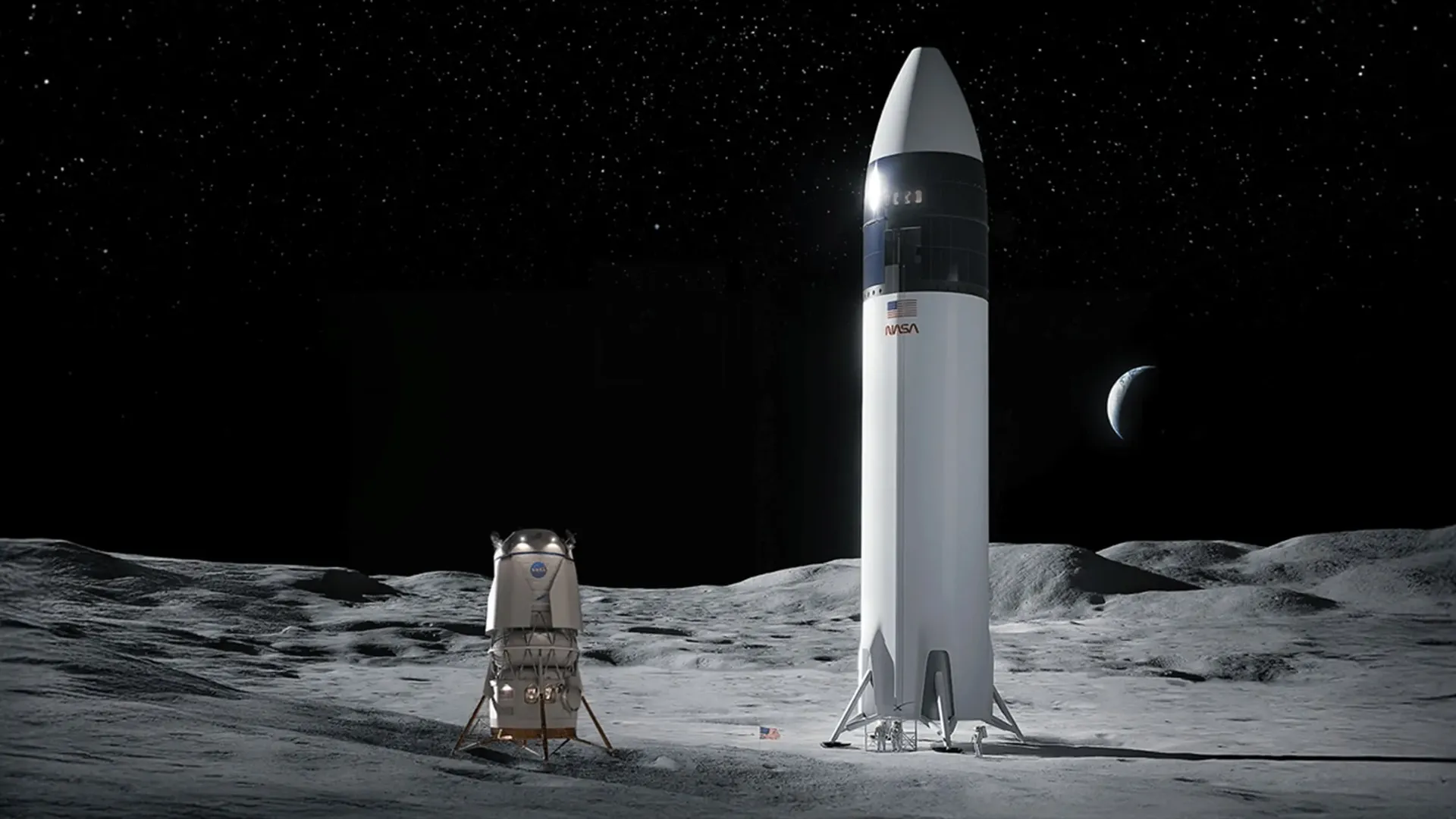
NASA has revealed new details about its plans to return astronauts to the surface of the moon, outlining a series of upcoming milestones for SpaceX and Blue Origin as both companies race to ready their lunar landers for the agency's Artemis program.

During an Oct. 5 presentation at the Astronautical Congress (IAC) in Antalya, Türkiye, Steve Creech, acting manager of NASA's Human Landing System (HLS) Program, laid out development timelines for both spacecraft, with key demonstrations planned through early 2028 that include orbital refueling and uncrewed lunar landing tests to qualify the vehicles to fly astronauts to the surface of the moon.

A more pressing deadline, however, is NASA's Artemis III mission, which is targeted for the third quarter (Q3) of 2027. Artemis III will launch four astronauts aboard NASA's Orion spacecraft to low Earth orbit (LEO), where they will rendezvous and dock with test versions of both companies' landers for interoperability checkouts. Those demonstrations will help inform NASA's determination about which lander the agency will choose to carry astronauts to the moon's surface on Artemis IV, targeted for early 2028.

SpaceX and Blue Origin were both awarded NASA contracts to develop HLS vehicles — Starship and Blue Moon, respectively — and have spent the past several years refining their respective lunar lander designs and dealing with various delays along the way. In the face of those delays, and in an effort to better structure its mission progression for success, NASA overhauled its Artemis program architecture in February to maintain its goal of landing astronauts on the moon by the end of 2028 and establish a more regular cadence of uncrewed landings in the meantime.

As part of that shakeup, Artemis III, previously the program's first crewed lunar landing mission, was moved up a year and repurposed for the lunar lander vehicle tests the agency is preparing to fly to LEO next year. The program's first moon landing remains scheduled for 2028, but was shifted to the manifest for Artemis IV.

Between now and then, both SpaceX and Blue Origin have more than a dozen test demonstrations and vehicle milestones to achieve, including success during Artemis III and flights afterward. This will all lead up to a key decision NASA must make: Which vehicle will carry out the first crewed landing on the surface of the moon since the Apollo program ended in 1972?

Starship reached for the first time on its most recent test flight, which occurred on Sept. 28 from SpaceX's Starbase site in South Texas. NASA lists several other important goals for the vehicle to achieve in 2026, including (in the order listed during the IAC presentation) the first return and catch of the rocket's upgraded Version 3 (V3) booster at its launch pad; the first-ever return and catch of a Ship upper stage; the first Starship launch from one of SpaceX's launch pads still under construction on Florida's Space Coast; and, possibly, the first V3 booster reflight.

NASA also expects SpaceX to complete the initial build of the crew cabin for its lunar lander Starship variant. SpaceX released renders of Starship's interior last year, as well as images of the test elevator astronauts are using to train for Starship egress on the lunar surface, but little else has been made public about the progress the company has made on the cabin's design.
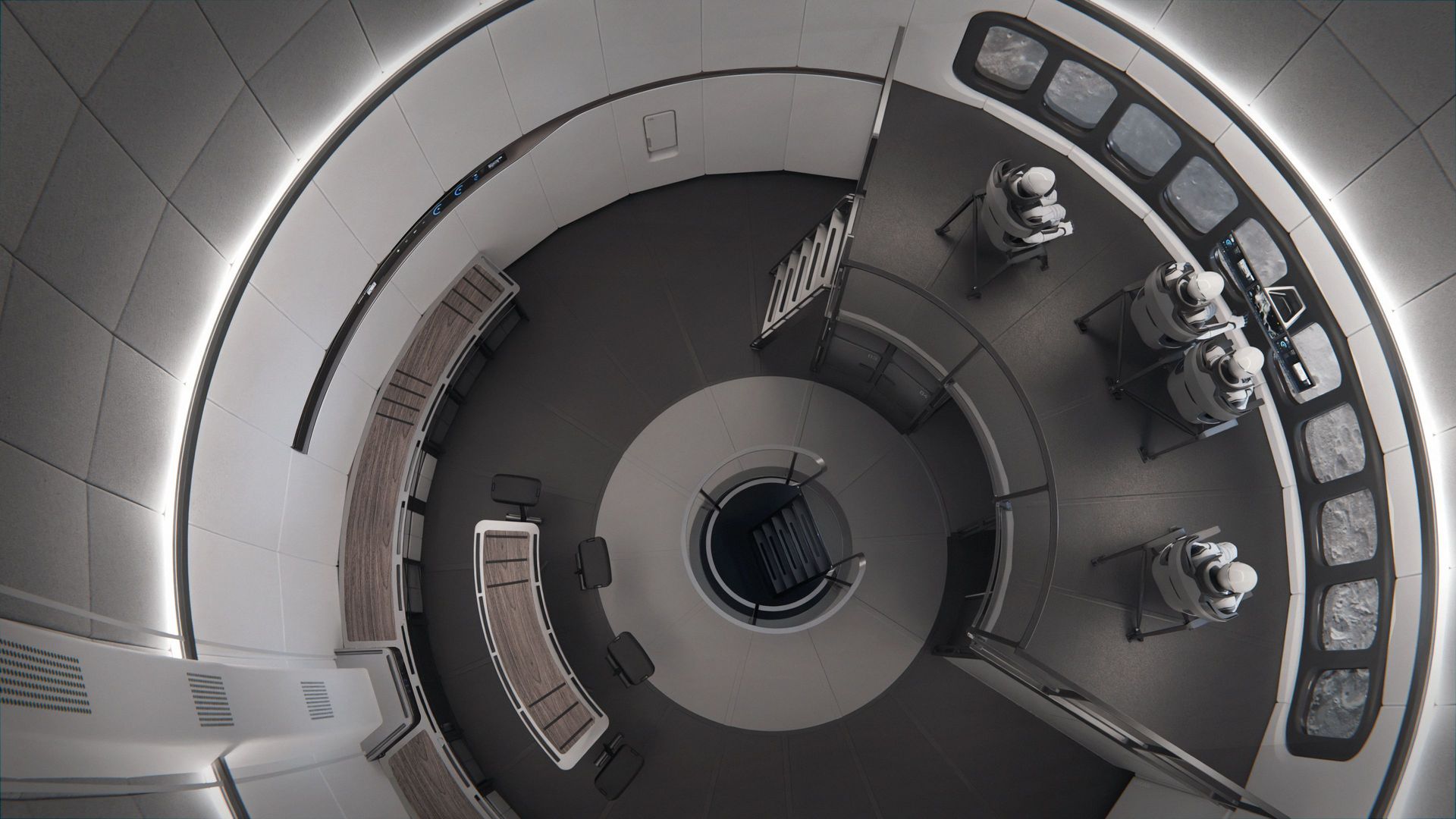
Artist's rendering of the cabin of SpaceX's Starship vehicle during an Artemis moon mission for NASA.

Artist's rendering of the cabin of SpaceX's Starship vehicle during an Artemis moon mission for NASA. (Image credit: SpaceX)

Should the cabin's initial build wrap up by the end of the year, as NASA's presentation suggested, SpaceX will use Q1 2027 to complete integration of the systems that Starship will need to communicate with Orion during Artemis III, and deliver a cabin simulator for astronauts to train on leading up to the mission. SpaceX plans to continue Starship test flights through Q2 of next year, complete a landing leg demonstration and begin crew cabin airlock tests.

Blue Origin's lunar lander mockup is ready for NASA Artemis astronaut training

For Artemis III, SpaceX plans to fly one of its existing V3 Starship upper stages, with some slight modifications. Starship and Orion will dock as part of Artemis III but the SpaceX vehicle won't be equipped with a crew cabin for the mission's astronauts to enter. Between the end of this year and the beginning of the next, SpaceX is expected to complete the addition of a docking system and nosecone cover to the Artemis III Starship vehicle, which, NASA documents suggest, has already completed its mechanical fit checks.
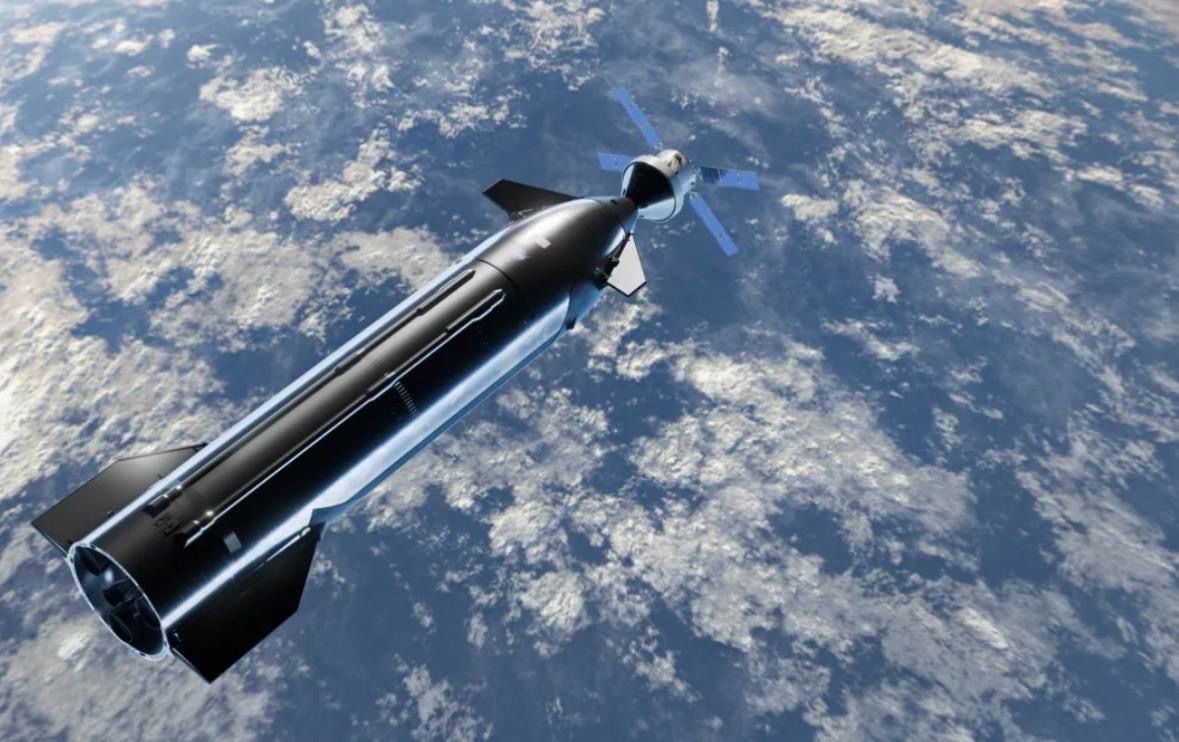
A giant chrome rocket and a small space capsule dock in low Earth orbit.

Render of SpaceX Starship and Orion docked in low Earth orbit. (Image credit: SpaceX)

Other notches on SpaceX's checklist leading up to Artemis III include the first propellant transfer demonstration with Starship in orbit. As the first-ever launch vehicle and spacecraft designed for full reusability, Starship's fuel constraints require that its tanks be topped off in order to fly beyond LEO. For a moon landing mission, this could mean up to a dozen launches of SpaceX's Starship "tanker" spacecraft to an orbiting fuel depot, which the moon-bound Starship will visit. To pull that off, though, SpaceX has to show it can successfully transfer those cryogenic fuels on orbit, and also store them effectively enough to prevent too much boil-off.

Starship won't require any refueling flights to complete its objectives for Artemis III, but SpaceX is expected to launch its first Starship tanker vehicle within a few months of that mission as it gears up for the Artemis IV moon landing mission. To that end, a launch of an uncrewed Starship lunar lander variant is targeted sometime toward the end of Q3/beginning of Q4, with an uncrewed lunar landing mission carried out before the end of 2027.

Blue Origin, meanwhile, has its own set of milestones to meet as it develops its Blue Moon Mark 2 (MK2) lander — a 52-foot-tall (16 meters) spacecraft powered by three BE-7 engines. Unlike the bare-bones V3 Starship that SpaceX will launch on Artemis III, Blue Origin plans to fly a completed test vehicle, incorporating the crew cabin, partial life-support, flight software and other systems needed to allow astronauts to enter the lander from Orion during their time docked in LEO. Astronauts will be able to enter Blue Moon from Orion to get a feel for the lander in zero-g and test some of its systems.
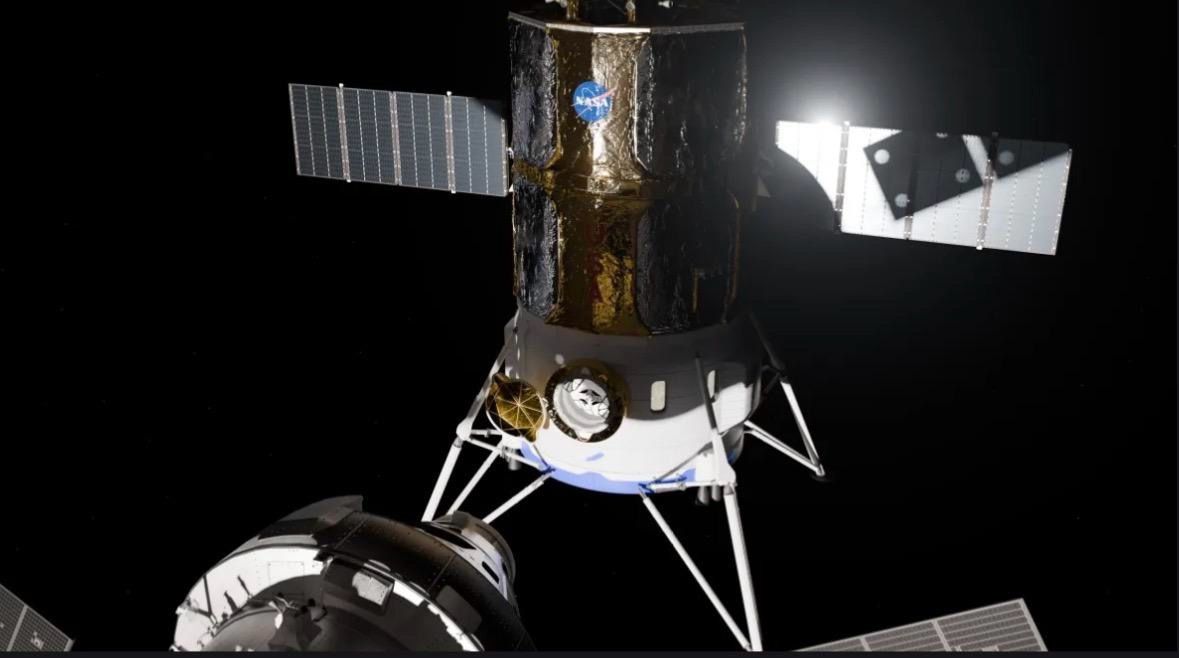
A lunar lander rendezvous with Orion in space.

Render of Blue Origin's Blue Moon lander and Orion prior to docking in low Earth orbit. (Image credit: Blue Moon)

NASA's timeline shows the company working to complete a series of manufacturing and testing milestones in the last few months of 2026, including continued BE-7 testing and qualification of Blue Moon's BT-7 maneuvering thrusters. The company also faces its Artemis III interim design review and a critical design review for an upcoming landing demonstration mission in 2028.

Blue Origin is also working to restore its pad at Cape Canaveral Space Force Station's Launch Complex-36 (LC-36) to operation and return its New Glenn rocket to flight, following an explosion of the rocket in May that caused extensive damage to the facility. NASA's presentation places that milestone in Q4 2026, a timeline the company has also been very vocal about maintaining. A recent Reuters report, however, suggests that may not happen until early 2027.

By early 2027, the company expects to complete the spacecraft's communications systems and finalize its flight software, with assembly, integration and testing continuing into Q2. Q1 2027 is also when Blue Origin's Blue Moon MK1 lander (a smaller, uncrewed version of its MK2 successor) will launch to the lunar surface as a part of NASA's Commercial Lunar Payload Services (CLPS) program of robotic moon missions.

During Q2 2027, as the Artemis III mission approaches, Blue Origin is expected to complete integration of its test lander with New Glenn and conclude qualification of its BE-7 engine. Throughout next year, the company plans to continue construction and refurbishments at its launch facilities and hopes to have a new launch pad ready to support the upgraded, more powerful New Glenn 9x4 rocket l by the end of Q3. The first flight of that rocket variant is scheduled for Q4 2027, alongside a second MK1 lunar mission and the launch of an uncrewed MK2 demonstration lander.

That spacecraft is expected to attempt its own uncrewed lunar landing in Q1 2028, around the same time Blue Origin has scheduled a third MK1 flight. Like SpaceX, Blue Origin will need to demonstrate that its lander can safely reach the moon's surface,operate there and return to lunar orbit before NASA clears it to carry astronauts on a future Artemis mission.

NASA's overall timeline remains the same as it has been since the February revamp, with Artemis III expected to launch in mid-2027, followed by a crewed lunar landing on Artemis IV in 2028, and possibly another on Artemis V that same year. There may be changes on the horizon, though. NASA will host a press conference on Friday (Oct. 23) with Administrator Jared Isaacman and Associate Administrator Amit Kshatriya, as well as Artemis program director Jeremy Parsons. During the event, which you'll be able to watch here at Space.com, they will discuss the status of the upcoming moon missions and an "Artemis acceleration."

SpaceX and Blue Origin still face tight schedules to complete their respective uncrewed landing demonstrations before Artemis IV. With SpaceX targeting Q4 2027 and Blue Origin Q1 2028, both are pushing the margins against NASA's hopes to return astronauts to the lunar surface that same year. Which company ultimately gets the green light for that first landing mission will depend on the progress each makes between now and then, and whether their landers can demonstrate the readiness that NASA requires to safely carry astronauts to the surface of the moon and back again.
  •  

Astronauts on the Moon could shelter from radiation, micrometeoroids and extreme temperatures inside a lava tube, and NASA is sending a suite called GIMLI to scan beneath the Marius Hills Pit to see whether the pit opens into one

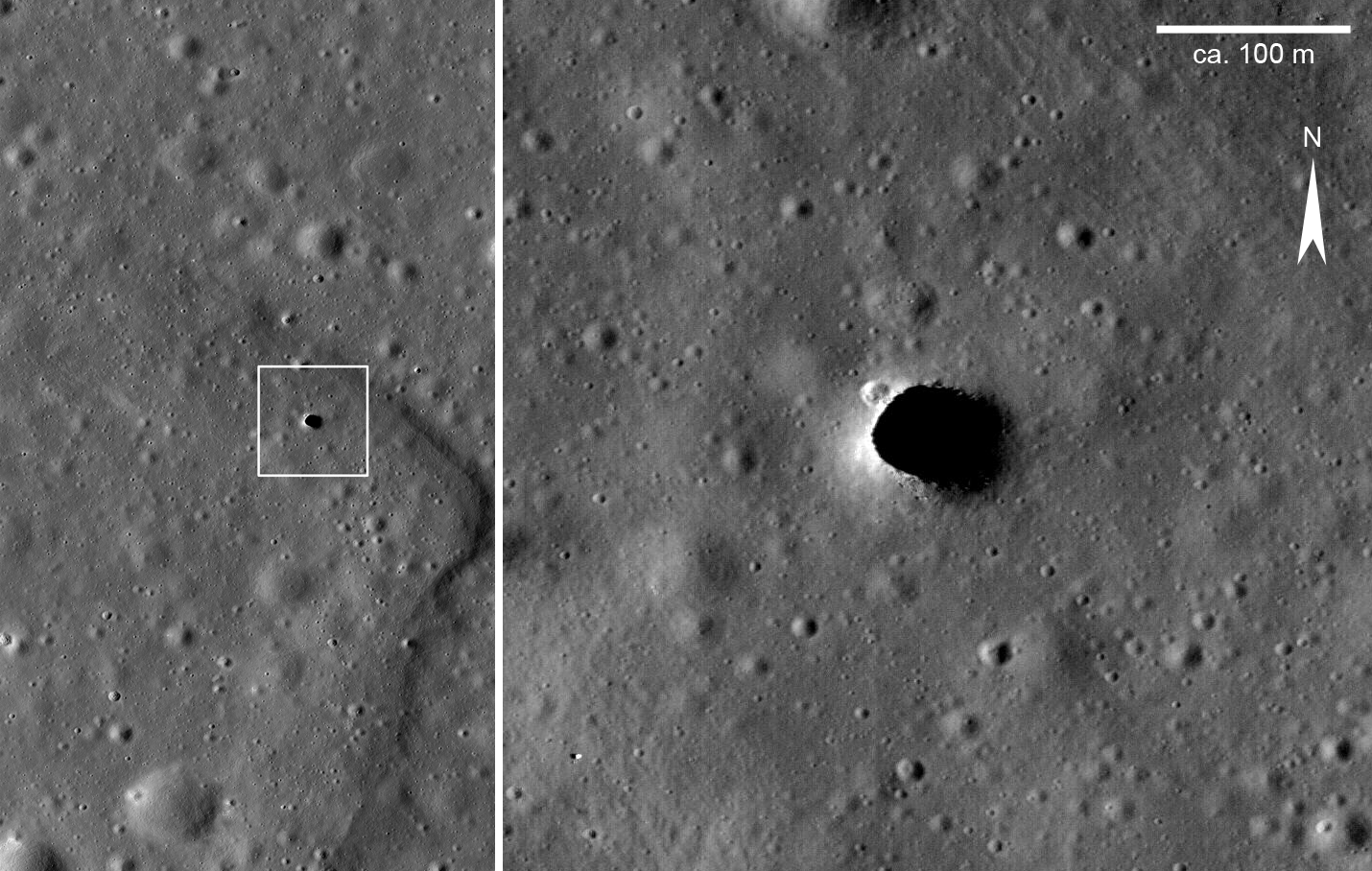
Orbital image of the Marius Hills pit, a dark hole in a lunar rille, with a magnified inset

WASHINGTON, NASA has selected a radar, seismic, gravity and camera suite called GIMLI to be deployed at the Marius Hills Pit and test from the surface whether the pit opens into a lava tube.

The agency named GIMLI on 30 September 2026 as one of three payload suites chosen under its PRISM programme for the Moon Base effort, to fly on a commercial lander under the Commercial Lunar Payload Services scheme. No launch date and no lander vendor have been named. The principal investigator is Nathaniel Putzig of the Planetary Science Institute.

The pit lies in the Marius Hills, an ancient volcanic region. In 2017 a team using the Lunar Radar Sounder on Japan’s Kaguya spacecraft reported echoes near the pit that it interpreted as an intact lava tube, and candidate tube sites line up with mass deficits in gravity maps from the GRAIL spacecraft, the Japanese space agency said. None of that has shown whether the hole leads anywhere.

“Readers should not conclude that the pit is an opening to a lava tube,” Gareth Morgan, GIMLI’s deputy principal investigator at the institute, told Space Daily in an email on 19 October 2026.

High-resolution images from NASA’s Lunar Reconnaissance Orbiter show the pit walls “form an overhang above a subsurface void space that is wider than the diameter of the pit itself”, Morgan said. The size of that void is unknown, and so is whether it is an isolated cavity or part of a larger cave system.

Similar pits exist in volcanic terrain on Earth, Morgan said. “Sometimes they are skylights into lava tubes, but in other cases they are isolated shafts/cavities caused by volcanic-tectonic activity,” he said. “GIMLI has been designed to differentiate between the two scenarios.”

“It has long been speculated that lava tubes, which on Earth are remnants of drained lava flows, exist on the Moon, but this has never been definitively confirmed,” Morgan said. “GIMLI will enable us to address this for the first time.”

“Confirming these void spaces now could shift future habitat planning, offering natural, ready-made shelters that provide crucial thermal stability and shielding from deadly ionizing radiation and micrometeoroid bombardment,” the agency said in its 30 September 2026 release.

GIMLI’s ground-penetrating radar is supplied by the Norwegian Space Agency, according to the institute. Honeybee Robotics, a Blue Origin company, is building the active-source seismic system, the gravimeter and the cameras, and is managing the project.

Each instrument should respond to a tunnel in its own way, Putzig told Space Daily in an email on 19 October 2026. “With the ground-penetrating radar, we would expect a strong reflection from the top of the lava tube back to the antenna, due to the high dielectric contrast between rock and the vacuum within the lava tube,” he said.

“For the active-source seismic, we would expect strong reflected and refracted acoustic waves from the perimeter of the lava tube, but the acoustic waves will not pass through the void space,” Putzig said. “For the gravimeter, we would expect to see a strong, negative gravity anomaly when passing over the lava tube, as it represents a locally reduced mass in what is otherwise dense rock.”

“If we see all of these effects, it will represent very strong evidence that the pit does in fact represent a collapse feature into a much more extensive lava tube,” he said.

Elevator and sealed walls

Published figures for the pit’s depth disagree. NASA’s description of the orbiter’s images puts the pit at about 34 metres deep. The Lunar Reconnaissance Orbiter Camera team gives 40 metres in a 2017 update. Putzig put the drop at about 60 metres.

“There’s a sharp drop of about 60 m between the pit rim and the floor of the pit, so while first explorations could be done by flying or rappelling into the pit, it may become necessary to install an elevator to move people and equipment in and out of a shelter,” Putzig said.

“Creating a shelter would require walling off either end of a portion of the lava tube and pressurizing the interior, but cross-cutting fractures could make it necessary to seal off the tube walls as well to avoid leaks,” he said.

In July 2022 NASA reported that Diviner data from the orbiter and computer modelling showed shaded locations within some lunar pits “always hover around a comfortable 63 F (about 17 C)”. Radiation shielding inside the Marius Hills Pit has not been measured on site.

Morgan said a null result would still be useful. “If we don’t find evidence of a cave system at our Marius Hills landing site, our measurements will still allow us to test alternative hypotheses for lunar pit formation, which in turn will provide new insights into volcanic activity, such as localized volcanic-tectonic processes,” he said.

The pit walls also expose layers of rock. The suite’s camera mast “will be used to inspect these outcrops (from a safe distance) to measure the number, thickness and origin of the layers”, Morgan said, with the results compared against the geophysical surveys to reconstruct the site’s sequence of eruptions.

Sources:

The post Astronauts on the Moon could shelter from radiation, micrometeoroids and extreme temperatures inside a lava tube, and NASA is sending a suite called GIMLI to scan beneath the Marius Hills Pit to see whether the pit opens into one appeared first on Space Daily.

  •  

Batteries help reduce emissions, but how do we reduce their emissions?

The first order of business for the energy transition is electrifying applications like vehicles and heating and making sure that the electricity that powers them is made using renewables. But once the dominant slices of the emissions pie have shrunk, other categories with less potential to reduce emissions become important.

A new study led by Haiwei Zhou at the University of Melbourne focused on the emissions associated with making lithium-ion batteries, which many parts of the energy transition rely on. Those emissions aren’t zero, so as we use more and more batteries, that number will grow. Right now, the researchers estimate that these emissions only account for 0.18 percent of annual greenhouse gas releases, but they could increase by a factor of 10 or more by 2050.

Avoiding production

There are a number of ways to reduce the emissions required to make a battery. Some elements used in various lithium-ion battery chemistries are more energy-intensive to mine and refine than others. The battery manufacturing process involves many steps that could be made more energy-efficient. And then there’s recycling, which can put battery materials back into the loop while requiring much less energy than mining.

Read full article

Comments

© Oleg Nikishin

  •  

Latest Climate Report Warns of Major Upheaval to California Way of Life

The dire projections come from the state’s Climate Change Assessment, which analyzes the impacts of changing weather patterns on the nation’s most-populous state.
  •  

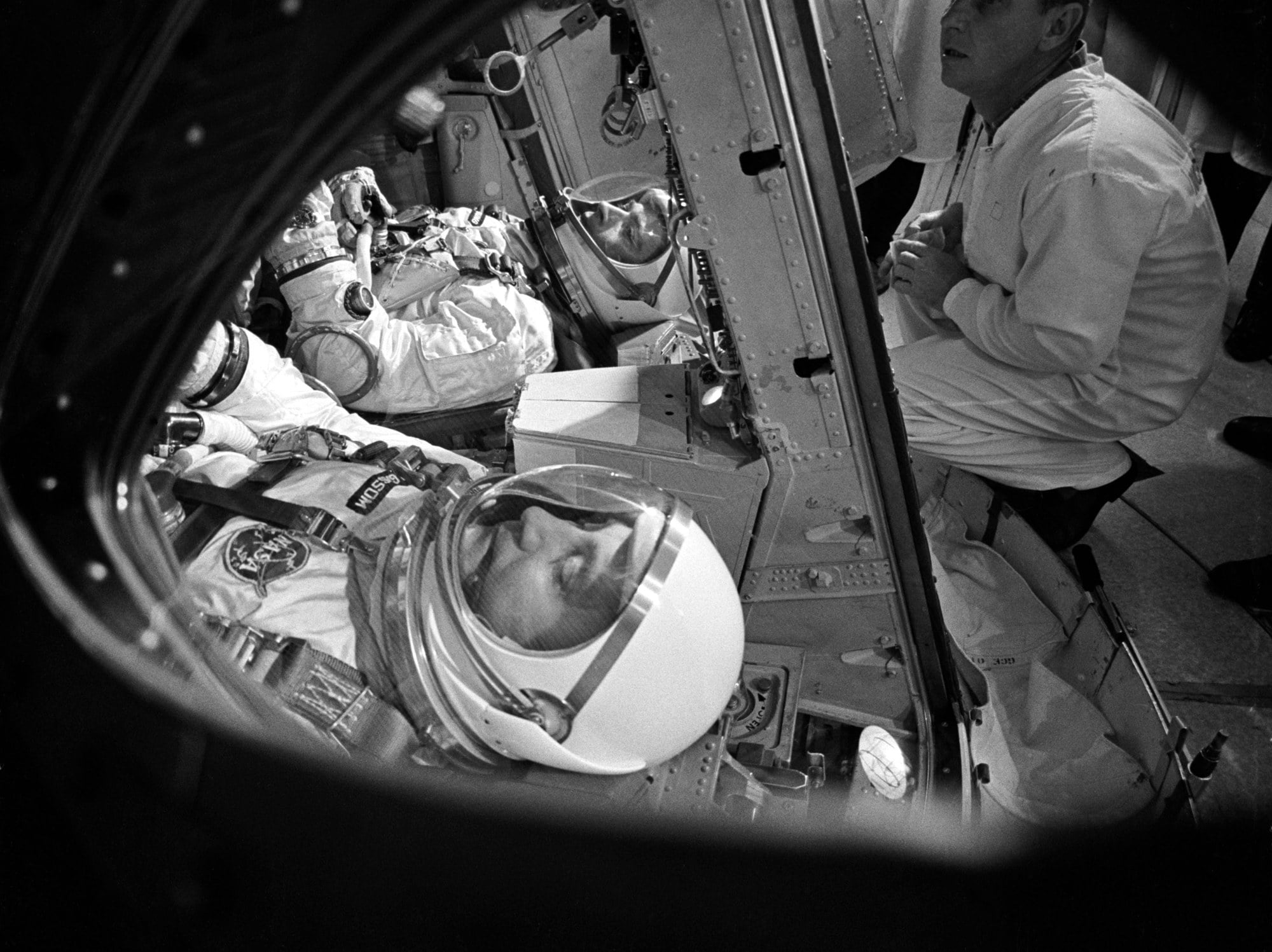
In 1965 an astronaut smuggled a corned beef sandwich into orbit, and NASA’s chief asked if he should be disciplined

Gus Grissom and John Young in spacesuits and helmets strapped into the Gemini III spacecraft, seen through the open hatch

NASA Administrator James Webb pressed Manned Spacecraft Center director Robert Gilruth for a report on whether John Young should be disciplined for smuggling a corned beef sandwich onto Gemini III, NASA’s History Office says.

Young had fellow astronaut Walter “Wally” Schirra, the backup command pilot, buy the sandwich, then pocketed it in his pressure suit as he headed to the launchpad on March 23, 1965, Jennifer Ross-Nazzal, NASA’s human spaceflight historian, wrote in the History Office essay on March 20, 2025.

Nearly two hours into a flight of almost five hours, Young offered it to commander Gus Grissom, historian James Anderson wrote in a NASA Ames essay published on March 17, 2022. Grissom took a bite, found the rye crumbling, and put the sandwich in his own suit pocket.

The whole exchange lasted less than a minute. Congress raised the matter with NASA leadership at hearings on the agency’s 1966 budget, Ross-Nazzal wrote.

Webb told the committee that “this is the United States of America’s space program and, as a matter of policy, we are not going to permit individuals to superimpose their judgment as to what is going to be taken on these flights.”

He added: “I think it is fine for Dr. Gilruth to take a very strong position with respect to the individuality of these men, but from those of us who have to look at the totality of the matter, this was not an adequate performance by an astronaut.”

Representative George E. Shipley likened the Gemini cabin to a “surgeon’s operating room” and called Young’s antics “foolish”. Crumbs behind an instrument panel could interfere with flight equipment and cost the mission and its crew.

George Mueller, associate administrator for Manned Space Flight, told the committee that NASA did not “approve [of] unauthorized objects such as sandwiches going on board the spacecraft.” He said the agency had “taken steps, obviously, to prevent recurrence of corned beef sandwiches in future flights.”

Mueller also said: “There was no detriment to the experimental program that was carried on, nor was there any detriment to the actual carrying out of the mission because of the ingestion of the sandwich.”

Gilruth defended the crew. Such antics, he told the committee, helped crews “break up the strain” of spaceflight.

Gilruth said he hesitated “to be too strict in the future by laying down a lot of rules for men who have this responsibility and who, in all the flights so far, have done such good jobs.”

Webb read the incident as a sign that Gilruth was too lax with his astronauts, Ross-Nazzal wrote, and pressed him for a report to determine whether Young should be disciplined or at the very least reprimanded. Young never received a formal reprimand.

The sea urchin experiment

Near the approved food box beside Grissom sat a canister of sea urchin eggs, Arbacia punctulata, Anderson wrote. It was NASA’s first fundamental space biology experiment in orbit.

The canister held eight identical chambers. Turning its handle was meant to start fertilization in specific chambers, with a fixative halting cell division at different stages through the flight.

The handle broke when Grissom turned it, and the experiment’s objectives were not achieved. NASA redesigned the canister, substituted frog eggs, and flew it on Gemini VIII and Gemini XII.

By the end of the program, cell division had been shown to occur in microgravity without detrimental effects attributable to lower gravity.

Gemini III had none of the strict diet controls that other Gemini experiments on astronauts often required, so a few bites of the sandwich “would not have disrupted any of the planned experiments,” Anderson wrote.

Young hatched the idea during training, when Grissom grew “bored” with the dehydrated food, Ross-Nazzal wrote. Bringing a sandwich “seemed like a fun idea at the time” to Young.

One goal of the flight was to test NASA’s food packaging and its waste disposal procedures. Young called the chicken bites “barely edible” in his post-flight debriefing.

On the air-to-ground recordings, Grissom asked, “Where did that come from?” Young said: “I brought it with me.” He added: “Let’s see how it tastes.” Then: “Smells, doesn’t it?”

Two days after the flight, reporter Bill Hines asked at the postflight press conference what became of the sandwich. “How did you find out about that?” Young said, then laughed and said Grissom “ate the sandwich.”

Starting with Gemini IV, crews had to submit a list of items they planned to carry. Sandwiches were prohibited, along with bulky, heavy or metal objects that could affect spacecraft equipment.

The incident did not harm Young’s career. He became the first astronaut to fly to space six times, on two Gemini, two Apollo and two space shuttle missions. He also served as chief of the Astronaut Office for 13 years.

Sources:

The post In 1965 an astronaut smuggled a corned beef sandwich into orbit, and NASA’s chief asked if he should be disciplined appeared first on Space Daily.

  •  

Returning the first samples from a Martian moon: Inside the science of Japan's bold MMX mission to Mars

Editor's note: Japan launched its bold MMX sample-return mission to the Mars moon Phobos on Oct. 19) at 3:41 p.m. EDT (1941 GMT).
Watch a replay of the liftoff and read our launch story here.

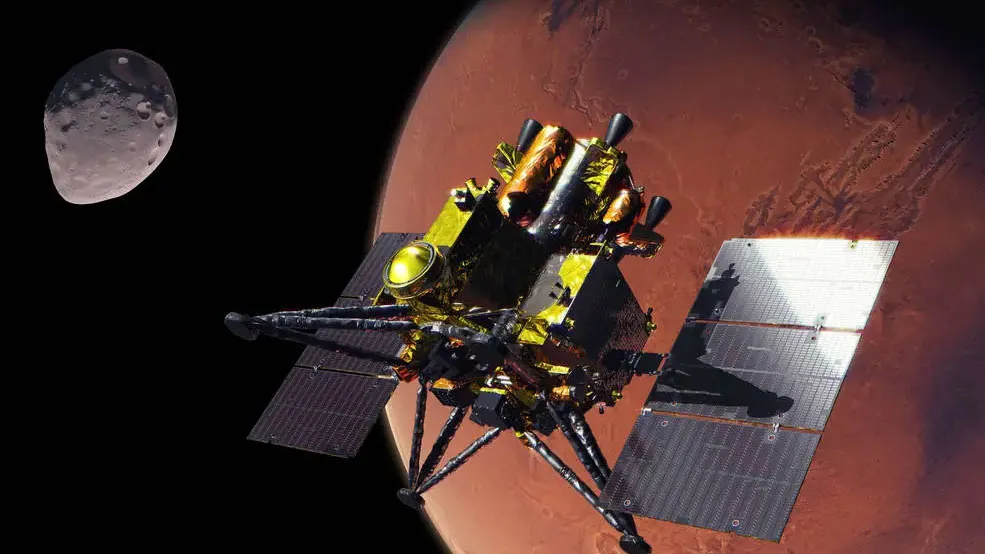
Japan's mission to Mars is one of the most ambitious in spaceflight history. It aims to become the first spacecraft to return to Earth from Mars orbit, carrying with it the first-ever samples from the Red Planet system.

The mission, known as Martian Moons eXploration (MMX), is a first-of-its-kind endeavor to study the origin of Mars' moons Phobos and Deimos. The robust undertaking includes a landing on Phobos to collect the samples — which will likely be the first from the Mars system to return to Earth — and a search for evidence that could shed light on events during the formation of the solar system billions of years ago.

MMX launched on an H3 rocket from Japan's Tanegashima Space Center on Monday (Oct. 19) at 3:41 p.m. EDT (1941 GMT; 4:41 a.m. local time in Japan, Oct. 20). After a 10-month journey to reach Mars, the spacecraft will spend about three years studying Phobos, deploying a rover and landing to collect its samples. The mission will then shift its focus to Deimos for a series of flybys before departing for Earth in November 2030. If all goes according to plan, the MMX sample-return capsule is scheduled to land in Australia in 2031.

The spacecraft

The MMX spacecraft is comprised of three main parts, as well as a small rover. After release from its H3 launch vehicle, a propulsion module will provide the boost to put MMX on course for Mars. MMX's main exploration module carries the microwave-size IDEFIX rover and most of the mission's scientific instruments, while the return module houses the sample-return capsule.

Japan's Mitsubishi Electric built MMX's three main modules, with the French space agency CNES (Centre National d'Études Spatiales) and Germany's DLR (Deutsches Zentrum für Luft-und Raumfahrt) jointly developing IDEFIX. The little rover is named for a dog in the 1960s French comic "Asterix," in a nod to the country's first satellite, Astérix, which launched in 1965.

IDEFIX carries a suite of cameras, as well as the Raman Spectrometer for MMX (RAX) and miniaturized radiometer (miniRAD) instruments to analyze Phobos' surface composition and temperature.

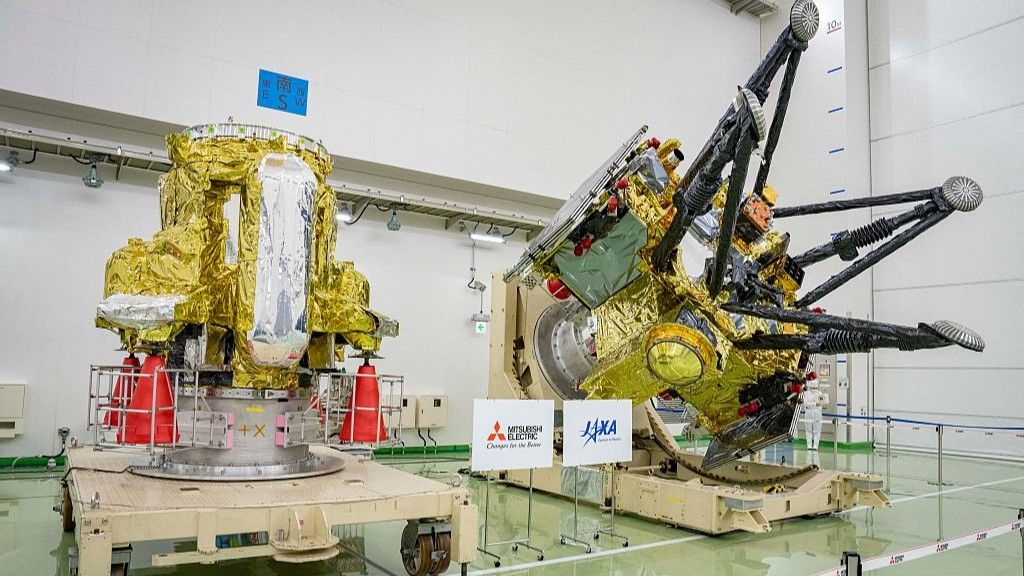
The Propulsion Module (left) and Exploration and Return Modules (right), which together make up Japan’s Martian Moons eXploration (MMX) spacecraft, are seen at the Tanegashima Space Center in Minamitane, Kagoshima prefecture on Aug. 13, 2026.

The Propulsion Module (left) and Exploration and Return Modules (right), which together make up Japan’s Martian Moons eXploration (MMX) spacecraft, are seen at the Tanegashima Space Center in Minamitane, Kagoshima prefecture on Aug. 13, 2026. (Image credit: Yuichi YAMAZAKI / AFP via Getty Images))

Most of MMX's scientific instruments are housed on the exploration module, like NASA's Mars-moon Exploration with Gamma rays and Neutrons (MEGANE, pronounced "meh-gah-nay") device, a gamma-ray and neutron spectrometer built by the Johns Hopkins Applied Physics Laboratory (APL), and France's MIRS (MMX InfraRed Spectrometer) instrument.

The exploration module also houses the Japanese-built TENGOO (TElescopic Nadir imager for GeOmOrphology) tight-zoom camera, wide-angle OROCHI (Optical RadiOmeter composed of CHromatic Imagers) multispectral camera, laser altimeter (LIDAR) and Mass Spectrum Analyzer (MSA). The return module, meanwhile, carries Japan's Circum-Martian Dust Monitor (CMDM) and Interplanetary Radiation Environment Monitor (IREM).

The mission

MMX will arrive in orbit around Mars in August 2027, at which point it will shed its propulsion module and transition into a quasi-satellite orbit (QSO) around Phobos that allows the probe to fly in a sort of formation with the small, asteroid-sized moon as they both circle the Red Planet.

The spacecraft will spend its first few months in the Martian system observing Phobos from different altitudes, using its TENGOO and OROCHI cameras, LIDAR and MSA to map the moon's surface, study its composition and select potential landing sites.

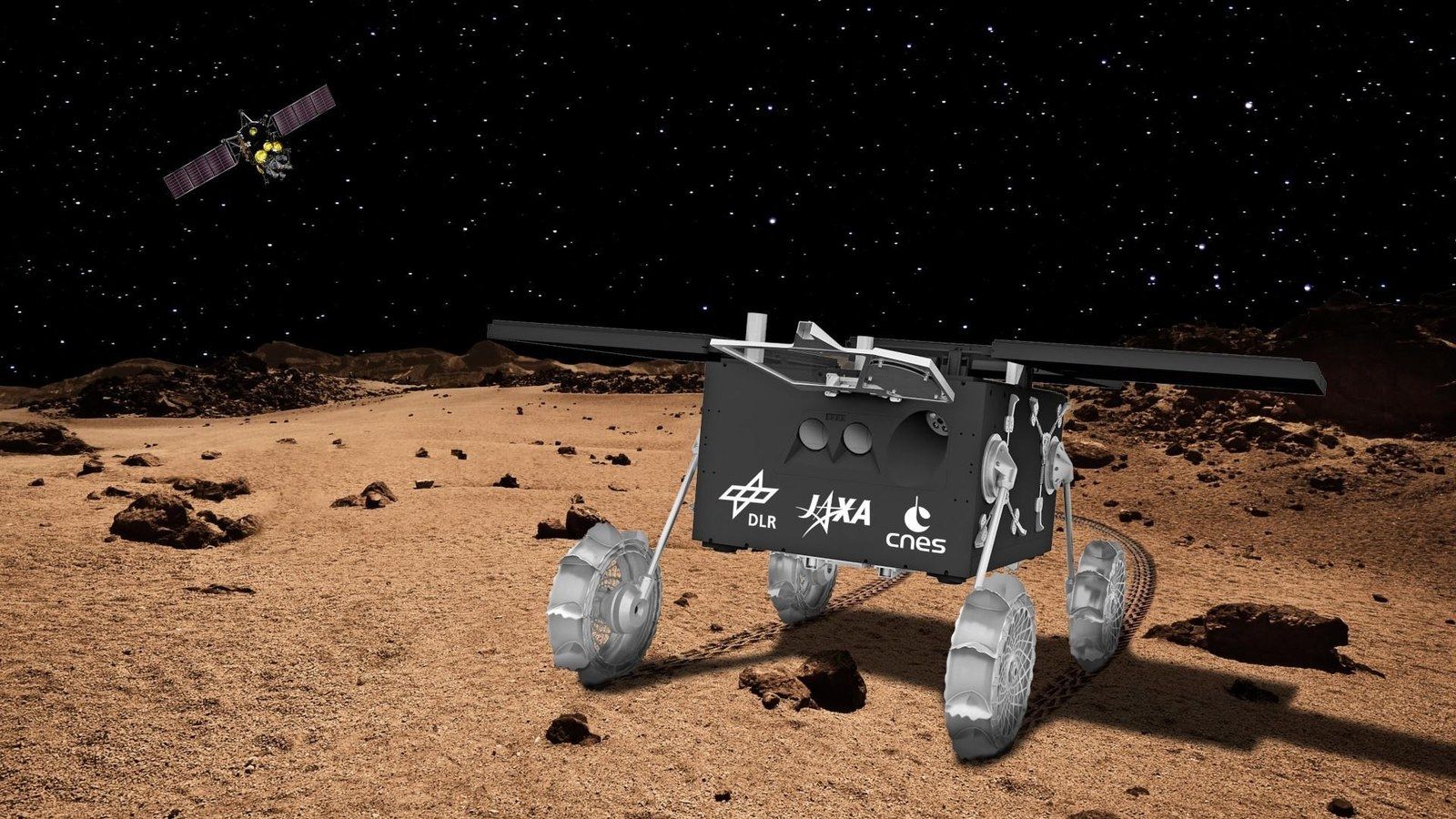
IDEFIX will be released in late 2028 or early 2029, during the first of two MMX landing rehearsals, at about 130 feet (40 meters) above Phobos. Due to the 14-mile-wide (22 kilometers) moon's extremely low gravity, the rover will be able free-fall to the surface damage-free (hopefully), right itself after a few bounces and begin exploring to gather data on the terrain and surface conditions.

a four-wheeled black cartoon rover stands on the surface of a planet hued in light browns. A starry night space scape is seen above with a satellite in the upper left.

An artists render of IDEFIX on the surface of Phobos. (Image credit: CNES/DLR/JAXA (ASTERIX® OBELIX® IDEFIX® © Année LES EDITIONS ALBERT RENE / GOSCINNY-UDERZO))

MMX sample collection could begin as early as December 2028, the acting director of NASA's Planetary Science Division, Lindsay Hays, said during a mission briefing on Oct. 15. The spacecraft will attempt two collection landings, with its exploration and return modules descending and returning to orbit as one vehicle.

On Phobos' surface, two different sampling mechanisms — the Corer Sampling Mechanism (C-sampler) and Pneumatic Sampling Mechanism (P-sampler) — will extract and collect at least 10 grams (0.35 ounces) of material for stowage inside the spacecraft's return capsule before MMX lifts off again for orbit. After its first touchdown and sample collection, MMX will return to QSO near Phobos before descending to a second landing site for a similar attempt and subsequent return to orbit.

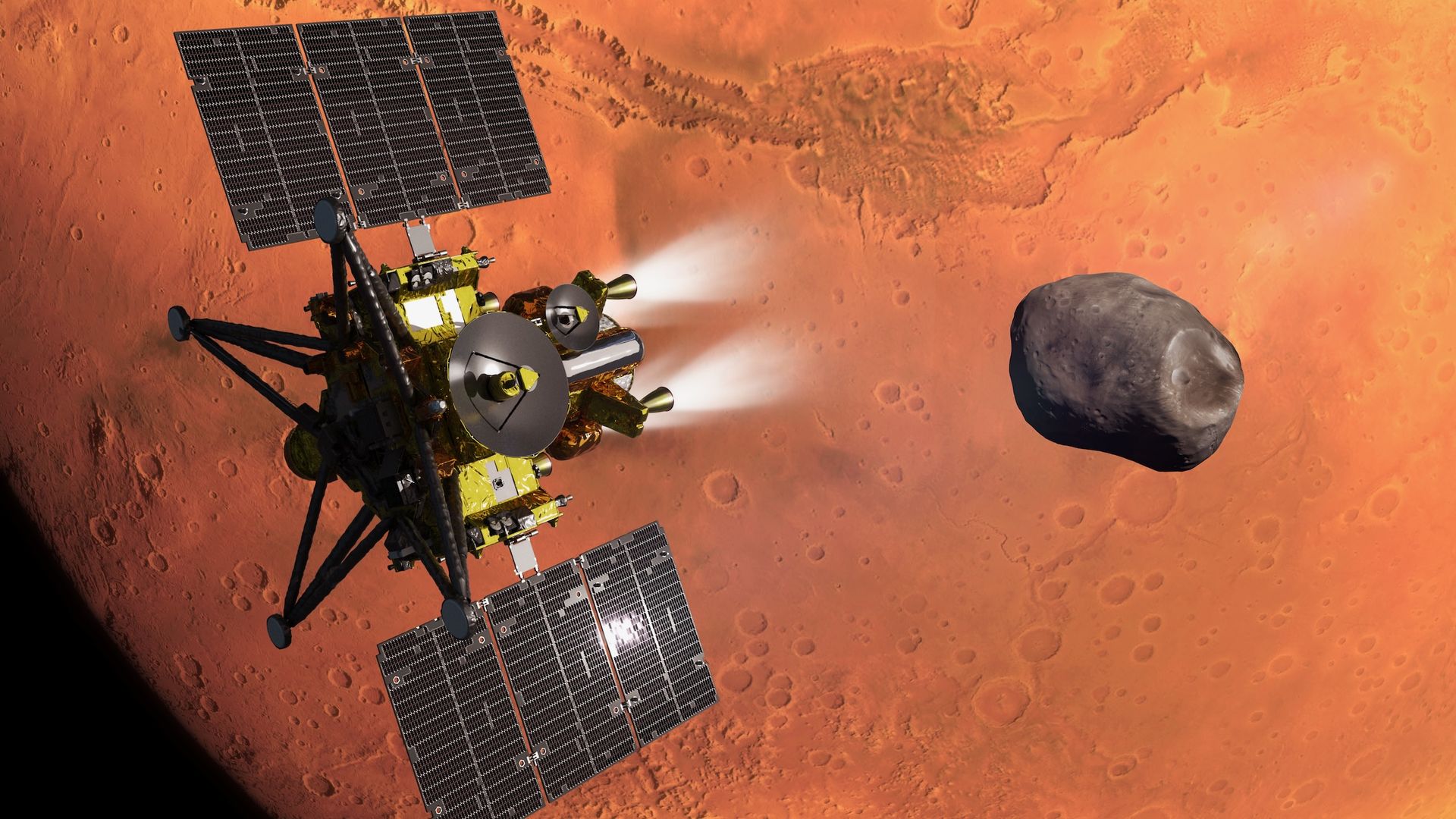
An artist’s concept of JAXA’s MMX spacecraft during its Mars’ orbit insertion. The Martian moon Phobos, which MMX will explore and sample, is in the background.

An artist’s concept of JAXA’s MMX spacecraft during its Mars’ orbit insertion. (Image credit: JAXA)

MMX will end its observations of Phobos after about three years focused on the Martian moon, and will transition into a higher, resonant orbit around Mars in 2030. That course will repeatedly intersect Deimos' path for a series of flybys to collect and compare data with those from Phobos observations as scientists aim to investigate the moons' origins.

Near the end of 2030, the exploration module will separate, leaving the return module to fire its engine out of Mars' gravitational influence and begin an eight-month journey back to Earth with the collected samples. As MMX closes the last stretch of void during its approach to Earth in 2031, the sample-return capsule will separate and enter the atmosphere for a targeted parachute landing in Australia's Woomera region, where its contents will be recovered for laboratory analysis by Japan and its mission partners.

Phobos and Deimos

Those samples, and the data collected by MMX, could tell scientists a lot — about the moons' composition, geography and, perhaps most importantly, how they came to exist in the first place. There are two leading theories for Phobos and Deimos' origins, both of which point to very different versions of ancient Martian history.

"Phobos and Deimos are interesting, but not just in their own right. Their presence is a key piece of the larger story of the Mars system," said Tom Statler, MMX program executive and scientist in NASA's Planetary Science Division, during the Oct. 15 mission briefing. "By uncovering the moons' origin, we'll gain new insights into the history of both Mars and Earth, especially those events that shaped both planets billions of years ago and helped create the worlds we see today."

Both Phobos and Deimos are relatively small and irregularly shaped, and bear several resemblances and spectral characteristics to primitive D-type asteroids — ancient bodies thought to preserve material dating back to the solar system's formation about 4.6 billion years ago. Those similarities suggest Phobos and Deimos may have formed elsewhere in the solar system and were later captured by Mars' gravity.

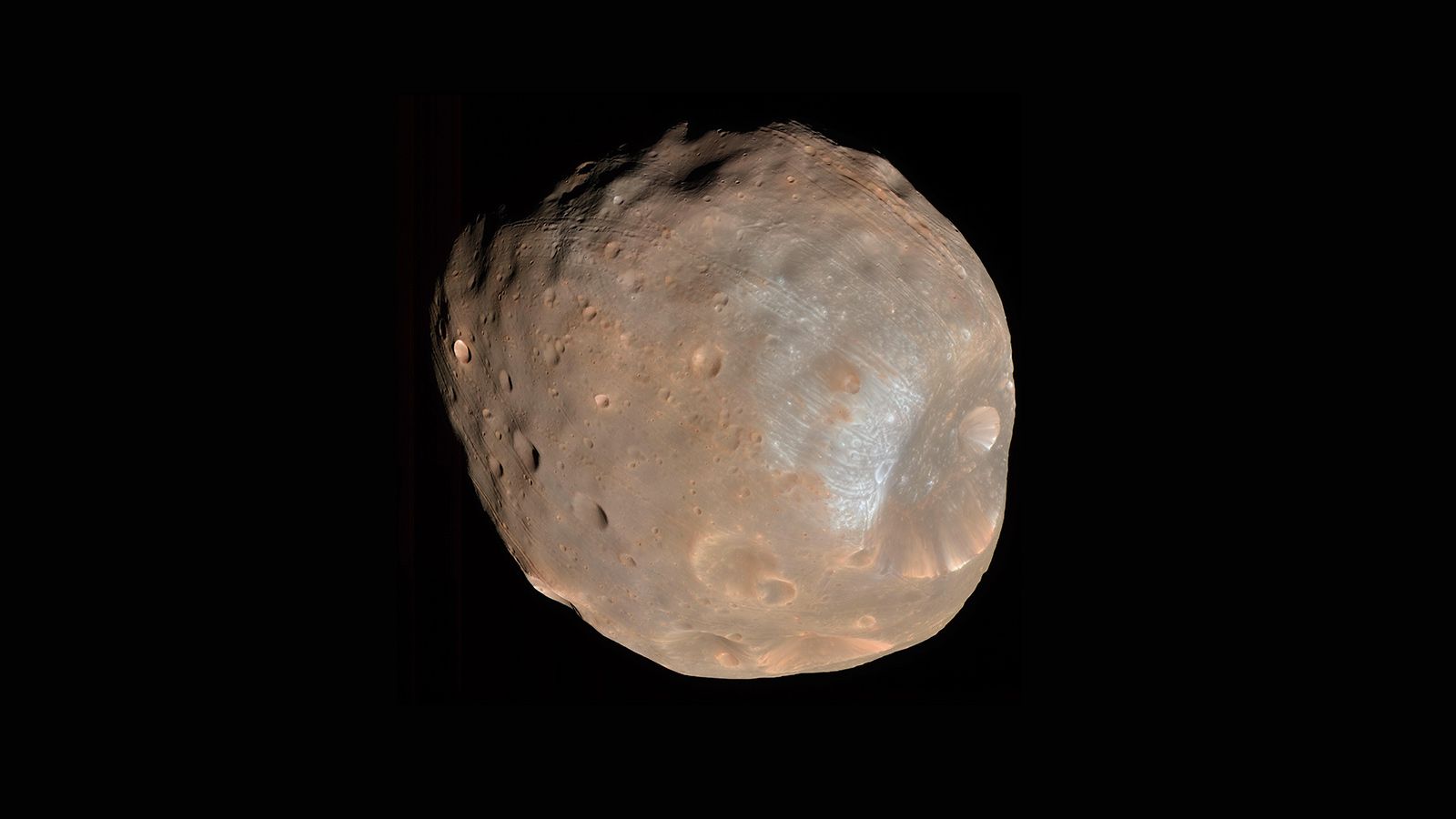
Phobos is the larger of Mars' two small moons and bears the scars of millennia of small impacts.

Phobos is the larger of Mars' two small moons and bears the scars of millennia of small impacts. (Image credit: NASA/JPL-Caltech/University of Arizona)

Their near-circular, equatorially-aligned orbits around the Red Planet, however, somewhat complicate that theory. For example, a captured asteroid would be much more likely to have entered an elongated and tilted orbit akin to the direction and velocity of its original approach, scientists say. A competing hypothesis, therefore, offers a much more violent, but somewhat familiar, narrative for the moons' origins.

An enormous collision with ancient Mars could have blasted material into orbit to form a debris disk from which the two moons eventually coalesced. Such a process, which would be similar to the formation of Earth's moon, could explain their circular, equatorial orbits.

The contradicting geological and orbital observations for Phobos and Deimos collected to date have prevented scientists from definitively establishing one hypothesis over the other. MMX aims to provide an answer.

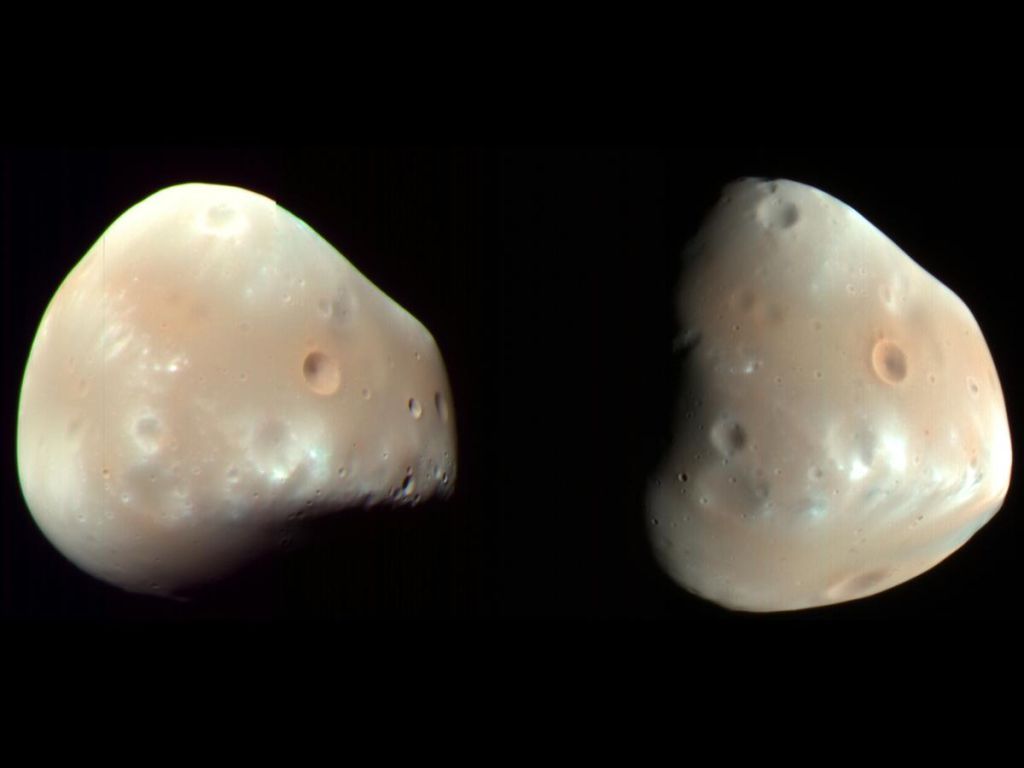
Images captured by NASA's Mars Reconnaissance Orbiter reveal that the surface of Deimos is mostly smooth, marred only by recent impact craters.

Images captured by NASA's Mars Reconnaissance Orbiter reveal that the surface of Deimos is mostly smooth, marred only by recent impact craters. (Image credit: NASA/JPL/University of Arizona)

"It's two totally different lines of evidence that point in two different directions. That's what makes it an interesting puzzle," Statler said. Several theories have also been presented for hybrid scenarios combining the two, he added.

"There's all kinds of different ways, all kinds of different combinations of those two basic scenarios," Statler explained. "But that's the puzzle from the start, the two seemingly contradictory lines of evidence that are pointing us to what … the real history was, but we don't know what it is yet."

The science

Each theory for where Mars' moons came from predicts different chemical characteristics for their surfaces. Presumably, captured asteroids would preserve chemical signatures of material originating elsewhere in the solar system, potentially rich in volatile elements like hydrogen. Moons formed through a planetary impact, however, would contain a mixture of Mars and impact material, altered by the intense heat of such a violent collision.

Determining which scenario is more likely could reveal whether Mars experienced a massive moon-forming collision or acquired its moons from elsewhere in the early solar system. Either answer could offer new insights into the planet's evolution and the events that shaped the terrestrial planets like Earth billions of years ago, mission team members say.

"At this point, we know nothing about the composition of Phobos," David Lawrence, MEGANE principal investigator at APL, said during the Oct. 15 briefing. "We have information about mineralogy, but no elemental composition. And so, elements are really a key way to get at some of these foundational questions."

MMX's scientific suite has been carefully calibrated to make those determinations. The cameras and sensors on the MMX exploration module's TENGOO, OROCHI and LIDAR instruments will map Phobos' terrain, geological features and variations in surface materials from orbit, to provide clues about the moon's formation and evolution. Complementing those measurements, MIRS is designed to detect and classify Phobos' surface minerals and search for organic compounds to further differentiate its possible origin as an asteroid or ancient chunk of Mars.

The RAX spectrometer and miniRAD instrument aboard IDEFIX will add localized context to those observations by examining surface mineralogy and their thermal properties up close.

Back in orbit, NASA's MEGANE instrument will measure Phobos' elemental composition through gamma-ray and neutron spectroscopy that can scan tens of centimeters beneath the moon's surface for signs of volatile elements. Higher abundances of hydrogen, chlorine, sodium and potassium, for instance, would favor the asteroid-capture hypothesis, while lower abundances of those compounds could point to the heat and chemical deterioration associated with a planetary impact.

"In Japanese, 'megane' means eyeglasses," Lawrence said. "So we like to think of MEGANE as being an instrument that will look at Phobos with gamma ray and neutron glasses."

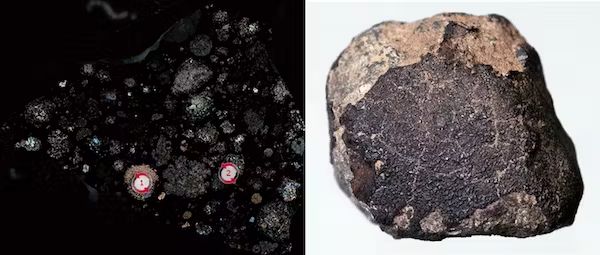
a split image. a dark background looks at microscopic pieces of mars rock. on the right, a mars rock.

A martian meteorite under the microscope and hand specimen. (Image credit: Open University, CC BY-NC-SA)

When compared to the samples MMX will return to Earth, MEGANE's findings could help scientists determine if volatile depletion found on Phobos reflects the intense heat of a post-impact formation or billions of years of subsequent erosion from the natural effects of space exposure.

MSA, meanwhile, will measure charged particles around Phobos, searching for evidence of subsurface ice and investigating how solar wind exposure has altered the moon's surface. It will also study atmospheric particles escaping from Mars. CMDM will measure dust around Mars, including particles potentially ejected from its moons by impacts.

Comparative observations of Deimos after MMX's final departure from Phobos will help establish whether the moons share similar compositions and, potentially, a common origin.

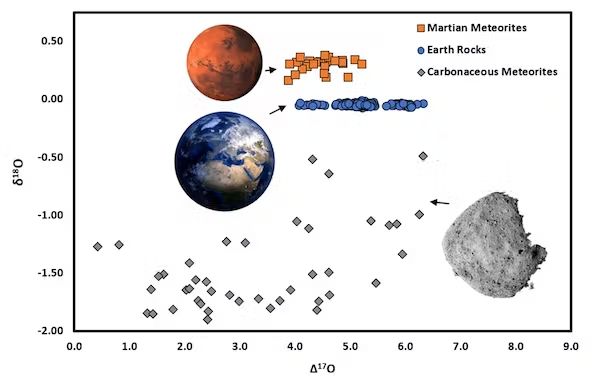
Once safely returned to Earth, laboratory analysis of the Phobos samples will allow scientists to examine chemical composition and mineralogy with a precision beyond that of MMX's onboard instruments. Tests like isotopic analyses — measuring subtle differences in the atomic makeup of elements — can help identify the samples' origins by comparing their chemical fingerprints with those of Martian rocks and asteroid material.

JAXA (Japan Aerospace Exploration Agency) scientists think some returned material could even originate from Mars itself, deposited on Phobos after ancient asteroid impacts blasted rocks off the Red Planet's surface, potentially holding evidence of its geological past.

a plot graph shows grey dots along the bottom with a grey asteroid on the bottom right. earth hangs middle left, with mars above. both planets have many dots, blue and orange, respectively, a crowded near the top right area of each planet.

Oxygen isotope plot showing the stark differences in oxygen between the Earth, Mars and asteroids. If Phobos does indeed represent an ancient fragment of Mars, it could comprise the most primitive of Martian material. (Image credit: Open University, CC BY-NC-SA)

International effort

The JAXA-led mission represents interagency partnerships with NASA and the European Space Agency (ESA), which are providing hardware and communications support through the Deep Space and Estrack networks.

NASA's contributions to MMX also include MEGANE, the Honeybee Robotics-built P-sampler, and an approximately $87 million investment through the end of the mission. NASA is funding the United States scientists on the MMX team, who will, alongside NASA's astromaterials experts, "be fully involved in the examination and scientific analysis of the Phobos samples when they are delivered to Earth," Hays said during the mission briefing. "We get all of the value and all of the scientific participation at a lower cost total [than funding the entire mission]."

For its role, NASA will receive at least 15% of the returned samples, with materials to be maintained at the agency's Johnson Space Center in Houston for analysis and long-term preservation. To that end, MMX's scientific impact could extend far beyond the mission's conclusion.

"The Phobos samples will be historic," Statler said, with the potential "for future research to answer the questions we don't even know yet how to ask."

  •  

Computer scientist Margaret Hamilton was a problem-solver for the ages (op-ed)

Dean Robbins is a journalist and children's author. He contributed this article to Space.com's Expert Voices: Op-Ed & Insights.

The pioneering computer scientist Margaret Hamilton, who died on Sept. 30 at age 90, played a key role in putting astronauts on the moon. She was a problem-solver extraordinaire, and it all started in early childhood.

Considering the name "daddy longlegs" unfair to female arachnids, young Margaret decided to call half of them "mommy longlegs." Wondering why the neighborhood baseball players were all boys, she determined to join the team herself.

As she grew up in the 1940s and '50s, Margaret noticed a similar problem with various professions. Why were doctors, judges and scientists almost always men? The solution: she would study hard in school and prepare herself for any job she might care to do.

It's no surprise that a born problem-solver would gravitate to computers. In the late 1950s, the new technology offered mind-bending possibilities, and this college math major saw a chance to put her skills to use on a cosmic scale.

Hamilton had long been a stargazer, thanks to a philosophical father who taught her to love the night sky. In 1965, after stints in meteorology and satellite tracking, she became interested in a Massachusetts Institute of Technology project that designed in-flight computers for NASA's moon mission.

The team, of course, consisted solely of men. But, just as with her neighborhood baseball team, Hamilton refused to accept limitations for herself or anybody else. She kicked open the door and quickly rose to director of software engineering.

With her knack for devising novel solutions to seemingly insoluble problems, no one was better suited for the job. Working with the era's primitive technology, Margaret thought through the various mishaps that could occur on a spaceflight and designed the software to handle every contingency.

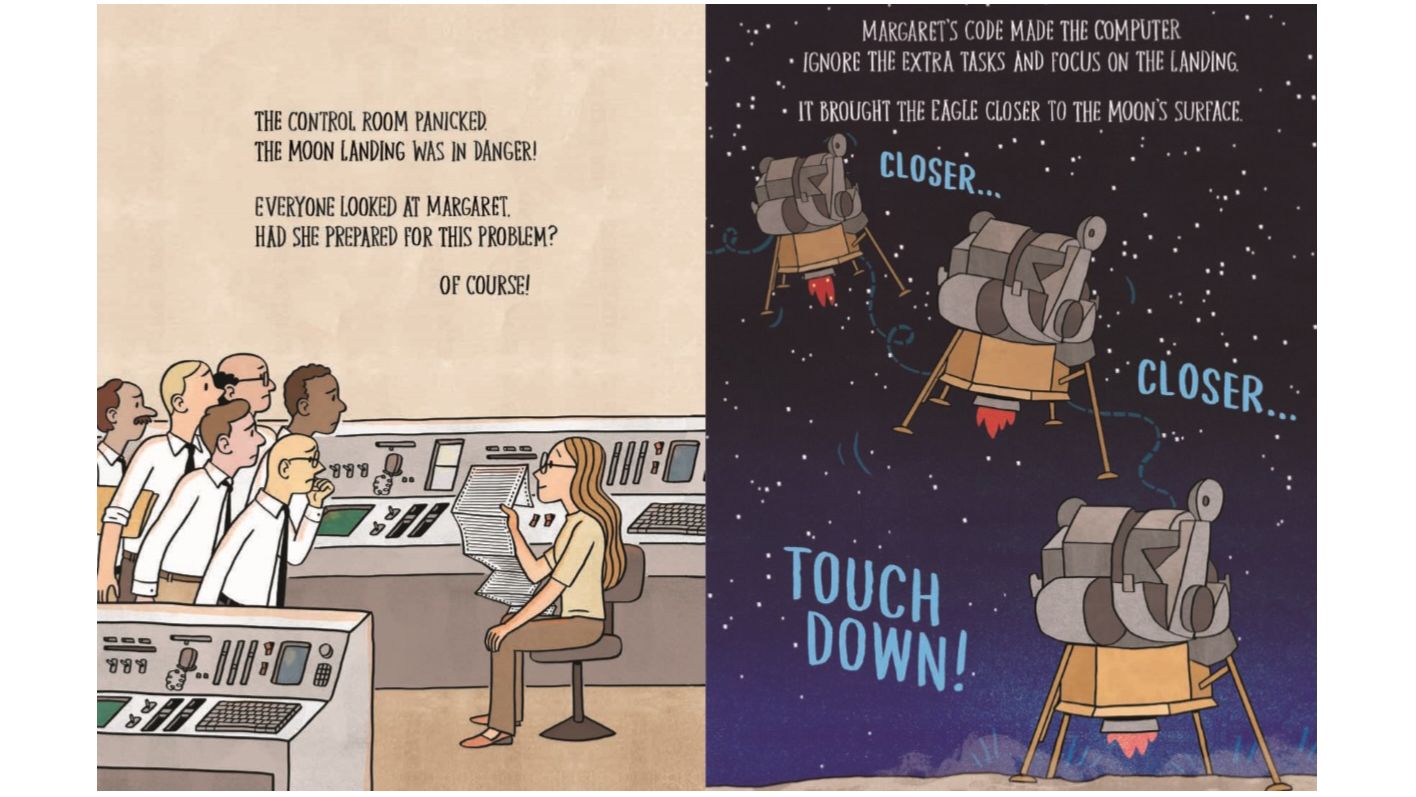
The epochal Apollo 11 moon mission of 1969 put her planning to the test. As astronauts Neil Armstrong and Buzz Aldrin neared the moon's surface in their lunar module, an error overloaded the onboard computer's processing unit. Mission Control faced the prospect of aborting the landing, but Margaret's ingenious programming allowed the system to prioritize essential tasks while canceling the inessential ones. The lunar module touched down without a hitch, and Armstrong and Aldrin became famous.

two-page spread from a graphic novel, showing a woman in glasses holding and then standing next to a giant stack of papers

An excerpt from Dean Robbins' 2017 book "Margaret and the Moon: How Margaret Hamilton Saved the First Lunar Landing." (Image credit: Illustrations by Lucy Knisley, illustrations copyright © 2017 by Lucy Knisley; and Excerpt(s) from MARGARET AND THE MOON by Dean Robbins, text copyright © 2017 by Dean Robbins. Used by permission of Alfred A. Knopf, an imprint of Random House Children's Books, a division of Penguin Random House LLC. All rights reserved.)

Sadly, Margaret Hamilton did not. She continued to work behind the scenes, contributing to the five additional lunar landings as well as Skylab and the space shuttle. In 1976, she struck off on her own to start a software company. She might have lived the rest of her life in obscurity if not for a fateful black-and-white photograph from 1969.

This image began to attract attention on the internet in the 2010s. It showed Margaret wedged between a coatrack and a blackboard at MIT, standing beside a towering stack of her printed code from the Apollo missions. Bespectacled and smiling, she radiates the confidence of a scientist who had stormed the boys' club and conquered the universe.

I was one of those fascinated by the photograph, and I contacted Margaret about the possibility of profiling her in a children's book. She initially resisted, uncomfortable with being the center of attention. But she came to see the appeal of a book about herself that she could read to her great-grandchildren, so that they might be inspired to break barriers themselves one day. She warmed to the task of telling her life story and even sent me examples of her Apollo code, which Lucy Knisley incorporated in the illustrations for "Margaret and the Moon: How Margaret Hamilton Saved the First Lunar Landing."

two pages from a graphic novel, showing a woman and six men in a computer lab and a spacecraft landing on the moon

Another few pages from "Margaret and the Moon." (Image credit: Illustrations by Lucy Knisley, illustrations copyright © 2017 by Lucy Knisley; and Excerpt(s) from MARGARET AND THE MOON by Dean Robbins, text copyright © 2017 by Dean Robbins. Used by permission of Alfred A. Knopf, an imprint of Random House Children's Books, a division of Penguin Random House LLC. All rights reserved.)

With the 2016 book and movie "Hidden Figures" calling attention to women's overlooked contributions to the space program, Hamilton soon had to get used to being the center of attention. She received a Presidential Medal of Freedom and achieved LEGO immortality in the "Women of NASA" set. In 2019, to mark the 50th anniversary of the first moon landing, Google used reflected moonlight to create a massive portrait of Margaret in the Mojave Desert. Rarely has so humble a soul received so grand a tribute.

The world will miss Margaret Hamilton, but, just like her great-grandchildren, we will always have her example to inspire us. She showed that, no matter how daunting the obstacles, there are few problems we can't solve.

  •  

'Let's all choose to make tomorrow better', Artemis II astronauts honored with Stephen Hawking Medal at Starmus

TENERIFE, CANARY ISLANDS — The Artemis II astronauts may have traveled hundreds of thousands of miles away from Earth to the moon, but they made sure the rest of us didn't miss out on the adventure.

Now, their efforts to bring the wonders of space exploration back down to Earth have earned them one of science communication's most prestigious honors: the Stephen Hawking Medal.

NASA astronauts Reid Wiseman and Victor Glover, alongside Canadian Space Agency astronaut Jeremy Hansen, accepted the award on Saturday (Oct. 17), during the opening ceremony of the Starmus VIII festival. The honor recognizes all four crew members, including NASA astronaut Christina Koch, who wasn't in attendance.

For Wiseman, the experience of seeing our home planet from the vicinity of the moon carried a powerful message.

"If we could take each of you 250,000 miles away from this planet, 400,000 kilometers away from planet Earth, and you would see Earth the size of your thumb. It's tiny," Wiseman told the audience.

"When you're there looking through the moon, back at this tiny Earth, the only thing you feel is love, peace, hope, unity", he continued. "Those aren't the right words, but that is all you feel."

artemis 2 astronuats on a stage

Reid Wiseman delivered a powerful message during the awards ceremony. (Image credit: Daisy Dobrijevic/Future)

During their historic Artemis II mission, the astronauts did far more than put NASA's Orion spacecraft through its paces. Through live communications, interviews and glimpses into life aboard the spacecraft, not to mention the jaw-dropping photos that just keep on coming, they helped turn an extraordinarily complex mission into something people worldwide could experience and connect with.

And that's exactly what the Stephen Hawking Medal is designed to celebrate.

Established in 2016 by physicist Stephen Hawking and Starmus, the award honors those who have gone above and beyond to make science accessible, engaging and inspiring.

The Artemis II crew joins some pretty impressive company. Previous recipients include Apollo 11 moonwalker Buzz Aldrin, naturalist David Attenborough, primatologist Jane Goodall and astrophysicist Neil DeGrasse Tyson.

This year's ceremony marks the medal's 10th anniversary, with filmmaker Ridley Scott also among the 2026 honourees.

"It's a special thrill for us at Starmus to be able to honor the intrepid Artemis II crew members in the same way that we honored the Apollo astronauts who paved the way to the moon over 50 years ago," Starmus co-founder and Queen guitarist Brian May said in a statement ahead of the ceremony.

Wiseman left the audience with one final thought.

"When you come home to this beautiful planet, you realise that it's in every single one of us to choose to make tomorrow better," he said. "So let's all choose to make tomorrow better".

Starmus VIII runs from Oct. 17-22 across Tenerife and La Palma in the Canary Islands. This year's festival, themed "The Search for Truth", brings together leading scientists, astronauts, musicians and artists to celebrate scientific discovery and explore the importance of evidence and scientific thinking.

stage with musicians and the word starmus written at the back. left is Borcelli, then Brian May and on the right Ron 'bumblefoot' Thal

Starmus VIII's opening ceremony gave us the mashup we didn't know we needed... Andrea Bocelli, Brian May and Ron 'Bumblefoot' Thal. (Image credit: Daisy Dobrijevic/Future)

  •  

'It really does change you': SpaceX Crew-12 commander wishes we could all see our fragile Earth from space

The astronauts of SpaceX's Crew-12 mission to the International Space Station wish that we could all see Earth as they just did.

An orbital view reveals the immense beauty of our blue planet, the only world we know of that hosts life. But it also highlights how fragile that life is, tethered to our lonely Earth in the vast void of space, according to Crew-12 commander Jessica Meir of NASA.

"You see this very thin, tenuous band of an atmosphere, and you know that that is all that is supporting life, and we really need to do our best to protect it," Meir said on Thursday afternoon (Oct. 15), during a press conference that discussed the recently concluded Crew-12 mission.

"I wish that I could bring all the eyes of all the humans to look back at the Earth in this extraordinary way that we are so privileged to have," she added. "I think it really does change you philosophically and [in] how you see each other, how you see yourself, how you see the human race when you look on it down from the vantage point that we have from above — you know, [it] gives everybody this understanding that we need to protect our planet, that it's not only so beautiful, but it's so precious."

From the International Space Station (ISS), Meir said, it's clear that everything on Earth is connected — and that the borders we've laid down between states and nations are artificial constructs.

"You realize that we really are one human when you are in space," she said. "I wish I could share that perspective with all the eyes of all the humans. I think it would be a very healthy thing for everyone to understand.

Crew-12 mission specialist Andrey Fedyaev, of the Russian space agency Roscosmos, voiced similar sentiments, though he would turn an ISS visitor's eyes inward, to focus on the crew.

"I always say that the life of crewmembers on board the space station is the best example of how people need to live on Earth," Fedyaev said during Thursday's briefing (in Russian; in interpreter translated his words into English in real time)."

"We don't have borders. We are all friendly. We're just one crew, and the safety of the crew, the safety of the station, depends on the actions of the entire crew," he added. "So, if humankind does arrive at the same conclusion — that our Earth, our planet, is one and the same space vessel that flies through space — we need to take care of it and not to destroy it. So, that's what I would like to show to everyone on Earth."

Meir and Fedyaev are far from the only ones to have their perpsectives shifted by a space mission. Pretty much every astronaut experiences this phenomenon, which is known as the overview effect, a term coined in 1987 by space philosopher Frank White.

Crew-12 consisted of Meir, Fedyaev, NASA astronaut Jack Hathaway (the mission's pilot) and the European Space Agency's Sophie Adenot (mission specialist). It was the second spaceflight for Meir and Fedyaev and the first for Hathaway and Adenot.

The quartet launched toward the ISS on Feb. 13 atop a SpaceX Falcon 9 rocket. Their Crew Dragon capsule, named Freedom, arrived at the orbiting lab a day later.

Crew-12 spent nearly eight months aboard the ISS, finally returning to Earth on Oct. 8. They conducted a wide range of scientific experiments and maintenance work during that time and set a few records as well.

For example, Adenot became the first French woman ever to perform a spacewalk, and she broke the mark for longest continuous spaceflight by a European at 237 days. The previous record, 201 days, was set by Luca Parmitano in 2019-2020.

  •  

'Mission: 60s' event promises passport back to the Space Age

Your invitation to revisit the Space Age has arrived.

Whether you miss the days when people got dressed up to fly or you wish your "other" ride was a rocket, Mission: 60s has a *space* reserved for you.

"This is a three-day celebration of Apollo, aviation, space exploration and 1960s culture," reads a promo for the Oct. 23 to 25 event in New York. "You will be fully immersed in the sights, sounds and spirit of the 1960s Space Age."

"The weekend features astronauts, Apollo flight directors, Mission Control engineers, Star Trek legends, space artists, a Saturday Spacefarer Soiree with live music (1960s attire encouraged!), and a Sunday NASA Artemis keynote."

Organized by Luna Replicas, a company specializing in vintage space gear, and Space for Humanity, a nonprofit that underwrites spaceflight experiences, Mission: 60s is aimed at being the bridge between the last time humanity reached for the moon and today's "second space race" to do it again — this time to stay.

an event poster depicting rockets, a large Earth globe and an airport terminal

Mission: 60s at the TWA Hotel, Oct. 23-25, 2026, includes a tour of the 1964 World's Fair site and its NASA Apollo-era rocket displays. (Image credit: Mission 60s)

Launch pad

Your journey back to the 60s begins when you check into the TWA Hotel at the John F. Kennedy International Airport (JFK) in New York.

Once a functioning terminal for Trans World Airlines (as featured in the 2002 movie "Catch Me If You Can"), the TWA Flight Center has been reimagined as a hotel like no other.

"At the center of the hotel is Eero Saarinen's iconic TWA Flight Center, where restaurants, bars and retail outlets have taken flight. Two hotel wings, designed to reflect and defer to the landmark TWA Flight Center, sit behind the historic building and contain 512 guest rooms with views of JFK's runways and the TWA Flight Center," reads the hotel's website.

The TWA Hotel is only the first sight straight out of the past that guests will encounter. On Friday (Oct. 23), Mission: 60s begins with a guided tour of the 1964 World's Fair site in Flushing Meadows. Today the home to the New York Hall of Science, the outdoor exhibits includes the Rocket Park, where Gemini-Titan II and Mercury-Atlas D rockets and a Saturn V F-1 engine still stand.

"The space age was less than 10 years old when rockets like these powered incredible missions to outer space," reads the description on the museum's website. "Visitors will learn about the history of these vehicles as well as the United States' mission to reach the moon."

Also on view at the World's Fair site is the Unisphere, a spherical stainless steel representation of Earth, and the Astro-View Observation Towers (later reimagined as actual flying saucers in the 1997 movie "Men in Black").

The first day concludes with Space For Humanity's (separately-ticketed) "Celestial Soiree" and a Mission: 60's pool party on the hotel's rooftop.

MCC, ILC and ILM

Saturday and Sunday at Mission: 60s will bring together members of Mission Control (MCC), spaceflight experts (including ILC Dover, makers of the Apollo spacesuit) and representatives from the Hollywood community who brought about the 60s-era visions of space exploration (including Industrial Light & Magic [ILM]) for a series of engaging panel discussions.

Among the various topics scheduled for the two days of talks are:

  • Apollo Mission Control & Flight Operations
  • Apollo to Artemis & Beyond
  • Women in Aerospace
  • Apollo Communications: The Sights & Sounds From the Moon
  • SciFi Inspires
  • The Overview Effect
  • Making Space Real: Art & Visual Effects That Sold Humanity on Space
  • Space Advocacy

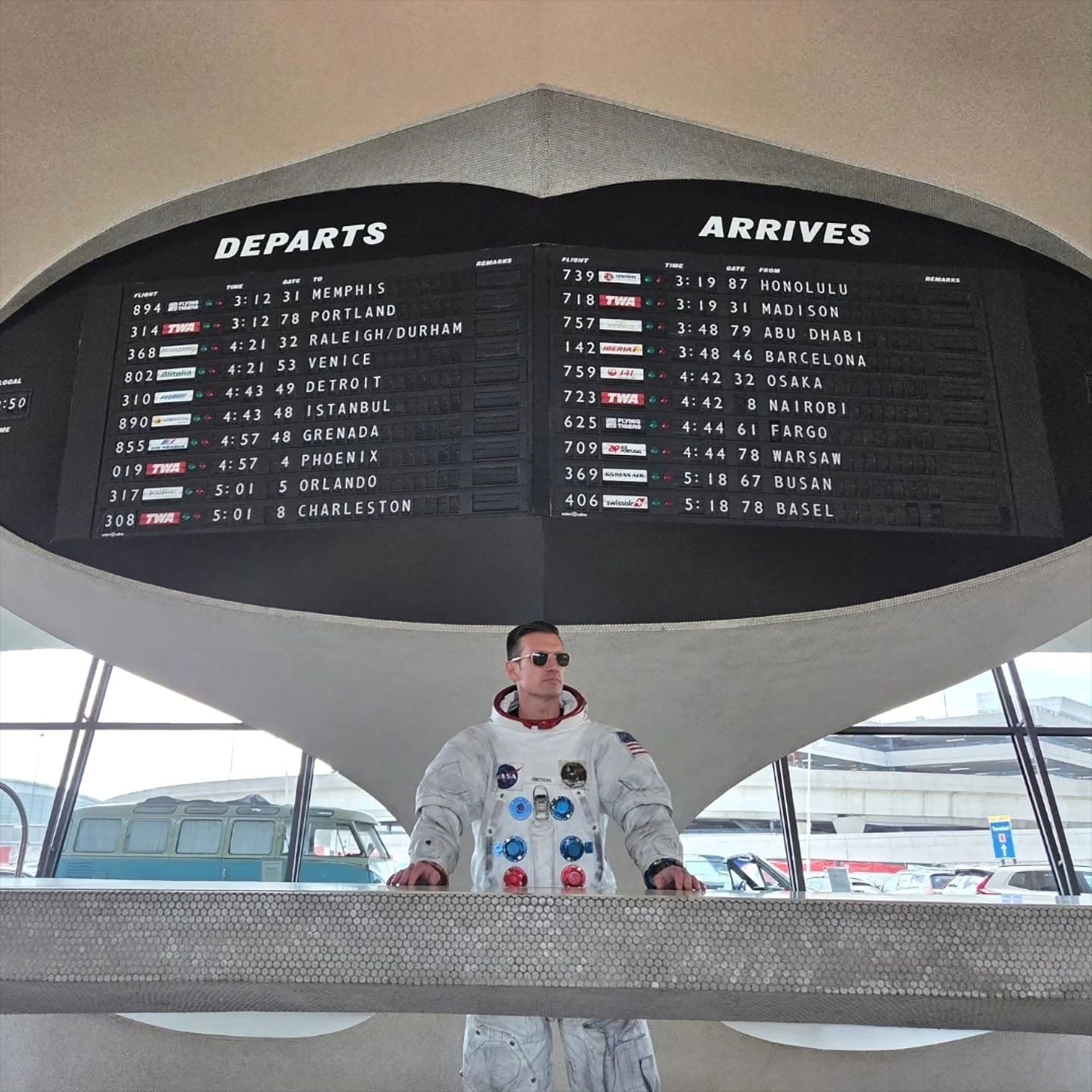
a man wearing a white spacesuit and sun glasses stands inside a retro airport terminal under a flight schedule board

Mission: 60s includes two full days of discussion panels spanning topics such as the Apollo spacesuit to the role of sci-fi in inspiring space exploration. (Image credit: Mission 60s)

Featured speakers and moderators include Apollo flight director Gerry Griffin, TIME Magazine science editor Jeffrey Kluger, former NASA astronauts Nicole Stott and Ron Garan, "Star Trek" actor Bob Picardo and researcher Frank White.

On Saturday evening, there will be a second gala, "The Spacefarer Soiree," featuring a limited meet and greet aboard a Lockheed Constellation airliner and music by Bonnie Gordon. Set in 1969, attendees are encouraged to come wearing their finest period clothing.

Then, on Sunday afternoon, Uplift Aerospace will host a shared "Overview" VR experience for up to 50 people participating together.

Both days will include a vendor and artists' hall, with guests signing autographs and their books, as well as companies such as NASA's official patch provider A-B Emblem, selling Apollo-themed souvenirs and memorabilia.

A weekend pass is $150 per person, with add-ons for VIP access, the galas and Friday's World Fair excursion. Single-day admission is $85.

  •  

Nobody can agree where space starts, and the 20 kilometres in dispute now matter to astronaut wings, space tourism and hypersonic weapons

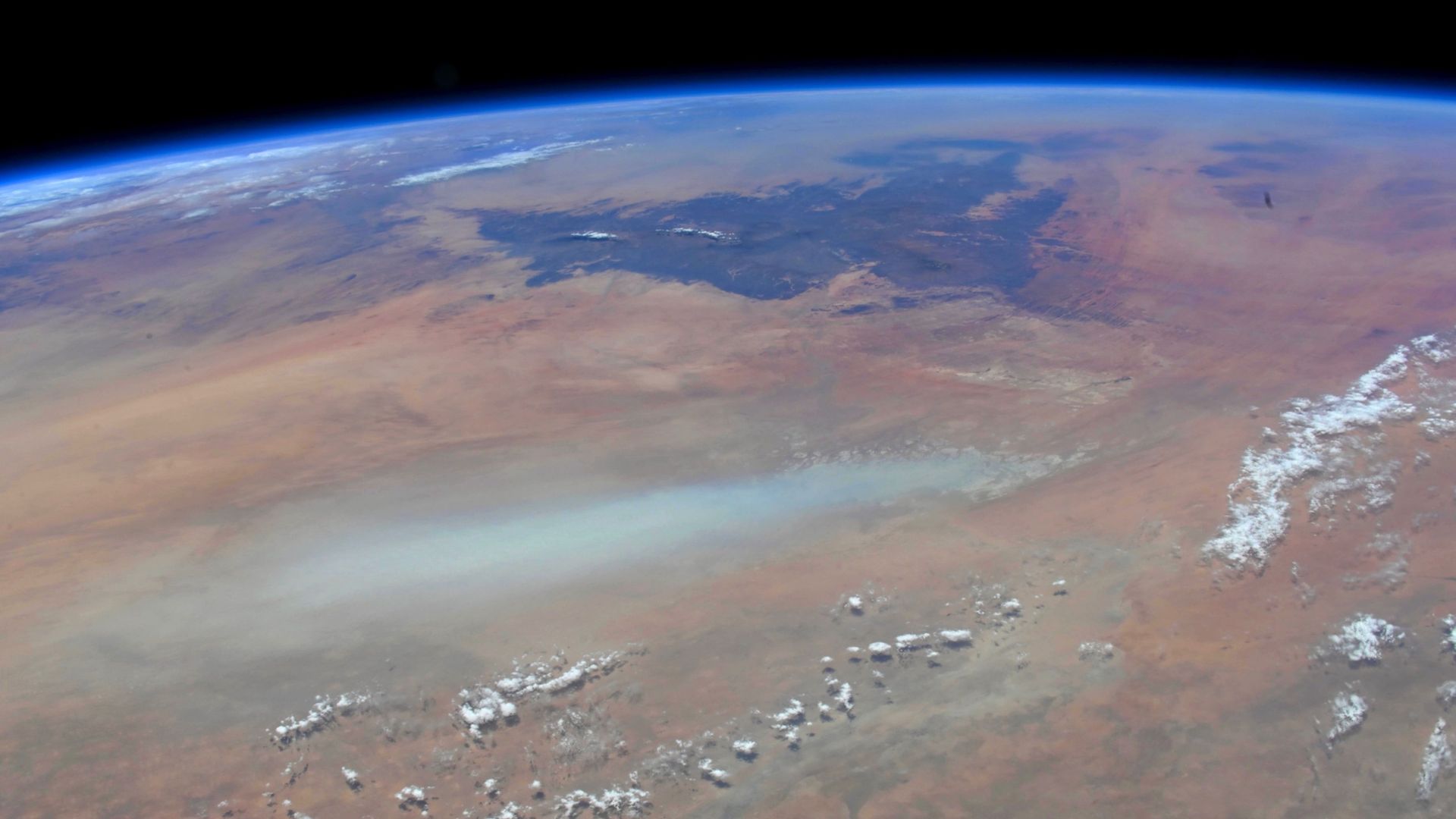
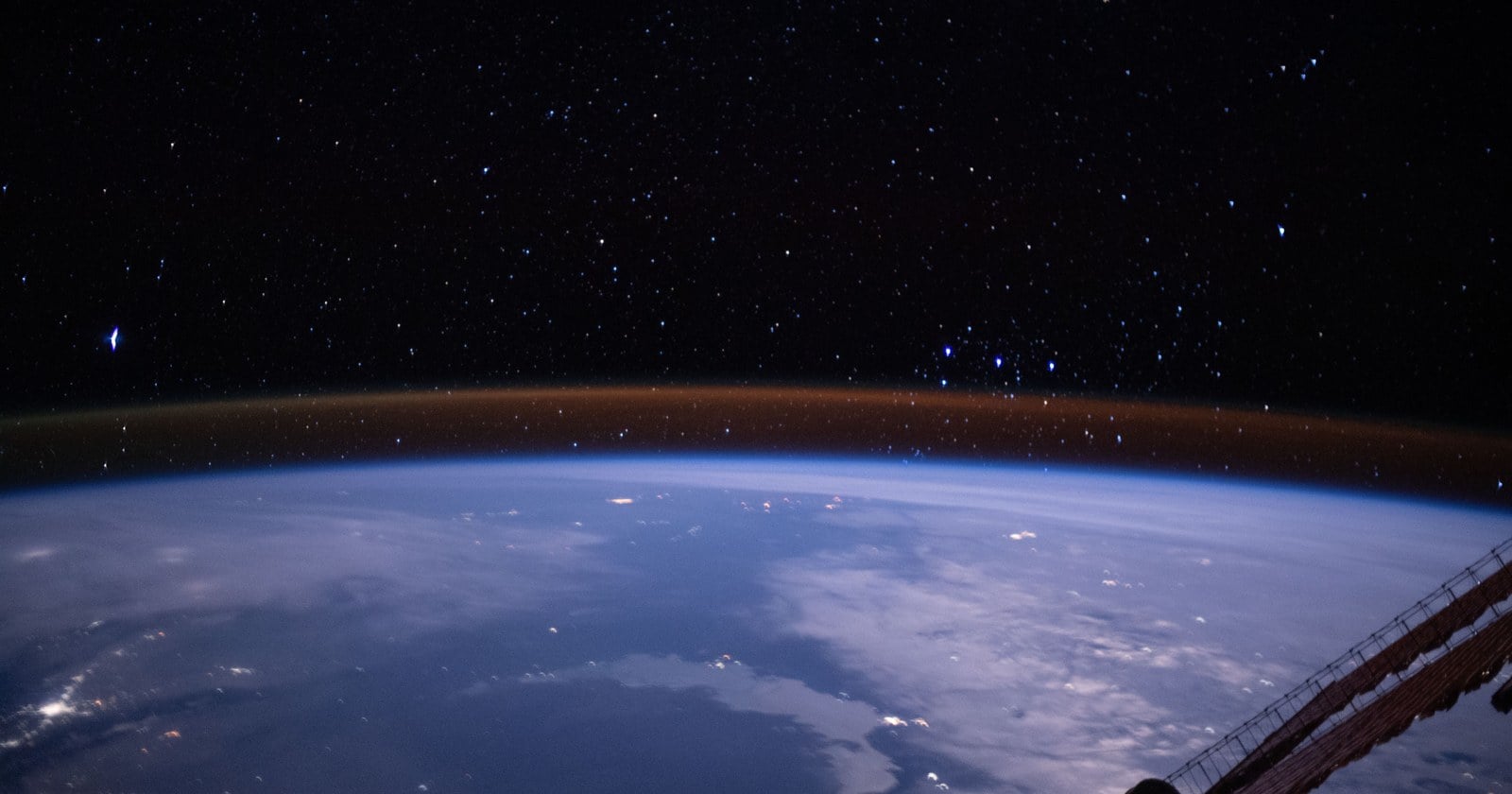
Earth's curved horizon from the International Space Station with a thin amber airglow band above the blue atmosphere and stars behind

There is no line where the atmosphere stops. It thins the way a beach gets wetter towards the sea, until at some point you are in the water and nobody can say exactly when that happened. So the edge of space is not something anyone discovered. It is something people chose, and they chose differently.

For decades that disagreement cost almost nobody anything. It is starting to. Tourist rockets fly into the disputed band with paying passengers and come back down. Hypersonic military vehicles pass through it. The question of which number is right has turned into a question about astronaut wings, ticket sales and, eventually, sovereign airspace.

Three numbers, one of them legal and it is blank

The familiar figure is 100 kilometres, the Kármán line. The FAI, the world air sports records body, uses it to separate aviation records from astronautics records. A 2023 FAI presentation by Nicolas Bérend says the federation set it in 1960, with a group of scientists that included Theodore von Kármán, “for separating aeronautics and astronautics records”. The name came slightly earlier: Andrew G. Haley coined “Kármán line” in a 1957 paper after discussions with Kármán. That is what the 100 kilometre figure is, a records-keeping convention with a date on it.

The American figure is 50 miles, about 80 kilometres. The US Air Force used it for its astronaut wings, and the Federal Aviation Administration used the same threshold for the commercial astronaut wings it handed out until it ended that programme after 2021. In 2005 NASA gave civilian astronaut wings to three X-15 pilots, retired NASA pilot Bill Dana and the families of the late John B. McKay and Joseph A. Walker, acknowledging “their flights above 264,000 feet altitude”. That is 50 miles. When those flights happened only the military had wings to hand out, so civilian pilots flew just as high and got no badge. Dana’s first flight into space took him 58.13 miles above the Mojave Desert on 1 November 1966.

The legal figure does not exist. The 1944 Chicago Convention gives every state complete and exclusive sovereignty over the airspace above its territory. The 1967 Outer Space Treaty says outer space is not subject to national appropriation. Neither treaty says where one ends and the other begins, a gap a 2017 briefing to the UN space committee’s legal subcommittee lays out plainly. The committee has had the item on its agenda since 1966. Inside it the USSR repeatedly proposed 100 or 110 kilometres and the United States rejected any definition at all. The subcommittee’s 2026 draft report still carries “Matters relating to the definition and delimitation of outer space”, sixty years on.

What the physics says depends on what you ask it

Kármán himself was blunt about this. In 1961 lectures quoted in the FAI presentation he said that where atmosphere ends and space begins “is a judiciary rather than a scientific problem”, and he proposed a range, 300,000 to 400,000 feet, roughly 91 to 122 kilometres, rather than a line. The 100 kilometre figure was a round number inside that range.

Bérend’s lift-based analysis for the FAI in 2023 points to about 110 kilometres. McDowell’s argument, based on satellite drag and orbital survival, points lower.

Jonathan McDowell, an astronomer who has worked at the Harvard-Smithsonian Center for Astrophysics, made the satellite case in a 2018 paper in Acta Astronautica, “The edge of space: Revisiting the Karman Line”, free to read on arXiv. He looked at the orbits of real satellites. An elliptical orbit whose lowest point sits at 100 kilometres can survive for long periods. A satellite whose lowest point drops below 80 kilometres is “highly unlikely to complete its next orbit”. That lowest point is the perigee. McDowell argues that this makes roughly 80 kilometres a useful boundary.

Two other things happen to land in the same place. Meteors, moving much faster than satellites, usually break apart somewhere in the 70 to 100 kilometre range, a sign that the atmosphere starts to bite there. The mesopause, a boundary layer in the upper atmosphere, lies in the same broad region, though its height varies with latitude and season and is not fixed at 80 kilometres. McDowell also notes that 80 kilometres falls within 500 metres of the old 50-mile astronaut wings line. Those are separate ideas that land in roughly the same place. He suggests adopting exactly 80 kilometres as a better convention, one that fits what satellites actually do.

He is also clear about how arbitrary the field has been. Citing an earlier survey by Goedhart, he counts almost 30 different proposals between 1951 and 1962, ranging from 20 kilometres to 400. A spread of twenty to one, inside a single decade, tells you how little the physics forced anyone’s hand before McDowell checked the orbits.

The FAI took the argument seriously. In a statement on 30 November 2018 it said recently published analyses presented “a compelling scientific case” for lowering the line from 100 to 80 kilometres, and it proposed a joint workshop with the International Astronautical Federation for 2019. The workshop did not move the line. The 2023 presentation’s own conclusion is that the boundary of space “is, in any case, a matter of convention”, and the commission’s March 2025 plenary minutes record “the decision to retain the 100 km value”. The FAI has looked at 80, and has chosen 100.

Why the 20 kilometres now matter

On 11 July 2021 Richard Branson flew on Virgin Galactic’s Unity 22 to an apogee of about 86 kilometres. Nine days later Jeff Bezos flew on Blue Origin’s New Shepard past 100. Two days before Branson’s flight, Blue Origin posted that New Shepard was designed to fly above the Kármán line “so none of our astronauts have an asterisk next to their name”. By McDowell’s number, and by the US number, Branson’s passengers went to space. By the FAI’s, they did not. Virgin Galactic has kept selling tickets in that gap ever since, even through its current pause in flights while it builds its next ships. The dispute is no longer about an X-15 pilot’s badge. It is about what a company can truthfully print on a brochure.

The military version is less visible and more serious. Some hypersonic boost-glide weapons pass through the band on the way up and down; a 2023 Congressional Budget Office analysis models one US design reaching about 120 kilometres before spending most of its flight at 30 to 40 kilometres. For a vehicle passing over another country at 90 kilometres, an agreed boundary could help determine whether it had entered sovereign airspace. Neither an astronaut-wings rule nor an air sports convention settles that question. Nor would being in space put a weapon beyond the law: the Outer Space Treaty says activities there are carried out in accordance with international law, including the UN Charter. An agreed boundary could clarify the sovereignty question, although it would not by itself settle the legality of a weapon’s passage or use. It is the piece that is missing.

We put that to McDowell by email. “I think indeed the choice of a boundary does start to matter more as there is more activity in that liminal region,” he wrote, “both tourist suborbital flights and hypersonic military tests.”

So why has the world not switched to 80? “These things take a long time, decades,” he said. “I think my view is slowly gaining ground but I don’t know if it will ever win out!”

What to make of it

The honest reading is this. Physics does not hand you one number. Different physical criteria produce different answers: about 110 kilometres in Bérend’s analysis, about 80 in McDowell’s, and Kármán’s own answer was a range. Every line anyone has drawn is a convention. McDowell’s case is that 80 is a better convention than 100 because it matches what satellites actually do, and that is a fair case. But physics can inform the choice without settling what the boundary should mean in law.

What has changed is not that vehicles reached the band. X-15 pilots were there in the 1960s. What has changed is that the band now has customers, competitors and weapons in it, and each of them is in space according to one authority and not according to another. The edge of space was always going to be a decision. For decades, states managed without agreeing on it. Commercial flights and military vehicles now give that unresolved question practical consequences, without making agreement inevitable. McDowell’s own estimate is decades, if ever.

The post Nobody can agree where space starts, and the 20 kilometres in dispute now matter to astronaut wings, space tourism and hypersonic weapons appeared first on Space Daily.

  •  

In 1967 the Americans had a spare rocket at Woomera, and Australia built a 45-kilogram satellite to fly on it in eleven months

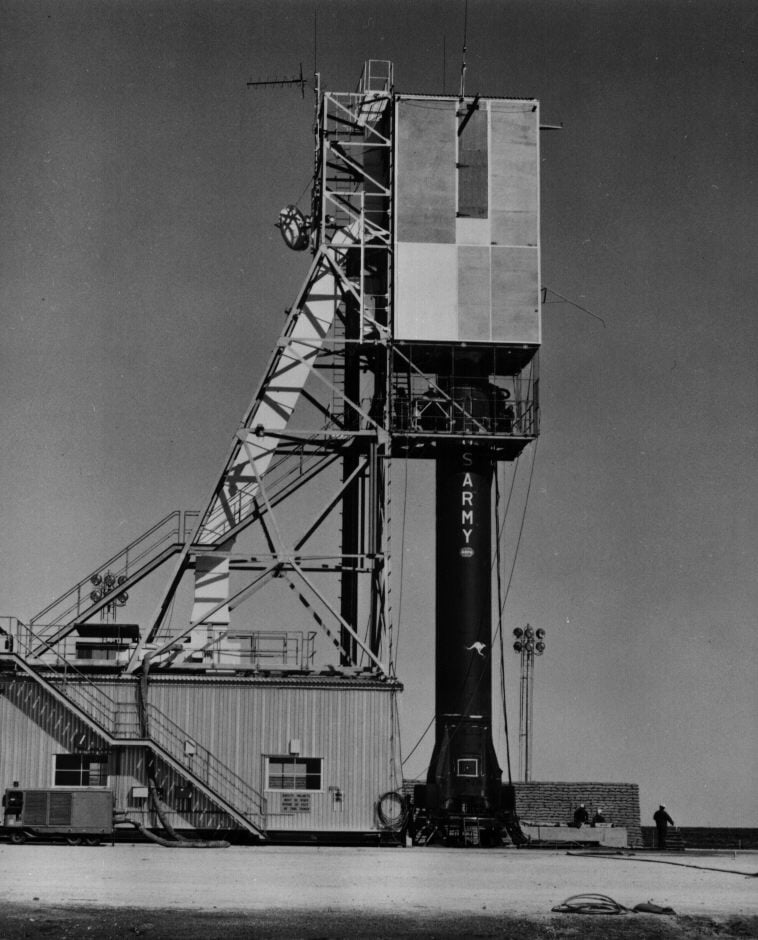
A Redstone-Sparta rocket beside its launch gantry at Woomera, South Australia.

On 28 November 1967, at the Woomera rocket range in outback South Australia, a six-hour countdown started on time and ticked all the way down to 30 seconds before launch. Then it stopped. A heating-cooler unit attached to the rocket had failed to eject, and everyone had to come back the next day.

I’m not a space engineer. I came across this story the way most people probably would, through a passing mention of Australia’s first satellite, and the more I read the more amazing it got. The rocket on that pad was a spare, left over from an American weapons test and given to Australia. The 45-kilogram satellite on top of it had been designed and built in Australia in about eleven months. And when it finally flew, at 2:19 the following afternoon, Australia had launched its first satellite, from its own soil, on an American rocket.

It was called WRESAT, short for Weapons Research Establishment Satellite. Here’s how it happened.

A spare rocket nobody wanted to ship home

The opportunity came out of a weapons program. During 1966 and 1967, Woomera hosted SPARTA, a joint US, UK and Australian project to gather data on the conditions nuclear warheads would face as they plunged back into the atmosphere. Ten American Redstone rockets were brought to Woomera for it, along with re-entry vehicles and an American team to fly them. If the name Redstone sounds familiar, it should. Modified Redstones launched America’s first satellite in 1958 and its first two astronauts, Alan Shepard and Gus Grissom, in 1961.

Only nine of them were needed, as Kerrie Dougherty OAM, space historian at the Australian Space Agency, notes in a paper on Australia’s early satellites. That left one spare. By then the Redstone was an obsolete rocket, and as Dougherty explained to me by email, the Americans “weren’t particularly interested in taking the spare back to the US”. Shipping it home wasn’t cheap either. As the Honeysuckle Creek history site puts it, “To send them back to the US would be a considerable expense.”

Project manager Des Barnsley, whose account is reproduced on that site, wrote that by late 1966 it was clear at least one of the ten vehicles would be surplus, and the idea of using it to launch an Australian satellite “was unofficially raised”. Who suggested it first has never been completely clear, Dougherty says. The Americans may have made the offer on their own, or WRE staff may have hinted that a rocket nobody wanted to take home would make a nice gift. Either way, the US decided it would be “a nice gesture of support to Australia” to donate it.

The catch: it had to fly before the end of 1967

The gift came with a deadline. The experienced American launch team would prepare and fire the rocket for the WRE, but only before they packed up and went home. That meant the launch had to happen as soon as possible after SPARTA wrapped up, and “definitely before the end of 1967”.

Everyone brought something to the table. The US supplied the rocket and a launch team from the aerospace company TRW “at no cost”. NASA agreed to track the satellite and collect its signals through STADAN, its worldwide network of tracking stations, “also at no cost”. The UK supported the launch operations through its long involvement with Woomera. Australia’s job was the satellite itself.

In other words, three countries lined up a rocket, a launch crew and a global tracking network, and Australia had less than a year to build something worth putting on top.

Eleven months, start to finish

Defence Science and Technology, the Weapons Research Establishment’s successor, records that design work began in early 1967 as a joint venture between the WRE and the University of Adelaide, and that the satellite was designed, developed, built and launched in eleven months. Barnsley’s own figure, written later, was “just less than twelve months”.

Whichever figure you use, the whole thing fitted inside a single year, with the team working towards a launch deadline that couldn’t move.

Not everyone thought it could be done. “There was plenty of scepticism from the US,” Dougherty told me. When I asked her what made it possible to build WRESAT so quickly, her answer was one word: “necessity!” If the satellite wasn’t ready before the US team left, the launch wouldn’t have gone ahead, or would have had to wait until a WRE team could be trained to prepare and fire the rocket themselves.

It also helped that the Australians weren’t starting cold. Barnsley put the speed down to work that had started long before the offer arrived. The WRE and the University of Adelaide’s physics department had spent years working together on upper atmosphere research using sounding rockets, small locally built rockets that carry instruments high into the sky and then fall back to Earth rather than going into orbit. WRESAT’s scientific payload, developed by the University of Adelaide, grew directly out of the instruments they had been flying on sounding rockets since 1962. The team already knew how to build the instruments. What they had never done was put them into orbit.

“With a lot of ingenuity, innovation and pragmatic decisions, they were able to have WRESAT ready to fly by November 1967,” Dougherty said.

The key people named on the history site are Barnsley as project manager, Professor J H Carver of the University of Adelaide, Bryan Rofe as officer in scientific charge, and Dr Don Woods. By Barnsley’s account, the outside contracts cost “a few hundred thousand dollars”.

Who deserves the credit?

I also asked Dougherty how she would split the credit between the two countries. She started with the Americans. The project “simply would not have occurred if the rocket had not been offered by the US”, the launch was handled by the experienced US team, and NASA provided the global tracking.

“But the rapid design and construction of the satellite itself, and its scientific payload, was an all-Australian project, albeit with advice and guidance from the US.”

Weighing it all up, this is where she landed.

“So I guess that I would have to put it at 50/50, or maybe even 60/40 in favour of the US, since their offer made the whole project happen. Australia gained entry to the ‘Space Club’ at a greatly discounted price!”

The tight schedule did come at a cost. The biggest drawback of working to the US timetable, Dougherty said, was that there was no time to design and build solar panels, so WRESAT had to run on batteries, “which severely limited its operational lifespan”.

Bumping around in the back of a truck

The satellite stayed attached to the rocket’s spent third stage in orbit, so there are two weights for it. The satellite on its own was a cone about 1.6 metres long, weighing 45 kilograms. Together with the burned-out stage it rode on, the whole package that reached orbit weighed about 72.5 kilograms and was a little over two metres long.

My favourite detail comes from the curator’s notes on Australian Screen Online. The American team was reportedly horrified to see WRESAT bumping around in the back of an open truck. The Australians’ response was that if it couldn’t survive the short ride, it was unlikely to survive lift-off.

The same notes record that very few dignitaries turned up to watch when it finally launched on the 29th.

What it did up there

WRESAT went into a near-polar orbit, so each lap carried it high over the far north and far south of the planet, without passing directly over either pole. Its path was a stretched oval, ranging from a couple of hundred kilometres above the Earth to more than 1,200 kilometres.

Its instruments measured ultraviolet light and X-rays coming from the Sun, along with a faint ultraviolet glow, called Lyman alpha, made when sunlight is scattered by the thin cloud of hydrogen surrounding the Earth. In plain terms, it was measuring kinds of sunlight that the upper atmosphere soaks up before they can reach the ground, which you can only properly study from above. Defence’s history describes the aim as improving understanding of how the upper atmosphere affects climate and weather, and helping US research programs gather physical data. The readings came back by radio on 136.350 MHz.

That was the big step up from the sounding rockets the team had flown before. A sounding rocket only spends a few minutes high enough to take these readings before it falls back to Earth. WRESAT could take them orbit after orbit, for days. Short as its working life was, Dougherty says it “obtained valuable data for comparison with the sounding rocket data already obtained at Woomera”.

With no solar panels, WRESAT simply transmitted until its batteries ran flat. According to DST, it completed 642 orbits and sent back scientific information during 73 of them, roughly its first five days. It then kept circling silently for weeks until it re-entered the atmosphere and burned up on 10 January 1968, over the Atlantic Ocean west of Ireland.

There’s one more neat footnote. As space writer Andrew LePage notes at Drew Ex Machina, the rocket that carried Australia’s first satellite was also the last known Redstone ever flown.

A donated rocket and a lot of goodwill

The successful launch brought congratulations from the US, including a message from the US Vice-President. Among them was a note from Gilbert Ousley at NASA in Maryland: “There were many sceptics here concerning the time scale, but you proved them wrong.”

Barnsley was blunt about where the whole thing came from. He wrote that “without the outstanding relationship between Australia and the US DoD and NASA the project could never have been contemplated, let alone undertaken.”

That seems fair to me. The rocket, the launch crew and the tracking network all belonged to someone else, and the window was a matter of months. What Australia brought was a group of people who already knew how to build the instruments, and who finished them inside a deadline that was set before the work began.

Dougherty summed it up better than I can. “WRESAT was a fine example of Australian technical and scientific skills, innovation and our inventive ‘make do’ tradition, made possible by the generous donation of the launch vehicle by the US.”

That’s what amazes me most. It wasn’t one country going it alone. It was three countries deciding a leftover rocket was too good to waste, and a small team in Adelaide and Woomera making sure it wasn’t.

The post In 1967 the Americans had a spare rocket at Woomera, and Australia built a 45-kilogram satellite to fly on it in eleven months appeared first on Space Daily.

  •  

MacVoices #26277: Live! – Evolving Full Disk Access For Security, and Voluntary AI Regulations

Apple’s warning about AI agents misusing Full Disk Access sparks a debate over Mac security, privacy, and the potential consequences for developers and users. The MacVoices Live! panel examines Apple’s permission system, the need for more granular controls, and concerns about restricting legitimate applications and developer options. The discussion also questions Mark Zuckerberg’s involvement in drafting the White House’s voluntary AI regulatory accord and whether self-regulation is the best solution to potentially dangerous advances in AI. 

💾

  •  

MIT built a ring of copper wire around Earth in 1963, and more than 20 clumps of it are still in orbit

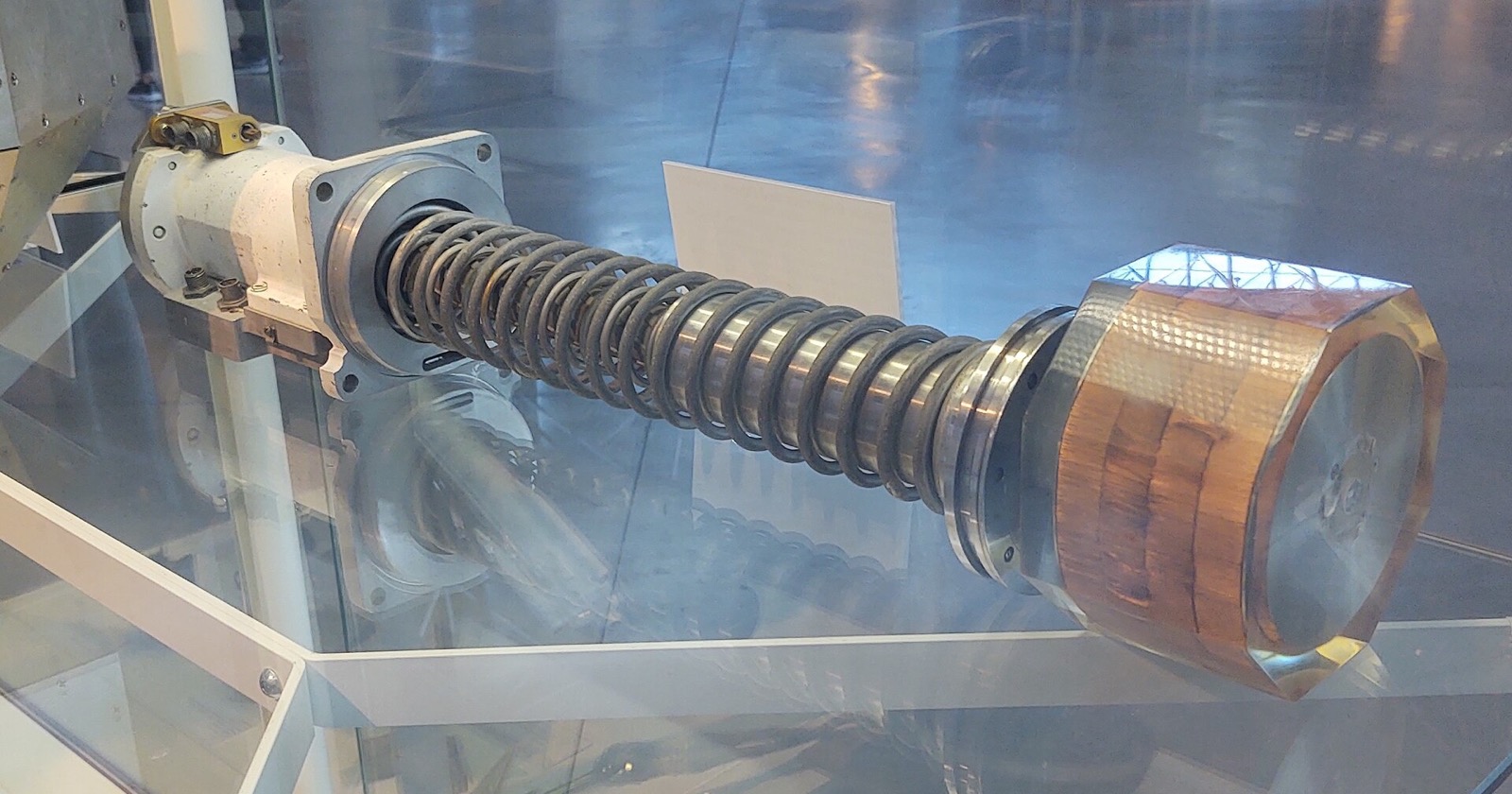
Project West Ford's spring-loaded dipole dispenser and copper-coloured needle canister in a glass display case

In May 1963, about 3,600 kilometres above Earth, a radio command reached a small package riding piggyback on an Air Force satellite. Inside were 480 million copper wires, each 1.78 centimetres long and less than two hundredths of a millimetre thick, set in a binder made to vanish in sunlight. As the binder turned straight to vapour in the vacuum, wires began to drift free and spread into a thin ring around the planet.

That was Project West Ford, built by MIT’s Lincoln Laboratory for the US Air Force and meant to carry long-distance radio that solar flares and jamming could not knock out. Lincoln Laboratory says the belt of loose wires had been swept from orbit by late 1965, on schedule. Many wires never came loose. Space Daily’s check of two public satellite catalogues, CelesTrak and Jonathan McDowell’s GCAT, on 8 October 2026 finds 36 to 39 clumps of West Ford wire still listed in orbit, 63 years later. CelesTrak has an orbit from the past month for 26 of its 39, and 23 of those are objects both catalogues agree are West Ford wire still in orbit. The most recent recorded reentry was in April 2024.

Space Daily told the story of the experiment itself in September. This piece follows the wire left behind, and sets two early forecasts about it, known here from the papers’ published summaries, beside six decades of tracking records.

A radio mirror for a fragile sky

In the early 1960s, much long-distance radio still worked by bouncing signals off the ionosphere, the electrically charged layer of the upper atmosphere. That mirror was unreliable. As the Harvard Crimson explained in May 1963, signals off the ionosphere could be jammed, and “a large solar flare can cause a radio fadeout by impairing the ionosphere’s ability to transmit signals.”

For a military with forces spread around the world, that was a serious weakness. Lincoln Laboratory’s own retrospective on the project describes communications for command and control as one of the Defense Department’s “acute problems” of the time. The idea, proposed by Walter Morrow of Lincoln Laboratory and Harold Meyer of Ramo-Wooldridge, was a belt of metal wires that would serve, “in effect, as an artificial ionosphere.” Morrow’s plan, the Crimson wrote, was meant “to provide a jam-proof, fail-proof, destruction-proof communication system.”

Each wire was a tiny antenna. A metal rod about half a wavelength long resonates with a radio wave, so the needles were sized for the X-band microwaves the ground stations used. Sixty-foot dishes would aim a powerful beam at the belt, and the scattered echo would reach a receiving dish across the continent. NASA’s Echo 1A balloon had used a similar passive trick in 1960 with a single giant reflector. West Ford tried it with a cloud.

The first attempt, in October 1961, failed. Lincoln Laboratory’s account says the dispenser’s ejection mechanism “didn’t spin up, so no dipoles were released.” NASA’s 2013 review puts it differently, saying the wires “did not dispense individually,” and the Crimson described “four or five useless clumps of wire floating around the earth.” The 1963 package packed its wires into a spinning cylinder, so that sunlight could turn the binder to vapour and release the needles from its surface, according to the engineering paper describing it.

A ring that worked, briefly

For a short window, it worked. The belt took about 40 days to close into a complete ring, according to a 1964 analysis of its orbit. Voice, data and teletype passed between West Ford stations at Millstone Hill in Massachusetts and Camp Parks in northern California.

The data rates fell fast. A 1964 report on the communications tests records digital data sent at 20,000 bits per second at first, sliding to around 100 bits per second. Digitised voice was sent during the first week. After about 50 days the belt was generally too sparse for the full scattering measurements, and the only traffic sent through it was teletype.

By late 1965, the Lincoln retrospective says, it was clear the future “belonged not to orbiting passive dipoles but to satellites with active transponders,” spacecraft that receive a signal and send it back out amplified.

The astronomers’ revolt

Astronomers had fought the project from the start, fearing the wires would spoil their view of the sky at both optical and radio wavelengths. The International Astronomical Union formally objected in 1961, and the Crimson reported that both the IAU and the US National Academy of Sciences set up “watchdog committees” because of West Ford.

The objection went beyond copper. Sir Bernard Lovell, head of Britain’s Jodrell Bank radio observatory, put it this way, as quoted by the Crimson: “The damage lies not with this experiment alone, but with the attitude of mind which makes it possible without international agreement and safeguards.”

The engineers’ answer was a short lifetime by design. The wires were so light for their size that sunlight itself would push on them, stretching their orbits into long ovals until the low point dipped into the atmosphere and air drag pulled them down. The Lincoln account calls this giving the dipoles “a high area-to-mass ratio.” In 1964 the Lincoln team concluded that the wires, loose or clumped, “never interfered with any astronomical observations,” a verdict from the project’s own scientists.

NASA’s Orbital Debris Program Office counts the 1967 Outer Space Treaty among the legacies of Project West Ford. Its Article IX says a state that “has reason to believe” an activity or experiment it plans “would cause potentially harmful interference” with other nations’ peaceful use of space “shall undertake appropriate international consultations” before going ahead. The office also notes that the international Committee on Space Research set up a group on potentially harmful space experiments after the failed 1961 mission. By 2013, NASA said, that group had evolved into the panel that hosts the committee’s discussions of orbital debris.

The clumps that stayed up

The loose needles behaved as predicted. In a 1966 paper in Science, Lincoln physicist Irwin Shapiro reported that radar confirmed the individual wires had reentered “in precise accord with predictions.” Calculations, he wrote, indicated that the wires survived reentry and “floated gently back to Earth,” though “the probability of finding one is minuscule.”

The trouble was how many had never separated. A 2013 review by NASA’s debris office says a post-mission investigation found only 25 to 45 percent of the planned 480 million dipoles dispersed properly. The rest are believed to have stayed stuck together, and the clumps were later picked up by the US Space Surveillance Network. NASA notes they are “still strongly affected by solar radiation pressure.”

Lincoln’s team expected those clumps to come down too, mostly. The published summary of their 1964 assessment said “the orbital lifetime of most of these clusters will be less than ten years; some, however, will orbit indefinitely.” The summary of Shapiro’s December 1966 paper went further: “Some dipole clusters remain in orbit but almost all should return to Earth within the next 2 years.”

That second forecast can at least be set against the clumps already in the US satellite catalogue when the paper appeared. The paper’s published summary does not say whether “almost all” meant only the clusters in that catalogue, but if it did, the record does not bear it out.

CelesTrak, a widely used public satellite-tracking site, lists 147 objects from the 1963 launch under the name “Westford Needles,” and the order of their catalogue numbers suggests roughly when each was first logged. About 30 clumps were already on the books by November 1966. None of them came down in the next two years. None came down within ten years of launch either. The first fell in November 1974, and CelesTrak still lists 16 in orbit today, 12 of them with orbits updated in the past month.

Across all 147, the record is slow too. Only 13 came down within ten years of launch, all of them clumps catalogued after 1966, and most of the 104 marked as decayed fell between the 1970s and the 1990s. Three came down in the 2010s and three more since 2020, in November 2020, October 2022 and April 2024.

Counting wire in the dark

CelesTrak shows 43 “Westford Needles” objects still in orbit, but not all of them are wire. Jonathan McDowell’s independent GCAT catalogue identifies two as solar array covers from the satellite that carried the package and two as parts of the West Ford package itself. That leaves 39 clumps in CelesTrak’s listing. NASA said in 2013 that two “Westford Needles” entries are assessed to be from a different mission, without saying which.

GCAT counts 36 West Ford wire objects in orbit, and five of those carry a flag meaning probably still in orbit but lost, with no recent tracking data. The two lists disagree on whether five objects are still up. GCAT records three that CelesTrak shows as orbiting as having reentered decades ago, though two of those still have current CelesTrak orbits. It assigns a fourth, which also has a current CelesTrak orbit, to a 1969 launch, and it keeps a fifth as lost that CelesTrak says reentered in 1989.

Only 26 of CelesTrak’s 39 have orbits updated in the past month, and three of those are objects GCAT disputes. That leaves 23 that both catalogues call West Ford wire and that have a current orbit, which is the firmest count of what is still circling. Small clumps on stretched, shifting orbits are hard to follow, and a missing public orbit does not prove an object is gone, or that it is still there.

The dates need care too. Fourteen objects in CelesTrak share one reentry date, 17 October 1987, which looks more like a catalogue clean-up than fourteen clumps falling on the same day. And the catalogue-number method used above to date when clumps were first logged is an inference, not a field the catalogues record.

NASA’s own figure in 2013 was 46 clumps. Both catalogues record six reentries since then, yet 46 minus six does not give either current count, most likely because entries have been added and reassigned along the way. Comparing the 2013 number with today’s is not a clean measure of decline.

The 1964 forecast is harder to hold anyone to. It covered all clusters, including small ones radar may never have caught, and it allowed that “some” would orbit indefinitely.

None of the sources reviewed for this piece reports a collision involving West Ford wire, and the 1964 team judged collisions with spacecraft “improbable.”

Looking for needles

West Ford left something else behind on the ground. Lincoln Laboratory had already been funded to develop a powerful ground terminal “of the sort that a higher-capacity West Ford system would use.” The retrospective explains the name it was given: Haystack, “because its main job was to look for needles in space.”

The future went to active satellites. Haystack stayed. In the same 2013 newsletter that counted the West Ford clumps, NASA described the Haystack radar sampling small orbital debris for its debris office.

Somewhere on Earth, more than a hundred million copper hairs from 1963 presumably lie where they settled, too fine to find. Overhead, more than 20 tangles of the same wire are still being tracked, nudged on every orbit by the sunlight that was supposed to bring them down.

The post MIT built a ring of copper wire around Earth in 1963, and more than 20 clumps of it are still in orbit appeared first on Space Daily.

  •  

To reach Jupiter, Juice took a detour past Venus, then returned to Earth on 28 September for a successful gravity boost while using our Moon to rehearse the navigation it will need around Jupiter’s icy moons.

Illustration of ESA’s Juice spacecraft flying past Earth, with its curved trajectory traced across the frame

ESA’s Jupiter Icy Moons Explorer returned to Earth on 28 September 2026, but home was only a waypoint. During a successful flyby 8,640 kilometres above the Indian Ocean, Earth’s motion and gravity deflected Juice’s path by 20 degrees and increased its speed relative to the Sun by 3.5 kilometres per second.

The encounter was the third of four planned gravity assists. It followed the first lunar-Earth double flyby in 2024 and a Venus flyby in August 2025. One more Earth pass in January 2029 will finally place Juice on its transfer towards Jupiter, where it is due to arrive in July 2031.

The mission turned this return into more than a trajectory correction. Juice’s navigation camera pointed at the Moon’s horizon to test a technique intended to improve optical navigation during selected encounters in a sequence of 35 future flybys of Ganymede, Callisto and Europa.

The Moon is not part of the gravity assist this time. It is a known target on which engineers can rehearse the image geometry they will later need around worlds hundreds of millions of kilometres away.

The detour through Venus began with a slowdown

The route looks inefficient only if distance is the sole measure. A direct flight would require a much more energetic launch and an enormous propellant load, first to reach Jupiter and then to prevent a nearly 6,000-kilogram spacecraft from flying straight past it.

A gravity assist avoids carrying most of that fuel. In the Sun’s frame, a spacecraft exchanges a minute amount of momentum with a moving planet as gravity curves its trajectory. The result can be a gain or loss of heliocentric speed, depending on the direction of approach. The planet’s own motion is what makes the encounter more than a simple U-turn.

Juice’s first assist in August 2024 deliberately removed energy. The Moon increased its speed by 0.9 kilometres per second relative to the Sun, positioning it for Earth one day later. Earth then reduced its heliocentric speed by 4.8 kilometres per second; overall, the lunar-Earth sequence turned the path by about 100 degrees.

That world-first lunar-Earth sequence sent Juice inward towards Venus while saving an estimated 100 to 150 kilograms of propellant. SpaceDaily’s account of the completed trajectory reset described how the two encounters worked together.

Venus supplied the next turn on 31 August 2025, bending the solar orbit back towards Earth and adding speed. The flyby had no sightseeing component. Juice was built for the cold outer Solar System, so it pointed its 2.5-metre high-gain antenna towards the Sun as a heat shield and kept its remote-sensing instruments inactive.

The operation followed a communications failure caused by a software timing bug that left a signal amplifier switched off. SpaceDaily covered the recovery and final preparation for the Venus encounter. ESA subsequently described the spacecraft as successfully through that flyby and on course for Earth.

Earth supplied a precisely aimed bend

According to ESA’s flyby report, closest approach occurred over the Indian Ocean at 11:45 UTC on 28 September. Earth deflected Juice’s trajectory by 20 degrees and increased its speed relative to the Sun by 3.5 kilometres per second.

Those numbers are not produced by an engine burn at perigee. They are the consequence of entering Earth’s moving gravitational field along a carefully chosen line and leaving it in a new direction. A mistimed arrival would change both the size and direction of the result.

The navigation campaign began on 17 August. Six correction opportunities were reserved at intervals including four weeks, two weeks, one week and three days before the encounter. ESA reported after the flyby that only one small manoeuvre had been required; enhanced tracking continues until 10 October.

The reserved final emergency manoeuvre was not needed. Juice passed above Australia before closest approach and then swept over the Indian Ocean along the planned trajectory.

This boost still does not send Juice straight to Jupiter. Jupiter is not yet in the right place. The 2026 encounter has shaped another solar orbit, returning Juice to Earth in January 2029 for the final push onto a path that intercepts Jupiter in July 2031.

Earth’s shadow turns geometry into a power problem

Before closest approach, Juice spent eight hours and 39 minutes in Earth’s shadow, from 19:24 UTC on 27 September until 04:03 UTC on 28 September. With no sunlight reaching its solar arrays, the spacecraft operated from batteries alone.

That eclipse did not threaten the flyby, but it limited how freely the payload could be used. Teams prioritised the most valuable observations during the battery-powered interval rather than switching on every instrument continuously.

Across a wider window from 23 September to 3 October, all ten science instruments were scheduled to gather data on Earth and the Moon, though not continuously or all at once. ESA expects to publish selected images and spectra after the data reach Earth and are evaluated. Both bodies are useful calibration targets because their shapes, surfaces and surrounding environment are already measured far better than the Jovian system.

Juice also spent several days inside Earth’s magnetotail, the long nightside extension of the magnetic field shaped by the solar wind. The measurements can test particle and field instruments in a complex but comparatively familiar plasma environment before they face Jupiter’s larger, faster-rotating and more intense magnetosphere.

Two small monitoring cameras photographed the passage as well. They should not be confused with NavCam or the JANUS science camera. The monitoring cameras provide engineering views of the spacecraft and its surroundings; NavCam extracts geometry; JANUS is designed for scientific imaging. NavCam also returned an image of Madagascar taken two minutes after closest approach.

The Moon stands in for three icy worlds

During this Earth approach, the navigation camera pointed towards the lunar horizon, also called the limb. An image of that curved boundary contains information about the apparent centre and angular size of the Moon. Compared with a predicted view, it can sharpen the estimate of the spacecraft’s position relative to the target.

ESA said the lunar observations were intended to test a technique for improving optical-navigation accuracy, but had not published an evaluated performance result at the time of this update. The careful claim is therefore that Moon-limb images tested the method, not that the September campaign has already proved a specific performance gain.

NavCam first operated on a real world during the 2024 lunar-Earth encounter. In its account of that first in-space test, ESA showed raw, uncalibrated lunar images and explained that the camera would later use the shapes of Jupiter’s moons to support navigation.

The 2026 geometry was different. Juice did not fly close to the Moon, and lunar gravity was not the manoeuvre. The Moon was observed from the Earth-approach trajectory as a reference object. Calling it a rehearsal is accurate; calling this another lunar gravity assist would not be.

Why a camera must share the navigation load

Ground-based radio tracking remains essential, but a complete Earth communications loop is too slow for fresh local relative-position updates during a close Jovian flyby. Near Jupiter, a radio message can take roughly 50 minutes each way. The location of the moon relative to the approaching spacecraft also matters more than an absolute position measured in isolation.

SpaceDaily’s earlier account of Juice’s image-based navigation system described onboard software that detects the edges of a moon in NavCam images. Those edge measurements allow the system to refine relative geometry without waiting through the complete Earth communications loop.

The underlying system is called Enhanced Attitude Guidance through Limb Extraction, or EAGLE. It is intended for use on the inbound leg of selected moon encounters, with mission planners deciding case by case when the technique should support guidance and pointing.

This does not mean Juice will improvise a tour or replace its flight-dynamics team. Ground controllers design and command the encounters. Optical navigation supplies a timely local measurement during sequences in which a small targeting error could move an instrument footprint by many kilometres or turn a planned close pass into a miss.

NavCam is also not a substitute for the science payload. It is a wide-field engineering camera optimised to tell the spacecraft where a world is. Scientific cameras and spectrometers ask what that world is made of and how its surface changes. A blurred-looking limb can still be excellent navigation data.

Earth is a rehearsal, not the destination

After Jupiter arrival, Juice will make 35 flybys of Ganymede, Callisto and Europa before entering orbit around Ganymede in 2034. Each encounter must satisfy navigation, power, communications, radiation and instrument-pointing constraints at the same time.

SpaceDaily has also reported an engineering-model rehearsal of a Callisto flyby, in which simulated images were projected into a navigation camera to exercise the flight software. That laboratory test supplied a synthetic moon; September’s observation supplied a real horizon to the flight camera in space.

Earth and the Moon offer known targets, stronger communications and time to improve procedures. At Jupiter, the encounters will be distant, fast and scientifically scarce. The apparent detour through Venus has preserved the fuel needed to conduct that tour, while the lunar images supplied something equally valuable: a navigation method tested before the real icy moons fill the camera. ESA had not yet released the evaluated performance result, so the size of any improvement remains unreported.

The post To reach Jupiter, Juice took a detour past Venus, then returned to Earth on 28 September for a successful gravity boost while using our Moon to rehearse the navigation it will need around Jupiter’s icy moons. appeared first on Space Daily.

  •  

In 2001, Taco Bell anchored a 40-foot floating target off Australia and promised every American a free taco if the falling Mir space station hit it — and the company took out an insurance policy against a direct strike before the 130-ton station came down

In March 2001, one of the largest objects humans had ever put in orbit was about to fall out of the sky, and a fast-food chain saw a marketing opportunity in the wreckage.

The object was Mir, the Russian space station — about 130 tonnes of hardware that had circled Earth for 15 years. Russia had run out of money to keep it up, so engineers were steering it down for a controlled, fiery death over the empty South Pacific. And floating out there in the ocean, waiting for it, was a giant bullseye that said “Free Taco Here.”

The bullseye in the sea

The stunt was pure Taco Bell. The company built a 40-by-40-foot vinyl target — its bell logo ringed by a bullseye, the words “Free Taco Here” in bold letters — and anchored it in the South Pacific about ten miles off the coast of Australia, along Mir’s expected re-entry path.

The promise: if the core of the plummeting space station struck the target, every single person in the United States would get a free taco. Roughly 280 million people. The company set up a countdown clock on its website and fed a hungry international press corps four days of coverage, tying its brand to what news anchors were solemnly calling one of the great celestial events of the era.

It was a promise engineered to be impossible to lose — and, almost certainly, impossible to pay out.

Why the insurance was the smart part, not the scared part

The detail everyone remembers is that Taco Bell bought an insurance policy against a direct hit. It’s tempting to read that as nerves — as if the company genuinely feared it would owe America ten million tacos. The truth is closer to the opposite, and it’s what makes the stunt a small masterpiece.

Taco Bell hired a Dallas firm called SCA Promotions — a company whose entire business is insuring exactly these kinds of prize offers. For a modest premium, SCA takes on the risk of a giant payout that is extremely unlikely to happen. And a piece of a space station hitting a 40-foot raft in the open Pacific was about as unlikely as promotions get: the target was a speck, the ocean is unimaginably vast, and Mir was coming down along a track thousands of miles long.

So the insurance wasn’t fear. It was the mechanism. It let Taco Bell dangle a genuinely enormous prize — free tacos for the entire country, an estimated $10 million liability — while its actual exposure was just the small, fixed cost of the premium. The company got to look daring and generous while a specialist quietly absorbed a risk that was never going to materialize. That is the whole trick of prize-indemnity marketing, performed here on a planetary stage.

Mir missed, obviously

On March 23, 2001, Mir blazed back into the atmosphere and broke apart, its surviving fragments splashing down in the South Pacific — closer to Chile than to Australia, and nowhere near the taco raft. The bullseye bobbed, un-struck. No free tacos for America.

Nobody at Taco Bell was surprised, or sorry. The company had never needed Mir to hit the target; it had needed the world to spend four days talking about Taco Bell and a space station in the same sentence, which the world dutifully did. As a fallback, the chain rolled out its real promotion — the one it had wanted to push all along — a “consolation” deal of two tacos for 99 cents. The falling space station was just the world’s most expensive attention-getter, and Taco Bell got to use it for the price of a vinyl sheet and an insurance premium.

The genius of aiming at the impossible

Strip the stunt down and it’s a clean lesson in how modern marketing actually works, which is why people still tell the story a quarter-century later.

Taco Bell risked almost nothing and bought enormous, global, free publicity — the kind money can’t easily buy directly — by attaching itself to a genuine, once-in-a-generation news event and making a promise it was statistically guaranteed not to have to keep. The insurance policy, the part that sounds like caution, was really the engine of the audacity: it converted a terrifying-sounding liability into a fixed, trivial line item, freeing the company to be as bold as it liked.

The Russians spent 15 years and billions of dollars building Mir, and its final act, on the way down, was to serve as a free billboard for a taco chain that had wagered a coupon it knew it would never have to honour. Mir aimed for an empty patch of ocean and hit it. Taco Bell aimed for the front page and hit that. Only one of them was ever really trying to miss.

The post In 2001, Taco Bell anchored a 40-foot floating target off Australia and promised every American a free taco if the falling Mir space station hit it — and the company took out an insurance policy against a direct strike before the 130-ton station came down appeared first on Space Daily.

  •  

Microbes may survive at the Moon’s south pole

The Moon’s polar regions may be less hostile to microbes than previously thought. This is the new finding from researchers at NASA and the University of Maryland in the US who say that future crewed missions to the lunar south pole will have to be carefully thought out to limit the unintended transfer of Earth life forms.

High ultraviolet radiation and temperatures make the Moon’s surface a harsh place and not somewhere bacteria and other micro-organisms can easily survive. This is particularly true for the equatorial regions, where all previous crewed missions have been sent. Things might be quite different at the lunar poles, however, since sunlight strikes these high-latitude regions at a low angle because of the Moon’s minimal tilt to the Sun of 1.5°. The result is long permanent shadows where it is cooler. The moonscape is also as rugged here as elsewhere with mountains and hills, which also cast shadows, and deep craters protected from the Sun’s heat and ultraviolet flux. These conditions allow for water ice too.

Because of these unique properties, future crewed missions, such as NASA’s Artemis IV, are scheduled to go to the Moon’s south pole, which has also been identified as a possible future location for a human outpost. The polar regions have already been observed by spacecraft such as ESA’s SMART-1, India’s Chandrayaan, Japan’s Kaguya and NASA’s Lunar Reconnaissance Orbiter. These provided a wealth of information that will be used to prepare future missions.

The problem is that no matter how stringent the sterilization procedures are prior to take-off, the astronauts on these missions will take microbes from Earth with them. Indeed, humans carry millions of microbes on their skin and even more in their bodies.

Landing sites for Artemis IV

To investigate whether microbes could survive in the polar regions, the researchers, led by Prabal Saxena, who works at NASA’s Goddard Space Flight Center, and Stefano Bertone at the University of Maryland, modelled how bacteria and fungi commonly found on human skin would behave in the environment of three candidate landing sites for the upcoming Artemis IV mission. The researchers began by making highly resolved spatial maps of the topography in these regions that included ruggedness, slopes and shadowing effects. They also modelled the UV exposure and temperature in these regions to identify specific locations where micro-organisms could survive for at least 24 h.

They obtained seasonal temperature data on length scales of 240 m from measurements by Lunar Reconnaissance Orbiter’s (LRO) Diviner. As for estimated regional UV (≤320 nm) fluxes, these were gleaned from averaged illumination maps with a pixel scale of 60 m based on topography derived from LRO Lunar Orbiter Laser Altimeter (LOLA) measurements.

“Since the temperatures at the lunar poles are rarely high enough to kill bacteria and low temperatures can preserve microbes on Earth, UV radiation is generally likely to be more dangerous in these regions, says Saxena. “We therefore analysed UV fluxes at finer spatial scales using a technique called ray tracing, and for some regions, included optical effects such as reflection and refraction as sunlight hits the Moon’s surface, leveraging updated LOLA-based topography maps on a scale of 5 m/pixel.”

Understanding how sunlight behaves at the poles is crucial, he adds. “Since the Moon has a very small axial tilt, the Sun appears to hover just above the horizon here, so even small hills and rocks can prevent light from reaching lower-lying ground, creating small, shadowed areas protected from UV rays.”

Up to seven days survival

The simulations revealed that the bacteria and fungi studied could survive in certain niches for up to or potentially beyond seven days. One particular fungus, the Aspergillus, is particularly resistant to UV radiation and could potentially survive in 15 to 30% of the areas assessed, even those that receive some sunlight during the lunar winter. The reconstructions also showed that all five microbes in this study, Bacillus, Deinococcus, Staphylococcus, Aspergillus and Fusarium could possibly survive in certain areas of the De Gerlache Rim’s permanently shaded regions, including when scattered UV light is incorporated into the simulations.

Survival does not mean growth (which requires active metabolism and potential reproduction), however, stresses Saxena. Indeed, surviving microbes are in a dormant, so-called cryptobiotic state and would only grow if the conditions were amenable to life – which is not the case for the Moon as we currently understand it.

“Cells may also be dead,” he tells Physics World, “but even dead cells may persist in the environment as another potential source of contamination.”

The work could apply beyond the Moon, he says. Indeed, a number of different airless bodies such as Mercury, Ceres, some asteroids and comets and exoplanets that may have similar properties could also have potential survivable niches for microbial life. Understanding how these niches may exist, how life may be transferred to them and how human exploration may leave its mark will all serve as a key testbed for future potential human exploration of Mars, which likely has far more habitable environments.

“We need to understand what was there before us, because when we search for signs of life beyond our planet on these bodies, we will want to make sure it’s not stuff we brought,” says Saxena.

The research is described in Science Advances.

The post Microbes may survive at the Moon’s south pole appeared first on Physics World.

  •  

Hurricane Polo Explodes in Pacific, UK Aphid Swarm Wipes Out 30 Million Lettuces, Glasgow Braces for Rubbish Pileup — Today’s Environmental Briefing for Thu, Sep 24 2026

Satellite view of Hurricane Polo swirling over the Pacific Ocean with visible eye structure

Across the stories today, a common thread emerges: the planet is speaking in signals — some subtle, some deafening — and the question is whether our institutions can listen fast enough to act.

Start with the signals themselves. El Niño has surged to record strength weeks ahead of schedule, and its fingerprints are already visible — from Hurricane Polo’s explosive intensification in the Pacific to the climate volatility rippling through global weather systems. In the UK, an aphid outbreak wiped out 30 million lettuce heads almost overnight, a small but telling example of how shifting conditions can upend food systems in ways no one budgets for. In Malawi, an unexplained weed overgrowth has choked Chia Lagoon, stranding farmers and fishers in flooded fields nearly seven months after the rains should have drained. These aren’t isolated oddities. They’re the planet’s early warning system, written in crop yields and clogged waterways.

Then there’s the human response — uneven, but not absent. Germany’s landmark pledge to phase out fossil fuels by 2045 marks a rare moment of policy catching up to urgency, moving beyond vague “carbon neutrality” language toward something more concrete. The UK’s decision to declassify a once-suppressed intelligence report — warning that climate breakdown is a direct threat to global security — suggests governments are quietly acknowledging what scientists have said for years, even if political will lags behind. And at UN climate talks in New York, amid what The Guardian describes as a genuinely grim mood, solar power’s continued growth offered rare, tangible hope. As Al Gore noted twenty years after An Inconvenient Truth, he’s surprised by the ferocity of fossil fuel pushback — but still believes, cautiously, that the fight can be won.

Behind the numbers are real communities adapting in real time. In the Andes, villagers near Villa de Arma are turning to ancient wetland systems as glaciers they once walked across vanish into bare rock. In Guam, resident Leevin Camacho learned his family’s water contained a pesticide banned since 1987 — a stark reminder that militarization and environmental cost are often intertwined, especially in the Pacific. And in Sarawak, Indigenous communities are still reckoning with displacement from the Bakun megadam three decades later, a cautionary tale as the world races toward a “clean” energy future that doesn’t always ask who pays for it.

It’s a reminder that progress and pressure often arrive together. Endangered birds on South Australia’s Eyre Peninsula won last-minute protection from a rocket launch site — a genuine conservation victory — even as a Norfolk Broads housing levy was quietly slashed, raising fears that environmental safeguards elsewhere are eroding. Meanwhile, olive ridley sea turtles nesting for the first time ever on California beaches offer something rarer: wonder. A signal, too, but one that invites curiosity rather than alarm — proof that the natural world is still capable of surprising us.

As the week unfolds, all eyes will be on whether momentum from Climate Week — bolstered even by a monster from Sesame Street reminding children it’s okay to feel both fear and courage — translates into follow-through. The data, the disasters, and the small human stories all point the same direction: the era of asking “if” is over. What remains is the harder work of “how fast,” and “for whom.”

The post Hurricane Polo Explodes in Pacific, UK Aphid Swarm Wipes Out 30 Million Lettuces, Glasgow Braces for Rubbish Pileup — Today’s Environmental Briefing for Thu, Sep 24 2026 first appeared on EnviroLink Network.

  •  

Trump’s EPA Ends America’s War on CO2

After nearly two decades, America's war on CO2 is being brought to a well-deserved end, with Lee Zeldin, the head of Trump's EPA, scrapping Biden-era green power plant rules, says Tilak Doshi.

The post Trump’s EPA Ends America’s War on CO2 appeared first on The Daily Sceptic.

  •  
❌