❌

Reading view

Survey links three capabilities with Indonesian welfare-data integration

A survey-based study of 246 village-level social welfare data operators found that business architecture, cross-organizational collaboration and technological readiness were positively and statistically significantly associated with perceived e-government integration impact in two Indonesian regencies. The research, focused on Gunung Kidul and Bangkalan, examined organizational, institutional, relational and technological capabilities associated with social welfare data integration. Governance and leadership and information policy did not show statistically significant direct relationships with perceived integration impact in the pooled sample.

The authors analyzed the survey with partial least squares structural equation modeling. In their framework, e-government integration impact, or EGII, represents perceived improvements in information, system and service quality, responsiveness and public trust. E-government integration scope, or EGIS, describes the breadth of integration across data, applications, electronic communication and knowledge-sharing processes.

EGII was strongly associated with EGIS, meaning that operators reporting more favorable perceived integration outcomes also tended to report broader integration. Because this was an observational analysis of survey responses, the results establish statistical relationships rather than causal effects. The findings identify three capabilities with significant direct relationships to EGII in the pooled model: business architecture, cross-organizational collaboration and technological readiness.

The evidence does not provide operational definitions for these constructs, but the results show that their measured levels were associated with respondents’ assessments of e-government integration outcomes. By contrast, governance and leadership and information policy had no statistically significant direct relationships with EGII in that analysis. This absence of a detected direct relationship does not establish that the two factors are unimportant or that they operate only through indirect pathways, because the supplied findings do not report such indirect effects.

A regency-based robustness analysis found that some relationships were sensitive to local implementation conditions. Significant differences between Gunung Kidul and Bangkan were reported for the technological-readiness-to-EGII relationship and the EGII-to-EGIS relationship. The geographic comparison therefore cautions against assuming that the same capability relationships apply uniformly across the two regencies, although it does not identify the specific local practices responsible for those differences.

Its direct contribution is to show which measured interoperability capabilities were associated with perceived integration impact in the surveyed population, alongside evidence that some relationships varied between the two regencies.

Subject of Research: Survey-based analysis of interoperability capabilities for social welfare data integration in two Indonesian regencies

Article Title: Determinants of E-government interoperability capabilities for social welfare data integration in Gunung Kidul and Bangkalan Regencies, Indonesia

Article References: Fikri, R., Purnomo, E. P., Pribadi, U., Mohamed, A. M., & Mohammad, N. B. (2026). Determinants of E-government interoperability capabilities for social welfare data integration in Gunung Kidul and Bangkalan Regencies, Indonesia. Discover Sustainability. https://doi.org/10.1007/s43621-026-04608-5

Image Credits: AI Generated

DOI: 10.1007/s43621-026-04608-5

Keywords: social welfare data, e-government, interoperability, Indonesia, PLS-SEM, technological readiness, cross-organizational collaboration, business architecture, digital governance, public services, Determinants, capabilities

  •  

25,000 Years Ago, the Earliest Human Drug Use May Have Occurred on This Small Island

What may be the earliest known evidence of human drug use suggests that it occurred 25,000 years ago, according to findings by archaeologists that push back on earlier estimates by over 10,000 years.

In a recent paper published in Science Advances, an international team of researchers led by Professor Adam Brumm from Griffith University’s Australian Research Center for Human Evolution (ARCHE) discovered betel nut residue on ancient teeth in Indonesia. 

Betel nuts are an addictive stimulant popular throughout the Asia-Pacific region, which researchers previously believed only came into use about 3,500 years ago. Globally, archaeologists had believed psychoactive drugs had been tied to the rise of agriculture.

Betel Nuts: the First Drugs

Archaeologists typically point to Israel’s brewing of fermented alcoholic drinks, such as those made of barley, as the earliest use of psychoactive drugs, roughly 13,000 years ago.

“However, this theory fails to account for the possibility that very ancient drug-taking lies at the roots of our most commonly used psychoactive substances,” Professor Brumm said.

Betel nuts are only regionally popular in India and the South Pacific, but their use is almost ubiquitous among the 10% of the world’s population that lives there. The psychoactive effects of the stimulant include enhanced alertness and mild euphoria.

The betel nut is the seed of the Areca catechu palm. Locals burn its shell, then grind it into a fine powder and mix it with slaked lime, another powder made from quicklime and water. They mix these powders with other minor ingredients, wrap them in a betel leaf, and chew them to produce a mild altered state.

Research on the drug suggests that this processing releases Arecoline, the neuroactive alkaloid present in the betel nut, in a more bioavailable form. Modern usage is linked to cancer, gum disease, and tooth decay, making it a significant public health problem in regions where it is used.

A Prehistory of Betel Nut Usage Uncovered

The seeds were rarely preserved in archeological sites, creating a great deal of uncertainty about the drug’s early history.

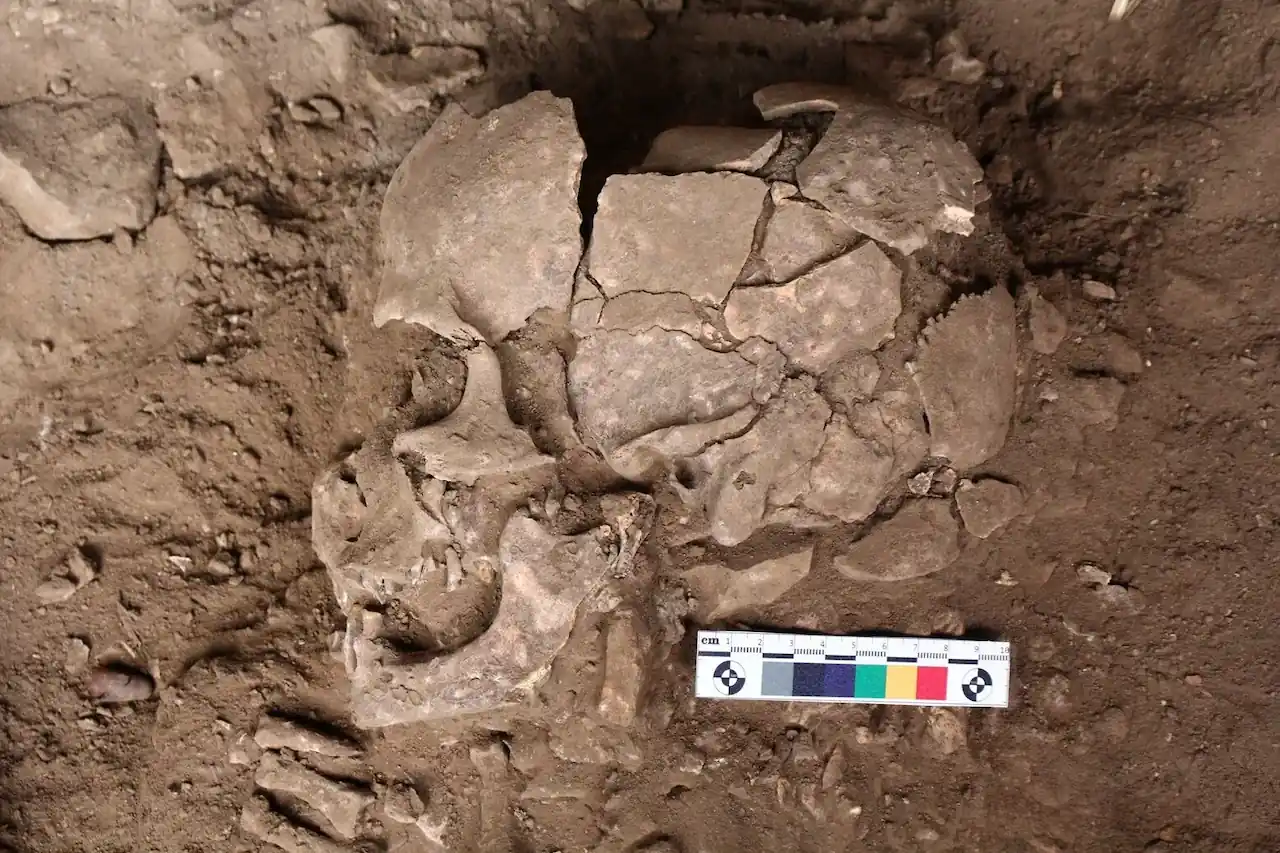
Human remains used in the study came from Sulawesi, one of the islands that make up Indonesia. There, archeologists uncovered two hunter-gatherer skeletons: one dating to 7,600 to 6,300 years old and the other 25,000 to 16,000 years old.

These skeletons carried an unusual signal, which the team interpreted as related to ancient drug use. Their teeth had deep, rounded grooves that the researchers believe developed from the habit of sucking on whole betel nuts. Biochemical analysis further supported this interpretation by identifying Arecoline in the remains’ dental tissues.

“But our team conducted experiments in which we soaked betel nuts in artificial saliva and tested the resultant broths against a panel of cloned human receptors expressed in frog egg cells, including specialized proteins that act as molecular switches, regulating neural activity,” said lead author Professor Adam Brumm. “This showed that just sucking on intact betel nuts will release Arecoline in sufficient amounts to have a physiological effect, altering brain function.”

Rethinking Prehistory

This crude attempt to use the betel nuts as a drug likely produced a milder high, while also promoting periodontal disease. Given the poor state of the teeth in human remains previously found on the island, the team believes the betel nuts may have initially been used as a toothache remedy, though it was a poor choice for that purpose.

“Over time, however, sucking these hard, abrasive seeds wore down the foragers’ teeth so badly that in some cases the inner pulp chamber became completely exposed – this would have been extremely painful, caused difficulty eating, and greatly increased the rate of chronic tooth infection,” Professor Brumm said. “So while this habit may have been a remedy for toothache, years of prolonged nut-sucking eventually caused much worse dental health problems, creating a cycle of continued habitual use.”

Pushing back the use of these psychoactive substances so far significantly rewrites our understanding of human drug history.

“Emerging by up to 25,000 years ago in Sulawesi, thus long preceding the onset of agriculture, betel nut-sucking may be the earliest evidence for drug use anywhere in the world,” Professor Brumm concluded. “By identifying the ancient practice underlying betel-nut chewing as we know it, the study implies that some modern drug-taking behaviors are deeply rooted in forager traditions.”

The paper, “Betel Nut Sucking is the Earliest Recorded Evidence for the Habitual Use of a Neuroactive Plant Drug,” appeared in Science Advances on September 9, 2026.

Ryan Whalen covers science and technology for The Debrief. He holds an MA in History and a Master of Library and Information Science with a certificate in Data Science. He can be contacted at ryan@thedebrief.org, and follow him on Twitter @mdntwvlf.

  •  

Forget Beer: Ice Age Hunters Were Getting High 12,000 Years Earlier — With Betel Nuts

Two skeletons from the Indonesian island of Sulawesi had something strange going on in their mouths. Not cavities. Not the usual wear from a tough diet. Deep, rounded grooves cut into the teeth — a pattern no archaeologist had documented before, and one nobody could explain. The answer, published in Science Advances, pushes the known […]

  •  

Antes de la cerveza y mucho antes de la agricultura: así se drogaban los cazadores de la Edad de Hielo

Dos esqueletos hallados en la isla indonesia de Sulawesi tenían algo raro en la boca. No eran caries, ni el desgaste habitual de una dieta dura. Eran unos surcos profundos y redondeados en los dientes, un patrón que ningún arqueólogo había visto antes y que nadie sabía explicar. La respuesta, publicada en la revista Science […]

  •  

Scientists Discover the Earliest Evidence of Drug Use in Really Old Teeth

A hunter-gatherer who lived in Indonesia as early as 25,000 years ago may have regularly sucked on betel nuts to release their psychoactive properties.
  •  

Echan más carbono al día que un país entero: los incendios bajo el suelo de Indonesia que no se pueden apagar

Al secarse por El Niño, las turberas de Indonesia liberan bajo tierra más carbono que economías enteras. ¿Cómo es posible que un fuego subterráneo sin llamas resulte tan destructor?
  •  

Ornithologists Describe New Bird Species from Remote Indonesian Islands

The cheerful fantail (Rhipidura laguceria) in November 2022. Image credit: James A. Eaton.

A small songbird inhabiting the Babar Islands, in the Banda Sea, Indonesia, has been identified as a new species after a duo of researchers discovered that its distinctive song sets it apart from its closest relative.

The post Ornithologists Describe New Bird Species from Remote Indonesian Islands appeared first on Sci.News: Breaking Science News.

  •  
❌