❌

Reading view

Featured Image: Examining Galactic Filaments
filaments in the galactic center

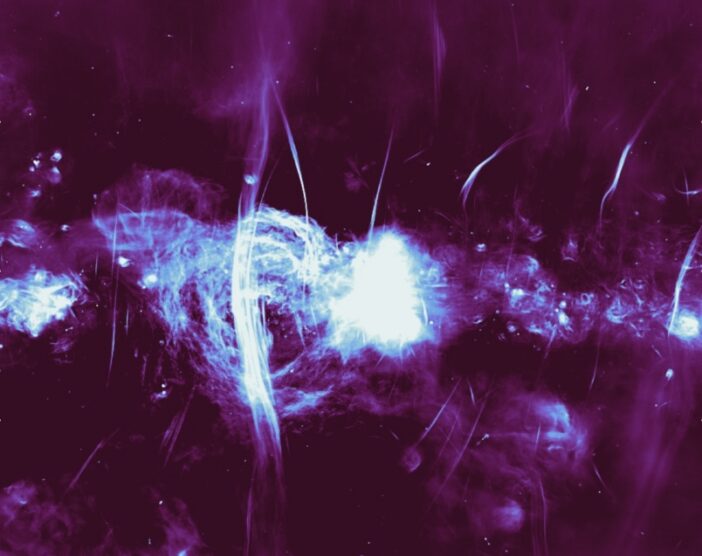
This image of the galactic center from the MeerKAT radio array shows wispy vertical lines known as galactic non-thermal filaments. These structures, which are tens of parsecs long and less than a tenth of a parsec wide, are found throughout a complex region called the central molecular zone. The filaments’ radio emission appears to come from charged particles spiraling around magnetic field lines, but it’s not yet known where the speeding particles that power this emission come from. Recently, Mohan Richter-Addo (University of Wisconsin–Madison) and collaborators used magnetohydrodynamics simulations to explore two potential sources: 1) the electron–positron winds of a pulsar or 2) a proton-rich mix of particles accelerated by interstellar shocks. The team found few discernible differences between simulated filaments illuminated by these two sources, but this work provided new avenues for future exploration. One facet that emerged from the team’s investigation is that filaments should grow longer as they age, with the maximum length set by the underlying magnetic field. This suggests that magnetohydrodynamic turbulence might play a role in shaping the filaments. To learn more about this exploration of galactic non-thermal filaments, be sure to check out the article linked below.

Citation

“The Effects of Cosmic-Ray Protons on Galactic Nonthermal Filaments,” Mohan Richter-Addo et al 2026 ApJ 1009 164. doi:10.3847/1538-4357/aea0c7

The post Featured Image: Examining Galactic Filaments appeared first on AAS Nova.
  •  

Featured Image: Echoes of Giant Pulses

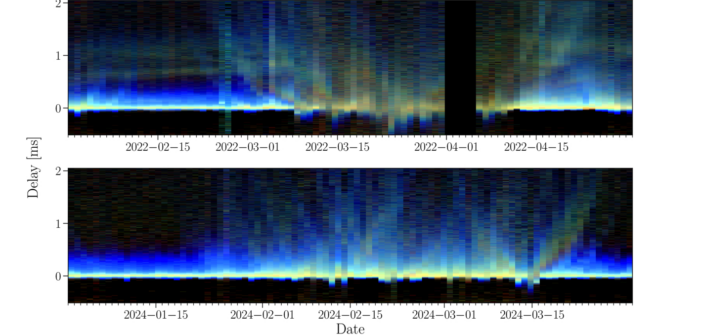
What at first might appear to be abstract pixel art or a fuzzy photograph of skyglow from a distant city is actually a representation of radio emission from the pulsar at the center of the Crab Nebula. When a pulsar’s radio emission passes through a region of ionized gas — like the complex filaments of the Crab Nebula — the plasma deflects the radio signal from its intended course. This detour can create “echoes”: copies of the pulsar signal that arrive later than the original pulse. Thierry Serafin Nadeau (University of Toronto) and collaborators studied these echoes from the Crab pulsar by compiling an archive of giant pulses detected over 2.5 years by the Canadian Hydrogen Intensity Mapping Experiment (CHIME). Giant pulses, which are brighter and narrower than typical pulses, offer a powerful way to probe plasma echoes. The image above shows sweeping parabola-shaped echoes during two particularly active periods. The color shows the frequencies at which power was received: mainly at low (blue), high (red), or all (yellow-white) frequencies. This dataset revealed for the first time a feature predicted to exist but never seen: echoes from plasma structures that never pass directly in front of the pulsar from our point of view. To learn more about the echoes of the Crab pulsar, be sure to check out the research article linked below.

Citation

“Echoes in Different Tempo: Long-Term Monitoring of Crab Echoes with CHIME,” Thierry Serafin Nadeau et al 2026 ApJ 1006 82. doi:10.3847/1538-4357/ae7336

The post Featured Image: Echoes of Giant Pulses appeared first on AAS Nova.

  •  

Featured Image: Evolution of a Cosmic Crab

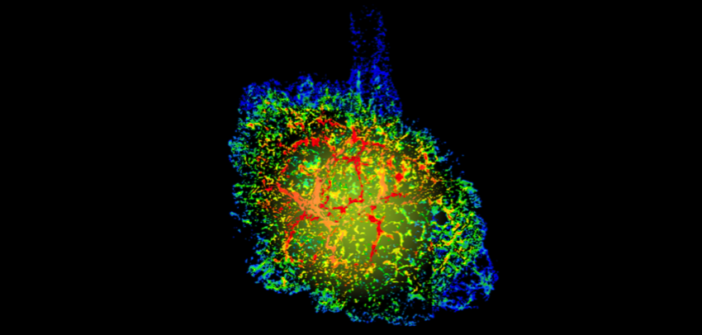
three-dimensional reconstruction of the Crab Nebula

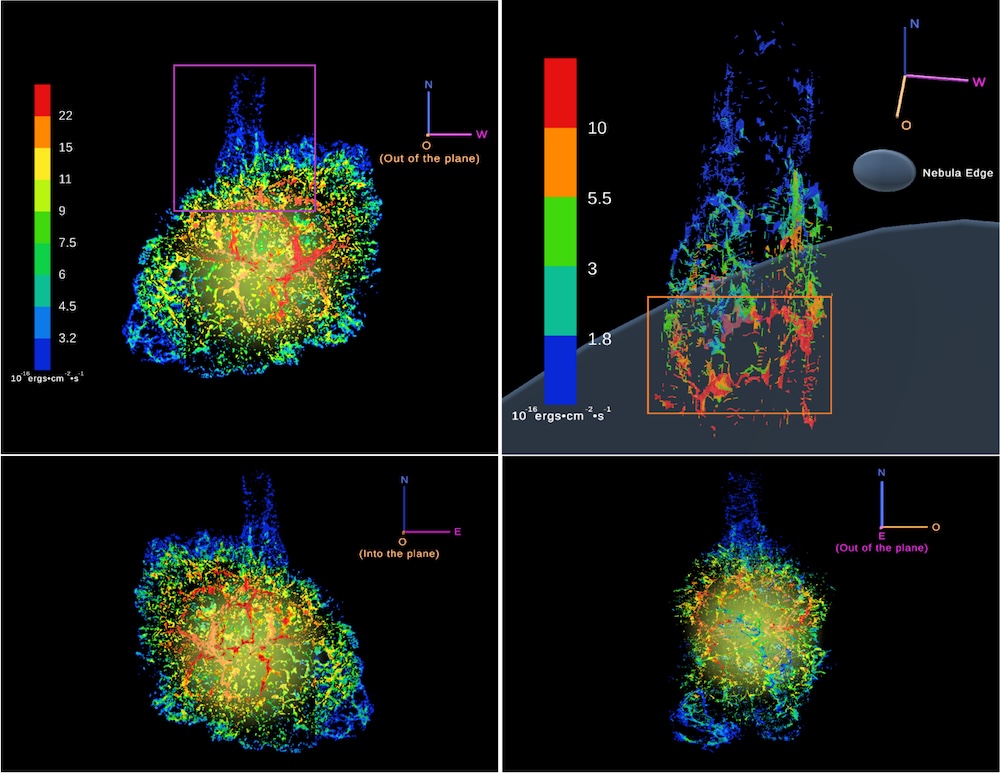
three-dimensional representation of the Crab Nebula

Three-dimensional reconstructions of the Crab Nebula using oxygen emission lines. An animation of the 3D reconstruction is also available. [Ding et al. 2026]

A recent research article by Ziwei Ding (Purdue University) and collaborators introduces a new 3D kinematic reconstruction of the Crab Nebula, the remnant of a supernova seen from Earth in the year 1054. The team observed the nebula’s oxygen emission in 2020 and 2022 with the Canada-France-Hawaii telescope, then compared these observations against others made in 2016 to study the nebula’s structure and motion. The images above and to the right show the nebula from multiple vantage points. These images show a prominent jet-like feature emerging vertically from the nebula. Ding and collaborators demonstrated that the jet appears to be linked to a light-year-wide cavity at its base. The source of the jet is not yet known; past mass loss, a circumstellar disk, and a locally under-dense region might all play a role. Future hydrodynamic simulations can probe each of these possibilities to understand how the winds of the young pulsar at the core of the nebula produced the features seen today. To learn more about these observations of the Crab Nebula, be sure to check out the full research article linked below.

Citation

“3D Kinematic Reconstruction of the Crab Nebula That Includes the Northern Ejecta ‘Jet,'” Z. Ding et al 2026 ApJ 1007 130. doi:10.3847/1538-4357/ae84c0

The post Featured Image: Evolution of a Cosmic Crab appeared first on AAS Nova.

  •  

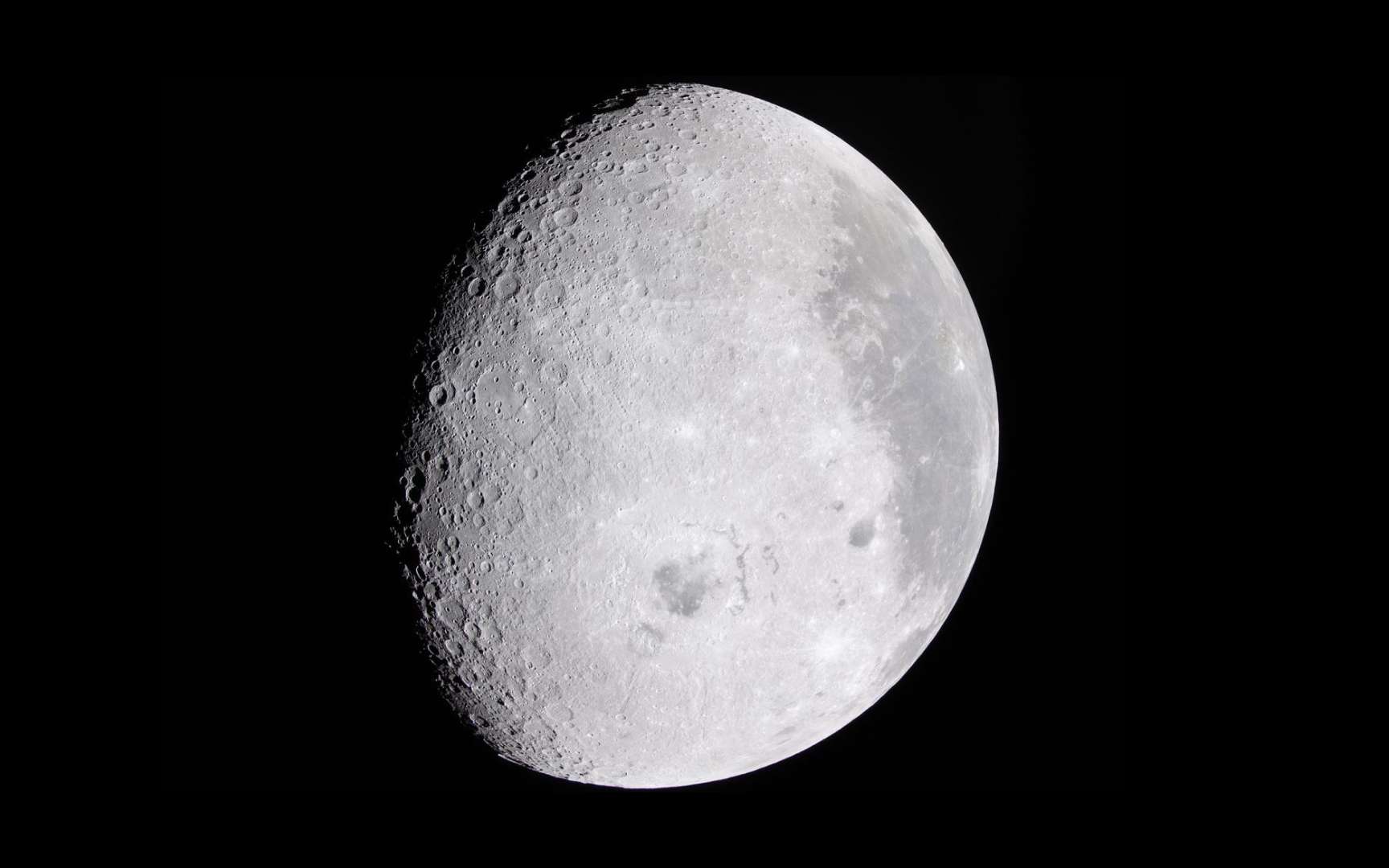
La Nasa vient de donner à une IA des données sur toute la Lune : elle sait désormais où chercher de l'eau en priorité

La Lune a été observée sous toutes les coutures depuis des décennies, mais ses données restent dispersées entre de nombreux instruments et missions. IBM et la Nasa viennent de rendre public un modèle d’intelligence artificielle conçu pour les faire dialoguer afin de mieux connaître le seul...

  •  
  •  

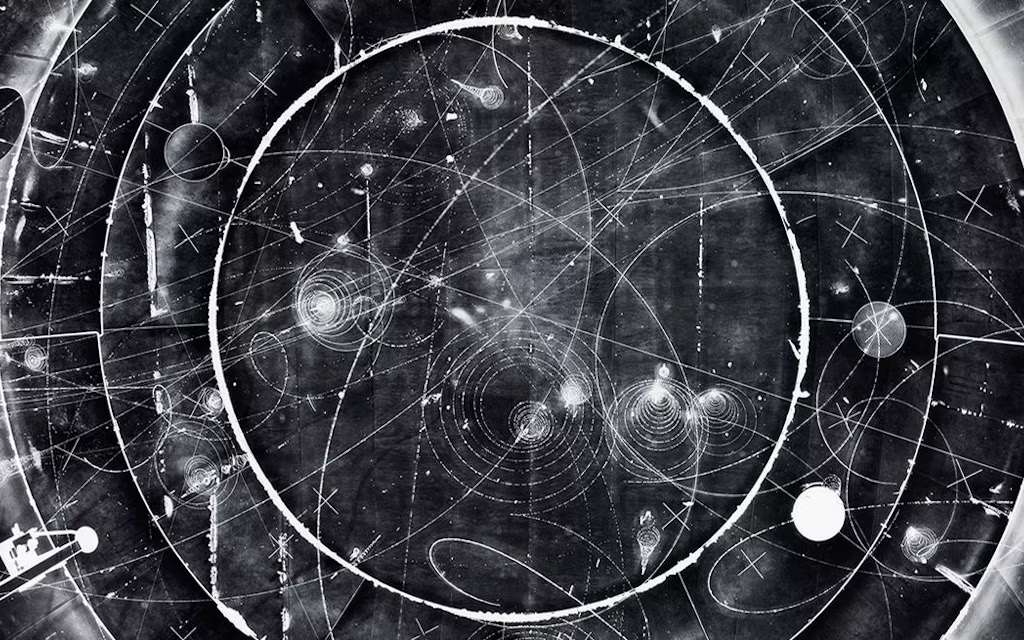
« Ce ne sont pas des photographies ordinaires » : ces images de particules menacées d’oubli pourraient encore surprendre

Alors que la France célèbre le bicentenaire de la photographie, des millions de négatifs, conservés dans les laboratoires de recherche fondamentale, demeurent dans l’ombre, menacés de disparition. Témoins de plusieurs décennies de recherches en physique des particules, ces archives constituent...

  •  

How to Manage Photos Between MacBook Pro & iPhone

Macbook Pro, 15", 2017
Mac OS Monterey, Version 12.6

iPhone 13 Pro Max
IOS 16.0

For managing Pictures in the Photo Application between my MacBook and iPhone - I want to be able to delete pictures from the iPhone but they always come back from the MacBook Pro?
How can I keep pictures from always coming back?

Apologies for not using correct nomenclature / terms - I am not much of a chiphead.

Is there a good resource for using Photo Application for both the Laptop and...

Read more
  •  

How do I get my photos from my iPhone to my Mac?

Hi,

I have to send from photos to a friend. I took these photos on my iPhone 5C (about 6 or 7 pics) and I'd like to transfer them to my Mac laptop (OSX 10.7.5) and then send them as attachments to an email to my friend. But I don't know how to do any of this. Sorry, I'm not really a power user and I don't usually take many photos. Of course, I do know how to send an attachment to an email but I don't know how to get the photos from my iPhone to my Mac. I have the latest version of iTunes...

Read more
  •  

Featured Image: A Pulsar in a Nebula in a Supernova Remnant

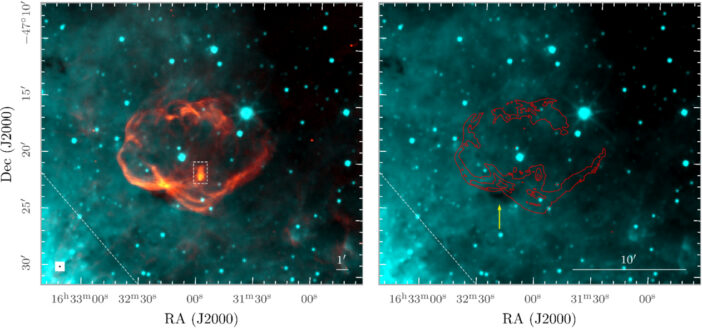
When a massive star collapses, the subsequent supernova can leave behind the star’s condensed core in the form of a neutron star. Some neutron stars are also pulsars, which rotate at incredible speeds, emit beamed radio emission, and expel winds of charged particles. A pulsar’s relativistic charged-particle winds billow around the pulsar as it travels through space — often at a few hundreds of kilometers per second or faster, having received a “kick” when its progenitor star exploded. When these winds interact with the surrounding supernova ejecta or the interstellar medium, the interaction creates a detectable pulsar wind nebula. The image above combines data from the Australian Square Kilometre Array Pathfinder (orange) and Wide-field Infrared Survey Explorer (cyan) to show a pulsar wind nebula, indicated with a white rectangle, within a larger supernova remnant. Sanja Lazarević (Western Sydney University) and collaborators discovered this pulsar wind nebula, which they’ve named “Thunder” in a nod to the supernova remnant’s moniker, “Nimbus.” The cometary shape of the pulsar wind nebula suggests that the pulsar is moving quickly, traveling outward from the center of the explosion that occurred some 30,000–45,000 years ago. To learn more about the discovery and characterization of this pulsar wind nebula, check out the article linked below.

Citation

“EMU Discovery of Thunder: A Bow-Shock PWN Powered by PSR J1631–4722 Escaping the Nimbus SNR (G336.7+0.5),” S. Lazarević et al 2026 ApJ 1007 159. doi:10.3847/1538-4357/ae7f11

The post Featured Image: A Pulsar in a Nebula in a Supernova Remnant appeared first on AAS Nova.

  •  

Featured Image: The Microquasar and the Manatee

multiwavelength view of SS 433 / W50

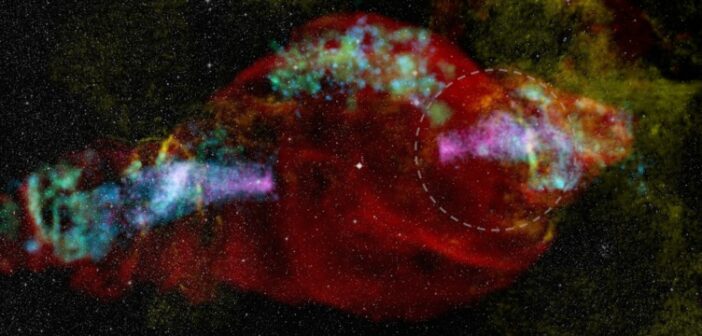
The supernova remnant W50 — nicknamed “the Manatee” because its blobby radio emission resembles an aquatic mammal floating through starry waters — harbors an extreme system at its heart. Near the center of the remnant, the microquasar SS 433 exhibits an immense pair of relativistic jets, likely powered by a stellar-mass black hole accreting material from a companion star. In the image of W50/SS 433 above, radio emission is in red, optical light is in yellow, and soft, medium, and hard X-ray emission are in green, cyan, and magenta, respectively. Brydyn Mac Intyre (University of Manitoba) and collaborators focused on the region circled above, using NuSTAR and XMM-Newton to understand the source of the X-ray emission in that region and the potential for SS 433 to accelerate particles to relativistic velocities. These observations suggest that W50/SS 433 accelerates electrons up to energies of more than 100 teraelectronvolts, and it may launch other particles into the highly sought-after petaelectronvolt range. To learn more about the particle-acceleration possibilities in this remarkable region, be sure to check out the full research article linked below.

Citation

“The Western Jet of SS 433/W50: Hard X-Ray Emission, Spectral Evolution, and Comparison to the Eastern Jet,” Brydyn Mac Intyre et al 2026 ApJ 1006 69. doi:10.3847/1538-4357/ae7a47

The post Featured Image: The Microquasar and the Manatee appeared first on AAS Nova.

  •  

MacVoices #26184: NAB – AI-Powered Thumbnails, Scoring, And Recommendations From Presaige

From NAB 2026 in Las Vegas, Skylar Holtzman of Presaige introduces their AI-powered content improvement tool that predicts how engaging images and short videos will be before posting. The discussion covers scoring, recommendations, thumbnail selection, carousel ordering, video limits, privacy, proprietary AI, pricing tiers, creator use cases, and API integration. 

💾

  •  

‘LION’ – new TV series chronicles four-year journey of lion cub Kio

It’s very much a real-life doco version of ‘The Lion King’, with Jon Favreau executive producing, and music from Hans Zimmer echoing themes from the Disney classic. It took Disney+ and BBC Studios’...

The post ‘LION’ – new TV series chronicles four-year journey of lion cub Kio first appeared on Science Illustrated.

  •  

Featured Image: Citizen Science and Solar Structure

solar corona during a solar eclipse

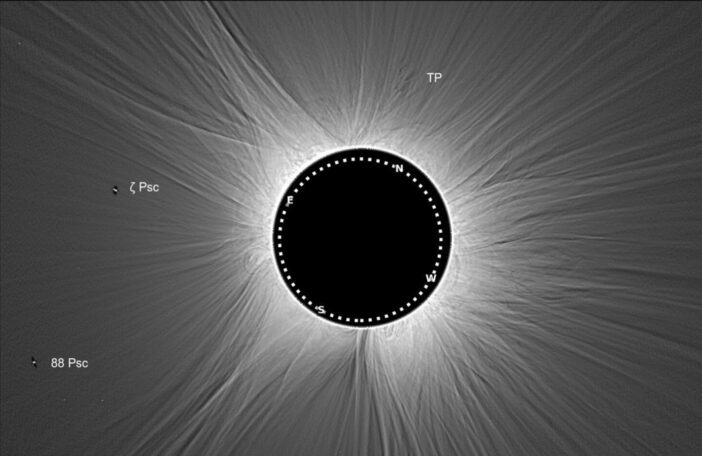
During the 8 April 2024 solar eclipse, the path of totality swept across North America, dazzling millions of skygazers. Scattered along this path were 82 viewing sites of the Dynamic Eclipse Broadcast Initiative citizen science project, which aimed to observe the dynamics of the tenuous solar corona. Though poor weather dashed many observers’ hopes, the project managed to collect data at 11 sites spanning 2,700 kilometers, capturing 49 minutes of coronal behavior. The image above shows the solar corona as seen during totality from one of the DEB Initiative sites. In a recent research article, Matthew J. Penn (Southern Illinois University Carbondale; Tucson Amateur Astronomy Association) and collaborators described the results of the Initiative’s viewing efforts, including identification of downflows and outflows, plumes, coronal loops, and apparent motion of background stars. To learn more about these observations of the solar corona, be sure to check out the full article linked below.

Citation

“Structure and Dynamics of the Inner Corona Measured from the DEB Initiative 2024 Eclipse Image Sequence,” Matthew J Penn et al 2026 ApJL 1006 L25. doi:10.3847/2041-8213/ae8797

The post Featured Image: Citizen Science and Solar Structure appeared first on AAS Nova.

  •  

Scanner occasional connection fail

I am using an Epson v850 Perfection scanner with my iMac on MacOS 15.7.7. Occasionally the connection fails and does not reconnect after starting and restarting the scanner and scanning utility. All cabling seems to be okay. I try again later or next day and it works fine.

The scanner is about 3M [10'] away so is the distance an issue?
  •  

Featured Image: A Rare Pair of Galaxies Lacking Dark Matter

This image, which combines a background view from the Dark Energy Camera Legacy Survey with two inset images from the Very Large Telescope, shows an unusual pair of galaxies in the Fornax Cluster. The galaxies FCC 224 and FCC 240 are under scrutiny because they may have formed via a high-velocity collision between dwarf galaxies — the so-called “bullet-dwarf” model. Using new spectroscopy from the Very Large Telescope, Maria Luísa Buzzo (Yale University) and collaborators analyzed the ages and kinematics of the galaxies’ stars as well as the unusually bright globular clusters swirling around each galaxy. These data suggest that both galaxies are deficient in dark matter, and their stellar populations and globular clusters are all roughly 10 billion years old. The lack of dark matter and the uniform stellar ages are both consistent with the bullet-dwarf model, in which the collision strips away dark matter and ignites a burst of star formation. Since this type of collision can create more than two remnants, the team suggests searching along the trajectory defined by FCC 224 and FCC 240 for more fragments from the collision, some of which may contain the galaxies’ lost dark matter. To learn more about these galaxies and what they might mean for the bullet-dwarf mechanism, be sure to check out the full research article linked below.

Citation

“Dark-Matter-Deficient Twins: FCC 224 and FCC 240 as Possible Analogs of NGC 1052-DF2 and DF4,” Maria Luísa Buzzo et al 2026 ApJ 1005 15. doi:10.3847/1538-4357/ae7349

The post Featured Image: A Rare Pair of Galaxies Lacking Dark Matter appeared first on AAS Nova.

  •  

Featured Image: A Mass Mystery in the Bullet Cluster

Bullet Cluster with mass countours

The Bullet Cluster is best known for being considered a “smoking gun” for the existence of dark matter, but even a famous galaxy cluster like this one has its secrets. For more than two decades, different measurements of the merging clusters’ dynamical mass ratio have yielded vastly different results. In a recent research article, Boseong Young Cho (Yonsei University) and collaborators used data from JWST and the Dark Energy Camera to revisit the Bullet Cluster and measure its mass ratio using new data. The image above shows a near-infrared view of the Bullet Cluster from JWST, with an overlay of mass contours derived from gravitational-lensing measurements. The team’s analysis assigned a mass of 1.5 quadrillion solar masses for the main cluster (on the left side of the image above), and a mass of 150 trillion solar masses for the subcluster. This suggests a mass ratio of roughly 10, which matches the value supported by hydrodynamical simulations and cements the event as a minor merger. The team also identified three distinct cluster halos (two in the main cluster and one in the subcluster), providing an important constraint on the cluster configuration for future modeling. To learn more about this investigation of the Bullet Cluster, be sure to check out the full research article linked below!

Citation

“Joint JWST–DECam Lensing Reveals that the Bullet Cluster Is a Minor Merger,” Boseong Young Cho et al 2026 ApJ 1005 28. doi:10.3847/1538-4357/ae6a90

The post Featured Image: A Mass Mystery in the Bullet Cluster appeared first on AAS Nova.

  •  

Annual SharkFest gets up close with hammerheads

Annual SharkFest gets up close with hammerheads Shark fans are warming up for their annual ‘SharkFest’ courtesy of National Geographic, now in its 14th year, and kicking off on July 5 with the...

The post Annual SharkFest gets up close with hammerheads first appeared on Science Illustrated.

  •  
❌