When it comes to putting strange substances into your body in 2026, the sky’s the limit.
First there were black-market Russian peptides — and now there are AI-generated viruses, which one startup claims has been used to successfully treat a bacterial infection.
On Tuesday, the company called Radical Numerics published a technical paper on its website, explaining the process by which they trialed an AI-engineered viral treatment on a human subject.
Targeting bacteria with special viruses isn’t new — it’s called “phage therapy,” and it involves deploying viruses that specifically target harmful microscopic organisms. But the hunt for viruses capable of locking onto a particular infection is arduous, and Radical Numerics says it’s found a way to use AI to revolutionize the process.
Yet as the New York Times notes in its reporting, Radical Numerics’ research is really more like a blog post — not only was the study self-published, rather than being vetted by a scientific journal, but it hasn’t even been peer reviewed. Making matters even murkier, the company declined to share clinical information about the patient or the doctors involved with the NYT, citing the proprietary nature of a treatment it hopes to monetize.
“We take our responsibility to protect patient confidentiality and maintain the trust of our clinical partners extremely seriously,” CEO of Radical Numerics Eric Nguyen told the paper. “We intend to publish our scientific findings through peer-reviewed research, with any future disclosure of clinical details subject to appropriate consent.”
As Harvard microbiologist Michael Baym told the NYT, “if it works, that’s incredible,” but his “impulse is to be skeptical.”
As the saying goes, extraordinary claims require extraordinary evidence — and that goes double when you’re running a venture-backed commercial lab exposing sick people to AI-generated viruses.
As Elon Musk tries to save face by claiming he’ll give every American child a chunk of SpaceX stock, here’s a chilling reminder of what he did that affected millions of children the second he had a whiff of federal power.
In a new interview, the documentary filmmaker Alex Gibney, who directed a just-released four-hour look at the billionaire’s life titled “Musk,” discussed the staggering death toll of Musk’s cuts to USAID, calling it a “crime against humanity.”
“There was an estimate that what [Musk] did by so suddenly cutting USAID would cost through disease and starvation as many as 14 million lives,” he told journalist Katie Couric. “Even if you discount that by an enormous amount, we know that within about a year of those summary cuts — where they were literally burning food that had already been paid for that was going to starving children — 500,000 children died.”
Musk, to Gibney’s astonishment, even joked about the cuts by saying he’d “put USAID into the woodchipper.”
“What he put into the woodchipper,” Gibney said, “were children.”
Gibney, whose documentary Musk called a “hit piece,” is drawing from a 2025 study published in The Lancet, one of the most prestigious medical journals. It estimated the impact of Musk effectively neutering USAID by implementing a freeze on its foreign aid funding — which went to programs to combat HIV/AIDS, malaria, and to address food insecurities — and slashing nearly 10,000 employees.
In sum, the researchers found that the “steep funding cuts could result in more than 14 million additional all-age deaths, including 4.5 million in children younger than age five, by 2030.”
Even conservative estimates concurred that the number of deaths would be staggering. A tracker created by Brooke Nichols, a professor and infectious disease mathematical modeler at Boston University, projects the 1-year death toll caused by the USAID cuts at 518,000 children.
It’s a touchy subject for Musk, who continues to bristle at accusations that his actions could’ve caused harm. This summer, he challenged his critics to “cite a single name of someone who died” as a result of him gutting USAID. Nicholas Kristof, a Pulitzer Prize-winning journalist, took him up on it and gave him a list of the specific children who had died directly from his policies, many of whom were in South Sudan and Liberia — places he had visited in person to talk to locals and healthcare workers.
Musk, rather than countering his arguments, called Kristof “evil.”
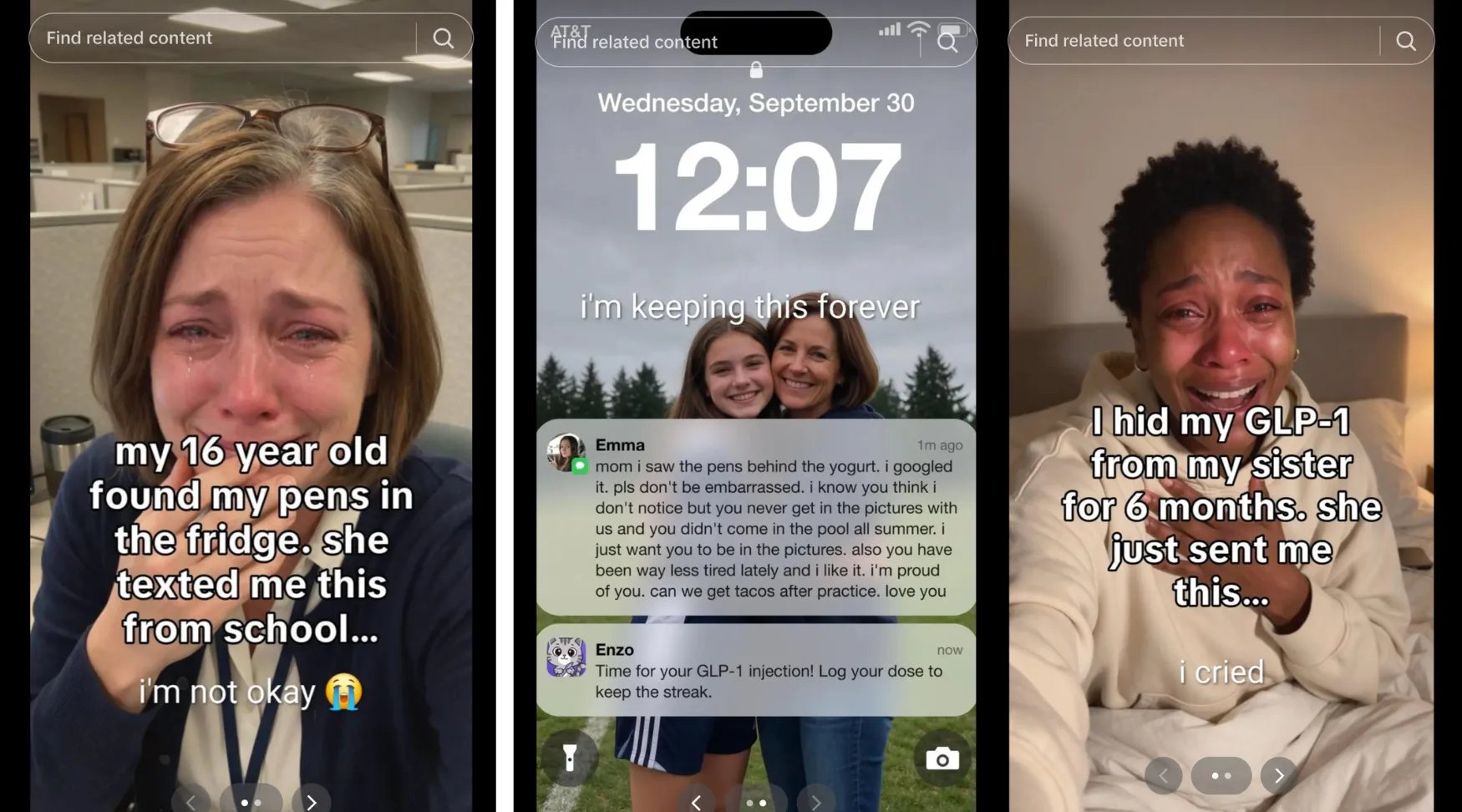
An image published by a TikTok account called “WellWithHer” shows a selfie of an obviously AI-generated woman sitting in her bed, weeping. According to the image’s caption, which is written in the first-person, the woman spent six months “hiding” her GLP-1 “pens in her bag,” only for her secret use of the meds to be discovered by her sister.
“I hid my GLP-1 from my sister for 6 months… she just sent me this,” reads text overlaying the image. “I cried.”
The next image in the carousel is a screenshot of a locked iPhone screen, which shows a lengthy text from a sender saved as “Sis.”
“I saw the pens in your bag on Sunday and i didn’t say anything because i didn’t want you to feel judged. I’ve watched you hate yourself in photos since we were teenagers. If something is finally making you feel okay in your own body, i’m not going to be the person who makes you feel bad about it,” reads the text. “I’m so proud of you. And i’m sorry it took me this long to say it.”
Beneath the purported text message is another notification: a reminder from a mobile app called Enzo instructing the poster to take their GLP-1 shot.
“Time for your GLP-1 injection!” reads the notification, which features a cutesy cartoon cat as its mascot. “Log your dose to keep the streak.”
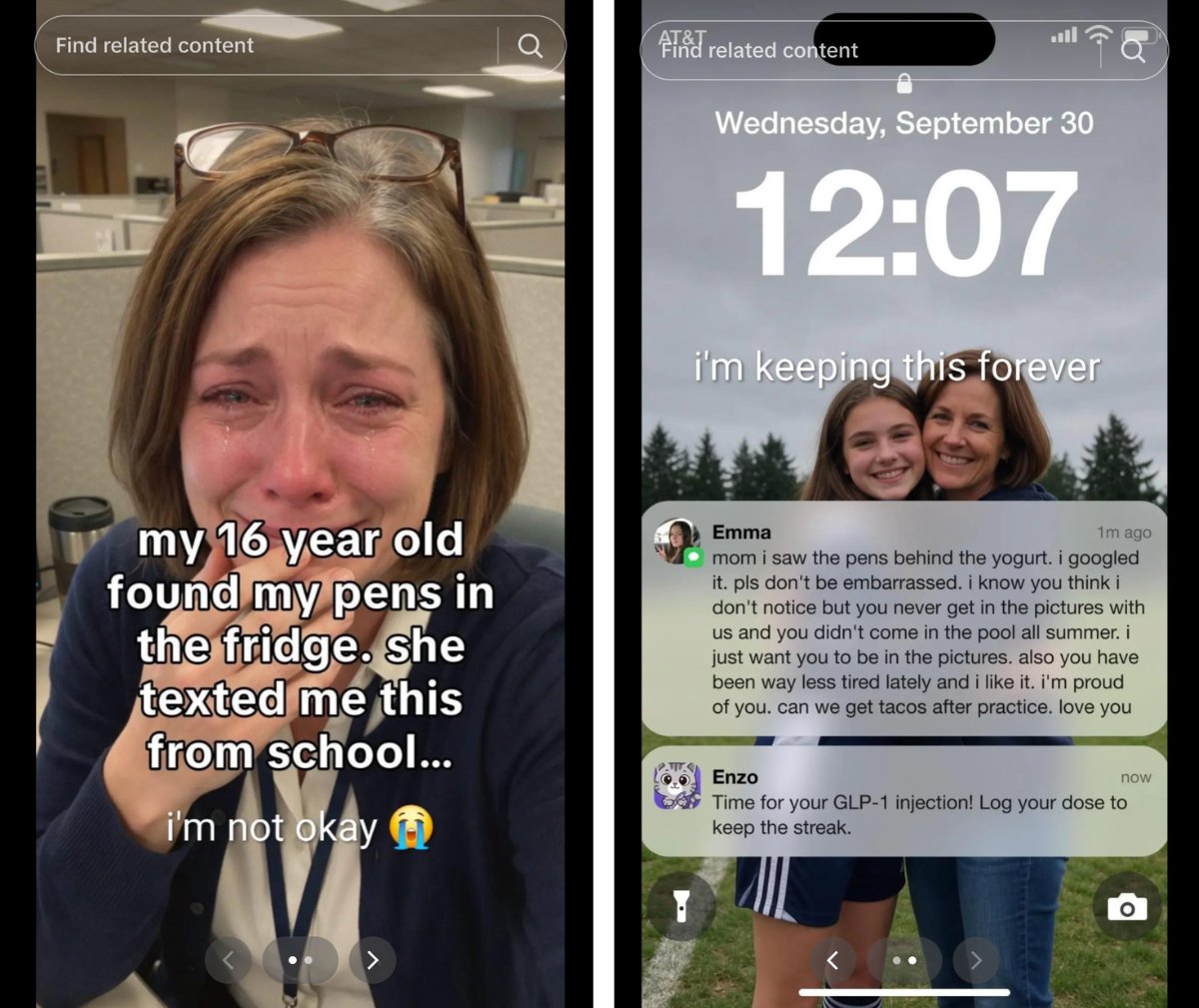
The same WellWithHer TikTok account is loaded with similar images crying AI-generated women sharing personal family stories about secretly taking GLP-1 weight loss injections like semaglutide and tirzepatide. Another post, for instance, shows an AI lady crying in her cubicle after purportedly receiving a text from daughter, “Emma,” who claims to have found her mom’s GLP-1 medicine “in the fridge” and is urging her to “pls don’t be embarrassed.”
“i know you think i don’t notice but you never get in the pictures with us and you didn’t come in the pool all summer,” the text continues. “i just want you to be in the pictures. also you have been way less tired lately and i like it. i’m proud of you. can we get tacos after practice. love you”
Below the text is another notification for Enzo, reminding the sobbing AI woman to take her GLP-1 shot.
“Time for your GLP-1 injection!” the notification chirps. “Log your dose to keep the streak.”
The psychology of the undisclosed ads is obvious and manipulative. The texts in the posts all offer variations of an emotional validation fantasy, in which loved ones of a GLP-1 taker, who may be feeling shameful or embarrassed, surprise them with love and support when they discover they’ve been taking the drugs. The messages, and the alleged GLP-1 users claiming to have received them, are clearly fake, and are designed to promote GLP-1-focused apps — yet aren’t being disclosed as advertisements, nor as AI-generated synthetic content.
Unfortunately, Enzo isn’t the only GLP-1 app being marketed through this style of manipulative synthetic content.
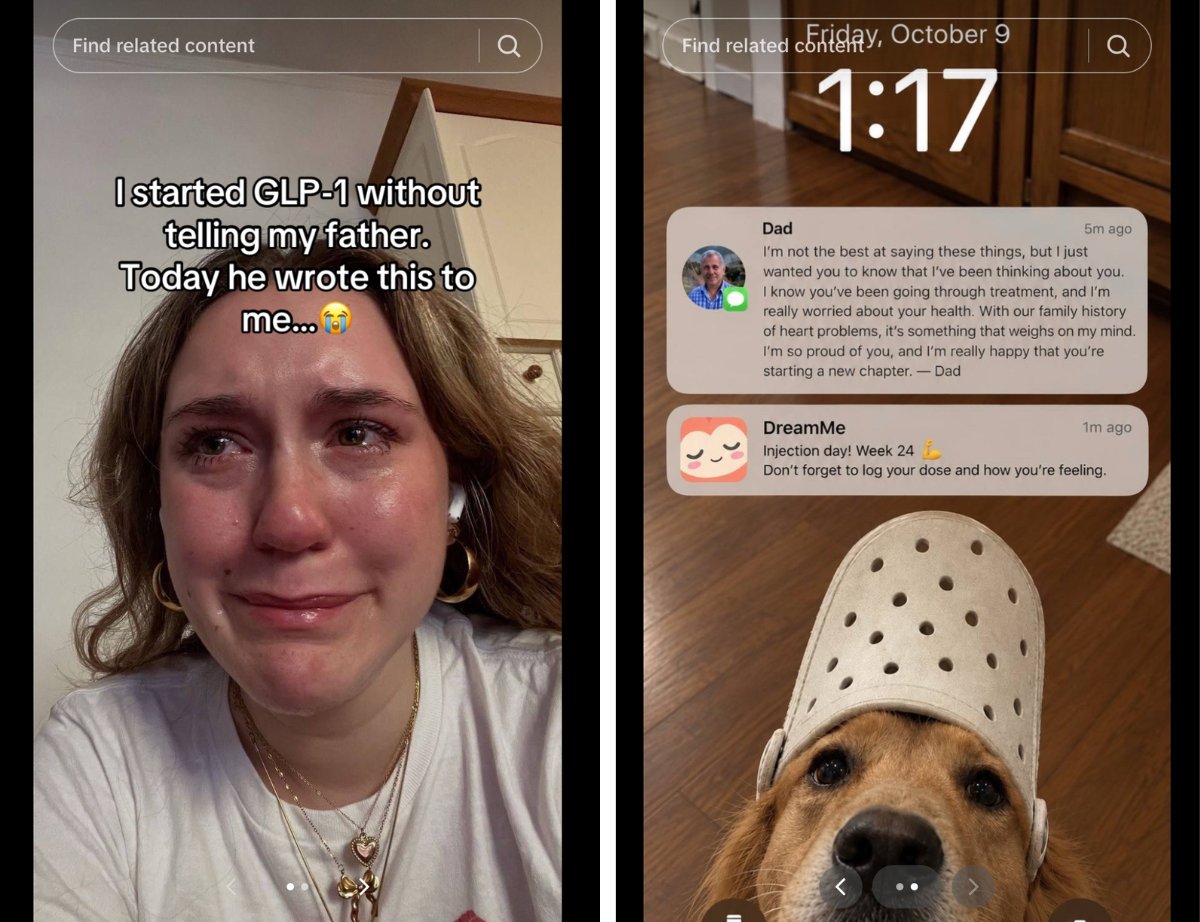
Over on another TikTok account, for example, a poster going by the name “Lara” uses a mix of stolen images of real influencers and AI-generated images — always of young women, some of whom are pictured crying — to market a completely different GLP-1 tracker called “DreamMe.”
In some posts, like “WellWithHer,” the account promotes a GLP-1 app called “DreamMe” by coupling weepy selfies with fake phony texts from family members offering words of support and understanding.
“I started GLP-1s without telling my father. Today he wrote this to me…” reads text overlaid on a selfie of a crying young woman.
On the next slide, sitting above a notification from DreamMe, is a text from “Dad.” His profile picture also appears to be AI-generated.
“I know you’ve been going through treatment, and I’m really worried about your health,” says the text. “With our family history of heart problems, it’s something that weighs on my mind. I’m so proud of you, and I’m really happy that you’re starting a new chapter.”
According to its website, “DreamMe” claims to provide users with their “new GLP-1 best friend” in the form of “Sushi,” a cartoon fish that helps keep track of GLP-1 meds. Its landing page features a handful of AI-generated women that the site bills as real customers who have shed weight with Sushi’s support.
Enzo’s unreality, in other words, doesn’t end with the TikTok content.
“Real journeys. Real members,” the page reads. “The numbers are theirs. The words are theirs. We just built the fish.”
The strange, heartstring-tugging posts used to promote Enzo and DreamMe are part of a larger trend on TikTok using fake AI-generated women to promote a range of dubious wellness apps. (In fact, some posts across accounts are so alike that different fake women have different-but-strikingly-similar images of dogs with Crocs on their heads as their phone wallpapers.)
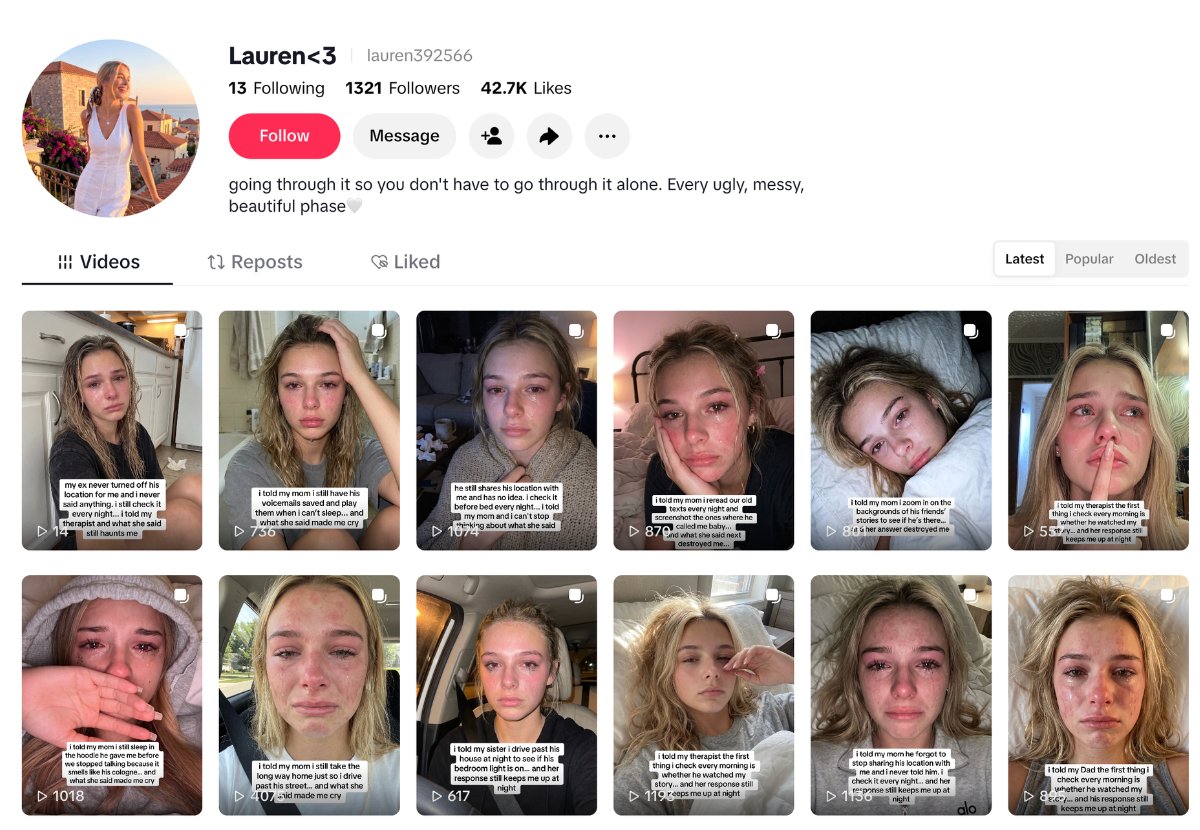
Take “Lauren<3,” a TikTok poster portrayed as a young woman publicly posting through her sudden breakup. Blonde and clearly AI-generated, the account published slideshow after slideshow of “Lauren” — in a bathtub, in a bed, in a car – with mascara running down her tear-covered cheeks as she recounted the process of going no-contact with her ex after a horrible breakup.
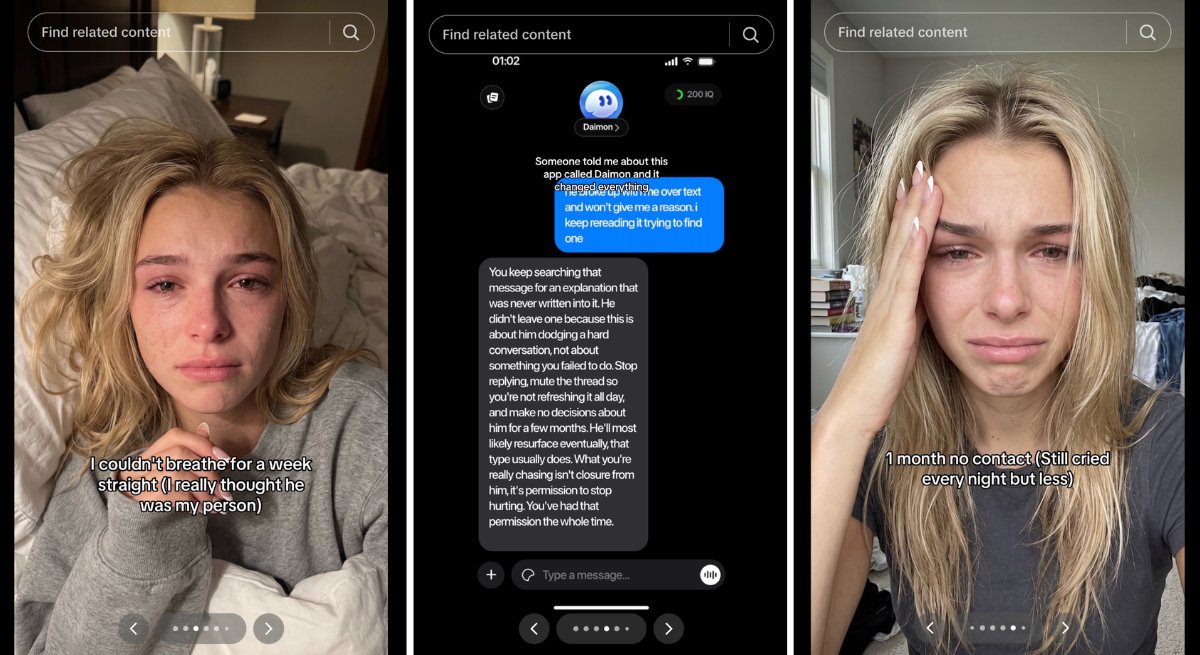
Photo carousels published to the account were interspersed with sobbing selfies and alleged screenshots of texts from her toxic ex — as well as screenshots of conversations with an AI companion app called “Daimon,” which Lauren claimed was helping her go no-contact with her former boyfriend.
“Someone told me about this app called Daimon and it changed everything,” the poster declared in one post’s caption. In another post, “Lauren” described Daimon as the “one app that wouldn’t judge me and give me the best advice.”
“(Daimon in the app store),” she added, for good measure.
Elsewhere a TikTok account identified as “Ashley Miller” posted AI selfie after AI selfie of a fake woman who was pictured crying as she shared sob stories about her divorce, tales of getting cheated on or abandoned by her partner, or confessions about regretting her recent engagement. Images posted on the Ashley account are accompanied by purported screenshots showing text messages from her parents or, in the account’s most viral posts, texts from her partner’s parents urging her to leave her new fiancé due to his abusive behavior or confessing to their son’s infidelities.
These posts were created to market a completely different app: a “wellness” service called Zenit, which is described on the App Store as a tool to help users “take care” of their “mental well-being with guided support, daily check-ins, and emotional growth tracking — all in one calm and safe space.” Its mascot is a kiddish-looking owl in a scarf.
“He proposed in Paris last night,” the “Ashley Miller” account claimed in a viral post that garnered more than 240,000 likes and over 1,000 comments. The post featured an AI-generated selfie of “Ashley” in front of a shimmering Eiffel Tower, holding an engagement ring up to her phone camera as she wept. “This morning his mom sent me this…”
The next image in the slideshow showed a text message, in which the sender — a woman named “Diane” whose face also appears to be AI-generated — told the fake AI selfie-taker that “I watched you say yes last night and I cried, but not for the reason everyone thought.”
“I’ve been quiet for two years because he’s my son and I love him. But I was you, thirty years ago, in front of that same tower, with his father,” the text continues. “The charm, the big gestures, the temper he shows you only in small flashes and and then apologizes for, I know the pattern because I married it. Ask him about his last relationship and why it really ended. Ask him in a public place. If I’m wrong about my own boy, no one will be happier than me. But if you feel a knot in your stomach reading this, that knot is the answer.”
Beneath the text is a notification for Zenit.
“Your heart’s been racing,” read the notification beneath the dramatic text. “I’m here whenever you need me.”
Indeed, all of the account’s posts showed Zenit notifications, making it clear that the fake woman and her sob stories were a fabricated marketing gimmick. Many of the account’s commenters, however, were duped.
“If the mama says this to you. Run,” remarked one commenter who was taken in by the false narrative. “She’s trying to protect you girl. I’m sorry.”
***
We reached out to the TikTok accounts we found publishing the manipulative AI-generated marketing content, as well as to the companies being promoted in the posts.
Very quickly after we reached out, the TikTok account associated with Zenit, the wellness app, was deactivated. The developer of Zenit, who identified himself as an independent developer named Pedro Pérez, told Futurism that he personally ran the account and that “no third party of marketing agency” was involved.
“I built Zenit to help people who struggle with overthinking, everyday stress or anxiety, or loneliness. The videos were based on realistic situations many people go through, with the goal of helping viewers feel understood and showing them a tool that could help them deal with those moments,” Pérez said. “The visuals were AI-generated and the posts promoted my app, so they should have been labeled as such.”
“After receiving your email, I tried to add TikTok’s AI-generated and commercial content labels, but the platform doesn’t allow adding them to videos that are already published, so I’ve deleted the account,” he added. “I think transparency matters, especially for a wellness app, which is why I’ve made this change.”
The account associated with Daimon, the AI companion, was abruptly scrubbed of all content after we reached out. The account owner also changed the handle from “Lauren<3” to simply “yooo.” When we reached out to Prospinity, the company behind the companion chatbot, it told us that the account was “absolutely not operated by our internal marketing team, and the content was neither created nor approved by us.”
“We’ve worked with external affiliate programs, and unfortunately, some affiliates were publishing content independently through accounts we didn’t directly manage. As soon as we became aware of this, we immediately looked into it, identified those responsible, and took action to shut down these activities,” the company said. “This kind of content is completely against our guidelines and is absolutely not how we want Daimon to be represented. We’re a small team that genuinely cares about what we’re building, and we take how Daimon is represented very seriously. While this content wasn’t created or authorized by us, we recognize the importance of making sure anyone promoting Daimon follows our standards.”
DreamMe didn’t responded to questions sent to email addresses listed on its website, and our email to Enzo bounced back. We also didn’t hear back from the TikTok accounts associated with their products.
They’re also continuing to post. The most recent post from the account promoting Enzo is now advertising a different app designed to track peptide consumption; the DreamMe account, meanwhile, has been promoting a phone-locking app.
A new piece of research is pushing back on the long-held belief that plastic is a harmless and chemically inert material.
The new study, published in the journal Nature, took a look at the way micro and nanoplastics interact with water-rich environments such as the human body. It found that typical consumer-grade microplastics exhibit “intrinsic physicochemical activity” there, indicating that the tiny chunks of plastic do indeed react chemically inside our bodies.
“As plastic fragments into smaller and smaller particles, its surface area increases enormously,” Columbia professor of chemistry and biomedical engineering and study co-author Wei Min said in a press release. “Then microplastics change the water that surrounds them, generating high-energy, reactive radicals… that very likely contribute to biological damage that we see in animals and potentially in humans as a result of microplastic exposure.”
Min was previously part of another alarming study, which found that the average liter of bottled water contains upward of 240,000 tiny microplastics, a much higher count than previously known. Combined with the new research, it looks like those untold thousands of plastic bits are capable of causing much more chemical harm than scientists had given them credit for.
As co-author Beizhan Yan put it, “this work has significant implications for environmental and human health,” particularly when it comes to food supply chains.
In the US, plastics make up an integral part of the food chain. They’re heavily integrated into industrial agriculture, present in high quantities throughout food processing, and are extensively used in food distribution, whether to preserve fruits and vegetables or as packaging for groceries.
The scale of plastic packaging alone is staggering: it’s estimated that food packaging accounts for 40 percent of the world’s total plastic production. With billions of dollars riding on the plastics industry, your average working-class person has little hope of skirting microplastics through a simple change in consumption habits — even if you have enough money to buy the haute premium foods packaged in glass or tin, individual consumers have no control over how much plastic their food is exposed throughout the production process.
Given the growing body of work pointing to the horrifying consequences of microplastics on the human body, it seems our collective health depends on finding a way out of this plasticky status-quo — and fast.
Nearly a year ago, news began to spread of an experimental weight loss drug called retatrutide, under development by Eli Lilly. Though the drug hadn’t made it through clinical trials, nevermind been released by a federally licensed manufacturer, a rapidly-growing black market ensured interested customers didn’t have to wait for the real deal.
Now, the bill on those black market knockoffs seems to be coming due. As CBS reports, the consequences of the unapproved retatrutide trade have now become deadly.
According to the broadcaster, the Food and Drug Administration has received at least two reports of deaths related to the use of bootleg retatrutide in recent months — the first public accounts from health officials acknowledging that the knockoffs contributed to users’ deaths.
Though CBS viewed documents related to the two deaths, it noted that the details haven’t been independently verified, and it remains to be seen whether the black market retatrutide was the principle cause of death in either case, or merely a complicating factor.
Documents related to the death of a 41-year-old woman in July, for example, names retatrutide as a “suspect product” which the deceased obtained “from an unreliable source.” The woman in question was labeled obese, and died after going into cardiac arrest.
Though more information is needed to determine whether the knockoffs were truly responsible for the deaths, the FDA’s interest is telling. In April, Medpage Today reported a case of retatrutide overdose which led to extreme side effects for the user which included kidney injury, extreme dehydration, and diarrhea lasting at least a week.
And though the FDA is at least aware of the dubious retatrutide trade, the federal government’s lax attitude toward bootleg peptides throughout the second Trump administration is arguably a principle factor contributing to the rise of sketchy knockoffs.
“It is concerning because of the breakdown of our drug-approval process in the United States of America,” associate professor at Harvard Medical School Pieter Cohen told CBS.
If you’re one of the over 100 million people around the world who regularly hits the vape, you might want to think about ways to start cutting back.
According to some recent research by scientists from Seoul National University and published in Nature Medicine, the use of non-tobacco devices like vapes and e-cigarettes to help quit smoking carries a strong link with the development of lung cancer.
The researchers analyzed anonymous health data from over 4.5 million Korean adults. They were split into three main groups: current smokers, short-term quitters, and long-term quitters. They were then categorized by whether they vaped daily during a 2018 screening in the Korean National Health survey, with adjustments to control for factors like age, sex, and prior health conditions.
In all, scientists found that those who had turned to vaping after quitting traditional cigarettes developed lung cancer at a rate about 56 percent higher than those who quit entirely. Alarmingly, incidents of lung cancer death among vape users nearly doubled, with a lung cancer-specific death rate 91 percent higher than non-vape users.
Of course, there’s an important group that falls outside the bounds of the study: anyone who got hooked on vaping without trying cigarettes first. It’d be fascinating to learn more about their fates, but the implication of the study — that vaping is turbocharging the chances of cancer among former smokers — is almost certainly cause for alarm.
While it may be easy for non-smokers to roll their eyes at the findings, it’s important to note that empirical data on the relationship between vaping and lung cancer remains relatively scarce.
“Although epidemiological and biological studies support the association between e-cigarettes and various respiratory disorders, evidence regarding the relationship between e-cigarettes and lung cancer risk remains limited,” the researchers wrote.
It’s an observational study, meaning that it can’t establish true causality. Going forward, more research is needed to say for sure whether there’s a causal association between vaping and cancer — but the early data doesn’t look pretty.
With gray market medical snake oil flooding the market and the head of the Food and Drug Administration smoking DMT behind the wheel, peptides are quickly becoming the go-to hack for just about any malady you can imagine. Yet for as popular as they are, they’re not necessarily safe to use — a fact many new users are starting to discover the hard way.
New reporting by KFF Health News revealed the story of Dylan Meetze, a weightlifter who bought an experimental peptide intended for laboratory research from a company called Researchem. Meetze’s peptide of choice was BPC-157, a synthetic substance derived from 15 amino acids and prized by YouTubers for its supposed ability to reduce inflammation and repair damaged tissue.
For Meetze, BPC-157 was a way to enhance his weightlifting performance. Yet after spraying the stuff up his nose for just three days, KFF notes the peptide user fell seriously ill.
“It was like I was underwater, like it took the most to do anything,” Meetze told the outlet.
Though he stopped huffing BPC-157 almost as soon as the side effects appeared, the weightlifter said he endured fatigue and anxiety, as well as eye and muscle spasms for months afterward.
“There are millions of success stories with these peptides,” he told KFF, “but no one wants to believe that this wrecks some of our lives.”
Another peptide user who combined BPC-157 with a naturally-occurring protein called TB-4 told KFF that his side effects also came within days of beginning the experimental treatment.
“My left eye started throbbing really badly, and the left side of my face became numb,” the man, identified only as Dominik E, told the publication. He went on to battle migraines for two months, calling the ordeal a “total nightmare.”
Certain peptides have become established treatments after passing clinical trials, like GLP-1 drugs for diabetes and weight loss.
But for the many other peptides that haven’t undergone clinical review, supporters in the medical research community are few and far between, despite what the chorus of pro-peptide comedians and health influencers would have you believe. Robust studies on their impact on human health remain exceedingly rare — making any use of unregulated peptides on the human body a serious roll of the dice.
“A lot of this pseudoscience stuff sounds deeply impressive — inflammation this and telomere that — but at the end of the day, none of it really matters,” former associate commissioner for public health strategy and analysis at the FDA Peter Lurie told KFF. “You’ve got to show clinical benefit in humans: does it work?”
While the recreational use of marijuana is usually associated with a more peaceful mental state, scientists just a made a surprising discovery.
As detailed in a meta analysis of cannabis-related studies published last month in the journal Psychological Medicine, a team of scientists in the UK discovered a significant link between cannabis use and an “increased risk of violence.”
The headline finding was that they found cannabis users were statistically more likely to be the perpetrators of violent acts. They also found that the use of the drug — particularly among women and mixed-gender cohorts — was “significantly associated with an increased risk of becoming a victim of violence” as well.
While it’s a classic case of correlation, not causation — the researchers stop far short of suggesting the drug directly motivates users to be more violent as we’re far from reaching a scientific consensus on the matter — the findings “underscore the importance of addressing this issue at both a societal and clinical level,” according to the paper.
In other words, it’s a highly nuanced and complex relationship with plenty of other factors at play.
“As a clinician, I’ve seen how heavy cannabis use can be a factor in violence,” said coauthor and King’s College London professor Marta Di Forti in a statement. “We’ve been cautious for a long time about how far we could go in describing this link, but a review of this size lets us speak with more confidence about the risks, while being careful not to stigmatise people who use cannabis more broadly.”
“As cannabis becomes more commercialized and legalised around the world, the conversation about its risks has focused mostly on the person using it,” added coauthor and King’s College London professor of psychiatric research Sir Robin Murray. “This review shows that violence, both committing it and experiencing it, needs to be part of that conversation too.”
For their paper, the researchers examined 63 cannabis-related studies, involving just over 265,000 subjects.
The researchers found that cannabis users “may place themselves in risky situations,” which could help explain the “increased vulnerability” to violence. Users may also be exposed to “peers who engage in substance use or criminal activities.”
The risk of violence was also more pronounced among psychiatric patients. Previous resarch has found that people who already suffer from pre-existing mental conditions such as psychosis may experience “poorer clinical outcomes” through continued cannabis use.
“Given the higher rate of cannabis use among individuals with severe mental disorders compared to the general population, this group represents a particularly at-risk population in terms of violent behavior,” the paper reads.
The researchers offered some key takeaways from their findings. At the societal level, the researchers suggest that “violence should be considered alongside other established cannabis-related harms when developing prevention strategies, public education campaigns, and regulatory policies.”
At the clinical level, the research highlights the “necessity for mental health professionals to routinely assess cannabis use in individuals presenting with violent tendencies, particularly among those with severe mental illness.”
However, to get a better picture of how cannabis use relates to violence, future studies will need to “disentangle causal pathways” by diving into how, why, and when people use the drug in more detail. Other studies should also “examine whether reducing cannabis use through clinical or public health interventions leads to reductions in violent behavior,” the researchers conclude.
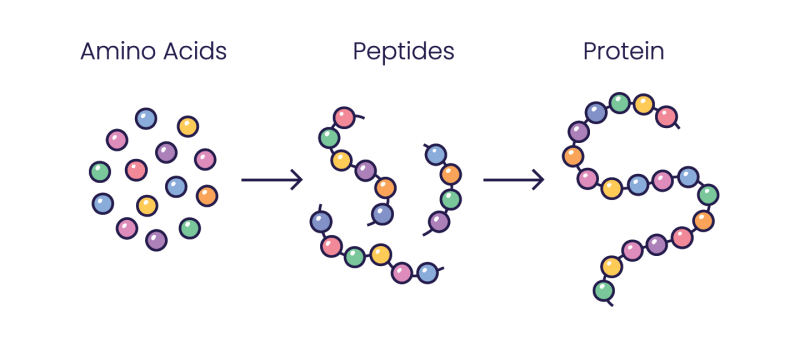
Proteins are made of building blocks known as amino acids. Human proteins are made of various combinations of 20 of these. A diet especially rich in one of them — arginine — appears to help the immune system. It can fend off infections and at least one type of cancer, finds a new study in mice.
Arginine appears to ramp up the immune system’s ability to spot danger. A high-arginine diet seemed to offer the rodents some protection against flu and COVID-19 viruses. It also quashed colon tumors, says Sohail Tavazoie. A doctor and cancer biologist, Tavazoie works at Rockefeller University in New York City.
His team shared the new findings July 30 in Cell.
“I don’t want the takeaway to be that everyone should be just consuming arginine all the time,” says Tavazoie. It’s just too soon, he says, to know if taking it as a food supplement could prevent or even treat these diseases in people. But he’s interested in launching human studies to test that.
The new data do make a compelling case for further testing, says Costas Lyssiotis. He had no role in the new study. But he is a cancer researcher at the University of Michigan Medical School in Ann Arbor.
Might a high-arginine diet help the human immune system recognize tumors and target them for destruction? That’s not yet clear, Lyssiotis says. But, he adds, it’s something that is “super provocative and should be pursued.”
Amino acids are the building blocks used to build proteins in the human body and in many other organisms. As they start to assemble, these amino acids may form small molecular chains known as peptides. Eventually, these short chains will collect into the longer proteins that cells use to carry out their tasks.Vitali Dumma/iStock/Getty Images Plus
Not ‘essential’ — but beneficial
Research has been suggesting that arginine may play an outsized role in disease.
Nine amino acids are considered “essential” nutrients. That’s because our bodies use them but can’t make them; they must be acquired as part of what we eat. Arginine is not one of those. But because this amino acid can open blood vessels, some people do take arginine as a food supplement. The goal is to help their blood circulate.
Arginine also tends to be scanty in the lungs of people with influenza or COVID-19. It’s barely present, too, in the tumors that develop in people with colon cancer. What’s more, studies have shown that both cancer and viral infections can crank up the destruction of arginine.
Tavazoie’s team wondered what was so important about this amino acid that multiple diseases shut it down.
In the lab, his group tinkered with arginine levels in mouse and human cells. Cutting back on arginine reduced levels of key immune proteins, they found.
Take what’s known as MHC class 1 proteins. Riding on the surface of our cells, they tell the immune system what to watch out for. Like a police officer holding up a sketch of a criminal, they display snippets of viral or cancer proteins. But the immune system has trouble recognizing and rousting those outlaws when cells have fewer MHC-1 proteins than normal.
A key player in immunity?
Tavazoie’s team then turned to mice at risk of colon cancer. When the researchers fed them a low-arginine diet, MHC-1 levels fell and the number of colon tumors rose. But add bonus arginine to the diet — what would be about 10 grams a day for humans — and the outcome flipped. Now MHC-1 levels rose and tumor-forming fell.
These data suggest dietary arginine can control MHC-1, a very important group of immune proteins, Tavazoie says.
Arginine-starved cells slowed their assembly of MHC-1 proteins. That may be because these proteins contain long stretches of arginine units. If there aren’t enough of these building blocks available, “there’s a supply-chain shortage,” he says. At that point, MHC-1 construction stalls.
The team observed a similar story in mice infected with the flu virus or the virus that causes COVID-19. Low-arginine diets led to them having low levels of MHC-1 proteins. They also had more viral proteins and inflammation in their lungs compared to mice eating high-arginine diets.
This suggests arginine was blunting the effects of infection. And arginine supplements given after flu infection boosted mouse survival, the team found. That points to it as a possible treatment one day. Tavazoie now wonders whether other amino acids may play similarly important roles.
There’s still much work needed to know if the mouse data predict effects in people, says Pierre Close. He’s a cancer researcher at the University of Liège in Belgium. He didn’t participate in the new study. But, he says, this research might one day lead to therapies that help the immune system better tackle disease. “We are all looking for new strategies.”
In September 2024, an entrepreneur named Justin Brown uploaded a YouTube video in which he argued that writers should be “scared right now” about the rise of AI.
“I think that one of the big dangers is that AI is going to take many people’s jobs,” Brown muses to the camera as he hikes through a national park in Australia. “This includes writers, by the way.”
What Justin didn’t mention in the video is that, along with his brothers Lachlan Brown and Brendan Brown, he runs a company called Brown Brothers Media — which, former insiders assure us, had just months earlier fired a stunning proportion of its own writers as it embraced generative AI.
Over the past few years, BBM has pioneered a remarkably cynical business model. First it buys online publications that have established themselves as offering a distinctive type of journalism, like coverage of space travel, parenting advice, or business news. Then it floods their websites with dizzying torrents of AI-generated content — many thousands of articles per month, by our count — in a bid to soak up as many readers as possible via Google and other platforms.
There are signs that this strategy has been extraordinarily successful, with BBM boasting in 2025 that its network of sites had surpassed 50 million page views per month. It’s difficult to verify a site’s traffic without access to its internal data, but the analytics service Similarweb corroborates the claim that BBM is pulling in vast audiences, estimating that over the past year its network of publications has attracted an average of 64.7 million visitors per month. According to a recent ranking, that would make it one of the 30 most trafficked English-language media enterprises on the web, with a total digital readership substantially higher than that of NPR, narrowly besting CBS News and Forbes, and just slightly behind the Washington Post.
A media organization like NPR or WaPo, though, employs hundreds or even thousands of journalists to gather and report news. BBM, as far as we can tell, has cut itself down to a skeleton crew of about a dozen employees, including its three founding brothers. To operate such a sprawling empire with such a tiny staff, former insiders told us, BBM uses AI to crank out content at a scale so immense that it’s difficult to comprehend.
Along the way, BBM has indulged in breathtaking acts of dishonesty — often in ways that seem specifically devised to manipulate platforms owned by Google, where Ahrefs data suggests that it sources the preponderance of its traffic. (Last year, BBM wrote in a press release that its enormous audience was “driven by organic reach through Google Discover and search.”)
One of BBM’s many unscrupulous practices, insiders confirmed to us, is that it has often invented entire fake personas for nonexistent writers — we found more than 50 spread across its dozens of sites — and published content under their names without revealing to readers that they weren’t real people.
In many cases, BBM has even outfitted these fictional writers with impressive-sounding bogus credentials as it uses their bylines to churn out AI-generated material.
The space news site Space Daily, for instance— one of BBM’smost successful publications, according to Similarweb data we reviewed, with an estimated average of 10 million page views per month over the past year — has published many articles under bylines it identified as scientists with distinguished résumés. There was “Dr. Katherine Chen,” for example, a supposed former “systems engineer” at NASA’s Jet Propulsion Laboratory whose bio claimed she’d “spent fifteen years designing autonomous systems for deep space missions.” Publishing alongside Chen was “Dr. James Whitfield,” who was said to be an “aerospace medicine researcher at the European Space Agency.”
Yet beyond Space Daily, neither Chen nor Whitfield actually exist — not on social media, nor in press releases, nor as coauthors on research they would have conducted at two of the world’s premier space agencies. NASA’s site doesn’t make a single mention of Chen, and the ESA’s site has never once referred to Whitfield. And though NASA declined to comment on grounds that it “does not verify past employment or affiliations with the agency,” the ESA confirmed that “Mr. James Whitfield is not currently employed by the European Space Agency, nor do our records indicate that he has ever worked here in the past.”
BBM’s fraudulent experts aren’t limited to space. A tech site owned by BBM, Direct Message News, has run many articles under the byline of “Rachel Vaughn” that provided intimate advice about mental health concerns. According to her bio on the site, Vaughn is a Dublin-based psychologist with an “MA in Applied Positive Psychology from Trinity College Dublin” who is a “Certified Mental-Health First Aider” and an “associate member of the British Psychological Society.” The bio adds that Vaughn “regularly delivers evidence-based resilience workshops for Irish mental-health NGOs.”
But there’s no trace of a practicing psychologist in Dublin by Vaughn’s name. When we reached out to the British Psychological Society, it confirmed that it had no record of a member named Rachel Vaughn. What’s more, “Applied Positive Psychology” isn’t a degree — or even a course — that exists at Trinity College Dublin, the university told us. A reverse-image search further found that Vaughn’s headshot is a stock photo.
BBM has also created fake journalists, using them to commit bold acts of plagiarism and fabulism.
Consider an “investigation” about the recycling system in Los Angeles, attributed to another fake author named “Jordan Cooper” — depicted as a tattooed “pop-culture writer and vegan-snack reviewer with roots in music blogging” — and published this past February by VegOut, a vegan news and recipes site owned by BBM that pulls in an estimated 13.3 million page views per month.
In the piece, the Cooper persona claimed to have “bought a four-pack of Apple AirTags, super-glued them inside plastic containers, and sent them on their journey through America’s recycling system,” writing that “what I discovered over the next month made me question everything I thought I knew about those little triangular arrows.”
But the story included a purported photo of a plastic bottle containing an AirTag that featured a suspiciously garbled Apple logo — and numerous AI detectors flagged an overwhelming probability that the image was AI-generated.
As it turns out, the piece was a blatant ripoff of a 2024 story by a local San Diego TV station, CBS8. In that story, the station’s journalists describe a near-identical investigation in which they glued AirTags to four pieces of recyclable trash: a “water bottle, a yogurt container, an orange juice bottle, and a wipes container” — a list that Cooper’s piece seems to have lightly rephrased as a “water bottle, an orange juice jug, a yogurt container, and a cleaning product bottle.” (The Cooper piece never mentioned CBS8‘s work, instead framing the investigation as VegOut‘s original effort. An AI detector flagged BBM’s text as 100 percent AI-generated, with no sign of human involvement whatsoever.)
In another article, the Cooper character claimed to have “voted for Trump’s ‘America First’ promise,” but later regretted it because “that promise has been broken in just about every way imaginable.”
In addition to the fake domain matter experts and journalists, BBM provided many of its phony writers with elaborate backstories that made them seem like ordinary people, with identities that seem crafted to exploit the insecurities of readers struggling with loneliness and other life difficulties. It then used these relatable everyday personas to publish colossal numbers of emotionally manipulative personal essays in which the fake writers shared AI-generated anecdotes framed as deeply personal life experiences.
On VegOut, for instance, a fake writer that BBM called “Marlene Martin” was identified as a “retired high school English teacher and longtime writer who draws on decades of lived experience to explore personal development, relationships, resilience, and finding purpose in life’s second act.”
“When she’s not at her laptop,” the bio continues, “she’s usually in the garden at dawn, baking Sunday bread, taking watercolor classes, playing piano, or volunteering at a local women’s shelter teaching life skills.”
BBM has used personas like Martin to pump out thousands of heartfelt personal essays that purport to draw on decades of memories and wisdom, often ruminating on topics like loneliness and lost feelings of purpose.
“When I retired at sixty-six after thirty-two years of teaching high school English, a colleague pulled me aside at my farewell party,” read an essay published under the Martin persona. “‘It must be bittersweet,’ she said, touching my arm gently. ‘All those years you could have been writing, traveling, pursuing your real passions. But you had to raise your kids instead.’ I smiled and nodded, not having the heart to correct her. The truth was more complicated, more beautiful, and took me decades to fully understand.”
In a bit of unintentional comedy, these AI-generated essayists have often bungled their own biographical details, resulting in bizarre continuity errors.
Remember that essay above, where Martin claimed she’d retired at age 66? In a different piece, she wrote that she’d stopped working at 64. In another, she said it was 61.
Martin’s age is similarly inconsistent. In January of this year, she wrote that she was 68 years old. By February, she claimed she was “69 with two bad knees” — which would be possible if she’d had a birthday, except that by March she’d turned 71. By April, Martin was aging backwards, stating in a depressive essay about her loss of identity after the death of her beloved spouse — “my husband died and the caregiving that had consumed seven years ended overnight,” she lamented — that she was only 70.
These incoherent claims about writers’ life stories can be jarring. A fake “lead editor” and “clinical psychologist” identified as “Sarah Mitchell” at Silicon Canals — another BBM tech site, this one drawing an estimated 3.3 million page views per month, according to Similarweb data — published a sentimental essay earlier this year about how her baby’s first word was “Max,” the name of the family dog. Weeks later, she wrote in a piece about the psychology of dog owners that “I don’t have a dog.”
“I should probably admit that upfront,” the Mitchell persona conceded.
Martin wasn’t the only fake BBM writer whose confused narratives extended to deeply sensitive topics like grief and death.
This past February, for instance, a VegOut author identified as “Adam Kelton” — his bio claimed he was a “writer and culinary professional with deep experience in luxury food and beverage” — published an essay complaining about his mother’s passive aggressive behavior regarding his vegan diet when they eat out at restaurants. In it, he writes about his mom in the present tense, describing a lunch with her as recently as the previous week.
Then, just two days later, Kelton bylined a piece about joining a “grief support group” to help him talk about his mother — who by then, he wrote, had been dead for nearly a year.
“My mother died eleven months ago. Pancreatic cancer. The last year and a half was a slow unraveling — her energy going first, then her independence, then her,” Kelton mourned. Later in the essay, Kelton adds: “I am thirty-six years old. I am a son who lost his mother. I am a former hospitality professional. I am a minimalist living in a bungalow in Austin who hosts dinner parties and reads novels and is still — somehow, after everything — the guy who once stood in front of a painting and forgot to check the time.”
Longtime readers of sites acquired by BBM have been appalled by the severe decline in quality after the transition.
“RIP Silicon Canals,” wrote a former fan of the BBM tech site in a LinkedIn post. “Never seen a brand destroyed this quickly. For years it was part of my morning routine… then Brown Brothers Media took over at the end of November 2025, and literally overnight the entire feed turned into pure AI slop.”
When BBM eviscerates a publication like this, it can be shocking to the community its human staff had built. After it bought VegOut last year, the site went from publishing reviews and food journalism to churning out formulaic pop psychology listicles and personal essays that often had no connection to plant-based eating. Readers quickly picked up on the shift, with one commenter fuming in a Reddit thread — titled “Anyone else tired of VegOut?” — that the site’s articles under BBM “reek of AI” being used to “pump out meaningless milquetoast garbage.”
“VegOut is clearly nothing more than [an] insipid content farm,” another angry reader chimed in, “that’s CLEARLY LOST ITS WAY!”
The VegOut transformation was so controversial that in May 2026, the magazine’s original founder, Maggie Ortlieb, took to social media to address it.
“If you’ve been in the vegan community for a while, you’ve probably heard of VegOut Magazine. It’s the company I founded when I was 24 years old. I ran it for about ten years and then sold it last summer,” Ortlieb said in a video, explaining that a combination of burnout and economic factors led to the sale. “Unfortunately, the new owners turned it into just another AI-written content website, so not really the direction I had in mind.”
What BBM has accomplished would be impressive if it wasn’t so dark. At a moment when legitimate news organizations are struggling to survive, it has raked in untold hundreds of millions of eyeballs — and likely formidable amounts of revenue via its advertisement-laden sites — by polluting the media ecosystem with noxious AI clickbait designed to do little else but trick Google’s algorithms. Every reader it steals in this way is prevented from supporting a real publication, and many may become turned off from engaging with the media in the future due to the abysmal quality of BBM’s work.
To help analyze BBM’s empire of spam, we reached out to Gisele Navarro, the managing editor of review site HouseFresh and an SEO specialist who has written extensively about the impacts that AI and changes made by Google have had on independent publishers.
Navarro told us that she was “shocked to see the growing number of websites in the network and the huge variety of the sites themselves — from cooking and space blogs, to small business and war news.” What surprised her the most, though, was how so many of the sites under BBM’s umbrella are effectively “indistinguishable from one another, publishing the same kind of first-person AI-generated stories around self-help topics aimed at people who are lonely.”
“Being an independent publisher in 2026 feels like an impossible task,” said Navarro, who helped us dissect BBM’s network and tactics. “We’re competing against our own content regurgitated by Google’s AI Overviews, having our information scraped without compensation by AI chatbots, battling with algorithms to reach our subscribers on social media platforms, and trying to build a relationship with an audience that is less likely to click and visit our websites.”
After we started reaching out to people connected to BBM this past May, the network abruptly deleted more than 50 fake writer profiles — and untold thousands of articles attributed to them — from across its many sites.
After months of ignoring our requests for comment, Justin Brown finally sent us a statement shortly before we published this story in September.
“Before May 2026, our publications used contributor bylines that did not identify real people, and some of those biographies included credentials that were not real,” the statement conceded. “That was wrong. In May, we stopped publishing under those bylines, began removing or correcting the older articles involved, and published network-wide and per-site editorial standards. That review is ongoing.”
What Brown’s statement didn’t mention: we kept digging after BBM’s massive deletion spree — and found that what it’s replaced the fake writers with has been, somehow, an even bleaker and more dishonest vision of the future of journalism than what it had been doing before.
***
The Brown brothers are Australian originally, but all three now live and work in Southeast Asia.
In a 2024 YouTube video, two of the brothers — Justin and Lachlan — enthuse about the region in a way that sounds strikingly extractive.
Vietnam was so “cheap” that it had been “essential while I was rebuilding the businesses,” Justin explained, adding that “there are a lot of economic opportunities in an emerging economy like Vietnam.”
“Saigon is an awesome place to come and reinvent yourself,” Lachlan cuts in, saying he had married a local woman after moving to Vietnam in the 2010s.
“There’s lots of opportunity here, especially if you want to make money, because of the developing economy,” Lachlan continues, encouraging others to set up shop in the area and “reap the rewards.” He adds that he’s been purchasing investment properties there that have “already risen in value.”
Southeast Asia may have been fertile ground for the Brown brothers, but for workers they’ve hired in the region, their entrepreneurial activities have been a wrecking ball.
Back before the advent of generative AI,BBM relied largely on human writers in the Philippines and other lower-income countries to produce content for its network. One former contractor told us that she had always dreamed of being a writer, so she was delighted to get a gig at the company in 2022 — before the global AI explosion that would later consume BBM — because it was an opportunity to be paid for doing what she loved.
“I think a part of me always felt a sense of instability when I was working for [BBM], because the writers who were working for them, I think most of us were Filipinos and were not under a formal contract,” recalled the writer, who like others in this story spoke under condition of anonymity due to fear of retaliation by the Brown brothers. “I was aware that they could let go of us any time they wanted.”
At first, it wasn’t clear what effect AI would have on the operation. After the release of OpenAI’s ChatGPT in November 2022, former workers told us, BBM prohibited them from using the tech, warning that it was employing tools to detect AI and plagiarism.
That soon changed. Internal records obtained by Futurism show that in 2023, BBM started testing what the company called “robot” content. The same writer eventually found herself assigned to BBM’s “robot team,” where she was instructed to “generate articles using AI, and then… edit it so it sounds human-written.”
“More and more writers became robot writers,” the former contractor said, “until it came to a point where everyone’s just a robot writer, essentially.”
At first, she told us, the robot writers were scrambling to “create our own prompts” to feed into ChatGPT, or were provided with prompts that the writer understood to have been created by the Brown brothers. By 2024, BBM was so invested in the tech that it rolled out its own internal AI tool. It was built into the company’s WordPress backend, the former writer told us, where it could generate entire articles straight into the content management system — with a series of options that let staff quickly specify what type of piece the AI should spit out.
“They started developing this AI tool that generates articles in a couple of minutes,” the former writer explained. “You just select the topic it belongs under (like zodiac, love and relationship advice, etc) and then you’d select the tone (friendly, informative, etc) and it generates an article for you.”
The Brown brothers, particularly Justin and Lachlan, have personally bylined prodigious numbers of articles for their publishing empire, where they typically strike a tone of chin-stroking wisdom about topics ranging from life and spirituality to psychology and society. But according to another former contractor and internal documentation obtained by Futurism,their articles are AI-generated as well, and the company’s AI tool includes a dropdown menu that lets users select the voice of the author in which to generate a piece — including the Brown brothers themselves. (AI detectors corroborate the claim that prior to BBM’s embrace of AI, articles attributed to the brothers were human-written, but are now entirely AI-generated.)
After embracing AI, BBM conducted a series of sweeping layoffs. Some staff were explicitly told they were being let go because of AI, while others were simply informed that the company was changing “strategy.” (We obtained multiple emails in which Justin terminated workers personally, but are opting not to quote them directly out of concern that doing so could allow BBM to identify which former workers shared them.)
An internal BBM spreadsheet obtained by Futurism charts the cullings in granular detail. As of December 2023, it shows that BBM had upwards of 60 active writers. By May 2024, that number was down to around 40 — and by August, it was cut to about 20. By December 2024, the document only listed 12 writers, all of whom it said were using AI to generate content. Only three of the 60 writers once listed on the sheet, in addition to one person it identified as an editor, are still involved with BBM, according to publicly-available information.
As she described her experience with BBM, one former writer began to choke up. “It’s just really difficult… I still really love writing,” she said through tears. “With the current economy, it’s just been really difficult.”
“People need to know that writers and artists are being replaced with AI,” she added.
Asked about the ethical implications of firing writers in the developing world and replacing them with a cornucopia of AI-generated personas that were overwhelmingly presented as white and living in Western countries, BBM didn’t respond.
“I mean, I’m from Southeast Asia,” said a former BBM writer in the Philippines. “I think them hiring from here was always a cost-cutting effort.”
But the firings were “still shocking,” a different Filipino writer added. “And of course, it felt a little dystopian, honestly, to have your writing used to train AI, and then to have that AI replace you.”
***
As BBM leaned full-throttle into AI while slashing its staff, its publishing empire grew dramatically. Records show that its portfolio mushroomed from fewer than a dozen sites in 2023, to around 17 in 2024, to at least 24 in 2025 as it acquired properties including VegOut, Silicon Canals, and Direct Message News.
BBM has continued to purchase new sites throughout 2026, adding titles including The Law Dictionary, Science Blog,and the sprawling Space Media Network, through which it acquired Space Daily and more than 20 sister sites including Mars Daily, Solar Daily, and Nuclear Power Daily. (In yet another dubious editorial move, BBM republished many thousands of extremely old Space Media Network articles as if they were current events that had just happened, resulting in surreal headlines like “iPhone 5 Rollout Draws Big Crowds Worldwide,” posted in June of this past summer about an Apple product released in 2012.)
The Brown brothers also appear to be involved with several AI companies that have marketed AI “scaling” techniques as a service, using language suggesting that they may produce similar content for other media ventures.
Two of these startups, Mosquito Fleet and Tippa Fleet, have United Arab Emirates business addresses and claim on nearly–identical sites to “specialize in using artificial intelligence to improve and scale content production for our partner websites.”
Another company linked to the Brown brothers, Cognitive AI Systems Limited, is registered in the British Virgin Islands. A version of its site archived in February 2025 marketed “state-of-the-art AI technologies to scale content responsibly,” emphasizing that potential partners could “tailor AI capabilities to fit your content production needs, whether you publish daily or by the minute.” By earlier this year, however, that language was gone, with the site’s homepage instead declaring that “Cognitive AI Systems Limited owns a portfolio of digital publications operated by Brown Brothers Media.”
Currently, Cognitive AI Systems’ site seems to mainly serve as an enticement for people in the media business looking to sell a struggling news site.
“We buy specialist digital publications and hold them,” it reads. “If you are considering a sale, we are interested in sites with a defined audience, an editorial identity that still means something, and economics we can underwrite.”
“After close we favour continuity,” it continues. “The brand keeps its name and character. We invest in the next chapter rather than stripping the thing that made it valuable.”
Do you know anything about the Brown brothers’ business activities, including partnerships with other media companies? Reach out: tips@futurism.com. We can keep you anonymous.
***
In early May, shortly after we started reaching out to people connected to BBM to report this story, the company abruptly embarked on an awe-inspiring deletion spree, in what seemed like a clear effort to cover up evidence and avoid penalties from Google.
We watched as it suddenly scrubbed what appeared to be many thousands of articles, as well as the fake authors that had bylined them — including Katherine Chen, James Whitfield, Rachel Vaughn, Marlene Martin, Sarah Mitchell, and Adam Kelton.
In some cases, it even pulled down entire publications. Bible Scriptures, a site where BBM had published content attributed to a roster of fake Christian theologians, hosted an AI-powered Jesus, and sold a $97 e-book supposedly penned by a made-up Franciscan scholar clad in a traditional robe — a curious choice, given that Franciscans famously take vows of poverty — has been locked behind a password since May. (BBM sold several other e-books attributed to fake writers on its site Hack Spirit; those volumes are still being sold, but they’ve now been altered so that the author is listed as Lachlan.)
Even Justin’s YouTube video in which he discussed AI replacing the jobs of writers was delisted during the rushed erasure.
Any remotely credible media company would feel immediately compelled to explain such a titanic expunging of content and entire authors, but BBM issued no such justification as the material vanished.
It did make some changes to the editorial guidelines listed on its various sites, we noticed. In the new guidelines, the company claimed that while it does use AI to “assist with research, drafting, source discovery, and editorial review,” it doesn’t use the tech to “fabricate quotes, invent sources, or present AI-generated content as first-hand reporting from real individuals” — which is confusing, since it sounds exactly like what BBM was doing with its battalion of fake writers.
BBM also published an exceptionally strange blog post in the wake of the mass deletion, bylined by Justin and titled “How Brown Brothers Media works: our editorial framework.”
The document is full of head-scratching claims, and feels as though it was sculpted in an unconvincing attempt to explain away the exact types of concerns we’d been asking around about.
In it, Justin describes BBM’s AI process as supplemental, writing that “AI tools assist” with its editorial process and that “editors are responsible for final publication decisions.”
Seemingly in reference to the many fake writers, Justin claimed that BBM “sometimes” uses “pen names for contributor bylines,” which “might be a real member of our editorial team or a freelance contributor writing under a chosen name.” Or, he continues, a “pen name” might “be an editorial device for personal-essay format content where a consistent voice serves the piece. Where a pen name is used as an editorial device, the byline page says so plainly. We don’t present fabricated personas or attach false professional credentials to bylines.”
Those claims felt stridently dishonest, especially because of the fabricated personas we found that had clearly been outfitted with fraudulent credentials. We also couldn’t find a single instance in which BBM provided readers with a disclaimer explaining that a writer was using a pen name.
And even more fundamentally, inventing an entire artificial character — whether it be a NASA scientist or a senior citizen dealing with loneliness in retirement — isn’t a “pen name.” It’s manipulative fabulism, deployed in a tactical attempt to scale the production of inauthentic content, in what seems to have been a highly successful strategy to exploit Google and other online platforms for profit.
In the statement it provided as we were preparing to publish this story — the same one that admitted it had used fake writers, further contradicting Brown’s “editorial framework” — BBM told Futurism that “today, AI tools assist with research and drafting” and “human editors are responsible for reviewing and approving articles before publication.”
“Collective editorial work is published under the publication’s editorial-team byline,” the statement continued. “Named bylines identify real contributors who take responsibility for that work. We disclose our use of AI in our editorial policies and investigate and correct errors when they are identified.”
***
But the reality is that nothing substantive has changed about BBM’s operation after its deletion bender.
Since the purge, it’s continued to post massive amounts of material that’s still clearly being produced by AI with minimal to no human oversight. Though AI detection technology isn’t perfect, we ran 30 recent BBM articles through Pangram, and every single one came back as 100 percent AI-generated, with zero signs of human editing — a near statistical guarantee that BBM’s publishing apparatus is still automated. As a reality check, we also tested ten stories bylined by Justin and Lachlan that were published between 2020 and 2021, before the release of ChatGPT; every single one came back as 100 percent human-written.
The only real change is that now, instead of publishing all this AI sludge under the names of fake writers, BBM’s strategy has shifted to be more dishonest and evasive than ever.
A lot of the dreck now appears under generalized bylines like “VegOut Editorial Team” and “Space Daily Editorial Team.” This can lead to BBM articles that read in a perplexing way, since these unspecified bylines have often been used to publish personal essays that were clearly written from the point of view of a fictional character.
“It happened at a dinner party,” reads a gloomy piece published under the “Space Daily Editorial Team” byline, which provides no hint as to who the person attending the supper was actually supposed to be. “Someone I’d just met asked me, the way people do when you’re a woman in your fifties without children, whether I’d ever wanted them.”
“For thirty-eight years I had been three things,” reads another somber authorless essay, this one run under the “VegOut Editorial Team” account. “A reliable employee. A dependable parent. A dutiful spouse. Each of those roles had a job description. Each one had clear expectations. Each one came with a set of tasks I was good at and that other people thanked me for.”
Even more egregiously than the general bylines, BBM has also started publishing large numbers of articles under the names of contributors who, as far as we can tell, are actual living humans. As with the general bylines, Pangram indicates that this material is entirely AI-generated. The implication is bleak: BBM appears to now be using these real people as the publishing version of “meat proxies” — affixing their names to fully AI-spun pieces not because they actually wrote them, but instead as a deceitful attempt at plausible deniability, presumably intended to bamboozle Google and other online platforms that discourage the scaled production of inauthentic content.
One such person who now publishes across multiple BBM sites does so under the name “Daniel Moran,” though a LinkedIn account previously linked in his BBM bio suggests that his actual name is Daniel Mabanta.
Regardless of his real name, Daniel is spectacularly prolific, grinding out articles for BBM publications ranging from Space News to the Scandinavian Standard, a publication formerly dedicated to news and culture in Northern Europe. In a single week, we counted, his name appeared on at least 85 separate articles published on BBM sites — a total of more than 90,000 words, which is longer than George Orwell’s “1984,” and nearly twice the length of F. Scott Fitzgerald’s “The Great Gatsby.” (The actual amount of material Daniel published that week was likely even higher, because large amounts of his work were inexplicably deleted from several BBM publications including VegOut before we could tally it.)
This isn’t just an inhuman number of words to produce, needless to say, but an impossible amount to effectively quality-control given BBM’s skeletal remaining staff.
Further undermining the notion that BBM is now conducting any type of meaningful scrutiny of its work, its “real” employees like Daniel have continued to publish articles with the same baffling continuity errors that the fake ones did. Back in May, Daniel claimed in aSilicon Canals piece that he was 11 years old in 1995, which would make him about 42 years old today. Yet he’s consistently claimed inother articles published this year that he’s currently 38. In another piece, he inexplicably referred to himself as a “daughter.”
Another writer whose name has frequently appeared on BBM articles since the mass deletion is Graeme Brown, the father of the Brown brothers. (Graeme is currently listed as the editor-in-chief of multiple BBM publications.)
Content bearing Graeme’s name has also contained BBM’s hallmark continuity flubs. On May 8, for example, Graeme bylined an article for Expert Editor — a BBM site pulling in an estimated 5.8 million page views per month —in which he declared that he was 77 years old. By May 11, however, he’d aged in reverse, repeatedly stating in another piece for the same site that he was 75. (These have since been deleted.)
Sometimes it appears that BBM has been so sloppy that it’s affixed the wrong name to a piece generated for a different author. Though Lachlan has written extensively about being married to a woman and having a young daughter, for example, the BBM cofounder recently bylined a May Expert Editor article — titled “10 Signs a Man Is Trustworthy and Has Good Intentions” — in which he mused that “in my personal experience, I knew my now-husband was a keeper when he bravely voiced his insecurities and fears about his career early into our relationship.”
At times, it’s difficult to believe that any human at BBM is taking a single look at drafts before they’re published, or even afterward. Another BBM property, Eluxe Magazine, seems to have accidentally published a pair of articles attributed to Lachlan this summer which consist of nothing more than a few lines of garbled computer code — where they remain pinned to the top of the publication’s home page at the time of this story’s publication.
In another piece, BBM appears to have accidentally left AI copy in the final version that was written from the point of view of a chatbot generating the article.
“Now I have all the verified sources I need,” reads the first sentence of a Space Daily article attributed to Lachlan Brown, who is listed as that publication’s editor-in-chief. “Let me write the article with exactly 4-5 inline hyperlinks to real, verified URLs.”
***
BBM often uses its armada of staff bylines and meat proxies to pump out ceaseless variations on a single idea that are essentially copies of each other, drawn from no original reporting and with no time peg to a current event or any explanation of why the ancient news is now relevant again.
The strategy is clear: flood the zone with regurgitations of the same piece — and when something hits, just keep churning out more.
BBM didn’t respond to specific questions about this tactic. But after we asked about the practice, it quietly altered the headlines of many of these stories.
The implications for the health of the media ecosystem are grim. Navarro, the SEO expert and managing editor of HouseFresh, pointed out that BBM has often purchased older publications with “domains registered in the 90s or the early 00s” — properties that already have a strong, established foothold with Google, in other words — before replacing their handcrafted human content with page after page of AI-generated dross.
BBM buys “old, established websites with real audiences only to replace most (or all) of their content with AI slop before plastering the sites with ads,” Navarro said. “The same articles are republished across websites, moving through cycles where hundreds of pages are taken down from one site only to appear in another soon after.”
“This makes it all the more disheartening to see content farms luring millions of readers with AI slop,” she added. “How many people will be put off from clicking on new stories surfaced by Google Discover or Google News after landing on ad-ridden slop sites like these?”
***
Google’s response to BBM’s empire of schlock doesn’t inspire confidence for its future as a steward of the media ecosystem.
In theory, the tech giant prohibits site owners from engaging in what it calls “scaled content abuse,” which it describes as “when many pages are generated for the primary purpose of manipulating search rankings and not helping users.”
Examples of scaled content abuse, according to Google’s guidelines, include “using generative AI tools or other similar tools to generate many pages without adding value for users,” as well as “creating multiple sites with the intent of hiding the scaled nature of the content” and “creating many pages where the content makes little or no sense to a reader but contains search keywords.”
In other words, if what BBM is doing — using the corpses of reliable publications to create a twisted, AI-powered imitation of a conventional media company, built on fake writers and redundant or incoherent content that appears to be garnering more traffic than many actual journalism enterprises — doesn’t count as scaled content abuse, it’s hard to imagine what would.
“Based on what I’ve seen, many of the websites acquired by Brown Brothers Media can rank on Google Discover and Google News,” Navarro told us. “This, combined with their capacity to quickly generate and publish dozens of pages about trendy topics, has allowed them to drive thousands of people to their AI-generated, ad-packed articles. They have now scaled this operation across multiple websites, some of which have been seen to publish hundreds of articles per week.”
“If this isn’t scaled content abuse,” she added, “I don’t know what is.”
But Google hasn’t taken any lasting action against BBM. After we sent detailed questions about this story, the tech giant initially deindexed several BBM sites, including VegOut and Silicon Canals. Weeks later, they appeared back in its search results.
“Our policies for Google Search and News are clear: we prohibit producing low-value content at scale to game ranking,” Google told us in a statement back in May. “While we generally don’t comment on individual sites, we act on policy violations to keep 99 percent of Search visits spam-free.”
As of when we published this story, articles by BBM are still appearing prominently on Google’s platforms. Reached with multiple followup questions about BBM’s vast scale, its presence in Google News and Discover, and the manipulative tactics it continues to employ, Google didn’t respond.
***
Earlier this week, we pressed BBM on its editorial practices in a detailed followup message, including specific questions about its failure to inform readers about the nature of its mass deletion.
“We use AI tools in our editorial work, and disclose that use in our published editorial standards. Under our current process, members of our editorial staff review and approve articles before publication, and Brown Brothers Media retains editorial responsibility for what we publish,” the company said in an additional statement. “When we identify errors or work that falls short of our guidelines, we correct it or withdraw it from publication. We believe AI tools can be used responsibly under human editorial judgment. We stand behind the editorial standards now in place and the work published under them.” (The company also updated the “editorial framework” it had first issued amid the mass deletion to echo that language.)
“DMNews has withdrawn this article,” it reads. “Published in April 2025 under Justin Brown’s byline, it presented interview anecdotes and quotations as original reporting that could not be substantiated. A correction on 15 September 2026 removed that material; on further review we concluded the article should be withdrawn rather than corrected, consistent with how we treat unsupported first-person reporting elsewhere in the network. The article text has been removed. We regret that it did not meet our editorial standards, which are set out in our editorial policy.”
At any normal publication, the implications would be stupifying. Imagine if the chief editor of Business Insider or Axios — both publications, according to data we reviewed, that draw far less traffic than BBM — had published an article under their own byline in which they claimed to have conducted extensive interviews, and then subsequently retracted the piece while admitting that its first-person descriptions of conversations with sources “could not be substantiated.” If the reaction to Stephen Glass at the New Republic or Jayson Blair at the New York Times is any indication, it would be one of the most explosive journalism scandals of all time.
But BBM isn’t the New Republic or the New York Times. Justin’s brain-melting retraction notice doesn’t seem to have drawn any attention online, both because BBM didn’t publicize it and, more fundamentally, because BBM is a media organization that’s carefully designed to look robust and trustworthy, but is only a façade — a reality that quickly becomes apparent the more time you spent digging through its vast archives of meaninglessness.
***
It’s hard to know what to make of the Brown brothers. We asked if they’d be willing to sit for an interview, but Justin repeatedly declined the offer when he sent the company’s statements.
Perhaps the brothers have been operating their blundering AI empire for years without even reading what they publish, ignorantly believing in their own vacuous promises about their company’s “commitment to high editorial standards” and “honest information.”
But the more likely explanation — especially after watching their machinations to hide their journalistic sins and remain in Google’s good graces by deleting content and employing human shields to byline AI-generated content — is that they know exactly what they’re doing and just don’t care.
Their trainwreck-laden funhouse mirror of a respectable media company has masqueraded as a purveyor of genuine news and information, enjoying enormous success at capturing reader eyes and attention through platforms that actual journalism relies on — while publishing oceans of trash that would get a real journalist fired immediately, and responding to questions with empty and contradictory platitudes about transparency, accountability, and responsible AI use.
In any case, BBM’s zombie content mill flounders onward. It recently started promoting a new site called Sentient Blogs, which positions itself as a publication dedicated to human authorship in an era of shoddy AI content.
“A platform dedicated to supporting and promoting the work of human bloggers that create human generated content, not AI,” reads its about page, with its FAQ further promising that “we are confident that between our amazing authors who are writing on this platform because they share the same initiative and our [quality assurance] measures, the likelihood of AI content is very very low.”
To kick it off, Lachlan bylined a piece about his touchingly human experiences with fatherhood, writing that a “thousand dinners become a family culture. Repeated school runs become the background of a child’s childhood. Years of quiet effort become a marriage, a friendship, a body of work or a sense of being useful to other people.”
A disclaimer at the bottom, dissonantly, says it was “produced with AI assistance.” According to Pangram, it was 100 percent AI-generated.
Conventional gym etiquette involves carefully wiping down the surfaces of any machines or equipment after using it. Businesses usually provide customers with wet wipes, or simple sprays and towels, to keep faux leather padding and other public surfaces pristine and sanitary.
But during professional events, that level of cleanliness isn’t always guaranteed. Organizers of a recent Hyrox competition in China, the spiritual successor of the Crossfit craze, have been accused of allowing participants be exposed to a trail of human waste — left behind, memorably, by the athlete who went on to win the competition.
As The Guardian reports, Australian world record holder Joanna Wietrzyk used shared stations, including rowing machines, sleds, and medicine balls, while “faecal matter” was “visibly running down her legs,” a horrifying incident vaguely reminiscent of one of the most infamous and reviled videos in internet history.
The incident drew an outburst of disgust across social media.
“I guess I’m never doing a Hyrox event,” one user wrote in a post on Bluesky. “Oh my god.”
“Saw a big Hyrox poster at the gym and all I thought of was that lady shitting herself,” another tweeted. “That’s their brand now.”
“This should result in a hard stop for the competitor because the public health risk is more important than the medal,” one user argued. “Hyrox has way too many shared touch points and surfaces to let this continue.”
Others used the opportunity to poke fun.
“A s****y situation for all parties and tough for Hyrox to save faeces,” another joked.
Organizers were criticized for allowing the competition to continue despite having clear bio-contaminant rules in place.
“Protocols designed for elite competition and mass participation became blurred, creating ambiguity in how they were applied and understood,” Hyrox World wrote in an statement, in one of the more acrobatic euphemisms we can recall.
“Hyrox made a mistake by not reacting immediately during the race,” he wrote. “In the end it is my job to foresee these potential incidents — and I did not.”
“Of course, we started improving event processes,” Fürste went on, “plus making rulebook changes immediately.”
The shocking incident highlights the fact that professional endurance athletes soiling themselves isn’t as rare as it may seem. Long distance runners, for instance, are known to suffer from “runner’s diarrhea,” like Paula Radcliffe, who had to relieve herself in full view of the public during the 2005 London marathon.
Radcliffe still won with a time of 2:17:42 — albeit with a little less dignity than she started.
Here’s a hazard you probably didn’t expect from too much screen time.
Two doctors in the UK reported in the journalBMJ Case Reports the bizarre case of a young boy whose laptop literally toasted his skin over weeks and maybe even months of using it. Thankfully, the kid’s fine and was never in any real pain, so we can dive into this medical oddity without feeling too guilty about it.
According to the eyebrow-raising paper, spotted by Ars Technica, the boy was first brought into an emergency department with reddish markings over his abdomen in a lace-like pattern. Nurses first described it as “spontaneous bruising,” but they didn’t find skin abnormalities anywhere else on his body. The boy also wasn’t in any pain, and didn’t have any history of trauma or illnesses that could explain the markings.
When doctors did a chest x-ray, they found some kind of build up in his lung, though it was unclear what it signified. The boy admitted that he got pushed into a chair while play-fighting with his siblings a week ago, leading the doctors to search for signs of a traumatic injury. But after a CT scan, they didn’t find any. They weren’t completely sure of what was going on, but the doctors discharged him with antibiotics for a suspected lung infection.
The boy was back several weeks later, though — and the rash was even worse. Parts of his abdomen were pinkish, exhibiting clear signs of skin breakdown, the doctors wrote, with mottled patches of dark brown. (You can view a photo, at your own peril, here, via Ars.)
That’s when the doctors began to suspect some kind of heat damage. But when they asked the boy about heat sources, nothing turned up.
Then, as they continued to question him, the boy mentioned something crucial: he was home-schooled and did most of his assignments on his laptop, sometimes for eight hours a day, often while charging. And of course, he usually rested the laptop on his torso while lying down.
This supported a diagnosis of a erythema ab igne (EAI), also known as “toasted skin syndrome.” It’s caused by repeated, close exposure to low heat, which slowly damages the skin over time. Patients often get it from heat pads and space heaters, but a warm laptop can cause it, too. It causes a distinctly lace-like rash, which explained the boy’s symptoms.
EAI is benign, and in most cases, its rashes disappear on their own once exposure to a heat source is stopped, taking weeks to months to heal. Once properly diagnosed, the boy’s rash was dressed, and he came back to the hospital several months later to confirm that he had fully healed. Now that he’s okay, he might try studying at a desk instead.
The myriad horrors of the US healthcare system have spawned generations ofmedical tourism from the wealthiest country on Earth to the periphery: Cuba, Mexico, Costa Rica, Canada, Turkey, and Thailand, to name just a few.
Now, Shanghai is quickly rising as one of the top destinations for cancer patients, as China’s biotech sector has spun an experimental treatment developed in the US into a standalone industry.
New reporting by the Wall Street Journal took a look at this fast-growth industry, centered around chimeric antigen receptor T-cell therapy, or CAR-T for short.
CAR-T is essentially a personalized form of immunotherapy, in which a patient’s own white blood cells are engineered to identify and attack specific proteins found in cancer cells. Though the process was first developed by US biotech giants, their inability — or unwillingness — to lower the cost and increase supply of the treatment has led to shortages throughout the country.
That’s where China comes in. As director of the CAR-T program at the University of Texas MD Anderson Cancer Center in Houston Sairah Ahmed told the WSJ, this therapy can cost around $150,000 to $230,000 in China — still a life-altering bill, but a sizeable discount compared to an insurmountable $550,000 to $850,000 in the US.
This, Ahmed says, is why she advises some patients to seek out treatment in the People’s Republic.
“China has basically done to CAR-T cell therapy the same thing that it’s done to other industries, which is, they’ve industrialized it,” Ahmed explained.
China’s CAR-T services aren’t just cheaper, either. They’re also faster, and come with a host of complimentary after-care treatments, the WSJ notes. As MD Anderson Cancer Center’s explainer on CAR-T therapy advises, the process of extracting and bio-engineering a patient’s cells to fight cancer can take over three weeks in the US. Compare that to China, where the WSJ reports labs near Shanghai can “crank out” the therapy in just a matter of days.
An important caveat here is that CAR-T cell therapy isn’t a catch-all for every type of cancer, and it’s typically only administered after other treatments have failed. It’s not exactly a walk in the park, either, requiring months of recovery and check-ups from a range of physical, neurological, and psychological health specialists. Still, if you had to go through with it, your first step should clearly be pricing out some flights to China.
As far as completely pointless ways to kill time on your phone, this is certainly one of the weirdest on record.
Behold the all-new invention of so-called “dopamine sites” — digital domains where you can browse and hunt for deals on nonexistent wares and services. Clothes, food delivery, you name it: you can pretend-shop for it all.
You don’t actually buy anything, crucially. You’re just pretending to have money to buy the things you want. It’s window-shopping reimagined for the age of doomscrolling.
But it’s also a little more than that. These cleverly-built sites simulate the experience down to checking out and “tracking” your shipment or delivery, and their absurdly realistic rituals can help people become more conscious of their spending habits. Supposedly.
The trend, according to the New York Times, originated in South Korea this spring, when Park Seohyun, a 21-year-old mechanical engineering student in Seoul, created a fake food-delivery site called “Food Never Arrives.” (It’s now an app).
Originally intended as a joke, she says, it lets you not only order nonexistent food, but provides you an estimate of the money and calories you saved by skipping on the real thing.
In a wintry economic climate, it became an unexpected hit.
“People began sharing it online and discussing whether it actually helped them resist ordering food,” Park told the NYT.
A wave of imitators followed. This summer marked the launch of “FakeHaul,” a dopamine site built by a Microsoft engineer that convincingly imitates shopping on Temu. Two developers in India inspired by Park’s site, Purvansh Parmar and Anshul Sharma, created “Food Never Comes,” which simulates food deliveries but provides real recipes for the food you didn’t actually order. Parmar and Sharma told the newspaper that their site had more than 2.7 million views since launching in June.
Whether these dopamine sites provide anything more than fleeting, empty pleasures is something experts are more skeptical about. Ravi Dhar, director of the Yale Center for Customer Insights, told the NYT that the “element of looking forward brings a lot of the pleasure, and we often crash after an event or feel let down.” Lingguo Xu, a behavioral economist studying anticipatory utility, warned that the dopamine tricks could quickly get old. And by simulating consumption, you risk developing “stronger cravings.”
Some take the original idea beyond getting high on simulated shopping. Ko Seojin, another South Korean developer, created a website for taking virtual smoke breaks called Damta World. You click to start smoking an animated cigarette, which starts burning on screen. You can “whisper” disappearing messages to other smokers on break, while a counter keeps track of the number of cigarette butts that have been tossed on the office rooftop each day.
Ko told the NYT that 150,000 people visit each month, and she says that some users have become real-life friends after meeting on the website. Those friendships, we hope, are something that’ll last longer than any fake-shopping dopamine hit.
GLP-1 weight loss drugs are changing lives in more ways than one.
In a new piece for The Guardian, the newspaper’s readers share how the weight loss journey that drugs like Wegovy, Ozempic, and Mounjaro have set them down on have drastically affected their interpersonal relationships — sometimes for the better, and sometimes for the worse.
Many of the GLP-1 users seem to harbor a sense of shame, hiding their use of the drugs. In their minds — and perhaps in the minds of those around them — they undermine the sense of accomplishment that comes with losing weight the old fashioned way, instead feeling that they “cheated” or are “being dishonest” about how they achieved their goals.
One parent wrote of how their 20-year-old daughter felt “worried, angry, and jealous” after she discovered they were hiding their use of Wegovy from her. “We had discussed weight, identity and GLP-1s, but I was so ashamed of going on it that I didn’t want to tell anyone,” they wrote, noting how food was a “huge part of our family life.” They wondered to themselves: “What kind of signal am I giving her and her brothers?”
Though they feel “mostly positive” about losing nearly thirty pounds using the drug, they added, they also can’t shake the feeling that they’re “cheating.”
“So much of my insecurity about my weight and appearance is offloaded on to an injectable pen,” they added.
Another wrote that despite their friends feeling pleased about their weight loss, they’ve kept their GLP-1 drugs secret for nearly two years. Their partner, they believe, “has felt insecure at times because of my glow-up.”
“I don’t want people to think I’ve cheated. I guess there is still fat shame somewhere,” they wrote.
Others don’t feel this guilt, but are frustrated that their spouses don’t realize how transformative the drugs have been for them. One complained that theirhusband was so unsupportive of their use of GLP-1s that they no longer could share their experience with him.
“This has been a life-changing drug so far, and I can’t share it with the person I’m closest with,” they lamented.
Though they’ve struggled with obesity their whole life, their “husband scoffs at characterizing obesity as a chronic and recurring disease” and “thinks people should just make better lifestyle choices and stop making excuses — which tells me a lot about how he views me, too.”
These downsides aren’t unique to GLP-1s. Significant weight loss has long been linked to divorce, and that doesn’t necessarily mean that someone who’s slimmed down is now feeling their oats. Weight loss can come with dramatic changes to a person’s lifestyle — from the food they eat and the exercise they do to how they socialize — and that can be a lot for someone close to them to adjust to.
“Relationships tend to develop a sense of equilibrium and predictability over time,” Lindsey Berisha, a clinical psychologist who’s worked with patients using GLP-1s for over a decade, told The Guardian. “When one partner undergoes a significant change, it can shift that equilibrium, and even positive change can create uncertainty for both partners.”
GLP-1s, of course, have made achieving this kind of significant weight loss much more accessible, which is why we’re now starting to hear about “Ozempic divorces.”
 Login