❌

Reading view

See Inside Cells Like Never Before in These Vivid Microscopic Images

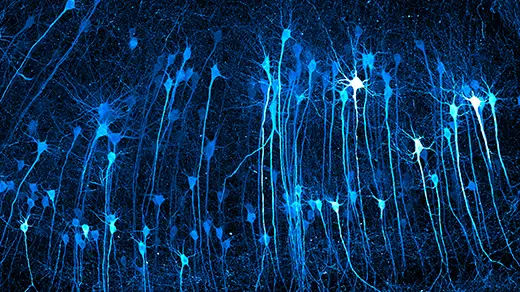
On a frigid February morning in Edinburgh, Scotland, Patrick Hickey had run out of living things to put under his microscope. The plants and fungi in his garden had dried up, and summer puddles, with their flamboyant biological complexity, had long frozen over. Hickey, a mycologist at Hypha Research Ltd., was using plant leaves to study mitochondria, cellular organelles that generate energy.
Source

  •  

AI Proved the Quasi-Riemann Hypothesis. What Happens Now?

Among the 377 results that OpenAI announced on October 6, 2026, one stood out. It claimed to settle the “quasi-Riemann hypothesis” — a weaker version of the Riemann hypothesis, which is arguably the biggest open question in math. The new proof is, as Jared Duker Lichtman of Stanford University put it, “the most significant AI-for-math achievement so far, by quite a margin.

Source

  •  

He Wants AI Benchmarking To Be a Science, Not a Dark Art

Benchmarks are the rulers of AI, in both senses of the word. As measuring sticks, they work according to an extremely simple logic: If you want to know what an AI model can do, devise a standardized test to gauge it. But AI benchmarks can also dominate the behavior of the entire field. In 1987, the Defense Advanced Research Projects Agency’s first benchmark on automatic speech-to-text…

Source

  •  

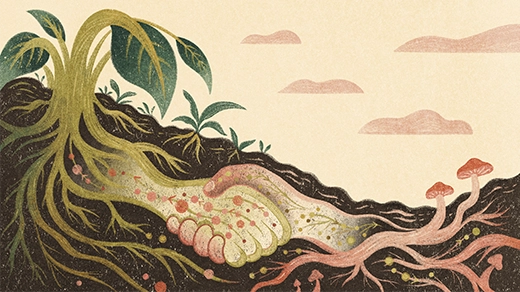
How Do Fungi Keep the Planet Healthy?

People may think of soil as just dirt, but it is anything but inert. Beneath your feet, a vast network of mycorrhizal fungi is hard at work, trading minerals with plant roots. This trading system helps enrich the soil, and it sequesters 13 billion tons of atmospheric carbon dioxide each year — roughly equivalent to one-third of the world’s fossil-fuel emissions. Scientists know that these fungi…

Source

  •  

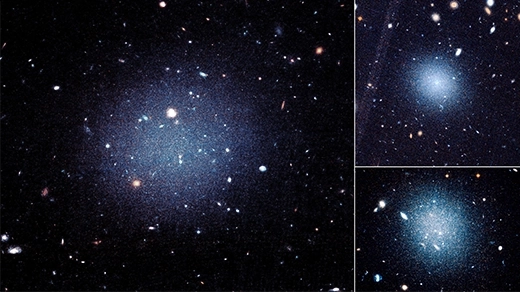
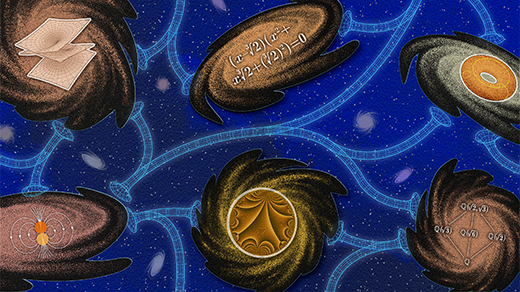
Triplet of ‘Ghostly’ Galaxies Hints at What Dark Matter Is — and Isn’t

About 65 million light-years from Earth, three galaxies don’t look quite right. They aren’t whirlpools bursting with light, but pallid objects dimly illuminated by a smattering of stars. “They have this ghostly appearance,” said Michael Keim, an astrophysicist at Yale University. And this isn’t even the weirdest thing about them. Dark matter is the invisible glue that keeps the largest…

Source

  •  

Biology Might Not Be Quantum, but Its Math Is Quantumlike

Two decades ago, scientists seemed on the verge of understanding biology in a new, quantum way. Life unfolds over an incomprehensible span of scales, from our planet-enveloping biosphere at one end, to individual cell-building biomolecules at the other. Even at its most microscopic, though, biology doesn’t really reach down to the quantum realm, in which particles act like waves…

Source

  •  

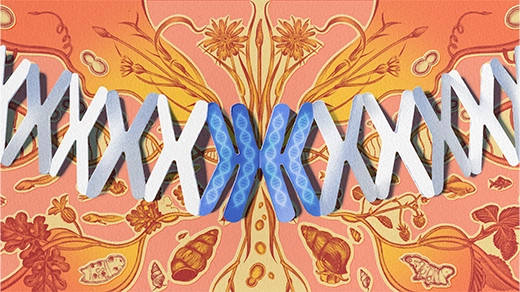
How Virus-like ‘Jumping Genes’ Became Our Partners in Evolution

You might imagine that the DNA in your cells has a simple history. Even though it’s been recombined in every generation through sex and gained the occasional mutation, on the whole the genome has been stable and has been passed down reliably from your ancestors. But that’s not the entire story. Nearly half of your genome is a wild drama: mobile, repetitive, disruptive, even viral.

Source

  •  

Mathematicians Build Long-Awaited Graph Sandwich

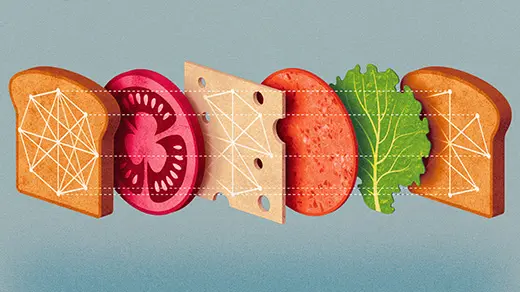
In 2004, two mathematicians hypothesized a powerful kind of sandwich. They were studying graphs, which are collections of points (called vertices) and lines (called edges). Graphs might represent anything from social groups to the internet to neurons in the brain. The mathematicians hoped to understand properties of one type of graph — a type that’s ubiquitous in mathematics and computer science…

Source

  •  

Where Does the Quantum World End and Ours Begin?

Quantum mechanics may be one of the most precisely tested paradigms in science, but there’s still no universally accepted interpretation of what it tells us about reality. How do we get from the wave-like behavior of quantum systems to the solid, macroscopic world of objects and the universe at large? Jonathan Halliwell, a professor of theoretical physics at Imperial College London…

Source

  •  

Ctenophores Aren’t Just Beautiful. They’re Biological Wonders.

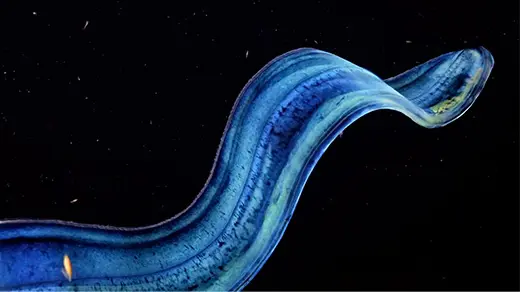
Around 700 million years ago, a group of organisms resembling little more than glowing, gelatinous blobs split off from the rest of the animals, forming possibly the earliest branching animal lineage. Nearly 200 species of ctenophores, commonly known as comb jellies (but unrelated to jellyfish), live today in environments ranging from the cold depths of the sea to warm coastal surface waters.

Source

  •  

Black Holes or Black Hole Stars? Astronomers Spar Over Webb Telescope’s ‘Little Red Dots.’

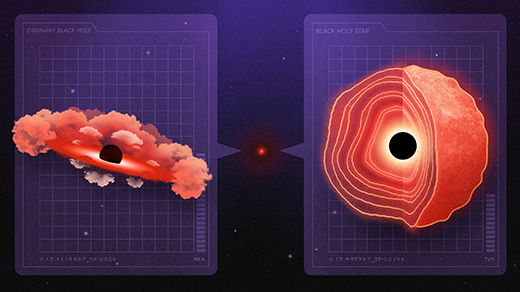
Astronomers built the James Webb Space Telescope to pick up faint light from the first billion years after the Big Bang, a chaotic era when vast swaths of hydrogen and helium gas gathered into the chains of galaxies we see today. Even in the telescope’s first images, astronomers could see a whole zoo of mysterious smears of light. One batch of objects proved especially difficult to interpret.

Source

  •  

Why Do These Fossil Shells Flip Their Spirals Every Few Millennia?

For thousands and sometimes millions of years, marine plankton all over the world built their spiral shells in one direction. Then, suddenly, the spirals switched direction at the same time, everywhere, only to switch back again later. These microorganisms are types of foraminifera, or forams. Found in all oceans, from the tropics to high latitudes, they’re among the most abundant eukaryotic…

Source

  •  

The Four-Color Theorem Gets a Rare New Proof

Some math problems continue to haunt researchers long after they’ve been solved. A proof emerges, is even celebrated, and yet dissatisfaction lingers. Perhaps the argument is too convoluted — the hunt persists for the elusive one-page paper — or perhaps it fails to give a deeper theoretical insight into why something is true. Whatever the reason, mathematicians return, again and again…

Source

  •  

What Is Math’s Mysterious Langlands Program Really About?

The mathematical universe is boundless and heterogeneous, encompassing, over here, truths about numbers and equations; there, the logic of shapes and spaces; and over there, the study of change and probability. Its domains have grown organically over centuries, each centered around its own objects, methods, and questions. That’s why it’s so surprising when direct connections between different…

Source

  •  

AI Has Solved One of Math’s $1 Million Millennium Prize Problems

On the morning of Tuesday, September 8, mathematicians at OpenAI announced that a group of 10,000 autonomous AI agents under their direction, running on an advanced model not available to the public, had found a “singularity” in the Navier-Stokes equations in three dimensions — thus resolving one of the six remaining Millennium Prize Problems posed in 2000 by the Clay Mathematics Institute…

Source

  •  

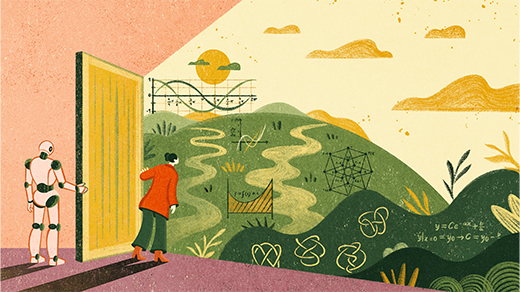
Live from ICM 2026: What Is Math For in the Age of AI?

Mathematicians are witnessing a profound shift in their field. AI systems are now producing proofs, spotting connections between distant fields, and, in a few cases, solving problems that had stumped mathematicians for decades. The pace of progress over the past several months has raised challenging questions: What can AI systems actually do? And what happens to the more human…

Source

  •  

In an Age of AI, a Physicist Seeks What Endures

In July 2026, the U.S. Department of Energy selected 278 projects to fund as part of its Genesis Mission, meant to incorporate artificial intelligence into the scientific process. One project will use AI to help physicists search for a vanishingly rare particle transformation — a muon becoming an electron — by controlling different aspects of the Mu2e experiment at Fermi National Accelerator…

Source

  •  

Genome Duplication Is a Radical Evolutionary Gamble

No larger than the head of a match, Potamopyrgus antipodarum doesn’t look very impressive. Few people visiting New Zealand’s Lake Alexandrina even notice the tiny gastropods littering the shores. The snail’s diminutive size, however, conceals a massive secret. Sometime in the recent past, its genome doubled. Instead of having two sets of chromosomes and two copies of every gene…

Source

  •  

Graduate Student Proves a Quantum Uncertainty Principle for Fractals

At the quantum scale, tiny particles behave in bizarre ways. One reason for this is the uncertainty principle, which says that the more you know about where a quantum particle is, the less you can know about how fast it’s moving, and vice versa. Recently, this rule got a rare upgrade. The new uncertainty principle relates to fractals, shapes that remain equally complex no matter how much you…

Source

  •  

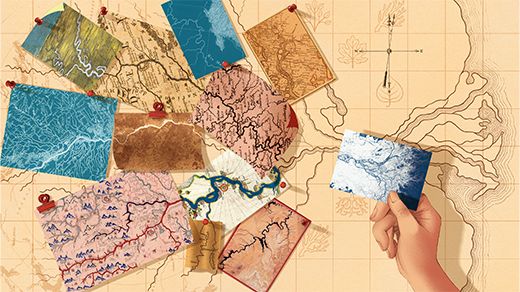
Why Are Rivers So Mathematical?

A river has my heart. It’s not the austere, black Thames winding through London, where I was born, but a lazy green one 5,000 miles away, where I spent my adolescence: the Blanco River in Texas. My maternal ancestors have dipped into its waters for generations, as I have on countless summer days. The Blanco is a tributary of the San Marcos, which flows into the Guadalupe, and on into the Gulf of…

Source

  •  
❌