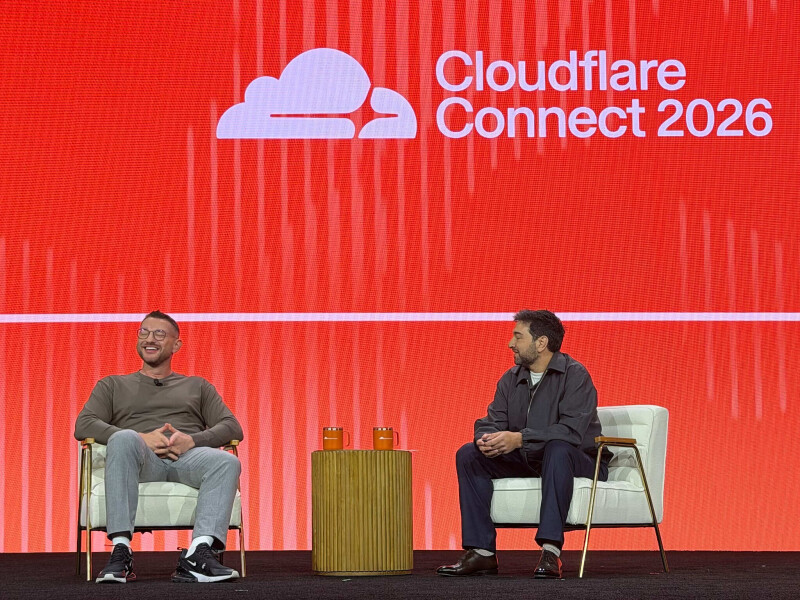
Peter Steinberger, member of technical staff at OpenAI and the creator of OpenClaw, estimates that he spent around $10 million in tokens running AI workloads last month. But don't feel bad for him, because it's all coming out of investors' pockets. He made this admission at the Cloudflare Connect 2026 conference in San Francisco on Wednesday, in a conversation with Cloudflare CTO Dane Knecht. Knecht previously observed that Steinberger has acknowledged having "a virtually unlimited token budget, which not all of us in the room have." Responding to the audible surprise rising from the audience, Steinberger added, "What people don't always understand is not all of that is useful." That only amplified the murmuring, perhaps not the effect he had been after. Meanwhile, his employer, OpenAI, is reportedly trying to "accelerate funding" ahead of rival Anthropic's expected IPO. Steinberger's subsequent musing about his preferred way of working failed to recognize Knecht's acknowledgement of financial limitations. "I feel like the main challenge a lot of people still have is that our infrastructure structure hasn't really caught up yet," Steinberger said. "Like why is this still using my computer? Shouldn't this all be in the cloud?" Apart from the privacy and compliance implications of relying on cloud-based AI, cost remains a consideration for anyone not setting venture funds alight. Cloud-hosted agents can be expensive. Shouldn't this all run locally? Pointing to the OpenClaw project and how a lot of open source maintainers have given up accepting pull requests due to frustration with AI slop, Knecht asked Steinberger whether we're approaching the death of open source or a golden age of AI. Steinberger said he thinks the way pull requests are handled needs to change because people don't explain how they arrived at their proposed changed code. "If I see your thoughts, how you got from A to B, my trust in the output is way higher than if you just throw the finished work across the fence," he said. Knecht also asked Steinberger whether everyone in the room would have hundreds of AI agents running in a few years. Steinberger doubts it will be hundreds. "I think everyone will have some sort of intelligence that runs and thinks and helps them throughout the day or even predicts what could help you in the future," he said. "So instead of asking the question, maybe you already get the answer." Toward the end of the session, Knecht raised the issue of trust and how to know what data to give to an agent. That's a hard question, Steinberger admitted. Part of it, he said, has to do with how much you trust the underlying model itself, because so much of model behavior is not governed by the harness – the code that wraps the model. "A lot of decisions that I built into OpenClaw early on now can change because the models are so much better," he said. Even if risks like prompt injection have been reduced through engineering efforts, Steinberger said, "you might not want to give your agent all the permissions." Instead, he suggested using an agent to authorize your agent. "You want to have another agent that can give it permissions or not and then this agent has to negotiate with another agent," he said. "Many times the agents are like, 'oh yeah, actually maybe I shouldn't do this,' or 'there's a simpler way that keeps it within the guardrails.' So those those two systems combined greatly increase my trust that I just can let the agent rip." ®
Why use your smartphone when AI can do it for you? We’ve reached a new level of AI inanity with the launch of Opposable, a tool that taps, swipes, and types on Android phones and controls iPhones through a companion computer, sparing users the apparent burden of operating their own devices. If you don't want to update a calendar event, start a timer, or enable dark mode, you can apparently use an AI agent app on your computer (any client that supports MCP will do) to have Opposable do the thing for you on a connected phone. You could just do it on your computer, of course, but that’d require actually using your hands - like it’s some sort of baby’s toy. Lame. Opposable describes the purpose of its app as being to “give your AI thumbs” that allow an agent to open apps, read the screen, tap, and type, all while signed in to a device as the person too lazy to use a super-convenient technology themselves. As described in a blog post published by its creators Wednesday, Opposable's developers explain that its Android implementation uses accessibility services to inspect the screen, while screenshots provide visual input for an AI model. The model then decodes the images and figures out where it needs to tap on the screen in order to do whatever its user asked of it. The visual processing is handled by a vision-language model known as GUI-Owl 1.5 2B, running through llama.cpp, while tasks can be handled by either a paired desktop AI agent or an on-device agent that works without a desktop connection (the latter is available only on Android devices – iPhones require a companion computer, with a Mac beta available and a hardware-assisted Windows/Linux option also advertised). Even then, AI isn’t used for everything, with around 40 common tasks (setting an alarm, sending a text, switching Wi-Fi on or off) running as fixed code without an AI model involved. Opposable doesn’t appear to be particularly fast, however, and its accuracy is questionable too. Opposable’s website includes three different examples of tasks executed using its product, and none seem to merit using an AI over, you know, human hands. In one example, Claude Code over MCP is used to change the system’s theme to dark mode and then set a five-minute timer. This takes 50 seconds and requires 17 tool calls. In a second example using Claude Code and MCP, Opposable is asked to look up when Apollo 11 launched and who was on board, which takes just shy of 2 minutes. The number of tool calls isn’t mentioned, but the run cost is $0.44, which seems ridiculous when you can use your hands and figure it out for free. Hell, just asking Gemini or Siri right on a smartphone would return the answer faster and cheaper. Those half-a-buck requests to Opposable could add up pretty quickly if you’re lazy enough to justify its use. A third example shows a virtual Android device operating without a paired desktop agent, instead relying on the on-device agent that Opposable installs on Android phones. Opening the clock app and switching to the stopwatch tab takes it about 96 seconds, which is supposed to be impressive, apparently, as the company behind Opposable decided to showcase it on the thing’s website. As for Opposable’s ability to actually accomplish tasks, well, that’s not exactly a sure thing. “On eight tasks the model had never been tuned on, run on the emulator twice each, giving it the whole task succeeded 4 and 3 times,” the blog post notes. I’m pretty sure my brain and hands can do better without burning tokens to fail. “Giving it one subgoal at a time and checking each claimed success against the accessibility tree before the next subgoal succeeded 6 times in both rounds,” the blog continues - so even when it gets babysat each step of the way, it still only succeeds at three-quarters of tasks. Cool - that’s really going to free up all that time wasted setting timers and doing other mundane tasks on my handset. Why someone would install this on their Android device - which requires sideloading an APK and manually granting access to read and interact with the screen through accessibility settings - seems like a bit of a mystery. Opposable’s website even warns that it could be a security disaster: “whoever holds the token can operate the phone, so treat it like a password,” but still invites users to try. An argument could be made for using Opposable as an accessibility tool for people with difficulty using a smartphone, but this isn’t mentioned anywhere on its website. Opposable is instead billed as a way to “hand off the phone chores,” leaving users free to do something else - just not on the phone currently being slowly controlled by a clumsy AI. Sure, you could give your AI some virtual thumbs through Opposable, but … why? We reached out to the Opposable team to get an answer to that question, but didn’t hear back. ®
Nvidia hopes to capitalize on European sovereign AI demand by unloading a slew of new open weights models spanning chatbots, healthcare, and robotics. The major model devs have the resources to build highly capable models from scratch. But most enterprises don't, and have instead been forced to fine tune open weights models from the likes of Mistral or H Company using their own datasets. At GTC Berlin, Nvidia unveiled its latest additions to its open weights model library with refreshed Nemotron Retriever embedding and Alpamayo autonomous vehicle models. The point of embedding models While by no means the sexiest subclass of models out there, embedding models are some of the more useful ones for enterprise apps. Retrieval augmented generation (RAG), a technology we've explored extensively in the past, relies heavily on the embeddings generated by these models for applications like AI-augmented search. At a high level, RAG works by cutting up documentation in chunks, then converting those into vectors called embeddings. The embeddings are then ranked based on their relevance to the user's query before they're fed into an LLM's context. Nvidia's latest embedding and reranking models, based on Nemotron 3.5, support embeddings of both images and text across 34 languages. This time around, the models are being offered in sizes ranging from one to eight billion parameters, with NVFP4-quantized versions for those running on new Blackwell-based accelerators. That's small enough to run on something like a DGX Spark with plenty of room to spare for other models. Always take vendor claims with the usual grain of salt, but among competing embedding models, Nvidia boasts that at BF16-precision, its new 8 billion parameter embedding and reranking models are now the top-ranked dense models on the ViDoRe V3.1 benchmarks. However, not all documents are easily converted into embeddings. PDFs are notoriously difficult for embedding models to make sense of. They're often scanned from printed source material and formatted for consumption, which means scraping text and parsing charts. For this, Nvidia has also launched a refreshed Nemotron Parse model that's been trained specifically to extract information from PDF documents. Nvidia claims the model can process roughly 10.5 pages a second when running the one billion-parameter model on a single H100. Alongside the new embedding models, Nvidia is also rolling out access to Alpamayo 2 Edge, a more compact version of its autonomous driving model based on which promises real-time processing of streaming video and sensor data when running on the company's DRIVE AGX Thor platform. The models come just a week after the GPU giant launched its Nemotron 3.5 Super vision language (VL) model and teased Nemotron 3.5 Bolt, a 74 billion-parameter mixture of experts (MoE) model designed to fit in as little as 24 GB of video memory. That model, Nvidia says, will be available for download starting Friday. While open models provide enterprises and governments a path toward sovereign AI, Nvidia's models are somewhat unique in how they're released. Most open weights models are a sort of black box. Anyone can download them, but the data and processes used to arrive at those weights is a mystery. This isn't the case with many of Nvidia's models: Alongside their weights, Nvidia routinely releases the training data and the recipes used to turn it into the final model. This means customers can not only inspect the model at a low level, but build a fully custom model based on Nvidia's Nemotron architecture, rather than trying to modify the weights after the fact through fine tuning. We should note that Nvidia is not the only one to do this. The Allen Institute has employed a similar strategy with its OLMo models for this very reason. ®
Unknown crims compromised LiteLLM's release process on Wednesday, distributing a malicious version (1.107.0) containing malware designed to steal cloud and AI credentials and a remote access trojan (RAT) capable of executing arbitrary code on infected machines through PyPI and Docker registries. PyPI quarantined the trojanized version of the popular open source AI gateway within hours, and the Docker image (litellm/litellm:1.107.0) was removed from both Docker Hub and GHCR soon after - but anyone who ran the compromised package on any platform should assume their secrets have been stolen. “Check for /tmp/.pc_once_* (the exfil has already fired if this file exists) and /tmp/remote_code_loader.lock (the C2 daemon ran or is still running if this file exists),” advised Aikido Security malware hunter Ilyas Makari. “The same applies to anyone who ran the official Docker image litellm/litellm:1.107.0, or pulled it via the latest, main-latest, or main-stable tags.” The most recent safe version is v1.106.2. While it’s too early to tell the scale of this latest LiteLLM supply chain attack – an earlier LiteLLM compromise in March potentially exposed more than 2,500 organizations and 434,000 CI/CD pipelines worldwide, according to CloudSEK – make sure to take these measures seriously, and check environments for any indicators of compromise. Aikido, Google’s Wiz cloud security biz, and supply-chain security provider Socket have all published extensive threat-hunting and mitigation instructions for LiteLLM users and security teams, so give those a read stat. LiteLLM, developed by BerriAI, provides a common interface for LLM providers, including OpenAI, Anthropic, and Google Gemini, and receives about 23 million weekly downloads. This means a compromised installation can run alongside LLM provider API keys, cloud identities, and database connection strings - and expose a ton of valuable credentials, secrets, and other sensitive data to whoever uploaded the malicious package. “Teams using 1.107.0 should stop deploying it and investigate environments where Python ran after installation, including proxy containers and CI runners,” Socket researchers said on Wednesday. The malicious version was uploaded at 11:39 UTC, and according to Wiz kids Benjamin Read and Rami McCarthy, the payload originates with malicious commits made on github.com/Berri-AI/litellm, which is a hyphenated variant of the legitimate BerriAI organization. Miscreants used this repo to inject the three malicious files into the LiteLLM release pipeline. These, according to Makari, include cook.pth, which causes the second file, cook.py, to run automatically every time Python is invoked on the machine, without any additional user action. Meanwhile, cook.py contains the infostealer, and the third file, sitecustomize.py, is the RAT. Python also executes the RAT at interpreter startup, and this file spawns a background daemon that polls the attacker's infrastructure every hour for new commands to execute. Upon executing, the infostealer harvests a ton of sensitive data across 16 modules targeting browsers, cloud providers, and AI services, according to Read and McCarthy. It steals browser credentials and cookies from Chrome, Firefox, Edge, and Safari, along with AWS credentials from ~/.aws/, environment variables, and EC2/ECS instance metadata (IMDS). It also collects users’ Google Cloud Platform service account keys and application default credentials, along with Microsoft Azure tokens from the CLI cache. And then it also swipes API keys for OpenAI, Anthropic, Cohere, and other LLM providers, plus SSH private keys, GPG keys, and shell history files. The malware then encrypts all of this stolen data using AES-256-CBC, wraps the encryption key with an RSA-4096 public key, and sends the encrypted data via HTTP POST to an attacker-controlled domain: http://www[.]litellm[.]dev/healthcheck. BerriAI did not respond to The Register’s inquiries. This is an emerging story, and we will continue to update it as we learn more details.®
More than half of CIOs are likely to miss their AI-related ROI targets next year, according to Forrester. The analyst firm's State Of AI Survey 2026 found that 45 percent of AI decision-makers need positive ROI within a year to consider their investments successful. Some tech leaders will get better at tying AI spend to planned returns. However, Forrester expects success to be confined to isolated use cases rather than whole programs, which won't be enough. “As with prior emerging technologies, organizational structures, processes, and ways of working need to change to drive measurable, firmwide results with AI,” the report says. Only 22 percent of AI decision-makers report a positive AI impact on EBITDA (earnings before income tax, depreciation and amortization) over the past 12 months. “This mismatch between the investment into technology adoption and organizational change will delay the realization of heightened ROI targets,” the report adds. The money will keep flowing through IT budgets regardless. In its Technology & Security Predictions, Forrester claimed AI will account for 20 percent of all business technology spend next year. Sharyn Leaver, chief research officer at Forrester, said that will increase the pressure on leaders to prove AI's value while keeping costs, infrastructure, and risk under control. “At the same time, emerging technologies, geopolitical pressures, and the growing use of AI across technology operations will introduce new complexities and potential points of failure,” she said. While tech teams struggle to get returns from growing AI spending, they will try to get more bang for their buck by investing in open-weight GenAI models, which can approach similar performance to the leading proprietary systems, at a fraction of the cost. Open-weight models will represent half of AI tokens but only five percent of enterprise spend, Forrester predicts. “Open-weight models such as Gemma, Llama, or Qwen are good enough for the enterprise workloads that generate the most token volume, such as document processing, customer support conversations, internal knowledge search, and the routine substeps inside agentic workflows,” Forrester said. Frontier models, including Anthropic's Claude Opus 5.5 and Claude Sonnet 5.5, OpenAI's GPT-6.1 Sol and GPT-6 Astra, and Google's Gemini 4 Argon, will be reserved for “the few deep knowledge and critical task automations where errors are expensive, but the token count will tip toward open weight”, Forrester said.
Make sure you don’t say anything mean or secret after hanging up a call on Signal, as a bug in the encrypted messaging app’s calling library could prevent a call from ending properly, potentially leaving audio and possibly video active. The vulnerability, CVE-2026-113380, was published by MITRE on Tuesday and given a CVSS score of 9.3, marking it as a critical issue in Signal’s open-source RingRTC library in every single version before 2.72.0. That update was pushed out last month, but the vulnerability wasn’t made public until now. RingRTC is Signal’s own calling library built on top of WebRTC, a technology introduced in 2011 that has since become widely used for voice and video communication over the internet. RingRTC provides Signal-specific calling functionality using WebRTC, which already encrypts media traffic, but that isn't stopping RingRTC from failing to hang up calls in certain conditions, according to the CVE report. What’s happening is, in essence, a denial-of-service attack on RingRTC’s finite state machine (FSM) event queue, which handles events involved in managing calls. If one of the people on the call saturates the FSM queue with requests, it can become overwhelmed and fail to process a hangup request, preventing the call from terminating properly. The vulnerability is classified as CWE-754, or improper checking for unusual or exceptional conditions, according to a report posted to GitHub. A conceptual proof of concept is available in the GitHub report linked above, using a Python script to simulate how flooding an event queue can prevent a hangup request from being processed. Were a malicious actor to exploit this, the person on the other end may think the call has been terminated, but either or both of their video and audio channels could still be open. The attack complexity is considered low according to the CVE, and while CISA’s known exploited vulnerabilities catalog doesn’t indicate this has been spotted in the wild, Signal users ought to ensure they’ve updated their apps - mobile and desktop - to the latest versions to ensure they don’t end up being caught on a hot mic without any notice. Comparing RingRTC 2.72.0 to the previous version indicates that Signal's fix allows the call's finite state machine (FSM) to detect termination requests independently of the event queue, while adding a timeout to prevent stalled processing from indefinitely blocking a hangup. It's not entirely clear from Signal's release notes when the fixed version of RingRTC reached the Android, iOS, and desktop versions of its apps. Signal Desktop's release history indicates that RingRTC 2.72.0 was incorporated in September, but the precise rollout dates across all platforms remain unclear. We’ve reached out to Signal to learn more, but haven’t heard back. In the meantime, best to update your installation to be sure you’re not still vulnerable. That, and watch what you say after hanging up a call. ®
OpenBSD 8.0 brings bigger virtual machines, graphics improvements, and another helping of AI mockery. The round version number doesn't signal a radical break with its predecessors. OpenBSD 8.0 is the 61st release of the project. Developer Bryan Steele posted a highlights rundown on Mastodon. Wireless improvements include updates to the qwx driver for Qualcomm Wi-Fi 6 hardware. Its VMM/VMD hypervisor now supports multiprocessor VMs with up to 64 virtual CPUs in each guest. The kernel virtual memory address space on x86-64 is now 512 GB, up from 4 GB, allowing for GPUs with large amounts of VRAM. On Arm64 machines, OpenBSD supports hibernation, and on both x86-64 and Arm64 it can use CPU AES instructions for faster encrypted swap. Component upgrades include OpenSSH 10.6 and LibreSSL 4.4.0, and the DRM graphics driver stack from Linux 6.18. The default C compiler is Clang/LLVM 22, including for the SPARC64 edition – but at the cost of dropping support for the Loongson architecture. The list of errata is short, with just four fixes – but then, version 8.0 is very new. Just days before this release, there was a high-profile OpenBSD issue: Calif's "Big Fish" research describes a decades-old shared-memory bug chained with a separate kernel flaw to gain local root access. Both were fixed in OpenBSD 7.9, through errata 026 and 018 respectively. Project leader Theo de Raadt forked OpenBSD from NetBSD 1.0 in 1995, and the first release of the new OS was OpenBSD 1.2 in July 1996 – so version 8.0 is as close as the project will get to a 30th anniversary release. According to Calif's proof-of-concept code on GitHub, the bug was in the original code that both OpenBSD and NetBSD inherited from the original BSD codebase – which is how come there's a 37-year-old bug in a 30-year-old project. A HackerNews comment says: "Interestingly, looks like this was accidentally fixed in NetBSD during a rewrite of that code in August of 1999." The project has not updated its infamous slogan. The homepage still proclaims: "Only two remote holes in the default install, in a heck of a long time!" As we noted in May when OpenBSD 7.9 appeared, the project rejects code generated by LLMs, although on the basis of licensing concerns rather than its cousin NetBSD's explicit anti-AI stance. As we reported recently, this strict anti-AI stance seems to be serving NetBSD well. OpenBSD is also an anti-AI project, and for this release, the website goes out of its way to make that very clear. OpenBSD's mascot is a pufferfish, and in the banner artwork for the new release, "Puffy" has an extra eye – and the signpost in the image's background also has malformed text, a hallmark of early image-generation bots. The eyes are also constantly blinking – one at a time – to emphasize that this is a reference to Blinky the mutant fish from The Simpsons. In case you missed The Simpsons reference, the version 8.0 release theme song makes it even more explicit: it's titled "The Simps on AI." The lyrics and the vocals parody both Simpsons characters and AI users. Our favorite line sounds like Grampa Simpson, and says: Back in my day we didn't have artificial intelligence, we had real stupidity – and we liked it. We've seen negative reactions online, but then we often find that some people lack much of a sense of humor. For our part, we really enjoyed seeing the OpenBSD team having such fun. We reckon it will appeal to many Butlerian Jihadi types. It certainly did to The Reg FOSS desk. A little Wine with your pufferfish A couple of days before the 8.0 release came an unexpected announcement on the openbsd-ports mailing list: a proposed port of Wine for OpenBSD. This is a new version of the Wine 11 runtime that allows Windows binaries to launch and run on OpenBSD. This is a 64-bit version of Wine for OpenBSD on x86-64, and for now, this means it can only run 64-bit Windows code. (For the technical nitty-gritty: Wine needs to manipulate the CPU's GS register. Windows on x86-64 uses the GS segment base to locate the Thread Environment Block (TEB), as the late great Geoff Chappell explained. This is a very longstanding Windows data structure, going all the way back through Windows 95 to OS/2. The port was particularly tricky because OpenBSD doesn't allow programs to alter that, so the port is emulating instructions that use the %gs segment override. The snags are that this means 32-bit code doesn't work, and secondly, because this is unnecessary on Linux, the code is unlikely to be merged back into upstream Wine.) If you want to see it working, there are a few screenshot galleries on Reddit's openbsd_gaming group, showing a number of recent major titles running: Some samples from WIP wine port, more wine-on-OpenBSD screenshots, and even more wine-on-OpenBSD proof. The port comes hedged with caveats, notable among them that Wine does not do any kind of sandboxing, so using it potentially opens up OpenBSD to Windows malware. However, for some users, this could be a very useful addition. OpenBSD is the simplest and cleanest member of the BSD family, indeed, of the FOSS Unix family. Part of this is because entire subsystems are missing that the other BSDs provide. Bluetooth connections to Apple's wireless keyboards and pointing devices aren't supported. There's no logical volume management – which would massively help with OpenBSD's complex disk partitioning. There's no journaling filesystem either (although a port of the new Gefs is in progress). While small and clean, its priorities favor security and simplicity, though performance will depend on the hardware and workload. Importantly – since you probably will need to ask for help – the OpenBSD community does not have a reputation for friendliness. Saying that, it is quite a lot easier to get OpenBSD installed and running, complete with its 25-year-old version 2.2.5 of the Fvwm window manager, than either NetBSD or FreeBSD. If you're looking for an AI-free, and indeed systemd-free, path away from Linux, OpenBSD 8.0 is very definitely worth a try. ®
PHP developers have released emergency updates for two critical vulnerabilities after cybersecurity authorities warned organizations to patch immediately or consider taking exposed applications offline. PHP 8.5.12, 8.4.27, 8.3.36, and 8.2.35 address CVE-2026-109618 and CVE-2026-109619, which can allow unauthenticated remote code execution. The project's developers urged users to update immediately. All PHP installations serving web requests are potentially affected, including deployments using PHP-FPM, Apache's mod_php, php-cgi, FrankenPHP, and LiteSpeed, the developers said. "We consider the risk highest for mod_php, with a demonstrated exploit where an unauthenticated request can trigger the attack before any application code runs." Jake Knott, head of threat intelligence at watchTowr, said: "As expected, watchTowr Intel is already observing in-the-wild exploitation of the latest PHP vulnerabilities, with a variety of vibecoded PoCs already hitting our sensors featuring a variety of 'php2shell' User-Agents. Whilst nobody has been successful to date, we don't expect that will last long." "Where immediate patching is not feasible, organizations should consider isolating internet-facing applications from public networks until a fix is available," CERT-EU said in an advisory issued ahead of the patches. The body lists both vulnerabilities with CVSS scores of 9.2. Finnish government services and websites belonging to the Dutch parliament, cybersecurity authorities, and data protection regulator were taken offline as a precaution. Privacy campaign group noyb also temporarily withdrew its website. PHP "powers WordPress, Drupal, Joomla, and Magento sites, shared hosting platforms, control panels, and an awful lot of software that doesn't even advertise that it runs PHP under the hood," infosec vendor Huntress noted. That makes identifying exposed installations a substantial job. "The number of places you have to go looking to identify vulnerable PHP versions gets very big, very fast," said John Hammond, Huntress's senior principal security researcher. ®
Cute robots stole the show at Nvidia's GTC keynote in Berlin, where Jensen Huang pitched a future powered by AI agents – and, naturally, plenty of his company's hardware. The Nvidia chief remained his usual ebullient self despite environmental protesters interrupting his presentation at Berlin's tent-shaped Tempodrom. "Why don't you clean up your act?" they demanded, holding up banners that partially obscured the presentation screen behind Huang. "All important issues, but let me get through my keynote," he joked, adding: "I'll talk to you guys later," as security swiftly removed them. Huang was discussing Vera Rubin systems before unveiling DSX POD, a reference design for factory-built, containerized AI infrastructure. DSX POD combines seven liquid-cooled Vera Rubin compute racks using Nvidia's Spectrum-X networking. Partners will cable, integrate, and test the systems in modular containers before delivery, with availability expected in early 2027. Nvidia claims deployment could shrink from six months to as little as 14 days at a prepared site. That excludes the not insignificant matter of getting power, connectivity, and other site infrastructure ready first. He was keen to add that Vera Rubin systems are designed for closed-loop liquid cooling with coolant temperatures up to 45°C, while outdoor dry coolers release heat into the air without needing to evaporate water. "At 2 gigawatts, DSX can save 54 million litres of water a day," Huang claimed, perhaps thinking of those environmental protesters. Yet much of the leather-jacketed leader's attention was focused on physical AI: robots, autonomous vehicles, and other machinery Nvidia hopes to supply with its hardware and software. The Microducks from Pollen Robotics are small, two-legged robots with cameras for faces. Huang interacted with them on stage, getting them to lie down and roll over by voice command, and the little robots all beeped back at him in response. The robo ducks demonstrated a workflow in which AI was trained in the cloud, evaluated on an Nvidia RTX Spark PC, then deployed on the robots. Huang also unveiled Agile ONE SN, a humanoid robot reference platform from German robotics startup Agile Robots, based on Nvidia's Isaac GR00T technology and a Jetson Thor compute module. Scheduled for early 2027, the platform is intended to give robotics researchers and developers a ready-made system for developing and testing capabilities. "This is going to be the next major industry, the next great industry," Huang claimed. Beyond robots, Nvidia is pushing its AI hardware and software into cars and telecoms networks. Huang boasted that Nvidia's Hyperion car system is being adopted by more vendors, saying: "We turned this into an industry standard, and now it's being designed into one car fleet after another." Europe's telecoms operators are also deploying Nvidia-powered computing in their networks to deliver advanced services using AI-RAN, according to Huang. "After working on this for nearly eight years, Nvidia made the first commercial phone call on the T-Mobile network with Nokia, and so now CUDA makes phone calls," he said. Far from slowing down the progression of AI, it seems Nvidia is determined to push its technology into every corner of the world. "Everyone will become an AI company," Huang claimed. He also took care to praise Europe and its technology efforts while he was in Berlin. "As expected, Jensen positioned Nvidia as a strong supporter of – and enabler for – Europe's sovereign tech ambitions. Nvidia has invested almost $10 billion into Europe in the past year, including 14 investments into European startups during Jensen's current trip," said Forrester principal analyst Paul Miller. But Miller pointed out that Nvidia itself is not European. "Anything with critical ongoing dependencies on Nvidia (or any other non-European firm) is unlikely to meet the purest definitions of European tech sovereignty," he added. Huang closed with a CGI video of robots performing a Eurovision-style song recapping his keynote. Yes, it was as bad as you imagine. ®
Microsoft is raising OneDrive's supported macOS sync limit to one million items, matching Windows, alongside new Copilot features, sharing controls, and an admin command-line tool. The macOS preview is scheduled for the Insiders ring this month, with general availability targeted for June 2027. Eligible devices must meet hardware and configuration requirements; others retain the existing 300,000-item supported limit. "This increase is intended to help organizations with large OneDrive and SharePoint libraries sync more content reliably across devices," Microsoft said. However, sync performance may suffer for large numbers of read-only files or accounts under legal hold. "We are actively working to improve performance and reliability for these scenarios," Microsoft said. Microsoft's cull of OneDrive's File Explorer shortcuts wasn't a retreat from AI. Its latest announcement gives Copilot more to do. The assistant can now be asked to analyze across files (for example, selecting several spreadsheets and getting the bot to come up with charts and graphs), told to organize folders, or save a repeated workflow as a personal skill in a Markdown file. There is also a Prompt Gallery to save the user from having to come up with their own ideas. Perhaps most interesting is the addition of "Hero Links," designed to end the proliferation of links to files and folders in OneDrive as permission needs change. The feature provides one link per file and folder by default, with permissions that can be updated while keeping the same URL. Automatic expiration controls are still coming, however. Organizations that require time-limited access will want to check that gap before adopting the feature. Administrators also get a OneDrive Sync command-line tool, available in private preview, for inspecting accounts, configuration, policies, and sync status. The tool can pull information from the OneDrive sync client and provide data on status, policy troubleshooting, and issue diagnosis, from folder backup and policy problems on a single PC to identifying devices that need attention across an organization. And yes, there is, of course, integration with AI agents. ®
Generative AI is saving open source developers time while giving maintainers more rubbish to sift through, according to a Linux Foundation survey. Respondents estimated that a quarter of incoming pull requests – proposed code changes – were low-quality "AI slop." Open source projects have spent the past year grappling with AI-generated contributions, useful vulnerability discoveries, false positives, and duplicate reports. Linus Torvalds has warmed to the tools, while remaining critical of low-quality submissions. The foundation argues that projects need clearer policies and better tools to handle the influx. Almost three-quarters (71 percent) of maintainers reckon GenAI has lowered the barriers to contributing to open source, but just over half (53 percent) disagree that the technology has improved community trust. Respondents estimated that AI cut code-authoring time by 52 percent on average. But for highly complex tasks, 21 percent reported taking longer. Then there is governance. Only 35 percent of projects have a formal policy permitting GenAI use, while 32 percent have no policy and no plans for one, leaving expectations unclear across much of the community. Hilary Carter, SVP of Research at the Linux Foundation, said: "Open source projects need to design for a growing AI-generated contributor base, not simply react to it. That means setting clear expectations for GenAI, putting responsibility for testing and disclosure on contributors and giving maintainers better tools to manage incoming pull requests." Among large projects, the estimated share of incoming pull requests classified as AI slop rises to 31 percent. The workload extends beyond proposed code changes. The curl project announced this week it will move low and medium severity severity flaws to public view to protect a security team almost overwhelmed by AI-assisted reports. Project maintainer Daniel Stenberg said: "We are struggling as a project as all key maintainers feel strained, overloaded and brought to the brink of what we can muster." On the need for better tools for maintainers, Carter said: "If we get those fundamentals right, AI can expand participation without overburdening and increasing costs for maintainers." ®
When it comes to cyberattacks that shut down power grids, drinking-water systems, and other critical infrastructure, AI doesn’t – yet – turn script kiddies into sophisticated, nation-state attackers. But “the potential is there,” according to operational technology (OT) security experts. "One thing that we've relied on for years is security by obscurity when it comes to utilities," said Steve Swick, former chief information security officer at American Electric Power. "The knowledge needed to do some of that stuff is getting less likely to be necessary," Swick added during a media panel ahead of the publication of Frenos' State of AI in Security report. AI makes it easier and faster for human attackers to target critical infrastructure, gain access to utilities and manufacturing plants, and perform OT system reconnaissance. “Basic access can recon documentation, and distill through that documentation very quickly to find out critical design features of your plant and facility,” said Paul Shaver, head of OT at Armadin, during the panel. “I can download the manual for almost any automation controller, parse through that very quickly, and come up with ways that I can exploit a dedicated feature of something that was not secure by design.” Armadin is Kevin Mandia’s new security startup that uses swarms of autonomous AI agents to simulate real-world cyberattacks. Prior to joining Armadin, Shaver spent six years as the global OT practice leader at Mandia’s earlier company, Mandiant, which Google acquired in 2022. “I will fly my Mandiant flag for a second and try to steer away from the fear, uncertainty, and death of the world is coming to an end, and every script kiddie is now a very sophisticated nation-state adversary. But I’m not going to say the potential is not there, because the tools are improving such that the access to information is so much quicker.” At Armadin, and with an AI assist, “I'm very quickly building tools in days that would normally have taken me months,” Shaver said. “If it can do that for me, it's doing something similar for the folks that have a very basic skill set. I wouldn't go so far as to script kiddies yet, but as the models improve, that becomes more of a possibility in this space.” Plus, as AI lowers the technical barriers to would-be OT hackers, “it advances the timeline,” said Harry Thomas, chief technology officer and co-founder of Frenos, a security company that does AI pentesting for OT environments. “If a better-than-average script kiddie can now perform attacks,” Thomas said, “You have more threat actors out there. There's an acceleration in timeline, more attacks could be happening, and from a defensive position, you might not know who your threat actor is anymore.” Testing the power of LLMs to help plan attacks The Frenos report, published Wednesday, examined the extent to which AI could help someone plan an attack on industrial systems. To do this, it ran several AI models through 16,980 tests between October 2025 and September 2026. These included 13,884 decision attempts, 2,520 planning attempts, and 576 simulated attacks. The company won’t disclose the models or providers’ names, but said it tested six frontier models, two US open weight models, and two foreign open weight models, on three kinds of tasks: choosing one action, planning the steps to a goal, and working through a simulated scenario. Each test gave the model background information and a set of attack actions to choose from. Before choosing, each model received details about assets, networks, and known weaknesses, plus the access each action required. Frenos then checked whether the model’s choice matched the required outcome. Depending on the model, between 6 percent and 47 percent of the choices passed. These tests found that the strongest three frontier models succeeded in about 90 percent of their planning attempts – meaning they produced a workable attack plan – but these same models weren’t consistent: 60 percent, 62.9 percent, and 74.3 percent of the attack plans passed every repeat. “A plan can look sensible and still leave out something essential,” according to the report. “The models had information about the task, but some answers skipped a step or assumed access that the plan had not established.” Meanwhile, the most successful of the four open weight models – a non-US model – achieved a 36.2 percent overall success rate. That figure, however, was still higher than the overall success rates of three other US frontier models, which scored 31.9 percent, 18.8 percent, and 17.9 percent, respectively. “We're seeing that even though AI models help us accelerate our tooling, accelerate our access and knowledge transfer, they are still prone to hallucinations – aka mistakes,” Thomas said. “We still think human judgment remains essential for these AI models to make the threat actors achieve whatever mission or goal they're trying to achieve.” In these tests, no humans asked the models to correct their plans, whereas in a real-life attack, a miscreant who understood the target could spot a gap in the AI’s plan, provide more information, and ask the model to revise its answer. “On top of that, when we were testing the AI models, we used a harness that was pretty simple: Here's some information. Here's the context. Give me an answer,” Thomas said. “A more capable harness could have given these AI models more of an edge.” Based on the findings, Frenos recommends actions for OT defenders to take, starting with a layered defense. This involves segmenting networks, limiting remote access and user permissions, and testing recovery steps. “We have our business continuity plans and disaster recovery plans for a reason,” Thomas said. “Let's execute them.” ®
Nvidia has proposed a new way to keep corporate AI agents in line. Nvidia on Wednesday introduced its OpenShell Reference Architecture. Based on the company's OpenShell secure runtime, It's a recipe for creating, operating, observing, and policing AI agents using OpenShell on Nvidia hardware. "Nvidia created OpenShell to give agents the freedom to do useful work within clearly defined boundaries — contained, monitored and under control," CEO Jensen Huang said in a canned statement. "With the OpenShell Reference Architecture, agents can think on Rubin, act on Vera and be governed on BlueField." AI agents are touted as a powerful automation technology. The reality is that they can be unruly, as demonstrated by security testing OpenAI and Anthropic conducted, during which their models exceeded their remit and attacked third-party organizations. Developers of existing agents, like Claude Code, Codex, OpenClaw, and OpenCode, therefore include controls that limit access to tools like curl and bash.Devs also create sandboxes to isolate an agentic process from the host, so that if agents go awry they're contained. OpenShell sits a level above that with a runtime that extends sandboxing to govern gateway-brokered credentials, identity and policy boundaries, and (eventually) routing and workflows too. At least mostly – OpenShell still has a few open security-related issues listed on GitHub. To implement OpenShell, organizations need Nvidia hardware. The company's blueprint calls for Nvidia Vera Rubin infrastructure to run models like Nvidia Nemotron, with agent harnesses handled via Vera CPUs, and Nvidia BlueField-4 DPUs (aka SmartNICs) propping up Nvidia Sentry security software to monitor agent behavior. The AI biz has made this blueprint available to partners capable of powering Linux and Kubernetes infrastructure. The usual suspects are aboard: Canonical, SUSE and Red Hat. Cloud hyperscalers Amazon Web Services, Google Cloud, and Microsoft Azure have also been tapped as vendors for this vision. And of course Nvidia's floor plan applies to agents from various model builders, including Anthropic, Cohere, Google, Meta, OpenAI, Perplexity, Reflection, and SpaceX. Nvidia says several banks – Europe’s BBVA and Santander – are perusing the OpenShell Reference Architecture spec to see how it aligns with their security and governance requirements. And the AI biz is not too modest to let slip that SAP is integrating the OpenShell Reference Architecture with its Joule Studio runtime for safer agent operations. It's worth noting that OpenShell collects telemetry data by default, "to improve the project," Nvidia insists. The biz allows users to opt-out, with a cautionary note: "Third-party services, model providers, inference endpoints, agents, or tools that you configure and use with OpenShell may have their own terms and privacy practices." ®
Datacenters are taking too long to bring online to fill the demand of the AI boom. So starting in 2027, Nvidia and its partners will offer its Vera Rubin rack systems fully plumbed, wired, and ready for deployment in modular bit barns. The containers, which Nvidia calls DSX pods, were unveiled at GTC Berlin this week and are essentially the datacenter equivalent of a trailer home. Built by partners like HPE, Dell, Schneider Electric, and others, each DSX pod will come fully furnished with all the compute, interconnects, electrical, and plumbing a growing AI factory might need. Just drop the pod on a prepared datacenter site, hook up power, networking, and cooling, and you'll be churning out tokens and raking in profit in no time. Or that's Nvidia's sales pitch anyway. Inside the 28 metric ton containers you'll find seven Vera Rubin NVL72 racks packing 504 GPUs and 252 Vera CPUs. GPUzilla says the pods will cut datacenter deployment times from six months to as little as two weeks because it will validate every fitting, cable, and component before it leaves the factory. The idea being if there is something wrong, it'll get caught there rather than after customers have gone through the trouble of hooking everything up. And just like a trailer home, Nvidia's DSX pods will be entirely customizable. Prefer HPE over Dell, or Eaton over Schneider? No problem, Nvidia has roped all its buddies into building these compute containers. And if you ever need more compute, just add another trailer and you've got yourself a double wide, which will surely be the envy of all your neocloud neighbors. The first DSX pods powered by Nvidia's Vera Rubin rack systems should roll off the production line early next year, and reflect the company's ongoing effort to quash supply chain challenges before they start eating into revenues. Also at GTC Berlin, Nvidia laid out out new DSX specs for waterless datacenters, which use closed loop coolants and dry coolers rather than water-thirsty cooling towers. This effort builds on work announced at the AI Infra Summit earlier this year, when Nvidia touted its effeorts to squeeze more performance out of less juice, while also allowing bit barns to spin down their workloads in response to changing grid conditions. ®
The European Commission has opened an investigation under the Digital Services Act into whether Booking.com is doing enough to stop fraudsters running scams, phishing and smishing on its platform. Officials told The Register the probe, which opened Wednesday, covers a very large online platform (one with more than 45 million EU users) and has three strands. The first is whether Booking.com is failing to prevent fraudulent and non-compliant listings. "This is very much about people portraying themselves as the owner of premises and putting it up for rent while they are not the real owner," an EC spokesperson said. The second is whether it does enough to counter phishing and smishing (SMS phishing), and social engineering. "Scammers take over the account of a property owner and… portray themselves as the property owner, but also take over the contact details," she said. "So they start sending messages that people need to pay additional amounts." The Commission also suspects Booking.com is not sufficiently protecting the data of its consumers and business users. The third strand is advertising transparency: whether the platform clearly distinguishes ads from organic results, and whether it is clear about boosted listings, where property owners pay for higher ranking. Officials cited Booking.com's own admission in June 2024 of a 500-900 percent jump in travel scams over the previous 18 months. "What made us concerned is the very high figures," an official said. In the Netherlands alone, more than 1,000 fraud notifications were made in the first part of 2026, causing damage of €82,000, a tenfold increase on the previous year. “This is a real problem, and this is only the Dutch element,” the official said. “We have reports like that almost from all member states… So, we have clear elements where we find that the risk assessment was not sufficient, and as you know, the risk assessment is a key tool for us.” The Commission acknowledges that Booking.com assesses fraud using cases on its own platform and external reports, and takes internal measures in response. But “we feel that what they have done is absolutely substandard,” the official said. “Although they take measures, they could go much further, and they could have much more solid systems to prevent fraud.” “In the future we expect Booking.com to do a more diligent risk assessment,” she added. That could include addressing abuse of the reservation system, rapidly removing listings when fraud is reported, checking licenses, and changing how property owners are onboarded. A spokesperson at Booking.com told The Register: "We are cooperating fully with the European Commission and engaging constructively on its questions under the Digital Services Act (DSA). Security, trust and the protection of personal information are top priorities at Booking.com. We remain committed to working with relevant governments, regulators, law enforcement and industry partners to combat cybercrime and online fraud and protect travelers and partners." ®
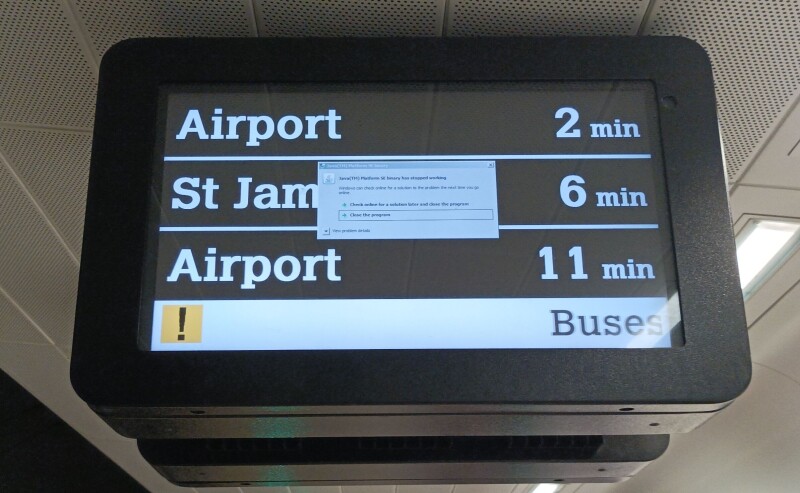
Java has elbowed its way onto a Tyne and Wear Metro information display, giving passengers an error message alongside their train times. Eagle-eyed Register reader abend0c4 spotted the sign, whose dialog design suggests a rather elderly Windows installation. Could it be Windows 7 in Classic guise, or perhaps Windows Server 2008 R2? Both wheezed their last in 2023, when the Extended Security Updates (ESU) program ended. Or perhaps POSReady 7? That kept going (again via ESU) until October 8, 2024. Not that the end of ESU means the code will suddenly stop working. Just that Microsoft has called a halt to updates. The Tyne and Wear Metro is no stranger to keeping old technology running past its expiration date. Opened in August 1980, the transit network has been replacing its aging rolling stock with new units, but the signage has endured. Then again, compared to the Commodore VIC-20 and Apple II, which ruled the home computing roost in 1980, perhaps an operating system that's only been obsolete for a few years isn't such a bad thing. Any second now somebody will be writing an email about some hardware by Sinclair, Acorn, or their particular device maker of choice. But back to the sign. Sadly, it's unclear which version of Java has elbowed its way to the foreground. Java's troubleshooting guidance lists video driver problems as one possible cause of this error. The train indicator seems to be operating as normal if somewhat obscured by Java's attempt to be the centre of attention," our reader noted. Java is longer be a bright young thing, yet it still keeps plenty of enterprise systems running behind the scenes. On this occasion, it appears to prefer the foreground. We'd prefer it kept a lower profile. Passengers have enough ups and downs without Java throwing its toys out of the virtual pram. ®
Software developers will need to get their kicks from becoming code coaches of AI, professors of prompt engineering, and masters of their domain. So says Pratik Wadher, chief technology officer at Kaseya, who oversaw a team of codesmiths rewriting software across the company’s managed services portfolio, which spans remote monitoring and management, backup and recovery, cybersecurity, and automation. “The goal is unifying our data, unifying our API, but as we are starting to also look at the product portfolio that we have, we're trying to understand what are the patterns that we can use to consolidate the product workflows,” he tells The Register. Storage is a good example. The basic workflows involve reading and writing data to storage arrays, Kaseya's own cloud environment, or the racks run by hyperscalers. The team re-architected the back end of its storage products so the storage engine reads and writes to any kind of storage from ZFS to S3. “This is where AI helps,” Wadher claims. “Fundamentally we have accelerated that piece of re-architecture.” Since joining Kaseya in September 2025, the CTO has been trying to simplify what he admits can be a “confusing” number of individual products. “The storage layer that we've been writing, we re-architected and wrote it in six weeks. And that's the actual writing, implementing and testing the code. There are years of domain expertise behind understanding how we want to write it.” In the process, Kaseya used Anthropic coding agents to help a human write the spec. The meatbags at Kaseya then iterated on it and peer-reviewed it with critique agents, before the AI generated the code. Anthropic’s Claude is becoming the “de facto standard” for writing code at Kaseya. “When I look at my engineers, it's not how I used to write code. It's almost like I'm manipulating these agents, but the best engineers are still critical, because you have developed a lot of experience in understanding what you need to do,” Wadher says. Does this take the fun out of coding? Yes and no, he claims. Mirroring the wider industry, some Kaseya engineers are embracing the new approach and some are more “hesitant.” “The fun part of coding is going to be the design, the architecture, the thinking. Writing code is fun but I don't think it's [the] fun [part]. The fun part is having the code run, seeing what it can do, and then tweaking it and changing it. If you can accelerate that and start seeing the results, I think that, for me at least, that would be the fun part: seeing the impact.” Developers must become proficient prompters and “you need the domain expertise,” he adds. “If you’re just using AI to generate code I don’t think you’re going to be useful and I don't think the code you're writing is going to be useful.” Some Reg readers and some of the article-writing vultures may disagree. There is a clear split happening in the world of FOSS, for example, where some projects want only human-written code and others take what they describe as a more pragmatic view of AI tools. AI is already forcing change upon the tech sector. Research last year suggested the number of graduates starting a career in technology is plunging with certain functions being subsumed by agents. “I think basic tasks will be done by AI, so you're not going to need that,” Wadher says. “The skills that will be extremely important are critical thinking and writing. “The worst part of coding, [the thing] engineers hate is writing the documentation. Well, guess what? That is going to become even more critical now. Being able to write clear, concise design specifications, the functional specifications, is going to be extremely important. The good thing is that you’ll now have an [AI] partner that can do this with you and you can iterate with this partner. “I would say the new code is the spec. That's what you're going to check into GitHub now, because you want to make sure that the spec you wrote is going to generate the same type of code now over and over again. I have seen variances." ®
Mass unemployment, boiling the planet, and human extinction within a decade: the dystopian visions of AI are well rehearsed. Academics now argue that EU policymakers should ensure the taxpayers helping to fund the tech get something back, a “happiness dividend.” Researchers at the Oxford Internet Institute (OII), led by Professor Sandra Wachter, say citizens who are inadvertently helping to create the next generation of tech billionaires need more than promises that AI will boost economic growth and fatten corporate profits. Their paper, "Optimising for happiness in EU technology policy to repay public subsidies for AI," published in the Royal Society Open Science, notes that the public backs AI development through funding, tax breaks, and access to land, water, energy, infrastructure, and data. On data, most people have no say in the matter. Creative work, social media posts, and user interactions have all been swept up to train frontier models, spurring a stream of lawsuits. The OII team proposes happiness as a third goal for AI heavyweights, alongside economic growth and risk mitigation. “Making technology less harmful is not the same as making it socially beneficial,” the researchers told us. What makes people happy? The researchers point to relatedness, competence, and autonomy, all of which some uses of AI could undermine. Chatbots that mimic human emotion may erode the value people place on real human connection. Heavy reliance on AI could dull skills. AI influence could make it harder for people to make their own choices. And datacenters threaten land and water, leaving fewer trees and green spaces for people to connect with nature. “Under the proposed approach, companies benefiting from public support would be expected to predict how their technologies will improve happiness and well-being, and be held accountable for delivering those benefits,” the researchers said. The EU has allocated €20 billion for AI gigafactories, while GenAI4EU and the Digital Europe programme is using €700 million through Horizon research projects into generative AI and supercomputing initiatives. “The public already pays for AI through subsidies, resources, and data, yet has little say over what it gets in return,” said lead author Professor Sandra Wachter. “We believe people deserve technology that increases their happiness. If the public is helping to build the AI industry, it should also share in its benefits.” Denser, more powerful servers in a growing number of datacenters are drawing more energy, potentially pushing up household electricity bills. Memory makers are prioritizing higher-margin chips, so ordinary DRAM and NAND cost more, and so do the devices that use them. Water, which some see as the planet’s next most precious commodity, is being used to cool server racks. Anthropic warned this year that humanity risks courting extinction unless powerful models are properly controlled. Last year it and OpenAI raised the prospect of mass unemployment as employers turn to AI to cut costs. The researchers add that the difficulty of getting data out of model makers and their cloud providers makes it harder to gauge the environmental damage datacenters are doing. Against that backdrop, finding some way to improve people’s well-being looks essential. Will the model makers take note? Even pessimists are sometimes pleasantly surprised, though we expect profits will trump pleasantness. ®
Britain is funding the next generation of tech companies without making sure taxpayers get a slice of the action, MPs have warned. In a new report shared with The Register ahead of publication, the Public Accounts Committee (PAC) has accused UK Research and Innovation (UKRI) of being overly cautious about protecting taxpayers' interests. Rather than simply handing out grants, MPs want UKRI to consider taking equity stakes in more of the businesses it backs, giving the public a chance to cash in when those companies succeed. According to the Department for Science, Innovation and Technology (DSIT), UK universities produce more spinouts and patents per pound of research funding than their US counterparts. But Britain is less adept at cashing in on its inventions. British startups still struggle to attract the investment needed to grow without moving overseas, while universities have a patchy record when it comes to exploiting their intellectual property. UKRI, meanwhile, has been reluctant to impose tougher conditions on the research it funds, arguing that doing so could discourage companies from growing. “This approach is far too cautious and we urge the Department to do much more to recover taxpayer's money when a successful company exploits research which the taxpayer, via UKRI, has paid for," the PAC said. It wants UKRI to review its standard funding terms, including whether it should take equity stakes in more companies benefiting from public money. Sir Geoffrey Clifton-Brown, chair of the PAC, acknowledged that calling for the government to behave more like a venture capitalist might seem an odd position for a committee normally concerned with keeping public spending in check. "It may strike followers of this Committee's work that our call for government to take a less cautious approach to taking a direct stake in British innovation is an unusual one," he said. "But we are a body dedicated to value for taxpayers' money, not hoarding it. The nations currently leading the global tech race did not achieve their positions by avoiding more entrepreneurial policies. This is a simple case for the government of nothing ventured, nothing gained." The government has made some effort to help British tech firms. UKRI gives AI startups free access to taxpayer-funded supercomputers, while DSIT has changed its procurement rules to give UK companies a better shot at supplying £400 million worth of specialist AI chips. The British Business Bank is also investing alongside pension funds, giving taxpayers a stake in some of the businesses receiving support. But efforts to attract more pension fund investment have been slower than ministers hoped, and MPs want DSIT to start measuring whether its various support schemes are actually helping British companies grow, rather than simply counting how much money it hands out. There's also the question of where all that research funding ends up. London, the South East, and the East of England continue to receive half of UKRI's funding, despite years of government promises to spread investment more evenly across the country. The North's share has improved from 12 to 20 percent over the past five years, but UKRI has yet to set specific regional funding targets. Clifton-Brown described the divide as "continuing and unacceptable," warning that progress could easily be reversed without a more deliberate effort to spread the cash around. And while MPs want UKRI to be more adventurous with its investments, they're considerably less impressed with how it manages some of the projects already on its books. The committee pointed to an airborne laboratory upgrade that UKRI abandoned after spending £46 million of its £49 million budget. Funding was finally canceled five years after the decision to upgrade the aircraft, prompting MPs to question why the plug hadn't been pulled sooner. Elsewhere, around 45 percent of the Science and Technology Facilities Council's estate is in unacceptable condition, and restoring university-owned research infrastructure to full working order would cost an estimated £5.6 billion. The PAC also criticized UKRI for failing to ensure a replacement for the ARCHER2 national supercomputer would be ready before the existing machine shuts down, leaving an expected 13-month gap. It seems Whitehall has mastered the art of spending money on innovation, but getting any back is another matter. ®
Google has fixed the flaws in the Chromium browser engine that saw it poll DNS root servers, but ISPs who seem to have odd views about resilience now emerged as a new source of probably-well-meaning overconsumption of internet resources. ICANN’s office of the Chief Technology Officer delivered that view on Monday during the governance org’s annual conference in Bali, Indonesia, in a session that shared recent data from its Identifier Technology Health Indicators (ITHI) research program which monitors the security, stability and resilience of the domain name system. ICANN principal technologist Maud Durand opened with a discussion of “Chromioids” the odd flaw in Chrome that meant well-meaning efforts to avoid a form of DNS hijacking caused the browser to generate about half of all DNS root server traffic during the year 2020. Given Chrome’s enormous prevalence, that traffic was unwelcome. ICANN, plus other internetworking and governance stakeholders, told Google to sort it out. Durand said the Chocolate Factory gradually did. ICANN has kept measuring the impact Chrome makes and Durand shared the graph below which shows the browser’s share of DNS root server traffic falling from 45 percent to one percent today. Or as Durand described it, “in the noise.” ICANN has now detected a new source of odd DNS traffic: ISPs that use multiple DNS servers for every one of their customers’ requests. “Every single DNS query is sent three times: to Google, to Cloudflare, and to another DNS resolver,” Durand said, labelling this practice a “belt and suspenders” approach because a single resolver usually suffices to keep services up. It’s good practice to specify primary and secondary DNS resolvers, in case one doesn’t work. But DNS resolvers are already very resilient, and making multiple requests is unusual. The ISPs ICANN has spotted send DNS requests over IPv4 and IPv6, and for non-cached requests repeat them within 100 milliseconds for about half of queries. A further 30 percent repeat within thirty seconds. “It is hard to know if it is a bug or a specific behaviour,” Durand said, before advancing a personal theory that the ISPs who use this odd resilience technique can’t hire skilled internetworking engineers and therefore created a kind of brute-force resilience routine. The organization is researching the cause. ICANN feels the ISPs using this practice aren’t major players, but the org worries that if the practice becomes widespread, or is adopted by a large entity, it could have a nasty impact. Pointlessly busy DNS servers also matter because ICANN thinks the number of DNS service providers is becoming more concentrated. ICANN has tried to calculate how many DNS resolvers half of internet users can “see” when they are online. As the graph below shows, users could see almost 250 resolver farms in the year 2020. That figure is just under 150 today. Again, Durand isn’t sure why but suspects the number of DNS resolver operators might be shrinking and that the remaining visible resolvers belong to tech giants. ®

 Login