Few sights thrill backyard observers as much as the Orion Nebula (M42). The brightest stellar nursery visible from mid-northern latitudes resolves into a complex web of luminous gas and dusty tendrils even through modest telescopes. And at its core, you’ll see the brilliant young stars of the Trapezium Cluster that provide the energy to setContinue reading "JWST tours Orion’s hidden stellar nursery"
Using NASA’s SPHEREx spacecraft, astronomers have studied a host of "failed stars," also known as brown dwarfs.
These strange cosmic bodies straddle the line between planets and stars, possessing a mass between 13 and 80 times that of Jupiter (0.013 to 0.08 times the mass of the sun). They get the nickname failed stars because they form like stars from collapsing clouds of gas and dust but fail to gather enough mass to trigger the fusion of hydrogen to helium in their cores, the process that powers actual stars.
This formation process also means that brown dwarfs are cosmic loners, wandering the darkness of space alone, bereft of the light of a parent star. That description might sound like lyrics from a Type O Negative song ("Black No. 1," anybody?). And that's apt, according to the leader of the new study, which reveals that, chemically speaking, the atmospheres of these dark and cloudy worlds are not unlike those of our solar system's gas giant planets.
"They’re kind of goth," Zafar Rustamkulov, of the California Institute of Technology (Caltech), said in a statement. "Unlike exoplanets, free-floating brown dwarfs are completely independent celestial objects that will fade into eternity alone. We’re still learning how complex they are."
Rustamkulov added that, from Earth orbit, SPHEREx — short for Spectro-Photometer for the History of the Universe, Epoch of Reionization, and Ices Explorer — sees wavelengths of light that are nigh-impossible to see with telescopes on the ground because water in Earth’s atmosphere absorbs them. That is important for bringing brown dwarfs into the light.
"We are picking up light from the deep, red clouds of brown dwarfs all over the sky," he said.
A forest (of brown dwarfs)
Brown dwarfs have been somewhat mysterious since their discovery in the 1990s, due to the fact that the small amount of nuclear fusion that occurs within them causes them to emit no more than a faint glow. That means that our understanding of their makeup, their storms, and their evolution really only comes from theory.
To help lift this observational darkness, the team turned to data from SPHEREx. They studied 37 nearby brown dwarfs in a spectrum of light including 102 wavelengths, from the deepest red our eyes can see to the invisible infrared light. These local failed stars spanned the full temperature range for brown dwarfs — from 4,000 degrees Fahrenheit to minus 10 degrees Fahrenheit (2,200 to minus 20 degrees Celsius).
Considering that the temperature of the sun is about 10,000 degrees Fahrenheit (5,500 degrees Celsius), you could definitely say brown dwarfs run cold.
Brown dwarfs observed by SPHEREx. (Image credit: Zafar Rustamkulov/NASA/JPL-Caltech)
The spectra of brown dwarfs seen by SPHEREx allowed the team to determine that their atmospheres are chemically rich in water, carbon dioxide, carbon monoxide and methane.
"We’re seeing the signatures of these molecules and how they change from object to object across the entire temperature regime," said team member J. Davy Kirkpatrick, also of Caltech. "Our paper concentrated on just three dozen, but we have thousands more that we are in the process of analyzing.
"I really want to see what bounds the universe places on the variety of brown dwarfs."
All my colors
Brown dwarfs have been routinely observed by other telescopes, including NASA's James Webb Space Telescope and the agency's now-retired Spitzer Space Telescope, but the wide wavelength coverage of SPHEREx has made it particularly useful in observing these failed stars. That's good news for astronomers waiting for change in the atmospheres of brown dwarfs as they age and grow cold.
The researchers found that some brown dwarfs observed by SPHEREx are at a stage of extreme change in which their clouds are clearing, creating atmospheres rich in methane.
The team may have discovered significant new details about brown dwarfs, but they are still on the proverbial mystery street when it comes to these strange celestial objects,
"The state-of-the-art models are capturing the general chemical trend, but when it comes to these cloudy transitions, the models are struggling to match the data," said Rustamkulov. "No two brown dwarfs are alike. Even at the same temperature, their spectra look quite distinct."
NASA’s SPHEREx reveals molecules like methane (CH4), carbon dioxide (CO2), and carbon monoxide (CO) in brown dwarf atmospheres. The telescope’s view of three different brown dwarfs appears on the left. (Image credit: Zafar Rustamkulov/International Gemini Observatory/NOIRLab/NSF/AURA, M.H. Wong (UC Berkeley) et al. Acknowledgments: M. Zamani)
"This journey has turned many of us into accidental meteorologists. We know how hard it is to predict weather on our own planet, and we realize it's going to be just as challenging to explain the phenomena we see in these bizarre, cold objects," Kirkpatrick said. "The findings are a call to action to explore even more of these dark worlds."
As astronomers resond to that call to action, I will ponder how I could have worked Bauhaus' Goth classic "Bela Lugosi is Dead" into this article.
Roughly one-third of stars in the Milky Way are in binary or multiple systems, but only ~1–10% of stars in globular clusters have a companion. Did globular clusters start with fewer binaries than the solar neighborhood, or have they since been wiped out?
Survival of the Tightest
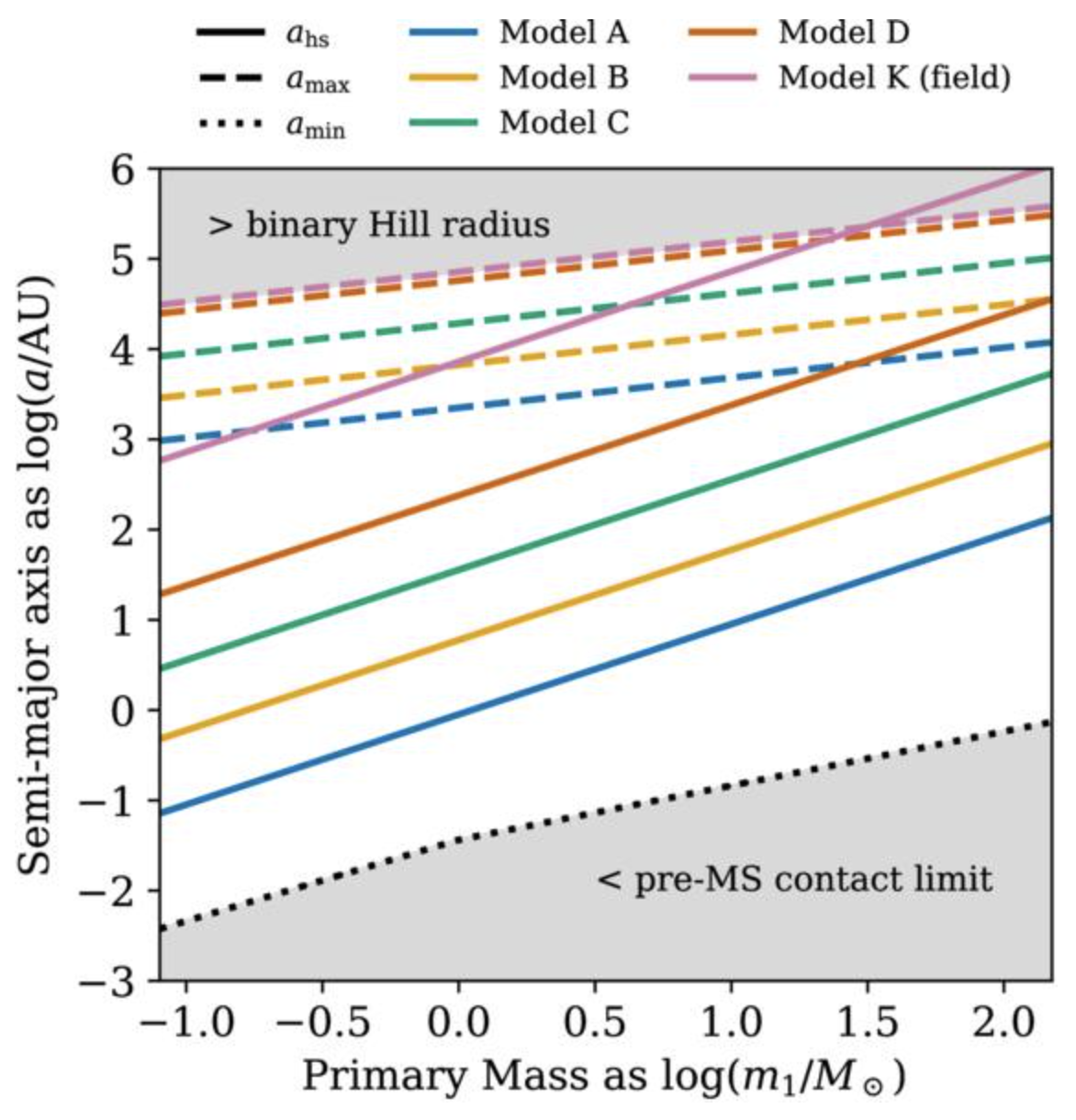
Map of the semi-major axis–primary mass parameter space for binary systems. Solid lines show the boundary between hard (below the line) and soft (above the line) binaries for a variety of models. Models A–K span a variety of cluster masses and virial radii (a proxy for cluster density). [O’Connor et al. 2026]
Globular clusters (GCs) are dense, ancient, gravitationally bound groups of stars. A team led by Christopher O’Connor at Northwestern University explored whether the lack of binary systems could be the result of some process unique to GCs. First, the team developed an analytical formalism to understand how binaries in a GC evolve depending on the binary stars’ masses, distance from each other, and interactions with other stars in the cluster.
It turns out that the fate of a binary system depends on whether it is dynamically “hard” or “soft.” Hard binaries are generally tightly bound, and they tend to get “harder” from stellar flybys, which are common in a crowded cluster environment. Soft binaries are the opposite — they have much shorter lifetimes since encounters with other stars tend to loosen them. The team found that, assuming GCs have the same initial distribution of binaries as the solar neighborhood, the dissolution of soft binaries is sufficient to explain the present-day scarcity of binaries in GCs.
Burning Away the Binaries
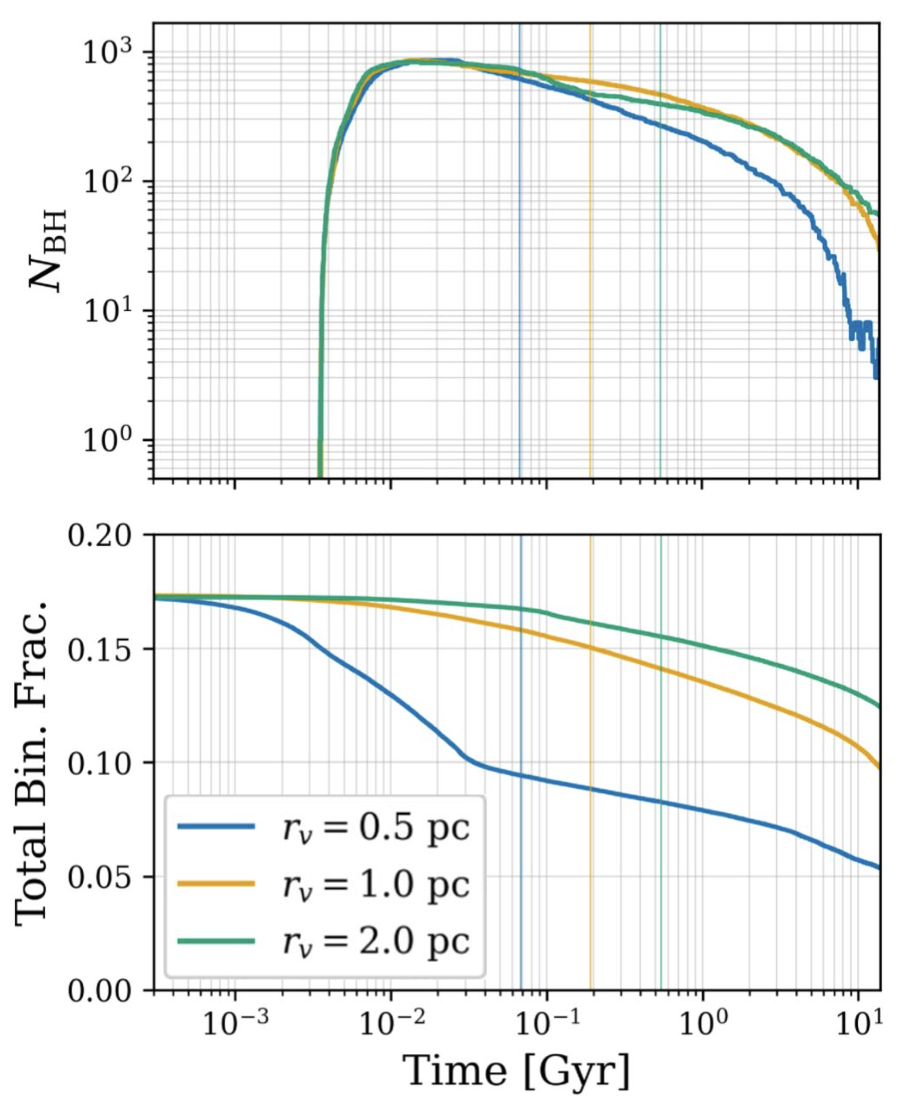
What actually tears the soft binaries apart? The answer is a process called “black hole burning.” As some of the most massive objects in a globular cluster, black holes in binary systems can transfer energy when they interact with passing stars. This influx of energy can excite soft binaries to the point of dissolution, the study shows.
Black hole burning can also prevent core collapse in GCs. Left to itself, a cluster’s core gradually loses energy to its outskirts, causing the core to grow hotter and denser with stars. This leads to more dynamical interactions between stars that can then get flung from the core or enter new tight binaries. Black hole burning pumps energy back into the core and prevents this from happening.
Putting the Theory to the Test
The total number of black holes in a cluster (top) and the binary fraction (bottom) as a function of time for three different cluster models. In the densest cluster (blue), binary dissolution starts early on, mainly driven by stellar collisions. For the other two models, binary dissolution mainly occurs after the number of black holes reaches its peak and black hole burning commences. [Adapted from O’Connor et al. 2026]
To validate their analytical results, the team performed N-body simulations of GC dynamics with the Cluster Monte Carlo code. They found that, in moderate-to-low-density clusters, the decline of binary systems is powered mainly by black hole burning. In more compact clusters, however, stellar collisions also play an important role in the dissolution of binary systems, and at earlier times than the onset of black hole burning.
In general, the final binary fractions of the simulated clusters agree with those predicted by the team’s analytical formalism. This further supports the theory that there is a universal initial binary distribution between galactic GCs and our solar neighborhood. Constraining this distribution is pivotal for refining dynamical models of GCs.
In short, GCs and the solar neighborhood likely started with the same amount of binary systems, and interstellar dynamics handled the rest.
Citation
“A Common Origin for Binary Fractions in the Field and in Dense Clusters,” Christopher E. O’Connor et al 2026 ApJ 1009 L80. doi:10.3847/1538-4357/aea078
By observing subtle variations in the timing of stellar pulsation modes, researchers may have made the first detection of a planet in the habitable zone of a massive A-type star.
Listening for Planets in Stellar Heartbeats
To date, some 6,000 exoplanets have been detected across a vast array of surveys and instruments. The majority of these have been detected around main-sequence F, G, and K stars — but not because these are the only places exoplanets can exist. Rather, this is a result of selection bias: these stars tend to be both bright and luminously stable enough for astronomers to deploy the radial velocity or transit methods.
Periodic modulations in the time of observed stellar pulsations can indicate the presence of an orbiting companion. In this case, timing variations are displayed for the two most prominent pulsation modes f1 and f2 for the variable star HD 156295. The sinusoidal pattern indicates they may be caused by an orbiting companion with a mass of about 6.3 Jupiter masses at a distance of 3.9 au, in this star’s habitable zone. [Adapted from Wilson et al. 2026]
A-type stars, by contrast, are challenging for exoplanet detections. These more massive stars tend to exhibit fewer and broader spectral lines than their F, G, or K counterparts, rendering radial velocity techniques largely ineffective. Many A-type stars also pulsate in brightness, making it hard to identify planetary transits within their erratic light curves.
Luckily, one transit astronomer’s trash data can be a pulsation timer’s treasure. For some A-type stars called δ Scuti stars, the pulsation is regular enough to be used like a cosmic clock. Subtle variations in a star’s position due to the tug of an orbiting companion can then disrupt the timing of its otherwise steady pulsation, allowing one to once again find planets via its light curve — including massive ones on intermediate-period orbits that are the most difficult to detect around massive stars using traditional methods.
A Massive Planet in the Habitable Zone of a Hot Star?
In a new study led by Logan Wilson (Center for Astrophysics | Harvard & Smithsonian), researchers analyzed 16,440 highly pulsating δ Scuti stars observed at a high cadence by the Transiting Exoplanet Survey Satellite (TESS) in order to look for the distinctive, periodic timing modulations associated with an orbiting companion. This sample was then whittled down to nine candidate systems they believe may contain substellar companions — likely either brown dwarfs or massive planets.
The properties of the nine candidate objects identified in this study and their host stars are shown here, along with the properties of other exoplanet systems. Through stellar pulsation timing, the researchers were able to identify substellar candidates around hot A-type stars in intermediate-period orbits, a region of parameter space that has been difficult to probe with other methods. [Wilson et al. 2026]
One particularly striking candidate was found when analyzing the star HD 156295. Based on their timing data, Wilson and collaborators deduce the star may have a 6.3 Jupiter-mass planetary companion orbiting every 2,200 days. That puts the companion’s distance from its host at about 3.9 au, right at the far edge of HD 156295’s habitable zone. If this planet turns out to be real, HD 156295 would be the hottest star known to host an exoplanet in its habitable zone. This detection also suggests a high occurrence rate of massive planets on intermediate orbits relative to expectations for other main-sequence stars, supporting theories that A-type stars may form companions like these more efficiently.
The other eight candidates are more consistent with brown dwarfs. Six of these candidates show somewhat uncommon masses and orbital separations that place them in a region of parameter space known as the “brown dwarf desert.” Some observations suggest this desert is less severe around hotter stars — a conclusion that this study supports.
All of these findings are still quite tentative, however; the researchers estimate that the probability for the planetary signal being real is just over 50%, and the parameters given for each candidate are still subject to large uncertainties. With new data arriving all the time, it may not take long before we have a clearer picture of these unique substellar companions.
Citation
“A Search for Substellar Companions around A-type Stars: Pulsation Timing Detection of Eight Brown Dwarf Candidates and a Possible Habitable-zone Planet,” Logan G. Wilson et al 2026 ApJ1009 78. doi:10.3847/1538-4357/ae93a0

 Login