New infrared observations of the Eskimo Nebula, a bipolar double-shell planetary nebula in the constellation of Gemini, reveal clumps of dust, ionized gas and expanding shells surrounding a central star.
Stunning new imagery of the distant celestial object NGC 2392, better known as the “Lion Nebula,” has been obtained by NASA’s James Webb Space Telescope.
The cosmic vista captured by Webb reveals a colorful view of the ancient nebula, whose characteristic appearance resembles one of nature’s most respected apex predators, complete with a bushy-looking “mane” composed of hazy stellar gases and objects similar to comets.
The new high-resolution imagery offers one of the clearest and most detailed views of the Lion Nebula ever seen. Previous images captured by Webb’s predecessor, the Hubble Space Telescope, were obtained in 2000, featuring the same celestial feature in visible light.
With the added spectral ranges Webb’s Near Infrared Camera (NIRCam) and Mid-Infrared Instrument (MIRI) can capture, the Lion Nebula now appears in colorful pinks and indigo hues, surrounded by distant galaxies blazing in brilliant orange from across vast cosmic distances, whose light has traveled billions of years to reach our Solar System.
A Lion Roars Across the Cosmos
A particularly striking feature about the new imagery is the way cosmic dust and regions of ionized gas are showcased in the new Webb imagery.
“It’s taken several thousand years for this collection of gas and dust to reach its current shape, and the nebula’s components continue to be altered,” read a portion of a statement released by the European Space Agency (ESA) that accompanied the new images.
The Lion Nebula, as seen with the MIRI instrument on board the James Webb Space Telescope (Image Credit: NASA, ESA, CSA, STScI; Image Processing: Alyssa Pagan (STScI)).
One reason that helps account for the changing appearance of the Lion Nebula over time can be found at its center, where the remnants of a slowly dying white dwarf star (which effectively forms the nose in the lion’s face after which the nebula is named) continues to supercharge the surrounding cosmic structures made visible in the new Webb imagery.
The rest of the lion’s face is composed of an expanding bubble of ionized gas, the nature of which remains somewhat mysterious. Presently, astronomers are uncertain about what exact mechanisms give rise to the complex appearance of this gassy bubble and its internal structures, which are a recurring element in ancient nebulae such as this.
NGC 2392 isn’t the only celestial feature known as the “Lion Nebula.” An entirely separate diffuse nebula located in the Cepheus constellation, known as Sharpless 2-132, also shares this nickname due to its shape, which resembles a lion’s body seen from the side.
A Cosmic Visage Frozen in Time
For now, the Lion Nebula is captured in the Webb imagery, which, despite its almost serene beauty, represents a highly active area of the cosmos, undergoing constant change as material is continually ripped away from the stellar central core.
Sometime in the next 10,000 years or so, this striking celestial feature will eventually be destroyed, once the white dwarf powering the nebula completely dies and the remnants of stellar material are completely dispersed into the surrounding space.
Until then, this remarkable cosmic feature will remain a target of study by astronomers, whose inquiries are helped significantly by the unprecedented clarity offered in the latest Webb images.
Micah Hanks is the Editor-in-Chief and Co-Founder of The Debrief. A longtime reporter on science, defense, and technology with a focus on space and astronomy, he can be reached atmicah@thedebrief.org. Follow him on X @MicahHanks, and at micahhanks.com.
A stunning new image from the NASA/ESA/CSA James Webb Space Telescope reveals a comet-shaped cloud in the Carina Nebula hiding a cluster of about 70 young stars, including a rare giant of O-type nearly 19 times as massive as the Sun.
A new school year brings fresh opportunities to get involved with NASA. Whether you’re curious about space or eager to build real STEM skills, NASA offers a world of experiences putting you close to the action. As we enter a new golden age of exploration, there’s no better time to jump in, try something bold, and see where your curiosity takes you.
Gain Hands-On NASA Experience
NASA opens the door to authentic mission experiences through internships and student challenges. As members of the NASA team, interns work on genuine agency projects and gain industry-ready skills, all with the guidance of NASA mentors. Visit NASA’s internships website to learn more about current vacancies, deadlines, eligibility requirements, and more.
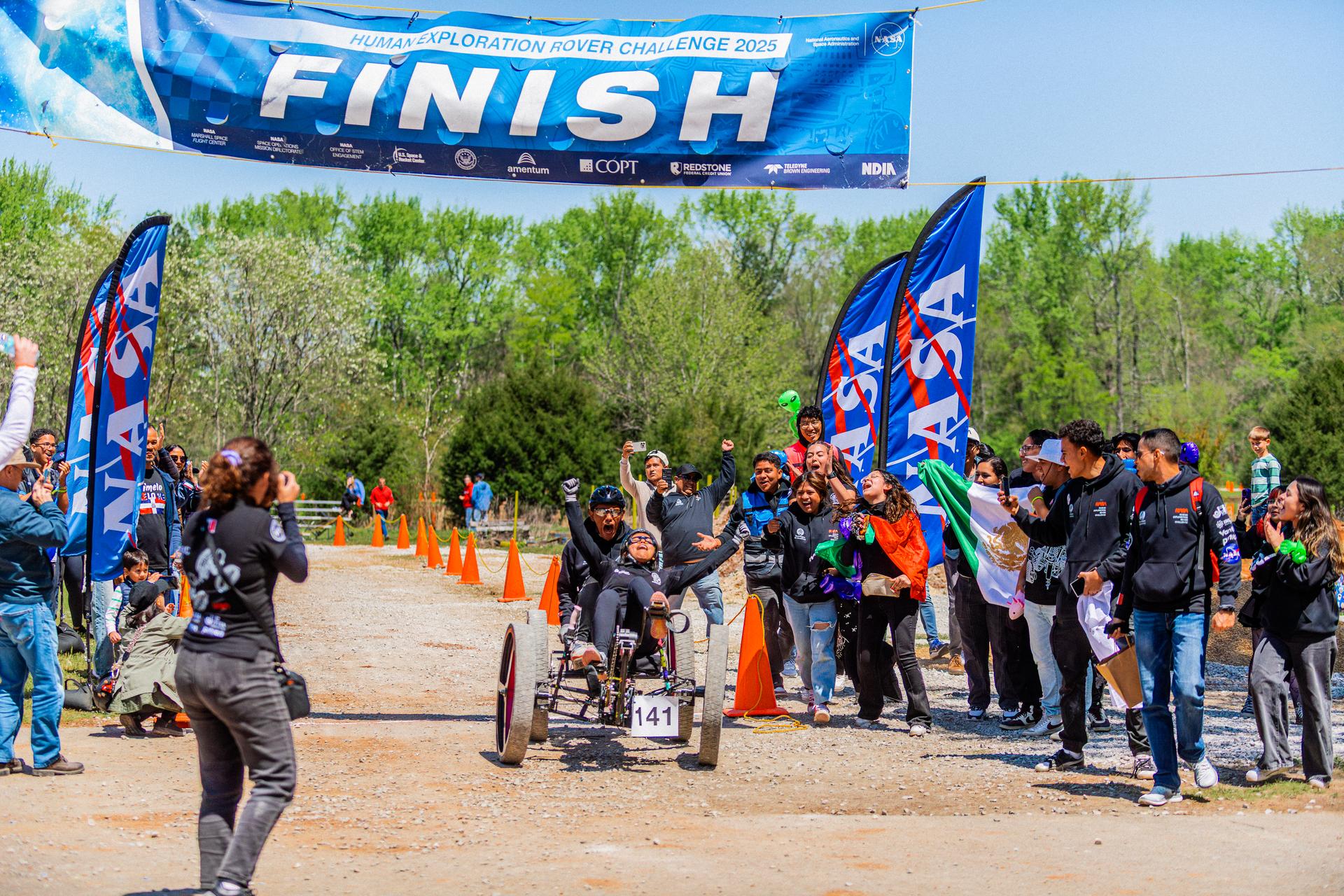
Through NASA’s student challenges and competitions, student teams tackle some of the critical technical hurdles facing mission planners. Flex your innovative muscles and sharpen your collaborative and problem-solving skills while developing, prototyping, and testing your team’s designs. Check out the full list of NASA STEM challenges and opportunities, choose one that fits your interests, and assemble your team.
Students cross the finish line in their human-powered rover during the 2025 Human Exploration Rover Challenge at NASA’s Marshall Space Flight Center in Huntsville, Alabama
USSRC/Emily Riddle
Discover Technical Careers at NASA
The future of aerospace depends on a steady pipeline of skilled technical experts ready to make missions and ideas a reality. NASA invites students in high school, community college, and career technical education programs to join in-person and virtual events to explore these important career paths.
NASA Career Technical Education Days bring students on-site to meet NASA skilled technical workers who share what their jobs are like, how they built their careers, and the skills, training, and certifications that have helped them succeed. During NASA’s Next Gen STEM Virtual Career Connections , students interact live with technical experts supporting the agency’s missions. Students and teachers can learn more on the Next Gen STEM for Careers website.
A technician performs welding on a spacecraft transporter at NASA’s Kennedy Space Center in Florida.
NASA/Ben Smegelsky
Contribute to NASA Science as a Citizen Scientist
NASA’s Science Mission Directorate invites you to help make real discoveries through science projects powered by volunteers. Join from anywhere, whenever it fits your schedule, and start working with authentic mission data. Help identify comets and asteroids, hunt for binary star systems, and more. Find the project that’s right for you on the list of current citizen science projects.
Keep Up With NASA Missions and Discoveries
Don’t miss out on NASA’s biggest mission milestones this school year! Up first is the Nancy Grace Roman Space Telescope, scheduled to launch no earlier than 7:20 a.m. EDT on Sunday, Aug. 30. This powerful new observatory has a field of view at least 100 times larger than the Hubble Space Telescope. Be a virtual guest for launch and learn more about the telescope with fun activities provided by NASA’s Science Mission Directorate. You can also sign up to be a virtual guest for NASA’s next crewed launch to the International Space Station, SpaceX Crew-13, set to launch in September.
And be sure to follow NASA’s continuing crew training and hardware preparations for Artemis III. Set to launch into Earth orbit in 2027, the flight will test rendezvous and docking capabilities with commercial human landing systems – landers that will carry astronauts to the lunar surface on Artemis IV and future missions to the Moon.
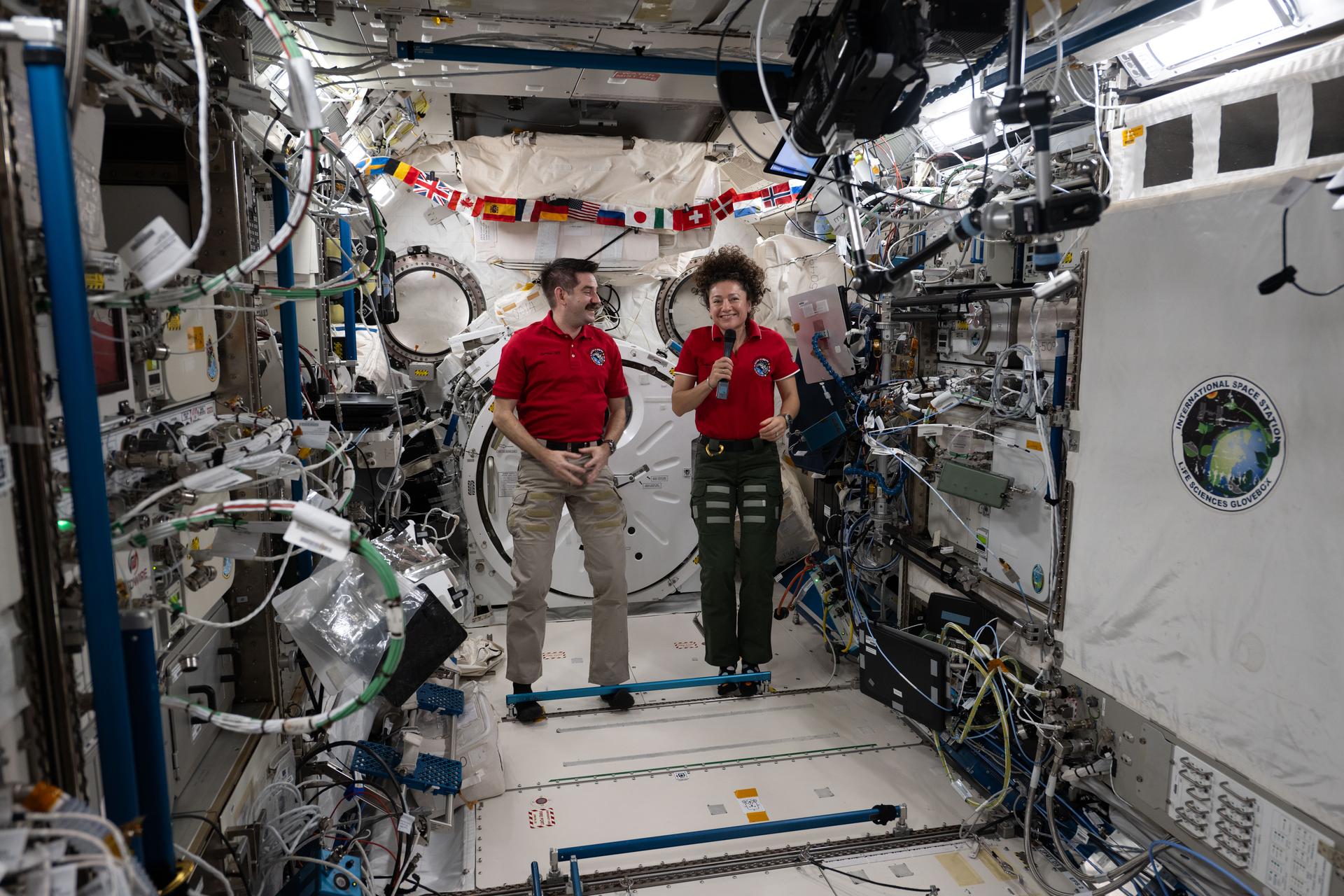
NASA astronauts Jack Hathaway and Jessica Meir answer questions inside the International Space Station’s Kibo laboratory module during a live downlink event in May 2026.
NASA
Stay Engaged With NASA
Schools, classrooms, and community-based student groups have further options to engage with NASA and its people. Through In-Flight STEM Downlinks, students have their pre-recorded questions answered live by astronauts aboard the International Space Station, demonstrating how STEM careers reach far beyond Earth. Additionally, the NASA Engages public outreach program connects agency experts with student audiences to share mission and science updates, helping people discover how NASA’s work unfolds and how they can be part of the journey.
This school year, whether you’re interested in aerospace jobs or eager to dive into authentic STEM challenges, you’ll find an array of activities and career exploration tools on NASA’s Learning Resources website. Explore exciting NASA student opportunities and subscribe to the weekly NASA EXPRESS email newsletter for the latest NASA STEM opportunities and updates!
Les microplastiques ne menacent pas seulement la biodiversité marine : ils pourraient aussi réduire la capacité des océans à absorber le dioxyde de carbone atmosphérique. En analysant l'impact de ces particules sur le phytoplancton, des chercheurs montrent que la pollution plastique perturbe...

 Login