Apple is recruiting a 6G cellular modem systems engineer, adding a next-generation research focus to its in-house modem development. The position, posted October 19 in Sunnyvale, California, describes responsibilities spanning cellular standards, hardware and software architecture, and power efficiency.
The Apple job listing establishes a concrete engineering focus. It does not identify a future iPhone, name a commercial modem, or provide a release date.
That makes the vacancy useful as a window into development priorities rather than a product announcement. The significant detail is how broadly Apple describes the work: connecting emerging standards with the decisions required to build a functioning cellular system.
The Role Connects Research With Product Engineering
The position covers feature definition, algorithm development, simulation, silicon testing, and preparation for production. Apple specifically identifies next-generation modem requirements with a focus on 6G evolution.
The listing also emphasizes translating engineering improvements into throughput, latency, battery life, and connection reliability. Candidates are expected to understand emerging 6G work alongside 5G and 4G standards.
Those responsibilities explain why modem development extends beyond designing a single chip. A cellular system must coordinate signal processing, software, and hardware while operating within a mobile device’s power constraints.
The practical challenge is balancing competing priorities. An approach that improves one performance measure may introduce costs elsewhere, such as greater processing demands. Evaluating those trade-offs is part of turning a technical possibility into something suitable for a portable product.
Image Credit: Apple Inc.
Apple’s 6G References Predate This Vacancy
The October posting is not the first public indication of this research. A separate Apple RF modeling position, dated June 24, includes modeling and simulation for 4G, 5G, and 6G modem systems.
The distinction matters when interpreting the latest recruitment. A newly published vacancy can reveal current responsibilities without establishing when a project began or how much its staffing has changed.
The two roles address different engineering tasks. The RF modeling position focuses on simulating radio-frequency behavior and investigating performance, while the newer systems role connects standards, algorithms, hardware, and software. Together, they illustrate why modem development requires work across several specialties.
The Standards Process Is Still Underway
The wider industry remains in the process of defining 6G. The International Telecommunication Union refers to the next generation as IMT-2030.
According to the ITU’s current development overview, its expert working party completed draft technical performance requirements in February 2026 and draft evaluation guidelines in June. Both documents have been submitted to ITU-R Study Group 5 for approval scheduled for December 2026.
The ITU has also invited proposals for candidate IMT-2030 radio technologies between February 2027 and February 2029. That window concerns submissions for evaluation, rather than consumer launches, and helps explain why companies are recruiting engineers while the technical framework is still taking shape.
These milestones concern how candidate technologies will be specified and assessed. They do not establish a date when a particular operator will offer service or when Apple will ship compatible hardware.
For readers, this is an important distinction between an industry framework and a usable connection. Standards work helps establish common expectations. Commercial availability requires additional decisions and implementation by device makers, network suppliers, operators, and regulators.
The Work Builds on Apple’s Existing Modem Effort
Apple already has experience bringing its own cellular modem to market. The company introduced C1 with iPhone 16e in February 2025, identifying it as its first internally designed cellular modem and a component supporting 5G connectivity.
That C1 announcement provides a commercial reference point for Apple’s modem work. The recruitment concerns a different stage: developing systems around emerging standards. Shipping a 5G modem and researching 6G are related activities, but progress in one does not establish a launch schedule for the other.
It does not establish that the new role belongs to a particular C-series successor. Assigning a name, manufacturing schedule, or specific iPhone generation would go beyond the information available.
What the Vacancy Means for iPhone Buyers
The immediate takeaway is about Apple’s development direction. The company is seeking engineers who can connect emerging wireless standards with practical requirements such as efficient operation and reliable connectivity.
For someone choosing a phone today, the vacancy provides no basis for predicting when 6G will become a useful purchasing consideration. Published device capabilities, local network coverage, and current service plans remain the information buyers can assess.
The more meaningful future milestones will be finalized specifications, announced compatible hardware, and documented operator deployments. Until those arrive, Apple’s recruitment offers evidence of preparation—and a clearer view of the engineering involved—without establishing the features or timing of a future iPhone.
If you’ve delved into the worlds of Star Trek, The Terminator or William Gibson’s cyberpunk novel Neuromancer, you’ll know that enhanced, electronic vision is a staple of science fiction. Now, what was once futuristic fiction is becoming a reality.
Researchers have developed bionic eyes that can restore some lost vision. These devices’ capabilities are currently basic, but they have been steadily improving in recent years.
One day, they might even offer features that transcend the limits of natural human eyesight – for instance by manipulating images in a way the human eye cannot or by seeing beyond the spectrum of visible light.
Technology that boosts people’s physical and mental abilities is no longer the preserve of science fiction. In this series, we explore cutting-edge ways that human capabilities could be augmented both now and in the near future – and the ethics of these innovations.
To date, implants have focused on combatting problems with the retina, the light-sensing layer of cells inside the back of the eye. Akin to the film in the back of a camera, the retina allows us to see the outside world. When things go badly wrong with it, the result can be a total loss of vision.
Work to fix retinal blindness with implants began more than two decades ago. One of the first devices, developed by the German manufacturer Retina Implant AG, featured a light-sensing chip placed under a person’s damaged retina. This connected with their remaining healthy retinal cells, which then transmitted the chip’s vision signal from the eye to the occipital cortex, the brain region where vision is perceived.
Surgery to implant the chip took about eight hours. This included creating a recess in the skull behind the ear to implant a power receiver and then connecting this with a wire beneath the skin to the chip.
The device offered only rudimentary vision, with patients seeing flashes of light that corresponded roughly to the shape of the object they were looking at. Many implants also broke over time, possibly because of the frequent rapid movements of the eye or corrosion caused by its salty liquid interior. Retina Implant AG ceased operations in 2019, citing its lack of medical progress as one of the main reasons.
The other leading early device, Argus II, combined a glasses-mounted camera with a chip surgically inserted on top of the retina. The camera’s picture was converted into a signal and transmitted wirelessly to the chip (along with power), which then stimulated healthy cells in the damaged retina using an array of 60 electrodes.
Despite positive early results and FDA authorisation in 2013, ARGUS II also ultimately failed to deliver sufficiently convincing results. It was discontinued in 2019.
Newer approaches
Despite these setbacks, investigators have persisted in trying to create artificial vision.
A newer approach is to use an external camera that wirelessly transfers power and image data to a chip implanted in the occipital cortex. This built on research that placed electrical probes directly into the occipital cortex to stimulate visual perception.
This approach can help both patients with diseases of the retina and those with conditions affecting the optic nerve, which connects the retina to the brain. But exactly how much resolution can be achieved with this technique isn’t clear, as the retina’s high resolution and complex signal processing is lost.
One company trying this technique, Belgium-based ReVision Implant, is launching its first human clinical test in October 2026.
Another option is to use spectacles that transmit both images and power to a surgically inserted subretinal chip via an infrared signal. A device using this technique, Prima, has been tested in a specific disease of the retina called dry age-related macular degeneration (AMD), a leading cause of blindness.
In a small clinical trial, the device restored functional central vision to 81% of patients, allowing them to read letters, numbers and words. The device is now authorised in 30 European countries.
As AMD is far more common than the inherited retinal diseases treated by most earlier devices, this device is much more appealing to investors. However, there are ethical questions here. Unlike patients with inherited retinal diseases, most with AMD still have good peripheral vision, so they have much to lose if things go wrong. The complex surgery to implant a subretinal chip is far from zero risk.
Super-human vision?
Because these technologies relay visual information electronically, extra functionality could potentially be built into them. With Prima, patients can already use optical zoom, while algorithms that could allow for image sharpening have been proposed.
In the future, it is possible that devices may emerge that use cameras capable of seeing beyond the visible light spectrum. This could potentially offer thermal imaging and night vision. One device offering near-infrared vision has already been tested in primates.
But while exciting, these will probably not offer enhanced vision until the currently rudimentary artificial vision is advanced to the point that these “optional extras” become more relevant.
For now, there are still many biomaterial and electrical challenges preventing retinal implants from offering full, long-term vision restoration. However, a potentially greater challenge comes from competing biological solutions, such as stem cells, which are in the early stages of human trials.
These have also had a few false dawns and there are big obstacles to overcome in terms of cell survival and integration. But if new human retinal cells can replace those lost to disease, they could one day overtake bionic eyes entirely as the solution for vision restoration.
Tim Jackson was involved in one of the trials of Retina AG’s device, and his NHS employer received site fees for participants enrolled on the trial. As part of this trial, he received support to attend surgeon training in Germany.
Wave coarsening in active elastic media is a phenomenon in which vibrations spontaneously increase in wavelength, period and amplitude before forming a globally synchronized time crystal.
App Tracking Transparency is at the center of a new UK lawsuit seeking approximately $2.7 billion (£2 billion), putting one of the most recognizable iPhone privacy features under fresh legal pressure. The claim follows earlier challenges to the tracking system in France, but this action seeks compensation for developers who say Apple imposed unfair restrictions on their businesses while favoring its own advertising services.
Filed on September 3 at London’s Competition Appeal Tribunal, the case represents another dispute over the rules behind the familiar permission prompt. Apple rejects the allegations and maintains that it follows the same App Tracking Transparency requirements as other developers.
The amount being sought is not a fine or an awarded payment. It is the claimants’ estimate of losses, which Apple disputes.
What the App Tracking Transparency Lawsuit Alleges
The action was brought by ATT Collective Action Limited, whose director, Ann Pope, previously led antitrust enforcement at the UK Competition and Markets Authority. Law firm Hausfeld is representing the proposed class.
According to Hausfeld’s announcement of the claim, developers argue that Apple introduced the framework unfairly, without adequate consultation, and applied more burdensome requirements to outside businesses than to its own services.
The complaint focuses partly on consent. It alleges that third-party developers must obtain permission under data-protection law and then secure an additional approval through the iOS tracking prompt. Apple’s advertising services, the claimants argue, operate under a less demanding process.
Developers also contend that the introduction left them insufficient time to adapt business models dependent on advertising.
These are allegations about how the system was designed and introduced—not established findings in this UK case. The claimants’ stated position is that privacy protections should remain compatible with fair treatment of businesses.
Image Credit: AppleMagazine
What the Tracking Prompt Actually Protects
For someone using an iPhone, App Tracking Transparency offers a direct choice about a practice that previously could be difficult to see.
An app may want to connect information about your activity with information gathered through other companies’ apps or websites. That connection can help advertisers build a profile, target advertisements, or measure whether an advertising campaign led to a purchase.
Under Apple’s explanation of the tracking rules, apps must request permission before carrying out the tracking covered by the framework. Choosing “Ask App Not to Track” blocks access to the system advertising identifier and prohibits using other identifying information to perform that tracking instead.
The feature arrived with iOS 14.5 in 2021. It does not remove advertisements, make an app anonymous, or serve as a universal switch for every kind of data collection.
That boundary matters. A retailer remembering purchases made within its own service is not automatically doing the same thing as an advertising company linking activity across unrelated businesses.
The disagreement concerns whether those distinctions, and the consent processes built around them, give Apple an unfair commercial advantage.
Apple Says the Same Rules Apply to Everyone
Apple has responded directly to the lawsuit, defending the feature as a way to give people control over tracking across other companies’ services.
In a statement reported by AFP, a spokesperson said: “Apple is bound by the exact same requirements as all developers under ATT.”
The company also pointed to support for the feature from customers and privacy advocates.
That response challenges the foundation of the developers’ case. Apple presents App Tracking Transparency as a rule based on the type of data activity involved. The claimants argue that its practical operation places competing advertising businesses at a disadvantage.
Resolving that disagreement requires more than comparing the appearance of two permission screens. The underlying data uses, consent requirements, and commercial effects all matter.
Why Free Apps Are Part of the Dispute
Advertising can support both sides of an app business. A developer may sell advertising space inside a free app while also buying advertisements elsewhere to attract new users.
A change to tracking can therefore affect how much an app earns and how confidently its developer can measure spending on promotion.
Consider a small game studio. It needs to know whether an advertising campaign brings in players who keep using the game. If measurement becomes less precise, deciding where to spend the next marketing dollar becomes harder. Separately, advertisers may value the game’s available ad space differently when less information is available for targeting.
That explains the commercial concern without proving the legal claim. Losing revenue after a privacy change does not, by itself, establish that the change was unlawful.
There is also a consumer interest that cannot be reduced to advertising performance. Someone choosing not to be tracked is expressing a preference about personal information, not making a promise to preserve a developer’s previous income.
The difficult question is whether that preference can be protected through a system that treats competing businesses fairly.
France Has Already Examined the Consent Process
The UK action arrives after a separate French competition investigation found problems with the implementation of App Tracking Transparency.
In its March 2025 decision, France’s Autorité de la concurrence distinguished between the legitimate objective of protecting privacy and the way Apple pursued it.
The authority criticized multiple consent requests and differences in treatment between Apple and outside publishers. It also highlighted the position of smaller businesses that lack the extensive first-party data available to large platforms.
Importantly, the French authority did not argue that people should lose the ability to refuse tracking. It said adjustments to the framework could address competition concerns while retaining privacy protections.
That distinction leaves room for changes to wording, consent flows, or implementation without automatically requiring the removal of the feature. The French decision, however, does not determine liability or compensation in the separate UK proceedings.
The Claim Is for Developers, Not iPhone Owners
The official claim website describes a proposed action for UK-based app developers affected since April 2021. It estimates losses across the group rather than offering a fixed payment to everyone who owns an iPhone.
The proposed scope includes developers earning advertising revenue from third-party iOS apps and developers spending money to attract users to those apps. Whether compensation becomes available depends on the proceedings and their outcome.
For U.S. readers, the filing does not announce a change to domestic iPhone settings or create a consumer refund program. There is no reason to grant an app tracking permission simply because its developer objects to the framework.
Businesses following the case should also distinguish registering interest from receiving compensation. The claim website currently invites affected organizations to provide their details; it is not distributing a settlement.
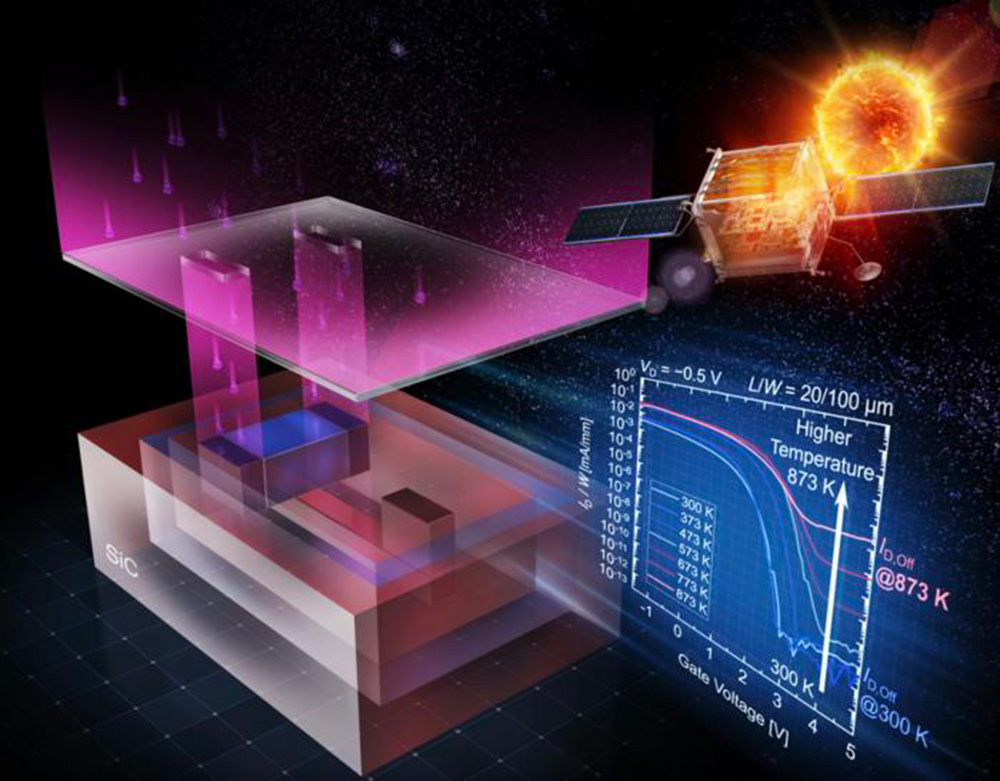
The transistor was able to operate normally at temperatures ranging from room temperature to 1112 F (600 C). (Image credit: Science Graphics)
Scientists in Japan have built a new transistor that can withstand temperatures of 1,110 degrees Fahrenheit (600 degrees Celsius). Components this robust could one day be used in surface probes on Venus — where the thick carbon dioxide atmosphere can reach temperatures of 860 F (460 C).
Most modern tech, including instruments used for deep-space exploration, uses transistors to control the flow of current. But the new device is a type of junction field-effect transistor (JFET), where the strength of an electrical field changes the channel’s conductivity.
JFETs are typically used in specialist applications because they are more difficult to scale down than the more common metal-oxide-semiconductor field-effect transistors (MOSFETs), which are widely used in consumer smartphones and computers. But JFETs can offer lower noise levels because their operation does not rely on an oxide layer, which can introduce interference.
The researchers outlined how the new transistor works in a study published Aug. 17 in the journal APL Electronic Devices.
Can't take the heat
Since at least the start of the century, silicon carbide (SiC) JFETs have been considered a promising option for low-power integrated circuits heading for Venus due to the material's inherent ability to withstand high temperatures.
As the scientists pointed out in the new study: "Past landers have been limited to only a few hours by silicon-based electronics." Venera 13, a Soviet-era lander, holds the world record for the longest time survived on Venus by a spacecraft, at 2 hours, 7 minutes.
"Integrated circuits (ICs) fabricated with SiC are particularly attractive for extreme environments, such as deep-space exploration, geothermal drilling, and aerospace engine control, where conventional silicon-based ICs cannot operate reliably," the researchers added.
But recently developed SiC-JFETs have all met the same two problems: low controllability and large leakage currents. The former is linked to how the SiC substrate is doped with other atoms to alter its electrical properties, defining its gate (where the electrical field is created) and channel (where the current flows) regions.
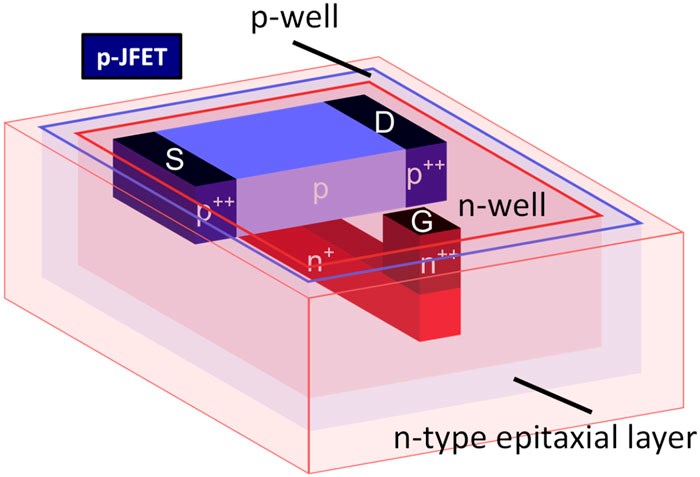
The team used dopants to create two semiconductor "wells" in the SiC around the transistor to avoid large leakage currents. (Image credit: Science Graphics)
In a material with a regular crystal structure, like SiC, some dopant atoms may penetrate deeper than expected. This doesn't matter under normal conditions, but when exposed to high temperatures, it causes variations in the field voltage required to open the channel and makes the transistor harder to control reliably. The scientists found that it can throw conventional JFET voltage thresholds off by over 2 volts.
Furthermore, at temperatures above 660 F (350 C), the SiC substrate can become less electrically resistive, allowing current to flow even when the transistor is switched off. This makes it harder for the JFET to control current properly, potentially causing incorrect signals and increased power consumption.
Even the highest-performing JFETs can only operate long-term at 930 F (500 C), but the Kyoto team had a theory as to why these challenges remained unresolved.
"We believe the lack of development is because the research community has been trying to apply silicon-era thinking to a fundamentally different material," said first author of the study Mitsuaki Kaneko, associate professor of engineering at Kyoto University, in a statement.
Turning the transistor on its head
The researchers designed their new SiC-JFET with these two challenges in mind. To improve controllability, they implemented a bottom-gate structure, where the gate is positioned underneath the SiC conducting channel.
Its gate region is heavily doped by design, so when dopant atoms in the channel penetrate deeper into the SiC, it doesn't change the overall doping profile of the channel-gate region, limiting its impact on the threshold voltage even at high temperatures.
The team also used dopants to create two semiconductor regions, or "wells", in the SiC around the JFET. The boundaries between the wells act as barriers to current flow, meaning that even when the SiC becomes more conductive at high temperatures, current cannot bypass the channel when the transistor is switched off.
A robust transistor could be used in surface probes on Venus, where the thick carbon dioxide atmosphere can reach 860 F (460 C). (Image credit: Science Graphics)
Researchers measured how well the new JFET could switch current on and off and how closely the actual threshold voltage matched the theoretical value, based on its thickness and level of doping. They recorded these metrics at temperatures ranging from room temperature to 1,110 F (600 C).
"The fabricated devices demonstrated stable, normal transistor operation at temperatures over 873 K [1,110°F], opening up possibilities for ultrahigh-temperature SiC devices," they wrote in the study. Furthermore, at about 750 F (400 C), the threshold-voltage error was found to be less than 0.1 V thanks to the bottom-gate design.
As well as surface probes on Venus, the transistor could be useful inside jet engines, the scientists said. Currently, components connected to gas turbines must be protected from extreme temperatures using thermal shielding, long wires and energy-intensive cooling systems, restricting engine design.
Before it can be launched into space or hooked up to a plane, the team still needs to test and optimise the transistor for practical use. This includes integrating it into more complex circuits, scaling it up to wafer-level and ensuring that the entire circuit package will withstand extreme temperatures and pressures.
Indeed, it may not be too lofty a goal. NASA demonstrated that integrated circuits with SiC-JFETs could withstand temperatures of 860 F (460 C) and 9.3 MPa of pressure for 60 days, and 930°F (500 C) in the air for over a year. Plus, in 2024, a team from the National Institute for Materials Science in Japan developed a MOSFET out of diamond that could operate above 570 F (300 C).
iPhone prices are drawing attention ahead of Wednesday’s launch, with U.S. estimates placing the iPhone 18 Pro around $1,250 to $1,300, the Pro Max around $1,350 to $1,400, and the foldable Ultra above $2,000. Those expectations build on reports of a new premium price tier for the foldable iPhone, but the figures circulating under Vodafone’s name need closer examination.
Vodafone Egypt has denied that the alleged pricing leak came from its operation. In a September 4 correction, PhoneArena reported the carrier’s response and acknowledged that it could not verify the material.
The American price estimates and the overseas carrier claims come from different sources. Apple has not announced U.S. retail prices for any of these devices.
U.S. iPhone Prices Could Rise Across the Pro Lineup
For American buyers, the most useful figures are the estimates expressed directly in U.S. dollars. Current reporting on the projected Pro prices places the iPhone 18 Pro between $1,249 and $1,299 and the iPhone 18 Pro Max between $1,349 and $1,399.
Those ranges reflect expectations built around TrendForce’s pricing outlook. They are possible starting prices before applicable sales tax, rather than authenticated carrier listings or amounts Apple has approved publicly.
The foldable has a wider potential spread. In its September 3 forecast, TrendForce estimated a starting price between $2,099 and $2,299, with the highest configurations potentially exceeding $3,000.
The firm expects price increases of roughly 10% to 20% for the new models as rising memory costs put pressure on production expenses. It also expects Apple to absorb some of those costs to protect demand.
An increase in component spending does not translate directly into the same increase at checkout. Apple can accept a smaller margin, negotiate elsewhere in the supply chain, or distribute the increase differently across models and storage configurations.
The exact starting capacities will therefore deserve attention alongside the prices. A more expensive entry model that includes additional storage presents a different comparison from an unchanged configuration carrying a higher charge.
Image Credit: AppleMagazine
Australian Ultra Claim Converts to About $2,700
The separate Australian claim would put the entry iPhone Ultra at approximately $2,700 when converted into U.S. dollars. The original amount is AU$3,699 for a purported 256GB model.
The same claim lists a 512GB version at roughly $3,000 in converted value, with an original price of AU$4,199. The alleged 1TB model approaches $3,400, corresponding to AU$4,699. These rounded equivalents provide context for the overseas figures; they are not predicted American retail prices.
The post also names September 12 as the preorder date. Neither that date nor the claimed Australian pricing has been authenticated through a public carrier announcement.
The proposed storage structure adds about $360 in converted value at each step, or AU$500 locally. If accurate, that would make storage selection a substantial part of the purchase rather than a minor addition to the headline price.
A buyer planning to record large amounts of video or carry a substantial offline library could quickly move into a more expensive configuration. Comparing an entry Pro with a fully equipped Ultra would then combine two separate premiums: the folding hardware and the extra capacity.
The Egyptian Figures Are Disputed
The alleged Egyptian listing translates to approximately $1,930 for the iPhone 18 Pro, $2,070 for the Pro Max, and a little over $3,000 for the Ultra, using the conversions reported when the claim circulated.
The original figures were EGP 98,000, EGP 105,000, and EGP 155,750, respectively. Vodafone Egypt’s denial means these amounts cannot be presented as prices confirmed or leaked by the carrier.
A recognizable logo and local currency can make a screenshot appear convincing. They do not establish that a company published it, that its contents are authentic, or that the amounts represent final retail pricing.
For U.S. buyers, this material offers no dependable basis for changing an upgrade budget. Its main relevance is explaining where some of the unusually high numbers appearing online originated.
Image Credit: AppleMagazine
Currency Conversions Can Exaggerate U.S. Expectations
An overseas price converted into dollars answers what that amount of foreign currency is worth. It does not reveal what the same product will cost in an American store.
Tax treatment contributes to the difference. Australian consumer prices generally include GST, while U.S. advertised prices typically exclude sales tax. Regional pricing also reflects currency planning, distribution expenses, and commercial decisions.
Removing tax and applying an exchange rate still would not produce an official American price. Companies set regional prices for a selling period, rather than adjusting them continuously to match daily currency movements.
The same limitation applies when comparing percentage differences with an older phone. Assuming that the Ultra will carry an identical premium over the Pro in Australia, Egypt, and the United States introduces another unverified step.
That is why the direct U.S. estimates deserve priority when considering a purchase here. The international claims can provide additional context, but they should not replace an American price forecast or be mixed into it as supporting confirmation.
The Ultra Premium Creates a Different Buying Decision
If the projected U.S. ranges hold, the foldable could cost roughly $700 to $950 more than the Pro Max at entry level. That is a substantial amount to spend on a different form factor.
The larger internal display would need to earn its place in everyday use. Reading documents, comparing information, reviewing photographs, and working with more content on screen could make the extra space valuable. Someone primarily interested in photography, messaging, and navigation may find fewer reasons to make the jump.
The most expensive device also will not automatically be the best choice in every category. Camera versatility, battery endurance, weight, and comfort can favor different designs. Those comparisons will become more useful once Apple publishes complete specifications.
For a first-generation foldable, repair pricing deserves particular attention. An attractive monthly device payment can look different once accidental-damage protection and display service costs enter the ownership budget.
Carrier Offers Will Need Their Own Comparison
Apple’s September 9 event announcement confirms a presentation at 10 a.m. Pacific Time. Product pricing, availability, and ordering details remain separate from that confirmed schedule.
When American carrier offers appear, the monthly figure should be read together with the requirements attached to it. A promotion may depend on an eligible trade-in, a particular service plan, or credits distributed across an extended agreement.
A household already using the required plan might receive substantial value. Someone moving to a more expensive plan solely to obtain a phone discount could spend more over the full term.
The final comparison should use the same storage capacity and include the upfront payment, service cost, financing charges, and any credits lost by leaving early. A smaller payment on the device line of the bill does not necessarily produce a smaller total bill.
Sam Altman has described himself as a “mega Apple fanboy” while discussing the trade secrets lawsuit now dividing two companies that were close technology partners only two years ago.
Speaking with journalist Alex Heath on the Sources podcast, the OpenAI CEO said he was “very sad” when he learned about the case. His admiration for Apple, however, did not soften his rejection of the allegations against OpenAI and two former employees.
Altman said the company does not want another business’s intellectual property and would dismiss anyone found to have improperly brought confidential material into OpenAI. He also said an internal investigation left him convinced that the employee at the center of the dispute had not acted improperly.
That is OpenAI’s account, not a resolution of the lawsuit. Apple alleges that trade secrets connected to hardware design, manufacturing and supply-chain operations were taken for the benefit of OpenAI’s consumer-device program. The defendants deny wrongdoing, and the court has not settled those competing claims.
Sam Altman Separates Personal Admiration From the Case
Altman’s response was unusually personal for a dispute of this scale.
Technology executives normally leave active litigation to lawyers and carefully written company statements. Calling himself a fanboy places Altman on familiar ground with millions of customers who admire Apple products while disagreeing with a corporate decision.
His first reaction, he said, was to assume that the accusations sounded serious enough that someone must have behaved badly. OpenAI then examined the matter and reached a different view.
Altman said the company would act if it found that someone had taken another company’s intellectual property. At the same time, he argued that an employee who had done nothing wrong deserved a defense.
That distinction is central to OpenAI’s public position. It does not deny that former Apple employees now work on its hardware initiative. Instead, the company disputes the allegation that their movement between employers brought protected information into the program.
Personal admiration cannot answer the evidentiary questions. Being a customer, praising a company or enjoying its products has no bearing on whether confidential files were accessed or used. Altman’s comments are more revealing as an account of how sharply the relationship has changed.
OpenAI once promoted its work with Apple as a partnership built around safety, innovation and access to advanced AI. It now describes the lawsuit as aggressive, inaccurate and unnecessary.
Image Credit: OpenAI
From ChatGPT Partnership to Hardware Rivalry
In June 2024, both companies announced an agreement to integrate ChatGPT into experiences across iPhone, iPad and Mac.
Siri could ask for permission to send certain requests to ChatGPT, while Writing Tools could use the model for composition and image generation. The integration gave OpenAI direct exposure inside some of the world’s most widely used personal devices without requiring every user to create an account.
At the time, Sam Altman said the partnership would introduce ChatGPT to users in a new way. Apple presented the external model as an optional extension of Apple Intelligence, keeping permission and privacy controls between the user and the third-party service.
The arrangement made sense while the companies occupied complementary positions. Apple controlled the devices and operating systems; OpenAI supplied a widely recognized generative model.
Consumer hardware changed that balance.
OpenAI is developing a family of AI-native devices with designer Jony Ive, whose work at Apple helped shape products including iPhone, iMac, iPod and Apple Watch. Tang Tan, another longtime hardware figure who previously worked on major Apple products, is now OpenAI’s chief hardware officer.
Once OpenAI began recruiting deeply from Apple’s hardware organization, the relationship was no longer limited to providing a model inside Siri. The companies were moving toward competition over the physical objects through which people may interact with AI.
That competition helps explain why the lawsuit reaches beyond an ordinary employment disagreement. Hardware development depends on manufacturing knowledge, component choices, testing systems, supplier relationships and production methods that can take years to build.
Apple’s complaint alleges that OpenAI benefited from confidential information in those areas. OpenAI argues that the case is being used to slow a potential rival and discourage employees from leaving.
What Apple Alleges Against OpenAI
Apple filed its lawsuit in July against OpenAI, Tang Tan and former electrical engineer Chang Liu.
The complaint alleges that former employees misappropriated trade secrets connected to product development and shared them with OpenAI as it accelerated its consumer-hardware ambitions. Apple has also sought a preliminary injunction intended to prevent the use of disputed information while the case proceeds.
According to Associated Press reporting on the original complaint, Apple accused OpenAI of encouraging recruits to provide confidential knowledge and advising them on how to avoid scrutiny during the transition between companies.
Those are allegations. OpenAI has denied that it requested, received or wants Apple’s trade secrets.
In its public response, OpenAI disputed several details surrounding Apple’s communications and treatment of departing employees. It argued that continued access to some files resulted from Apple’s own account-management practices and said former employees had attempted to handle that access responsibly.
OpenAI also said Tan had instructed his team not to use confidential material belonging to previous employers. Its motion to dismiss asks the court to reject Apple’s case, while its opposition to the requested injunction challenges the evidence and need for immediate restrictions.
Reuters reported that roughly 400 former Apple employees had joined OpenAI’s hardware initiative, according to figures appearing in court filings. Headcount alone does not establish misuse of trade secrets. It does illustrate the scale of the talent movement and why the dispute has become a defining fight over the next generation of personal hardware.
OpenAI’s Device Work Is Continuing
Sam Altman said he does not expect the lawsuit to slow the company’s device program.
That is the most direct business claim in his interview. It suggests that OpenAI has separated disputed material and personnel questions from the work it believes can continue without relying on protected Apple information.
Whether the schedule remains unaffected may depend on the court. A preliminary injunction could impose restrictions before a full trial, depending on its scope. A denial would allow development to proceed without that requested intervention, although the wider lawsuit would remain active.
OpenAI has revealed little about the devices themselves. The company has discussed an AI-native hardware family rather than a single conventional phone replacement, and Altman has spoken about the privacy discomfort created by products that visibly point cameras at other people.
That leaves the design, release timing and commercial strategy largely unknown. No product has been publicly introduced, and Altman’s assurance that development continues does not amount to a launch announcement.
The lawsuit also does not automatically end ChatGPT’s role across Apple platforms. The existing integration remains a separate customer-facing arrangement unless either company announces a change.
For people using ChatGPT through Siri or Writing Tools, the legal conflict currently produces more drama in court filings than difference on the screen. The stranger question is how long two companies can remain software partners while preparing to compete over the device sitting on the table beside that screen.
Image Credit: Samuel Boivin—NurPhoto via Getty Images
 Login