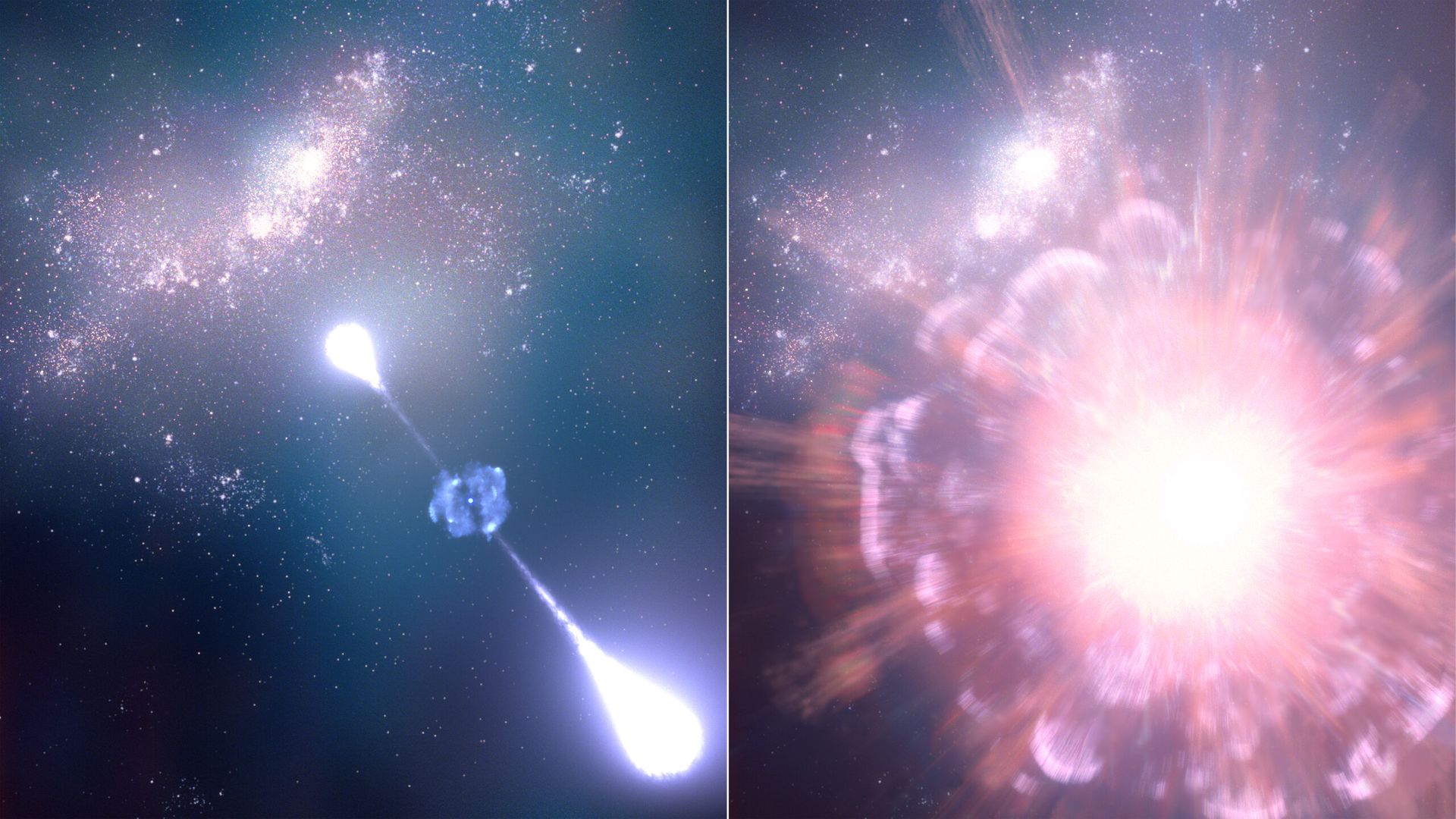
Keep your eyes peeled and your binoculars primed tonight, stargazers. The distant Halley’s Comet is reminding us of its far-off presence by pelting our planet with a barrage of meteors which will make the eastern welkin blush with a cosmic light show.
The meteor shower, known as the Orionids, is characterized by its fast-moving bright streaks and fireballs that can be seen for minutes at a time, with some trails staying visible even after the meteor has blinked out. And yes, you can see them with the naked eye.
Though it began at the start of October and is projected to last until November 7, the shower is expected to hit peak brightness this Wednesday night and early Thursday morning.
Its resplendence, however, will be challenged by a waxing gibbous Moon, which will be around 77 percent full tonight and as such fairly shiny in its own right, but will set early in the morning.
Halley’s Comet is a long period comet that takes 76 years to orbit the Sun and only makes an appearance in our skies roughly just as often. Last time it swung by was back in 1986, and it won’t return until 2061, but the Orionids, which are essentially the debris discarded by the comet as it nears our star, can be seen at other times because they linger around long after it has departed back into the void.
Our planet happens to pass through this debris field twice a year, producing a meteor shower. The Orionids falls in October, and the other meteor shower, known as the Eta Aquariid, occurs in May. The streaks of light in our sky are the comet’s ejected particles burning up as they tear through our atmosphere.
To watch the Orionids, NASA recommends viewing it after moonset and before dawn because of the bright gibbous Moon. That will probably be around 3:30 AM EST. You don’t need any special equipment, but you should get outside the city and go somewhere far from any sources of light pollution. Then cross your fingers and hope for clear weather.
The shower originates from a point near the star system Betelgeuse in the constellation Orion, but the shower is noticeable enough that you won’t have to do much more than look towards the southeast to spot it. If you’re lucky, you’ll see up to 20 streaks cross the sky each hour.
In its current iteration, SpaceX is largely a data company seeking to provide enormous amounts of compute for artificial intelligence. During an earnings call on Tuesday afternoon, company officials spent much of their time discussing ambitious plans to roll out up to 10 GW of compute in 2027—on the ground.
Gone are the days of aspirational talk about sending humans to Mars and settling the red planet. Now it is almost all about artificial intelligence and the data needed to support its expansion. However, the company's long-term ambitions to provide data services from space, initially with the Starlink Internet constellation and eventually through the "Starmind" data center constellation, still rely on an actual rocket.
That would be the Starship vehicle, and during the earnings call, SpaceX founder Elon Musk and the company's president and chief operating officer, Gwynne Shotwell, provided new performance targets for the vehicle.
Last week, the Sheriff’s Office in Stevens County, Minnesota made a startling Facebook post.
“On October 14, 2026, at approximately 3:30pm, the Stevens County Sheriff’s Office received a phone call of foreign debris that was found in a cornfield in Scott Township,” it wrote. “Upon responding, deputies confirmed that a large, metallic object, approximately 11-feet in diameter, presumably a space object, was present in the cornfield. The Sheriff’s Office is working closely with several state and federal agencies to identify and notify the owner of the debris and to plan for removal from the field.”
The post, which included a photo of a banged-up metal object surrounded by yellowed stalks of corn, quickly started picking up traction on social media due to the implication that the object had come from space.
Now, Ars Technica has the receipts: the object was almost certainly chunk of a Chinese Zhuque-2E rocket that launched from the Gobi Desert, deployed 10 satellites, and then headed back Earthward, where it was spotted burning up in the skies over Kansas and Minnesota.
As launches get more common and rockets get larger and sturdier — the model built by LandSpace, which deposited the debris in the cornfield, is a workhorse spacecraft meant to ferry cargo to Earth’s orbit — the chances of their detritus surviving the journey back to the ground increases.
These chunks of spacefaring equipment can sometimes crash down in populated areas. In 2024, a NASA component from the International Space Station withstood reentry and crashed through a home in Florida where a family was sleeping. Space wreckage has previously been discovered previously on farms in Canada and Australia.
Nobody has yet been injured by a piece of falling space debris, but as commercial ambitions for Earth’s orbit increase — the Chinese rocket had been launched to deploy satellites for a connectivity constellation meant to rival SpaceX’s Starlink — it’s probably only a matter of time.
Paris, France | October 2026 – Global satellite services revenues are forecast to grow 44% to reach $145 billion by 2035, according to the 33rd edition of Novaspace’s Satellite Connectivity […]
As Elon Musk tries to save face by claiming he’ll give every American child a chunk of SpaceX stock, here’s a chilling reminder of what he did that affected millions of children the second he had a whiff of federal power.
In a new interview, the documentary filmmaker Alex Gibney, who directed a just-released four-hour look at the billionaire’s life titled “Musk,” discussed the staggering death toll of Musk’s cuts to USAID, calling it a “crime against humanity.”
“There was an estimate that what [Musk] did by so suddenly cutting USAID would cost through disease and starvation as many as 14 million lives,” he told journalist Katie Couric. “Even if you discount that by an enormous amount, we know that within about a year of those summary cuts — where they were literally burning food that had already been paid for that was going to starving children — 500,000 children died.”
Musk, to Gibney’s astonishment, even joked about the cuts by saying he’d “put USAID into the woodchipper.”
“What he put into the woodchipper,” Gibney said, “were children.”
Gibney, whose documentary Musk called a “hit piece,” is drawing from a 2025 study published in The Lancet, one of the most prestigious medical journals. It estimated the impact of Musk effectively neutering USAID by implementing a freeze on its foreign aid funding — which went to programs to combat HIV/AIDS, malaria, and to address food insecurities — and slashing nearly 10,000 employees.
In sum, the researchers found that the “steep funding cuts could result in more than 14 million additional all-age deaths, including 4.5 million in children younger than age five, by 2030.”
Even conservative estimates concurred that the number of deaths would be staggering. A tracker created by Brooke Nichols, a professor and infectious disease mathematical modeler at Boston University, projects the 1-year death toll caused by the USAID cuts at 518,000 children.
It’s a touchy subject for Musk, who continues to bristle at accusations that his actions could’ve caused harm. This summer, he challenged his critics to “cite a single name of someone who died” as a result of him gutting USAID. Nicholas Kristof, a Pulitzer Prize-winning journalist, took him up on it and gave him a list of the specific children who had died directly from his policies, many of whom were in South Sudan and Liberia — places he had visited in person to talk to locals and healthcare workers.
Musk, rather than countering his arguments, called Kristof “evil.”
Astronomers have found a rare view of a giant planet-forming disk that resembles a hamburger seen from the side. Its layered gas and dust may help explain how enormous planets begin forming far from their stars. The system, nicknamed Gomez’s Hamburger or GoHam, contains a young star surrounded by an unusually large disk. Because the […]
A space telescope built to study distant galaxies has unexpectedly discovered a comet about 810 million miles from Earth. The find shows that even a mission looking far beyond our solar system can reveal previously unknown objects much closer to home. The European Space Agency’s Euclid telescope detected the comet in images collected between September […]
Just before the Artemis II crew began its historic slingshot around the moon this past April, NASA announced plans to build Space Reactor-1 Freedom. SR-1, the first-ever nuclear-reactor-powered interplanetary spacecraft, is meant to fly an uncrewed mission to Mars by the end of 2028, arriving in 2029. A successful mission would herald a new era of more efficient, potentially faster spaceflight—saving astronauts time and cutting their exposure to harmful cosmic radiation as they travel to Mars and beyond. “You wake up to that announcement, and it puts a big smile on your face,” says Simon Middleburgh, co-director of the Nuclear Futures Institute at Bangor University in Wales.
The sticking points
Running a nuclear reactor in space may sound like lunacy, but it’s not. The Soviet Union sent dozens of reactors into orbit, often to power spy satellites. And experts say there aren’t any major technical obstacles to making nuclear space propulsion happen. “I think it’s a very doable technology,” says Philip Metzger, a spaceflight engineering researcher at the Florida Space Institute.“I’m happy to see them finally doing this.”
Still, developing space propulsion using reactors has been slow going. The US has started—and terminated—several programs looking into it over the past 75 years. The latest casualty was DRACO, a collaboration between NASA and the Department of Defense, which ended in 2025. The project was canceled because of high experimentation costs, an inability to compete with conventional rocket propulsion on price, and difficulty ensuring that ground tests could be performed safely and effectively. (You are creating an incredibly powerful nuclear reaction, after all.)
The progress
After much wavering, it now appears that nuclear-powered interplanetary travel is a $2 billion bet NASA is willing to make. The agency is pursuing an approach called nuclear electric propulsion, which uses the neutrons produced in a self-sustaining, uranium-atom-splitting reaction to create heat and ultimately electricity. The electricity is used to ionize a gas, which is blasted out of the spacecraft with the help of magnetic fields, generating thrust. The approach “is very low thrust, but very efficient,” says Sebastian Corbisiero, the US Department of Energy’s national technical director of space reactor programs. “So you can use it for a long period of time.”
What might such a rocket look like? A presentation by Steve Sinacore, program director of NASA’s SR-1 program, offers some clues. So far, the concept art makes the craft look like a colossal fletched arrow. The back will house the power-and-propulsion system, while the tip will hold a uranium-filled nuclear reactor with a capacity of at least 20 kilowatts. (For context, a typical nuclear plant on Earth is about 50,000 times more powerful.) The “fletches” on SR-1 are large fins that help cool the reactor by radiating heat into space.
Like many other pieces of space hardware, the reactor will need to be put through its paces on the ground before it’s cleared for the rough rocket trip to space. “Going through the launch safely is going to be a challenge,” says Middleburgh. “You are being shaken, rattled, and rolled.” For safety reasons, the reactor will be switched on around two days post-launch, when it’s comfortably far from Earth. Uranium isn’t tremendously dangerous by itself, but that can’t be said of the waste products that emerge when the reactor is running. If SR-1 works as planned, its journey to Mars will take about a year.
Will this novel form of space propulsion actually reach the Red Planet by 2029? It’s possible. NASA says the Idaho National Laboratory, which is building SR-1’s reactor, is making progress and is on target for a late-2028 launch. “Procurement of major components is underway, and integration work on the power and propulsion element is advancing steadily,” Sinacore told MIT Technology Review. The outlook will get even sunnier if the Artemis program, which aims to start laying the foundations for a base on the lunar south pole by the decade’s end, keeps to its own bold deadline.
“It’s an aggressive timeline,” says Lindsey Holmes, who is vice president of advanced projects at Analytical Mechanics Associates, an aerospace company in Virginia. She suspects the push is being driven partly by China’s and Russia’s own deep-space nuclear ambitions. The two countries have spoken about plans to place a reactor on the moon’s surface in the mid-2030s to power a jointly operated lunar base. Whether it flies or fails in space, SR-1’s development should help NASA put its own reactor on the moon; the technology involved in the two projects is broadly similar, given that the lunar surface, like space itself, is a vacuum. If an interplanetary nuclear-powered spacecraft works, a nuclear reactor on the moon should too.
Progress meter . . . . . . . . . . . . 6
Most of the technology for SR-1 already exists; it’s going to come down to piecing it all together and then seeing how it performs in space.
Longtime Slashdot reader schwit1 shares a report from TWZ: A Russian satellite, Kosmos 2612, may have passed within approximately 85 feet (26 meters) of a U.S.-registered satellite belonging to commercial imagery provider ICEYE. This would be an extraordinarily close and potentially dangerous pass-by for two objects in space traveling at thousands of miles per hour. For weeks beforehand, ICEYE-X36, which would be of special interest to Russia, had already found itself in increasingly close orbital alignment with its pursuer. The two satellites now look to be drifting further and further apart, but the episode has been a clear sign of what is to come as the potential for conflict in space only continues to grow.
Publicly available space tracking data from the satellitemap.space and orbitalradar.com websites show that Kosmos 2612 (also written sometimes Cosmos 2612 and abbreviated K2612) and ICEYE X36 had their especially close encounter at approximately 16:07 UTC today. Private space services company LeoLabs also told TWZ today that it could not "confirm or contradict what other data sources have stated publicly," but that it has "high-confidence that the objects came within approximately [emphasis in the original] 500 meters [1,640 feet] of each other." Kosmos 2612 had been making progressively closer passes by ICEYE X36 in recent days. "This is the most advanced and potentially dangerous uncooperative RPO we've observed," Adam Marsh, LeoLabs vice president for technical solutions, separately told Breaking Defense.
"It's important to note that 'red' on 'blue' engagements, such as this, are relatively uncommon in Low Earth Orbit (LEO)," LeoLabs' report points out. At the same time, "this was not a routine conjunction or 'fly by.' The sequence included a controlled approach, changes in relative position, close-proximity loitering, additional small maneuvers, and a controlled departure. The behavior is consistent with sophisticated rendezvous and proximity operations (RPO)."
"We can only speculate about the operation's goal, but it could have been anything from simply intimidation to outright destruction or sabotage of a U.S.-registered satellite," CSIS' Clayton Swope told TWZ. "Perhaps the operation is on hold. There are, however, several other satellites that shadowed ICEYE X36 back in May that could be brought in[to] action too."
Elon Musk said Tuesday that he would like to see the consolidation of his business empire by formally merging his two largest companies, SpaceX and Tesla.
"Do I think it would be a good idea? Yes," Musk said of a potential merger. He was speaking during a question-and-answer period as part of SpaceX's third-quarter earnings call. Musk said, ultimately, it not his decision. "But at the end of the day the shareholders have to be supportive of this."
Musk's talk of a merger comes after a busy year in which SpaceX already acquired Musk's artificial intelligence firm, xAI, in February. In June, SpaceX went public with the largest initial public offering on record.
It has been 13 years since the debut of a new medium-lift rocket in the United States, the Antares vehicle developed by Orbital Sciences Corporation.
The initial 100-series variant of the Antares rocket was kind of a hot mess. The rocket used old Soviet engines built during the era when Apollo astronauts were landing on the Moon. Decades later, in the 1990s, Aerojet acquired the engines and refurbished them for a rocket that would launch in the 2010s. Predictably, on the fifth launch of an Antares rocket in 2014, it exploded.
The Antares vehicle is the last of a dying breed of medium-lift rockets—defined as having a lift capacity of 2 to 20 metric tons—in the United States. Nearly a decade and a half later there is a new generation of medium-lift vehicles coming online, and they are starkly different from Antares, which had not just Russian engines but a core stage manufactured in Ukraine.
Astronomers using the James Webb Space Telescope (JWST) have found what may be one of the most distant supernovas ever observed. And in a stroke of cosmic luck, the team thinks they're seeing what the explosion looked like just days after it ignited.
The supernova, named AT 2026abck, dates to around 1.15 billion years after the Big Bang, when the universe was less than one-tenth of its current age and bursting with massive stars flickering into life. The massive exploding star violently released its light over 12.5 billion years ago, according to the researchers — so long ago that the distance between us has effectively ballooned sixfold due to the expansion of the universe.
The discovery was described in a paper that was uploaded to the preprint server arXiv Sept. 29 and has not yet been peer reviewed. According to the study authors, this ancient speck of light is stupendously bright.
"At its peak, the supernova is about 8 billion times the brightness of the sun … almost as bright as the whole Milky Way Galaxy," study co-author Xiaohui Fan, an observational cosmologist and professor of astronomy at the University of Arizona, told Live Science via email. "Over the course of the explosion, it radiates the energy that the sun will radiate over about 2 billion years."
A beacon from the beginning of space-time
The newly discovered supernova shines brilliantly at over 30,000 degrees Fahrenheit (16,000 degrees Celsius). Its incandescent shell of ejected material has billowed to a radius of approximately 46 astronomical units — about 46 times the distance between Earth and the sun, or about as far as Pluto swings at its farthest point from the sun.
The supernova's host galaxy, designated ID101411, holds about 6.3 billion solar masses and is "forming new stars more than ten times faster than our Milky Way," first author Mingyang Zhuang, an observational astrophysicist at the University of Illinois Urbana-Champaign, told Live Science via email.
As with other early galaxies, ID101411 is deficient in metals, meaning any elements heavier than hydrogen and helium, because not enough time had passed to create those heavier elements in the forges of massive stars and their apocalyptic explosions.
An illustration of a supernova erupting when the universe was just 730 million years old. (Image credit: NASA, ESA, CSA, STScI, L. Hustak (STScI))
The study authors estimate that they observed the supernova as it would have looked just four to 10 days after it exploded. Although this is relatively common, spotting one at such an incredible distance "is extremely rare," Zhuang emphasized. "You have to observe the exact same tiny patch of sky repeatedly with [JWST], and the explosion has to happen at the right moment. We were lucky."
There's another layer of luck that made the discovery even more remarkable: It was observed without the aid of a cosmological quirk called gravitational lensing — a phenomenon predicted by Einstein in which the gravity of a massive object in space bends and magnifies the light emitted by objects behind it.
"Most supernovas this far away were found with help from a massive foreground galaxy cluster acting as a natural magnifying glass," Zhuang explained. "It's the most distant one we've actually seen appear."
This supernova was discovered as part of the NEXUS Treasury program, in which JWST intermittently scours patches of the sky for ancient explosions. It had previously observed the explosion's host galaxy over the past few years and finally witnessed the supernova on Aug. 7 of this year.
An explosion in slow motion
Intriguingly, the star had not yet exploded in JWST's previous viewing, on May 28, 2026, meaning that 71 days passed on our Earthly clocks, even though only about 12 days passed in the supernova's own time frame.
This highlights a mind-bending cosmological effect: The universe's expansion doesn't just stretch space; it slows down time from our perspective.
"Because the universe has expanded since this light was emitted, everything about this explosion appears to us in slow motion, about six times slower than it actually happened," Zhuang said. "Changes that took one week at the supernova take about six weeks to unfold from our point of view."
Mysteries still remain about the nature of this ancient explosion that shone so brilliantly we can observe it across nearly the entire universe.
Rather than a conventional core collapse supernova — in which a star between approximately eight and 50 times the mass of the sun exhaust its nuclear fuel and suffers a rapid core collapse and subsequent explosion — the recently discovered supernova may be one of the universe's rarest, most powerful explosions, the study authors said. Known as a superluminous supernova, this type of explosion releases tens or hundreds of times more energy than conventional supernovas. Whether the explosion continues to heat up or starts to cool could reveal exactly what is happening in its environment and what caused it, the team said.
"Our interpretation is still preliminary," Zhuang concluded. "Follow-up observations will tell us more about exactly what kind of explosion this was."
How well do you know our home galaxy? Find out with our Milky Way quiz!
One of the best fall meteor showers peaks this week, when pieces of the famous Halley's Comet streak across Earth's atmosphere as fast-moving "shooting stars."
The Orionid meteor shower will peak overnight Wednesday (Oct. 21) through Thursday (Oct. 22), potentially producing around 20 meteors per hour under a dark sky, according to Time and Date. The Orionids are caused when Earth passes through the debris left by Halley's Comet, which last passed through the inner solar system in 1986 and will return in 2061.
Halley's Comet is presently beyond the orbit of Neptune, according to The Planets Today, but it doesn't need to be close to Earth to cause "shooting stars." Every time the comet travels through the inner solar system, heat from the sun causes it to shed dust and rocky particles along its orbital path. Earth's own orbit takes the comet through streams of that ancient debris several times a year, with the particles vaporizing as they slam into our planet's atmosphere.
The Orionids are particularly fast meteors, striking Earth's atmosphere at around 41 miles per second (66 kilometers per second). They can produce bright streaks, occasional fireballs (extremely bright, sometimes colorful meteors) and "persistent trains" — glowing trails that remain visible briefly after a meteor has disappeared. The best way to view them is with the naked eye, although a nice pair of stargazing binoculars or a small backyard telescope will help you enjoy more sights during peak skywatching season this fall.
Halley's Comet produces not one but two annual meteor showers. Its orbit comes close to Earth's at two different points, so our planet encounters the comet's debris twice each year — once during the Orionids in late October, and again during the Eta Aquariid meteor shower in early May.
There's a slight complication with the Orionids this year. A 71%-illuminated waxing gibbous moon will brighten much of the night, making it harder to spot meteors. However, the moon will set early Thursday morning, creating a valuable window of darkness before dawn. That's also when the constellation Orion will be high in the sky, making the predawn hours the best time to watch.
You can trace the paths of Orionid meteors back to their radiant: the famous red supergiant star system Betelgeuse in the constellation Orion. (That's why the shower is called the Orionids.) However, there's no need to look directly at Orion. Meteors seen farther from the radiant can produce longer streaks across the sky; each one comes from a tiny piece of Halley's Comet completing a journey that began many centuries ago.
La Lune se contracte en refroidissant, comme en témoignent les nombreuses failles qui sillonnent sa surface. Mais une nouvelle étude suggère que cette activité tectonique serait bien plus récente qu'on ne le pensait et avance une explication inattendue à ce retard.
Japan launched a $578 million mission Monday on a five-year expedition to land on the largest moon of Mars and retrieve samples for return to Earth, a daring international project that could yield new insights into the formation of the Solar System.
The robotic Martian Moons eXploration mission, known as MMX, lifted off at 3:41 pm EDT Monday (4:41 am Japan Standard Time Tuesday) from Tanegashima Space Center in southern Japan.
The MMX spacecraft rode into orbit atop a 207-foot-tall (63-meter) H3 rocket, Japan's flagship launch vehicle. The rocket assigned to MMX debuted a new souped-up configuration with four strap-on solid rocket boosters, full-throttle main engines, and an extended payload shroud to accommodate the demands of Japan's heaviest and most ambitious interplanetary mission to date.

 Login