❌

Normal view

HD 156295’s Pulsations Point to a Possible Giant Planet

20 October 2026 at 16:00

A tentative six-year timing signal suggests a massive companion near the hot star’s habitable zone. The detection remains uncertain.

The post HD 156295’s Pulsations Point to a Possible Giant Planet appeared first on Curiosmos.

Webb and Spitzer Telescopes Explore the Planets That Never Were

19 October 2026 at 13:00

Planetesimal wrecks are raging around distant stars. With the Webb and Spitzer Space Telescopes, astronomers are learning what that looks like.

The post Webb and Spitzer Telescopes Explore the Planets That Never Were appeared first on Sky & Telescope.

70 Ophiuchi’s Two Suns Leave Room for an Earth-Mass Planet

19 October 2026 at 10:00

Orbital simulations identify room for a small world around one of the nearby binary’s stars. Observations have not detected a planet there.

The post 70 Ophiuchi’s Two Suns Leave Room for an Earth-Mass Planet appeared first on Curiosmos.

Scientists find 'gemstones' in atmosphere of bizarre, scorching-hot 'marshmallow' exoplanet

16 October 2026 at 19:00

Using data from the James Webb Space Telescope (JWST), astronomers have unraveled some of the atmospheric secrets of a bizarre, blisteringly hot world that has the consistency of marshmallow.

The extrasolar planet, or exoplanet, under the watchful infrared eye of the JWST, is WASP-17b, located around 1,300 light-years away. The exoplanet has a mass around 0.8 times that of Jupiter, but it is around twice as wide as the solar system's largest planet, giving it a "super-puff" consistency comparable to the Earth-based treat. WASP-17 b is so close to its parent star that it completes an orbit in under four Earth days, with this proximity also making the temperature of this "hot Jupiter" skyrocket.

Given the extreme conditions of this exoplanet, it is little wonder that its atmosphere is pretty unusual too. Using a new technique called transmission strings, a team of scientists mapped the contours of the atmosphere of WASP-17b. They found that the atmosphere is shaped like a ring with prominent "gems" rising from it.

"Planets are temperamental, their atmospheres complex and chaotic," team member Hannah Wakeford of the University of Bristol said in a statement. "The fact that all of these numbers came together and showed us this very structured, dynamical picture of this giant world over 1,000 light-years away was just really exciting."

Astronomers like WASP-17b so much they put a ring on it

WASP-17b is so close to its parent star that it is tidally locked, meaning one side permanently faces the star; its dayside is constantly bombarded with stellar radiation. In contrast, the planet also has a cooler nightside, which faces out into space in perpetuity.

By creating incredibly comprehensive 3D views of this exoplanet's atmosphere, researchers found that WASP-17b's atmosphere has a chemical composition and temperature that shift between dayside and nightside according to theory and modelling.

This was possible because the transmission strings technique tracked WASP-17b as it crossed or transited in front of its star, capturing the composition of light around the edge of the planet's atmosphere, or limb, from different angles. This method trumps standard approaches because traditional modelling only maps light as an average across the entire limb.

"Rather than assuming your atmosphere is a circle with the same radius all the way around, our technique allows you to pull out different distances from the center to the edge of the planet," Lili Alderson, of Cornell University, said. "We're able to go around the edge.

"So, we've gone from a ring to understanding where on the ring the gemstones are, so to speak."

The modelling showed just such a "gem," that occurs where hot winds from the planet reach the equator and the nightside of WASP-17b, the atmosphere of the cooler side inflates.

A rusty red shape surrounded by a spiky cloud of white smoke

An illustration of the atmosphere of WASP-17b with "gems" rising from it. (Image credit: Robert Lea)

"Theory predicts that the morning and the evening sides should have a strong temperature difference, and WASP-17b fits really nicely in that trend – pretty much bang-on what we thought it would be," Alderson said.

The successful application of the transmission strings method is an exciting step forward in the modelling of the atmospheres of the over 6,000 worlds in NASA's exoplanet catalog.

"This is proof of concept that planets are, in fact, 3D objects, and that, consistently, as they go around their star, what we predict should be happening is happening," Alderson concluded. "To move beyond computational exercises and see it for real is a different matter."

The team's research was published on Wednesday (Oct.14) in the journal Nature Astronomy.

Tilting WASP-12b Doesn’t Solve the Mystery of Its Inspiral

7 October 2026 at 20:59

Illustration of the exoplanet WASP-12 b.

In 3 million years or less, WASP-12b will tumble into its host star. It’s not surprising that the planet will meet its end this way, but it is surprising that it will happen so soon. New work tests a potential explanation for the planet’s rapid orbital decay.

Diagnosing a Doomed Planet

Roughly twice as wide as Jupiter and almost 50% more massive, exoplanet WASP-12b zips around its Sun-like stellar host every 1.09 days at a distance of just 0.023 au (3.4 million kilometers or 2.1 million miles). If placed in our solar system, WASP-12b would easily dethrone Mercury as the nearest planet to the Sun.

Observations show that WASP-12b’s already tiny orbit is shrinking, with each orbital period growing shorter at a rate of 29 milliseconds per year (Earth-year, that is). While we would expect the planet to slowly spiral inward due to tidal interactions with its star, it’s moving several orders of magnitude faster than predicted. The planet’s motion has so far defied all attempts to explain it, and now, a new research article by Caleb Lammers (Princeton University) and collaborators appears to topple yet another hypothesis for WASP-12b’s unexpectedly fast orbital decay.

A Tidy Tidal Explanation?

Previous work has proposed that WASP-12b’s rapidly shrinking orbit is due to obliquity tides, which could come into play if the planet had a nonzero obliquity, or axial tilt. Tidal dissipation generally works to keep close-in giant planets like WASP-12b from having a significant axial tilt. However, if you throw a second planet into the system, the companion can exert a torque that could force WASP-12b to remain tilted. This outside forcing, the hypothesis suggests, changes the orbital, spin, and tilt evolution of WASP-12b and ultimately pushes it toward its star far faster than expected without the tilt or the companion.

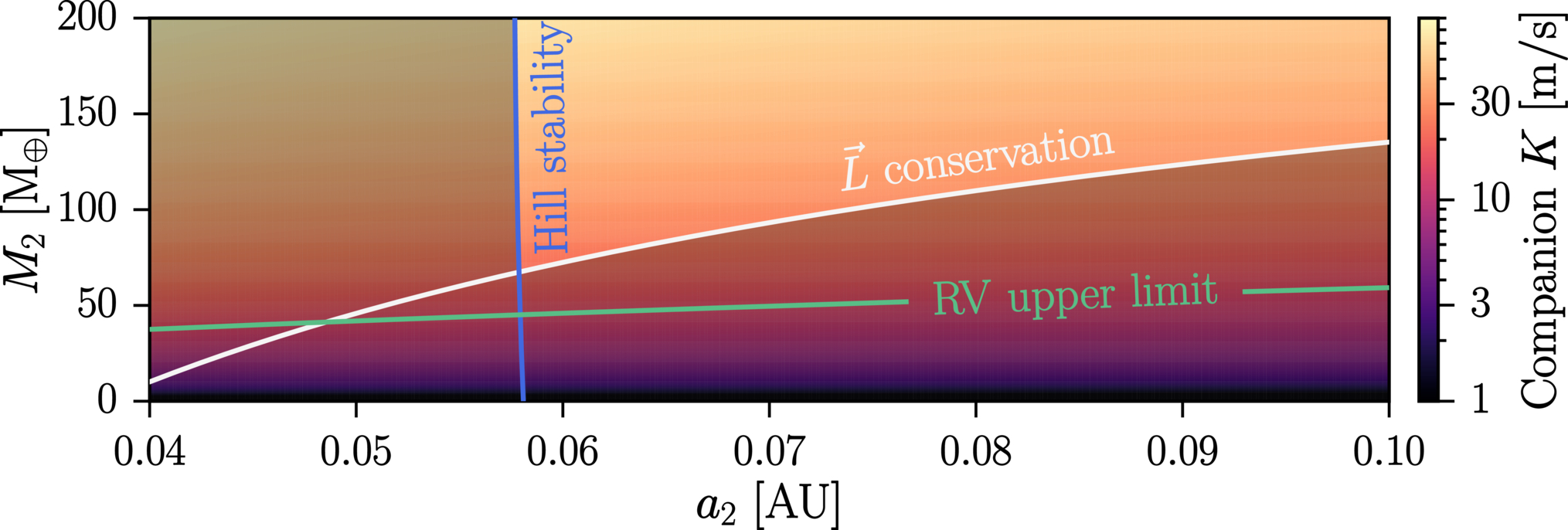
plot of mass versus orbital distance showing the radial velocity signal for each combination of parameters

Constraints on the mass and orbital distance of the companion planet in the obliquity-tide scenario. The color shows the radial velocity signal associated with each combination of parameters. The green line shows the maximum radial velocity allowed by observations. Click to enlarge. [Lammers et al. 2026]

Lammers and coauthors examined this hypothesis by tracking how the angular momentum of a system containing both WASP-12b and a companion planet would evolve over time. As WASP-12b spirals inward, it loses angular momentum. For the planet’s lost angular momentum to be absorbed by the star and the companion planet — while maintaining a stable orbital configuration for both planets — the companion must orbit at least 0.06 au from the star and have a mass of at least 65 Earth masses.

The Mystery Persists

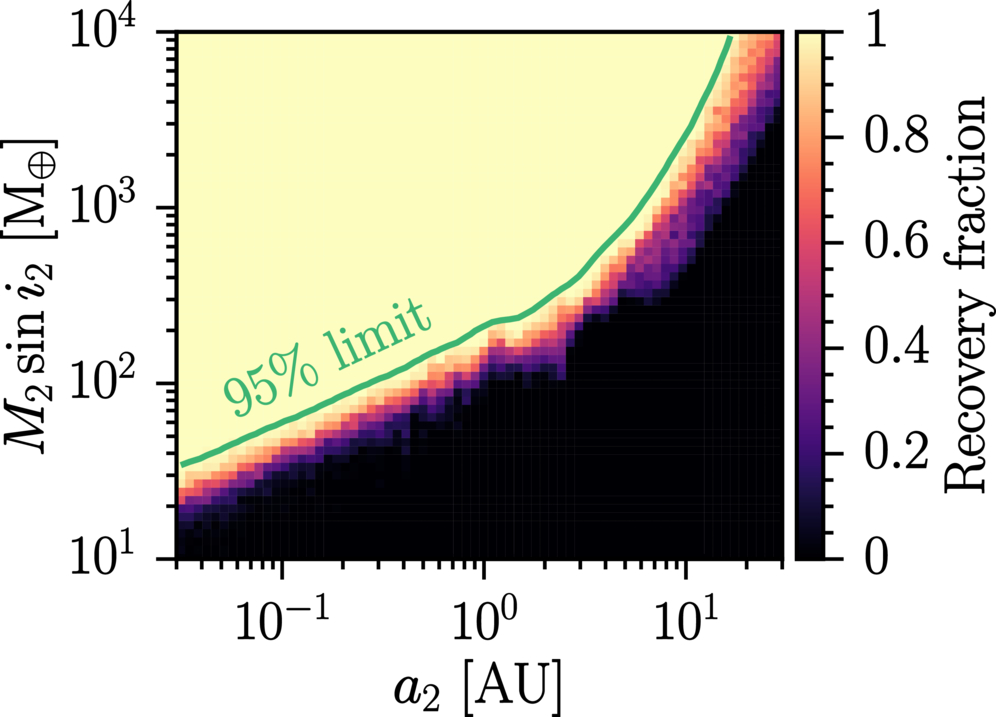
This companion mass and orbital distance are both larger than predicted by previous work, which had suggested that a 10–20-Earth-mass planet at 0.04 au would be sufficient to drive WASP-12b’s inward journey. Lammers and coauthors analyzed WASP-12’s radial velocity data for evidence of such a planet tugging on the star, but found none; only under extremely particular conditions could such a planet exist and not be detected in current data.

radial-velocity constraints on a second planet in the WASP-12 system

Radial velocity constraints on the properties of a hypothetical second planet in the WASP-12 system, obtained via injection-recovery tests. [Lammers et al. 2026]

Taking their calculations further, the team found it unlikely that this mechanism is at work in planetary systems in general, not just in the WASP-12 system. This leaves the mystery of WASP-12b’s rapid orbital decay wide open, and with only 3 million years to ponder it before the planet’s demise.

Citation

“The Mysterious Inspiral of WASP-12 b: Why Obliquity Tides Cannot Drive Orbital Decay,” Caleb Lammers et al 2026 ApJL 1009 L43. doi:10.3847/2041-8213/aea405

The post Tilting WASP-12b Doesn’t Solve the Mystery of Its Inspiral appeared first on AAS Nova.

The Solar System Has a New Life Expectancy, and It’s a Billion Times Shorter

30 September 2026 at 17:00

Image of a solar flare.

Isaac Newton suspected that the gravitational dance between the Sun and Jupiter would eventually destabilize the solar system, but modern computational research has shown that its long-term stability is, statistically, pretty secure. However, new simulations with more realistic solar mass-loss conditions make a strong case for the disassembly of the outer solar system — and on timescales much shorter than previously thought.

Kick It Up a Notch

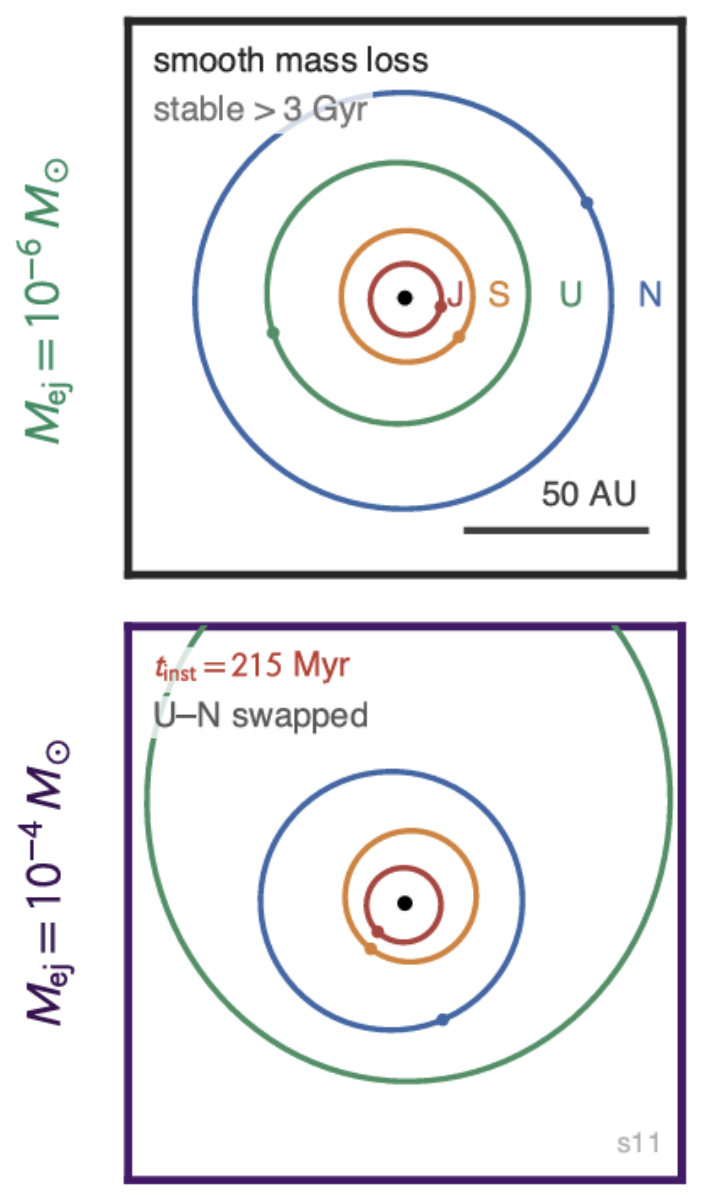
A plot showing final orbits of the outer planets for two simulations.

Final outer planet orbital configurations for two simulations — one stable and one unstable. t=0 at the onset of white dwarf formation. Click to enlarge. [Adapted from Batygin et al. 2026]

Several studies have investigated what will happen to the orbits of planets in our solar system as the Sun sheds its mass during its transition to a white dwarf. These studies have found that while the semimajor axes of the planets will expand by approximately a factor of 2, their orbits remain stable on timescales longer than the age of the universe (approximately 1018 years). This expanded orbital architecture will make the solar system more prone to jostles from stellar flybys, but even accounting for this, the giant planets’ orbits wouldn’t disassemble for another 30–100 billion years.

However, all of these studies modeled solar mass loss as a smooth function, so the dismantling of the solar system was left up to external forcings. In reality, stars on the red giant branch undergo mass ejections that are random in time and direction, corresponding to velocity “kicks” that can alter the dynamics of the planets. 

A team led by Konstantin Batygin at the California Institute of Technology conducted numerical experiments to analyze the orbital dynamics of the outer solar system under different solar mass-loss conditions. First, they tested the classic case of smooth mass loss and validated previous findings that, despite planetary orbits doubling in size, the dynamics are pretty tame. This holds true even when mass is ejected anisotropically: if the timing is smooth, the asymmetries cancel out.

Outer Solar System, Your Days Are Numbered

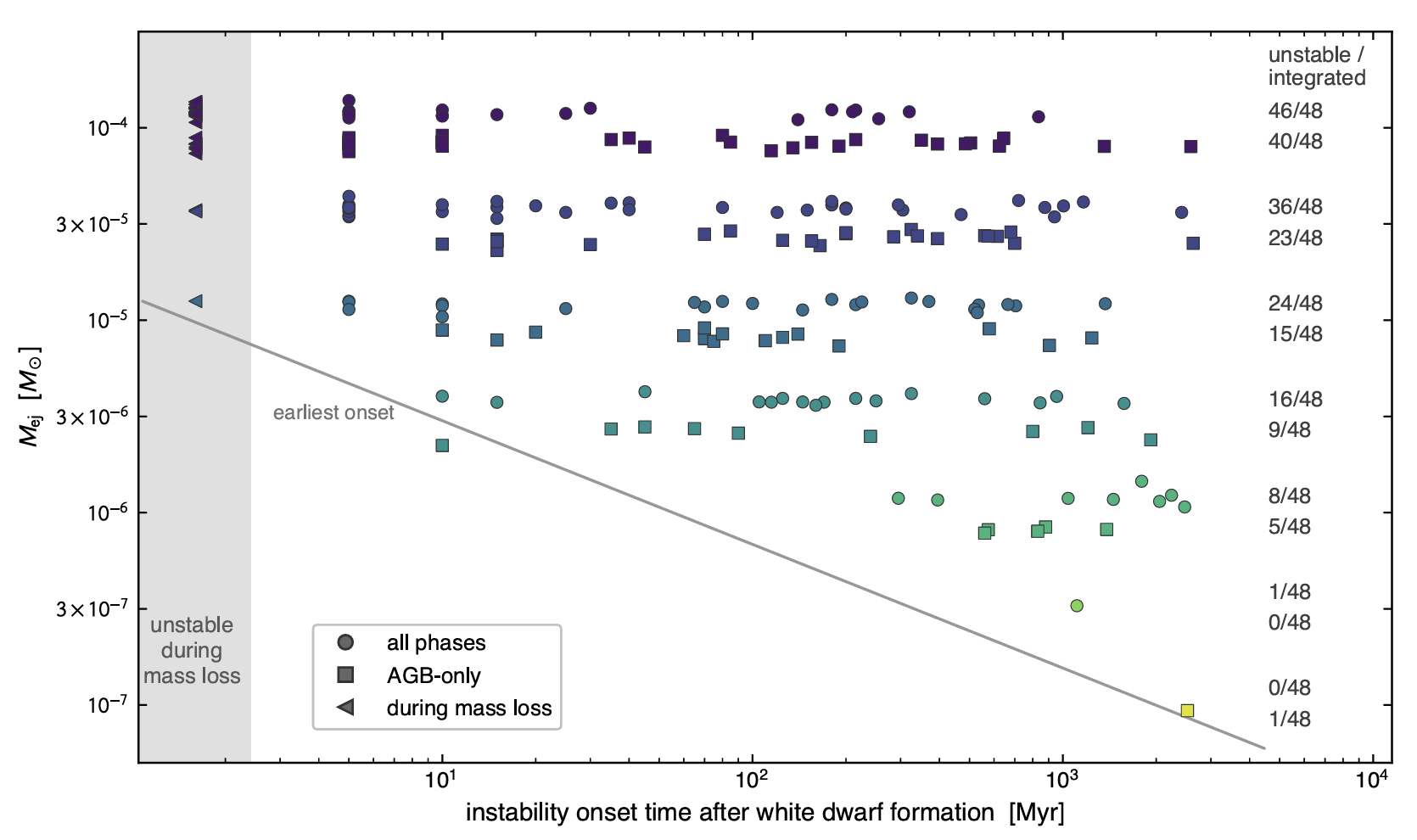
Next, they simulated stochastic kicks and found that the behavior of the outer planets was largely tied to the ejection mass of each kick. For very small ejection masses (≤ 10-7 M☉), dynamics mimic the smooth mass-loss case. For intermediate values (10-7 to 10-6 M☉), there’s a roughly 20% chance Jupiter–Saturn and Uranus–Neptune enter mean-motion resonances: an orbital configuration where planets’ periods are a ratio of small integers. These resonant configurations don’t protect the giant planets, however: resonant simulations disassemble slightly more often than nonresonant simulations. For larger ejection masses (≥ 10-5 M☉), the outer solar system disassembles on the timescale of billions of years. 

Plot showing the instability onset times as a function of ejection mass for all simulations.

Instability onset time — or how long after white dwarf formation the outer solar system disassembles — as a function of ejection mass. The larger the ejection mass, the greater the chance of instability. Click to enlarge. [Batygin et al. 2026]

Which ejection masses are the most accurate for our Sun? Well, unfortunately for our beloved outer planets, ejection models and observed kick amplitudes suggest a future ejection mass of 10-4 M☉. With kicks like these, not only is there a considerable chance of orbit destabilization, but it could happen before the white dwarf even forms. About 40% of simulations lead to disruption or violent scattering while the Sun is in its red giant phase, and roughly 90% break down within 3 billion years. 

This new discovery reduces the life expectancy of the solar system from one billion billion years to a meager one billion years after white dwarf formation. 

Citation

“Terminal Instability of the Solar System Triggered by Stochastic Solar Mass Loss,” Konstantin Batygin et al 2026 ApJL 1009 L22. doi:10.3847/2041-8213/aea290

The post The Solar System Has a New Life Expectancy, and It’s a Billion Times Shorter appeared first on AAS Nova.

Stellar Pulsations Suggest Habitable-Zone Planet Around a Massive Star

25 September 2026 at 18:48

Stellar field observed by ESO.

By observing subtle variations in the timing of stellar pulsation modes, researchers may have made the first detection of a planet in the habitable zone of a massive A-type star.

Listening for Planets in Stellar Heartbeats

To date, some 6,000 exoplanets have been detected across a vast array of surveys and instruments. The majority of these have been detected around main-sequence F, G, and K stars — but not because these are the only places exoplanets can exist. Rather, this is a result of selection bias: these stars tend to be both bright and luminously stable enough for astronomers to deploy the radial velocity or transit methods.

Sinusoidal graph showing planet-induced timing delays in stellar pulsation modes.

Periodic modulations in the time of observed stellar pulsations can indicate the presence of an orbiting companion. In this case, timing variations are displayed for the two most prominent pulsation modes f1 and f2 for the variable star HD 156295. The sinusoidal pattern indicates they may be caused by an orbiting companion with a mass of about 6.3 Jupiter masses at a distance of 3.9 au, in this star’s habitable zone. [Adapted from Wilson et al. 2026]

A-type stars, by contrast, are challenging for exoplanet detections. These more massive stars tend to exhibit fewer and broader spectral lines than their F, G, or K counterparts, rendering radial velocity techniques largely ineffective. Many A-type stars also pulsate in brightness, making it hard to identify planetary transits within their erratic light curves. 

Luckily, one transit astronomer’s trash data can be a pulsation timer’s treasure. For some A-type stars called δ Scuti stars, the pulsation is regular enough to be used like a cosmic clock. Subtle variations in a star’s position due to the tug of an orbiting companion can then disrupt the timing of its otherwise steady pulsation, allowing one to once again find planets via its light curve — including massive ones on intermediate-period orbits that are the most difficult to detect around massive stars using traditional methods.

A Massive Planet in the Habitable Zone of a Hot Star?

In a new study led by Logan Wilson (Center for Astrophysics | Harvard & Smithsonian), researchers analyzed 16,440 highly pulsating δ Scuti stars observed at a high cadence by the Transiting Exoplanet Survey Satellite (TESS) in order to look for the distinctive, periodic timing modulations associated with an orbiting companion. This sample was then whittled down to nine candidate systems they believe may contain substellar companions — likely either brown dwarfs or massive planets.

Scatterplot showing population of substellar companion objects found to date.

The properties of the nine candidate objects identified in this study and their host stars are shown here, along with the properties of other exoplanet systems. Through stellar pulsation timing, the researchers were able to identify substellar candidates around hot A-type stars in intermediate-period orbits, a region of parameter space that has been difficult to probe with other methods. [Wilson et al. 2026]

One particularly striking candidate was found when analyzing the star HD 156295. Based on their timing data, Wilson and collaborators deduce the star may have a 6.3 Jupiter-mass planetary companion orbiting every 2,200 days. That puts the companion’s distance from its host at about 3.9 au, right at the far edge of HD 156295’s habitable zone. If this planet turns out to be real, HD 156295 would be the hottest star known to host an exoplanet in its habitable zone. This detection also suggests a high occurrence rate of massive planets on intermediate orbits relative to expectations for other main-sequence stars, supporting theories that A-type stars may form companions like these more efficiently. 

The other eight candidates are more consistent with brown dwarfs. Six of these candidates show somewhat uncommon masses and orbital separations that place them in a region of parameter space known as the “brown dwarf desert.” Some observations suggest this desert is less severe around hotter stars — a conclusion that this study supports.

All of these findings are still quite tentative, however; the researchers estimate that the probability for the planetary signal being real is just over 50%, and the parameters given for each candidate are still subject to large uncertainties. With new data arriving all the time, it may not take long before we have a clearer picture of these unique substellar companions.

Citation

“A Search for Substellar Companions around A-type Stars: Pulsation Timing Detection of Eight Brown Dwarf Candidates and a Possible Habitable-zone Planet,” Logan G. Wilson et al 2026 ApJ 1009 78. doi:10.3847/1538-4357/ae93a0

The post Stellar Pulsations Suggest Habitable-Zone Planet Around a Massive Star appeared first on AAS Nova.

To reach Jupiter, Juice took a detour past Venus, then returned to Earth on 28 September for a successful gravity boost while using our Moon to rehearse the navigation it will need around Jupiter’s icy moons.

23 September 2026 at 08:23
Illustration of ESA’s Juice spacecraft flying past Earth, with its curved trajectory traced across the frame

ESA’s Jupiter Icy Moons Explorer returned to Earth on 28 September 2026, but home was only a waypoint. During a successful flyby 8,640 kilometres above the Indian Ocean, Earth’s motion and gravity deflected Juice’s path by 20 degrees and increased its speed relative to the Sun by 3.5 kilometres per second.

The encounter was the third of four planned gravity assists. It followed the first lunar-Earth double flyby in 2024 and a Venus flyby in August 2025. One more Earth pass in January 2029 will finally place Juice on its transfer towards Jupiter, where it is due to arrive in July 2031.

The mission turned this return into more than a trajectory correction. Juice’s navigation camera pointed at the Moon’s horizon to test a technique intended to improve optical navigation during selected encounters in a sequence of 35 future flybys of Ganymede, Callisto and Europa.

The Moon is not part of the gravity assist this time. It is a known target on which engineers can rehearse the image geometry they will later need around worlds hundreds of millions of kilometres away.

The detour through Venus began with a slowdown

The route looks inefficient only if distance is the sole measure. A direct flight would require a much more energetic launch and an enormous propellant load, first to reach Jupiter and then to prevent a nearly 6,000-kilogram spacecraft from flying straight past it.

A gravity assist avoids carrying most of that fuel. In the Sun’s frame, a spacecraft exchanges a minute amount of momentum with a moving planet as gravity curves its trajectory. The result can be a gain or loss of heliocentric speed, depending on the direction of approach. The planet’s own motion is what makes the encounter more than a simple U-turn.

Juice’s first assist in August 2024 deliberately removed energy. The Moon increased its speed by 0.9 kilometres per second relative to the Sun, positioning it for Earth one day later. Earth then reduced its heliocentric speed by 4.8 kilometres per second; overall, the lunar-Earth sequence turned the path by about 100 degrees.

That world-first lunar-Earth sequence sent Juice inward towards Venus while saving an estimated 100 to 150 kilograms of propellant. SpaceDaily’s account of the completed trajectory reset described how the two encounters worked together.

Venus supplied the next turn on 31 August 2025, bending the solar orbit back towards Earth and adding speed. The flyby had no sightseeing component. Juice was built for the cold outer Solar System, so it pointed its 2.5-metre high-gain antenna towards the Sun as a heat shield and kept its remote-sensing instruments inactive.

The operation followed a communications failure caused by a software timing bug that left a signal amplifier switched off. SpaceDaily covered the recovery and final preparation for the Venus encounter. ESA subsequently described the spacecraft as successfully through that flyby and on course for Earth.

Earth supplied a precisely aimed bend

According to ESA’s flyby report, closest approach occurred over the Indian Ocean at 11:45 UTC on 28 September. Earth deflected Juice’s trajectory by 20 degrees and increased its speed relative to the Sun by 3.5 kilometres per second.

Those numbers are not produced by an engine burn at perigee. They are the consequence of entering Earth’s moving gravitational field along a carefully chosen line and leaving it in a new direction. A mistimed arrival would change both the size and direction of the result.

The navigation campaign began on 17 August. Six correction opportunities were reserved at intervals including four weeks, two weeks, one week and three days before the encounter. ESA reported after the flyby that only one small manoeuvre had been required; enhanced tracking continues until 10 October.

The reserved final emergency manoeuvre was not needed. Juice passed above Australia before closest approach and then swept over the Indian Ocean along the planned trajectory.

This boost still does not send Juice straight to Jupiter. Jupiter is not yet in the right place. The 2026 encounter has shaped another solar orbit, returning Juice to Earth in January 2029 for the final push onto a path that intercepts Jupiter in July 2031.

Earth’s shadow turns geometry into a power problem

Before closest approach, Juice spent eight hours and 39 minutes in Earth’s shadow, from 19:24 UTC on 27 September until 04:03 UTC on 28 September. With no sunlight reaching its solar arrays, the spacecraft operated from batteries alone.

That eclipse did not threaten the flyby, but it limited how freely the payload could be used. Teams prioritised the most valuable observations during the battery-powered interval rather than switching on every instrument continuously.

Across a wider window from 23 September to 3 October, all ten science instruments were scheduled to gather data on Earth and the Moon, though not continuously or all at once. ESA expects to publish selected images and spectra after the data reach Earth and are evaluated. Both bodies are useful calibration targets because their shapes, surfaces and surrounding environment are already measured far better than the Jovian system.

Juice also spent several days inside Earth’s magnetotail, the long nightside extension of the magnetic field shaped by the solar wind. The measurements can test particle and field instruments in a complex but comparatively familiar plasma environment before they face Jupiter’s larger, faster-rotating and more intense magnetosphere.

Two small monitoring cameras photographed the passage as well. They should not be confused with NavCam or the JANUS science camera. The monitoring cameras provide engineering views of the spacecraft and its surroundings; NavCam extracts geometry; JANUS is designed for scientific imaging. NavCam also returned an image of Madagascar taken two minutes after closest approach.

The Moon stands in for three icy worlds

During this Earth approach, the navigation camera pointed towards the lunar horizon, also called the limb. An image of that curved boundary contains information about the apparent centre and angular size of the Moon. Compared with a predicted view, it can sharpen the estimate of the spacecraft’s position relative to the target.

ESA said the lunar observations were intended to test a technique for improving optical-navigation accuracy, but had not published an evaluated performance result at the time of this update. The careful claim is therefore that Moon-limb images tested the method, not that the September campaign has already proved a specific performance gain.

NavCam first operated on a real world during the 2024 lunar-Earth encounter. In its account of that first in-space test, ESA showed raw, uncalibrated lunar images and explained that the camera would later use the shapes of Jupiter’s moons to support navigation.

The 2026 geometry was different. Juice did not fly close to the Moon, and lunar gravity was not the manoeuvre. The Moon was observed from the Earth-approach trajectory as a reference object. Calling it a rehearsal is accurate; calling this another lunar gravity assist would not be.

Why a camera must share the navigation load

Ground-based radio tracking remains essential, but a complete Earth communications loop is too slow for fresh local relative-position updates during a close Jovian flyby. Near Jupiter, a radio message can take roughly 50 minutes each way. The location of the moon relative to the approaching spacecraft also matters more than an absolute position measured in isolation.

SpaceDaily’s earlier account of Juice’s image-based navigation system described onboard software that detects the edges of a moon in NavCam images. Those edge measurements allow the system to refine relative geometry without waiting through the complete Earth communications loop.

The underlying system is called Enhanced Attitude Guidance through Limb Extraction, or EAGLE. It is intended for use on the inbound leg of selected moon encounters, with mission planners deciding case by case when the technique should support guidance and pointing.

This does not mean Juice will improvise a tour or replace its flight-dynamics team. Ground controllers design and command the encounters. Optical navigation supplies a timely local measurement during sequences in which a small targeting error could move an instrument footprint by many kilometres or turn a planned close pass into a miss.

NavCam is also not a substitute for the science payload. It is a wide-field engineering camera optimised to tell the spacecraft where a world is. Scientific cameras and spectrometers ask what that world is made of and how its surface changes. A blurred-looking limb can still be excellent navigation data.

Earth is a rehearsal, not the destination

After Jupiter arrival, Juice will make 35 flybys of Ganymede, Callisto and Europa before entering orbit around Ganymede in 2034. Each encounter must satisfy navigation, power, communications, radiation and instrument-pointing constraints at the same time.

SpaceDaily has also reported an engineering-model rehearsal of a Callisto flyby, in which simulated images were projected into a navigation camera to exercise the flight software. That laboratory test supplied a synthetic moon; September’s observation supplied a real horizon to the flight camera in space.

Earth and the Moon offer known targets, stronger communications and time to improve procedures. At Jupiter, the encounters will be distant, fast and scientifically scarce. The apparent detour through Venus has preserved the fuel needed to conduct that tour, while the lunar images supplied something equally valuable: a navigation method tested before the real icy moons fill the camera. ESA had not yet released the evaluated performance result, so the size of any improvement remains unreported.

The post To reach Jupiter, Juice took a detour past Venus, then returned to Earth on 28 September for a successful gravity boost while using our Moon to rehearse the navigation it will need around Jupiter’s icy moons. appeared first on Space Daily.

Planets Scattering Planets in Warm Jupiter Systems

18 September 2026 at 18:38

exoplanet system with three planets

While our solar system sports one Jupiter-like planet, exoplanet discoveries have revealed that giant planets come in a few different forms in systems with varying architectures. A recent study has explored how the mass–eccentricity relationship in warm Jupiters is shaped by dynamical interactions between planets.

Jupiter-like Planet Eccentricities

Exoplanet surveys have uncovered three different Jupiter-like planet populations across the galaxy: hot, warm, and cold Jupiters. Much like our own, cold Jupiters orbit on long periods, far away from their host stars. Conversely, hot Jupiters zip around their host stars on extremely short-period orbits. Somewhere in between, warm Jupiters orbit their host stars with periods from 10 to 365 days.

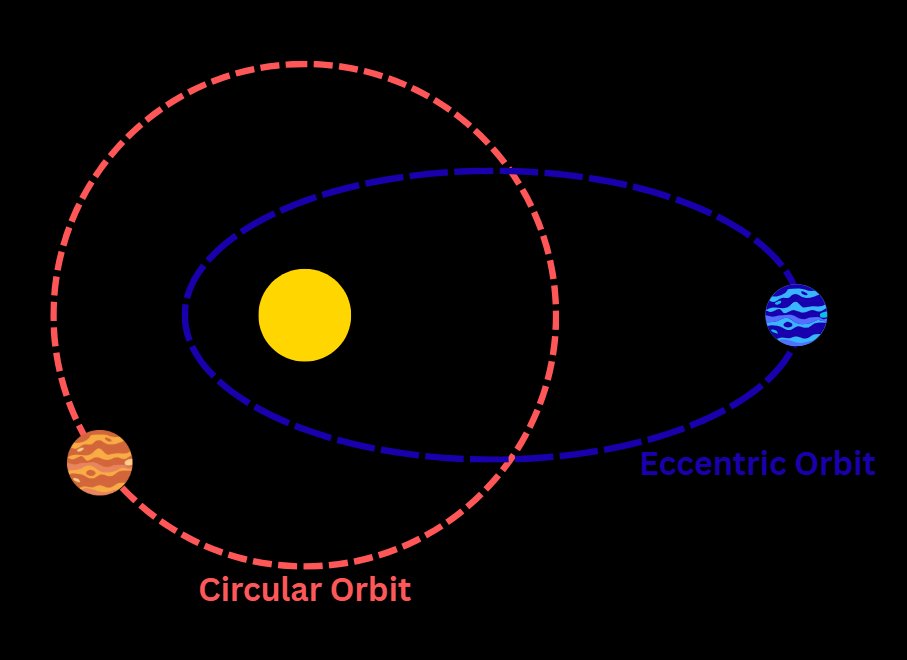
eccentric and circular orbits

Diagram showing examples of a circular and an eccentric orbit. Click to enlarge. [AAS Nova/Lexi Gault]

These giant planets have proven to be deeply entwined with the makeup of their host systems, and their orbital properties have been used to test and trace planet formation pathways. For example, long-period cold Jupiters discovered in radial velocity surveys have exhibited a positive correlation between planetary mass and orbital eccentricity. This mass–eccentricity relationship, as previous studies have suggested, is likely the result of a process known as planet–planet scattering, in which dynamical interactions between planets in the same system cause significant and chaotic changes to their orbits.

Does this relationship extend to shorter-period giant planets as well? Hot Jupiters are heavily impacted by tidal interactions with their host stars, circularizing their orbits and erasing dynamical imprints on their eccentricities. Warm Jupiters, on the other hand, orbit far enough away for their eccentricities to preserve clues about their energetic histories. Recently, thanks to the Transiting Exoplanet Survey Satellite (TESS), astronomers have identified a positive correlation between planetary mass and eccentricity in a growing sample of warm Jupiters, but the exact driver of this trend has yet to be uncovered.

Planets Scattering Planets

To test if the positive mass–eccentricity correlation in warm Jupiters is consistent with planet–planet scattering, Jiayin Dong (University of Illinois at Urbana-Champaign) constructed a sample of 85 warm Jupiters from the NASA Exoplanet Archive. This carefully selected sample, dominated by discoveries from TESS and Kepler, included planets with masses between 0.3 and 15 Jupiter masses and orbital periods between 10 and 365 days. In conjunction with this sample, the authors built a planet–planet scattering framework to assess the range of properties anticipated for scattered warm Jupiter systems.

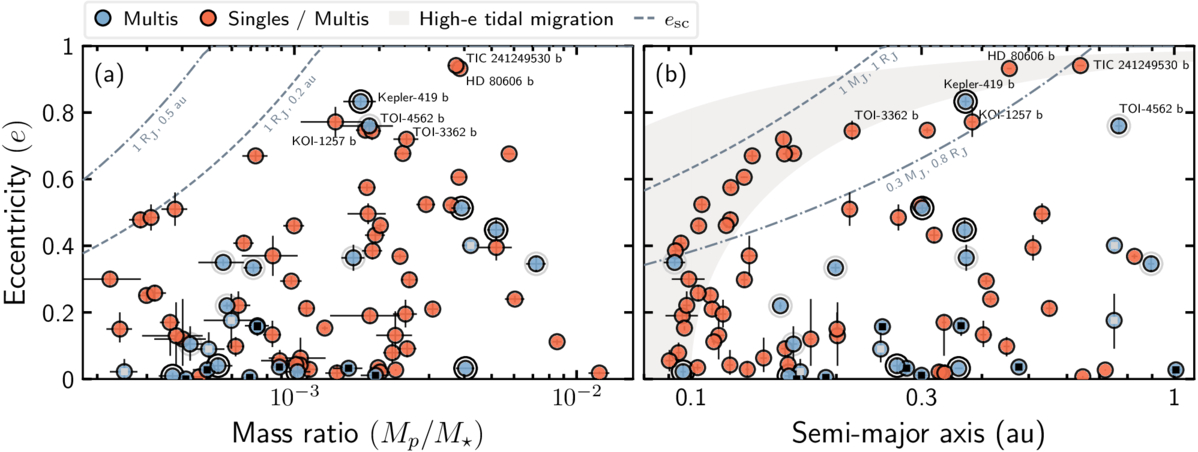
Eccentricity planet-star mass ratio and semimajor axis

Warm Jupiter eccentricity versus planet–star mass ratio (left) and semimajor axis (right). Click to enlarge. [Dong et al 2026]

Comparing the observed trends in their sample with their theory-based expectations, Dong and team showed that planet–planet scattering naturally explains the mass–eccentricity relation of warm Jupiters. In their framework, warm Jupiters originate in compact, multiplanet systems, and as the systems evolve, gravitational interactions between planets excite orbital eccentricities and inclinations, leading to close encounters. These encounters can cause planets to collide or to be ejected from the system entirely.

The mass–eccentricity relation of warm Jupiters, the authors suggested, represents a transition from collision-dominated interactions among low-mass planets to ejection-dominated interactions among high-mass planets. For massive enough systems, scattering can excite eccentricities high enough to trigger the high-eccentricity migration responsible for moving hot Jupiters to their close-in orbits. Overall, this study suggests that warm Jupiters are not a distinct planet species, but instead may represent the shorter-period counterparts of cold Jupiters whose orbits are shaped by the same dynamical processes. Future observations expanding the sample of warm Jupiters and discoveries of additional planet companions will further uncover the links between hot, warm, and cold Jupiter systems.

Citation

“Planet–Planet Scattering Explains the Mass–Eccentricity Relation of Warm Jupiters,” Jiayin Dong et al 2026 ApJL 1007 L29. doi:10.3847/2041-8213/ae930e

The post Planets Scattering Planets in Warm Jupiter Systems appeared first on AAS Nova.

Distant space ‘hamburger’ hides a baby gas giant

21 October 2026 at 17:04

A cosmic Quarter-Pounder is providing us with a near-perfect view of a distant gas giant’s earliest moments. Known as Gomez’s Hamburger (or GoHam for short), the massive protoplanetary disk surrounds a young star located in the Scorpius-Centaurus stellar region of our home galaxy about 453 light-years away from Earth. As researchers explained in a study recently published in The Astrophysical Journal, GoHam’s vantage from Earth is virtually unparalleled for anyone hoping to glimpse the subtle layers of dust and particles that will one day coalesce into a humongous gas giant.

Early observers first spotted GoHam in 1985, but initially pegged it for a planetary nebula as far as 6,500 light-years from Earth. Astronomers have since revised their assessments with data gathered by the Atacama Large Millimeter/submillimeter Array (ALMA) in northern Chile. As its full name implies, ALMA measures millimeter-and-smaller wavelengths, allowing scientists to map the miniscule dust grains and gaseous molecules that compose distant objects. GoHam is a particularly unique subject for ALMA, because its position makes it a new benchmark example for testing models of how planets evolve.

“GoHam gives us a rare and clear view of the vertical and radial structure of a very large, nearly edge‑on disk,” explained study co-author and University of Minnesota astronomer Charles Law.

Three telescope images of Gomez's Hamburger with outlines defining its gas layers
Gomez’s Hamburger was first discovered in 1985, but originally misidentified as a planetary nebula. Credit: Law, et al. (2026)

According to Law, its mixture of cosmic winds, large formational asymmetries, massive disk size, as well as the potential for planetary formation makes GoHam a “perfect laboratory.” With ALMA, Law and his colleagues analyzed GoHam’s layers of carbon monoxide, and sulfur-bearing molecules. As predicted, the lightest gas is in the highest layer above the formation’s midplane, while the heavier sulfur components lay beneath it. Meanwhile, a thin but concentrated section of millimeter dust is visible in the midplane itself.

Comparisons to GoHam’s fast food namesake only go so far, however. Its dust clouds lean north–south, with one side containing brighter and wider emissions. This likely stems from a disturbance such as a cosmic vortex, which may capture additional material for planetary formation. Dim, thin carbon monoxide emissions along the disk’s northern section also suggest GoHam’s central star is blowing gases into deep space as what’s known as photoevaporative wind.

Astronomers also noted that GoHam is one of the largest protoplanetary disks ever observed. At nearly 93 billion miles wide and with an exponentially larger dust mass than the typical protoplanet disk, GoHam may ultimately host not just one gas giant, but an entire planetary system.

The post Distant space ‘hamburger’ hides a baby gas giant appeared first on Popular Science.

❌