❌

Normal view

Nurse-led urology clinic records 14,013 registrations in descriptive study

21 October 2026 at 23:17

A nurse-led chronic disease management clinic in the urology department of a tertiary hospital recorded 14,013 outpatient registrations between July 2024 and September 2026, according to a single-center retrospective descriptive study using routinely collected service records. The clinic primarily supported long-term management of patients with prostate and bladder cancer while also providing specialty nursing services for other urological conditions. Its follow-up system marked 3,547 of 3,553 assigned tasks as successful, a task-level success rate of 99.83%. These figures describe service activity and record completion; the study did not measure whether the clinic improved clinical outcomes or economic performance.

The clinic was established in July 2024 within the hospital’s existing specialty nursing outpatient service framework. Its operating model included staffing and qualification requirements, professional training, clearly defined nursing responsibilities, physician–nurse collaboration, standardized procedures, information-system support and quality management. Nurses worked within their authorized scope of practice, while urologists participated in medical assessment and treatment decisions when required. The service had four reported components: patient assessment and follow-up planning; treatment follow-up and adverse-event monitoring; rehabilitation guidance and health promotion; and assistance with healthcare policies and basic nursing care.

Monthly registrations increased from 147 in July 2024 to a peak of 710 in August 2026, with fluctuations during the reporting period. Total registration fees were CNY 152,758. The clinic delivered 14,246 prostate cancer-related injections, 3,523 urinary catheterizations, 2,777 intravesical instillation procedures and 2,142 urinary catheter removals. It also assisted patients with prostate or bladder cancer in applying for outpatient chronic and special disease insurance benefits. The study reports these counts as routine service activities, but it did not compare the procedures with those delivered elsewhere or evaluate their individual clinical effects.

Follow-up management was integrated into the clinic’s information system, which contained records for 1,111 patients. Of these, 953 patients had been followed up and 951 had successful follow-up records. Nurses also executed 3,553 follow-up tasks, of which 3,547 were successful, corresponding to the reported 99.83% task-level rate. The descriptive data do not specify the duration or effectiveness of patient follow-up, assess whether missed contacts influenced treatment adherence or health outcomes, or establish how the results would compare with another care model.

Because the research covered one tertiary hospital and relied on routinely collected records, it cannot establish how the clinic would operate in smaller facilities, under different staffing arrangements or in other health systems. The findings offer a documented example of a nurse-led outpatient service with defined responsibilities, standardized workflows, follow-up documentation and collaboration with urologists. The authors stated that further research is needed to evaluate the model’s clinical outcomes and economic implications. Accordingly, the registration growth, procedural workload and high proportion of completed follow-up tasks should be interpreted as descriptions of implementation and recorded service delivery, not as evidence of improved survival, fewer complications, lower costs or other patient benefits.

Subject of Research: Operation and service activity of a nurse-led chronic disease management clinic in hospital urology

Article Title: Development and implementation of a nurse-led chronic disease management clinic in the urology department of a tertiary hospital: a descriptive study

Article References: Liu, C., Xia, Y., Jia, X., Wang, R., Li, T., Ma, Y., & Long, H. (2026). Development and implementation of a nurse-led chronic disease management clinic in the urology department of a tertiary hospital: a descriptive study. BMC Nursing. https://doi.org/10.1186/s12912-026-05566-z

Image Credits: AI Generated

DOI: 10.1186/s12912-026-05566-z

Keywords: nurse-led care, urology, outpatient nursing, chronic disease management, prostate cancer, bladder cancer, patient follow-up, service implementation, descriptive study, Development, implementation, nurse-led

Survey links three capabilities with Indonesian welfare-data integration

21 October 2026 at 23:09

A survey-based study of 246 village-level social welfare data operators found that business architecture, cross-organizational collaboration and technological readiness were positively and statistically significantly associated with perceived e-government integration impact in two Indonesian regencies. The research, focused on Gunung Kidul and Bangkalan, examined organizational, institutional, relational and technological capabilities associated with social welfare data integration. Governance and leadership and information policy did not show statistically significant direct relationships with perceived integration impact in the pooled sample.

The authors analyzed the survey with partial least squares structural equation modeling. In their framework, e-government integration impact, or EGII, represents perceived improvements in information, system and service quality, responsiveness and public trust. E-government integration scope, or EGIS, describes the breadth of integration across data, applications, electronic communication and knowledge-sharing processes.

EGII was strongly associated with EGIS, meaning that operators reporting more favorable perceived integration outcomes also tended to report broader integration. Because this was an observational analysis of survey responses, the results establish statistical relationships rather than causal effects. The findings identify three capabilities with significant direct relationships to EGII in the pooled model: business architecture, cross-organizational collaboration and technological readiness.

The evidence does not provide operational definitions for these constructs, but the results show that their measured levels were associated with respondents’ assessments of e-government integration outcomes. By contrast, governance and leadership and information policy had no statistically significant direct relationships with EGII in that analysis. This absence of a detected direct relationship does not establish that the two factors are unimportant or that they operate only through indirect pathways, because the supplied findings do not report such indirect effects.

A regency-based robustness analysis found that some relationships were sensitive to local implementation conditions. Significant differences between Gunung Kidul and Bangkan were reported for the technological-readiness-to-EGII relationship and the EGII-to-EGIS relationship. The geographic comparison therefore cautions against assuming that the same capability relationships apply uniformly across the two regencies, although it does not identify the specific local practices responsible for those differences.

Its direct contribution is to show which measured interoperability capabilities were associated with perceived integration impact in the surveyed population, alongside evidence that some relationships varied between the two regencies.

Subject of Research: Survey-based analysis of interoperability capabilities for social welfare data integration in two Indonesian regencies

Article Title: Determinants of E-government interoperability capabilities for social welfare data integration in Gunung Kidul and Bangkalan Regencies, Indonesia

Article References: Fikri, R., Purnomo, E. P., Pribadi, U., Mohamed, A. M., & Mohammad, N. B. (2026). Determinants of E-government interoperability capabilities for social welfare data integration in Gunung Kidul and Bangkalan Regencies, Indonesia. Discover Sustainability. https://doi.org/10.1007/s43621-026-04608-5

Image Credits: AI Generated

DOI: 10.1007/s43621-026-04608-5

Keywords: social welfare data, e-government, interoperability, Indonesia, PLS-SEM, technological readiness, cross-organizational collaboration, business architecture, digital governance, public services, Determinants, capabilities

It’s a Beautiful Day in the (Solar) Neighborhood

21 October 2026 at 17:00

Hyades star cluster

It’s never been easier to get to know your neighbors: a new database introduces open star clusters, stellar associations, and substellar objects within 500 parsecs (1,630 light-years) of the Sun.

Too Much of a Good Thing

Astronomers today must contend with a difficult but delightful problem — there’s just so much data available. As a researcher attempting to study a particular slice of the universe, it can be challenging to pinpoint the correct data and to know whether you’ve collected all the data relevant to your science. This prospect is already daunting, and the deluge of data from surveys like the Vera C. Rubin Observatory’s Legacy Survey of Space and Time will make the situation even harder to manage.

This is where specialized databases can help. Often crafted with specific science goals in mind, database creators do the work for you by compiling objects within a well-defined parameter space. Today’s article describes a new database that takes a census of the solar neighborhood, with applications for studies of stellar evolution, exoplanets, and more.

Compiling Clusters

Jonathan Gagné (Montreal Planetarium; University of Montreal) and collaborators have compiled the Montreal Open Clusters and Associations (MOCA) database, which contains detailed information on nearby star clusters, stellar associations, and substellar objects.

visualization of stellar association hierarchies

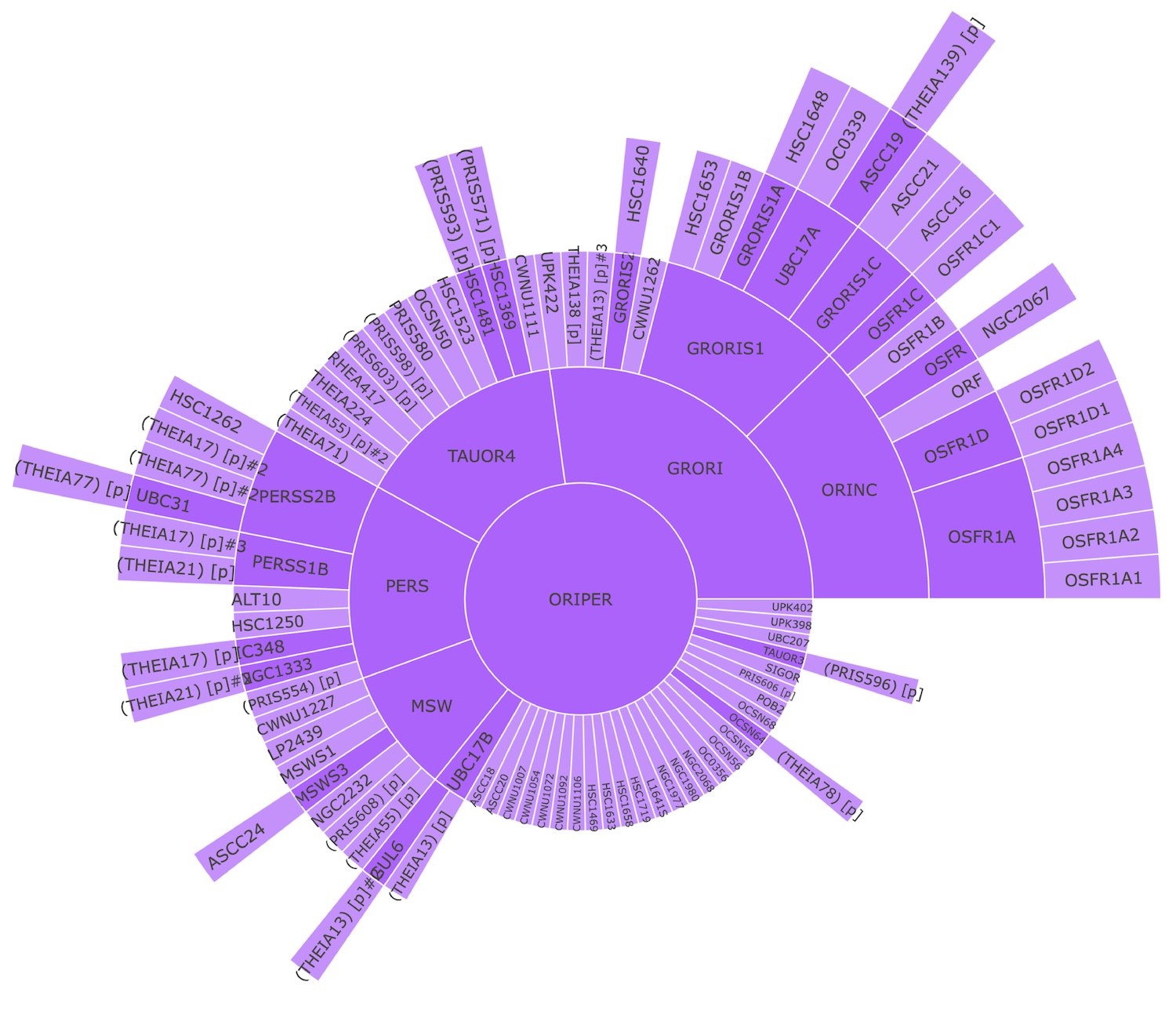
Visualization of the hierarchy of young stellar associations within the Orion–Perseus branch of the database. Click to enlarge. [Gagné et al. 2026]

Gagné’s team began the monumental task of constructing the database by amassing a list of nearby groups of stars from the literature, drawing on recent searches using data from the Gaia mission and other sources. This task required reconciling cluster names and memberships from multiple sources and detailing a cluster hierarchy that places subgroups within larger cluster structures.

In total, the complete database contains information about 10,259 star clusters and stellar associations and their individual members. The authors identified more than 11,000 new candidate cluster and association members, most of which are M dwarfs. The database also contains 1,620 substellar objects, 196 of which are newly identified through this work, and 101 candidate isolated planetary-mass objects.

Science with MOCA

For each star, the team compiled the available measurements from the literature and, from these core measurements, derived quantities like distance and spectral type. They then used empirical methods to estimate further properties like age, mass, and effective temperature.

properties of confirmed exoplanets and exoplanets in young stellar associations

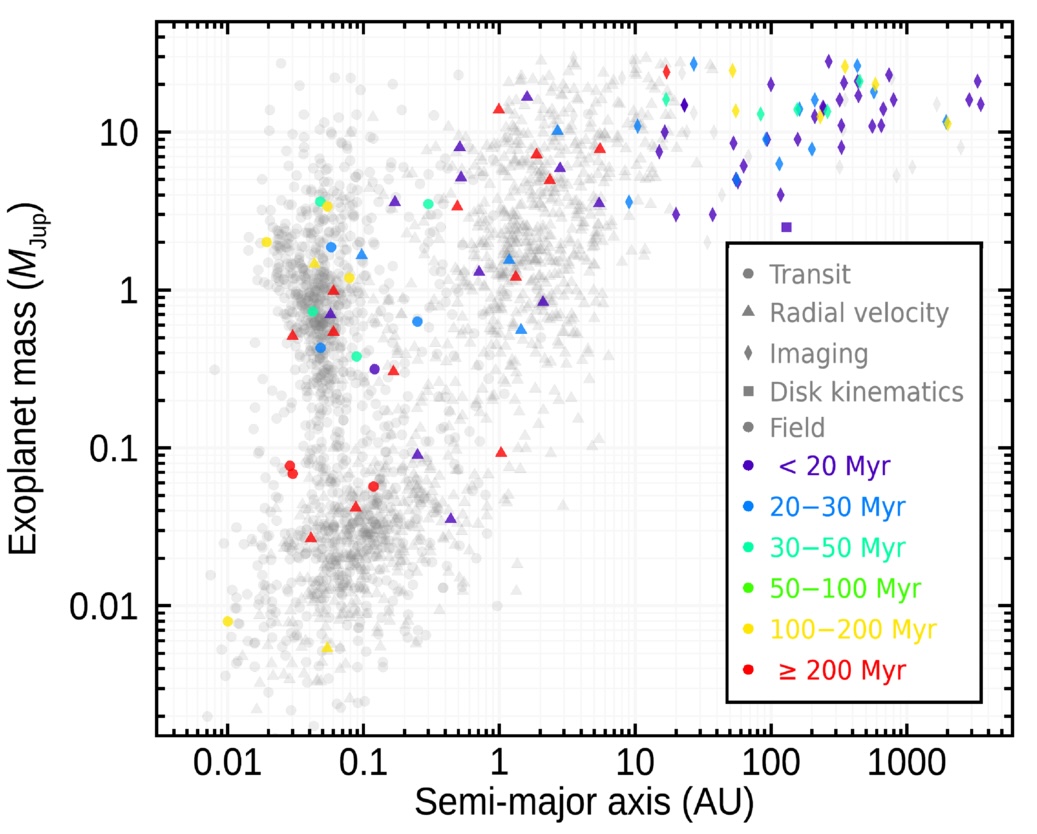
Masses and semi-major axes for confirmed exoplanets from the NASA Exoplanet Archive (gray symbols). Colored symbols indicate planets belonging to a young stellar association, with the color denoting the age of the association. Click to enlarge. [Adapted from Gagné et al. 2026]

Assigning ages to star clusters and stellar associations enhances the scientific value of the database, making it broadly accessible to studies of stellar and planetary evolution. For exoplanet science, the team identified 134 confirmed exoplanet systems and 121 planet candidates in young stellar associations with well-determined ages. This includes 46 confirmed and 53 candidate planets that appear to be assigned to an age-dated association for the first time.

MOCA already offers an impressive census of our patch of the Milky Way, but this isn’t its final iteration. As new data become available — including future Gaia data releases that will improve our understanding of cluster membership and reveal a population of astrometrically detected exoplanets — they will be incorporated into the existing database.

Interested in seeing what MOCA can do for your research? You can access the database online.

Citation

“The Montreal Open Clusters and Associations (MOCA) Database: A Census of Nearby Associations, Open Clusters, and Young Substellar Objects Within 500 pc of the Sun,” Jonathan Gagné et al 2026 ApJS 287 8. doi:10.3847/1538-4365/ae9b09

The post It’s a Beautiful Day in the (Solar) Neighborhood appeared first on AAS Nova.

SpamSieve 3.3.2

18 September 2026 at 21:37

SpamSieve 3.3.2 is an update of my Mac e-mail spam filter that improves remote training, can export more rule information, and improves uninstallation, help, and more. The most significant news is that Microsoft has changed plans again. They will no longer be preventing users from continuing to use Legacy Outlook and in fact will keep it available for download as part of the combined Outlook app. This gives more time to adapt to their change in plans for AppleScript. Exchange (EWS) support remains an issue. Microsoft is still planning to cut off Legacy Outlook users, and Apple has yet to announce when Mail will support Graph. So far, I’ve not heard that it’s enabled in the macOS 27.2 beta.

We’re participating in a seasonal festival of artisanal software called SummerFest. For a limited time, you can get a 25% discount on new purchases of SpamSieve, EagleFiler, and other top Mac apps from our indie developer friends.

Some interesting engineering issues were:

  • Updating NSWorkspace APIs introduced a problem because with the old launchApplication(at:options:), the .withErrorPresentation option is off by default, whereas with the newer openApplication(at:configuration:completionHandler:), the promptsUserIfNeeded option is on by default.

  • Previously, Core Data would strip leading BOMs from NSStrings when saving to a SQLite database. With macOS 27, this happens for Swift Strings, too.

  • I have lots of unit tests that check for memory leaks. These caught a change where addPersistentStore(type:configuration:at:options:) now seems to return an autoreleased store. Without adding a pool, it looked like there was a leak.

  • Also, the tests were finding lots of “leaks” because KVO was retaining NSTabView, which retains a controller. Previously, XCTestCase.waitForExpectations(timeout:) would spin the run loop, and everything would get cleaned up. With Xcode 27 and macOS 27, I need to manually spin the run loop before waiting for the expectations.

  • During a software update, macOS may decide to reload the Dock icon. The application package no longer exists because it’s been replaced with a new version. This wasn’t a problem before because SpamSieve had been drawing to an image in memory and setting that as the Dock icon. Now, with the Liquid Glass–imposed removal of custom Dock icons, macOS tries to load the icon from disk, and rather than handling errors gracefully it will crash. I fixed this by setting an image with a memory representation before starting a software update.

  • SpamSieve 3.3.1 introduced a crash affecting a small but significant number of users when doing a Core Data fetch of a large number of objects. The private [_PFManagedObjectReferenceQueue _processReferenceQueue:] method was seemingly releasing an object that had already been released. What’s odd is that, as far as I can tell, none of the related app code had changed since the previous version, yet suddenly crashes started happening all the way from macOS 12 through macOS 27. If I had to guess, this was triggered by upgrading from Xcode 26.2 to Xcode 26.6. Maybe Swift’s ARC optimizations are doing something subtly different?

    The crash was triggered by an autorelease pool that I had inserted to promptly clean up any temporary objects after a fetch. (The actual fetched objects were returned and used outside of the pool.) Interestingly, both Gemini and ChatGPT were convinced that this is a well-known exception to standard memory management rules. They said it’s never safe to use managed objects outside of a pool they were fetched in because they depend on internal Core Data objects that the pool will have released. I was not able to find any basis for this “belief,” but it was easy enough to test. As expected, removing the pools (during the beta cycle) just made the same crashes happen slightly later.

    I think there’s probably something wrong in Core Data’s internal bookkeeping, but this does not seem to be a popular crash (and I’ve never seen it on any of my Macs), so my code must be doing something uncommon to trigger it. My current best guess is that it was related to calling refreshAllObjects() after saving. (I bet there’s some fancy bookkeeping to make that efficient.) I was doing this throughout the app to break retain cycles so that unused objects could be deallocated. But it wasn’t necessary in this particular case because the entity being fetched has no relationships. So far, removing the refresh seems to have stopped the crashes, but I won’t know for sure until more people have been using this version for a while.

Previously:

❌