❌

Normal view

SpaceX will attempt 1st-ever double Starship rocket catch on next test launch, a 'profound technology milestone,' Elon Musk says

20 October 2026 at 23:29

SpaceX will soon notch a huge spaceflight milestone, if all goes according to plan.

The company will try to catch both stages of its Starship megarocket during the vehicle's next test flight, which is targeted for next month, founder and CEO Elon Musk announced during SpaceX's quarter 3 (Q3) earnings call today (Oct. 20).

If SpaceX succeeds, this "will be the first time that an orbital launch vehicle has been fully recovered," Musk said. "The only way that we can extend consciousness beyond Earth on a sustained basis is with a fully reusable orbital launch vehicle. So this is, I think, a profound technology milestone in the history of civilization and consciousness."

illustration of a silver spacecraft suspended in midair by the metallic arms of a launch tower

Artist's illustration of SpaceX catching the upper stage of its Starship megarocket, something the company expects to do on the vehicle's 15th test flight. (Image credit: SpaceX)

Starship is the biggest and most powerful rocket ever built, standing more than 400 feet (122 meters) tall when fully stacked.

As Musk noted, both of its stages β€” the Super Heavy booster and Ship spacecraft β€” are designed to be fully and rapidly reusable, a breakthrough that SpaceX thinks will make Mars settlement and other grand exploration feats economically feasible.

Starship's recovery strategy is different than that for SpaceX's Falcon 9 and Falcon Heavy rockets, which are partially reusable. (The latter two rockets have expendable upper stages). Falcon 9 and Falcon Heavy boosters come back to Earth on landing pads near the launch site or on ships at sea downrange. Super Heavy and Ship, however, will steer themselves directly back to their launch tower, which will capture each vehicle with its "chopstick" arms.

This will allow SpaceX to inspect, refurbish and refly Starship at an accelerated rate, which is a priority for the company: Musk has said he envisions launching Starship more than 10,000 times per year by 2030.

Starship has conducted 14 test flights to date, and SpaceX has pulled off chopstick catches with Super Heavy on three of them. The company has not yet tried to catch Ship, which is a more difficult proposition, as the upper stage travels higher, farther and faster than the booster does.

Still, Musk is confident that SpaceX will pull off a Ship catch on the first try. (He did not give a specific target date for Flight 15, saying only that it was expected next month.)

"I'd say it's more likely than not that this succeeds next flight," he said. "And if not, we have a steady stream of Starship flight attempts through the end of this year, and and then accelerating next year."

Success would mean back-to-back Starship flights with huge milestones. On Flight 14, which occurred on Sept. 28, Ship reached orbit for the first time ever. It also deployed 26 of SpaceX's Starlink Version 3 satellites β€” the first 26 members of a next-gen broadband constellation in low Earth orbit that will eventually consist of about 100,000 spacecraft.

The Starship Flight 15 preview was something of an aside during today's call. The event primarily served to announce SpaceX's financial performance during Q3, the three-month stretch that ended on Sept. 30.

And that performance was strong, company representatives said. SpaceX recorded revenues of $14.6 billion during Q3, an increase of 161% from the $5.6 billion earned during Q3 of 2025. The company had a net income of $4.4 billion during Q3, $5.5 billion better than the result from the same stretch last year, when SpaceX lost $1.1 billion.

Just $1.8 billion of 2026 Q3 revenue came from SpaceX's launch division. The vast majority was generated by two other segments β€” connectivity (services provided by its Starlink megaconstellation) and artificial intelligence (or, as the Trump administration has recently rebranded it, "superintelligence").

SpaceX thinks these latter two segments will continue to boom. That's why it's building the infrastructure to support thousands of Starship launches per year β€” to loft lots of Starlink satellites and AI data centers to Earth orbit. And the company believes that it's positioned to really start raking in the cash, starting as soon as next year.

"In a nutshell, what this implies for SpaceX annual recurring revenue by the end of '27 is somewhere between 500 billion [dollars] and a trillion," Musk said.

SpaceX launches its 'Starfall' return capsule for 2nd time ever (video)

20 October 2026 at 12:16

SpaceX just launched its mysterious "Starfall" return capsule for the second time ever.

Starfall was one of 32 payloads on the company's Bandwagon-5 rideshare mission, which launched atop a Falcon 9 rocket at 7:04 a.m. EDT (1104 GMT) today (Oct. 20) from Cape Canaveral Space Force Station in Florida.

SpaceX has been relatively quiet about Starfall, which debuted this past June on a Falcon 9 launch from the Cape.

photo of a stack of satellites being processed for launch inside a large white clean room

The payloads of SpaceX's Bandwagon-5 rideshare mission, seen in a prelaunch photo. The company's Starfall capsule sits at the very top of the stack. (Image credit: SpaceX)

That June 23 flight was a dedicated demonstration mission for Starfall, designed to show that the capsule can fly in a controlled fashion and survive the harrowing downward trip through Earth's atmosphere.

And those will be Starfall's main jobs. The vehicle "will enable affordable, routine access to the microgravity environment for scientific research and in-space manufacturing," SpaceX in a June 23 X post, one of the few public statements the company has made about Starfall.

Indeed, most of the details that we have about the capsule come from an environmental assessment that was published by the U.S. Federal Aviation Administration in May.

According to that document, the disk-shaped Starfall is roughly 2.5 feet (0.75 meters) tall and 10.2 feet (3.1 m) wide. It weighs about 4,600 pounds (2,100 kilograms) and can bring 2,200 pounds (1,000 kg) of payload back down to Earth.

a flat space capsule reenters Earth's atmosphere

Artist's illustration of a SpaceX Starfall capsule reentering Earth's atmosphere. (Image credit: SpaceX)

Starfall wasn't the only return capsule that went up on Bandwagon-5. Among the other 31 payloads on the flight was W-Series 7, the latest orbital "mini-factory" built and operated by the California company Varda Space Industries.

The W-Series capsules are designed to both host the production of valuable goods such as pharmaceuticals and bring them safely down to Earth, Varda has said.

The other payloads on Bandwagon-5 are a mix of "cubesats and microsats," according to SpaceX's mission description. Among the latter is Pelican-12, a sharp-eyed Earth-observation satellite built by the San Francisco company Planet.

Payload deployment sequence is completeOctober 20, 2026

The 32 payloads were deployed over a two-hour span beginning about 57 minutes after launch. Starfall will be the last to separate, releasing from the Falcon 9's upper stage two hours and 48 minutes post-liftoff.

The Falcon 9's first stage, meanwhile, came back to Earth as planned on Bandwagon-5. It touched down about nine minutes after launch, coming down in the Atlantic Ocean atop the SpaceX drone ship "A Shortfall of Gravitas." It was the 19th mission for this particular booster, according to the company.

A sooty booster stands on 4 legs on a barge at sea.

(Image credit: SpaceX)

Bandwagon is one of two SpaceX rideshare programs. The other, known as Transporter, has been busier, flying 18 missions to date.

The first Transporter mission, which lifted off in January 2021, delivered 143 payloads to Earth orbit, a single-launch record that still stands.

Japan launches historic MMX sample-return mission to Mars' moon Phobos (video)

19 October 2026 at 20:53

Japan's groundbreaking mission to Mars is officially underway, headed to the Red Planet's mysterious moons Phobos and Deimos for a historic sample-return attempt.

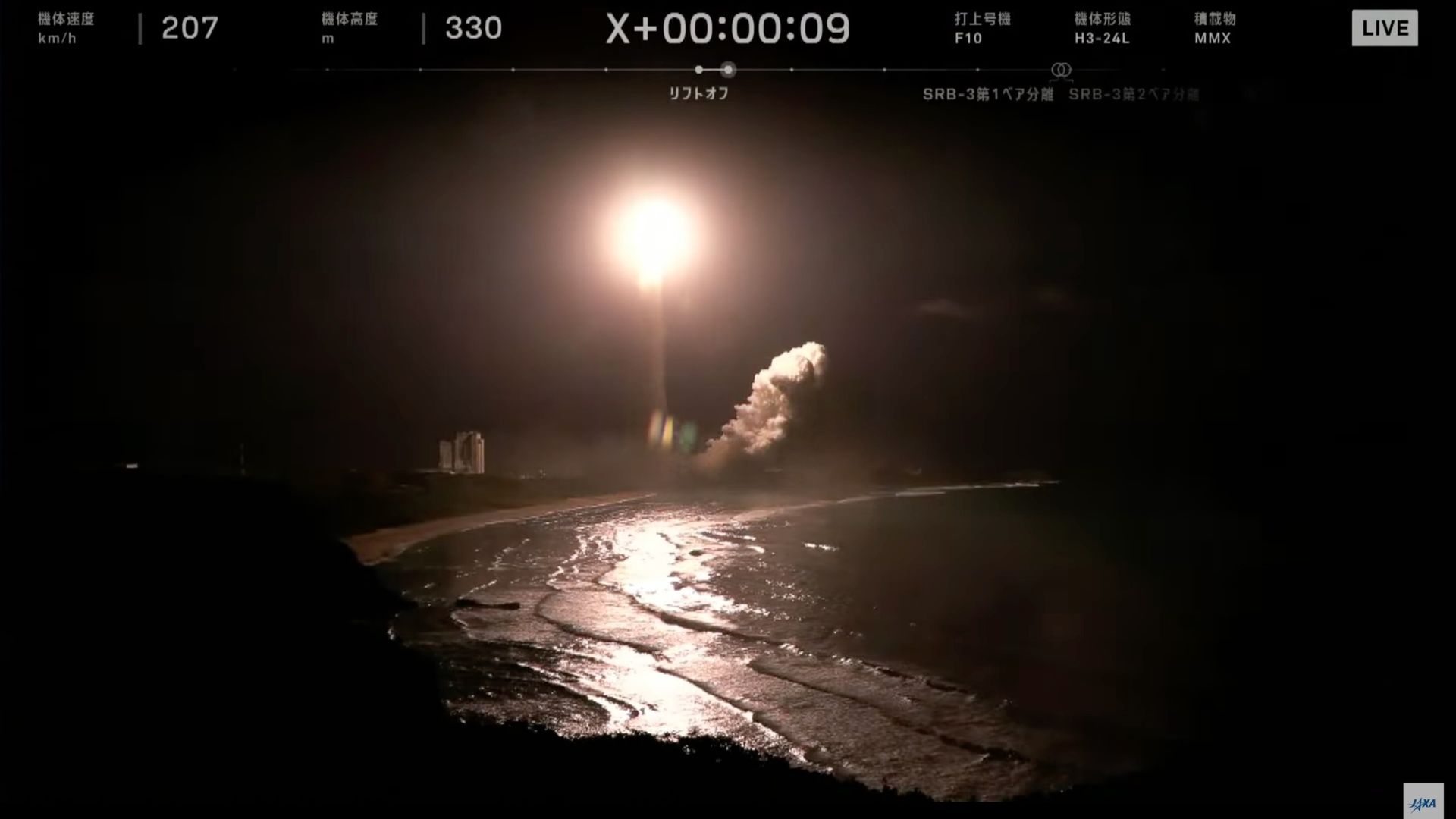
The Martian Moons eXploration (MMX) mission launched today (Oct. 19) from Tanegashima Space Center in Japan, riding an H3 rocket that lifted off from Pad-2 at Tanegashima's Yoshinobu Launch Complex at 3:41 p.m. EDT (1941 GMT; 4:41 a.m. local time in Japan on Oct. 20).

The JAXA (Japan Aerospace Exploration Agency)-led MMX mission is bound for Mars orbit, where it will study the planet's two moons, Phobos and Deimos. If everything goes according to plan, MMX will become the first spacecraft to land on and return samples from Phobos for study back on Earth, which scientists think could shed light on a decades-old mystery about the moons' origins and reveal clues about the formation of the early solar system.

Japan's MMX mission to Mars' moon Phobos launches from Tanegashima Space Center on Oct. 19, 2026.

a rocket launches into a night sky from a seaside pad (Image credit: JAXA)

It was the 10th liftoff of Japan's expendable, two-stage H3 rocket, which was jointly developed by JAXA and Mitsubishi Heavy Industries. After clearing its launch pad today, the 207-foot-tall (63 meters) launch vehicle flew a nominal trajectory through its ascent corridor over the Pacific Ocean, jettisoning its four solid boosters in pairs just before the flight clock reached two minutes. The rocket shed its payload fairings about one minute and 20 seconds later, exposing MMX to the vacuum of space for the first time.

H3's first stage, powered by two LE-9 rocket engines, channels a mixture of liquid hydrogen and liquid oxygen to produce a combined thrust of 331,000 pounds (1,471 kN), according to Mitsubishi Heavy Industries. As the mission clock approached T+5 minutes, H3 executed its main engine cutoff procedure and separated from the second stage, which ignited its engines for a 5.5-minute burn about 10 seconds later.

All continued to go to plan after that. The H3's upper stage ignited its engine for a second time for a trans-Mars injection burn about one hour and four minutes after liftoff, a maneuver that lasted roughly six minutes and 25 seconds and took MMX to a maximum velocity of about 24,145 mph (38,858 kph).

MMX was released from the rocket's upper stage right on schedule, about one minute after the completion of that burn and roughly 71 minutes after liftoff. The success elicited loud cheers in mission control, which viewers saw and heard on JAXA's launch webcast.

MMX is now under its own power, and on course for Mars. The interplanetary transit will last about 10 months, with the spacecraft scheduled to arrive at the Red Planet in August 2027. When it does, MMX's propulsion module will execute an orbital insertion burn to place itself in a quasi-satellite orbit (QSO) around Phobos, which places MMX within the space around the moon as both circle Mars.

MMX will spend about three years in the Martian system, devoting much of that time to studying the 14-mile-wide (22 km) Phobos with its science instruments. The spacecraft also carries the IDEFIX rover, a joint effort of the space agencies of France and Germany, which is scheduled to deploy to the surface of Phobos in late 2028 or early 2029.

After a mapping campaign to select suitable landing sites, MMX will perform two separate touchdowns on Phobos to collect and stow samples in the spacecraft's return capsule. Following its second landing and sample collection, MMX will briefly return to QSO with Phobos before transferring to a more elongated orbit around Mars that intersects with the planet's smaller moon, Deimos, which is just 8 miles (14 km) in diameter.

During the last several months of its time around Mars, MMX will perform a series of Deimos flybys before departing for Earth in November 2030. If all goes according to plan, the MMX sample-return capsule will land in Australia in 2031.

Scientists are counting on those samples, and other data collected during MMX's time around Mars, to answer a decades-old question surrounding the Martian moons' origins. Competing theories and conflicting evidence point to two possibilities for how Mars got its moons.

Their near-circular, equatorial orbits suggest a narrative similar to how Earth's moon is thought to have formed β€” as a result of a massive planetary impact between Mars and some other giant space rock, which broke off pieces of the planet that eventually coalesced to form the natural satellites that orbit there today.

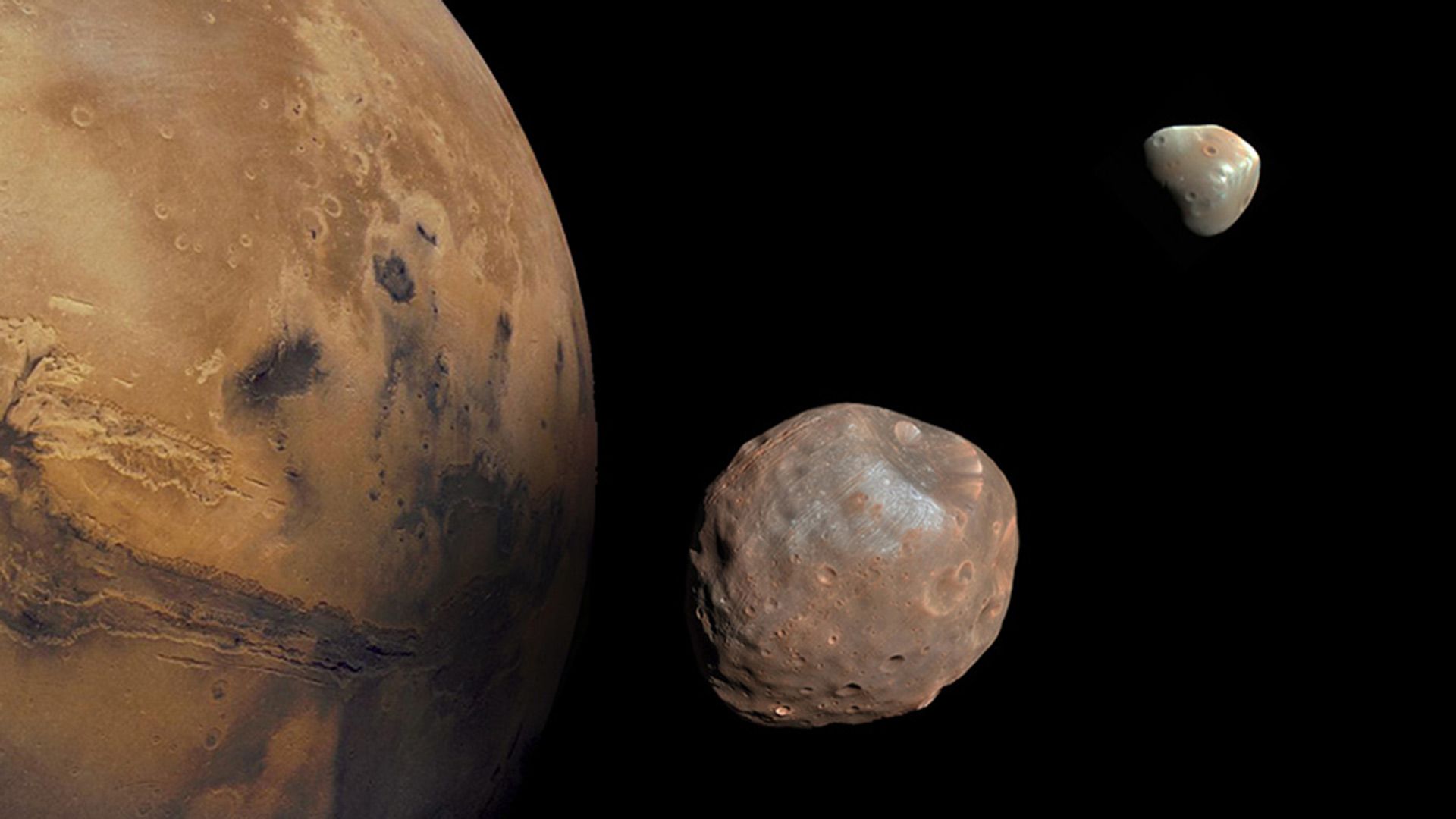
Mars and its two moons, Phobos and Deimos.

A composite image with Mars and its two moons, Phobos and Deimos. (Image credit: NASA/JPL/University of Arizona)

Neither Phobos nor Deimos is spherical, isntead; both are oblong and lumpy, like potatoes. That fact β€” along with their chemical composition, as far as we have been able to tell using telescopic spectroscopy β€” point to the possibility that Phobos and Deimos were asteroids from the early solar system that were captured by Mars' gravitational pull. Figuring out the moons' true origin story would provide key clues about Mars' geological past, the solar system's early history and the formation of the inner planets, mission team members have said.

Once the MMX samples are safely returned to Earth, scientists will study their composition and mineralogy, then compare such chemical fingerprints with those of Martian rocks and asteroid material. These analyses, combined with data collected by MMX during its mission, will help nail down the origin of Phobos β€” and by extension, Deimos. β€” by

While JAXA leads MMX, the mission is an international effort, with interagency partnerships between JAXA, NASA and the European Space Agency (ESA), as well as U.S. and European companies, which supplied a handful of the spacecraft's scientific hardware and communications equipment.

NASA's contributions to MMX include the Mars-moon Exploration with Gamma rays and Neutrons (MEGANE, pronounced "meh-gah-nay") device, which is a gamma-ray and neutron spectrometer built by the Johns Hopkins Applied Physics Laboratory (APL); a Honeybee Robotics-built pneumatic sampler; and communications support using the agency's Deep Space Network.

NASA has also invested approximately $87 million through the end of the mission, which includes funding for United States scientists and astromaterials experts on the MMX team. The agency is getting something concrete for such contributions: At least 15% of the planned 10-gram (0.35 ounces) returned Phobos sample will be reserved for NASA's study. Those materials will be transferred and maintained at the agency's Johnson Space Center in Houston for analysis and long-term preservation.

MMX is not the first Phobos sample-return project to take flight, by the way. That distinction goes to Russia's Phobos-Grunt ("Phobos-Soil") mission, which launched in November 2011 but failed to get out of Earth orbit due to a rocket glitch. The 14.5-ton spacecraft eventually crashed back to Earth over the Pacific Ocean in January 2012.

Editor's note: This story was updated at 5 p.m. ET on Oct. 19 with news of MMX's successful separation from the H3 rocket's upper stage.

❌