
❌

Normal view

Featured Image: Examining Galactic Filaments

20 October 2026 at 17:00

filaments in the galactic center

This image of the galactic center from the MeerKAT radio array shows wispy vertical lines known as galactic non-thermal filaments. These structures, which are tens of parsecs long and less than a tenth of a parsec wide, are found throughout a complex region called the central molecular zone. The filaments’ radio emission appears to come from charged particles spiraling around magnetic field lines, but it’s not yet known where the speeding particles that power this emission come from. Recently, Mohan Richter-Addo (University of Wisconsin–Madison) and collaborators used magnetohydrodynamics simulations to explore two potential sources: 1) the electron–positron winds of a pulsar or 2) a proton-rich mix of particles accelerated by interstellar shocks. The team found few discernible differences between simulated filaments illuminated by these two sources, but this work provided new avenues for future exploration. One facet that emerged from the team’s investigation is that filaments should grow longer as they age, with the maximum length set by the underlying magnetic field. This suggests that magnetohydrodynamic turbulence might play a role in shaping the filaments. To learn more about this exploration of galactic non-thermal filaments, be sure to check out the article linked below.

Citation

β€œThe Effects of Cosmic-Ray Protons on Galactic Nonthermal Filaments,” Mohan Richter-Addo et al 2026 ApJ 1009 164. doi:10.3847/1538-4357/aea0c7

The post Featured Image: Examining Galactic Filaments appeared first on AAS Nova.
Featured Image: Echoes of Giant Pulses

6 October 2026 at 17:00

What at first might appear to be abstract pixel art or a fuzzy photograph of skyglow from a distant city is actually a representation of radio emission from the pulsar at the center of the Crab Nebula. When a pulsar’s radio emission passes through a region of ionized gas β€” like the complex filaments of the Crab Nebula β€” the plasma deflects the radio signal from its intended course. This detour can create β€œechoes”: copies of the pulsar signal that arrive later than the original pulse. Thierry Serafin Nadeau (University of Toronto) and collaborators studied these echoes from the Crab pulsar by compiling an archive of giant pulses detected over 2.5 years by the Canadian Hydrogen Intensity Mapping Experiment (CHIME). Giant pulses, which are brighter and narrower than typical pulses, offer a powerful way to probe plasma echoes. The image above shows sweeping parabola-shaped echoes during two particularly active periods. The color shows the frequencies at which power was received: mainly at low (blue), high (red), or all (yellow-white) frequencies. This dataset revealed for the first time a feature predicted to exist but never seen: echoes from plasma structures that never pass directly in front of the pulsar from our point of view. To learn more about the echoes of the Crab pulsar, be sure to check out the research article linked below.

Citation

β€œEchoes in Different Tempo: Long-Term Monitoring of Crab Echoes with CHIME,” Thierry Serafin Nadeau et al 2026 ApJ 1006 82. doi:10.3847/1538-4357/ae7336

The post Featured Image: Echoes of Giant Pulses appeared first on AAS Nova.

Featured Image: Evolution of a Cosmic Crab

21 September 2026 at 17:00

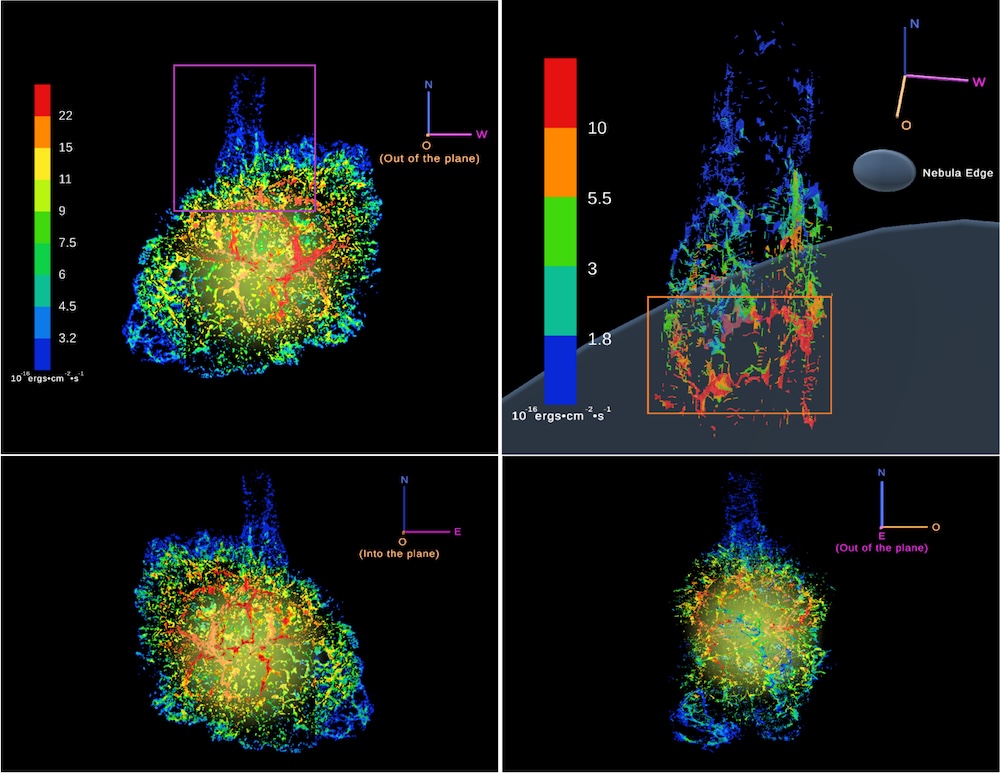
three-dimensional reconstruction of the Crab Nebula

three-dimensional representation of the Crab Nebula

Three-dimensional reconstructions of the Crab Nebula using oxygen emission lines. An animation of the 3D reconstruction is also available. [Ding et al. 2026]

A recent research article by Ziwei Ding (Purdue University) and collaborators introduces a new 3D kinematic reconstruction of the Crab Nebula, the remnant of a supernova seen from Earth in the year 1054. The team observed the nebula’s oxygen emission in 2020 and 2022 with the Canada-France-Hawaii telescope, then compared these observations against others made in 2016 to study the nebula’s structure and motion. The images above and to the right show the nebula from multiple vantage points. These images show a prominent jet-like feature emerging vertically from the nebula. Ding and collaborators demonstrated that the jet appears to be linked to a light-year-wide cavity at its base. The source of the jet is not yet known; past mass loss, a circumstellar disk, and a locally under-dense region might all play a role. Future hydrodynamic simulations can probe each of these possibilities to understand how the winds of the young pulsar at the core of the nebula produced the features seen today. To learn more about these observations of the Crab Nebula, be sure to check out the full research article linked below.

Citation

β€œ3D Kinematic Reconstruction of the Crab Nebula That Includes the Northern Ejecta β€˜Jet,'” Z. Ding et al 2026 ApJ 1007 130. doi:10.3847/1538-4357/ae84c0

The post Featured Image: Evolution of a Cosmic Crab appeared first on AAS Nova.

❌