❌

Normal view

A Pulsar in a Rare Triple System

9 October 2026 at 17:00

triple-star system containing the pulsar PSR J0435+3233

Follow-up observations show that a recently discovered pulsar has two stellar companions, making it one of just a handful of millisecond pulsars known to be in triple-star systems.

An Unusual New Pulsar

Earlier this year, researchers reported the discovery of a pulsar with the Five-hundred-meter Aperture Spherical radio Telescope (FAST). The newfound pulsar, PSR J0435+3233, is a millisecond pulsar, rotating once every 3.2 milliseconds. What’s unique about this pulsar is how quickly it’s spinning down: its spin rate is decreasing roughly 100 times faster than other millisecond pulsars in our galaxy, suggesting an unusually strong magnetic field and the possibility of an exotic formation pathway.

The FAST observations also showed that the pulsar is not alone: it appears to be on an 8-day orbit with a white dwarf. Now, follow-up observations have revealed the pulsar’s membership in an intriguing stellar system.

From Radio to Gamma Rays

Zonglin Yang (National Astronomical Observatories, Chinese Academy of Sciences) and coauthors followed up on the discovery of PSR J0435+3233 using multiwavelength data from FAST, multiple optical and infrared observatories, and the Fermi Gamma-Ray Space Telescope.
optical image of the subgiant companion to PSR J0435+3233

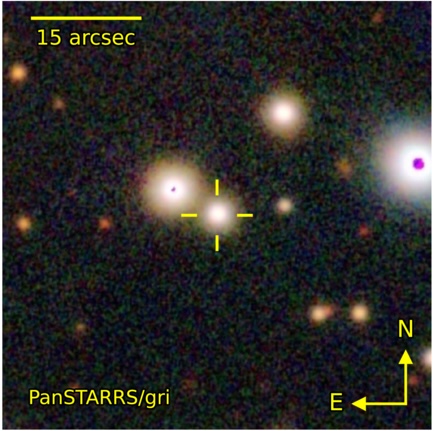
Visible-light image from PanSTARRS of the outer subgiant companion. [Adapted from Yang et al. 2026]

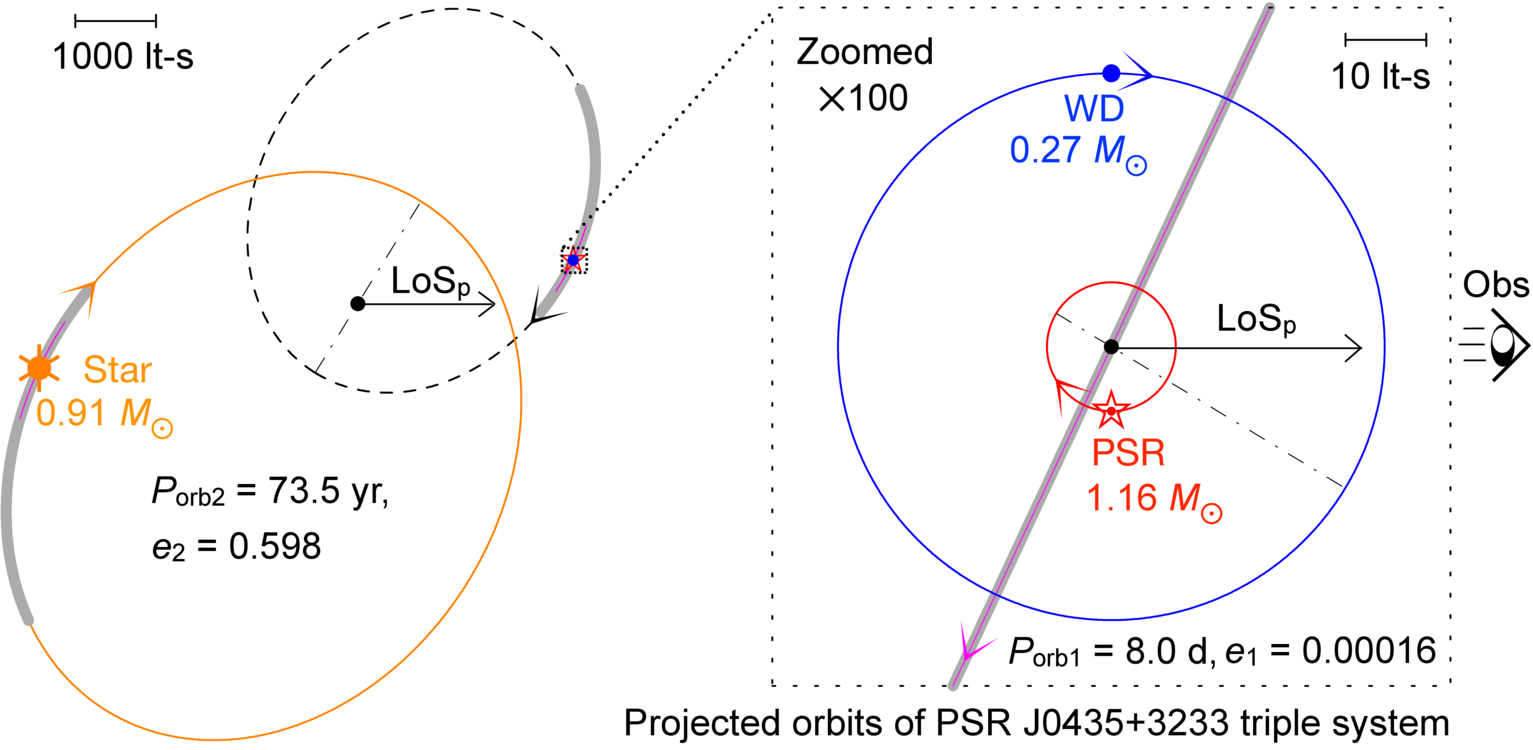
With this broad dataset, the team confirmed the identity of the pulsar’s white-dwarf companion, detected gamma-ray emission from the pulsar, and identified a second previously unknown companion, a subgiant star roughly as massive as the Sun. These three stars are arranged in a hierarchical triple: the pulsar and white dwarf orbit one another tightly, and the subgiant is a more distant companion, orbiting in decades rather than days. Current observations show that the orbits of the inner binary and the outer star are tilted relative to one another, either nearly perpendicularly or at about 54 degrees. While a triple system of three closely intertwined stars invites chaos, this configuration is stable long term.

Insights into Stellar Evolution

While it’s common to find millisecond pulsars in binary systems β€” in fact, many millisecond pulsars are thought to spin up to their incredible speeds via accretion from a stellar companion β€” it’s rare to discover them in triple systems. Because this system is isolated out in the field rather than crowded together with other stars in a dense cluster, Yang and collaborators suspect that the three stars have been together since birth, as opposed to being assembled dynamically later on.
projected orbits of PSR J0435+3233 and its two stellar companions

Projected orbits of the three stars in the system. Click to enlarge. [Yang et al. 2026]

The most massive star in the trio would have hurried through its main-sequence lifetime in less than 10 million years, culminating in a supernova. The remaining two members of the system would have had to withstand this explosion, which the team found is possible but not especially likely; the likelihood of the system coming unglued due to a star going supernova depends on how much of a β€œkick” the explosion gives the newborn pulsar, and even in a zero-kick scenario, the likelihood of the system remaining bound is only 35%. The future evolution of the system will be less dramatic. The outer star will eventually evolve into a white dwarf, undergoing a gentle transition that poses no threat to the stability of the system.

Triple-star systems are common among massive stars, but how this configuration affects stellar evolution is still being explored. This discovery offers a valuable opportunity to study dynamics and stellar evolution in a rare triple system.

Citation

β€œThe PSR J0435+3233 Triple System,” Z. L. Yang et al 2026 ApJL 1010 L9. doi:10.3847/2041-8213/aeaa29

The post A Pulsar in a Rare Triple System appeared first on AAS Nova.
The Solar System Has a New Life Expectancy, and It’s a Billion Times Shorter

30 September 2026 at 17:00

Image of a solar flare.

Isaac Newton suspected that the gravitational dance between the Sun and Jupiter would eventually destabilize the solar system, but modern computational research has shown that its long-term stability is, statistically, pretty secure. However, new simulations with more realistic solar mass-loss conditions make a strong case for the disassembly of the outer solar system β€” and on timescales much shorter than previously thought.

Kick It Up a Notch

A plot showing final orbits of the outer planets for two simulations.

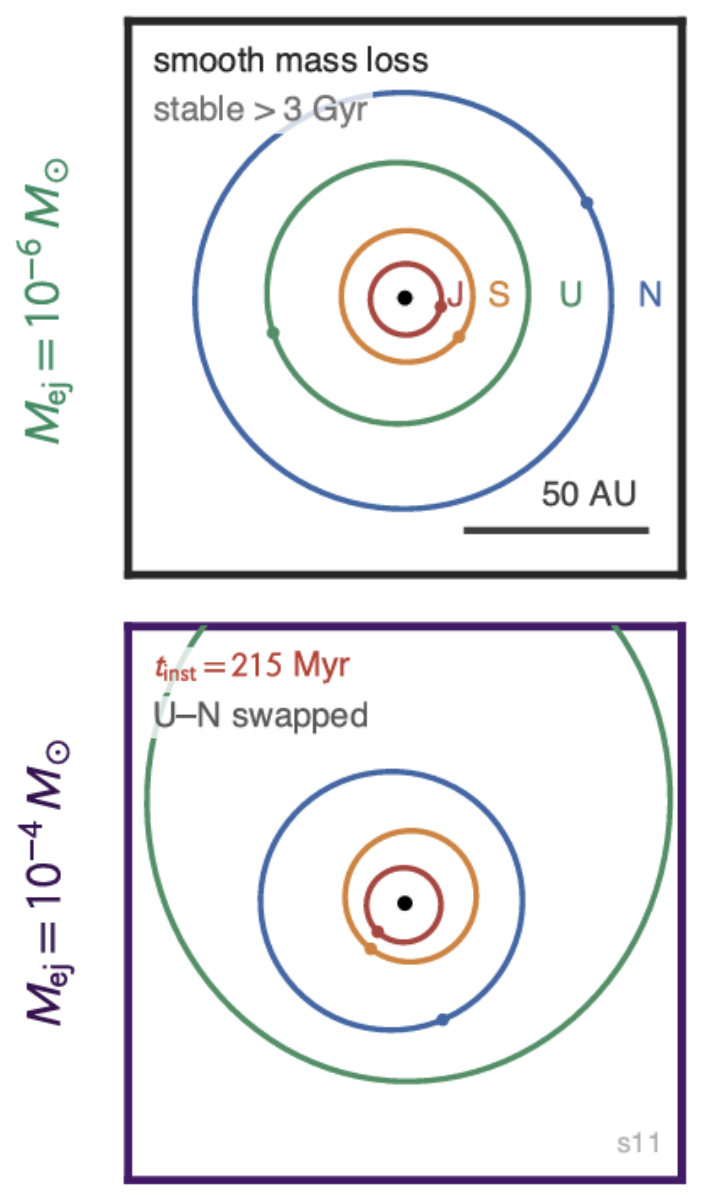
Final outer planet orbital configurations for two simulations β€” one stable and one unstable. t=0 at the onset of white dwarf formation. Click to enlarge. [Adapted from Batygin et al. 2026]

Several studies have investigated what will happen to the orbits of planets in our solar system as the Sun sheds its mass during its transition to a white dwarf. These studies have found that while the semimajor axes of the planets will expand by approximately a factor of 2, their orbits remain stable on timescales longer than the age of the universe (approximately 1018 years). This expanded orbital architecture will make the solar system more prone to jostles from stellar flybys, but even accounting for this, the giant planets’ orbits wouldn’t disassemble for another 30–100 billion years.

However, all of these studies modeled solar mass loss as a smooth function, so the dismantling of the solar system was left up to external forcings. In reality, stars on the red giant branch undergo mass ejections that are random in time and direction, corresponding to velocity β€œkicks” that can alter the dynamics of the planets.Β 

A team led by Konstantin Batygin at the California Institute of Technology conducted numerical experiments to analyze the orbital dynamics of the outer solar system under different solar mass-loss conditions. First, they tested the classic case of smooth mass loss and validated previous findings that, despite planetary orbits doubling in size, the dynamics are pretty tame. This holds true even when mass is ejected anisotropically: if the timing is smooth, the asymmetries cancel out.

Outer Solar System, Your Days Are Numbered

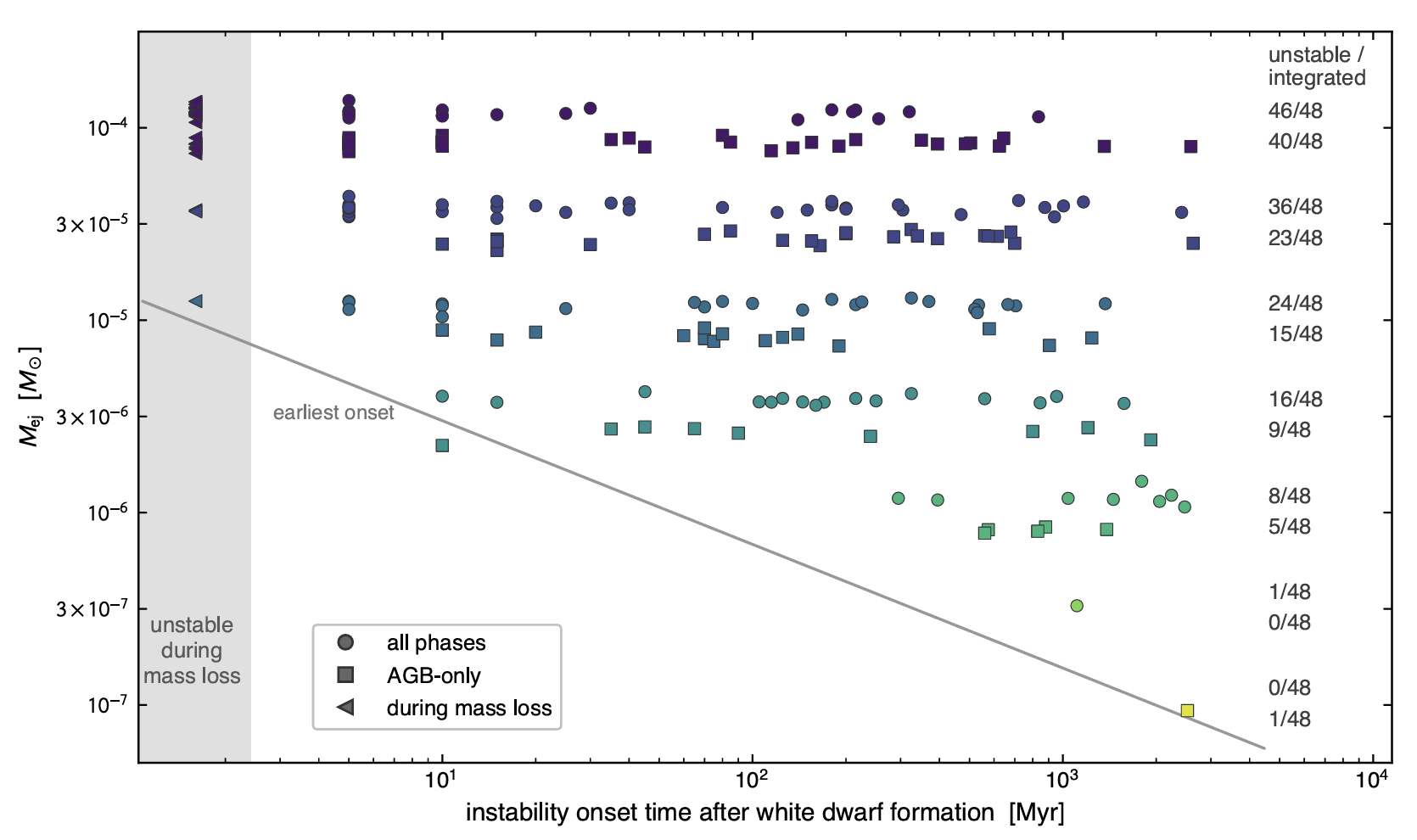
Next, they simulated stochastic kicks and found that the behavior of the outer planets was largely tied to the ejection mass of each kick. For very small ejection masses (≀ 10-7 Mβ˜‰), dynamics mimic the smooth mass-loss case. For intermediate values (10-7 to 10-6 Mβ˜‰), there’s a roughly 20% chance Jupiter–Saturn and Uranus–Neptune enter mean-motion resonances: an orbital configuration where planets’ periods are a ratio of small integers. These resonant configurations don’t protect the giant planets, however: resonant simulations disassemble slightly more often than nonresonant simulations. For larger ejection masses (β‰₯ 10-5 Mβ˜‰), the outer solar system disassembles on the timescale of billions of years.Β 

Plot showing the instability onset times as a function of ejection mass for all simulations.

Instability onset time β€” or how long after white dwarf formation the outer solar system disassembles β€” as a function of ejection mass. The larger the ejection mass, the greater the chance of instability. Click to enlarge. [Batygin et al. 2026]

Which ejection masses are the most accurate for our Sun? Well, unfortunately for our beloved outer planets, ejection models and observed kick amplitudes suggest a future ejection mass of 10-4 Mβ˜‰. With kicks like these, not only is there a considerable chance of orbit destabilization, but it could happen before the white dwarf even forms. About 40% of simulations lead to disruption or violent scattering while the Sun is in its red giant phase, and roughly 90% break down within 3 billion years.Β 

This new discovery reduces the life expectancy of the solar system from one billion billion years to a meager one billion years after white dwarf formation.Β 

Citation

β€œTerminal Instability of the Solar System Triggered by Stochastic Solar Mass Loss,” Konstantin Batygin et al 2026 ApJL 1009 L22. doi:10.3847/2041-8213/aea290

The post The Solar System Has a New Life Expectancy, and It’s a Billion Times Shorter appeared first on AAS Nova.

❌