Login
How to Catch the Orionids, a Meteor Shower From Halley’s Comet
21 October 2026 at 10:00
It’s a fall favorite among stargazers, known for bright, speedy streaks that can sometimes linger in the sky for minutes.


Uranus and Neptune are often described as near-twins, but a new study suggests their chemistry, and possibly their histories, may differ more than expected.
The post Uranus and Neptune May Have Taken Different Paths to Becoming Ice Giants appeared first on Sci.News: Breaking Science News.

On Sept. 30, NASA formally concluded OSIRIS-REx, the historic first U.S. mission to pluck a pristine piece of an asteroid and deliver it safely back to Earth.
The van-sized OSIRIS-REx spacecraft — whose name is short for Origins, Spectral Interpretation, Resource Identification, Security-Regolith Explorer — visited and sampled Bennu, an ancient space rock holding pristine remnants from the dawn of our solar system more than 4.5 billion years ago. Among those cosmic relics are raw organic building blocks, the kind that may have seeded life on Earth.
"I have known this day was coming for a long time, but it is still difficult to see it arrive," OSIRIS-REx Principal Investigator Dante Lauretta, who's based at the University of Arizona, said in a post on LinkedIn. "I feel enormous pride in what we accomplished together, and real sadness that this journey has come to an end."
For the mission team, the farewell capped a decade of high-stakes engineering, on-the-fly troubleshooting and nail-biting close calls that ultimately delivered to Earth the largest asteroid sample ever collected in space, one that held secrets from the early solar system.
Long before launch, the team faced obstacles that nearly thwarted the endeavor — chiefly, two rejections from NASA — before finally securing the green light for the $1 billion project under the New Frontiers Program in 2011.
When OSIRIS-REx launched on Sept. 8, 2016, on a two-year journey across the inner solar system, Bennu was little more than a point of light in telescopes. Scientists expected the asteroid’s surface to be a smooth, sandy sphere where OSIRIS-REx could seamlessly touch down. Much to their surprise, however, when the probe arrived at the asteroid in late 2018, it revealed Bennu to be a treacherous, loosely bound amalgamation of jagged boulders.
"Our expectations about the asteroid's surface were completely wrong," Lauretta said in an Oct. 7 statement from the University of Arizona. "There was no obvious place to collect a sample anywhere."
When OSIRIS-REx touched down on a small crater named Nightingale, Bennu offered so little structural resistance that scientists said its surface reacted more like fluid than a hard, rocky shell. The spacecraft's sampling head sank directly into the asteroid, stopping after burrowing 20 inches (51 centimeters) deep by firing its thrusters at the right time to pull away, with the precious sample in hand.
Then came another nail-biting moment: The sample collector lid got jammed in a partially open position because so much material was scooped up, allowing fragments of the precious cargo to escape. In a race against time to prevent further loss, the mission team quickly stowed the sampler head directly inside the return capsule, securing the cosmic treasure for its journey back to Earth.
Even the final return to Earth, on Sept. 24, 2023, kept the team on edge: A parachute failed to deploy properly during reentry, forcing a tense but ultimately safe landing in the Utah desert.
"Successful exploration missions are not those that avoid surprises; they are those that are deliberately designed to adapt to them," Lauretta said in the statement, quoting a line from the mission's final report to NASA.
"That certainly describes OSIRIS-REx," he said. "Again and again, the mission presented us with circumstances we had not expected, and again and again, this team found a way forward."
The mission's triumphs began long before the samples reached Earth. For example, the probe set a Guinness World Record when it slid into orbit around the 1,610-foot-wide (490 meters) Bennu, which became the smallest object ever circled by a spacecraft.
The scientific payoff that followed included remote-sensing work that confirmed Bennu's surface is coated in carbon-bearing compounds. Those observations also revealed that Bennu was once part of a much larger, water-rich parent asteroid that shattered in a catastrophic collision in the main asteroid belt between Mars and Jupiter.
The returned sample — which weighs 4.29 ounces (121.6 grams) here on Earth, more than twice the mission's requirement — continues to thrill and occupy scientists.
A wave of research papers, now topping 200, continues to piece together the composition and history of the ancient space rock. Among other findings, Bennu's pristine material has revealed amino acids and sugars that, on Earth, are essential for life, alongside a history of exposure to liquid water that could have served as the "broth" for these compounds to interact.
More discoveries are likely to come. Most of the returned Bennu sample is being preserved for future generations of scientists, who will study it "with questions and instruments we cannot yet anticipate," Lauretta said in the statement.
Though its OSIRIS-REx chapter is closed, the spacecraft itself is far from retired. Renamed OSIRIS-APEX (OSIRIS-APophis EXplorer), the probe is using its remaining propellant to head toward Apophis, another near-Earth asteroid and a different type of space rock from Bennu. It is scheduled to arrive in 2029.
Japan launched a $578 million mission Monday on a five-year expedition to land on the largest moon of Mars and retrieve samples for return to Earth, a daring international project that could yield new insights into the formation of the Solar System.
The robotic Martian Moons eXploration mission, known as MMX, lifted off at 3:41 pm EDT Monday (4:41 am Japan Standard Time Tuesday) from Tanegashima Space Center in southern Japan.
The MMX spacecraft rode into orbit atop a 207-foot-tall (63-meter) H3 rocket, Japan's flagship launch vehicle. The rocket assigned to MMX debuted a new souped-up configuration with four strap-on solid rocket boosters, full-throttle main engines, and an extended payload shroud to accommodate the demands of Japan's heaviest and most ambitious interplanetary mission to date.
© ESA/DLR/FU Berlin/Andrea Luck
Officially named C/2026 S1 (Euclid), the comet turned up in images Euclid captured between September 16 and 24, 2026.
The post ESA’s Euclid Space Telescope Discovers Its First Comet appeared first on Sci.News: Breaking Science News.
The moon is shrinking, and scientists are narrowing in on exactly how much our natural satellite has dwindled over the years.
The moon is thought to have formed from a violent collision between a massive object and our young Earth roughly 4.5 billion years ago, and its interior is still gradually cooling off from this ancient collision. As it cools, the moon contracts, leading to a long, slow shrinking process. Now, in a new study, scientists think that they have figured out how much smaller the moon is actually getting.
In this new study, scientists analyzing images snapped by the Lunar Reconnaissance Orbiter Camera (LROC) have spotted over 10,000 young faults, or cracks across the moon's surface. This helped them to figure out how much the moon has contracted over time, and they now estimate that the moon's radius has decreased by about 148 feet (45 meters) over the past 400 to 800 million years.
"The number of these young faults revealed in LROC images is much greater than I ever imagined," study lead Thomas Watters, a geologist and scientist emeritus at the Center for Earth and Planetary Studies at the Smithsonian's National Air and Space Museum, said in a statement. "As the interior of the moon continues to cool and contract, it is expected that the growth of existing faults and formation of new faults continues today."
With these LROC observations, researchers in this study saw a variety of different types of cracks and landforms across the lunar surface. This included lobate scarps, or long, curved structures that form when the moon's surface contracts, cracks and is pushed upwards; and small mare ridges, or narrow "wrinkles" in the lunar surface, across the dark plains on the moon.
Tectonic activity on the moon looks a lot different than it does on Earth. On our own planet, there are about 15 major tectonic plates. On the moon, there are no tectonic plates at all. Instead, the moon has a single-plate body meaning its outer shell is a single piece only broken by faults or other such cracks created by the moon contracting. This means that instead of faults or cracks appearing at tectonic plate boundaries, they are instead scattered all over the moon.
By mapping these thousands of different features, all created from the moon cooling and contracting over time, the researchers are piecing together lunar history. In addition to finding the extent to which the moon has shrunk over time, they also found that some areas of the moon are covered in many more faults than other areas, and the areas with fewer cracks and faults have thicker moon crust.
This led them to conclude that not only are these areas with thicker crust more stable, but they suggest that a great deal of the widespread cracks in the lunar surface were created later in the moon's history as, in its earlier years, its thick crust would have insulated the moon's warm interior and prevented cooling, contracting and cracking.
This work was described in a study published Oct. 14 in The Planetary Science Journal.
Planetary researchers at the University of Sydney have proposed a new way to classify the soils of Mars, along with a new word for them: areth (the name comes from Ares, the Greek name for Mars).
The post Planetary Scientists Create Classification System and Map of Martian Soils appeared first on Sci.News: Breaking Science News.
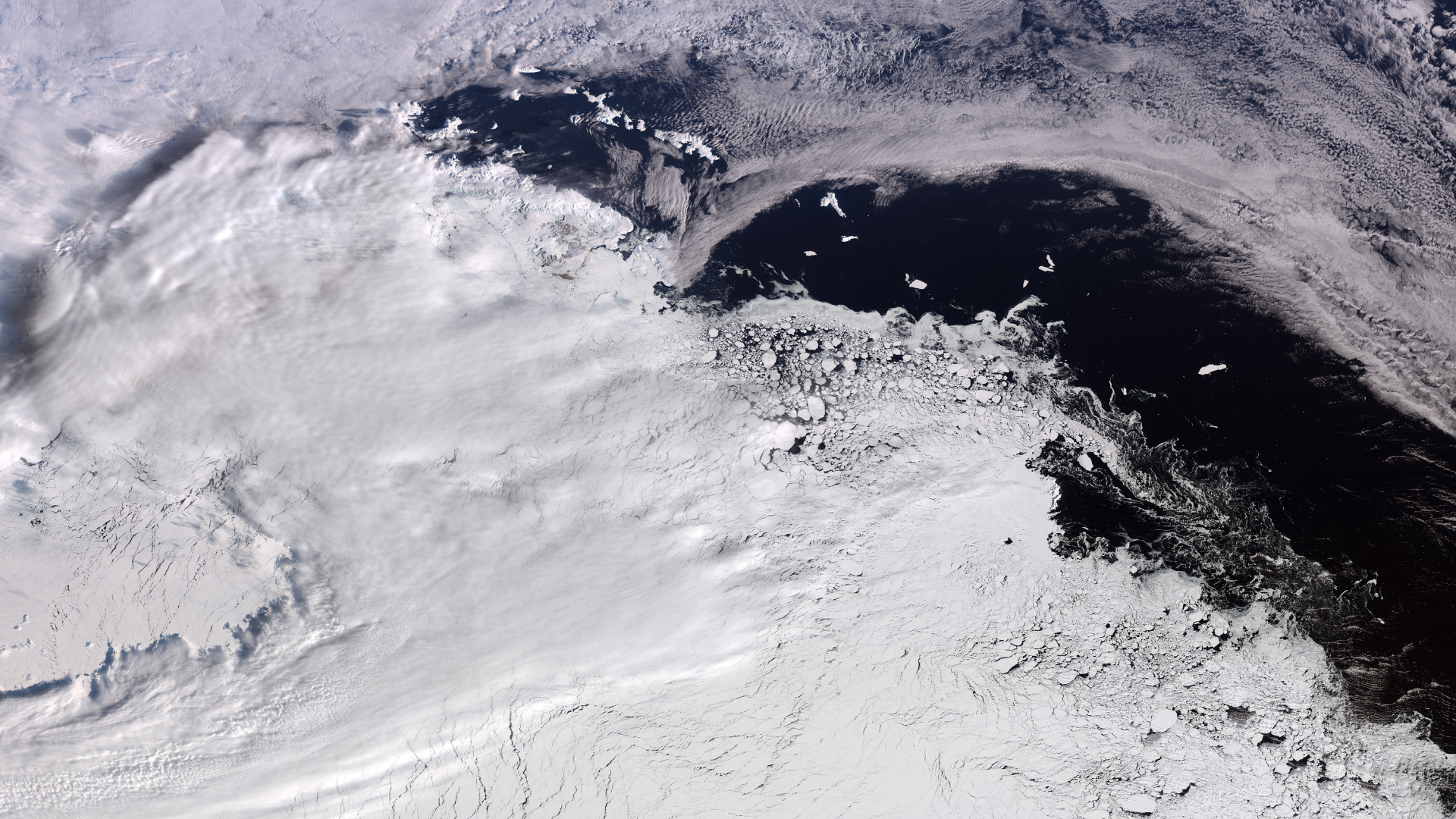
Antarctica is a magnificent sight, and that beauty is visible all the way from space.
Orbiting planet Earth, the European Space Agency's (ESA) Copernicus Sentinel-3 mission captured a close-up of West Antarctica.
Winter is ending in the Southern Hemisphere, meaning this is the peak of icy weather and sea ice in the Arctic.
In this image snapped by Sentinel-3, you can see a massive swath of ice which includes Elephant Island on the left-hand side. An ice-covered island off the Antarctic coast, Elephant Island floats in the Southern Ocean. It got its name both from the island's shape, which some liken to that of an elephant's head, and the fact that the island is home to a community of elephant seals.
While a seal-inhabited island on the left floats near the Antarctic coast, across the water is a vast, frozen landscape. In just this snapshot, you can see about between 746 and 1,056 miles (1,200 to 1,700 kilometers) of the icy continent.
This image was captured on Sept. 30, 2026. In the Southern Hemisphere, that was just past the end of winter. The absolute peak for sea ice in Antarctica fell just a couple weeks before, on Sept. 14, according to the National Snow and Ice Data Center, ESA reported.
So in this one snapshot, we can see a near-maximum for sea ice in the Antarctic, spanning hundreds of miles. In observing our own planet from space, we are able to peer across vast landscapes, capturing important observational data. This is especially critical for the Antarctic as, with the progression of climate change, this sea ice continues to dwindle, adding to sea level rise among other serious consequences across the planet.
For as long as humans have watched the night sky, we have wondered about the moon, pondering everything from its alien appearance to its influence over phenomena on Earth such as ocean tides, climate stability, and even the natural rhythms of many organisms.
Among the many questions we have about Earth's lone natural satellite, one remains preeminent: what are the moon's origins, and how long has it orbited Earth?
Today, the leading theory among astronomers is that deep in our planet's past — perhaps within roughly the first 100 million years of solar system history — Earth collided with a planet-sized object, creating the moon within a period that may have been as short as just a few hours. Known as the giant-impact hypothesis, this proposed event involves a hypothetical Mars-sized protoplanet astronomers call Theia. The material ejected into orbit by the powerful impact in question would have accumulated afterward, forming the moon that we observe today.
The evolution of this striking solution to one of the moon's most enduring mysteries goes back to 1946, when geologist Reginald Aldworth Daly was among the first to suggest that an impact event might explain the formation of the moon.
Before Daly, scientists had been leaning toward theories that involved Earth's rapid spin billions of years ago, when each day may have at one time lasted as little as 2 or 3 hours. Decades later in the 1970s, researchers William Hartmann and Donald Davis developed their own models involving collisions of large bodies left over from planetary formation, which could collide with younger planets.
Building on such ideas, other researchers went on to propose similar scenarios between the early Earth and a Mars-sized object. Early in the following decade, the concept eventually claimed its place as the leading lunar-formation process during a landmark conference held in Kona, Hawaii, in 1984.
The popularity of the giant-impact hypothesis can be attributed to the multiple lines of evidence supporting the impact scenario. For instance, researchers have long recognized the similar stable-isotope ratios between both moon rocks and those from Earth, strongly suggesting a link between their origins.
Additionally, the unusually high angular momentum (or spin) of the Earth-moon system, when compared to observations of other rocky planets, also could be explained as one of the effects of a massive collision.
Further clues can be found in the moon's composition, which reveals a relatively small iron core and lower density. This is significant to astronomers, since a hypothetical giant impact would have seen the suspected Theia protoplanet's metallic core merging with the young Earth's interior — meanwhile, lighter mantle and crust material from both worlds would have become dislodged and blasted into orbit, eventually helping form the moon.
Another important piece of evidence involves the relative depletion of volatile substances (a chemical that easily turns into gas or vapor at room temperatures) in lunar material, which again suggests that it might have been lost during an extremely energetic event, an idea further supported by evidence that the early moon once possessed a substantial magma ocean.
Still, several significant questions remain, including what precise conditions led to the impact, and how the resulting planetary material evolved into the moon as it appears today.
Recently, a new study by Adeene Denton of Southwest Research Institute and colleagues at the University of Arizona's Lunar and Planetary Laboratory put a new spin on the Theia hypothesis, suggesting that the suspected ancient impact may have been significantly influenced by the heat and physical strength of the two colliding bodies.
The team's findings challenge some long-held views about the giant-impact hypothesis, while lending new support to others. For instance, the team's simulations revealed that while some impacts lead to the creation of a disk of debris that later coalesces into a moon, under other conditions, simulations support the idea that the moon could have been formed in a remarkably short period of time — perhaps within around five hours.
However, one of the primary issues with determining the exact conditions of the giant-impact hypothesis involves the ongoing debate over the moon's age.
"There is a large controversy regarding the age of the moon," said Dr. Erik Asphaug, a planetary science professor at the University of Arizona's Lunar and Planetary Laboratory and one of the new study's co-authors.
In an email to Space, Asphaug explained some of the issues arising from this, since current estimates place the timing of the moon's formation anywhere from around 40 to 120 million years after the formation of the solar system. Therein lies part of the issue, according to Asphaug, who says this timing could have significant implications for models of the Theia impact.
If it had been an earlier collision, Asphaug says this would have involved a hotter Theia due to the greater degree of radiogenic heating; by contrast, a later impact would have meant a cooler and stronger Theia.
"I don't think we know enough yet to say the moon (and by corollary, the Earth) formed this way or that way," Asphaug told Space. "But knowing how temperature affects the result opens up a new dimension for viewing the problem, and that is always helpful because it shifts our frame of reference, like getting out of the car to have a walk around."
For researchers like Asphaug, understanding the moon's formation requires looking at it as more than just an event in space, but also as one in time. Doing so allows comparisons between three different metrics: isotopic decay, temperature-dependent material strength, and the geological record of debris striking other planets — a process through which he believes tighter constraints could be placed on precisely when the moon-forming impact might have occurred.
Adeene Denton, the study's lead author, also emphasized the introduction of the time component her team's research brings to the table, telling Space in an email that the outcome of the moon-forming impact could have depended significantly on the timing of the collision.
"Before, scientists have generally assumed that the outcome of the collision will be the same regardless of when it takes place," Denton wrote. "But now we know that temperature's effect on material properties, which is dictated by how old and/or cold the proto-Earth and Theia might be, alters things substantially."
By connecting impact simulations to data related to the moon's geochemical record, as well as models of early solar system formation, Denton thinks her team's work could help scientists better constrain precisely how and when the moon formed.
For now, in terms of which possible scenario — an earlier or later collision event — emerges as being the most likely, Denton says it's still difficult to say.
"It depends on which scenarios for solar system formation you favor," Denton told Space.
"I am generally in favor of an earlier formation of the moon, consistent with a rapid planet-building phase in our solar system," Denton said, "but we can't neglect the possibility that the moon formed late."
While much work remains to be done, Denton and Asphaug believe their findings help significantly advance present efforts to resolve some of the questions about the giant-impact hypothesis — a few of which have lingered now for many years.
For Asphaug, however, such lingering questions may simply be part of the scientific process.
"Science has a way of wandering around for a long time until finally it all comes to focus," Asphaug said.
"I believe that will happen, in part thanks to this work, in the coming decade."
Planetesimal wrecks are raging around distant stars. With the Webb and Spitzer Space Telescopes, astronomers are learning what that looks like.
The post Webb and Spitzer Telescopes Explore the Planets That Never Were appeared first on Sky & Telescope.
Editor's note: Japan launched its bold MMX sample-return mission to the Mars moon Phobos on Oct. 19) at 3:41 p.m. EDT (1941 GMT).
Watch a replay of the liftoff and read our launch story here.
Japan will launch an epic mission to Mars today (Oct. 19), and you can watch the action live.
The Martian Moons eXploration (MMX) mission is scheduled to lift off atop an H3 rocket from Japan's Tanegashima Space Center today at 3:41 p.m. EDT (1941 GMT; 4:41 a.m. on Oct. 20 local Japan time).
You can watch it live via the Japan Aerospace Exploration Agency (JAXA). Coverage will begin at 2:45 p.m. EDT (1845 GMT).
As its full name suggests, MMX will focus on Mars' two moons, Phobos and Deimos. They're both tiny compared to Earth's own moon; Phobos is just 14 miles (22 kilometers) wide, and Deimos is even smaller, with a diameter of about 8 miles (13 km).
They're also quite mysterious. While astronomers have a pretty clear understanding of our own moon's birth — it coalesced from material blasted into space when a Mars-sized planet slammed into Earth long ago — there's no consensus about Phobos and Deimos' origin story.
The duo "may be the remains of a massive impact on Mars that sent material into orbit around the planet, or they could be ancient asteroids that were captured by Mars' gravity billions of years ago," Tom Statler, MMX program executive and program scientist at NASA Headquarters, said in an Oct. 15 statement. (NASA is a partner on the mission, providing a scientific instrument, a technology demonstration, communication support and funding for American scientists on the MMX team.)
"Having the answer will help illuminate that early era when Earth and the other inner planets may have been acquiring much of their water and organic compounds," Statler added.
MMX will help provide that answer, if all goes according to plan.
The spacecraft will arrive in the Mars system in August 2027, then slip into orbit around Phobos a month later. It will study that moon and Deimos from a distance for about 18 months, then deploy the French-German Idefix rover onto Phobos' surface in early 2029.
The 55-pound (25 kilograms) Idefix "has two main tasks: providing information to prepare for the landing of the main spacecraft to collect samples, and analyzing the composition and texture of Phobos' surface," European Space Agency officials wrote in an MMX mission description.
"The gravity on Phobos is so low that Idefix will only weigh the equivalent of 15 grams [0.5 ounces] on its surface!" they added.
The MMX mothership's Phobos landing will occur in 2030. The spacecraft will grab at least 10 grams (0.4 ounces) of samples from the moon, then head back toward Earth with this extraterrestrial bounty. MMX's return capsule will land here in 2031, after which scientists around the world will scrutinize the Phobos sample for clues about the history and evolution of Mars and our solar system more broadly.
MMX was originally supposed to launch in 2024, but issues with the H3 rocket prevented it from doing so. Mars and Earth align properly for interplanetary launches just once every 26 months, so MMX had to wait a while for its next chance.
Japan already has an impressive sample-return track record. The country's Hayabusa mission brought home pieces of the asteroid Itokawa in 2010, for example, and Hayabusa2 did the same with material from the space rock Ryugu a decade later.
Most planetary scientists will tell you the heyday of Venus exploration was more than a generation ago. That is about to change.
Two NASA missions are on track to launch to Venus in the early 2030s. The first, known as the Deep Atmosphere Venus Investigation of Noble gases, Chemistry, and Imaging (DAVINCI), is now scheduled for launch in December 2030, a year earlier than previously planned. DAVINCI will send a parachute-assisted descent probe through the atmosphere of Venus, returning the first direct images of the planet's surface since 1982. A second mission, Venus Emissivity, Radio science, InSAR, Topography, And Spectroscopy (VERITAS), will follow with a launch in November 2032 to map the Venusian surface by radar from orbit.
The European Space Agency is building another orbiter, Envision, for launch to Venus in 2032. The Venus armada might get started as soon as next year, when Rocket Lab aims to launch a privately funded probe to search for signs of organic material in the planet's clouds.
© NASA/Mike Guinto
On October 11, 2026, NASA’s Perseverance rover reached 45.22 km (28.1 miles), edging past the 45.16 km (28.06 miles) logged by NASA’s Opportunity rover, which explored Mars from 2004 to 2018.
The post Perseverance Becomes Farthest-Traveling Vehicle on Another World appeared first on Sci.News: Breaking Science News.
Isaac Newton suspected that the gravitational dance between the Sun and Jupiter would eventually destabilize the solar system, but modern computational research has shown that its long-term stability is, statistically, pretty secure. However, new simulations with more realistic solar mass-loss conditions make a strong case for the disassembly of the outer solar system — and on timescales much shorter than previously thought.
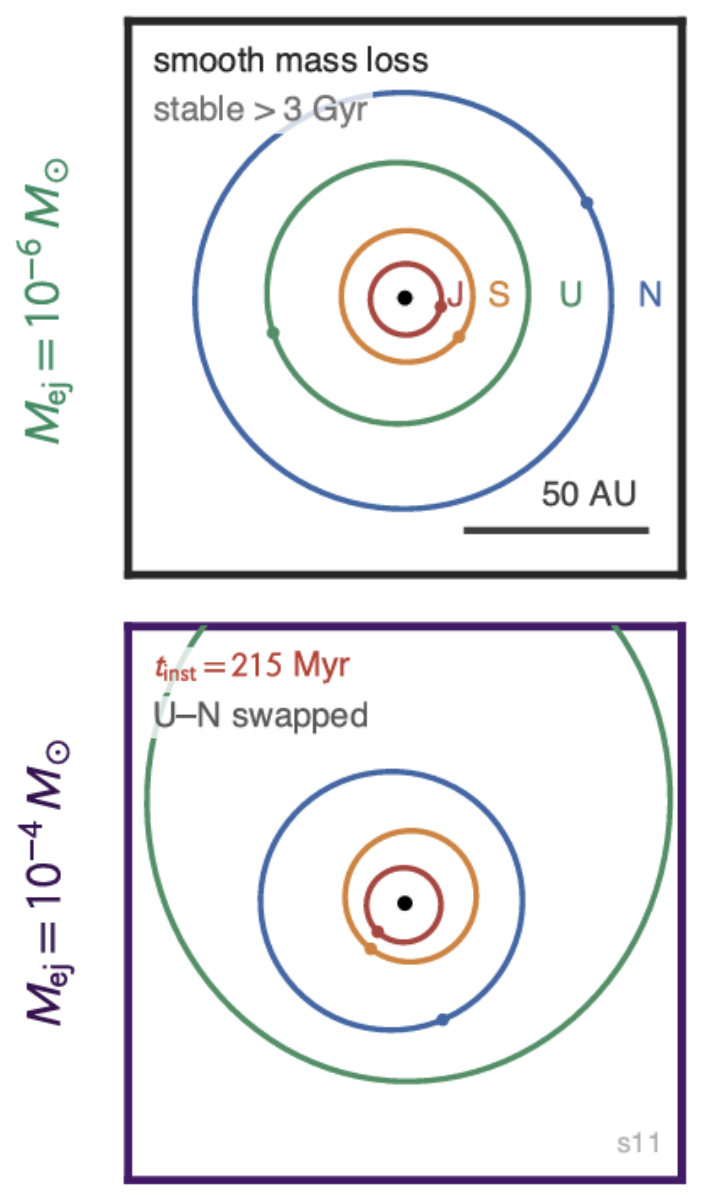
Final outer planet orbital configurations for two simulations — one stable and one unstable. t=0 at the onset of white dwarf formation. Click to enlarge. [Adapted from Batygin et al. 2026]
However, all of these studies modeled solar mass loss as a smooth function, so the dismantling of the solar system was left up to external forcings. In reality, stars on the red giant branch undergo mass ejections that are random in time and direction, corresponding to velocity “kicks” that can alter the dynamics of the planets.
A team led by Konstantin Batygin at the California Institute of Technology conducted numerical experiments to analyze the orbital dynamics of the outer solar system under different solar mass-loss conditions. First, they tested the classic case of smooth mass loss and validated previous findings that, despite planetary orbits doubling in size, the dynamics are pretty tame. This holds true even when mass is ejected anisotropically: if the timing is smooth, the asymmetries cancel out.
Next, they simulated stochastic kicks and found that the behavior of the outer planets was largely tied to the ejection mass of each kick. For very small ejection masses (≤ 10-7 M☉), dynamics mimic the smooth mass-loss case. For intermediate values (10-7 to 10-6 M☉), there’s a roughly 20% chance Jupiter–Saturn and Uranus–Neptune enter mean-motion resonances: an orbital configuration where planets’ periods are a ratio of small integers. These resonant configurations don’t protect the giant planets, however: resonant simulations disassemble slightly more often than nonresonant simulations. For larger ejection masses (≥ 10-5 M☉), the outer solar system disassembles on the timescale of billions of years.
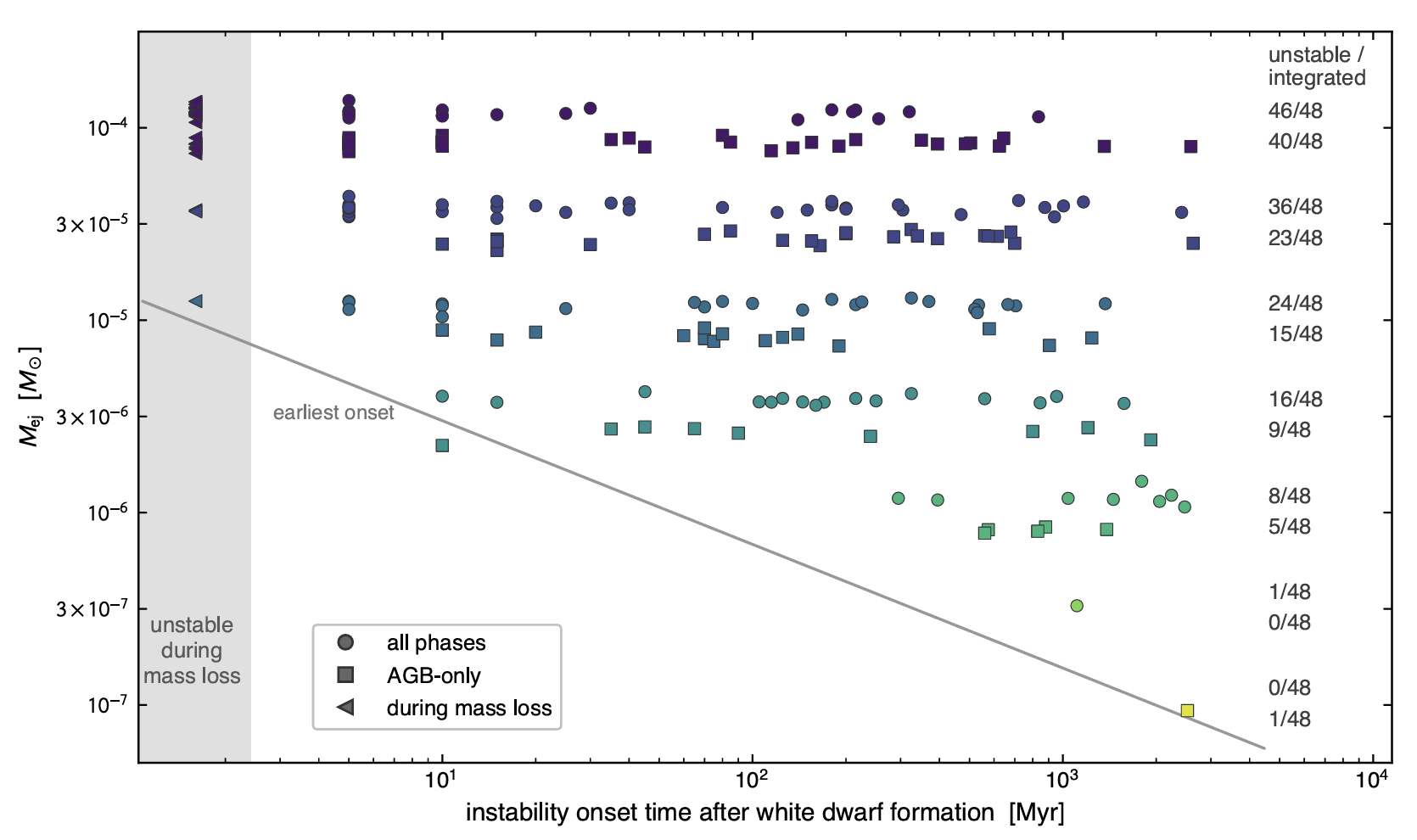
Instability onset time — or how long after white dwarf formation the outer solar system disassembles — as a function of ejection mass. The larger the ejection mass, the greater the chance of instability. Click to enlarge. [Batygin et al. 2026]
This new discovery reduces the life expectancy of the solar system from one billion billion years to a meager one billion years after white dwarf formation.
“Terminal Instability of the Solar System Triggered by Stochastic Solar Mass Loss,” Konstantin Batygin et al 2026 ApJL 1009 L22. doi:10.3847/2041-8213/aea290
The post The Solar System Has a New Life Expectancy, and It’s a Billion Times Shorter appeared first on AAS Nova.