❌

Normal view

Not All Black Holes Who Wander Are Lost

19 October 2026 at 17:00

interacting galaxies Arp 147

Editor’s Note: Astrobites is a graduate-student-run organization that digests astrophysical literature for undergraduate students. As part of the partnership between the AAS and astrobites, we occasionally repost astrobites content here at AAS Nova. We hope you enjoy this post from astrobites; the original can be viewed at astrobites.org.

Title: Tracing Black Hole and Galaxy Growth Across Environments Since Cosmic Noon
Authors: Emma Jane Weller et al.
First Author’s Institution: Yale University
Status: Published in ApJ

They say you can’t choose your hometown, but it still ends up shaping who you become. Turns out the same is true for black holes. The galaxy a black hole grows up in will have a major impact on how it will live out the rest of its life. Similarly, the black hole can leave a lasting impression on its galaxy!

Astronomers have long known that a galaxy’s stellar mass (the combined mass of all its stars) tracks pretty tightly with the mass of the black hole sitting at its centre: bigger galaxy, bigger black hole. This is one pillar of the idea that galaxies and their central black holes coevolve; that is, their life stories are tangled up with one another from early on. But ever since JWST started spotting suspiciously large black holes in the early universe, astronomers have been debating whether this relationship holds steady across cosmic time, or whether the rules were different when the universe and everything in it was younger.

Not Everyone Stays in the Town Centre

Most previous studies of the relationship between black holes and their galaxies have focused only on the central black hole: the biggest, most famous resident of a galaxy, sitting right downtown at its centre. That’s a reasonable place to start, since the central black hole is usually the most massive one around and tends to dominate the story. But this article’s authors wanted to know what happens to everyone else in town, too!

That includes satellite black holes, which are the central black holes of smaller “satellite” galaxies that orbit a bigger “primary” galaxy, a bit like a small town around a big city. It also includes a stranger, more recently discovered population: wandering black holes. These are the black hole equivalent of someone whose hometown got swallowed up by an expanding metropolis, and who never quite settled into their new surroundings.

Here’s how it happens: when a small satellite galaxy merges with a larger one, the satellite gets torn apart by tidal forces and its gas and stars are stripped away. However, its central black hole is often left behind, drifting through the new, much bigger galaxy on a wide orbit. The process that would normally drag a black hole down to the centre of a galaxy, called dynamical friction, is painfully slow, so wanderers can spend billions of years roaming the outskirts.

Two Cities, Two Sets of Rules

To study how these different black hole “life paths” shape, and are shaped by, their host galaxies, the authors turned to two cosmological simulations, ASTRID and TNG300, which handle black hole physics quite differently.

In TNG300, black holes are assumed to start fairly massive and are snapped straight to the centre of their host galaxy at every timestep. This makes mergers happen quickly and often, but it also means there’s no such thing as a wandering black hole in TNG300.

ASTRID, on the other hand, seeds smaller black holes and lets them move more realistically through their galaxy using a subgrid dynamical friction model. This is what allows wandering black holes, with their slow, aimless orbits, to exist and be studied in the first place.

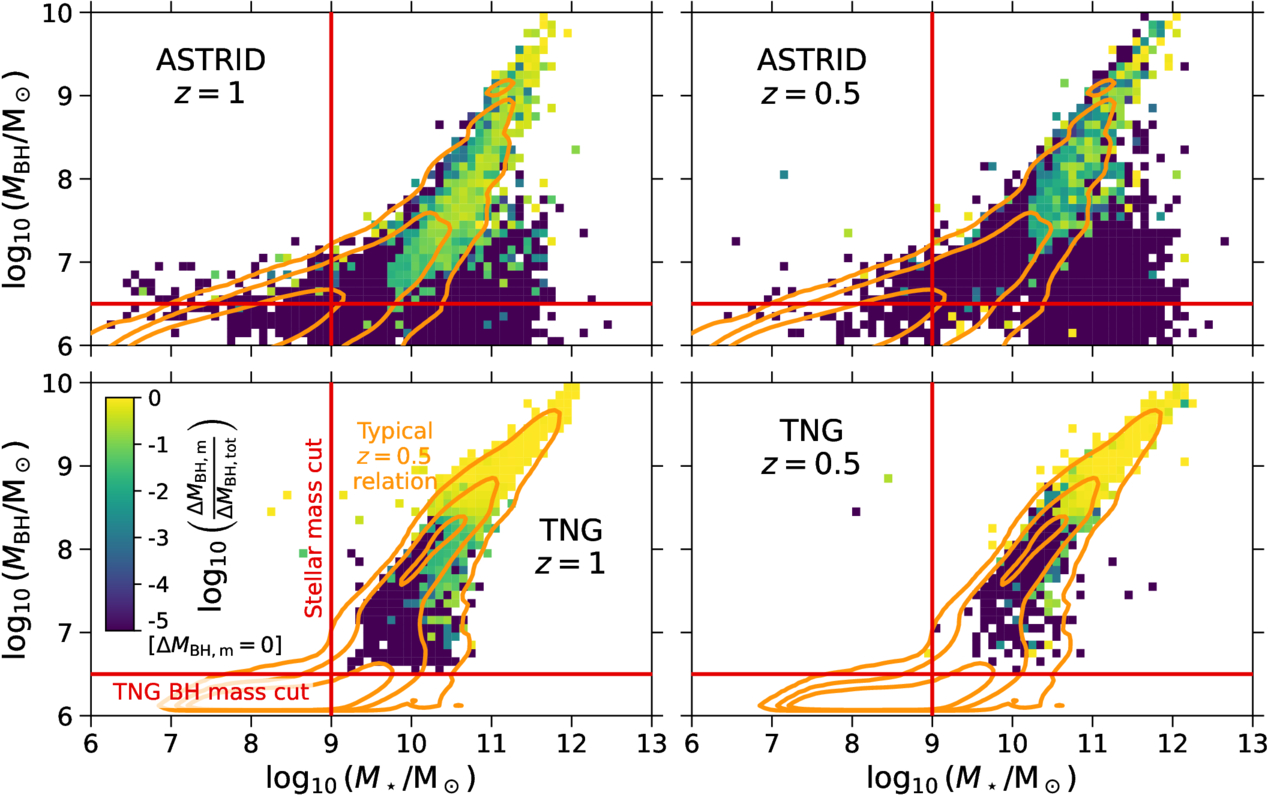
Figure 1 reveals a lot at once. First, ASTRID (the simulation that allows wandering black holes and tidally stripped satellites) has whole new neighbourhoods on the map that simply don’t exist in TNG300. Those populations clearly aren’t following the same tidy, linear coevolution that central black holes enjoy with their galaxies. Second, the most massive black holes tend to be the most yellow, meaning mergers did the heavy lifting for their growth. This is especially pronounced in TNG300, where roughly 80–90% of the growth of the most massive black holes comes from mergers. Meanwhile, the wanderers and stripped satellites sit at the deep-purple end: these black holes have barely merged with anyone at all.
relation between black hole mass and host galaxy stellar mass

Figure 1: How black hole mass relates to host galaxy stellar mass, shown at two snapshots in cosmic history, 8 and 5 billion years ago, for both simulations (ASTRID: top row; TNG300: bottom row). Colour shows what fraction of each black hole’s growth since the last snapshot came from mergers, from purple (grown almost entirely by slowly swallowing gas) to yellow (grown mostly by swallowing other black holes). [Weller et al. 2026]

Four Kinds of Black Hole Life Stories

Pulling all of this together, the authors sketch out a kind of “neighborhood map” of black hole fates, sorted by where a black hole ends up on the mass-relation plot and how it got there (see Figure 2).
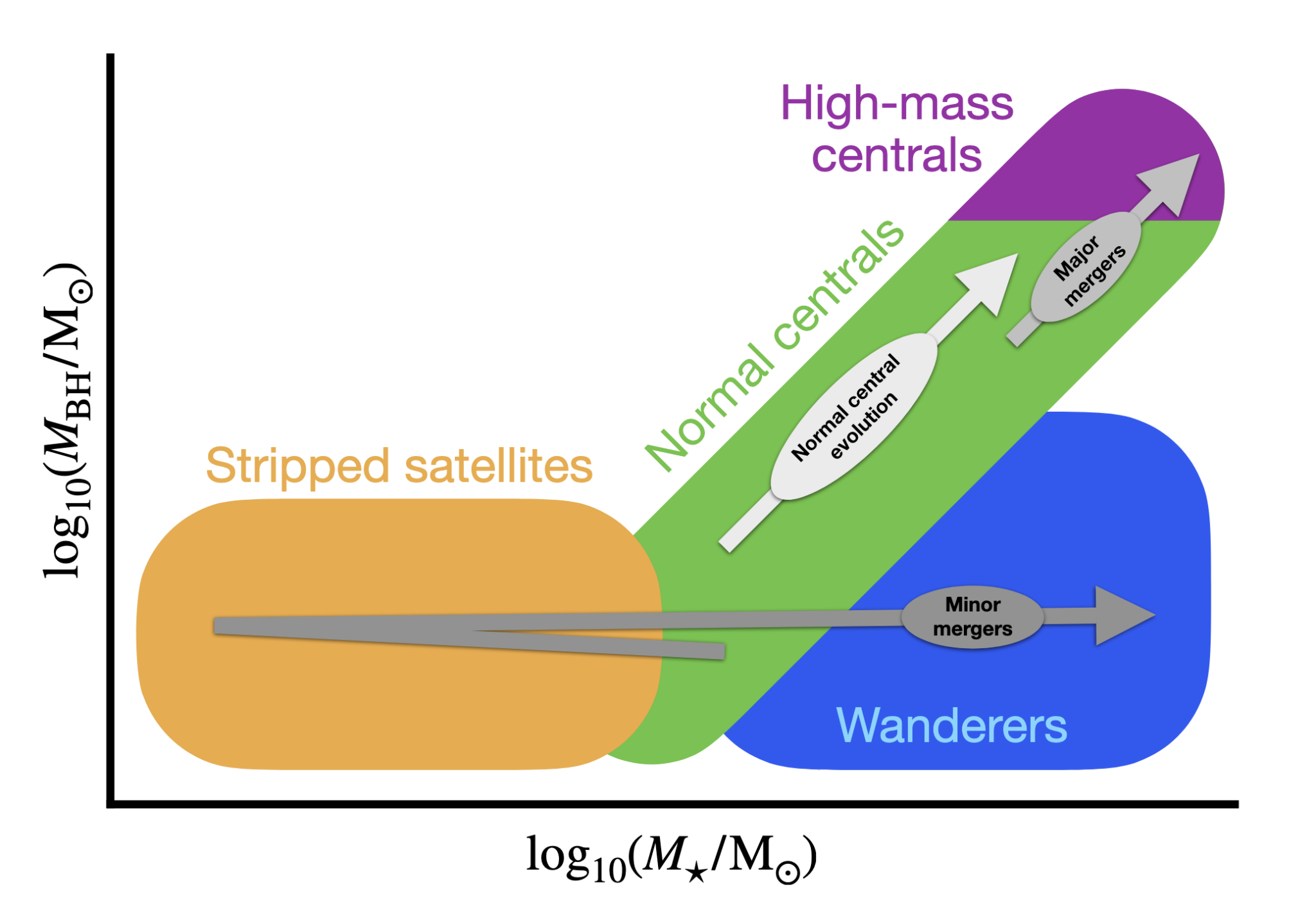
diagram showing the distinct populations revealed by the black hole mass–stellar mass relation

Figure 2: The distinct black hole populations revealed by the black hole mass–stellar mass relation, and the evolutionary path that lands each population in its corner of the map. [Weller et al. 2026]

  • Normal centrals are the homebodies. They sit at the centre of primary or satellite galaxies and grow up steadily alongside their hometown, climbing the mass relation together through a healthy mix of accretion and the occasional merger. Their galaxies keep forming stars the whole time in a functional, unremarkable, thoroughly nice place to live.
  • High-mass centrals are the ones who “made it.” These are central black holes in big primary galaxies, and their growth comes overwhelmingly from mergers with other black holes. Once they get big enough, they start throwing their weight around: their jets blast gas out of the galaxy, shutting down both star formation and their own further growth.
  • Stripped satellites are the annexed suburbs. They start out on the normal mass relation, but a merger with a bigger galaxy tears away their gas and stars, shrinking their stellar mass while their black hole is left comparatively overweight for its new, smaller home. With their gas reserves gone, star formation grinds to a halt, and their black holes, starved of fuel, barely grow either.
  • Wanderers are the ones who moved to the big city and never quite settled in. They start out on the normal relation inside a satellite galaxy, but when that galaxy merges into something much bigger, they’re left drifting through unfamiliar, low-density territory. With little gas around to feed on and almost no chance of merging with anyone else, their growth basically stalls.

This four-way map is a genuinely useful new way to read the black hole–galaxy relation: a black hole’s exact position on the plot isn’t just a number, it’s a fossil record of everywhere it’s ever “lived.”

There’s plenty more in the article we haven’t covered here, including how quenching plays out over time, how these results stack up against the local universe, and a closer look at how star formation rates and black hole accretion rates track each other across all four populations. If any of this piqued your interest, the full article is well worth a read.

Original astrobite edited by Ryan White and Chloe Klare.

About the author, Jayde Willingham:

I am a first-year PhD student at Swinburne University of Technology studying the early universe and how the first galaxies came to be. My work combines observations and theoretical modelling to explore how galaxies form, evolve, and shape the universe we see today. When I’m not at my desk or doing SciComm, I’m probably reading a good book with a hot beverage under a cozy blanket.

The post Not All Black Holes Who Wander Are Lost appeared first on AAS Nova.
Astronomers want your help finding 'missing' black holes in the Milky Way

18 October 2026 at 13:00

Astronomers estimate that our home galaxy, the Milky Way, has churned out more than 10 million black holes over its 13-billion-year history. Yet so far, they have found only 70.

Now, a group of astronomers in the U.K. is trying to close that vast gap by enlisting the public. Their project, called Black Hole Hunters, is looking for volunteers with a computer and a few spare minutes to sift through troves of data gathered by a NASA space telescope. By flagging recognizable patterns that could point to a "missing" black hole, volunteers can help fast-track a search that would otherwise take years, the team says.

"You'll be narrowing down precisely where we need to point our telescopes next," project co-lead Adam McMaster, an astronomer at the University of Southampton in the U.K., said in a statement, "and you might be the one to discover a black hole."

Cosmic magnifying glasses

Black holes form when massive stars roughly 20 times heavier than our sun run out of fuel and collapse, leaving behind an abyss with gravity so immense that even light cannot escape. While invisible themselves, these cosmic behemoths reveal their presence by bending the light of nearby objects, and the Black Hole Hunters project is searching for one specific manifestation of this effect.

It happens thanks to the fact that massive stars often form in pairs, and a star can sometimes survive the violent supernova explosion that turns its companion into a black hole. When that happens, the two bodies continue to orbit each other. If such a duo aligns just right with Earth, the black hole will periodically pass directly between its companion star and our planet. And when it does, the black hole's gravity acts like a cosmic magnifying glass, bending and magnifying the star's light, causing it to briefly appear brighter to watchful telescopes.

To find these hidden giants, the project relies on data from NASA's Transiting Exoplanet Survey Satellite, or TESS. Although the satellite's primary mission is to hunt for planets beyond our solar system, its method of data collection — tracking tiny, continuous changes in a star's brightness over time — is ideally suited for identifying black hole magnification events, the project description notes.

"It's a simple task with no expertise required," McMaster said in the statement. "We will show volunteers examples of what to look for so all they have to do is recognise the right patterns."

Automated algorithms conduct a preliminary sweep of the TESS data, screening millions of potential stars for the most obvious black hole candidate locations, according to the project description. But, the researchers say, artificial intelligence struggles with the messy realities of the cosmos, such as stellar flares and the natural pulsations of stars that can trick the algorithms into false positives.

The human touch

That makes human volunteers a key part of the search. To keep errors in check, each graph is shown to multiple volunteers, and their answers are combined so that individual mistakes average out, according to the project's website.

"I can search for black holes on my laptop from my bedroom — and could make a real impact on real space science," Grace Clarke, an undergraduate student of physics and astronomy at the University of Southampton who's involved with the project, said in the same statement. "The data's easy to understand — it's just pattern recognition — and you don't need a degree in astronomy to read it."

The crowdsourced shortlist of promising signals lets astronomers aim follow-up observations at specific stars, such as precise measurements of whether a star is being tugged at by an unseen companion. Those measurements take time and are expensive, so a good shortlist helps researchers spend scarce telescope time wisely, the team says.

Since launching on the Zooniverse platform in October 2021, the project has attracted nearly 23,000 volunteers, who have completed more than 12 million classifications, according to its website.

Before turning to TESS, the team ran a similar search using data from SuperWASP, a ground-based survey that, like TESS, monitored stars for signs of planets from 2004 to 2016. Those results are still being analyzed and are expected to be published soon.

The team also plans to widen its search with observations from other instruments, including the European Space Agency's Euclid mission and NASA's recently launched Nancy Grace Roman Space Telescope.

"With potentially thousands of new discoveries, we need all the help we can get," McMaster said in the statement.

Supermassive black hole blasts out a neon 'treble clef' | Space photo of the day for Oct. 16, 2026

A blue gaseous galaxy background with a bright neon pink treble clef shape through the center.

The "treble clef" galaxy cluster is an unusual source of radio waves, the Chandra X-ray observatory has found. (Image credit: X-ray: NASA/CXC/INAF-IRA/A. Botteon et al.; Infrared: UKIDSS-GPS ; Radio: ASTRON/LOFAR; Image processing: NASA/CXC/SAO/N. Wolk)

What looks like a neon pink treble clef floating out in space is actually a bizarre source of radio waves spotted deep in the cosmos.

What is it?

Scientists using NASA's Chandra X-ray Observatory have peered far out into space to look at strange radio waves coming from what they have nicknamed the "treble clef" because of its distinct shape, which looks a lot like the musical notation.

Using Chandra, as well as the German Extended RÖntgen Survey with an Imaging Telescope Array (eROSITA) X-ray telescope, researchers looking at this strange sight spotted a big cloud of blue gas, which we can see in this image, along with radio signals (seen here in bright pink). They think that this object is actually a huge galaxy cluster made up of two different clusters that are in the process of merging.

Why is it incredible?

The researchers think they may have gotten to the bottom of where these radio waves are coming from, they report in a new study.

The team thinks that the treble clef-shaped radio signals were created by an outburst from a supermassive black hole. They believe that this outburst pushed clouds of charged particles and magnetic fields away from the galaxy cluster's center, producing bright radio waves.

According to the scientists, following this bright outburst, there was likely an extreme collision between two galaxy clusters. This cosmic smash-up either compressed or somehow reenergized these charged particles to amplify the radio signal.

When we see beautiful images of objects in space such as this, they can seem just like peaceful, colorful, cosmic clouds. But when you look a bit deeper, these spectacular scenes can actually be evidence of violent, chaotic events.

This work was described in a study published in the journal Astronomy & Astrophysics.

Catching the Culprit Behind Globular Clusters’ Disappearing Binaries

14 October 2026 at 17:00

The formation of young binary protostars.

Roughly one-third of stars in the Milky Way are in binary or multiple systems, but only ~1–10% of stars in globular clusters have a companion. Did globular clusters start with fewer binaries than the solar neighborhood, or have they since been wiped out? 

Survival of the Tightest

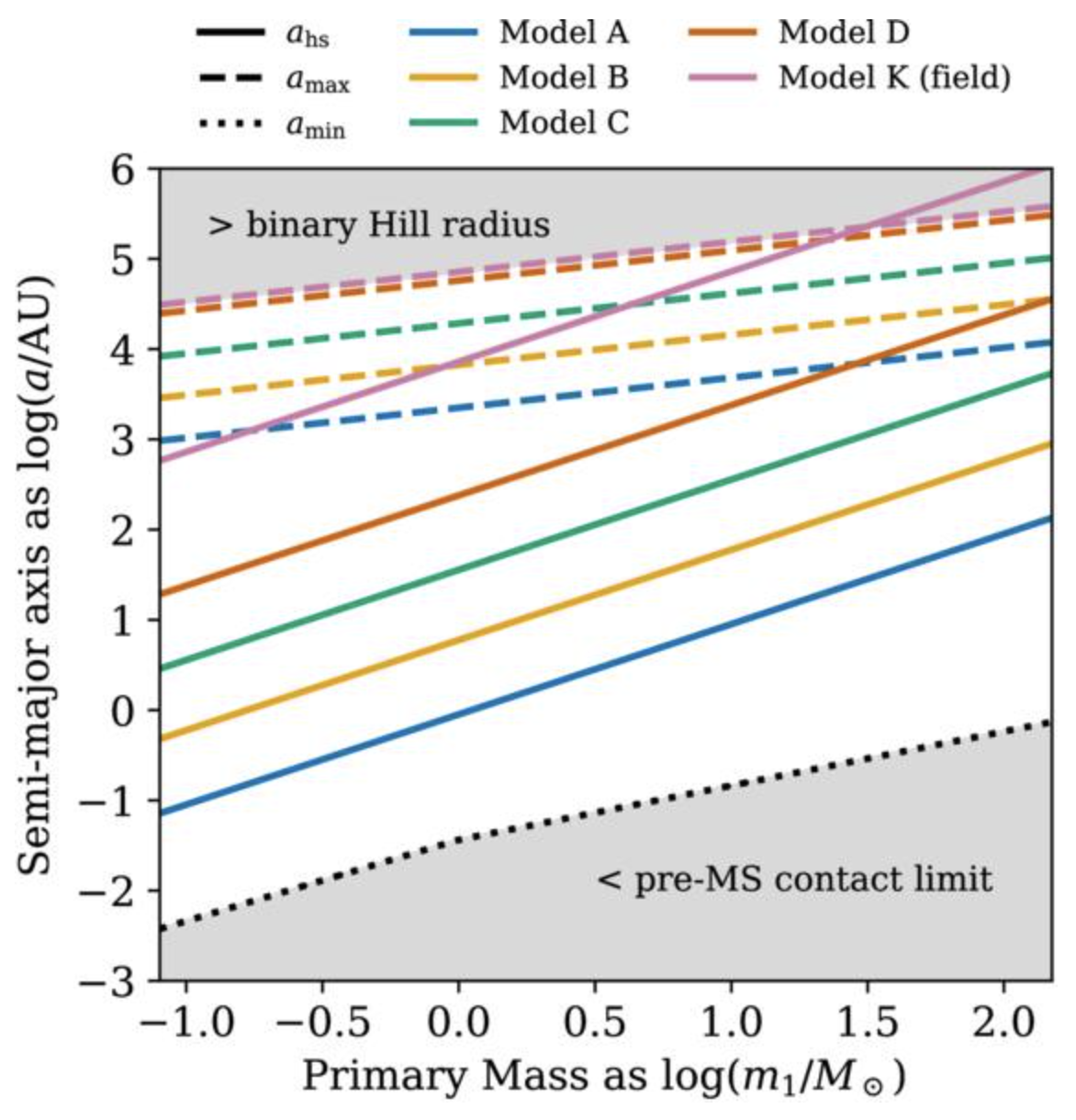
Plot of semi-major axis vs. primary mass of binary stars.

Map of the semi-major axis–primary mass parameter space for binary systems. Solid lines show the boundary between hard (below the line) and soft (above the line) binaries for a variety of models. Models A–K span a variety of cluster masses and virial radii (a proxy for cluster density). [O’Connor et al. 2026]

Globular clusters (GCs) are dense, ancient, gravitationally bound groups of stars. A team led by Christopher O’Connor at Northwestern University explored whether the lack of binary systems could be the result of some process unique to GCs. First, the team developed an analytical formalism to understand how binaries in a GC evolve depending on the binary stars’ masses, distance from each other, and interactions with other stars in the cluster. 

It turns out that the fate of a binary system depends on whether it is dynamically “hard” or “soft.” Hard binaries are generally tightly bound, and they tend to get “harder” from stellar flybys, which are common in a crowded cluster environment. Soft binaries are the opposite — they have much shorter lifetimes since encounters with other stars tend to loosen them. The team found that, assuming GCs have the same initial distribution of binaries as the solar neighborhood, the dissolution of soft binaries is sufficient to explain the present-day scarcity of binaries in GCs. 

Burning Away the Binaries

What actually tears the soft binaries apart? The answer is a process called “black hole burning.” As some of the most massive objects in a globular cluster, black holes in binary systems can transfer energy when they interact with passing stars. This influx of energy can excite soft binaries to the point of dissolution, the study shows. 

Black hole burning can also prevent core collapse in GCs. Left to itself, a cluster’s core gradually loses energy to its outskirts, causing the core to grow hotter and denser with stars. This leads to more dynamical interactions between stars that can then get flung from the core or enter new tight binaries. Black hole burning pumps energy back into the core and prevents this from happening. 

Putting the Theory to the Test

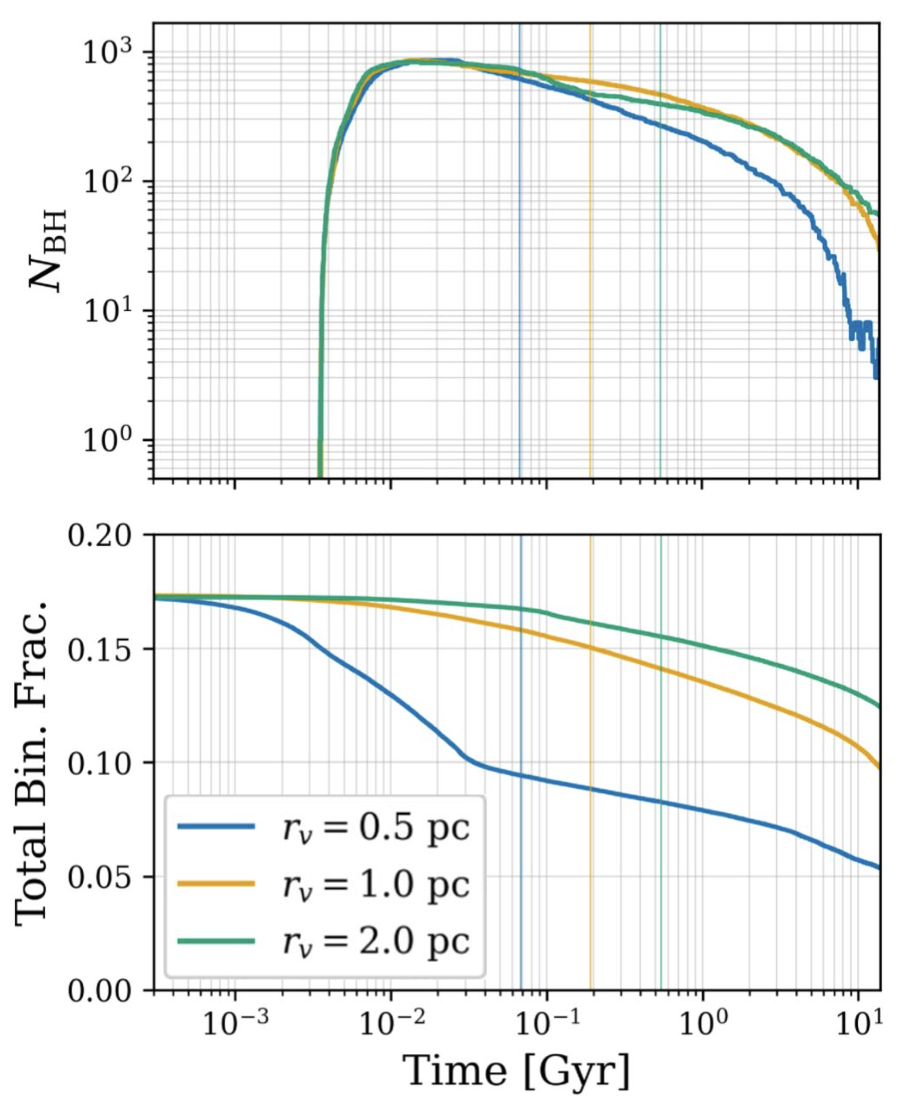
Plot that shows the number of black holes and total binary fraction in simulated globular clusters with time.

The total number of black holes in a cluster (top) and the binary fraction (bottom) as a function of time for three different cluster models. In the densest cluster (blue), binary dissolution starts early on, mainly driven by stellar collisions. For the other two models, binary dissolution mainly occurs after the number of black holes reaches its peak and black hole burning commences. [Adapted from O’Connor et al. 2026]

To validate their analytical results, the team performed N-body simulations of GC dynamics with the Cluster Monte Carlo code. They found that, in moderate-to-low-density clusters, the decline of binary systems is powered mainly by black hole burning. In more compact clusters, however, stellar collisions also play an important role in the dissolution of binary systems, and at earlier times than the onset of black hole burning.

In general, the final binary fractions of the simulated clusters agree with those predicted by the team’s analytical formalism. This further supports the theory that there is a universal initial binary distribution between galactic GCs and our solar neighborhood. Constraining this distribution is pivotal for refining dynamical models of GCs.

In short, GCs and the solar neighborhood likely started with the same amount of binary systems, and interstellar dynamics handled the rest. 

Citation

“A Common Origin for Binary Fractions in the Field and in Dense Clusters,” Christopher E. O’Connor et al 2026 ApJ 1009 L80. doi:10.3847/1538-4357/aea078

The post Catching the Culprit Behind Globular Clusters’ Disappearing Binaries appeared first on AAS Nova.

❌