L'acqua del rubinetto italiana è sicura nel 99,1% dei casi con controlli rigorosi, ma un italiano su tre non si fida nonostante i dati. Può contenere residui di cloro, microplastiche o metalli in tubazioni vecchie, ma non compromette la sicurezza. Leggere, usare vista e olfatto per verificare, e contattare il Comune se l'acqua è torbida o con odori sgradevoli.
Your public Facebook posts could help inform AI-generated results in Meta's new AI Mode. When you search on Facebook, the "AI Mode" option will appear alongside the usual search modes like "People" and "Marketplace." It's one of several new AI features Meta is rolling out starting today, including photo presets that swap sports jerseys onto fans and suggestions for collage templates.
Instead of "just links," it gives users AI-generated results that pull from publicly-posted content across Meta's platforms, like the AI search feature in its new Reddit-like Forum app. Users can also ask Meta's AI follow-up questions in response to the search …
Un equipo científico logró detectar cómo se distribuye una molécula dentro de una gota de helio superfluido, revelando una especie de sombra cuántica imposible de ver con luz convencional. El resultado ofrece una forma inédita de observar la función de onda, una de las ideas más abstractas de la física cuántica.
Deep inside a limestone cave in southern China, paleontologists have uncovered an assemblage of thirteen fossilized teeth belonging to Gigantopithecus blacki, the largest primate species ever known to have lived.
Per oltre due decenni gli scienziati hanno cercato di comprendere meglio il misterioso Atelocynus microtis, un raro canide amazzonico soprannominato “cane fantasma” per la sua estrema elusività. Grazie a una vasta rete di fototrappole installate nelle foreste della Bolivia e del Perù, nelle regioni del Grande Madidi-Tambopata e dei Llanos de Moxos, i ricercatori della […]
Nuevas excavaciones y dataciones han permitido situar las enigmáticas esculturas de piedra del Cáucaso en una etapa mucho más antigua de lo que muchos imaginaban. Los vishaps no serían simples monumentos aislados, sino piezas de un sistema ritual conectado con montañas, manantiales y paisajes sagrados.
Tra i reperti più affascinanti giunti fino a noi dalla civiltà azteca vi è una rara maschera rituale in legno raffigurante Mictlantecuhtli, il potente dio della morte e signore dell’oltretomba. Scolpita oltre cinque secoli fa, questa straordinaria opera rappresenta una preziosa testimonianza delle credenze religiose di uno dei più grandi imperi dell’America precolombiana. Conservata oggi […]
I ricercatori hanno studiato un raro meteorite lunare trovato nell’Africa nord-occidentale, chiamato NWA 12593, che conserva al suo interno le tracce di tre distinti eventi di impatto avvenuti sulla Luna in epoche molto remote. Lo studio si è concentrato soprattutto sul più antico di questi impatti, che è stato datato a circa 3,5 miliardi di […]
Solar Orbiter obtuvo las primeras observaciones directas del polo sur solar y encontró un comportamiento inesperado en su campo magnético. Los datos muestran que los supergránulos transportan magnetismo hacia los polos a velocidades que los modelos actuales del ciclo solar no habían anticipado.
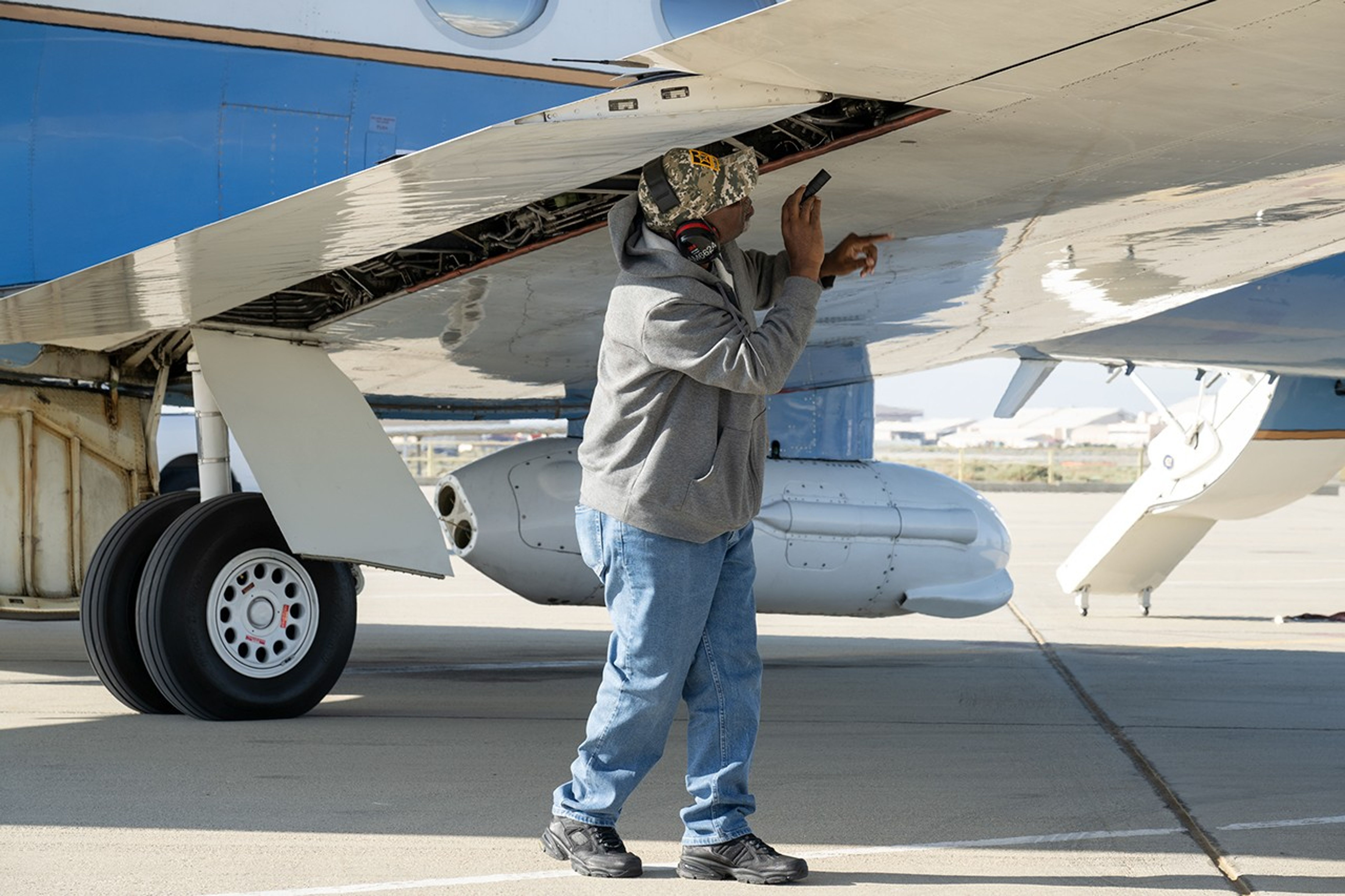
Alvin Mitchell, a NASA C-20A aircraft quality assurance inspector, completes preflight checks at NASA’s Armstrong Flight Research Center in Edwards, California, on April 29 for a mission over Central California. On May 2, the aircraft departed for the Tropical Synthetic Aperture Radar campaign carrying NASA’s Uninhabited Aerial Vehicle Synthetic Aperture Radar.
NASA/Ryan Kline
Data from a NASA campaign in Panama and Peru will help communities prepare for tropical floods in cloud-covered areas, improve scientific understanding of forest health, and support planning for spaceborne missions.
NASA’s C-20A aircraft from Armstrong Flight Research Center in Edwards, California, flew the Uninhabited Aerial Vehicle Synthetic Aperture Radar (UAVSAR) instrument, developed at NASA’s Jet Propulsion Laboratory in Southern California, to gather mission data. While flying repeat paths, the instrument collected high-resolution radar data from a pod mounted beneath the aircraft. The monthlong campaign, known as Tropical Synthetic Aperture Radar, or TropiSAR, concluded on June 4 after 17 flights totaling 75 hours.
Airborne data were captured over Peru in the same times and locations as data captured by the NISAR (NASA-ISRO Synthetic Aperture Radar) satellite to validate key NISAR capabilities and support calibration of the satellite’s L-band radar system. The science validation targeted two measurements: tropical rainforest flood extent within the Pacaya-Samiria National Reserve in Peru, one of the world’s largest protected flooded forests, and glacier movement in the Huascarán National Park in the Peruvian Andes, which is home to the largest concentration of tropical glaciers. The mission also gathered detailed 3D views of tree height and density to estimate biomass, assess forest health, and better understand how forest ecosystems store and release carbon.
In Panama, TropiSAR also supported NASA’s Airborne Validation Unified Experiment: Land and Ocean (AVUELO) campaign in collaboration with the Smithsonian Tropical Research Institute. Airborne radar data were collected from dry forests and coastal wetlands with the goal of better understanding Panama’s rich biodiversity. By linking field measurements with airborne and satellite observations, AVUELO may advance new methods for studying the tropics.
The upper stage from a commercial Chinese rocket that launched last week has broken apart in space, spreading debris in a heavily trafficked part of low-Earth orbit home to the International Space Station and a significant portion of SpaceX's Starlink broadband network.
The breakup occurred shortly after the Zhuque-2E rocket reached orbit on June 9 with two satellites providing direct-to-cell communications, perhaps around the time the upper stage was expected to perform a disposal burn. The US Space Force confirmed the breakup event in a post on space-track.org, a website used by the military to distribute orbit data to the public.
"The tracked pieces are being incorporated into routine conjunction assessment to support spaceflight safety," the Space Force wrote in an advisory. "There are currently no threats to human spaceflight. Analysis is ongoing."
A simple vista parece un objeto salido de una película de ovnis. En realidad, es uno de los mejores laboratorios naturales para entender cómo nacen los planetas. Un equipo internacional ha conseguido algo inédito: mapear en tres dimensiones las capas químicas de este disco y señalar exactamente dónde la materia empieza a congelarse.
Meta announced Monday that it's rolling out a wave of new AI features on Facebook, the latest sign of the company's effort to catch up in the AI race and keep users more engaged on the platform.
Tres mandíbulas halladas en Marruecos han abierto una nueva discusión en paleoantropología. Los fósiles podrían pertenecer a un linaje humano situado cerca del punto donde comenzó a definirse la historia evolutiva que terminaría dando lugar a Homo sapiens.
À mesure que les systèmes d’intelligence artificielle gagnent en puissance et en autonomie, leur fonctionnement devient de plus en plus difficile à saisir. Des chercheurs mettent en garde contre une tendance qui pourrait compliquer notre capacité à garder le contrôle sur ces technologies.

 Login