Login
In a Win for SEO’s and Webmasters, Googles’ SERPAPI “Scraping” Lawsuit Tossed
22 July 2026 at 11:54
The ruling is narrower than some headlines suggest. The court dismissed Google’s current DMCA claims, permanently rejecting the theory for…



Torna in promo, con uno sconto al check-out, il Google Pixel 10 Pro XL. Il modello è ora disponibile con un prezzo ridotto a 899 euro e con anche la possibilità di pagare in 12 rate mensili senza interessi, per tutti gli utenti abilitati a questo tipo di acquisti.
Si tratta di un'opportunità da cogliere al volo: i nuovi Pixel 11 stanno arrivando e potrebbero registrare un rincaro nel prezzo di listino. Il futuro 11 Pro XL, quindi, sarà disponibile con un prezzo sensibilmente superiore a quello dell'attuale 10 Pro XL.
Per sfruttare la promo basta premere sul box qui di sotto.
a 949 euro.a 896 euro.
As fears of a bursting AI bubble reach new heights, Google has emerged as arguably one of the best yard sticks available to measure investor sentiment around AI.
Google’s parent company, Alphabet, released its quarterly earnings report on Wednesday. On the surface, there were plenty of reasons to pop the champagne: as the New York Times reported, the company’s profits rose to a staggering $112 billion, four times higher than the nearly $25 billion in profit over the same period last year.
Yet underlying that banner profit is a familiar beast: the same circular financial motions that gave rise to the AI bubble narrative in the first place.
As the NYT observes, the vast majority of Google’s windfall — $99 billion, to be exact — wasn’t due to actual revenue from AI or any other services the company offers; instead, it was due to Alphabet’s mammoth investments in other tech companies. In particular, Alphabet attributed the massive profits to investments in corporations also chasing the AI payday, like Elon Musk’s SpaceX, as well as Anthropic, the company behind the popular chatbot Claude.
In other words, it’s great financial news — until the instant the AI market crashes, in which case it would all come crashing down. (In an earnings statement, Alphabet CEO Sundar Pichai enthused that Google’s “AI investments are redefining what’s possible across every part of our business.”)
Under that green surface froth is a churning sea of red. In addition to those starry revenue numbers, Google upped its anticipated 2026 capital expenditures from $180 to $190 billion — already staggering numbers — to an eye-watering $195 to $205 billion. The argument, in a nutshell, is that it needs to spend much more to break out of the computing bottleneck, which will unlock even higher profits next year.
As Gizmodo observed, Alphabet’s chief financial officer Anat Ashkenazi told investors to expect that figure to “increase significantly in 2027.”
At the same time, Alphabet posted a negative free cash flow for the first time as a publicly traded company, meaning the actual cash it generated after covering operating expenses and capital expenditures is worse than nil.
That revised forecast, coupled with the bone-dry cash flow, left investors shellshocked. On Thursday, the day after the company’s earnings report hit newsrooms, Alphabet’s stock fell by 6.89 percent — evidence, perhaps, that massive profits on paper are no longer enough to keep investors hooked at this stage of the AI bubble.
More on Google: Google’s Immense Greed Is Destroying the Open Web
The post Google’s Profits Look a Little Terrifying Under the Hood appeared first on Futurism.
A court has dismissed Google’s case against SerpApi over that company’s scraping of search results to train AI models.
The US District Court for the Northern District of California found that there was no indication that any copyright had been breached.
Google announced in December that it was suing SerpApI for its alleged web scraping, claiming that it was protecting copyright holders. In February, SerpApI fought back and asked the court to dismiss Google’s case. And this week, Judge Yvonne Gonzalez Rogers agreed with SerpApi that Google’s case has no merit.
Google’s argument was that SerpApi’s actions breached the US Digital Millennium Copyright Act (DCMA). It made two claims: first, that no person shall circumvent a technological measure that effectively controls access to a work protected under this title, and second that no person shall manufacture, import, offer to the public, provide, or otherwise traffic in any technology, product, service, device, or component protected by the Act.
SerpApi claimed that the URLs and other links that were being served by Google did not in themselves entail copyright and the judge agreed. In her judgment, she said that there was no indication that the copyright holders had authorized Google to take action against SerpApi.
The case is not completely over as the judge has given Google 21 days to amend its complaint to demonstrate that it was acting on behalf of the copyright owners. It remains to be seen whether its war against the web scrapers is finally over.
The European Commission has fined Google a total of €890 million ($1 billion) for its breaches of the Digital Market Act (DMA).
Just over half the fine — €460 million — was because Google illegally gave preference to its own services in Google Search results.
The remainder was because in the Google Play store for Android apps, the company prevented app developers from leading consumers to alternative, often cheaper, purchase channels. Under the DMA, app developers who distribute their apps via Google Play or Apple’s App Store should be able to inform customers of alternative offers.
Now Google must give third-party services featuring in its results the same treatment as its own services, and allow developers of apps in the Play Store to communicate about offers both in and outside the Play Store, or face further fines.
The Commission first raised these issues with Google in March 2025. In April of this year, the Commission laid out plans as to how Google should allow other third-parties to share its searches, suggestions that the tech firm firmly resisted. Earlier this month, the Commission also said Android should be open to other AI agents and not limited to Google’s own Gemini.
Google is not the only US company to have fallen foul of the DMA. In April 2025, Apple was fined €500 million for breaching the Act and, last month, the Commission fired the first shots at cloud hyperscalers Microsoft and Amazon.
Publishers have watched in horror as Google continues to double down on AI features that discourage users from actually clicking on links — a once-steady source of readership that’s causing a crisis in the media now that the search engine is cutting it off.
The situation has become so dire that some publications are now debating whether to cut Google off entirely, as the Wall Street Journal reports, illustrating an increasingly fraught relationship between the tech giant and the publishers that are creating content its AI models are regurgitating.
According to the newspaper, prominent outlets including USA Today, Politico, the Economist, People, and Reuters are all reexamining their relationship with Google. Some are debating whether to continue to work with the tech giant at all.
“This is existential for some categories of publishers,” media consulting firm media consulting firm DJB Strategies CEO David Buttle told the WSJ. “They are looking at more radical things.”
Even Reddit executives are reevaluating the company’s $60 million-a-year contract that allows Google to train its AI models on user-submitted content on the platform. They’ve similarly watched as Google’s AI features discourage users from navigating to Reddit.
Last month, Cloudflare CEO Matthew Prince noticed that automated bot traffic had overtaken human traffic for the first time in the internet’s history, a sobering turning point and concerning inflection point for anyone in the attention economy.
USA Today has seen its traffic from US users drop by almost half over the last year, leading executives to ponder whether to cut off Google’s access entirely.
“It’s time to take a stand and say enough is enough,” USA Today CEO Mike Reed told the WSJ.
Naturally, Google doesn’t see itself as the one to blame, arguing that it’s still sending “billions of clicks to the web every week” and helping “creators and publishers grow their audiences” with the help of AI, as a spokesperson told the newspaper.
Those reassurances, however, are seemingly falling on deaf ears. Beyond pondering whether to cut Google off, other publishers have resorted to suing the company, accusing it of illegally rehashing their intellectual property via AI summaries.
It’s an extremely undesirable position for publishers. By severing ties with the search giant, they could face even steeper declines in traffic. At the same time, there’s seemingly little to gain from having Google’s AIs crawl their content — and in the long term, it could guarantee their destruction.
In some ways, Google is biting the hand that feeds it. AI companies are desperately trying to find new training data that doesn’t include AI-generated slop. By actively discouraging users from visiting websites that source new information, the company is cutting off a fresh supply of the data it so desperately needs.
More on Google: Google Admits It Missed Its Climate Goals — Again — Because of AI
The post Google’s Immense Greed Is Destroying the Open Web appeared first on Futurism.
Google was today fined €890 million ($1 billion) by the European Union for breaching antitrust rules with regard to its search and Google Play store services.
The European Commission found that Google had broken the Digital Markets Act (DMA) by using its dominant position in the search market to favour its own services, like shopping and hotel deals, over those of rivals.
The Commission also said that the company had abused its position by preventing developers from directing users to cheaper ways to buy apps and app subscriptions on websites and alternative app stores.
The Commission noted that Google has begun testing changes to how its own services are placed in search results and rolled out changes to its steering terms, which the EU’s main executive body described as substantial progress towards compliance.
“Google has fallen short of effective compliance with the Digital Markets Act, and today we have taken decisive yet balanced enforcement action sanctioning these breaches,” said Teresa Ribera, Executive Vice-President for Clean, Just and Competitive Transition.
“The best products should succeed because they’re better, not because they’re owned by the company running the search engine. And European consumers have a right to be told by app developers where to sign up to the best offers, even when the app store owner does not get a cut.”
With search, Google is required to share with competitors — search engines and AI chatbots alike — a massive amount of user data from Google Search user interactions. What terms people search for, what they click on in results, what languages and devices they use. It’s all ostensibly anonymized but that’s tricky when it comes to search terms. A lot of the terms people type into web search fields are to some degree personally identifying. The EC seems to be saying it’s Google’s problem to filter out things like passwords and usernames and omit them from the shared datasets. Google can charge money for this access, but only under “fair, reasonable, and non-discriminatory (FRAND)” prices, based on a Commission-defined methodology.
Previously:
Update (2026-07-27): John Gruber:
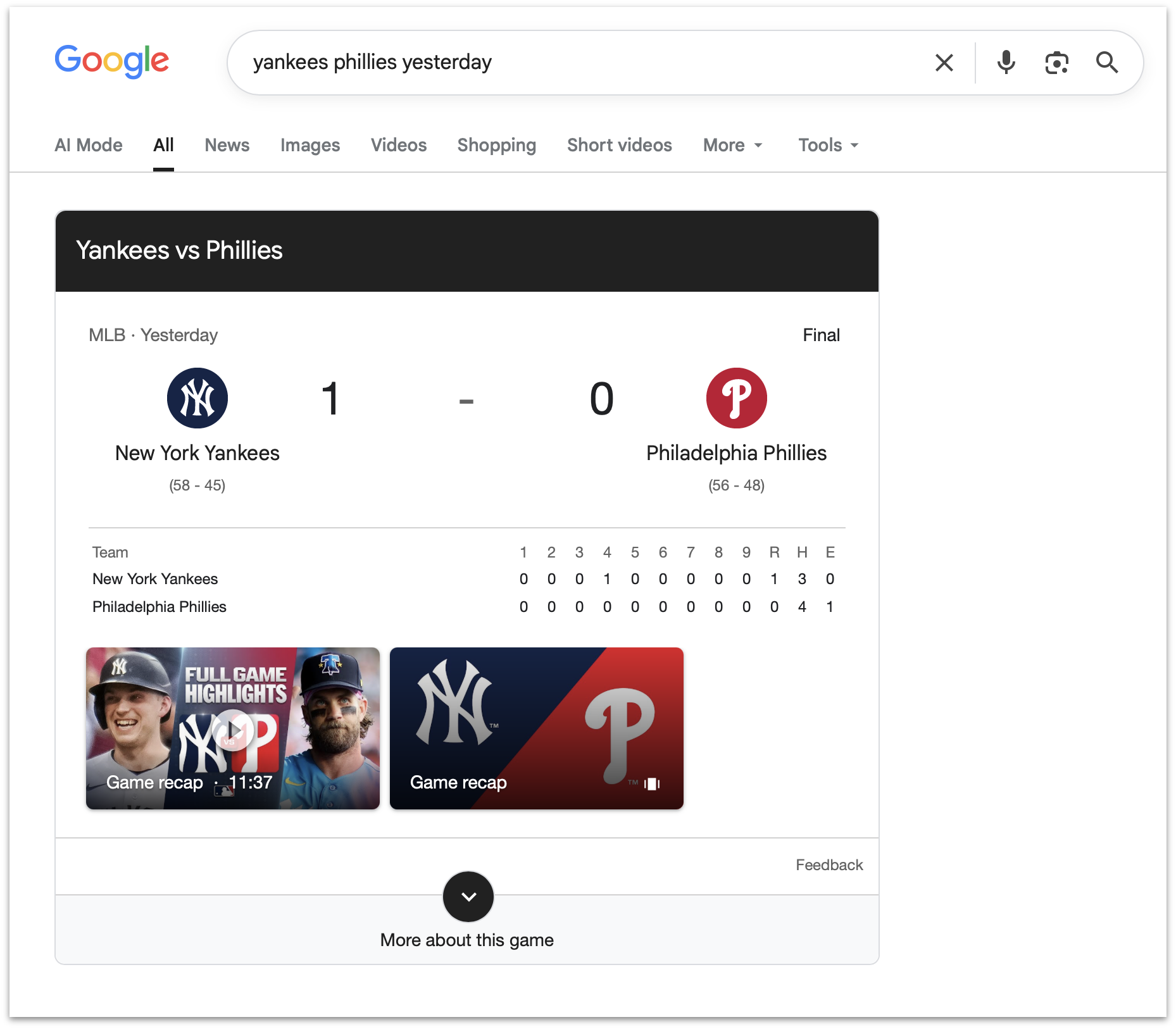
So if you search for the score of a sporting event, it’s illegal in the EU for Google to show you the score, like this search I just tried. What the EC is saying is that because Google Search is so popular, it’s no longer allowed to improve.
It drives me insane when in Europe the link between Google Search and Google Maps is broken and I often have to copy paste an address between the two. Thanks EU, what if I like Google’s integrations?
They could have simply added a selector when a user first clicks on the maps preview in the search result, and then remembered it on device or across that user’s account.
But of course, then the user could choose a competitor’s product and Google would have to honor it. That would be horrible, so instead they just made the user experience worse for everyone and elegantly made people blame the EU.
See also: Hacker News.
Ryan Whitwam (PDF, Reddit):
Back in 2018, Google was handed a record-setting 4.34 billion-euro ($4.9 billion) fine in Europe for abusing its monopoly on Android. The company has spent the intervening years challenging that decision, but the continent’s highest court has put a stop to that. The Court of Justice of the European Union has affirmed the penalty, meaning Google is out of options.
[…]
The EU took issue with Google search and Chrome being the default options on Android. Even devices made by other companies, such as Samsung and Xiaomi, include Google apps as the default per the Android licensing agreement, giving Google an unfair advantage, according to European antitrust regulators. This is not to be confused with a 2.95 billion euro ($3.45 billion) fine against Google’s advertising monopoly issued by the European Union last year.
In 2022, a lower EU court reduced the fine to the current 4.1 billion euros from 4.34 billion euros previously.
Google has argued that the Android operating system provides choice for users and supports developers and businesses across Europe.
Via John Gruber:
Google last year booked $132 billion in profit; this fine is about 3 percent of that..
[…]
There’s never a reason not to string the appeal process out, but it’s especially true when your profits are growing at an exceptional rate. By growing their profits around 5×, they’ve reduced the relative sting of this fine by 5×
Previously: