
❌

Normal view

The Invisible Architecture Between the Stars

12 October 2026 at 17:00

NGC 2467

Editor’s Note: Astrobites is a graduate-student-run organization that digests astrophysical literature for undergraduate students. As part of the partnership between the AAS and astrobites, we occasionally repost astrobites content here at AAS Nova. We hope you enjoy this post from astrobites; the original can be viewed at astrobites.org.

Title: Phase-Dependent Magnetic Coherence in the Turbulent Interstellar Medium
Authors: Iryna S. Butsky et al.
First Author’s Institution: Stanford University
Status: Accepted to ApJ

The space between stars isn’t empty, because it’s threaded with magnetic fields that shape how gas moves and steer cosmic rays as they race across the galaxy. As a result, understanding how the magnetic field is structured within different components of the interstellar medium, specifically clouds of different temperatures, is a key part of understanding how the interstellar medium we see today takes shape.

Because magnetic fields are invisible, astronomers need tracers to reveal their structure. One such tracer is the emission from dust grains. Dust grains are not spherical, and a dust grain’s long axis tends to align at a right angle to the magnetic field, causing dust grains to emit light that vibrates in a particular direction. This is called polarized emission. If the magnetic field in a region is very ordered, the grains all align the same way, and a large fraction of their emitted light vibrates in the same direction, giving a high polarization fraction. This fraction is therefore used as a proxy for whether the field can maintain a consistent direction on large scales (an ordered/regular magnetic field).

Comparing the polarization fraction with other tracers of gas lets astronomers infer the field’s structure in the interstellar medium. Previous observations found that the polarization fraction correlates with the fraction of cold gas, but not with the total amount of gas along the line of sight. This suggests that the field is preferentially ordered within cold clouds rather than warm clouds. Curiously, this seemed to contradict other studies that found the field to be more ordered in the warm clouds. Such disagreements are where simulations become useful: because the true magnetic field is known in a simulation, astronomers can test which interpretation the observations actually support.

In this article, the authors use high-resolution numerical simulations to reproduce the relationship between polarization fraction and cold cloud fraction. They find that as long as the line of sight crosses fewer than about 20 clouds, the polarization fraction correlates with the cold cloud fraction, but not with the total neutral gas (Figure 1). This matches earlier observations, where the correlation shows up at high galactic latitudes, which point out of the galactic plane and therefore cross only a few cold structures. When too many clouds lie along the line of sight, each cloud carries an ordered field pointing in a different direction. Averaged together, these vibration directions cancel out, lowering the polarization fraction and washing the correlation away.
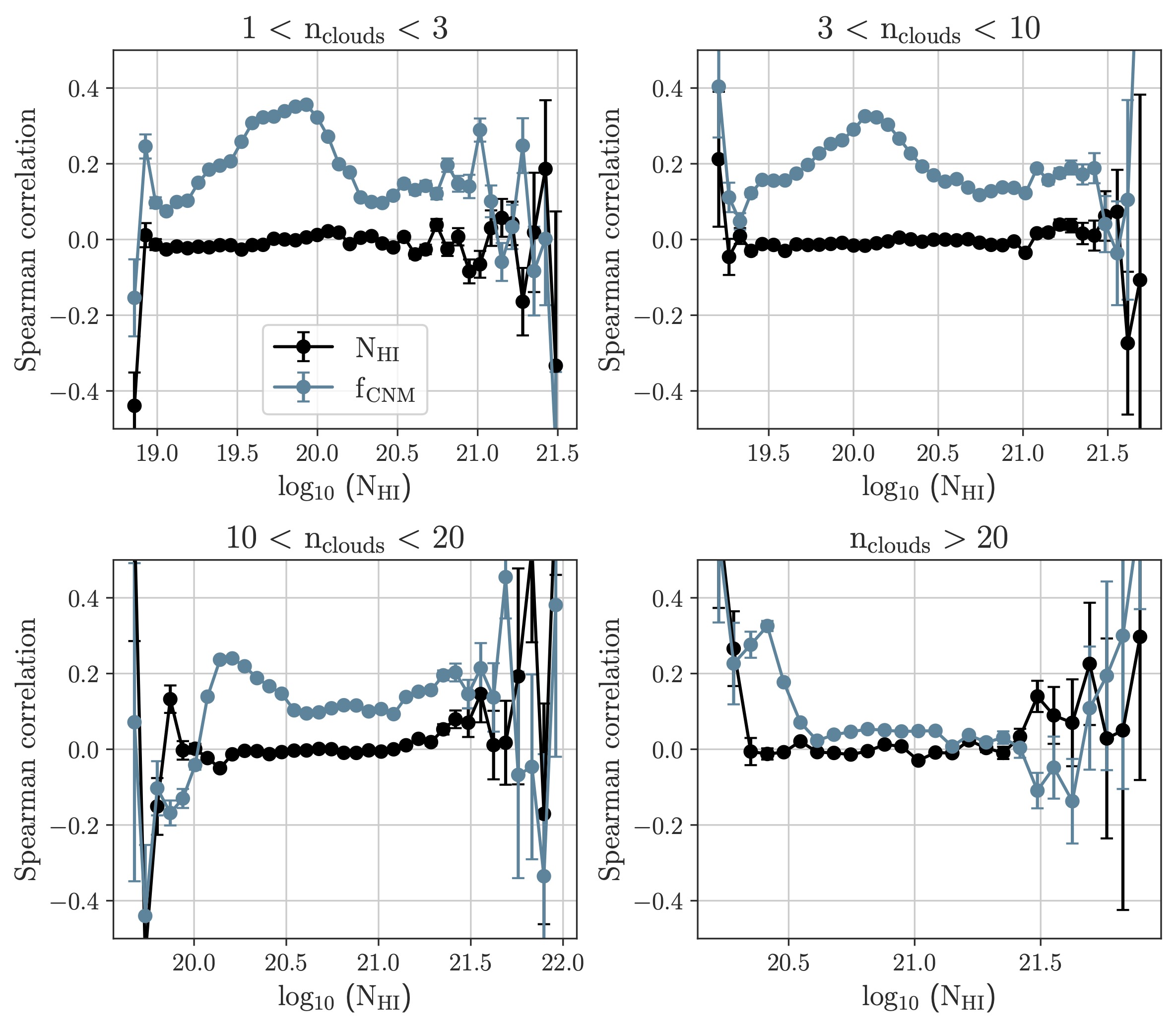
Plots showing the correlation between dust polarization fraction, the total gas amount, and the fraction of cold medium along the line of sight

Figure 1: Correlation between dust polarization fraction, the total gas amount (neutral hydrogen column density, NHI), and the fraction of cold medium along the line of sight (fCNM) for projections of different path lengths. The polarization fraction correlates with fCNM but not with NHI. The correlation disappears once many clouds lie along the line of sight (see lower-right panel). [Butsky et al., in press]
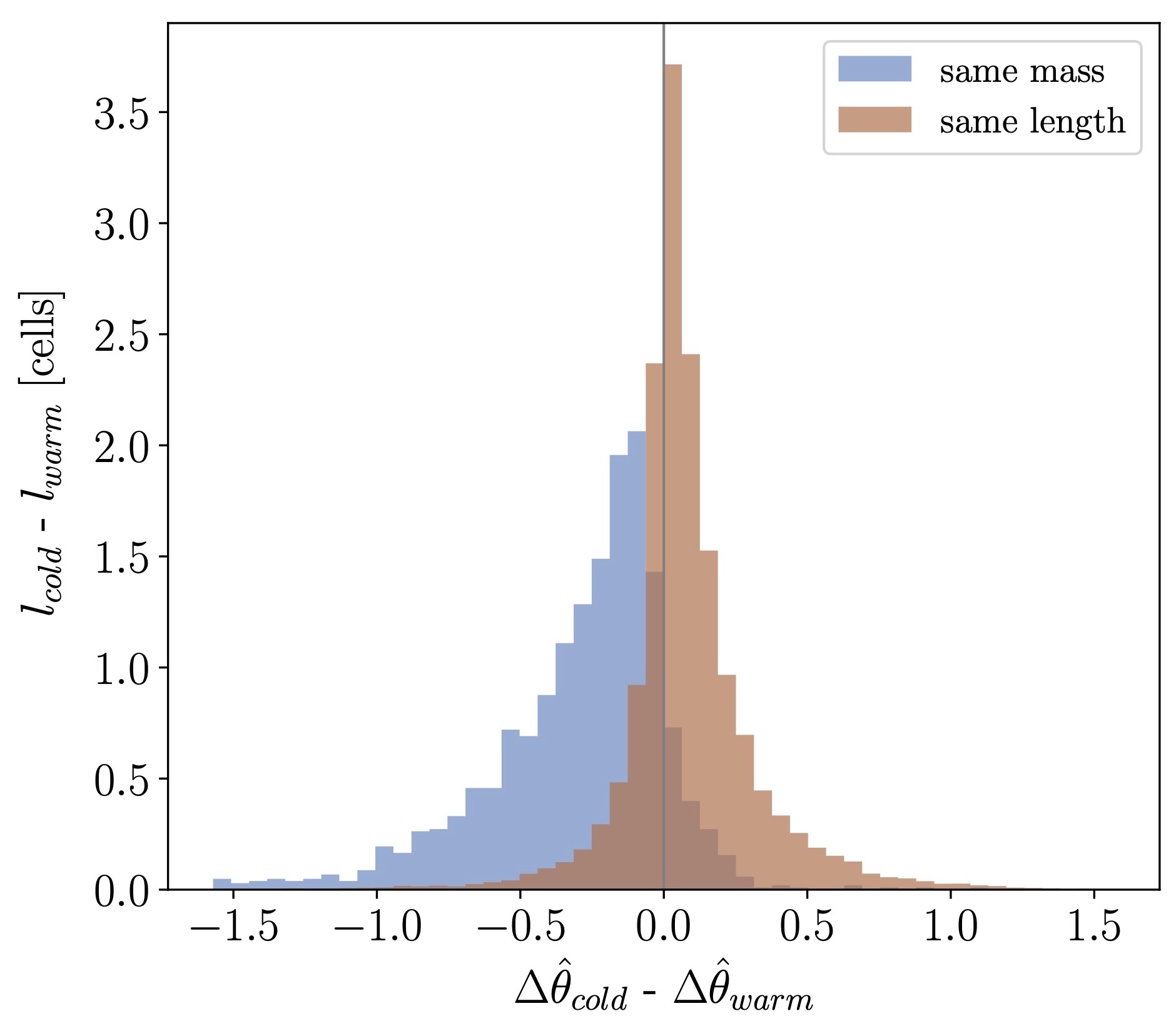
Distribution of the angle difference between the average magnetic field and the line of sight for cold and warm clouds

Figure 2: Distribution of the angle difference between the average magnetic field and the line of sight for cold and warm clouds, shown for clouds matched by mass and by length. A smaller angle difference means a more ordered field. At similar mass, cold clouds show a more ordered field; at similar length, the reverse holds. [Adapted from Butsky et al., in press]

Since the simulation reproduces the observational result, does it therefore agree with the conclusion that magnetic fields are genuinely more ordered in the cold neutral medium? The authors argue that the answer depends on how you measure “order.” Comparing the magnetic field direction in individual dense clouds, they find that cold clouds have more ordered fields when compared against warm clouds of similar mass, but the conclusion flips when comparing clouds of similar length (Figure 2).

This apparent paradox comes from the different nature of cold and warm clouds. Cold clouds are denser and more compact, occupying much smaller physical scales than warm clouds. So to match the length of a warm cloud, you have to string together several cold structures, sampling more of the field’s variation and making the cold gas look disordered. Measured per unit length, then, warm clouds appear more ordered. Measured per unit mass, cold clouds appear more ordered. Crucially, when we observe dust emission, we are naturally weighting by mass, so real observations effectively trace the polarization fraction per unit mass, the regime in which the cold clouds are the more coherent phase.

In the end, this work shows that the ordering of interstellar magnetic fields depends on both the gas phase and how we choose to measure it. Cold clouds carry more coherent fields per unit mass, which is exactly the quantity dust observations trace, resolving an apparent contradiction between earlier studies. It is a reminder that even our best observations come with hidden assumptions, and that simulations, where the true field is known, are essential for interpreting what the sky is really telling us.

Original astrobite edited by Viviana Cáceres.

About the author, Sandy Chiu:

I’m a PhD candidate at the University of Michigan, Ann Arbor. I’m interested in numerical simulations of cosmic rays feedback in galaxies and their comparison with observation.

The post The Invisible Architecture Between the Stars appeared first on AAS Nova.
Astronomers Detect Gamma-Ray Burst’s Magnetic Fingerprint

15 July 2026 at 23:42
This illustration depicts Faraday rotation in the afterglow of a gamma-ray burst. A powerful jet (upper left) sends polarized radio waves outward through the thin wall of a surrounding bubble of magnetized gas called an HII region. As the light passes through this material, its polarization angle is twisted by the magnetic field. Because the effect is stronger at longer wavelengths, the red and blue waves, which represent different radio wavelengths, exit the bubble oscillating in different directions. By measuring this difference, astronomers were able to map the magnetic environment surrounding GRB 260310A for the first time. Image credit: NSF / AUI / NRAO / M. Weiss

Using NSF’s Very Large Array (VLA), astronomers made the first radio detection of polarized light and Faraday rotation from a gamma-ray burst afterglow, offering an unprecedented glimpse of the magnetic fields surrounding one of the Universe’s most powerful explosions.

The post Astronomers Detect Gamma-Ray Burst’s Magnetic Fingerprint appeared first on Sci.News: Breaking Science News.

A New Way to Measure Black Hole Spin

30 April 2025 at 17:00

Messier 87 jet

Upgraded interferometers will give researchers a never-before-seen view of the jets of active supermassive black holes. By modeling what might be seen when these instruments come online, researchers have discovered a new way to measure black hole spin.

Black Holes and Relativistic Jets

Closeup of Messier 87's relativistic jet

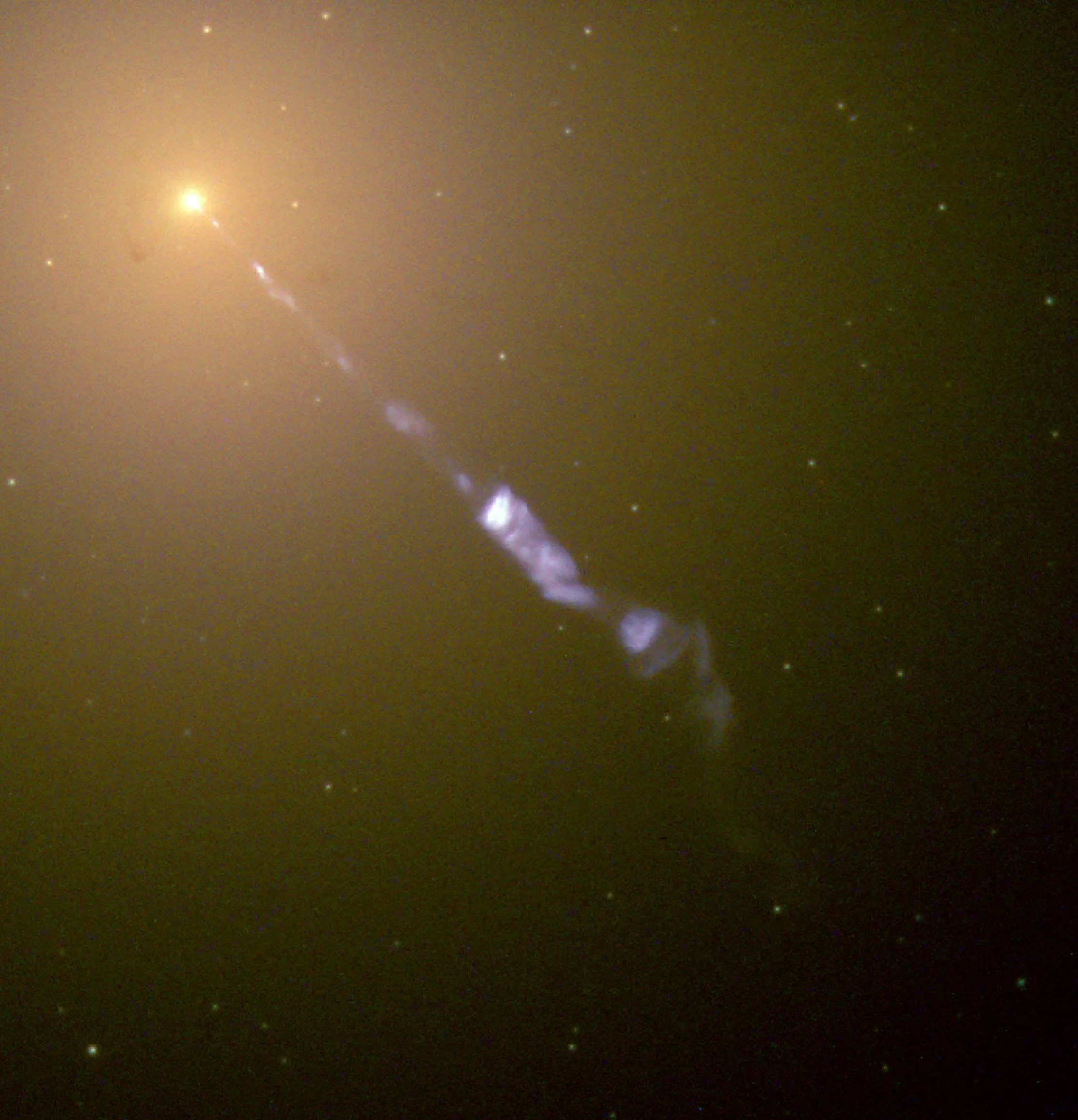
Closeup of Messier 87’s relativistic jet. [NASA and the Hubble Heritage Team (STScI/AURA)]

Galaxies across the universe harbor supermassive black holes. Determining the properties of these black holes — their masses and spins — is key to understanding the formation and evolution of supermassive black holes and how they shape the evolution of their host galaxies.

Some supermassive black holes produce relativistic particle jets that are thought to be powered by the black hole’s spin. This means that precise observations of black hole jets could provide a potential way to measure the spin of a black hole.

Planned and proposed interferometers will stretch observing baselines to great distances — even into space — to attain the high resolution necessary for this sensitive measurement. Building on the successes of the Event Horizon Telescope, a planet-spanning interferometer that has revealed images of the supermassive black holes at the center of the giant elliptical galaxy Messier 87 and the Milky Way, observatories like the Next-Generation Event Horizon Telescope and the Black Hole Explorer will advance our understanding of supermassive black holes and relativistic jets.

Tracing Rays from Modeled Jets

To learn what might be gleaned from future images of black holes and black hole jets, Zachary Gelles (Princeton University) and collaborators developed a model of a nearly face-on relativistic black hole jet, much like the jet from Messier 87’s black hole. The team’s model incorporates both general relativistic magnetohydrodynamics, which describes a magnetized fluid subjected to the rules of Einstein’s General Theory of Relativity, and force-free electrodynamics, which focuses on the dynamics of the system’s electromagnetic fields.

ray-traced polarized image of a relativistic jet

Ray-traced polarized image of a collimated black hole jet. The white bars show the direction of polarization, while the color scale shows the normalized intensity. Several abrupt changes in the polarization direction as a function of radius are visible. Click to enlarge. [Adapted from Gelles et al. 2025]

With this model in hand, the team used ray tracing — following the paths that photons would take through the modeled jet — to predict how the jet would appear in polarized light. Examining the results for jets with varying degrees of narrowness, or collimation, the team noted that the polarization of the most collimated jet behaved strangely, with the polarization angle changing dramatically with position.

Gelles and coauthors demonstrated that one of these sudden polarization changes happens at the black hole’s light cylinder, or the radius at which the jet becomes relativistic and the magnetic field switches from being mostly poloidal to mostly azimuthal. Because the position of the light cylinder is dependent upon the spin of the black hole, measuring the location of this polarization swing allows for a measurement of the black hole’s spin.

The Promise of Polarization

This method has several potential advantages over other methods. Unlike the current leading method for measuring black hole spin, X-ray spectroscopy, this method applies to low-luminosity active black holes, which are thought to be common throughout the universe. And while the model includes a number of simplifications, the team asserts that incorporating features of more realistic jets, such as asymmetry, is unlikely to change the outcome.

plot of polarization angle as a function of impact parameter

Polarization direction as a function of impact parameter, showing the locations and causes of the abrupt changes in polarization angle. Click to enlarge. [Gelles et al. 2025]

Gelles’s team also showed that the location of the polarization flip for slowly spinning black holes is 10 times farther out than it is for rapidly spinning black holes. What this means in practice is that determining whether a black hole is slowly or rapidly spinning doesn’t require extraordinarily high resolution, just a general sense of where the flip happens.

Looking forward, Gelles’s team plans to continue their simulations, shoring up their predictions until they can be tested when future interferometers come online.

Citation

“Signatures of Black Hole Spin and Plasma Acceleration in Jet Polarimetry,” Z. Gelles et al 2025 ApJ 981 204. doi:10.3847/1538-4357/adb1aa

The post A New Way to Measure Black Hole Spin appeared first on AAS Nova.

❌