❌

Normal view

A Sneak Peek into Early-Universe Star Formation with Boötes I

22 September 2026 at 17:00

star-forming region N44

Editor’s Note: Astrobites is a graduate-student-run organization that digests astrophysical literature for undergraduate students. As part of the partnership between the AAS and astrobites, we occasionally repost astrobites content here at AAS Nova. We hope you enjoy this post from astrobites; the original can be viewed at astrobites.org.

Title: Probing the IMF in the Early Universe — Direct Measurements in the Boötes I UFD with JWST/NIRCam
Authors: Keyi Ding et al.
First Author’s Institution: University of Maryland
Status: Published in ApJ

The Stellar Initial Mass Function
plot of different formulations of the initial mass function

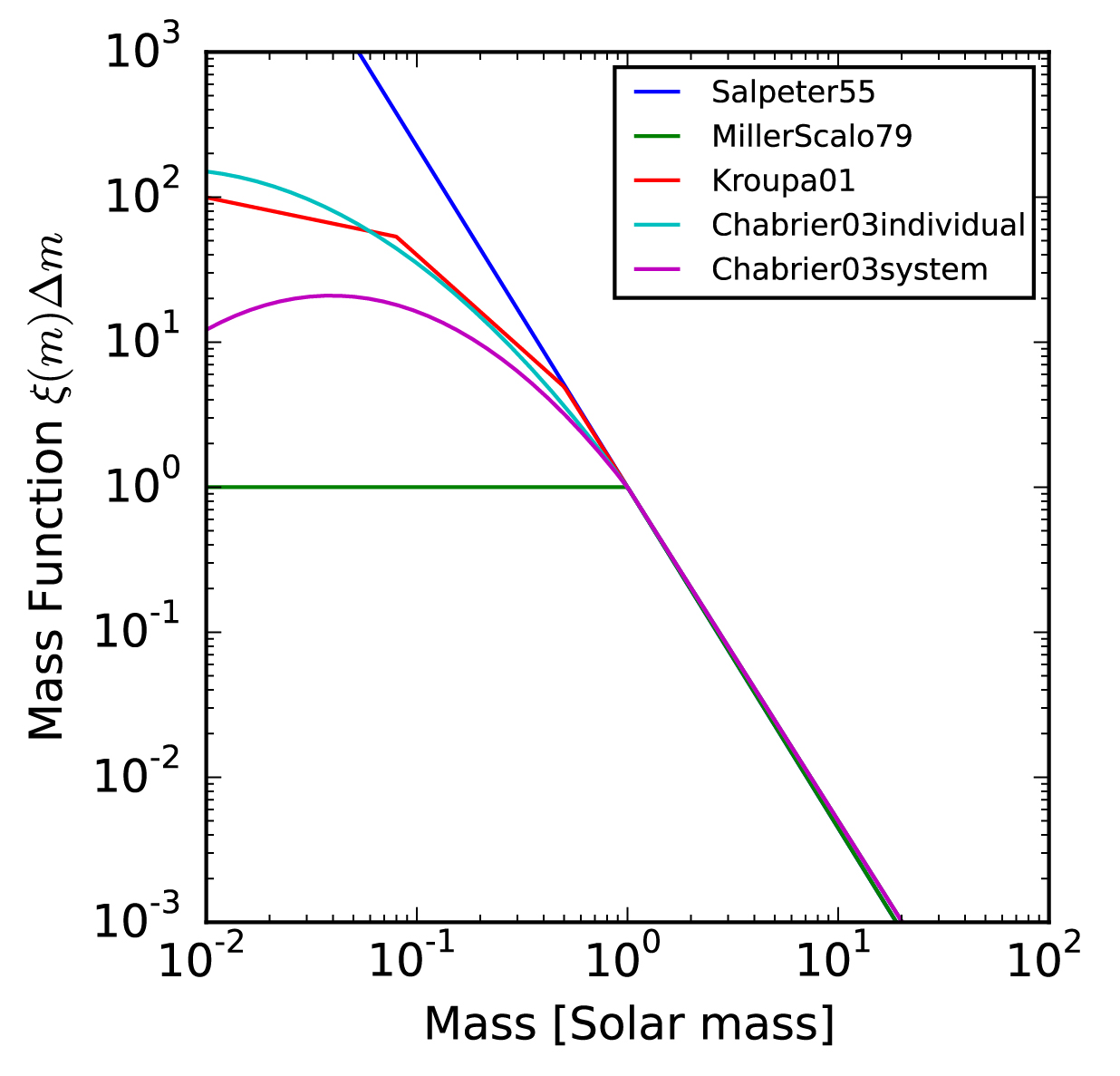
Figure 1: Several different formulations for the IMF. Astronomers have found that the Milky Way IMF seems to follow either a broken power law (Kroupa), or a log-normal (Chabrier) distribution. [JohannesBuchner; CC BY-SA 4.0]

A fundamental concept in astronomy is the stellar initial mass function (IMF). The IMF describes the number of stars of each mass that form from a single birth cloud. If the IMF has a negative slope, it means most stars are low in mass; if it has a positive slope, it means most stars are high in mass. Figure 1 shows some examples of commonly used IMFs, all of which have a negative slope, since we see far more low-mass stars than high-mass stars in the Milky Way. You may notice that several models deviate from a straight line at about 0.5 solar mass. This point, known as the turnover or critical mass, is crucial in determining the exact shape of the IMF.

For a relatively simple concept, the IMF is shaped by incredibly complicated underlying physical mechanisms. Things like turbulence, magnetic fields, and chemical enrichment all play a role in shaping the observed IMF. Additionally, the IMF is a pretty fundamental quantity. An enormous amount of astronomy research relies on assumptions made about the IMF. For example, since most stars are low in mass, and low-mass stars are dimmer, astronomers use the IMF to convert the amount of light in a galaxy to the number of stars; if there are more or fewer low-mass stars than we expect, our measurements will be wrong.

A big question surrounding the IMF is whether or not it’s universal. In the Milky Way, astronomers have been able to measure the IMF accurately, and they have found that it seems to be the same regardless of which bunch of stars we use to measure it.1 However, we know that galaxies in the early universe were very different compared to today. Things get tricky when you acknowledge that most measurements made of early-universe galaxies rely on modeling tools that are entirely reliant on assuming an IMF. This gnarly little detail makes measuring the IMF in the early universe especially valuable to astronomers.

What Makes Ultra-Faint Dwarfs So Special?

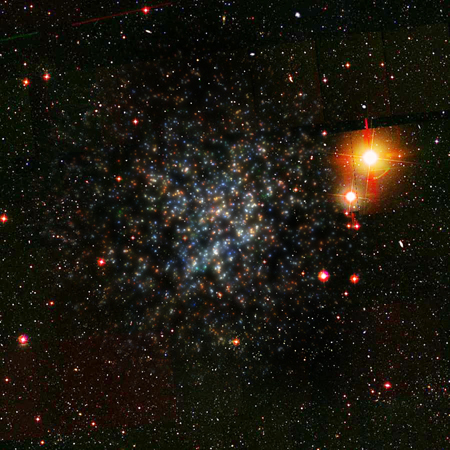
Today’s authors attempt to measure the early-universe IMF using a local relic, an ultra-faint dwarf galaxy (UFD). You might describe UFDs as “incredibly funky little galaxies.” They’re much less massive than the Milky Way, with about 10,000 times less stellar mass. What stars they do have tend to be very old and metal poor. The nature of UFDs has led many astronomers to think of them as fossils: relatively untouched galaxies formed in the early universe. Since we think UFDs are fossils of earlier galaxies, measuring the IMF in a UFD tells us whether the IMF was the same in the early universe as it is today. The authors focus on Boötes I, a relatively luminous UFD orbiting the Milky Way. Figure 2 shows Boötes I as seen by the Sloan Digital Sky Survey.
Boötes I

Figure 2: Boötes I as seen by the Sloan Digital Sky Survey. Because they’re so diffuse, UFDs look less like galaxies and more like groups of stars. [Vasily Belokurov – SDSS-II Collaboration]

The IMF in Boötes I

Measuring the IMF can get tricky — it’s typically pretty difficult to measure the mass of each individual star in a galaxy. Thankfully, Boötes I is close enough that we can do exactly that! Using JWST’s NIRCam instrument, today’s authors obtain imaging of Boötes I that is sensitive enough to extract roughly 10,000 stars belonging to the galaxy.

To measure the IMF from the observed population of stars, the authors use a modified version of Starwave, a Bayesian inference tool. In short, the tool takes in some assumptions about the population of stars in the galaxy, then generates many potential color–magnitude diagrams for various parameter selections. You can then assess how well each simulated color–magnitude diagram fits the observed data, thus determining likely parameters for the stellar population. The authors apply their tool for three different IMF models, testing how close the IMF in Boötes I is to that of the Milky Way. This allows them to determine how well the IMF compares to that of the Milky Way, which is typically thought of as a broken power law or log-normal distribution. If the IMF in Boötes I aligns with the Milky Way’s IMF, we’ll have a solid piece of evidence for a truly invariant IMF across cosmic time, allowing astronomers to rest easy knowing our modeling efforts haven’t been bunk this whole time.

So… What Did We Learn?

The authors find that a single power law can be ruled out to a good degree of confidence. This is good, as Milky Way studies show undeniable evidence of a turnover in the distribution. The broken power law and log-normal models both fit the observed data relatively well, aligning well with Milky Way–derived IMFs. All in all, they find solid evidence for an invariant IMF in the early universe.

However, they are unable to say with absolute certainty that the IMF is invariant. Given that their data are nearly perfect (that is, it’s pretty much impossible to get better data for Boötes I), the authors emphasize that a larger sample of UFD IMFs is needed to truly rule out an invariant IMF, but we’re certainly taking steps in the right direction! As the age-old saying goes, “more data are needed!”

Original astrobite edited by Maggie Verrico.

  1. Editor’s Note: The Milky Way IMF may vary from star cluster to star cluster; as described in this AAS Nova highlight from 8 July 2026, recent research using data from the Gaia spacecraft has found evidence for IMF variation in our galaxy. ↩︎

About the author, Drew Lapeer:

Drew is a first-year PhD student at the University of Massachusetts Amherst. They are broadly interested in the evolution of galaxies, with a focus on the impact of cosmic feedback on the galactic ecosystem. In their free time, they enjoy reading, rock climbing, hiking, and baking!

The post A Sneak Peek into Early-Universe Star Formation with Boötes I appeared first on AAS Nova.
Gaia Data Show That the Initial Mass Function Is Not Universal

8 July 2026 at 22:48

star-forming cloud OMC-2

Do all star-forming regions birth stars with the same distribution of masses? Theory suggests that they do not, but researchers often assume they do for simplicity. Now, ultra-precise observations from Gaia have demonstrated that the initial mass function varies across star clusters in the Milky Way.

A Universal Initial Mass Function?

JWST image of galaxies in the iconic Hubble Ultra Deep Field

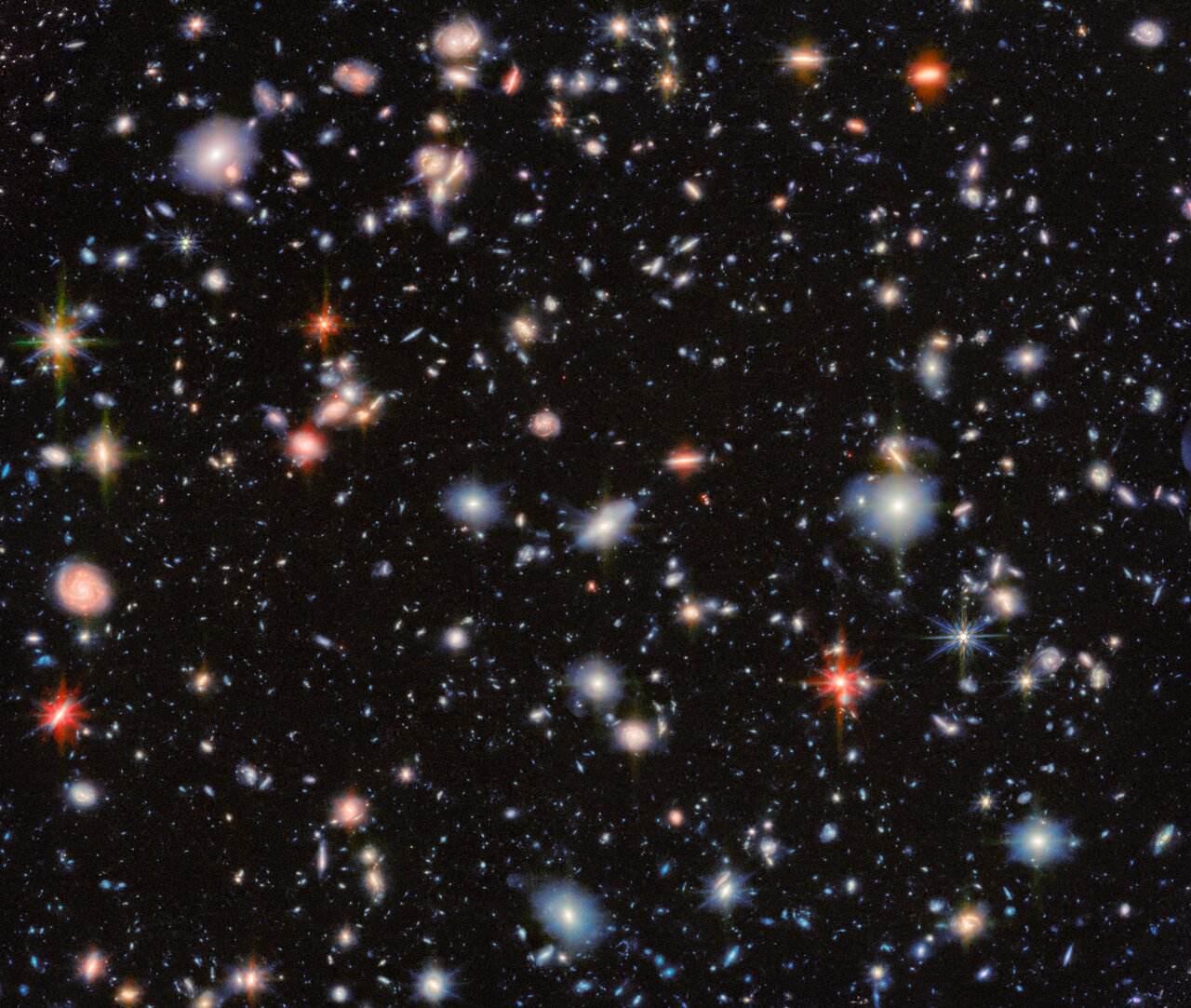
The light from distant galaxies is dominated by high-mass stars, requiring the use of the IMF to estimate the stellar mass of a galaxy. [ESA/Webb, NASA & CSA, G. Östlin, P. G. Perez-Gonzalez, J. Melinder, the JADES Collaboration, the MIDIS collaboration, M. Zamani (ESA/Webb); CC BY 4.0]

When a molecular cloud fragments, collapses, and births a star cluster, how many stars form, and what are their masses? The answer to that question is what astronomers term the initial mass function, or IMF: the distribution of masses of stars born in a cluster.

The IMF is important in many areas of astronomy, and it’s relied on especially heavily in studies of distant galaxies. The light from these galaxies is dominated by high-mass stars, with the emission from lower-mass stars lost in the glare, so astronomers must use the IMF to reconstruct the stellar populations of these far-off locales.

Though theory suggests that the IMF should vary with factors like temperature and metallicity, demonstrating these variations has been difficult, even within our own galaxy. Because of this, researchers often adopt a universal IMF drawn from observations of star clusters in the Milky Way. But is the IMF truly universal?

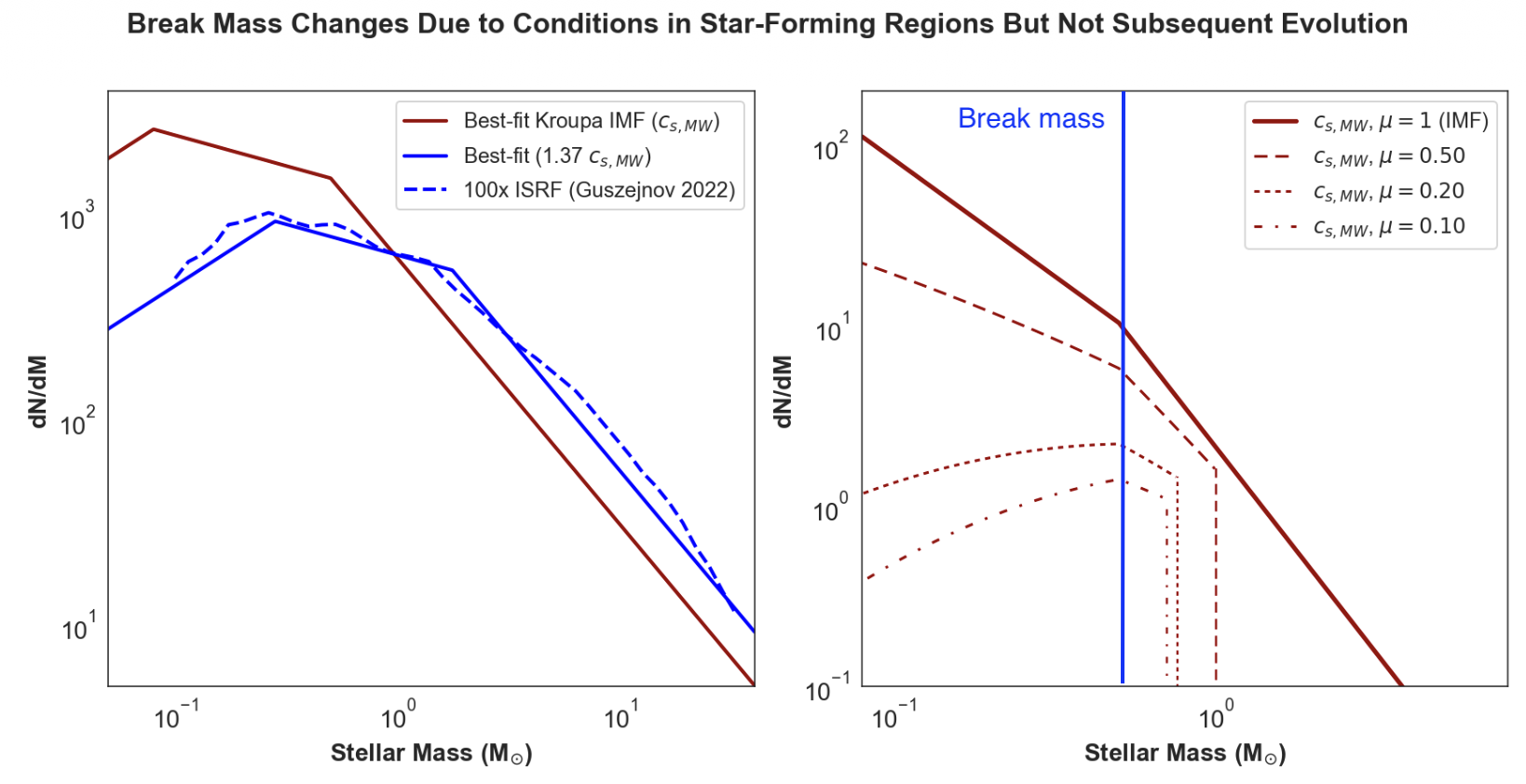
The More the Slope Changes, the More the Break Mass Stays the Same

Determining whether the IMF is universal is more complicated than simply comparing the stars in one cluster to those in another. That’s because what astronomers measure in present-day star clusters is not the initial mass function, but a version of the IMF that has been skewed by millions to billions of years of evolution; over time, high-mass stars die and low-mass stars get ejected, warping the shape of the mass function.

Plots of the stellar mass function

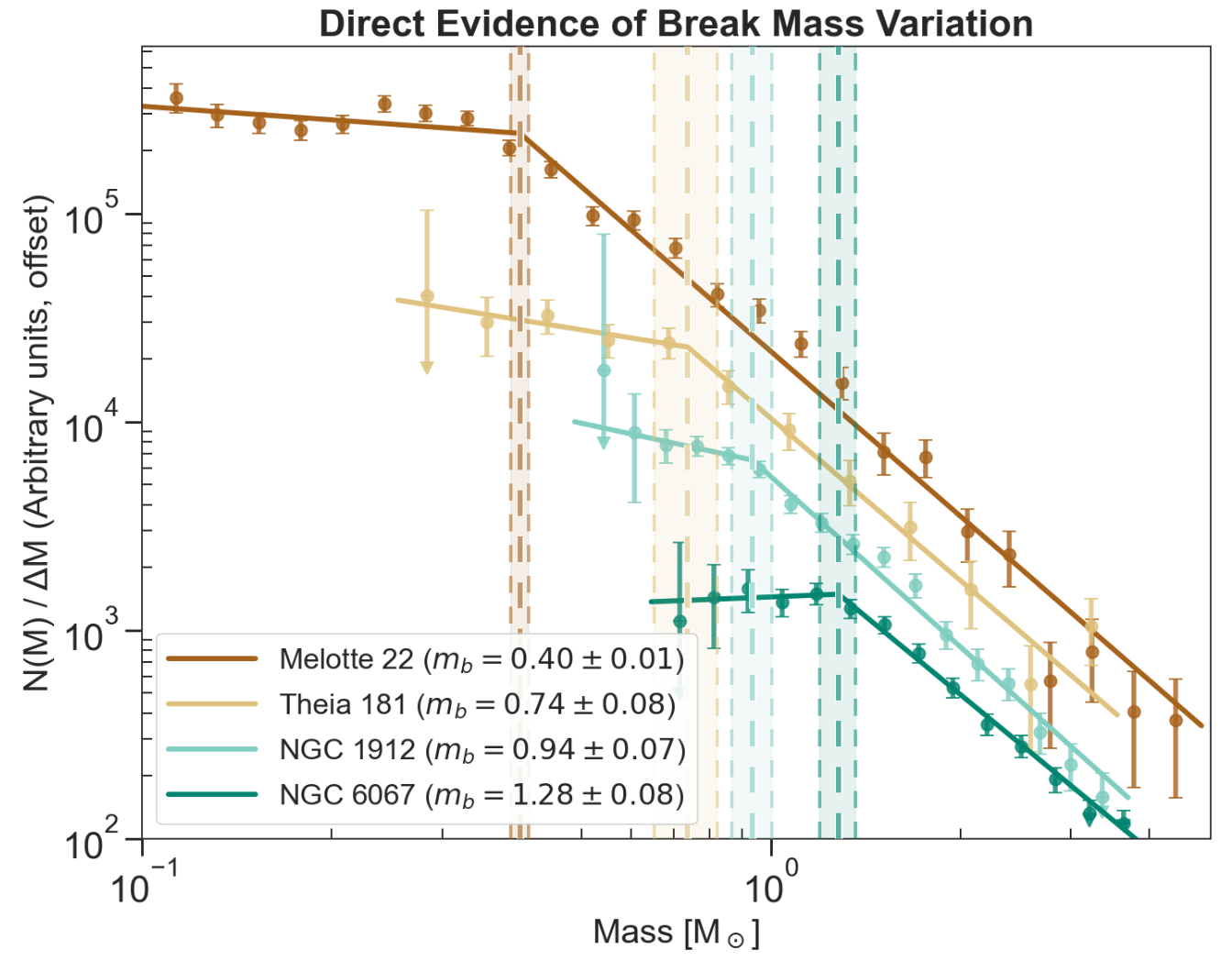
Left: Different break masses arise for different properties (here, the sound speed) of a given star-forming cloud. Right: Evolution of the mass function over time for a single star cluster. Over time, high-mass stars die and low-mass stars are ejected from the cluster, resulting in a decrease in the remaining mass fraction, μ, from 1 to 0.1. The slopes change, but the break mass does not. Click to enlarge. [Adapted from Steinhardt et al. 2026]

However, as demonstrated in a recent research article led by Charles L. Steinhardt (University of Missouri), certain aspects of the IMF may remain unchanged as clusters evolve. When the mass function of a star cluster is described using a broken power law (commonly called a “Kroupa-like” IMF in reference to work by Pavel Kroupa), the slopes of the power-law segments are affected by stellar evolution and dynamical interactions. Crucially, these effects appear not to alter the break mass — the mass at which the IMF transitions from one slope to another. Therefore, differences in the break mass from cluster to cluster reflect differences in the underlying IMF rather than the stellar and dynamical evolution of the clusters.

Insights from Gaia

Thanks to the Gaia spacecraft, which made precise observations of more than 2 billion stars in the Milky Way and beyond, it’s now possible to measure and compare the break masses of individual star clusters. Out of an initial catalog of 7,167 Milky Way clusters observed with Gaia, Steinhardt’s team selected just 110 that were of high enough quality and contained a sufficient number of stars to measure cluster break masses accurately.

Plot of stellar mass function for four Milky Way clusters

Observed mass functions of four Milky Way star clusters. The break masses are clearly different, showing that the IMF must vary from cluster to cluster. Click to enlarge. [Steinhardt et al. 2026]

The team found that the break mass differs considerably between the clusters in their sample, showing that the IMF is not universal. The observed variety of break masses appears to be linked to the age of the cluster, but instead of reflecting the impact of stellar and dynamical evolution — which have no effect on the break mass — these differences reflect the properties of the clouds in which the clusters were born. This implies that the properties of star-forming clouds in the Milky Way have, on average, changed over cosmic time. Thus, a star cluster that formed billions of years ago would have had a different IMF than one forming today.

This finding has implications for studies of high-redshift galaxies, where the properties of star-forming clouds are markedly different from those in the Milky Way. Going forward, Steinhardt and coauthors recommend developing a flexible parameterization of the IMF to capture how this critical function behaves in environments vastly different from our own.

Citation

“Direct Evidence for Stellar Initial Mass Function Variation in the Milky Way,” Charles L. Steinhardt et al 2026 ApJL 1005 L40. doi:10.3847/2041-8213/ae7444

The post Gaia Data Show That the Initial Mass Function Is Not Universal appeared first on AAS Nova.

Featured Image: Low-Mass Brown Dwarfs in a Class of Their Own?

14 July 2025 at 17:00

IC 348

The glowing green nebula in this JWST image surrounds the star cluster IC 348, which is the subject of a recent study by Kevin Luhman (Penn State University) and Catarina Alves de Oliveira (European Space Agency). Using JWST’s Near-Infrared Camera, Luhman and Alves de Oliveira searched the cluster’s young stellar population for free-floating brown dwarfs — objects that are less massive than stars but more massive than most planets — and discovered multiple candidates with masses down to just twice the mass of Jupiter. Follow-up JWST spectroscopy confirmed the masses of these objects, making them the lowest-mass brown dwarfs known to date. In addition to their mass, these newly discovered brown dwarfs are remarkable because their spectra show evidence of hydrocarbon molecules, the exact identities of which are not yet known. Luhman and Alves de Oliveira proposed that low-mass brown dwarfs bearing this chemical signature be inducted into a new spectral class called “H” for “hydrocarbon.” To add to the intrigue of these objects, the authors also discovered signs of circumstellar disks around two of them, suggesting that they may be capable of forming and harboring planets. To learn more about the low-mass brown dwarfs in IC 348, be sure to check out the full research article linked below.

Citation

“A New Spectral Class of Brown Dwarfs at the Bottom of the IMF in IC 348,” K. L. Luhman and C. Alves de Oliveira 2025 ApJL 986 L14. doi:10.3847/2041-8213/addc55

The post Featured Image: Low-Mass Brown Dwarfs in a Class of Their Own? appeared first on AAS Nova.

❌