❌

Normal view

SpaceX will attempt 1st-ever double Starship rocket catch on next test launch, a 'profound technology milestone,' Elon Musk says

20 October 2026 at 23:29

SpaceX will soon notch a huge spaceflight milestone, if all goes according to plan.

The company will try to catch both stages of its Starship megarocket during the vehicle's next test flight, which is targeted for next month, founder and CEO Elon Musk announced during SpaceX's quarter 3 (Q3) earnings call today (Oct. 20).

If SpaceX succeeds, this "will be the first time that an orbital launch vehicle has been fully recovered," Musk said. "The only way that we can extend consciousness beyond Earth on a sustained basis is with a fully reusable orbital launch vehicle. So this is, I think, a profound technology milestone in the history of civilization and consciousness."

illustration of a silver spacecraft suspended in midair by the metallic arms of a launch tower

Artist's illustration of SpaceX catching the upper stage of its Starship megarocket, something the company expects to do on the vehicle's 15th test flight. (Image credit: SpaceX)

Starship is the biggest and most powerful rocket ever built, standing more than 400 feet (122 meters) tall when fully stacked.

As Musk noted, both of its stages β€” the Super Heavy booster and Ship spacecraft β€” are designed to be fully and rapidly reusable, a breakthrough that SpaceX thinks will make Mars settlement and other grand exploration feats economically feasible.

Starship's recovery strategy is different than that for SpaceX's Falcon 9 and Falcon Heavy rockets, which are partially reusable. (The latter two rockets have expendable upper stages). Falcon 9 and Falcon Heavy boosters come back to Earth on landing pads near the launch site or on ships at sea downrange. Super Heavy and Ship, however, will steer themselves directly back to their launch tower, which will capture each vehicle with its "chopstick" arms.

This will allow SpaceX to inspect, refurbish and refly Starship at an accelerated rate, which is a priority for the company: Musk has said he envisions launching Starship more than 10,000 times per year by 2030.

Starship has conducted 14 test flights to date, and SpaceX has pulled off chopstick catches with Super Heavy on three of them. The company has not yet tried to catch Ship, which is a more difficult proposition, as the upper stage travels higher, farther and faster than the booster does.

Still, Musk is confident that SpaceX will pull off a Ship catch on the first try. (He did not give a specific target date for Flight 15, saying only that it was expected next month.)

"I'd say it's more likely than not that this succeeds next flight," he said. "And if not, we have a steady stream of Starship flight attempts through the end of this year, and and then accelerating next year."

Success would mean back-to-back Starship flights with huge milestones. On Flight 14, which occurred on Sept. 28, Ship reached orbit for the first time ever. It also deployed 26 of SpaceX's Starlink Version 3 satellites β€” the first 26 members of a next-gen broadband constellation in low Earth orbit that will eventually consist of about 100,000 spacecraft.

The Starship Flight 15 preview was something of an aside during today's call. The event primarily served to announce SpaceX's financial performance during Q3, the three-month stretch that ended on Sept. 30.

And that performance was strong, company representatives said. SpaceX recorded revenues of $14.6 billion during Q3, an increase of 161% from the $5.6 billion earned during Q3 of 2025. The company had a net income of $4.4 billion during Q3, $5.5 billion better than the result from the same stretch last year, when SpaceX lost $1.1 billion.

Just $1.8 billion of 2026 Q3 revenue came from SpaceX's launch division. The vast majority was generated by two other segments β€” connectivity (services provided by its Starlink megaconstellation) and artificial intelligence (or, as the Trump administration has recently rebranded it, "superintelligence").

SpaceX thinks these latter two segments will continue to boom. That's why it's building the infrastructure to support thousands of Starship launches per year β€” to loft lots of Starlink satellites and AI data centers to Earth orbit. And the company believes that it's positioned to really start raking in the cash, starting as soon as next year.

"In a nutshell, what this implies for SpaceX annual recurring revenue by the end of '27 is somewhere between 500 billion [dollars] and a trillion," Musk said.

SpaceX launches its 'Starfall' return capsule for 2nd time ever (video)

20 October 2026 at 12:16

SpaceX just launched its mysterious "Starfall" return capsule for the second time ever.

Starfall was one of 32 payloads on the company's Bandwagon-5 rideshare mission, which launched atop a Falcon 9 rocket at 7:04 a.m. EDT (1104 GMT) today (Oct. 20) from Cape Canaveral Space Force Station in Florida.

SpaceX has been relatively quiet about Starfall, which debuted this past June on a Falcon 9 launch from the Cape.

photo of a stack of satellites being processed for launch inside a large white clean room

The payloads of SpaceX's Bandwagon-5 rideshare mission, seen in a prelaunch photo. The company's Starfall capsule sits at the very top of the stack. (Image credit: SpaceX)

That June 23 flight was a dedicated demonstration mission for Starfall, designed to show that the capsule can fly in a controlled fashion and survive the harrowing downward trip through Earth's atmosphere.

And those will be Starfall's main jobs. The vehicle "will enable affordable, routine access to the microgravity environment for scientific research and in-space manufacturing," SpaceX in a June 23 X post, one of the few public statements the company has made about Starfall.

Indeed, most of the details that we have about the capsule come from an environmental assessment that was published by the U.S. Federal Aviation Administration in May.

According to that document, the disk-shaped Starfall is roughly 2.5 feet (0.75 meters) tall and 10.2 feet (3.1 m) wide. It weighs about 4,600 pounds (2,100 kilograms) and can bring 2,200 pounds (1,000 kg) of payload back down to Earth.

a flat space capsule reenters Earth's atmosphere

Artist's illustration of a SpaceX Starfall capsule reentering Earth's atmosphere. (Image credit: SpaceX)

Starfall wasn't the only return capsule that went up on Bandwagon-5. Among the other 31 payloads on the flight was W-Series 7, the latest orbital "mini-factory" built and operated by the California company Varda Space Industries.

The W-Series capsules are designed to both host the production of valuable goods such as pharmaceuticals and bring them safely down to Earth, Varda has said.

The other payloads on Bandwagon-5 are a mix of "cubesats and microsats," according to SpaceX's mission description. Among the latter is Pelican-12, a sharp-eyed Earth-observation satellite built by the San Francisco company Planet.

Payload deployment sequence is completeOctober 20, 2026

The 32 payloads were deployed over a two-hour span beginning about 57 minutes after launch. Starfall will be the last to separate, releasing from the Falcon 9's upper stage two hours and 48 minutes post-liftoff.

The Falcon 9's first stage, meanwhile, came back to Earth as planned on Bandwagon-5. It touched down about nine minutes after launch, coming down in the Atlantic Ocean atop the SpaceX drone ship "A Shortfall of Gravitas." It was the 19th mission for this particular booster, according to the company.

A sooty booster stands on 4 legs on a barge at sea.

(Image credit: SpaceX)

Bandwagon is one of two SpaceX rideshare programs. The other, known as Transporter, has been busier, flying 18 missions to date.

The first Transporter mission, which lifted off in January 2021, delivered 143 payloads to Earth orbit, a single-launch record that still stands.

Japan launches historic MMX sample-return mission to Mars' moon Phobos (video)

19 October 2026 at 20:53

Japan's groundbreaking mission to Mars is officially underway, headed to the Red Planet's mysterious moons Phobos and Deimos for a historic sample-return attempt.

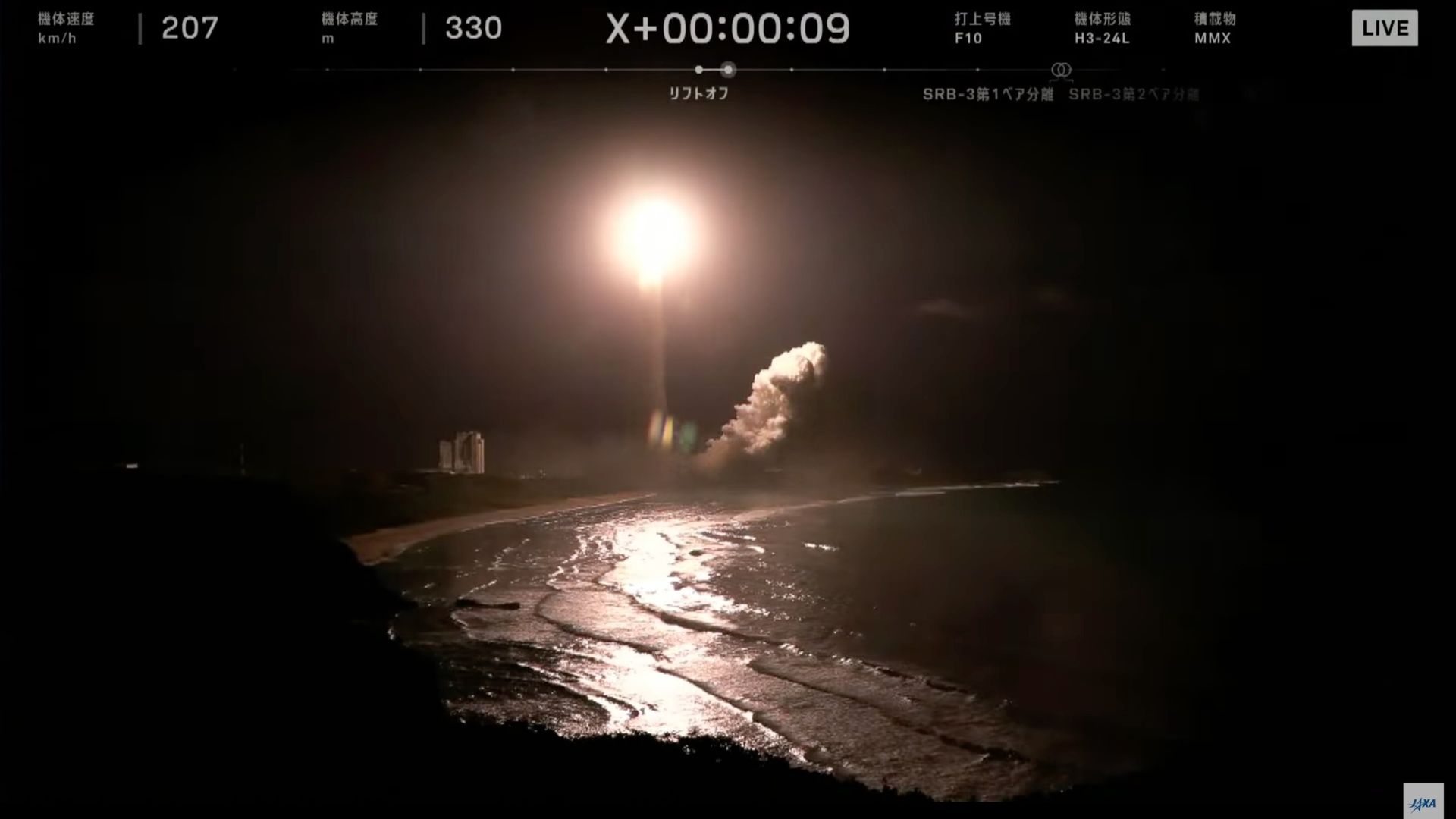
The Martian Moons eXploration (MMX) mission launched today (Oct. 19) from Tanegashima Space Center in Japan, riding an H3 rocket that lifted off from Pad-2 at Tanegashima's Yoshinobu Launch Complex at 3:41 p.m. EDT (1941 GMT; 4:41 a.m. local time in Japan on Oct. 20).

The JAXA (Japan Aerospace Exploration Agency)-led MMX mission is bound for Mars orbit, where it will study the planet's two moons, Phobos and Deimos. If everything goes according to plan, MMX will become the first spacecraft to land on and return samples from Phobos for study back on Earth, which scientists think could shed light on a decades-old mystery about the moons' origins and reveal clues about the formation of the early solar system.

Japan's MMX mission to Mars' moon Phobos launches from Tanegashima Space Center on Oct. 19, 2026.

a rocket launches into a night sky from a seaside pad (Image credit: JAXA)

It was the 10th liftoff of Japan's expendable, two-stage H3 rocket, which was jointly developed by JAXA and Mitsubishi Heavy Industries. After clearing its launch pad today, the 207-foot-tall (63 meters) launch vehicle flew a nominal trajectory through its ascent corridor over the Pacific Ocean, jettisoning its four solid boosters in pairs just before the flight clock reached two minutes. The rocket shed its payload fairings about one minute and 20 seconds later, exposing MMX to the vacuum of space for the first time.

H3's first stage, powered by two LE-9 rocket engines, channels a mixture of liquid hydrogen and liquid oxygen to produce a combined thrust of 331,000 pounds (1,471 kN), according to Mitsubishi Heavy Industries. As the mission clock approached T+5 minutes, H3 executed its main engine cutoff procedure and separated from the second stage, which ignited its engines for a 5.5-minute burn about 10 seconds later.

All continued to go to plan after that. The H3's upper stage ignited its engine for a second time for a trans-Mars injection burn about one hour and four minutes after liftoff, a maneuver that lasted roughly six minutes and 25 seconds and took MMX to a maximum velocity of about 24,145 mph (38,858 kph).

MMX was released from the rocket's upper stage right on schedule, about one minute after the completion of that burn and roughly 71 minutes after liftoff. The success elicited loud cheers in mission control, which viewers saw and heard on JAXA's launch webcast.

MMX is now under its own power, and on course for Mars. The interplanetary transit will last about 10 months, with the spacecraft scheduled to arrive at the Red Planet in August 2027. When it does, MMX's propulsion module will execute an orbital insertion burn to place itself in a quasi-satellite orbit (QSO) around Phobos, which places MMX within the space around the moon as both circle Mars.

MMX will spend about three years in the Martian system, devoting much of that time to studying the 14-mile-wide (22 km) Phobos with its science instruments. The spacecraft also carries the IDEFIX rover, a joint effort of the space agencies of France and Germany, which is scheduled to deploy to the surface of Phobos in late 2028 or early 2029.

After a mapping campaign to select suitable landing sites, MMX will perform two separate touchdowns on Phobos to collect and stow samples in the spacecraft's return capsule. Following its second landing and sample collection, MMX will briefly return to QSO with Phobos before transferring to a more elongated orbit around Mars that intersects with the planet's smaller moon, Deimos, which is just 8 miles (14 km) in diameter.

During the last several months of its time around Mars, MMX will perform a series of Deimos flybys before departing for Earth in November 2030. If all goes according to plan, the MMX sample-return capsule will land in Australia in 2031.

Scientists are counting on those samples, and other data collected during MMX's time around Mars, to answer a decades-old question surrounding the Martian moons' origins. Competing theories and conflicting evidence point to two possibilities for how Mars got its moons.

Their near-circular, equatorial orbits suggest a narrative similar to how Earth's moon is thought to have formed β€” as a result of a massive planetary impact between Mars and some other giant space rock, which broke off pieces of the planet that eventually coalesced to form the natural satellites that orbit there today.

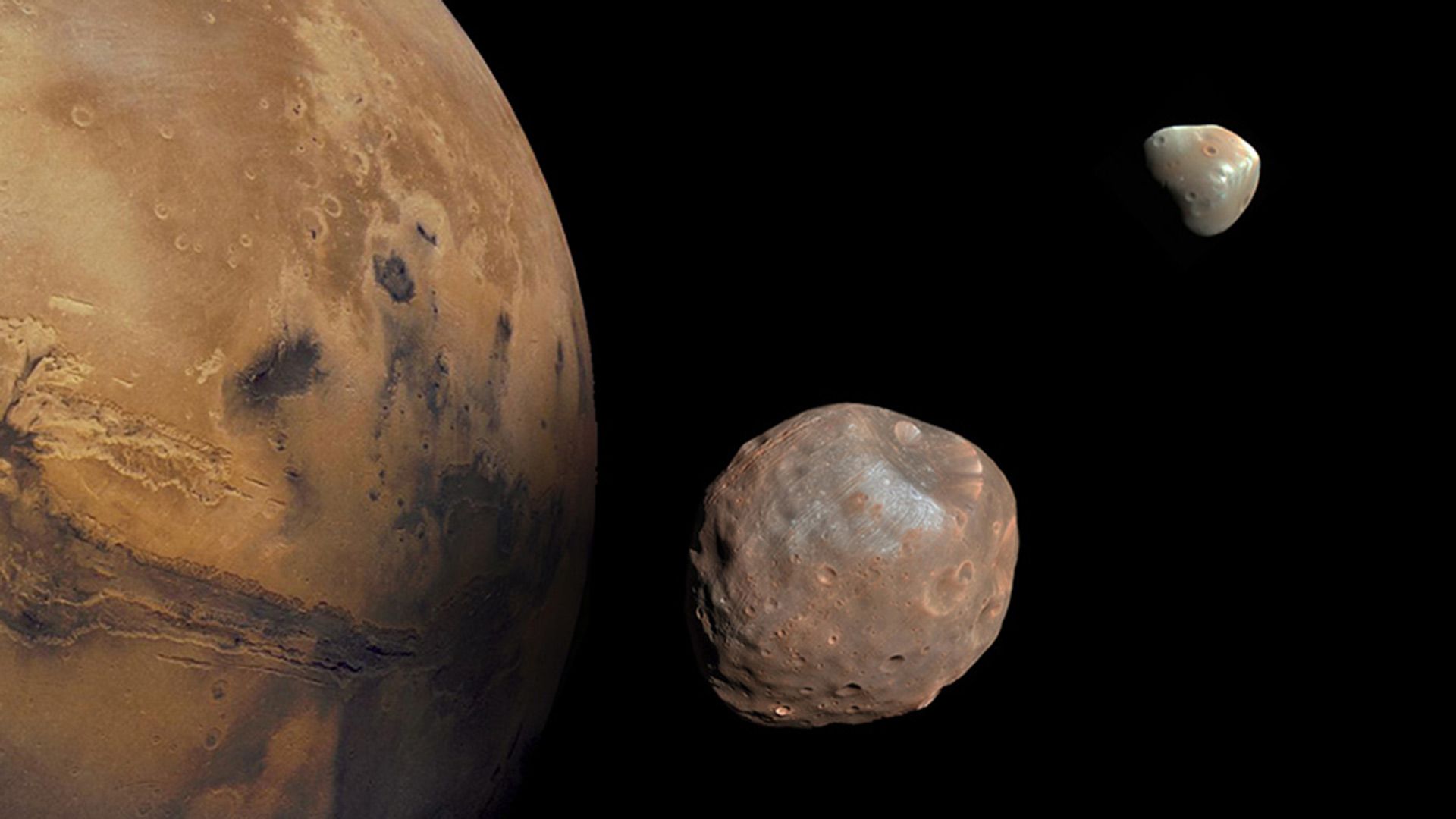
Mars and its two moons, Phobos and Deimos.

A composite image with Mars and its two moons, Phobos and Deimos. (Image credit: NASA/JPL/University of Arizona)

Neither Phobos nor Deimos is spherical, isntead; both are oblong and lumpy, like potatoes. That fact β€” along with their chemical composition, as far as we have been able to tell using telescopic spectroscopy β€” point to the possibility that Phobos and Deimos were asteroids from the early solar system that were captured by Mars' gravitational pull. Figuring out the moons' true origin story would provide key clues about Mars' geological past, the solar system's early history and the formation of the inner planets, mission team members have said.

Once the MMX samples are safely returned to Earth, scientists will study their composition and mineralogy, then compare such chemical fingerprints with those of Martian rocks and asteroid material. These analyses, combined with data collected by MMX during its mission, will help nail down the origin of Phobos β€” and by extension, Deimos. β€” by

While JAXA leads MMX, the mission is an international effort, with interagency partnerships between JAXA, NASA and the European Space Agency (ESA), as well as U.S. and European companies, which supplied a handful of the spacecraft's scientific hardware and communications equipment.

NASA's contributions to MMX include the Mars-moon Exploration with Gamma rays and Neutrons (MEGANE, pronounced "meh-gah-nay") device, which is a gamma-ray and neutron spectrometer built by the Johns Hopkins Applied Physics Laboratory (APL); a Honeybee Robotics-built pneumatic sampler; and communications support using the agency's Deep Space Network.

NASA has also invested approximately $87 million through the end of the mission, which includes funding for United States scientists and astromaterials experts on the MMX team. The agency is getting something concrete for such contributions: At least 15% of the planned 10-gram (0.35 ounces) returned Phobos sample will be reserved for NASA's study. Those materials will be transferred and maintained at the agency's Johnson Space Center in Houston for analysis and long-term preservation.

MMX is not the first Phobos sample-return project to take flight, by the way. That distinction goes to Russia's Phobos-Grunt ("Phobos-Soil") mission, which launched in November 2011 but failed to get out of Earth orbit due to a rocket glitch. The 14.5-ton spacecraft eventually crashed back to Earth over the Pacific Ocean in January 2012.

Editor's note: This story was updated at 5 p.m. ET on Oct. 19 with news of MMX's successful separation from the H3 rocket's upper stage.

SpaceX's next Starship launch will lift off on Sept. 22 and aim to reach orbit for 1st time

15 September 2026 at 19:33

We now have a launch date for Starship's most ambitious mission to date.

SpaceX announced today (Sept. 15) that it's targeting Sept. 22 for the first orbital flight of Starship, the fully reusable megarocket that the company is developing to help humanity settle the moon, Mars and more.

Liftoff, from SpaceX's Starbase site in South Texas, will occur during a 75-minute window that opens at 8:15 a.m. EDT (1215 GMT and 7:15 a.m. local Texas time). You can watch it live here at Space.com when the time comes.

SpaceX's Starship megarocket launches on its 12th test flight, on May 22, 2026.

SpaceX is targeting Sept. 22 for Starship's first-ever orbital launch, a landmark flight that will deploy 26 Starlink satellites and last about 10 hours. (Image credit: SpaceX)

Starship Die Cast Rocket Model Was $47.99 Now $39.99 on Amazon.

Even if you can't see SpaceX's Starship in person, you can score a model of your own. Standing at 13.77 inches (35 cm), this is a 1:375 ratio of SpaceX's Starship as a desktop model. The materials here are alloy steel and it weighs just 225g.View Deal

The upcoming flight will be the 14th overall for Starship, which debuted in April 2023 and has flown twice so far in 2026. But the 408-foot-tall (124-meter-tall) vehicle's first 13 jaunts were all suborbital, so Flight 14 will be a landmark.

"By going to orbit, the next phase of developing Starship to be fully and rapidly reusable can begin," SpaceX wrote in a Flight 14 mission description.

"This will also mark the first time we plan to deploy Starlink V3 satellites into the constellation, delivering a payload that will dramatically expand connectivity speeds and reliability around the world," the company added.

Starlink, SpaceX's network of broadband satellites in low Earth orbit, currently consists of more than 11,000 active spacecraft. None of those are the larger, more capable V3 version, which are designed to launch on Starship.

Flight 14 will carry up 26 of these next-gen craft β€” the first of many, if all goes to plan. SpaceX founder and CEO Elon Musk has said the company wants the Starlink megaconstellation to eventually consist of 100,000 V3 satellites.

Three of the Starlink craft launching on Flight 14 have been outfitted with cameras and will photograph the heat shield on Starship's upper stage, known as Ship, after deployment. SpaceX will use this imagery to study and potentially improve the heat shield, which protects Ship during its return trip through Earth's atmosphere.

If all goes according to plan on Sept. 22, the 171-foot-tall (52-m-tall) Ship will complete six orbits of Earth at an altitude of about 171 miles (275 kilometers). The vehicle will then maneuver its way to a splashdown in the Pacific Ocean west of Chile about 10 hours after launch, SpaceX wrote in the mission description.

That's a very different plan than previous Starship flights. On those suborbital missions, Ship stayed aloft for just 65 minutes or so, did not complete an orbit of Earth and came down in the Indian Ocean, off the coast of Western Australia.

But Flight 14 will be more of the same for Starship's first-stage booster, known as Super Heavy. If all goes to plan, the giant rocket will splash down in the Gulf of Mexico about seven minutes after liftoff, as it has done on a number of previous flights.

So there will be no catch β€” of either Ship or Super Heavy β€” by the "chopstick" arms of Starbase's launch tower on Flight 14. SpaceX has pulled off tower catches of Super Heavy on three occasions to date but has never done so with Ship. This recovery method will eventually be the norm on Starship flights, leading to faster and more efficient reuse of the vehicle, Musk has said.

So, while Flight 14 aims to check a very big box β€” reaching orbit β€” other milestones will be reserved for future flights. A Ship tower catch will be among the most anticipated, along with refueling the vehicle in orbit, something that will be required for missions to the moon, Mars and beyond.

SpaceX launches 2nd classified mission for US Space Force in less than a week (photos)

15 September 2026 at 13:00

SpaceX launched its second classified mission for the U.S. Space Force in less than a week tonight (Sept. 16).

A Falcon 9 rocket lifted off from California's Vandenberg Space Force Base today at 9:07 p.m. EDT (6:07 p.m. local California time; 0107 GMT on Sept. 17).

We don't know much about tonight's mission, which was called USSF-259. SpaceX's webcast didn't shed any light of note; it ended shortly after the Falcon 9's first stage returned to Earth for a landing in the Pacific Ocean atop a drone ship about 8.5 minutes after launch.

a rocket rests on the deck of a ship at sea

The Falcon 9's first stage rests on the deck of a drone ship shortly after launching the USSF-259 mission for the U.S. Space Force on Sept. 16, 2026. (Image credit: SpaceX)

That touchdown was the 13th for this particular booster, which is designated 1097. One of the booster's previous landings was a big milestone for SpaceX. This past April, B1097 pulled off SpaceX's 600th touchdown of an orbital-class rocket, during a launch that sent 25 of the company's Starlink internet satellites to low Earth orbit.

Tonight's mission was the second that SpaceX has flown for the U.S. Space Force in a six-day span: A Falcon 9 launched the similarly classified USSF-153 from Vandenberg on Sept. 10.

Previous Booster 1097 missions

Sentinel-6B | Twilight | NROL-172 | Transporter-17 | 8 Starlink missions

Tonight's launch was SpaceX's 110th of 2026. The vast majority of the company's flights so far this year β€” 106 of them, in fact β€” have been performed by the workhorse Falcon 9.

The powerful Falcon Heavy has launched twice in 2026, as has SpaceX's next-gen megarocket, Starship. Both Starship liftoffs this year have been suborbital test flights. The next Starship launch, which is expected to occur in the next two weeks, will apparently take the vehicle orbital for the first time.

Editor's note: This story was updated at 11:50 p.m. ET on Sept. 15 with the new launch date of Sept. 16. It was updated agai at 9:28 p.m. ET on Sept. 16 with news of successful launch and rocket landing.

Vega C rocket launches 2 European Earth-observing satellites to orbit from South America (video)

14 September 2026 at 19:00

Two European Earth-observing spacecraft lifted off from South America tonight (Sept. 14).

A Vega C rocket carrying the FLEX and Copernicus-3C satellites launched from Europe's Spaceport in Kourou, French Guiana at 9:21 p.m. EDT (10:21 p.m. local time in Kourou and 0121 GMT on Sept. 15).

Both FLEX and Sentinel-3C were deployed as planned. They were released at an altitude of about 509 miles (820 kilometers), and both were flying freely by 116 minutes after launch.

A Vega C rocket launches the FLEX and Sentinel-3C Earth-observation satellites to Earth orbit from Kourou, French Guiana on Sept. 14, 2026.

A Vega C rocket launches the FLEX and Sentinel-3C Earth-observation satellites to Earth orbit from Kourou, French Guiana on Sept. 14, 2026. (Image credit: ESA/Avio)

The 875-pound (397-kilogram) FLEX will detect and monitor vegetation fluorescence, which explains its name (a shortening of "Fluorescence Explorer"). By doing so, it will map plant photosynthetic activity β€” something no satellite can do at the moment, according to ESA.

FLEX's data will be important not only "for a better understanding of the global carbon cycle, but also for agricultural management and food security," ESA wrote in a FLEX mission desription. "This is of particular relevance due to demand the growing world population is placing on the production of food."

Sentinel-3C is part of the European Union's Copernicus Earth-observation program. The 2,520-pound (1,1143-kg) satellite will continue the Sentinel-3 line, which is aging but still going strong in low Earth orbit; Sentinel-3A and Sentinel-3B, which launched in 2016 and 2018, respectively, remain active.

"Like its two older siblings in orbit, Sentinel-3C carries a suite of cutting-edge instruments that measure systematically Earth’s oceans, land, ice and atmosphere to monitor and understand large-scale global dynamics," ESA wrote in a Sentinel-3C description. "It provides essential information in near-real time for ocean and weather forecasting."

illustration of a boxy silver satellite flying over earth

Artist's illustration of a Sentinel-3 satellite in orbit. (Image credit: ESA/ATG medialab)

The 115-foot-tall (35-meter-tall) Vega C debuted in July 2022 and had seven flights under its belt before today, six of them successful.

The rocket was developed by the European Space Agency and originally operated by the France-based company Arianespace. The Italian outfit Avio now runs the vehicle's liftoffs, however; today's launch was the second Avio has managed.

Editor's note: This story was updated at 9:35 p.m. ET with news of successful liftoff, then again at 1:10 a.m. ET with news of successful satellite deployment.

SpaceX launches 3 telecom satellites to orbit on 700th Falcon mission of all time (video)

13 September 2026 at 22:41

SpaceX lofted three telecom satellites to orbit today (Sept. 13) on a milestone mission for the company.

A Falcon 9 rocket lifted off from Florida's Cape Canaveral Space Force Station today at 2:49 p.m. EDT (1849 GMT), carrying the final three satellites for Luxembourg-based SES' O3b mPOWER constellation.

It was the 700th mission to date for SpaceX's Falcon rocket family, according to the company. That family first spread its wings in March 2006 when the Falcon 1 debuted. The Falcon 1 flew a total of five times, twice successfully, before giving way to the workhorse Falcon 9 in 2010. The Falcon 9 has conducted the vast majority of the family's flights; the only other member, the still-active Falcon Heavy, has launched 13 times to date.

A SpaceX Falcon 9 rocket launches three O3b mPOWER satellites for the telecom company SES from Florida on Sept. 13, 2026.

A SpaceX Falcon 9 rocket launches three O3b mPOWER satellites for the telecom company SES from Florida on Sept. 13, 2026. (Image credit: SpaceX)

The Falcon 9's first stage came back to Earth a little less than nine minutes after launch today, landing in the Atlantic Ocean on the SpaceX drone ship "A Shortfall of Gravitas." It was the 29th flight for this particular booster, which is designated B1080.

The rocket's upper stage, meanwhile, continued hauling the O3b mPOWER trio to medium Earth orbit (MEO). The satellites were deployed as scheduled, being released at an altitude of 5,000 miles (8,000 kilometers) over a 14-minute span starting roughly 33.5 minutes after launch.

SES already operates 10 O3b mPOWER satellites in MEO. The spacecraft that went up today will complete the constellation, which is "purpose-built to deliver predictable low latency, exceptional throughput and unprecedented flexibility for industries where uptime isn’t optional," according to the company.

"It transforms how networks operate by pairing advanced software defined satellites with an intelligent ground and software ecosystem β€” ensuring guaranteed performance, even as global bandwidth demands surge," the company wrote.

The O3b mPOWER satellites, which are built by Boeing, weigh about 3,750 pounds (1,700 kilograms) apiece. SpaceX has launched all of them, on six Falcon 9 launches beginning in December 2022.

Previous Booster 1080 missions:

Ax-2 | Euclid | Ax-3 | CRS-30 | SES ASTRA 1P | NG-21 | 22 Starlink missions

Today's launch was SpaceX's 107th orbital mission of the year. The Falcon 9 has performed 105 of those flights, with the Falcon Heavy conducting the other two.

SpaceX has also launched two suborbital test flights of its Starship megarocket in 2026 and is gearing up for the third, which apparently will take the giant vehicle orbital for the first time.

Rocket Lab launches mystery satellite to orbit for secret customer (photo)

11 September 2026 at 20:00

Rocket Lab just launched a mystery mission to orbit.

An Electron rocket lifted off from Rocket Lab's New Zealand site on Thursday (Sept. 10) at 11:28 p.m. EDT (0328 GMT and 3:28 p.m. local New Zealand time on Sept. 11).

The launched kicked off a mission the company called "Happily Ever Faster," which we know little about.

'Happily Ever Faster' to orbit 🌌✨ Today we launched our 95th Electron at 3:28 pm NZST and deployed a single Earth observation satellite to a 500km LEO for a confidential customer - our 16th mission of the year with 100% mission success. pic.twitter.com/xAsy30uyNPSeptember 11, 2026

Rocket Lab did not livestream the mission or reveal who booked it, saying only that it aimed to loft "a single commercial satellite to a 500 km low Earth orbit." That did indeed happen successfully, the company announced via X about 80 minutes after launch.

Speculation has worked to fill the information vacuum, as it generally does. For example, some outside observers think "Happily Ever Faster" carried up a "Gen-3" satellite for the geospatial intelligence company BlackSky.

These spacecraft are powerful Earth observers, capable of resolving features as small as 14 inches (35 centimeters) on our planet's surface. Rocket Lab has launched BlackSky Gen-3 satellites before, so this is a pretty good bet β€” especially since, in that post-launch X post, the company revealed that the deployed payload was an Earth-observing craft.

"Happily Ever Faster" was Rocket Lab's 16th launch of 2026, and the 13th involving the 59-foot-tall (18 meters) Electron, which gives small satellites dedicated rides to space.

The company has also launched three missions this year with HASTE, a suborbital version of Electron that tests customer equipment in a hypersonic flight environment. All 16 launches in 2026 have been successful.

SpaceX launches classified mission for the US Space Force from California (video)

10 September 2026 at 05:05

SpaceX launched a secret mission for the U.S. Space Force today (Sept. 10) from California's central coast.

A Falcon 9 rocket lifted off from Vandenberg Space Force Base today at 11:42 a.m. EDT (1542 GMT; 8:42 a.m. local time), kicking off a mission called USSF-153.

The rocket's first stage came back to Earth about 8.5 minutes later, landing in the Pacific Ocean atop the SpaceX drone ship "Of Course I Still Love You." It was the 27th flight for this particular booster, which is designated B1801. The record for a SpaceX rocket is 37, set last month during a launch of the company's Starlink internet satellites.

a black and white rocket rests on the deck of a ship at sea

The first stage of a SpaceX Falcon 9 rocket rests on the deck of a drone ship after launching the USSF-153 mission from Vandenberg Space Force Base in California on Sept. 10, 2026. (Image credit: SpaceX)

USSF-153 is a classified mission, so little is known about its payloads β€” what they are or where exactly they're headed. We didn't get much clarity from the webcast, which ended shortly after the Falcon 9's first stage landed.

However, the location of that touchdown provided some potentially useful information about USSF-153, according to NextSpaceflight.com.

The mission might be carrying "a batch of classified LEO [low Earth orbit] satellites for a U.S. government entity based on SpaceX's Starshield satellite bus, based on locations of rocket stage drop zones being exact fits with previous Starlink Group 15 launches," the outlet wrote.

"Starshield leverages SpaceX's Starlink technology and launch capability to support national security efforts," SpaceX wrote in a description of the Starshield program.

Previous Booster 1081 launches

Today's launch was the 104th Falcon 9 mission of 2026. Eighty of the rocket's flights this year have been dedicated to building out the Starlink megaconstellation, which currently consists of more than 11,000 active spacecraft.

Editor's note: This story was updated at 11:55 a.m. ET on Sept. 10 with news of successful launch and rocket landing.

SpaceX Falcon 9 rocket launches 27 Starlink satellites, lands on ship at sea (video)

6 September 2026 at 16:54

SpaceX launched 27 more of its Starlink internet satellites to orbit today (Sept. 6).

The spacecraft rode to low Earth orbit (LEO) atop a Falcon 9 rocket, which lifted off from California's Vandenberg Space Force Base at 10:26 a.m. EDT (1426 GMT; 7:26 a.m. local California time). The Falcon 9 rose into blue morning skies β€”Β something of a rarity for California's central coast, which is often cloaked in fog.

The Falcon 9's first stage came back to Earth as planned 8.5 minutes later, landing in the Pacific Ocean on the SpaceX drone ship "Of Course I Still Love You."

A black and white SpaceX satellite launches Starlink satellites from a seaside launch pad.

A SpaceX Falcon 9 rocket launches 27 Starlink satellites into orbit from Vandenberg Space Force Base in California on Sept. 6, 2026. (Image credit: SpaceX)

It was the 19th flight for this particular booster, which is designated B1088. This marks about the halfway point to the SpaceX record of 37 flights, which was set by B1067 during a Starlink launch on Aug. 25.

The Falcon 9's upper stage, meanwhile, carried the 27 Starlink satellites to LEO, deploying them on schedule 62 minutes after launch.

A sooty SpaceX rocket stands on an ocean drone ship platform after landing

SpaceX's sooty Falcon 9 rocket first stage on the drone ship Of Course I Still Love You in the Pacific Ocean after a successful launch and landing on Sept. 6, 2026. (Image credit: SpaceX)
Previous Booster 1088 launches

NROL-126 | Transporter-12 | SPHEREx | NROL-57 | 13 Starlink missions

Today's launch was the 103rd Falcon 9 mission of 2026. Eighty of those flights have been dedicated to building out the Starlink megaconstellation, by far the largest satellite network ever assembled. It currently consists of more than 11,000 active spacecraft, according to astronomer and satellite tracker Jonathan McDowell.

Starlink missions fly exclusively out of Vandenberg these days. SpaceX used to launch them from Florida as well, but the company recently put those missions on hold until it gets its Starship megarocket up and running on the Space Coast.

SpaceX will rely on Starship to launch its next-gen Starlink V3 satellites, which are bigger and more capable than the current V2. The company wants to assemble a network of about 100,000 Starlink V3s in LEO, Elon Musk has said.

Private German rocket makes history, reaches orbit from European soil

5 September 2026 at 15:00

No rocket had ever reached orbit from Western European soil β€” until today.

The German company Isar Aerospace launched its Spectrum rocket from AndΓΈya Space Center in northern Norway today (Sept. 5) at 4:12 p.m. EDT (2012 GMT; 10:12 p.m. local time in Norway). A little over seven minutes later, it etched its name into the record books, settling into an elliptical path around our planet.

"This is right now making history β€” making history for Spectrum, making history for Isar, making history for Europe,” Nikolaos Perakis, Spectrum chief engineer at Isar, said during today's launch webcast, which the company produced in collaboration with NASASpaceflight. "I'm incredibly proud of this massive achievement."

view from a rocket stage looking down at a cloudy earth

The view from the second stage of Isar Aerospace's Spectrum rocket after it reached orbit on Sept. 5, 2026. (Image credit: Isar Aerospace/NASASpaceflight)

This was Spectrum's second bite at the apple: The two-stage, 95-foot-tall (28-meter-tall) rocket first flew in March 2025, lifting off from AndΓΈya on a flight Isar called "Going Full Spectrum." But, as often happens on debut missions, Spectrum suffered an anomaly that day; it came crashing back to Earth less than a minute after launch.

"A comprehensive investigation was completed within two months of the launch," Isar wrote in a September 2025 update. "The findings identified an unintended opening of the vent valve and a loss of attitude control at the start of the roll maneuver as the initiating events that led to the in-flight failure."

The company took the lessons learned that day and geared up for flight number two, "Onward and Upward," which was originally supposed to launch in January.

An issue with a pressurization valve nixed that plan, however, pushing the flight to March. Bad weather and an intruding boat scuttled multiple attempts that month, and an April 9 try was scrubbed due to a leak in a composite overwrapped pressure vessel.

Isar next tried to fly on June 15 but stood down after "detecting off-nominal behavior in the vehicle's fluid systems," according to a company update that day on X. But the company got that issue under control, rolling Spectrum back to the pad for today's launch.

"We had some delays, obviously," Petrakis said during the webcast. "We had some setbacks, but we came back stronger from them. And it validates this tremendous amount of engineering across all the teams, and that's what brings us into orbit."

Spectrum didn't carry viable payloads on its debut flight, but it did today: Five cubesats and one non-deployable scientific experiment went up on "Onward and Upward."

Spectrum's upper stage needed to deploy those payloads before Isar could declare full mission success. And deployment couldn't occur until after the rocket performed a circularization burn to get out of its initial elliptical orbit, which was estimated to feature a closest approach to Earth of 112 miles (180 kilometers) and a farthest-away point of 311 miles (500 km).

Spectrum was able to check those boxes, ultimately deploying the payloads as planned, Isar announced via X about two hours after launch.

So today was a very big day for Isar, which is thinking big with Spectrum. The company sees the rocket β€” which can haul about 2,200 pounds (1,000 kilograms) of payload to low Earth orbit β€” becoming a workhorse launcher of small to medium-size satellites down the road, and its infrastructure supports that vision. Isar says its manufacturing facility near Munich can churn out more than 30 of the rockets per year.

β€œFlight 2 is a big, big milestone, big success," Petrakis said. "But this is just the beginning. So I'm really looking forward to the next steps."

Spectrum is the first rocket to reach orbit from Western Europe, but others have long flown from a different part of the continent β€” the Russian part. For example, Plesetsk Cosmodrome has hosted orbital launches for about six decades now. (About 25% of Russia lies in Europe, with the rest classified as part of Asia.)

Editor's note: This story was updated at 4:45 p.m. ET with news of successful launch and orbital insertion, then again at 8:35 p.m. ET with news of payload deployment.

❌