NASA astronaut Luke Delaney conducts botany experiments on the ISS. (Image credit: NASA/Jessica Watkins)
Growing plants in space? Yes indeed! NASA astronauts are conducting botany experiments aboard the International Space Station (ISS).
What is it?
In this snapshot — captured by NASA astronaut Jessica Watkins, commander of SpaceX's Crew-13 mission to the ISS — we can see fellow NASA spaceflyer Luke Delaney hard at work aboard the ISS. And while he's orbiting around our planet aboard a laboratory in the vacuum of space, he's also growing plants.
In the photo, Delaney is working petri dishes and experiment modules that support our growing understanding of how plants grow in the microgravity environment aboard the station. Specifically, the experiments Delaney is working on will investigate the genetic responses of plants in this environment.
This is not the first time that researchers have studied plants in space. In fact, ISS astronauts have conducted a wide variety of plant experiments and investigations over the years. They've grown peppers and other edible produce and even proved that moss can survive outside the station, in the harsh environment of space.
Why is it incredible?
When you picture the inside of an orbiting space station, you might imagine the white and gray walls with computers, buttons, switches and other such tech speckling the scene. But the space station is also full of (non-astronaut) life, thanks to the incredible variety of biological experiments onboard.
While space is "the final frontier," and we look outward to study everything from black holes to exploding stars, outer space can also help teach us about own planet. Satellites look back at Earth, studying its changing landforms, migrating wildlife, diminishing glaciers and natural disasters. Onboard the ISS, astronauts conduct experiments with plants, animals, microscopic organisms and an incredible amount of studies supporting human health and medical care. While space might be the final frontier, so much of the work done in space is designed to benefit us back here on Earth.
HAWTHORNE, Calif. — A moon buggy carrying a history-making supercomputer is ready to launch to the lunar surface. And it's taking some inspiration from Mars.
Later this year, Astrolab will launch its uncrewed moon rover FLIP to the lunar south pole as part of the Griffin Mission 1, or Griffin-1. The California company is one of two that NASA has selected to develop a drivable rover for the agency's Artemis program. On board FLIP will be Hewlett Packard Enterprise's (HPE) Spaceborne Computer-4, an advanced computer module built to be used in space.
This will be the first time that high-performance computing and artificial intelligence will be tested on the lunar surface. As NASA gets closer to landing humans back on the moon with Artemis, advancements like this aim to support future human habitation as well as economic activity on and around the moon.
"We're sending the first supercomputer from HPE to the lunar surface later this year, doing the first GPU [graphics processing unit] on the moon [and the] first AI experiments on the moon," Jaret Matthews, founder and CEO of Astrolab, said during an Oct. 14 media event here at Astrolab's headquarters. "They're breaking new ground, and they're ahead of the curve."
The computer is designed to be lightweight, compact, self-contained and fanless. It has a low-power 64-bit CPU (central processing unit) with a GPU. The computer will be attached to FLIP's cooling system and will be powered by a system supported by both batteries and solar cells on the rover. The computer will also be paired with solid state drives from the company KIOXIA that will allow for memory storage.
Mission Control at Astrolab.Chelsea GohdAstrolab CEO and founder Jaret Matthews points out the Astrolab landing site among other locations at the lunar south pole. Chelsea GohdJaret Matthews presents Astrolab's FLIP rover. Chelsea GohdThe FLIP rover's headlights and attached artwork. Chelsea GohdA close-up of the attached artwork on the FLIP rover. Chelsea Gohd
So, what will a supercomputer and AI accomplish on this uncrewed mission? First and foremost, the flightwill test how the computer works in this extreme environment. The computer is built with heat-conductive aluminum and is designed with the specific conditions of the lunar south pole in mind. But while it was designed and tested to be able to withstand the extreme temperatures and conditions on the moon's surface, the upcoming mission seeks to show that this advanced technology can actually work in this environment.
"NASA's given us a real challenge," Matthews told Space.com at the media event. "We have to design for a full year on the lunar surface. So that means surviving multiple lunar nights, upwards of 150 hours of complete darkness where we're not receiving energy or warmth from the sun. And then, also, there's going to be a long period [in] which we're operating semi-autonomously for [when] the astronauts are not there … and so we're having to develop a semi-autonomous platform that will spend many months [and] travel hundreds of kilometers [on the moon]."
But the computer will more than just prove its durability, if all goes to plan. It will also analyze visual data captured on the mission and enable autonomous observations, process navigation, mapping and terrain analysis. The mission also promises to test AI capabilities, though it's unclear what exact applications we'll see with this lunar AI. HPE shared in a statement that "an AI services container will demonstrate reliable deployment of scalable AI service applications on the moon."
It is also to be determined exactly how, once tested, these capabilities might be used with future crewed missions. Astronauts aboard the International Space Station already use computers for communications, science experiments and other daily tasks while living in space, but we can't say yet exactly how future astronauts might use these capabilities, especially with the addition of AI, on the moon.
From Mars to the moon
One interesting aspect of this new development is where it came from. While HPE has provided computing power to NASA for decades, Matthews is also bringing his previous experience working at NASA's Jet Propulsion Laboratory (JPL) into this new venture.
"One of the experiments [that will be] running on the spaceborne computer on the moon is a localization software experiment from JPL. It has been used on Mars, and this will be the first time it's used on the moon," Matthews said.
"The challenge with the moon and Mars is that there's no GPS, so locating yourself and knowing where you are on the surface [can be difficult]," he added. "So we're going to be running what is essentially a machine learning algorithm that JPL developed to take a map that's stored in memory … and compare it to the local terrain we see around us, and then do a match. So essentially, match features of the local terrain to the map that's stored in memory to help find ourselves on the map and keep ourselves away from dangerous craters."
As its name suggests, Griffin-1 will be the first mission for the robotic Griffin moon lander, which was developed by Astrobotic. The Pittsburgh company is flying Griffin-1 for NASA, under the agency's CLPS (Commercial Lunar Payload Services) program. In addition to FLIP, the mission will carry Astrobiotic's CubeRover, a small, uncrewed rover; LandCam-X, an optical navigation system; and Nanofiche GLPH (Galactic Library to Preserve Humanity), a tiny archive of human history, to the moon's surface.
"The moon presents a challenging environment for advanced computing, and we’re pleased to provide HPE with an opportunity to demonstrate its technology on the lunar surface," Matthews added in a statement. "Our FLIP rover is designed to accommodate a variety of payloads, and this mission will demonstrate how commercial lunar mobility platforms can support technology development and scientific research."
The spiral galaxy NGC 1827, as seen from the side by the Hubble Space Telescope. (Image credit: NASA, ESA, Michael Jones (California Institute of Technology); Image Processing: Gladys Kober (NASA/Catholic University of America))
If you were approaching the edge of a spiral galaxy, arriving from afar through the cosmos, it might look something like this.
What is it?
In this new snapshot by the Hubble Space Telescope's Advanced Camera for Surveys (ACS), we can see the edge of the spiral galaxy NGC 1827. Found about 37 million light-years from Earth, this galaxy sparkles in this side-on view.
Not all spiral galaxies are the same. This galaxy is what is known as an "intermediate" spiral, which means that its structure sits somewhere between that of a barred and unbarred spiral galaxy. Barred galaxies have a distinctive central, bar-shaped structure, while the unbarred variety lacks this bar and can look more like circular spirals.
NGC 1827's spiral shape isn't clear from the side, however. From this perspective, we see its twinkling edge, speckled with stars and woven together with brown ribbons of dust.
Why is it incredible?
Beneath the beauty of this spiral edge lies an expansive, cosmic landscape. Bright blue stars dot the spiral's side, with one particularly luminous star taking the spotlight with four diffraction spikes — created by light bending through the inner workings of Hubble's camera — emanating from its center.
This image was captured as part of a larger Hubble survey that's exploring 260 satellite galaxies, which are galaxies gravitationally bound to larger hosts. Hubble is specifically looking to survey satellite galaxies that lie near host galaxies similar to our own Milky Way.
So far, Hubble has spotted 111 such satellites and will continue to observe, hunting for the rest.
By studying satellite galaxies like this one, which also happens to be an especially low-mass galaxy, researchers could better understand the complicated dynamics both within the galaxies themselves and between them and their host galaxies.
The moon is shrinking, and scientists are narrowing in on exactly how much our natural satellite has dwindled over the years.
The moon is thought to have formed from a violent collision between a massive object and our young Earth roughly 4.5 billion years ago, and its interior is still gradually cooling off from this ancient collision. As it cools, the moon contracts, leading to a long, slow shrinking process. Now, in a new study, scientists think that they have figured out how much smaller the moon is actually getting.
In this new study, scientists analyzing images snapped by the Lunar Reconnaissance Orbiter Camera (LROC) have spotted over 10,000 young faults, or cracks across the moon's surface. This helped them to figure out how much the moon has contracted over time, and they now estimate that the moon's radius has decreased by about 148 feet (45 meters) over the past 400 to 800 million years.
"The number of these young faults revealed in LROC images is much greater than I ever imagined," study lead Thomas Watters, a geologist and scientist emeritus at the Center for Earth and Planetary Studies at the Smithsonian's National Air and Space Museum, said in a statement. "As the interior of the moon continues to cool and contract, it is expected that the growth of existing faults and formation of new faults continues today."
Lobate scarps on the lunar surface, as seen by LROC. (Image credit: NASA/KARI/ASU/Intuitive Machines/Smithsonian )
With these LROC observations, researchers in this study saw a variety of different types of cracks and landforms across the lunar surface. This included lobate scarps, or long, curved structures that form when the moon's surface contracts, cracks and is pushed upwards; and small mare ridges, or narrow "wrinkles" in the lunar surface, across the dark plains on the moon.
Lobate scarps on the moon, as seen by LROC. (Image credit: NASA/KARI/ASU/Intuitive Machines/Smithsonian)
Tectonic activity on the moon looks a lot different than it does on Earth. On our own planet, there are about 15 major tectonic plates. On the moon, there are no tectonic plates at all. Instead, the moon has a single-plate body meaning its outer shell is a single piece only broken by faults or other such cracks created by the moon contracting. This means that instead of faults or cracks appearing at tectonic plate boundaries, they are instead scattered all over the moon.
A global map of lunar faults. Red lines indicate over 8,900 lobate scarps while blue lines show over 2,000 small mare ridges. (Image credit: NASA/ASU/Intuitive Machines/Smithsonian)
By mapping these thousands of different features, all created from the moon cooling and contracting over time, the researchers are piecing together lunar history. In addition to finding the extent to which the moon has shrunk over time, they also found that some areas of the moon are covered in many more faults than other areas, and the areas with fewer cracks and faults have thicker moon crust.
This led them to conclude that not only are these areas with thicker crust more stable, but they suggest that a great deal of the widespread cracks in the lunar surface were created later in the moon's history as, in its earlier years, its thick crust would have insulated the moon's warm interior and prevented cooling, contracting and cracking.
This work was described in a study published Oct. 14 in The Planetary Science Journal.
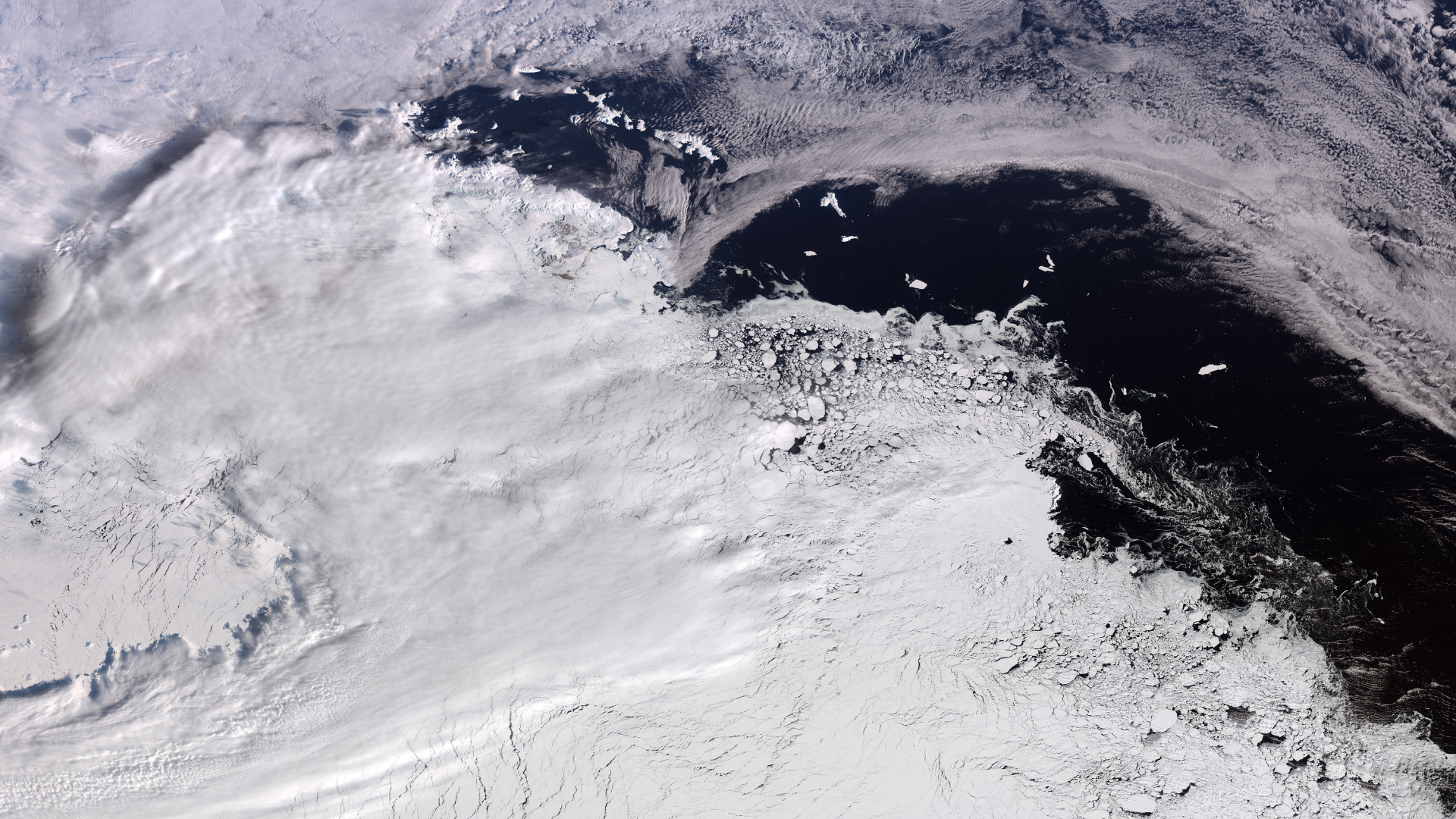
Ice floats by in West Antarctica as winter comes to an end in the Southern Hemisphere. (Image credit: contains modified Copernicus Sentinel data (2026), processed by ESA)
Antarctica is a magnificent sight, and that beauty is visible all the way from space.
What is it?
Orbiting planet Earth, the European Space Agency's (ESA) Copernicus Sentinel-3 mission captured a close-up of West Antarctica.
Winter is ending in the Southern Hemisphere, meaning this is the peak of icy weather and sea ice in the Arctic.
In this image snapped by Sentinel-3, you can see a massive swath of ice which includes Elephant Island on the left-hand side. An ice-covered island off the Antarctic coast, Elephant Island floats in the Southern Ocean. It got its name both from the island's shape, which some liken to that of an elephant's head, and the fact that the island is home to a community of elephant seals.
Why is it incredible?
While a seal-inhabited island on the left floats near the Antarctic coast, across the water is a vast, frozen landscape. In just this snapshot, you can see about between 746 and 1,056 miles (1,200 to 1,700 kilometers) of the icy continent.
This image was captured on Sept. 30, 2026. In the Southern Hemisphere, that was just past the end of winter. The absolute peak for sea ice in Antarctica fell just a couple weeks before, on Sept. 14, according to the National Snow and Ice Data Center, ESA reported.
So in this one snapshot, we can see a near-maximum for sea ice in the Antarctic, spanning hundreds of miles. In observing our own planet from space, we are able to peer across vast landscapes, capturing important observational data. This is especially critical for the Antarctic as, with the progression of climate change, this sea ice continues to dwindle, adding to sea level rise among other serious consequences across the planet.
The "treble clef" galaxy cluster is an unusual source of radio waves, the Chandra X-ray observatory has found. (Image credit: X-ray: NASA/CXC/INAF-IRA/A. Botteon et al.; Infrared: UKIDSS-GPS ; Radio: ASTRON/LOFAR; Image processing: NASA/CXC/SAO/N. Wolk)
What looks like a neon pink treble clef floating out in space is actually a bizarre source of radio waves spotted deep in the cosmos.
What is it?
Scientists using NASA's Chandra X-ray Observatory have peered far out into space to look at strange radio waves coming from what they have nicknamed the "treble clef" because of its distinct shape, which looks a lot like the musical notation.
Using Chandra, as well as the German Extended RÖntgen Survey with an Imaging Telescope Array (eROSITA) X-ray telescope, researchers looking at this strange sight spotted a big cloud of blue gas, which we can see in this image, along with radio signals (seen here in bright pink). They think that this object is actually a huge galaxy cluster made up of two different clusters that are in the process of merging.
Why is it incredible?
The researchers think they may have gotten to the bottom of where these radio waves are coming from, they report in a new study.
The team thinks that the treble clef-shaped radio signals were created by an outburst from a supermassive black hole. They believe that this outburst pushed clouds of charged particles and magnetic fields away from the galaxy cluster's center, producing bright radio waves.
According to the scientists, following this bright outburst, there was likely an extreme collision between two galaxy clusters. This cosmic smash-up either compressed or somehow reenergized these charged particles to amplify the radio signal.
When we see beautiful images of objects in space such as this, they can seem just like peaceful, colorful, cosmic clouds. But when you look a bit deeper, these spectacular scenes can actually be evidence of violent, chaotic events.
The star-forming region IC 348, as imaged by the James Webb Space Telescope. (Image credit: ESA/Webb, NASA, CSA, K. Luhman, C. Alves De Oliveira, M. Zamani (ESA/Webb))
An ethereal and magnificent display of gas and dust stretches across the cosmos in a spectacular new image captured by NASA's James Webb Space Telescope.
What is it?
Glowing wisps of translucent gas and dust paint a striking image of the star-forming region IC 348 in this new JWST snapshot. In the image, you can see IC 348, a region found about 1,000 light-years away.
In this vast expanse of gas and dust, cold molecular hydrogen gas collapses to create new stars. And this image has no shortage of suns, with twinkling stars speckling the entire cosmic landscape, diffraction spikes and all.
But while this is a star-forming region, objects are found here as well. This image was captured as part of a scientific search for brown dwarfs, which are objects that form like stars but aren't massive enough to kickstart hydrogen fusion in their cores.
Why is it incredible?
Brown dwarfs are one of the great mysteries of our universe. Not as massive as the least massive stars, but more massive than the biggest planets, brown dwarfs are strange objects stuck in the middle.
Brown dwarfs do emit some light and heat, which helps scientists to find them, though doing so can be tricky, as they're much cooler than stars and not that bright (at least in visible light). However, despite being dim, they give off infrared radiation, allowing them to be spotted by infrared instruments aboard space telescopes like JWST.
This incredible new image is part of an observing program that aims to use JWST to find and study the smallest brown dwarfs. In 2022, researchers looking at IC 348 found brown dwarfs just a few times more massive than Jupiter, so they were on the very small end. Researchers hope to find even smaller brown dwarfs to help them better understand how these strange objects form and vary across space.
A broad pit that looks almost like a "footprint" on Mars is unlike anything researchers have ever seen on the Red Planet. (Image credit: NASA/JPL-Caltech/MSSS)
Is that a footprint on Mars? Sorry to burst your bubble, but no. However, scientists have found a strange feature unlike anything they've seen before on the Red Planet's surface.
What is it?
While NASA's Perseverance rover is the newest addition to the agency's robotic Red Planet fleet, its cousin Curiosity is still going strong and finding strange and unusual things on Mars 14 years after landing.
In new observations captured on Mars' Mount Sharp, the Curiosity team has identified "features unlike quite anything we have seen in the past," Michelle Minitti, deputy principal investigator for Curiosity's Mars Hand Lens Imager (MAHLI), said in a statement.
These mysterious features are a bunch of broad, shallow pits scattered across the Martian bedrock.
Why is it incredible?
While little pits and divots are common to find on the Martian surface, these wide, shallow pits that researchers saw with Curiosity are quite different from surface features that have been seen before.
"The pits of this week were much broader and shallower than past features and were not accompanied by obvious objects that were once in the pits," Minitti said.
The team collected as much data as they could on the strange pits using Curiosity's various instruments, including MAHLI, the Mastcam camera, ChemCam (the Chemistry and Camera complex) and APX (Alpha Particle X-Ray Spectrometer).
They have so far found interesting layers in the pit material that seems chemically different from the main bedrock.
But we will have to wait and see what else researchers might be able to learn about these odd pits. How did they form? How long have they existed? What can they tell us about the history of Mars?
If this summer felt hotter than usual, you're not alone. As it turns out, this past summer was the hottest on record in the United States.
This is the hottest that summer in the U.S. has been in at least 132 years. Specifically, the temperatures rose to 3 degrees Fahrenheit (1.67 degrees Celsius) above average, beating out the most recent record set in 2021 of 0.4 degrees F (0.22 degrees C) above average, according to a new report from National Oceanic and Atmospheric Administration (NOAA). And looking month-to-month, this was also the hottest August we've ever seen.
The record-breaking season saw unmatched temperature highs across the contiguous U.S. (all of the adjoining states, excluding Alaska and Hawaii which just aren't a part of this record) from June through August. But scorching temperatures aren't all that this new record reveals, as this summer was also one of the driest on record for the contiguous U.S., with more than half of the country in a drought by September. The summer of 2026 saw both extreme precipitation highs and lows across the country, too. From droughts to heavy rain, there was nothing average about the precipitation seen across the U.S. this summer.
A closer look
Digging into some of the details, the full summer was 3 degrees F above the average for the season, 74.4 degrees F (23.5 degrees C). August was 3.5 degrees F (1.94 degrees C) above average for the month at 75.6 F (24.2 C). And while most of the contiguous U.S. experienced well above average temperatures this summer, some locations felt the heat the most. The Southwest, the southern Rockies, the southwestern Plains, southern Florida, California, Nevada, New Mexico and Colorado hit particularly high temperatures this August.
Looking at the summer's unusual precipitation levels, the total precipitation across the contiguous U.S. was 0.32 inches (0.8 centimeters) below average, making this past summer the third driest on record, and the driest summer since 2000. By Sept. 1, 59.1% of the country was in drought. There was drought across the West, the upper Midwest, the Deep South and more. Over 75% of Puerto Rico lie in drought conditions as well, with 40% being in "extreme drought." And while summer might be ending, a lot of this drought is projected to continue, according to the report from NOAA. When it comes to drier lands, that also means an increased risk of wildfire.
Though these temperature differences might seem small or relatively mild at face value, they have massive consequences. As climate change progresses primarily due to greenhouse gas emissions caused by human activities like transportation and manufacturing, we continue to see a whole host of its effects across the world. This ranges from rising average temperatures and glacial ice loss to sea level rise and worsening natural disasters. Those natural disasters include events like flooding, hurricanes, wildfires and cyclones.
While different areas of the world will experience different effects of global warming, one thing remains true for all: The consequences will only continue to worsen asour planet warms.
This infographic shows some of the weather and climate events that took place in the U.S. during August, 2026. (Image credit: NOAA)
If we just look at this past August 2026 in the U.S., not only did we see record-high temperatures, but also weather and climate disasters of all varieties. Fires broke out over 10,000 acres of eastern Washington, even spreading across the state and into Oregon. More fires, in fact, spread across Nevada and Alaska while wind gusts up to 111 miles per hour (178.6 kilometers per hour) tore across South Dakota. A heatwave brought sweltering temperatures to south Florida and Hurricane Lala brought intense winds, rain and flooding to Hawaii;. And these are just a few of the many examples — from just this last month.
The engines fire on Northrop Grumman's Cygnus XL cargo spacecraft to lift up the International Space Station's orbit. (Image credit: NASA)
Everyone needs a helping hand from their friends now and again — even space stations. Recently, the International Space Station got an orbital boost from the docked Cygnus XL spacecraft, helping the station get to the correct altitude.
What is it?
On Aug. 27, while attached to the International Space Station's Unity module, Northrop Grumman's Cygnus XL cargo spacecraft turned its engines on and fired them.
This planned maneuver lifted the space station's orbit, pushing it into a higher altitude. This image snapped from orbit shows Cygnus, named for the swan constellation, as it's attached to the station for this planned push.
But why lift the space station to a higher altitude above Earth?
Next week, the space station will receive a new visitor: the Progress 96 resupply spacecraft. This altitude shift allowed the space station to shift into a position that will allow Progress 96, the 96th cargo mission in a series of Russian Progress cargo missions, to rendezvous and dock with the station.
Why is it incredible?
This maneuver was routine, but emblematic of the incredible progress we've made in space. Not only can we build spacecraft and send them into orbit, but we can control these spacecraft well enough that they help each other out, boosting each other when necessary.
And while Progress 96 might seem like a run-of-the-mill cargo ship carrying cargo like water, fuel, food, scientific instruments and additional supplies to the station, it is also the 96th Progress mission to a space station. In fact, the first Progress mission took place way before the International Space Station even existed. This first mission sent cargo to the Soviet Salyut 6 station all the way back in 1978 and with 96 on the verge of liftoff, the Russian Progress missions are going strong to this day.
Together, the combination of this lift maneuver and this 96th cargo mission show how incredibly well we as humans have worked together to build a sustainable presence in orbit and how that has happened with the aid of international collaboration between nations like the U.S. and Russia.
A dune field on Mars, as seen by the Mars Reconnaissance Orbiter. (Image credit: NASA/JPL-Caltech/University of Arizona)
Are those purple, wavy, alien thumbprints? Or perhaps an otherworldly ocean? Nope! It's actually a dune field on Mars, colored purple.
What is it?
Across the Martian surface are all sorts of unique features in the rocky, dusty surface material. In this false-color image, snapped by the HiRISE (High Resolution Imaging Science Experiment) camera on NASA's Mars Reconnaissance Orbiter, you can see the incredible and strange ripples of a dune field on Mars.
"Our science goal for this observation is to observe any changes from a previous image we acquired in 2011," a statement sharing the image reads. "For this footprint, the target enlarged and centered more over the dune field, which is located on the floor in the northern half of an unnamed impact crater."
Why is it incredible?
Spacecraft like MRO, with its HiRISE camera, have opened our eyes to the incredible features across the Martian surface.
From dune fields like we see here to craters and ancient riverbeds, these views have helped scientists piece together the planet's incredible, dynamic history. For decades, observations from orbit around Mars and by rovers on the planet's surface have helped to solve at least part of the mystery of what Mars was once like.
Researchers are still looking for signs that unequivocally point to life once existing on the planet. But so far, observations have showed that, billions of years in the past, Mars had abundant surface water — lakes, rivers perhaps even a huge ocean. In analyzing the material in and near ancient waterways on the planet with NASA's Perseverance rover, researchers have already found evidence that could possibly link to biosignatures.
While this image might look like a strange but beautiful purple-colored desktop background, photos like it this can be essential clues for scientists hunting for answers.
This new satellite image shows Vasquez Rocks in southern California, where Captain Kirk once faced off against the Gorn. (Image credit: NASA Earth Observatory/Michala Garrison/CBS via Getty Images)
Decades ago, Captain Kirk faced off against the Gorn on the uncharted desert planet Metron. But as we can see in new satellite imagery from NASA, that mysterious rocky world can actually be found right here on Earth in California.
What is it?
In this new image captured by the Operational Land Imager (OLI) on NASA's Landsat 9 satellite, you can see the wide variety of rock and vegetation in the area around Vasquez Rocks Natural Area County Park in southern California.
The 25-million-year-old Vasquez Rocks is a magnificent natural area with an incredible range of unique, large rocks jutting out of the ground. In this false-color image, you can see the area in shortwave-infrared and near-infrared wavelengths that show the differences in vegetation across the landscape.
And this location hides some amazing history. Not only is Vasquez Rocks home to incredible rock formations and desert vegetation, it is also where Captain Kirk fought the Gorn in Star Trek the Original Series. It's not a surprise the series chose this location for its infamous fight scene (among many other Trek scenes), as the massive, sun-bleached boulders pointing to the sky and barren landscape give it a distinctly alien feel.
A satellite view of the are around Vasquez Rocks. (Image credit: NASA Earth Observatory/Michala Garrison)
Why is it incredible?
While the rocky landscape of Vasquez Rocks is firmly fixed here on Earth, it has consistently made history as the backdrop to a whole host of iconic science fiction moments.
Indeed, Star Trek is one as Vasquez Rocks has been used for filming in a whole host of Trek episodes. It was even Spock's home world of Vulcan in the films Star Trek IV: The Voyage Home and Star Trek (2009).
But beyond Star Trek, the site has been used for filming sci-fi classics like Galaxy Quest, Battlestar Galactica and Planet of the Apes in addition to a whole host of cowboy movies and more.
It turns out that right here on Earth, we can find perfectly good alien worlds.
Global warming will soon cross a critical threshold, surpassing a dangerous limit set years ago, the United Nations Environment Programme (UNEP) has found. But experts say it's still possible to cool things back down, emphasizing that the stakes are too high to stop trying.
In 2015, 196 nations and territories signed the Paris Agreement, pledging to restrict the average rise of global temperatures to below 2 degrees Celsius (3.6 degrees Fahrenheit) above pre-industrial levels. Ideally, the rise was meant to be kept to 1.5 degrees C (2.7 degrees F) above those levels. However, according to a new report detailed by the UNEP, we are on track to cross that 1.5 C line — and soon.
"This summer's scorching heat, raging wildfires and deadly floods are a warning of what lies ahead. We must make the overshoot above 1.5 degrees as small and short as possible. That demands an overshoot of ambition," U.N. Secretary-General Antőnio Guterres said in a statement.
According to the new report, experts have found that if we as a planet continue with business as usual, not only will we pass 1.5 C, but it will happen within just a few years. The report, however, maintained a positive tone. Rather than simply predicting a doomsday plot, the main purpose of this release is to outline a pathway with the necessary steps to set things on the right track.
"As global temperature rise gets set to cross 1.5°C, pushing climate risks and impacts to dangerous new heights, the world must strive to return to below 1.5°C as soon as possible and simultaneously reduce the vulnerability of societies, communities and economies to climate impacts," the report, titled "Limiting Overshoot: Navigating exceedance of 1.5°C and pathways towards return," states in its abstract.
Climate change is primarily caused and driven by human activities like transportation, industrial manufacturing, agriculture and more. According to the report, the two main aspects of this work need to be: reducing emissions and enabling adaptations to protect people impacted by the effects of climate change.
The U.N. states in the report the necessity of both an immediate and sustained reduction in the emissions of greenhouse gases like methane and carbon dioxide. Not only do we need to find a way to cut emissions fairly immediately, but we also need to find a way to sustain that effort over time. The U.N. further states it is important to not only work toward removing carbon from the atmosphere, eventually reaching net-negative emissions where more emissions are removed by humans from the atmosphere than added to the atmosphere.
This sort of carbon capture technology is still fairly early in its development, but according to the U.N., it is essential we find ways to rapidly move toward a future where we can capture and store carbon from the air and therefore reduce the quantity of greenhouse gases around our planet.
In addition to these long-term emission reduction actions, in this report the U.N. has also asserted that this process will need to include "adaptation actions," or ways to support the many people and communities already affected by climate change.
Even if all of the world's nations start working immediately to drastically reduce emissions, we are already seeing the sometimes fatal and irreversible effects of climate change. From increasing the intensity of wildfire seasons to worsening natural disasters, climate change is far from a distant future. It's our reality, especially for those living in high-risk areas like coastlines. So, while the nations of the world need to work together to reduce emissions, it is also important that adaptations are found to reduce the existing and future impacts of climate change on our communities.
"There are no good outcomes if we remain above 1.5°C. Across the globe, extreme heatwaves are already proving that climate impacts will strike faster, hit harder, and last longer — costing more lives and causing deeper disruption," Inger Andersen, the Executive Director of UNEP, said in the same statement. "Now is the time we must double down on climate action. We can — and must — get on the right path. By cutting greenhouse gas emissions, strengthening resilience and adaptation, and ensuring exceedance of 1.5°C is as small and short as possible."
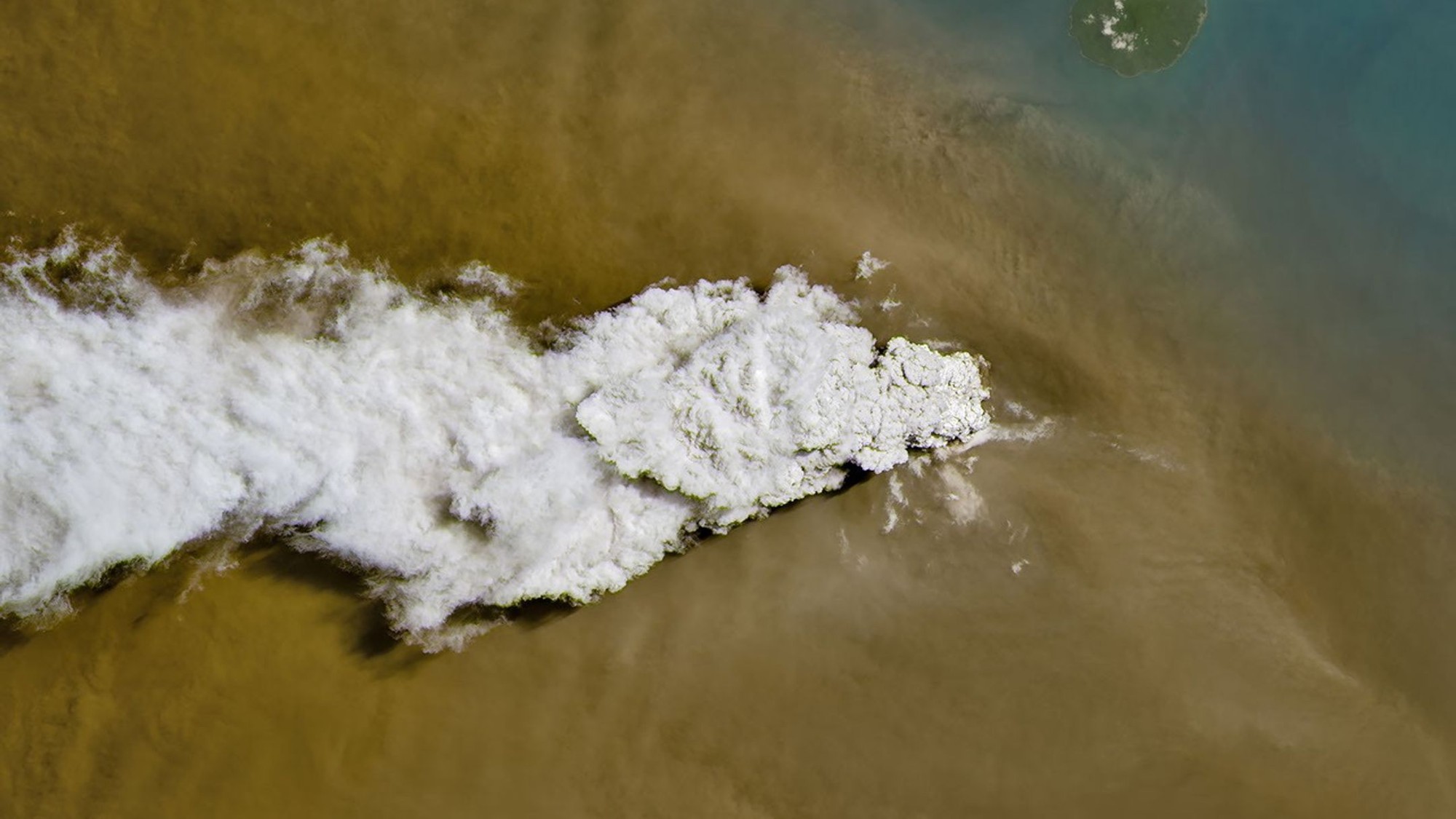
The Anak Krakatau volcano began erupting on Sept. 4, 2026, as seen here on Sept. 5 by the Landsat 8 satellite jointly operated between NASA and the U.S. Geological Survey (USGS) (Image credit: NASA Earth Observatory/Michala Garrison)
A volcano on an Indonesian archipelago began erupting on Sept. 4, and satellites in orbit have been watching closely.
What is it?
The volcano Anak Krakatau started spitting out ash and lava on Sept. 4. On an archipelago between Sumatra and Java, the island volcano's sudden eruption grounded flights, closed schools and even stopped fishing in the area.
The volcano launched ash into the air and into the city of Jakarta and the Lampung province during a 25-hour-long eruption. But even following this eruption, Anak Krakatau remained active throughout the weekend. In fact, the volcano is still so active that it could erupt again soon.
But it wasn't just people on Earth watching the volcano erupt this past weekend. The Landsat 8 satellite, operated by NASA and the U.S. Geological Survey (USGS), spotted a white plume of volcanic gas billowing into the atmosphere all the way from space. The white plumes of gas are thought to mainly contain water vapor, carbon dioxide and sulfur dioxide, while ash and debris make up the brown clouds surrounding the plumes.
Why is it incredible?
While Anak Krakatau simmers after this most recent eruption, this event isn't a major shock, as the volcano sits in what is known as the "Ring of Fire." This "ring" (a loose term, as it's not exactly a ring) snakes about 25,000 miles (40,000 kilometers) around the Pacific Ocean and includes over 750 volcanoes, some dormant and some active.
In fact, in Indonesia alone there are 500 volcanoes, and 127 of them are active, including Anak Krakatau. And this volcano has a particularly interesting story: It emerged from the sea in 1927, rising from the caldera formed by the 1883 eruption of Krakatau (also known as Krakotoa), which was one of the most famous and destructive volcanic events in history. (Anak Krakatau means "child of Krakatau" in the Indonesian language.)
While not all geologists agree on the exact margins of the Ring of Fire, it rests on a string of tectonic plates and has existed for over 35 million years. And not only is this ring home to hundreds of volcanoes, it's also a hot spot for earthquakes.
This image of the sun — the sharpest ever snapped — was captured by the NSF Inouye solar telescope. (Image credit: NSF, NSO, AURA, MPS, Inouye Tel)
Scientists have captured the sharpest image ever of our sun's surface. This view has revealed incredible new details about the inner mechanisms driving stellar activity.
What is it?
An international team of researchers using the U.S. National Science Foundation's Inouye Solar Telescope has captured the highest-resolution view of the sun's surface.
In analyzing observations from this telescope, the team, made up of researchers from the National Solar Observatory, the NSF NCR High Altitude Observatory and the German Max Planck Institut für Sonnensystemforschung, discovered strange patterns on the sun's surface. The whirling patterns, they found, are actually evidence of what's called Kelvin-Helmholtz instability (KHI), or instability that happens when there is a change in velocity of fluids.
Why is it incredible?
This image is groundbreaking. Capturing the highest-resolution view of the sun's surface is a massive accomplishment, and in the time-lapse video above, you can even see the fluid dynamics on the surface of the sun in motion.
But this view is much more than a beautiful, high-resolution image. These observations have revealed swirls on the sun's surface at the edges of the magnetic areas, allowing the team to identify KHI on the sun's surface. This fluid instability has long been suspected on the sun, but these observations are the first time they have ever been directly seen like this.
“We believe that the discovery of Kelvin-Helmholtz Instability in the solar photosphere, backed up by analysis of numerical simulations, is a major step forward in our understanding of the dynamics and evolution of solar and stellar plasma, and will serve as a basis for future discoveries," David Boboltz, the deputy director at the National Solar Observatory, said in a statement.
A paper describing these findings was published recently in the journal Nature.
Picture it: A swarm of tiny robot helicopters descends through a reddish-brown sky, landing gracefully on the Martian surface. What are they wearing? Tiny capes.
NASA's SkyFall mission will send a trio of mini rotorcraft to Mars equipped with ground penetrating radar technology which happens to look like little capes. These uniquely designed swaths of fabric look decidedly strange or even accidental in new videos from NASA's Jet Propulsion Laboratory (JPL) that show the little drones practice landing. But these capes are actually flexible antennae that will allow the craft to peer beneath the Red Planet's surface in search of water ice.
"The only way to detect shallow subsurface ice remotely is to fly close to the ground," Adrian Tang, SkyFall’s ground-penetrating radar lead instrument scientist at JPL, said in a statement on Thursday (Aug. 6). "By flying low and slow, a SkyFall helicopter could capture radar images that resolve the fine layering where dry soil gives way to ice, detecting its presence and mapping its extent."
Orbiting spacecraft have studied Mars for decades, imaging the planet and mapping it with radar. But from orbit, their radar is unable to see the first few feet of material just below the planet's surface — a zone where scientists expect to find shallow ice deposits mixed in with the rocks and dust. This work could be important for future astronauts who need to better understand the ground below their feet for safety reasons, and for future travelers searching for accessible ice to process for drinking water, oxygen and fuel.
Skyfall will follow in the footsteps of Ingenuity, the first rotorcraft on another world, which hitched a ride to Mars aboard NASA's Perseverance rover. The new choppers are based heavily on Ingenuity, which weighed just 4 pounds (1.8 kilograms) here on Earth. But Skyfall will be more capable than Ingenuity, whose main job was to show that choppers can explore the thin skies of Mars.
SkyFall's tiny cape ground-penetrating radar, which uses a type of flexible antenna called Vivaldi that was invented back in 1978, is designed to survey up to 16 feet (5 meters) below the Martian surface. The radar will be able to reach anywhere from several yards below the planet's surface to the uppermost layers of surface material.
And the antenna's unique design ensures that the SkyFall drones will be able to make these subsurface observations without damaging the equipment during landing.. The antenna is extremely lightweight, and the team miniaturized it to be both the right size and shape to fit the tiny helicopters, which sit just 6 inches (15 centimeters) above the ground at rest. The tricky thing was, the designers had to miniaturize the radar antennae while maintaining functionality. But they did just that, and these tiny radar capes will be able to bend and move out of the way as the rotorcraft do their thing, flying above and landing on the Red Planet.
"Although we managed to shrink the antenna quite a bit, it is about 1.5 times longer than the helicopter’s legs," Christine Gebara, SkyFall ground-penetrating radar mechanical lead at JPL, added in the statement.
"That means during landing, the Vivaldi has to bend out of the way — and if it lands on a rock, it bends even further," she added. "But when the helicopter takes off again, the antenna must spring back into place for data collection. Because SkyFall is expected to make dozens of flights exploring Mars, we needed an antenna that could repeatedly handle those pressures without losing its shape in flight."
A radar engineer at NASA JPL works to test the antenna on the SkyFall helicopter. (Image credit: NASA/JPL-Caltech)
To make these little capes capable of withstanding incredible feats on another world, the engineers behind the helicopters covered the antenna in layers of polyester and Vectran, a flexible (but incredibly strong) material that was previously used for the airbag that cushioned NASA's Spirit and Opportunity Mars rovers during their touchdowns in 2004. The antenna's shape is also reinforced with flexible fiberglass tape springs and a lightweight structure. In total, each antenna weighs a miniscule 5 ounces (142 grams).
But a crafty design isn't enough. Getting to Mars is no small feat, and NASA needs to be sure that these little helicopters and their gear are up to the challenge. So, in JPL's Environmental Test Laboratory, which recreates different elements of environments beyond Earth, the SkyFall team put the rotorcraft and its little radar antenna to the test. They bent and flexed the antenna over and over, recreating multiple landings on the surface, exposed the craft to extreme temperatures, and continually checked to make sure that, throughout this testing, the helicopter could still transmit and receive radar signals. At the end of this testing, the antenna had endured 200 simulated Mars landings and was still working just fine. That is more than twice the number of landings expected from the mission.
"This test checked every box it was supposed to and answered our biggest technical questions," Tang added. "While we still have work ahead of us before the antenna is fully flight-qualified, this was a major milestone, and the hardware performed exactly as expected."
The trio of SkyFall helicopters will put their radar capes to the ultimate test when they fly to Mars. NASA plans to launch this mission to the Red Planet in 2028 aboard NASA's Space Reactor-1 Freedom, the first nuclear fission-powered interplanetary spacecraft.
The Carina Nebula's "Treasure Chest" stuns in this new image captured by the James Webb Space Telescope. (Image credit: ESA/Webb, NASA & CSA, M. Reiter)
In a nebula far, far away, colossal clouds of dust and gas tower amongst the stars.
What is it?
This spectacular new image from the James Webb Space Telescope showcases the brilliant majesty of the Carina Nebula, a giant cloud of dust and gas found 7,500 light-years away in the constellation Carina.
In this new image, captured by JWST's Near-Infrared Camera (NIRCam), you can see the nebula in a whole new light. This snapshot captures a specific feature that is being dubbed the "Treasure Chest," as it vaguely resembles a glowing coffer overflowing with stellar jewels.
This "Treasure Chest" contains a cluster of young stars, approximately 70 stars in total. While these might be young, growing stars, the most massive of the bunch is a whopping 19 times more massive than our sun.
Why is it incredible?
While JWST has looked at the Carina Nebula before, new observations can reveal completely new details and help scientists uncover new information about the nebula and the strange ways in which the universe works.
Right now, scientists think that the star cluster in the "Treasure Chest" is about 1.3 million years old. However, previous estimates thought the grouping could be just 100,000 years old. So, new observations by powerful telescopes like JWST can significantly change our understanding of the cosmos.
With each new observation or data point, the history and context of the universe around us could completely transform. And, as this star cluster grows over time, its stars will become more brilliant. They may therefore illuminate more of this star cluster, potentially revealing details and secrets of this "treasure" that scientists might never have predicted.
Early this morning, a SpaceX rocket slammed into the moon at seven times the speed of sound. Now, lunar orbiters are trying to get a look at the aftermath.
This morning (Aug. 5) at about 2:35 a.m. EDT (0635 GMT), the upper stage of a SpaceX Falcon 9 rocket crashed into the moon. To dissect what exactly happened, scientists are looking for imagery of the crash site, with the help of a couple of moon probes.
"NASA’s Lunar Reconnaissance Orbiter and NASA’s ShadowCam instrument on the Korea Pathfinder Lunar Orbiter will look for opportunities to capture before‑and‑after imagery of the impact site," NASA spokesperson Rob Garner, of NASA's Goddard Space Flight Center in Maryland, told Space.com. "Image availability depends on several factors, including the impact location, lighting conditions, and when each spacecraft’s orbit next carries it over the area, which may take a few days to receive any imagery."
While you've likely seen the first stages of Falcon 9 rockets gracefully land back on Earth for reuse, the rocket's 9,000-pound (4,000 kilograms) upper stage is disposable. Typically, it's sent to burn up in our atmosphere after its missions are over.
However, that wasn't possible with this rocket, which launched two private lunar landers — Firefly Aerospace's Blue Ghost and Tokyo-based ispace's Resilience — to a high, moon-crossing Earth orbit in January 2025. The Falcon 9 upper stage used most of its fuel getting to this distant location and couldn't make it back to deorbit in Earth's atmosphere.
So the company performed a different maneuver to take care of this upper stage, Julianna Scheiman, director of NASA science and Dragon programs at SpaceX, said during a press conference on Aug. 3.
"For high-energy missions, we need to perform a different maneuver to ensure the second stage itself is safe per the appropriate rules and regulations, and so we did that here," she said.
But the rocket body was still subject to natural forces, which acted on it over time.
"What has happened is, essentially, a mixture of solar activity and gravity forces have put it on a path towards the moon," Scheiman said.
The Falcon 9 upper stage ended up slamming into the moon this morning at about 5,400 mph (8,690 kph). It likely blasted out a crater up to 89 feet (27 meters) wide, according to scientists' calculations.
This was certainly not the original intended outcome for this rocket. But it presents an opportunity for researchers, who plan to take advantage of it to learn more about the moon.
"NASA’s Meteoroid Environments Office will attempt to image the impact around the predicted time using ground‑based telescopes at the agency's Marshall Space Flight Center in Huntsville [Alabama]," Garner added. "Because the impact flash and plume are expected to be faint, the chance of seeing anything from Earth remains low, and local weather can affect observations as well. Any data collected will help scientists better understand impacts from artificial objects and the potential effects on future lunar exploration."
Today's impact took place on the sunlit side of the moon, the brightness of which made observations difficult for skywatchers hoping to watch the crash from afar with telescopes. But the two lunar orbiters might be able to see not just the crash and impact crater but also the plume of dust kicked up by the rocket's death dive.
So far, observations from Earth have revealed some information. Scientists at the Lowell Observatory in Flagstaff, Arizona reported detections of a lunar plume from the impact.
"We can safely say that we measured a response from the rocket stage impact as a sodium and lithium gas plume a few 10’s of kilometers in size lasting between 5 and 10 minutes after impact," Carl Schmidt told Inside Outer Space's Leonard David.
Detections by the Lowell Observatory in Flagstaff, Arizona, show evidence of a plume on the moon caused by the impact of a SpaceX rocket on Aug. 5, 2026. (Image credit: Carl Schmidt/Lowell Observatory)
Such images of the event would provide "an opportunity to test pipelines for measuring flash properties to locate impact events seismically, and to better understand the multi-modal hazards posed to future lunar infrastructure and astronauts from space debris impacting the moon," researchers led by Benjamin Fernando of Los Alamos National Laboratory in New Mexico wrote in a recent paper discussing the then-upcoming event.
So hold tight, as researchers are now eagerly collecting and analyzing the images captured by these orbiters, and we might get images of the rocket crash, the lunar plumes and remaining aftermath soon.
ESA's Plato spacecraft completes critical testing ahead of its spaceflight. (Image credit: ESA - R. Moorkens O'Reilly)
A planet-hunting spacecraft named Plato just passed a series of critical tests as it prepares for the challenges of outer space.
What is it?
Gleaming in the light of a laboratory, this box of electronics is actually the European Space Agency's Platospacecraft sitting inside a special test chamber where it underwent critical tests ahead of its planned spaceflight.
The Plato (PLAnetary Transits and Oscillations of stars) probe is designed to study terrestrial exoplanets, or rocky planets outside of our solar system that are Earth-sized or smaller.
This chamber, called the Maxwell Test Chamber (which is located at the European Space Research and Technology Centre in the Netherlands), is an enclosure made of conductive metal that blocks electromagnetic fields. On top of the conductive metal are foam spikes. Combined, they block out and/or absorb all electrical signals and sounds to mimic some aspects of the environment of the vacuum of space.
In this enclosure, the team turned on Plato's electronics to make sure that signals from some of the probe's instruments don't interfere with other systems or electronics on the craft. With all other signals blocked out, scientists had a clear look into how it might perform in space.
Why is it incredible?
This test is critical as Plato will need to be able to collect data and run its instruments without interference from electronics or signals from elsewhere on the spacecraft. But it's pretty impossible to ensure that things would work as planned amidst the "noise" on planet Earth.
To get any spacecraft ready to operate in the void of space, researchers conduct all sorts of tests to make absolutely sure that they're up to the challenge. In addition to tests like this, spacecraft can be placed in extremely hot or cold temperature chambers or even shaken around to make sure that they can handle the violent conditions of a rocket launch. It's amazing how we can recreate different aspects of outer space here on Earth to prepare for these missions.
LOS ANGELES — Standing in the shadow of the space shuttle Endeavour, a group of retired NASA astronauts announced their plan to travel the country visiting colleges to try to inspire younger generations to get out and vote. This campaign comes as we lead up to the November midterm election.
This past year, a group of retired NASA astronauts teamed up for a single cause: to defend the U.S. constitution. They banded together as part of a non-profit, non-partisan activist organization called Astronauts for America. So far, they have been speaking out, using their astronaut expertise, platforms, cultural relevance and role model status to speak out in support of "science, evidence-based decision-making, public service and the rule of law," their website reads. Now, as the group announced at an event at the California Science Center's new air and space center — home to the shuttle Endeavour — they're hitting the road on a campaign tour of colleges called "Vote for Freedom."
"We have to do what we can to ensure that the country makes it through the challenges that we're dealing with here, and that is the message that we're going to be taking to colleges and universities," Apollo 9 astronaut Rusty Schweickart told Space.com. "And the agency that we have, the immediate agency, is to vote."
This tour will send astronauts from the group on a four-month jaunt across the country. Astronauts from the group's more than 100 members will visit state and community colleges, county fairs and even town halls, aiming to reach first-time voters and young people who might be new to voting.
"I'm really excited to look a bunch of younger Americans in the eye and make sure that they know that someone that they can trust said: ;Listen, you matter, because our country matters, and our country needs you,'" former NASA astronaut Cady Coleman told Space.com.
"It's with a uniquely American kind of freedom that we were able to go to the moon, and that same freedom launched the spaceship behind us 25 times into space. Now we see those freedoms under heavy threat," former NASA astronaut Steve Smith said during the event. "We're seeing chaos instead of community, violence instead of votes, lies instead of laws, and fear instead of fate. That's how democracy and freedom die."
"The mission is all that matters. Now, our country is the mission, and our message is simple: going to the polls is one small step for you, and one giant leap for our country," Smith added.
Former NASA astronaut Steve Smith speaks alongside other former astronauts in front of the space shuttle Endeavor at the California Science Center on July 20, 2026. (Image credit: Space.com/Chelsea Gohd)
This campaign leads up to the U.S. midterm elections this November. Midterm elections happen halfway through every four-year presidency. This election allows voters to decide what Congress looks like, and which political party controls Congress. This can ultimately have a major impact on what laws and decisions are passed moving forward, and whether Congress will reject or change actions by the president moving forward. And this group of astronauts is serious about the importance of getting people out to exercise their right to vote.
"I'm a child of the segregated South; I grew up in Columbia, South Carolina," former astronaut and NASA Administrator Charlie Bolden, who also serves as a steering committee member for Astronauts for America, said at the event. "I graduated in 1964. Anybody know what happened in 1964? The Voting Rights Act. So, as a person growing up in my hometown, it wasn't a guarantee that my mom and dad were going to be able to go out and vote. I look at what's going on today about people trying to restrict the ability of people to cast their ballot. That's not who we are. That's not America."
The group of astronauts recently spoke out about voting access after the U.S. Supreme Court ruled in favor of protecting the right to absentee voting, in response to attempts by the Trump administration to place restrictions on the current voting process. Especially leading up to the November midterms, each vote carries significant weight. And while this nonpartisan group isn't telling you who to vote for, they do think that everyone who can should vote.
"As astronauts, we signed an oath to our nation, and we are mission-oriented people. And our nation is now the mission," Coleman added. "We need to recognize that everyone's voice is important, and one of the voices that we don't hear very much is the young people. And we want them to understand that, even though sometimes change can seem daunting, their perspective is really important, and, you know, their voice is important."

 Login