Normal view
- SciTechDaily
- Scientists Are Building Electronics That Stretch Like Human Skin and Learn Like a Brain
- EnviroLink Network
- Middle East Conflict Threatens Global Food Security Through Fertilizer Trade Disruption
Middle East Conflict Threatens Global Food Security Through Fertilizer Trade Disruption
The ongoing conflict in the Middle East is creating ripple effects far beyond rising gas prices, with global food security now at serious risk due to disrupted fertilizer supplies. The largely blocked Strait of Hormuz has become what UN Food and Agriculture Organization chief economist Máximo Torero Cullen calls “a critical failure point for global food security.”
Approximately one-third of the world’s seaborne fertilizer trade typically passes through this strategic waterway, making the current blockade a significant threat to agricultural production worldwide. When fertilizer supplies are disrupted, crop yields can plummet, potentially leading to food shortages and price spikes that disproportionately affect vulnerable populations.
The crisis highlights the fragility of global supply chains and the interconnected nature of modern agriculture. Many countries depend heavily on imported fertilizers to maintain their food production levels, leaving them exposed when geopolitical conflicts disrupt trade routes.
However, experts suggest this crisis could serve as a catalyst for positive change. Transitioning to more sustainable agricultural practices could help build resilience against both geopolitical disruptions and climate-related threats. Strategies such as regenerative farming, reduced chemical dependency, and diversified supply chains could help insulate food systems from future shocks while simultaneously reducing environmental impact.
The post Middle East Conflict Threatens Global Food Security Through Fertilizer Trade Disruption first appeared on EnviroLink Network.
- EnviroLink Network
- Mangrove Forests Face Existential Threat as Rising Seas Challenge Nature’s Carbon Guardians
Mangrove Forests Face Existential Threat as Rising Seas Challenge Nature’s Carbon Guardians
For tens of millions of years, mangrove forests have stood as nature’s ultimate survivors, thriving where land meets sea in some of Earth’s harshest conditions. These remarkable trees have mastered the art of living in saltwater, creating vast coastal ecosystems that serve as powerful weapons against climate change by storing enormous amounts of carbon in their roots, trunks, and surrounding soil.
Beyond their role as carbon storage champions, mangroves form living shields that protect millions of people from storm surges and coastal flooding. Their intricate root systems act as natural breakwaters, absorbing wave energy and preventing erosion that could devastate coastal communities. These forests also support incredible biodiversity, serving as nurseries for countless fish species and providing habitat for birds, reptiles, and marine life.
However, new research reveals a troubling paradox: while mangroves are among our most effective natural allies in fighting climate change, they may not be able to withstand the very problem they help solve. Rising sea levels driven by global warming threaten to push even these resilient ecosystems beyond their survival threshold. The modeling study suggests that the rate of sea level rise may soon outpace the mangroves’ ability to adapt, potentially triggering a devastating feedback loop where the loss of these forests releases stored carbon back into the atmosphere.
This threat represents more than just the loss of trees—it signals the potential collapse of a critical natural infrastructure that protects both climate stability and human communities worldwide.
The post Mangrove Forests Face Existential Threat as Rising Seas Challenge Nature’s Carbon Guardians first appeared on EnviroLink Network.
- EnviroLink Network
- Duke Energy Set to Receive $28.4 Million in Federal Funds for Coal Plant Upgrades in North Carolina
Duke Energy Set to Receive $28.4 Million in Federal Funds for Coal Plant Upgrades in North Carolina
Duke Energy is poised to receive $28.4 million in federal taxpayer funding to upgrade two aging coal-fired power units at its Roxboro plant in Person County, North Carolina. The federal grant would be supplemented by an additional $44 million from ratepayer funds, bringing the total investment to over $72 million for the coal facility improvements.
The funding announcement comes as Person County residents are already grappling with significant energy infrastructure changes in their community. The area is simultaneously dealing with the construction of new natural gas power plants, pipeline development, and a proposed Microsoft data center that would dramatically increase local energy demand.
The Roxboro plant upgrades are part of a broader national initiative, with similar coal plant improvement projects planned across 13 locations nationwide. This federal investment in coal infrastructure represents a notable shift toward supporting fossil fuel facilities at a time when many utilities are transitioning away from coal-fired power generation due to environmental concerns and economic factors.
The timing of these coal plant upgrades has raised questions among environmental advocates about the long-term energy strategy for the region, particularly given the concurrent natural gas development and the growing energy needs from technology companies establishing data centers in North Carolina. The combination of these projects signals a continued reliance on fossil fuel infrastructure despite ongoing climate commitments at state and federal levels.
The post Duke Energy Set to Receive $28.4 Million in Federal Funds for Coal Plant Upgrades in North Carolina first appeared on EnviroLink Network.
- EnviroLink Network
- Federal Government to Impose Colorado River Management Plan as Seven States Fail to Reach Agreement
Federal Government to Impose Colorado River Management Plan as Seven States Fail to Reach Agreement
The federal government is preparing to step in with its own 10-year management framework for the Colorado River if the seven states that depend on this critical water source cannot reach an agreement by summer’s end. Scott Cameron, acting commissioner for the Bureau of Reclamation, announced the ultimatum at a water conference in Boulder, Colorado.
The Colorado River Basin is experiencing its worst water year on record, intensifying pressure on negotiations that have been deadlocked for months. The river supplies water to approximately 40 million people across Arizona, California, Colorado, Nevada, New Mexico, Utah, and Wyoming, making any management decision crucial for the region’s future.
Years of severe drought, combined with rising temperatures and increased water demand, have pushed the river system to critical levels. Major reservoirs like Lake Mead and Lake Powell have dropped to historic lows, forcing difficult conversations about water allocation among the basin states. Despite the urgency of the situation, the states have struggled to agree on how to share reduced water supplies and implement necessary conservation measures.
If federal intervention becomes necessary, it would mark a significant shift in how the Colorado River is managed. The Bureau of Reclamation’s imposed framework would override state-level negotiations and establish binding water use guidelines for the next decade, potentially reshaping water rights and usage patterns across the entire Southwest.
The post Federal Government to Impose Colorado River Management Plan as Seven States Fail to Reach Agreement first appeared on EnviroLink Network.
- EnviroLink Network
- Federal Government Allocates $700 Million to Support Struggling Coal Industry Through Defense Production Act
Federal Government Allocates $700 Million to Support Struggling Coal Industry Through Defense Production Act
The U.S. Department of Energy announced a massive $700 million funding package on Thursday aimed at bolstering the nation’s declining coal industry, drawing sharp criticism from environmental advocates who argue the move prioritizes outdated energy sources over cleaner alternatives.
The funding, sourced from the Defense Production Act, includes $425 million specifically designated to extend the operational lifespan of 12 coal-fired power plants across multiple states. Among the recipients, the Wheeling Power Company will receive $50 million to “modernize” its Mitchell Plant facility in Moundsville, West Virginia. The remaining $275 million will reportedly fund the construction of two new coal plants, as part of what officials are calling an “energy dominance” strategy.
Environmental groups have condemned the announcement, emphasizing that coal remains one of the most polluting and increasingly expensive forms of energy generation. Critics argue that the substantial federal investment contradicts national climate commitments and represents a step backward in the transition toward renewable energy sources. They point to coal’s significant contribution to greenhouse gas emissions and air pollution, which pose serious risks to public health and environmental quality.
The funding comes at a time when the coal industry has been struggling economically, with many plants closing due to competition from cheaper natural gas and renewable energy sources. While supporters argue the investment will preserve jobs and maintain energy security, opponents question whether taxpayer dollars should support an industry that many consider obsolete in the face of climate change.
The post Federal Government Allocates $700 Million to Support Struggling Coal Industry Through Defense Production Act first appeared on EnviroLink Network.
- EnviroLink Network
- Washington DC Pop-Up Museum Confronts Americans with Personal Cost of Climate Disasters
Washington DC Pop-Up Museum Confronts Americans with Personal Cost of Climate Disasters
What would you grab if you had just minutes to evacuate your home before a wildfire or hurricane struck? Your family photos? A beloved pet? That handmade quilt from your grandmother?
This deeply personal question lies at the heart of the Museum of Unnatural Disasters, a powerful new pop-up exhibit that has opened in Washington DC. The interactive display forces visitors to confront the human reality behind climate change statistics by focusing on the impossible choices people face when extreme weather threatens everything they hold dear.
The museum brings together an unlikely coalition of voices – disaster survivors sharing their harrowing experiences, lawmakers grappling with policy responses, and activists demanding urgent action. Through personal stories and immersive displays, visitors experience what it means to lose a lifetime of memories to rising floodwaters or watch irreplaceable family heirlooms turn to ash in a wildfire.
The exhibit arrives at a critical moment as extreme weather events become increasingly frequent and severe across the United States. By transforming abstract climate data into visceral, emotional experiences, the museum aims to bridge the gap between scientific warnings and public understanding. Rather than overwhelming visitors with statistics about global temperature rise, the display asks them to imagine their own most treasured possessions at risk, making the climate crisis intensely personal and immediate.
The post Washington DC Pop-Up Museum Confronts Americans with Personal Cost of Climate Disasters first appeared on EnviroLink Network.
- EnviroLink Network
- Montana Braces for Severe 2026 Wildfire Season as Drought and Heat Create Perfect Storm
Montana Braces for Severe 2026 Wildfire Season as Drought and Heat Create Perfect Storm
Montana is preparing for what could be one of its most challenging wildfire seasons in recent years, as a dangerous combination of environmental factors creates elevated fire risk across the state. Officials warned this week that drought conditions, unusual wind patterns, and warmer-than-average winter temperatures are setting the stage for above-normal wildfire activity in 2026.
The concerning forecast comes as the state grapples with ongoing climate challenges that have made wildfire seasons increasingly unpredictable and severe. Warmer winter temperatures have reduced snowpack levels, while persistent drought conditions have left vegetation dry and highly combustible. When combined with expected wind events throughout the fire season, these factors create ideal conditions for rapid fire spread and intensity.
Adding to the challenges, Montana’s firefighting infrastructure faces significant strain. Volunteer fire departments, which often serve as the crucial first responders to emerging blazes, are struggling with recruitment and staffing shortages. Meanwhile, federal firefighting agencies are undergoing organizational changes that could impact response capabilities during critical moments.
The early warning allows communities across Montana to begin preparation efforts, including vegetation management, emergency planning, and resource allocation. State officials emphasized the importance of proactive measures, as the convergence of drought, heat, and wind creates conditions where small fires can rapidly escalate into major emergencies that threaten both natural landscapes and human communities.
The post Montana Braces for Severe 2026 Wildfire Season as Drought and Heat Create Perfect Storm first appeared on EnviroLink Network.
- Futura
- Patient bizarre : les médecins découvrent qu’il a reçu bien plus qu’un rein lors de sa greffe
Patient bizarre : les médecins découvrent qu’il a reçu bien plus qu’un rein lors de sa greffe

Mass Measurements of the Double Neutron Star System PSR J0641+0448
Using the Five-hundred-meter Aperture Spherical radio Telescope, researchers have discovered and measured the spins and masses of a pair of neutron stars using the pulsar timing method.
The post Mass Measurements of the Double Neutron Star System PSR J0641+0448 appeared first on AAS Nova.
The First Dedicated Survey of Atmospheric Escape from Planets Orbiting F Stars
A survey of six gas giants orbiting F-type stars suggests that atmospheric escape of these planets is determined by the X-ray and extreme-ultraviolet output of their host stars as well as the Roche filling factor.
The post The First Dedicated Survey of Atmospheric Escape from Planets Orbiting F Stars appeared first on AAS Nova.
Now That’s Metal: How to Spot Stars That Have Swallowed Their Planets
![]()
Planets that get too close to their host stars are liable to be engulfed and consumed. New research explores how to identify stars that have had a planetary snack.
It’s Snack Time
Being a planet that closely orbits its star is dangerous, and various dynamical processes can draw a planet inward past the point of no return. When a planet vanishes beneath the surface of its host, it eventually disintegrates within the star, its atoms mixing into the blazing stellar soup.
This outcome is likely extremely common across the universe, and researchers have begun to see evidence for it: stars that appear to have absorbed angular momentum from their planets, white dwarfs with uncanny metals in their spectra, and stars with chemical abundances that don’t match those of their siblings. Now, in a recent publication led by Kaitlyn Lane (Vanderbilt University), researchers seek to find observational signatures of planetary engulfment of rocky exoplanets by main-sequence stars.
Modeling Engulfment
Lane’s team focused on main-sequence stars in the range of 0.5 to 1.4 solar masses, using one-dimensional analytical models to determine which of these stars will most readily display signs of having engulfed a planet. They simulated the stars as they consumed either an Earth-like planet or a super-Earth with the same composition as Earth but 15 times its mass.
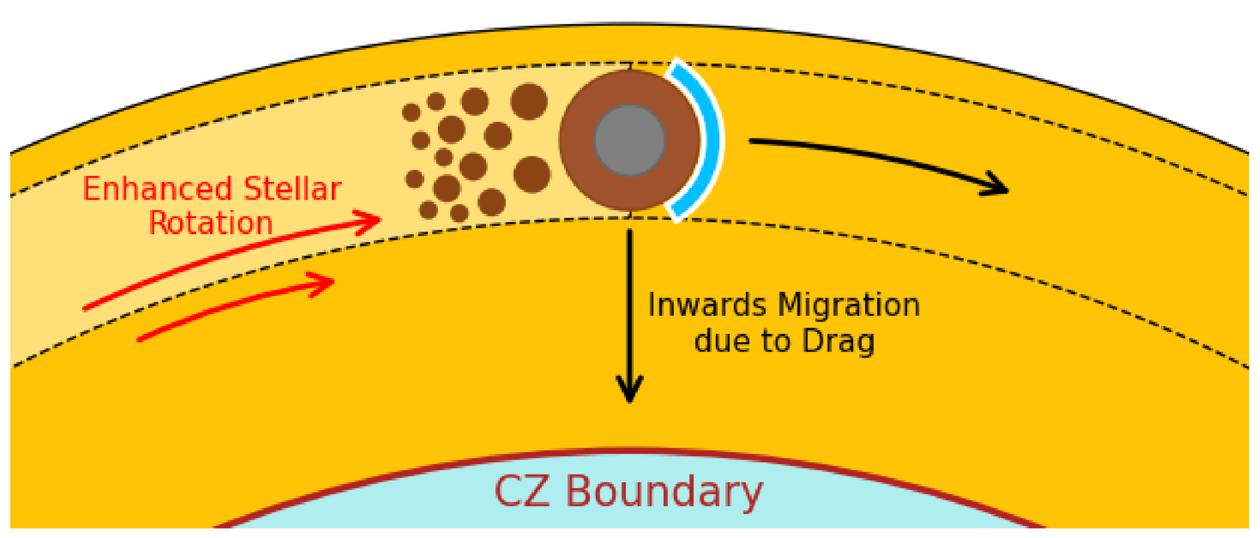
Diagram showing a planet being engulfed by its star and beginning to disintegrate before migrating inward. The boundary between the star’s outer convective zone (CZ) and inner radiative zone is shown. Click to enlarge. [Lane et al. 2026]
After that relatively lengthy phase, the process proceeds rapidly: as the planet inches deeper into its star, the drag forces grow stronger and the planet’s demise accelerates, with the planet disintegrating over the course of hours. In the last phase, the planet makes its final plunge and is destroyed in a half hour.
Signs of Planets Past
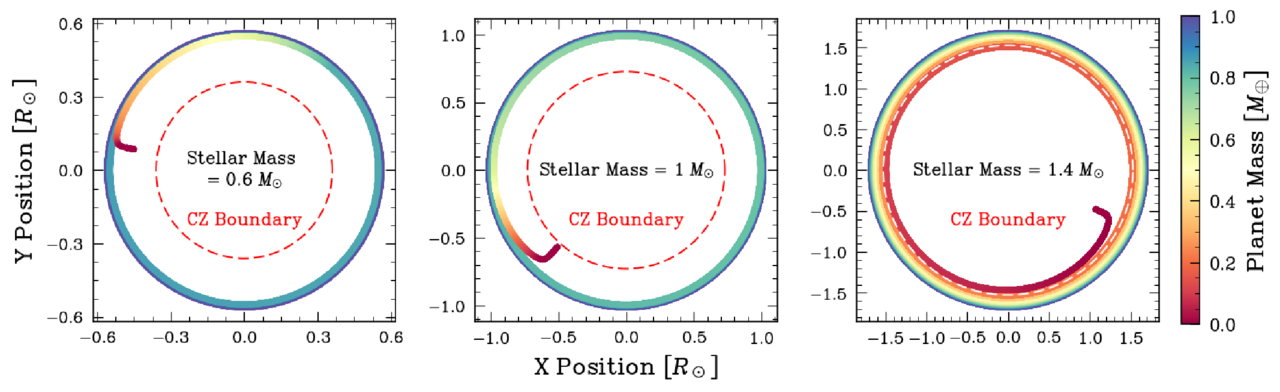
Lane’s team found that the planets tended to be destroyed fully within the outer convective layer of their stars, except in the case of the most massive stars studied here. For more massive stars, the outer convective zone is shallower than it is for the less massive stars, allowing a chunk of each planet to survive the passage through the convective zone to reach the radiative zone below.
The trajectories of three example cases, showing how the planet loses mass as it spirals inward. In the 1.4-solar-mass case, part of the planet survives to reach the radiative zone, but the shallowness of the star’s convective zone means that the disintegrated planetary material is easier to observe. Click to enlarge. [Lane et al. 2026]
While the authors acknowledge that there’s more work to be done — they plan to investigate the impacts of planetary engulfment on stellar structure more closely, for example — this work represents an important foray into identifying targets for future studies of stars that have eaten their planets.
Citation
“Observable Metal Pollution in Main-Sequence Stars: Simulations of Rocky Planets Engulfed by Stars in the 0.5 to 1.4 M⊙ Range,” Kaitlyn T. Lane et al 2026 ApJ 1003 67. doi:10.3847/1538-4357/ae5b9a
The post Now That’s Metal: How to Spot Stars That Have Swallowed Their Planets appeared first on AAS Nova.

- AAS Nova
- Measuring the Distances to Asteroids from One Observatory in One Night with Upcoming All-Sky Telescopes
Measuring the Distances to Asteroids from One Observatory in One Night with Upcoming All-Sky Telescopes
Using simulations of 20 asteroids from 0.05 to 2.4 au away, researchers demonstrate how the technique of topocentric parallax could be used to determine the distance to an asteroid in a single night.
The post Measuring the Distances to Asteroids from One Observatory in One Night with Upcoming All-Sky Telescopes appeared first on AAS Nova.
Predictions of Imminent Earth Impactors Discovered by LSST
Simulations suggest that Rubin Observatory will discover 1–2 meter-size or larger imminent impactors each year, nearly doubling the discovery rate and providing an important set of eyes in the Southern Hemisphere.
The post Predictions of Imminent Earth Impactors Discovered by LSST appeared first on AAS Nova.
Blue Straggler in the Making: An X-Ray Active Binary in Algol Configuration
Researchers have found a rare example of a blue straggler star in the process of formation, providing direct evidence for the formation of these puzzling stars through ongoing mass transfer in a binary system.
The post Blue Straggler in the Making: An X-Ray Active Binary in Algol Configuration appeared first on AAS Nova.
Featured Image: Massive Young Star Clusters, Revealed
![]()
The Antennae galaxies are a nearby pair of interacting galaxies, shown in optical light from the Hubble Space Telescope (left) and in infrared light from JWST (right) in the image above. Between the two galaxies’ bright nuclei, there is a vast and dusty molecular cloud complex that harbors a large number of massive young star clusters — and in a recent article led by Rupali Chandar (University of Toledo), researchers have worked to pin down exactly how many clusters are embedded within the dusty whorls of the Antennae galaxies. The team used JWST to search for emission from star clusters too thickly blanketed with dust to be visible in previous observations by Hubble. They ultimately identified 45 sources, 40 of which were seen for the first time in this study. These star clusters mostly inhabit the overlap region between the two galaxies, are less than 2.5 million years old, and each contain roughly 104–106 solar masses. To learn more about how JWST’s infrared capabilities unveiled young star clusters in these interacting galaxies, be sure to check out the full article linked below.
Citation
“Nowhere Left to Hide: Uncovering All of the Massive Young Embedded Star Clusters in the Antennae with JWST,” Rupali Chandar et al 2026 ApJ 1002 64. doi:10.3847/1538-4357/ae56e8
The post Featured Image: Massive Young Star Clusters, Revealed appeared first on AAS Nova.
Dual Active Galactic Nuclei on 100 kpc Scales from the Million Quasar Catalog
In a sample of 171 new dual active galactic nuclei, four triplets, and one quadruplet drawn from a catalog of nearly a million quasars, researchers find that roughly 16% of targets exhibit tidal features.
The post Dual Active Galactic Nuclei on 100 kpc Scales from the Million Quasar Catalog appeared first on AAS Nova.
Stacking Up the Discovery of Six Millisecond Pulsars
![]()
The fastest spinning pulsars in the universe are often quite difficult to detect. Leveraging multiple observations from the largest single-dish telescope in the world, researchers have discovered six previously undetected pulsars.
Millisecond Pulsars in Globular Clusters
Globular clusters, compact collections of tens of thousands to millions of stars, are highly dense and rife with dynamical interactions. These active environments are ideal factories for the formation of millisecond pulsars — the extremely fast-spinning cores of once-massive stars, shining beams of radio emission from their poles. One way millisecond pulsars are thought to form is when a pulsar in a binary system steals mass from its companion star, transferring angular momentum and causing the pulsar to spin up. The densely packed environment in a globular cluster provides ample opportunity for a pulsar to acquire a companion to siphon.
However, millisecond pulsars in distant globular clusters are notoriously difficult to detect. Traditional pulsar searches that rely on a single observation tend to miss millisecond pulsars, many of which have signals too faint to be distinguished from noise or radio interference. Instead, researchers must rely on a different method to find these fast-spinning pulsars.
FAST, the 500-meter single-dish radio telescope located in southwestern China. [Wikipedia user SCJiang; CC BY 4.0]
Stack Search Success
To find faint millisecond pulsars, researchers have developed the stack search method, in which multiple radio observations are combined to tease out faint signals and decrease noise. Reliably stacking observations across epochs requires stability; isolated millisecond pulsars, now no longer spinning up after losing their companion, have very stable rotation periods, making them ideal targets for the stack search method. To date, the stack search method has successfully identified nine isolated globular cluster millisecond pulsars using data from the Arecibo, Parkes, and Green Bank radio telescopes.
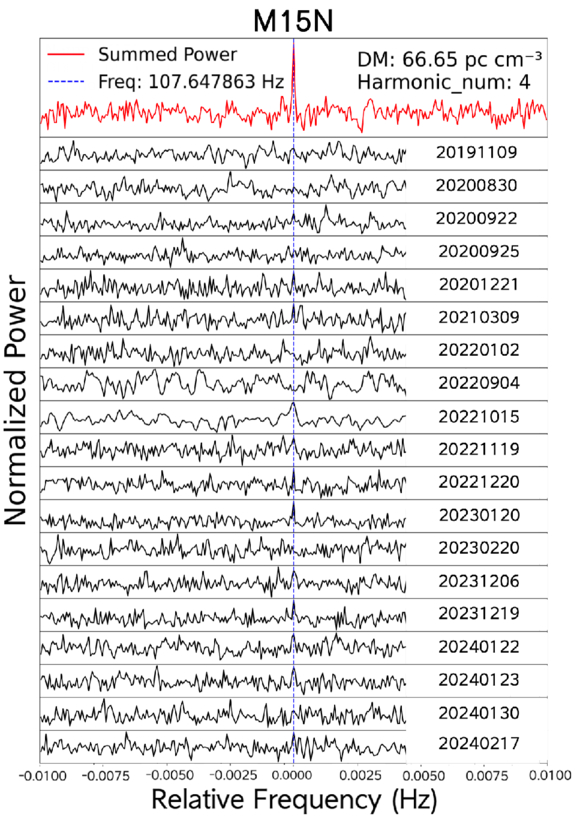
Power spectra from a discovered millisecond pulsar M15N. The black solid lines show the 19 individual observations of the pulsar, and the red solid line in the top panel shows the stacked spectrum. The stack search method pulls out a clear pulsar signal. [Dai et al. 2026]
While previous studies identified brighter pulsars in the targeted globular clusters, the authors confirmed that all six newly discovered pulsars are too weak to be reliably recovered from single-epoch searches, underscoring the importance of the stack search method. In particular, this search increased the known pulsar populations of NGC 6517 and M15 by 27% and 18%, respectively, suggesting that a meaningful fraction of globular cluster pulsars are easily missed in traditional pulsar searches. Future studies employing this stack search method will continue to detect faint millisecond pulsars, unlocking this elusive population for further exploration.
Citation
“The Stack Search Tests on FAST Data: Discovery of Six Faint Isolated Millisecond Pulsars in NGC 6517 and NGC 7078 (M15),” Yinfeng Dai et al 2026 ApJL 1002 L31. doi:10.3847/2041-8213/ae5dbb
The post Stacking Up the Discovery of Six Millisecond Pulsars appeared first on AAS Nova.
Can the Dust Eclipses in WR 104 Provide Constraints on the System’s Inclination?
Researchers find a system inclination of 41.8 degrees for WR 104; this result is at odds with previous interpretations of the system’s dust plume, but a new geometric model reconciles these results.
The post Can the Dust Eclipses in WR 104 Provide Constraints on the System’s Inclination? appeared first on AAS Nova.