❌

Normal view

It’s a Beautiful Day in the (Solar) Neighborhood

21 October 2026 at 17:00

Hyades star cluster

It’s never been easier to get to know your neighbors: a new database introduces open star clusters, stellar associations, and substellar objects within 500 parsecs (1,630 light-years) of the Sun.

Too Much of a Good Thing

Astronomers today must contend with a difficult but delightful problem — there’s just so much data available. As a researcher attempting to study a particular slice of the universe, it can be challenging to pinpoint the correct data and to know whether you’ve collected all the data relevant to your science. This prospect is already daunting, and the deluge of data from surveys like the Vera C. Rubin Observatory’s Legacy Survey of Space and Time will make the situation even harder to manage.

This is where specialized databases can help. Often crafted with specific science goals in mind, database creators do the work for you by compiling objects within a well-defined parameter space. Today’s article describes a new database that takes a census of the solar neighborhood, with applications for studies of stellar evolution, exoplanets, and more.

Compiling Clusters

Jonathan Gagné (Montreal Planetarium; University of Montreal) and collaborators have compiled the Montreal Open Clusters and Associations (MOCA) database, which contains detailed information on nearby star clusters, stellar associations, and substellar objects.

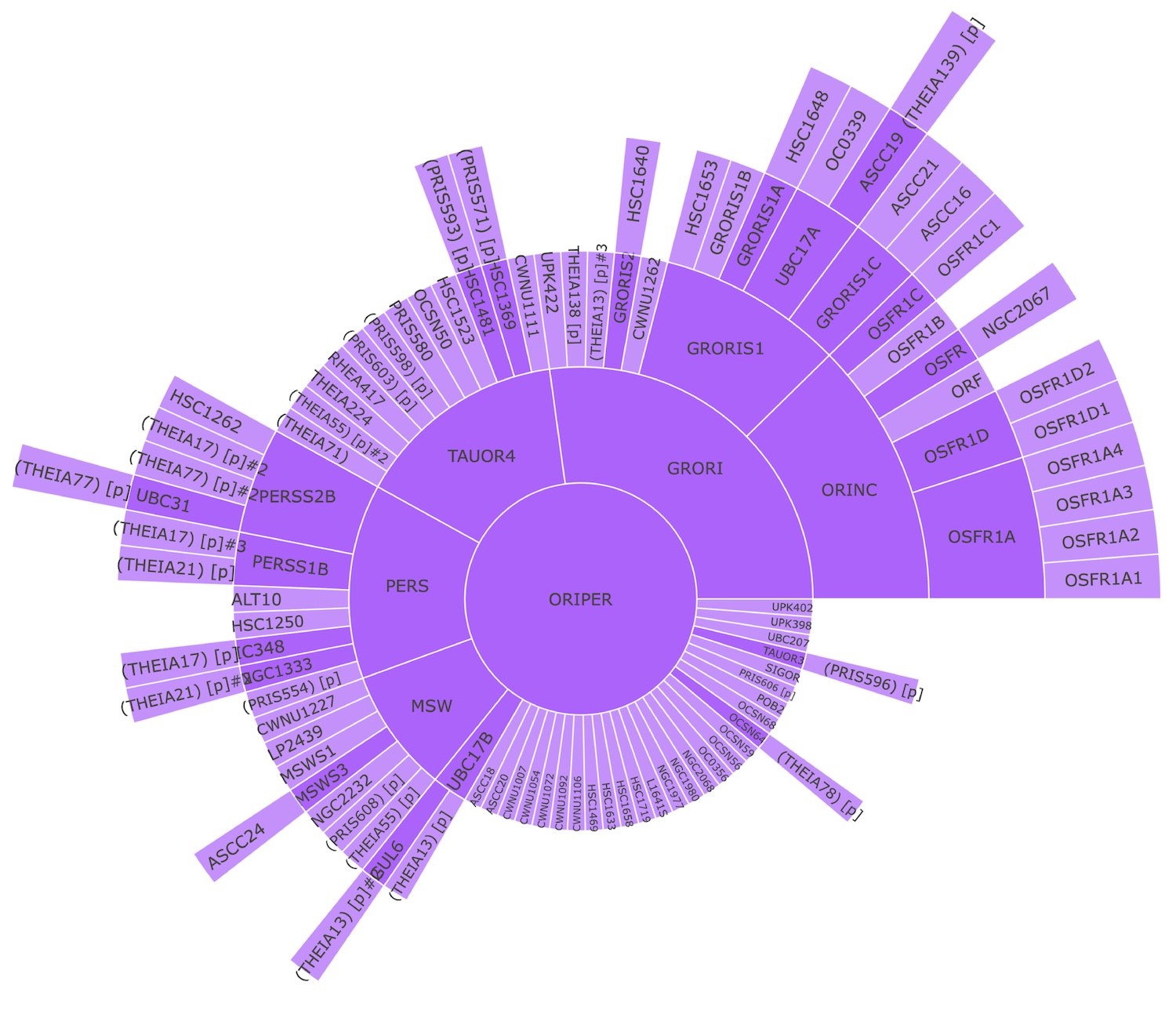
visualization of stellar association hierarchies

Visualization of the hierarchy of young stellar associations within the Orion–Perseus branch of the database. Click to enlarge. [Gagné et al. 2026]

Gagné’s team began the monumental task of constructing the database by amassing a list of nearby groups of stars from the literature, drawing on recent searches using data from the Gaia mission and other sources. This task required reconciling cluster names and memberships from multiple sources and detailing a cluster hierarchy that places subgroups within larger cluster structures.

In total, the complete database contains information about 10,259 star clusters and stellar associations and their individual members. The authors identified more than 11,000 new candidate cluster and association members, most of which are M dwarfs. The database also contains 1,620 substellar objects, 196 of which are newly identified through this work, and 101 candidate isolated planetary-mass objects.

Science with MOCA

For each star, the team compiled the available measurements from the literature and, from these core measurements, derived quantities like distance and spectral type. They then used empirical methods to estimate further properties like age, mass, and effective temperature.

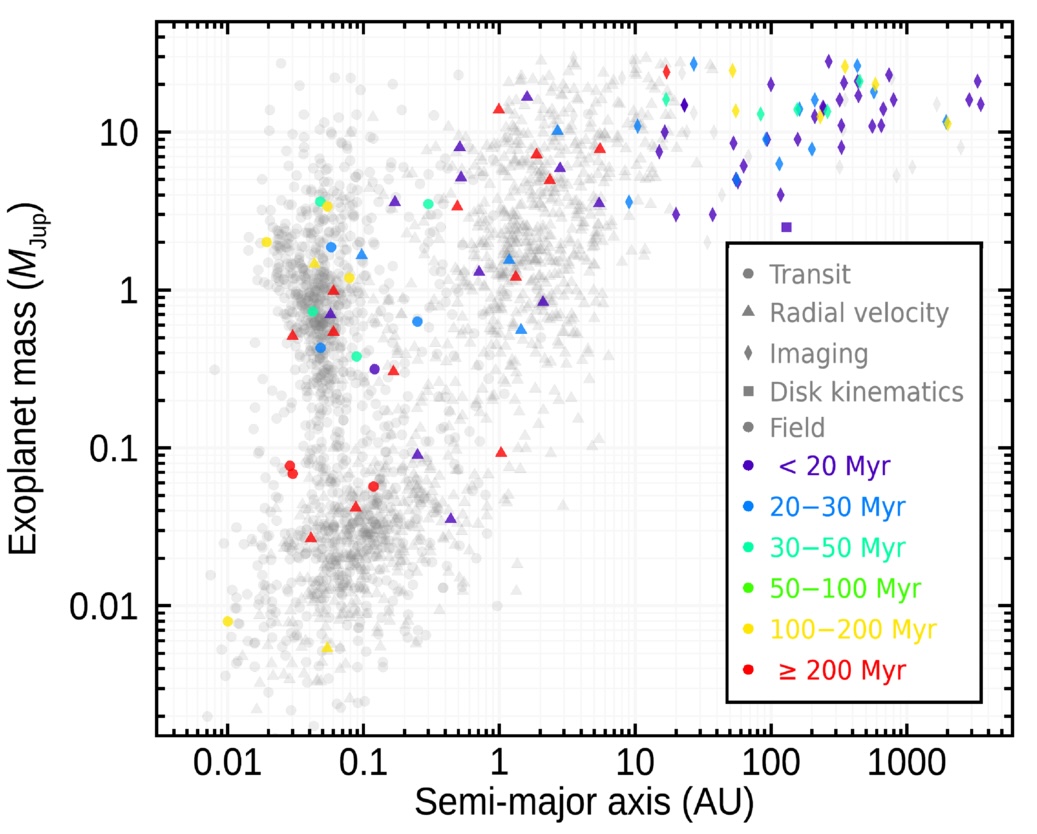
properties of confirmed exoplanets and exoplanets in young stellar associations

Masses and semi-major axes for confirmed exoplanets from the NASA Exoplanet Archive (gray symbols). Colored symbols indicate planets belonging to a young stellar association, with the color denoting the age of the association. Click to enlarge. [Adapted from Gagné et al. 2026]

Assigning ages to star clusters and stellar associations enhances the scientific value of the database, making it broadly accessible to studies of stellar and planetary evolution. For exoplanet science, the team identified 134 confirmed exoplanet systems and 121 planet candidates in young stellar associations with well-determined ages. This includes 46 confirmed and 53 candidate planets that appear to be assigned to an age-dated association for the first time.

MOCA already offers an impressive census of our patch of the Milky Way, but this isn’t its final iteration. As new data become available — including future Gaia data releases that will improve our understanding of cluster membership and reveal a population of astrometrically detected exoplanets — they will be incorporated into the existing database.

Interested in seeing what MOCA can do for your research? You can access the database online.

Citation

“The Montreal Open Clusters and Associations (MOCA) Database: A Census of Nearby Associations, Open Clusters, and Young Substellar Objects Within 500 pc of the Sun,” Jonathan Gagné et al 2026 ApJS 287 8. doi:10.3847/1538-4365/ae9b09

The post It’s a Beautiful Day in the (Solar) Neighborhood appeared first on AAS Nova.

Four Cold Giant Planets Discovered by High-Cadence Microlensing Surveys

21 October 2026 at 17:00

Cheongho Han et al 2026 AJ 172 110

Four giant planets with masses of 0.2–2.5 Jupiter masses, orbiting hosts of 7–60% the mass of the Sun, have been discovered using microlensing; all the planets appear to lie beyond the snow lines of their hosts.

The post Four Cold Giant Planets Discovered by High-Cadence Microlensing Surveys appeared first on AAS Nova.

Megaparsec-Scale Neutral Hydrogen Flows in the Neighborhood of Hickson Compact Group 100

20 October 2026 at 17:00

Qingzheng Yu et al 2026 ApJL 1007 L32

Using the Five-hundred-meter Aperture Spherical radio Telescope, astronomers have discovered an extended neutral hydrogen structure indicative of either tidal debris or accretion from the cosmic web.

The post Megaparsec-Scale Neutral Hydrogen Flows in the Neighborhood of Hickson Compact Group 100 appeared first on AAS Nova.

Featured Image: Examining Galactic Filaments

20 October 2026 at 17:00

filaments in the galactic center

This image of the galactic center from the MeerKAT radio array shows wispy vertical lines known as galactic non-thermal filaments. These structures, which are tens of parsecs long and less than a tenth of a parsec wide, are found throughout a complex region called the central molecular zone. The filaments’ radio emission appears to come from charged particles spiraling around magnetic field lines, but it’s not yet known where the speeding particles that power this emission come from. Recently, Mohan Richter-Addo (University of Wisconsin–Madison) and collaborators used magnetohydrodynamics simulations to explore two potential sources: 1) the electron–positron winds of a pulsar or 2) a proton-rich mix of particles accelerated by interstellar shocks. The team found few discernible differences between simulated filaments illuminated by these two sources, but this work provided new avenues for future exploration. One facet that emerged from the team’s investigation is that filaments should grow longer as they age, with the maximum length set by the underlying magnetic field. This suggests that magnetohydrodynamic turbulence might play a role in shaping the filaments. To learn more about this exploration of galactic non-thermal filaments, be sure to check out the article linked below.

Citation

“The Effects of Cosmic-Ray Protons on Galactic Nonthermal Filaments,” Mohan Richter-Addo et al 2026 ApJ 1009 164. doi:10.3847/1538-4357/aea0c7

The post Featured Image: Examining Galactic Filaments appeared first on AAS Nova.

Tree-Ring Structure of Galactic Bar Resonance in N-Body Simulations

19 October 2026 at 17:00

Rimpei Chiba et al 2026 ApJ 1006 132

Even in a noisy environment with fluctuations in pattern speed and encounters with the Sagittarius dwarf galaxy, a tree-ring structure arises in phase space measurements of the Milky Way’s galactic bar.

The post Tree-Ring Structure of Galactic Bar Resonance in N-Body Simulations appeared first on AAS Nova.

Not All Black Holes Who Wander Are Lost

19 October 2026 at 17:00

interacting galaxies Arp 147

Editor’s Note: Astrobites is a graduate-student-run organization that digests astrophysical literature for undergraduate students. As part of the partnership between the AAS and astrobites, we occasionally repost astrobites content here at AAS Nova. We hope you enjoy this post from astrobites; the original can be viewed at astrobites.org.

Title: Tracing Black Hole and Galaxy Growth Across Environments Since Cosmic Noon
Authors: Emma Jane Weller et al.
First Author’s Institution: Yale University
Status: Published in ApJ

They say you can’t choose your hometown, but it still ends up shaping who you become. Turns out the same is true for black holes. The galaxy a black hole grows up in will have a major impact on how it will live out the rest of its life. Similarly, the black hole can leave a lasting impression on its galaxy!

Astronomers have long known that a galaxy’s stellar mass (the combined mass of all its stars) tracks pretty tightly with the mass of the black hole sitting at its centre: bigger galaxy, bigger black hole. This is one pillar of the idea that galaxies and their central black holes coevolve; that is, their life stories are tangled up with one another from early on. But ever since JWST started spotting suspiciously large black holes in the early universe, astronomers have been debating whether this relationship holds steady across cosmic time, or whether the rules were different when the universe and everything in it was younger.

Not Everyone Stays in the Town Centre

Most previous studies of the relationship between black holes and their galaxies have focused only on the central black hole: the biggest, most famous resident of a galaxy, sitting right downtown at its centre. That’s a reasonable place to start, since the central black hole is usually the most massive one around and tends to dominate the story. But this article’s authors wanted to know what happens to everyone else in town, too!

That includes satellite black holes, which are the central black holes of smaller “satellite” galaxies that orbit a bigger “primary” galaxy, a bit like a small town around a big city. It also includes a stranger, more recently discovered population: wandering black holes. These are the black hole equivalent of someone whose hometown got swallowed up by an expanding metropolis, and who never quite settled into their new surroundings.

Here’s how it happens: when a small satellite galaxy merges with a larger one, the satellite gets torn apart by tidal forces and its gas and stars are stripped away. However, its central black hole is often left behind, drifting through the new, much bigger galaxy on a wide orbit. The process that would normally drag a black hole down to the centre of a galaxy, called dynamical friction, is painfully slow, so wanderers can spend billions of years roaming the outskirts.

Two Cities, Two Sets of Rules

To study how these different black hole “life paths” shape, and are shaped by, their host galaxies, the authors turned to two cosmological simulations, ASTRID and TNG300, which handle black hole physics quite differently.

In TNG300, black holes are assumed to start fairly massive and are snapped straight to the centre of their host galaxy at every timestep. This makes mergers happen quickly and often, but it also means there’s no such thing as a wandering black hole in TNG300.

ASTRID, on the other hand, seeds smaller black holes and lets them move more realistically through their galaxy using a subgrid dynamical friction model. This is what allows wandering black holes, with their slow, aimless orbits, to exist and be studied in the first place.

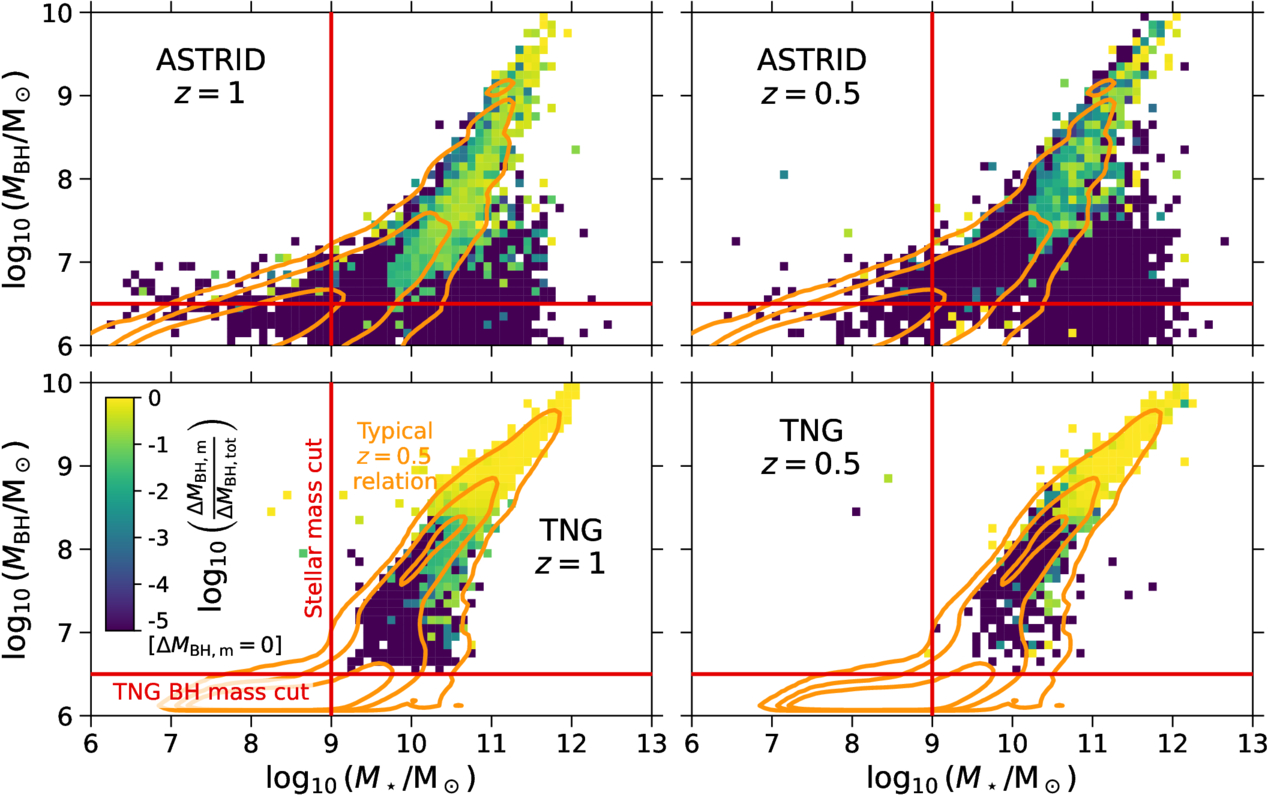
Figure 1 reveals a lot at once. First, ASTRID (the simulation that allows wandering black holes and tidally stripped satellites) has whole new neighbourhoods on the map that simply don’t exist in TNG300. Those populations clearly aren’t following the same tidy, linear coevolution that central black holes enjoy with their galaxies. Second, the most massive black holes tend to be the most yellow, meaning mergers did the heavy lifting for their growth. This is especially pronounced in TNG300, where roughly 80–90% of the growth of the most massive black holes comes from mergers. Meanwhile, the wanderers and stripped satellites sit at the deep-purple end: these black holes have barely merged with anyone at all.

relation between black hole mass and host galaxy stellar mass

Figure 1: How black hole mass relates to host galaxy stellar mass, shown at two snapshots in cosmic history, 8 and 5 billion years ago, for both simulations (ASTRID: top row; TNG300: bottom row). Colour shows what fraction of each black hole’s growth since the last snapshot came from mergers, from purple (grown almost entirely by slowly swallowing gas) to yellow (grown mostly by swallowing other black holes). [Weller et al. 2026]

Four Kinds of Black Hole Life Stories

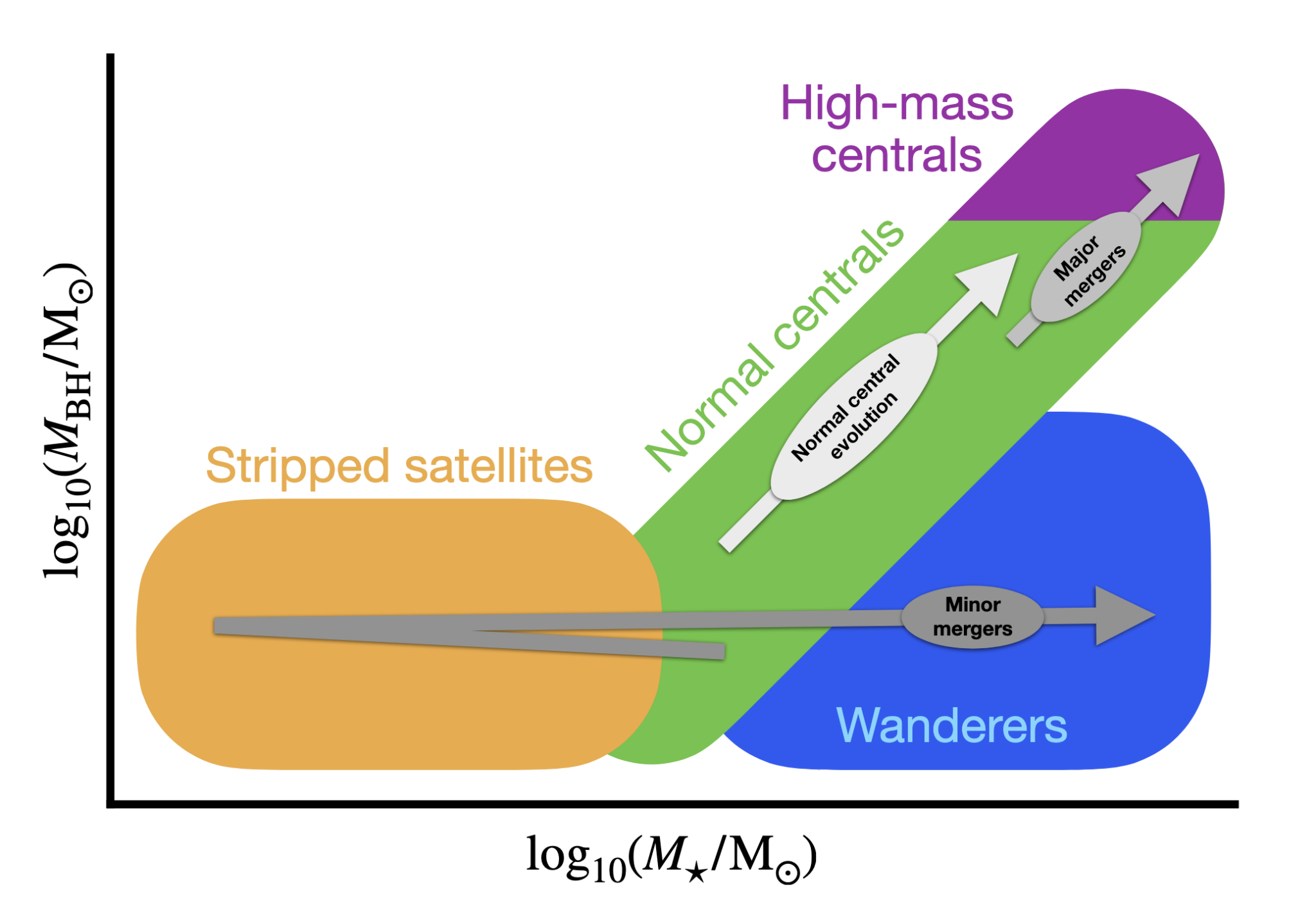
Pulling all of this together, the authors sketch out a kind of “neighborhood map” of black hole fates, sorted by where a black hole ends up on the mass-relation plot and how it got there (see Figure 2).

diagram showing the distinct populations revealed by the black hole mass–stellar mass relation

Figure 2: The distinct black hole populations revealed by the black hole mass–stellar mass relation, and the evolutionary path that lands each population in its corner of the map. [Weller et al. 2026]

  • Normal centrals are the homebodies. They sit at the centre of primary or satellite galaxies and grow up steadily alongside their hometown, climbing the mass relation together through a healthy mix of accretion and the occasional merger. Their galaxies keep forming stars the whole time in a functional, unremarkable, thoroughly nice place to live.
  • High-mass centrals are the ones who “made it.” These are central black holes in big primary galaxies, and their growth comes overwhelmingly from mergers with other black holes. Once they get big enough, they start throwing their weight around: their jets blast gas out of the galaxy, shutting down both star formation and their own further growth.
  • Stripped satellites are the annexed suburbs. They start out on the normal mass relation, but a merger with a bigger galaxy tears away their gas and stars, shrinking their stellar mass while their black hole is left comparatively overweight for its new, smaller home. With their gas reserves gone, star formation grinds to a halt, and their black holes, starved of fuel, barely grow either.
  • Wanderers are the ones who moved to the big city and never quite settled in. They start out on the normal relation inside a satellite galaxy, but when that galaxy merges into something much bigger, they’re left drifting through unfamiliar, low-density territory. With little gas around to feed on and almost no chance of merging with anyone else, their growth basically stalls.

This four-way map is a genuinely useful new way to read the black hole–galaxy relation: a black hole’s exact position on the plot isn’t just a number, it’s a fossil record of everywhere it’s ever “lived.”

There’s plenty more in the article we haven’t covered here, including how quenching plays out over time, how these results stack up against the local universe, and a closer look at how star formation rates and black hole accretion rates track each other across all four populations. If any of this piqued your interest, the full article is well worth a read.

Original astrobite edited by Ryan White and Chloe Klare.

About the author, Jayde Willingham:

I am a first-year PhD student at Swinburne University of Technology studying the early universe and how the first galaxies came to be. My work combines observations and theoretical modelling to explore how galaxies form, evolve, and shape the universe we see today. When I’m not at my desk or doing SciComm, I’m probably reading a good book with a hot beverage under a cozy blanket.

The post Not All Black Holes Who Wander Are Lost appeared first on AAS Nova.

Astronomers Get a Better Look at a Rare White Dwarf–Brown Dwarf Pair

16 October 2026 at 17:00

Illustration of a brown dwarf orbiting a white dwarf

Researchers have followed up on the discovery of a rare binary system containing a white dwarf and a brown dwarf. This unusual pairing offers valuable insights into the physics of atmospheres subjected to strong radiation.

Odd Couple

In 2025, researchers searching through observations from the Transiting Exoplanet Survey Satellite (TESS) spotted an eclipsing binary system in which a brown dwarf orbits the white dwarf J0404+1112 every 2.93 hours. Only about a dozen white dwarf–brown dwarf binaries have been confirmed so far, and each newfound system offers clues to how substellar or planetary companions survive a star’s transition from main-sequence star to swollen red giant to blazing white dwarf.

Because the two objects orbit one another so closely, this remarkable system also offers researchers an opportunity to study the dynamics and chemistry of an atmosphere blasted with high-energy radiation, with important implications for close-in brown dwarfs and giant planets.

Insights from New Observations

eclipse photometry of J0404+1112

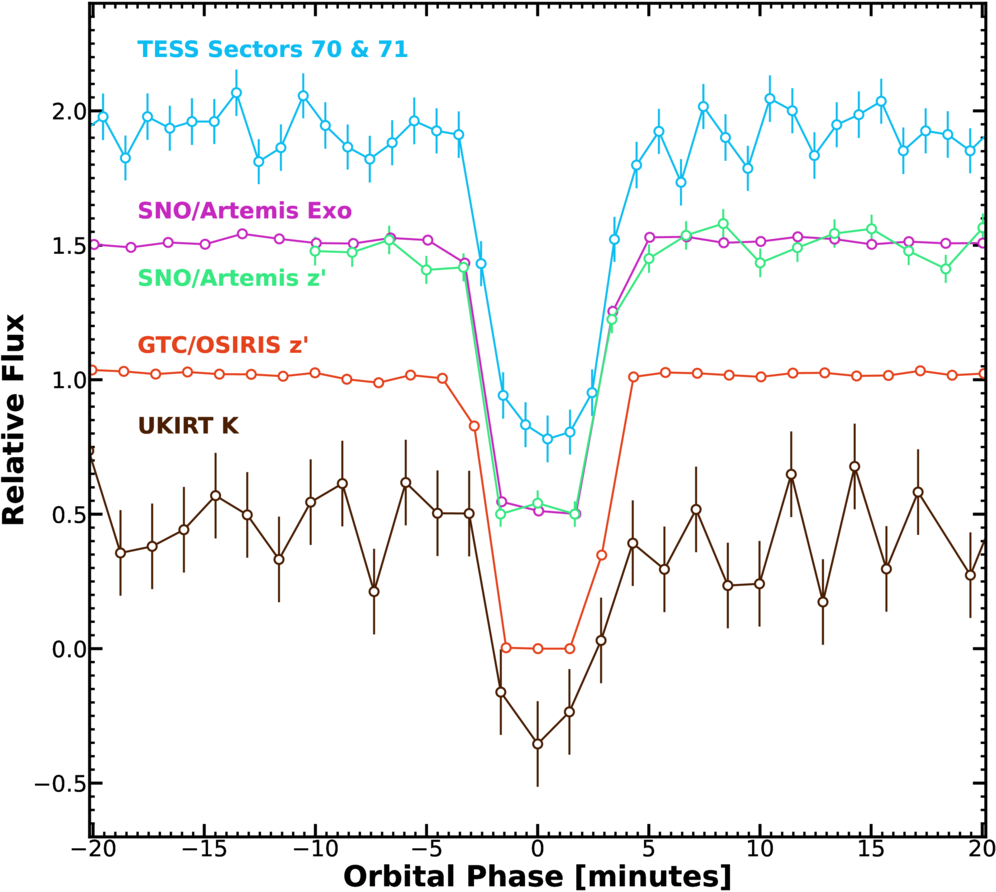
Eclipse photometry of J0404+1112 from TESS, SPECULOOS, the Gran Telescopio Canarias, and the United Kingdom Infra-Red Telescope. [de Wit et al. 2026]

Based on early data from TESS and SPECULOOS, Julien de Wit (Massachusetts Institute of Technology) and collaborators posited that the J0404+1112 system contained an unusually puffy low-mass white dwarf and a 25-Jupiter-mass brown dwarf. However, the initial data couldn’t fully constrain the white dwarf’s properties, leaving degeneracies between its temperature, radius, and other factors.

Now, the team has obtained new photometry from the Gran Telescopio Canarias and the United Kingdom Infra-Red Telescope, plus spectroscopy from the Gran Telescopio Canarias, to get a better sense of the system. These observations allowed them to break the degeneracies in the white dwarf’s properties, showing it to be an 0.60-solar-mass white dwarf that has been cooling for more than 10 million years to a present-day temperature of 28,000K. The brown dwarf also appears to be more massive than initially thought, weighing in at roughly 40 Jupiter masses.

diagram illustrating the relative sizes of J0404+1112 and its companion brown dwarf

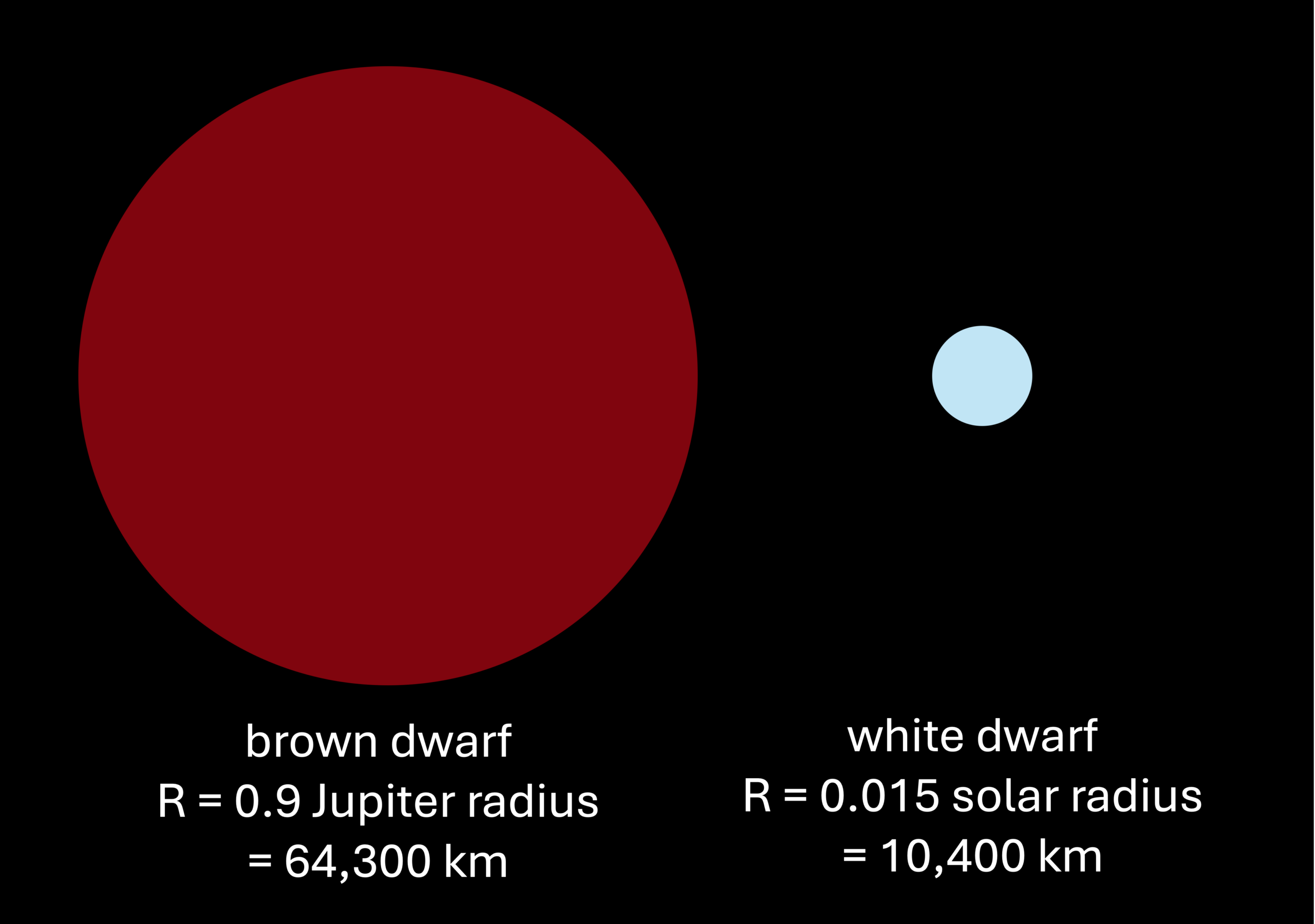
This diagram shows the relative sizes of the brown dwarf and the white dwarf. [AAS Nova/Kerry Hensley]

Like Night and Day

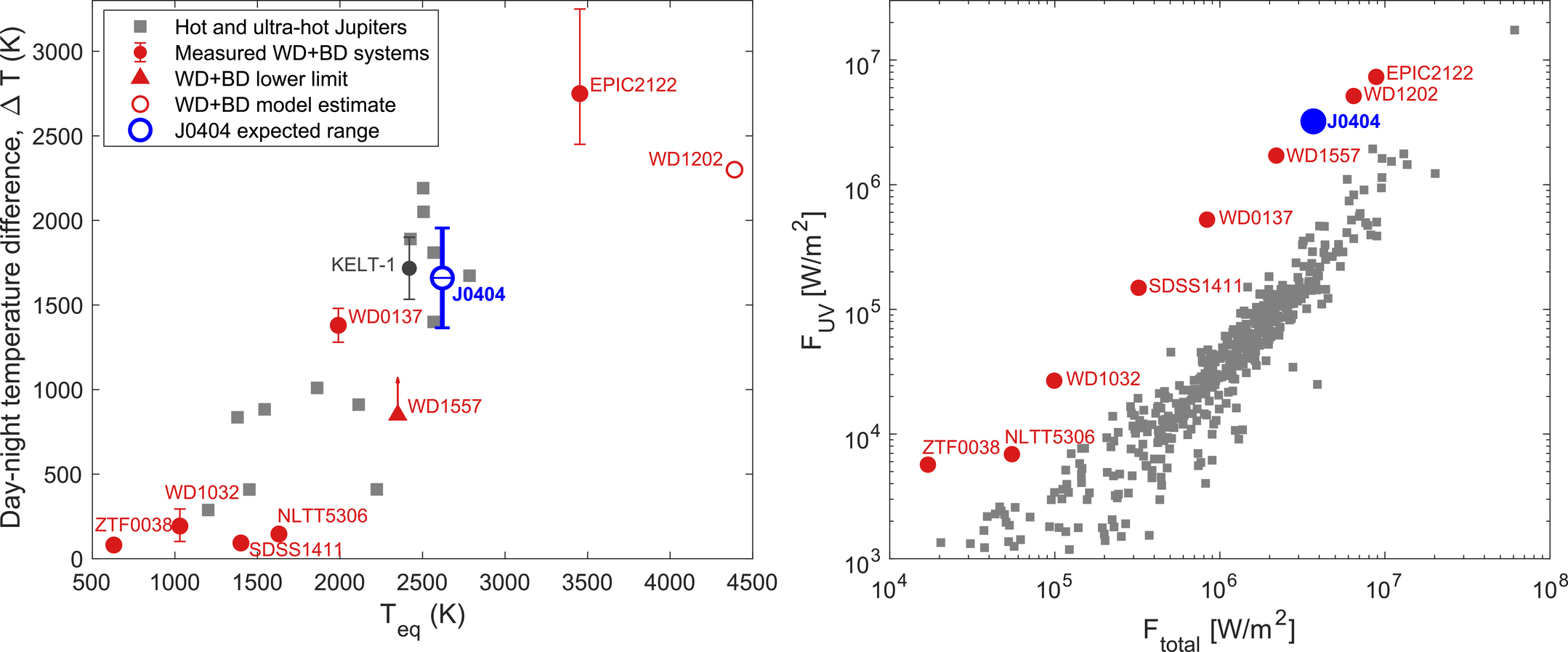
Because the system’s orbit is almost exactly edge on from our point of view, the white dwarf is completely eclipsed as the much larger brown dwarf passes in front of it. This allows the contributions from the two components to be separated, and for the emission from the brown dwarf’s nightside to be measured. The authors constrained the brown dwarf’s nightside temperature to roughly 1750K. Its dayside temperatures are likely to be significantly higher — potentially around 3750K at the point where the white dwarf is directly overhead — but more data are needed to constrain the dayside temperature of this world.

comparison of day–night temperature difference and irradiation flux of J0404+1112 compared to other systems

Day–night temperature difference (left) and irradiation flux (right) of the brown dwarf in this system compared to other white dwarf–brown dwarf systems and hot and ultra-hot Jupiters. Click to enlarge. [de Wit et al. 2026]

The estimated day–night temperature difference for this brown dwarf places it in the realm of hot and ultra-hot Jupiters. However, it’s subjected to more ultraviolet radiation than a typical hot or ultra-hot Jupiter orbiting a main-sequence star. This makes J0404+1112 a valuable system for disentangling the interconnected effects of temperature, radiation environment, atmospheric composition, and other factors on hot or ultra-hot Jupiters and other strongly irradiated brown dwarfs. We can certainly expect to learn more about this rare system as new data are collected!

Citation

“J0404+1112: A 3 hr Eclipsing White Dwarf–Brown Dwarf Probing Multiple Atmospheric Regimes,” J. de Wit et al 2026 ApJL 1009 L40. doi:10.3847/2041-8213/ae9a97

The post Astronomers Get a Better Look at a Rare White Dwarf–Brown Dwarf Pair appeared first on AAS Nova.

A Point-Spread Function for the Extreme Ultraviolet High-Resolution Imager on Board Solar Orbiter

16 October 2026 at 17:00

Stefan J. Hofmeister et al 2026 ApJS 286 3

Researchers have assessed the diffusion and scattering within an ultraviolet instrument on board Solar Orbiter, which takes detailed observations of our home star from as close as about 60 au.

The post A Point-Spread Function for the Extreme Ultraviolet High-Resolution Imager on Board Solar Orbiter appeared first on AAS Nova.

Inferring Globular Cluster Initial Mass Function from Stellar Streams

15 October 2026 at 17:00

Claire S. Ye and Raymond G. Carlberg 2026 ApJL 1007 L25

Pairing cold dark matter simulations with observations of stellar streams and globular clusters, researchers have extracted a declining power-law-like globular cluster initial mass function.

The post Inferring Globular Cluster Initial Mass Function from Stellar Streams appeared first on AAS Nova.

Electromagnetic Flares from Compact-Object Mergers in Active Galactic Nucleus Disks: Signatures and Predictions

14 October 2026 at 17:00

Hiromichi Tagawa et al 2026 ApJ 1006 121

Emission arising from the merger of stellar-mass black holes in an active galactic nucleus disk should be identifiable through monitoring of order 1,000 active galactic nuclei of sufficient luminosity for a year.

The post Electromagnetic Flares from Compact-Object Mergers in Active Galactic Nucleus Disks: Signatures and Predictions appeared first on AAS Nova.

Catching the Culprit Behind Globular Clusters’ Disappearing Binaries

14 October 2026 at 17:00

The formation of young binary protostars.

Roughly one-third of stars in the Milky Way are in binary or multiple systems, but only ~1–10% of stars in globular clusters have a companion. Did globular clusters start with fewer binaries than the solar neighborhood, or have they since been wiped out? 

Survival of the Tightest

Plot of semi-major axis vs. primary mass of binary stars.

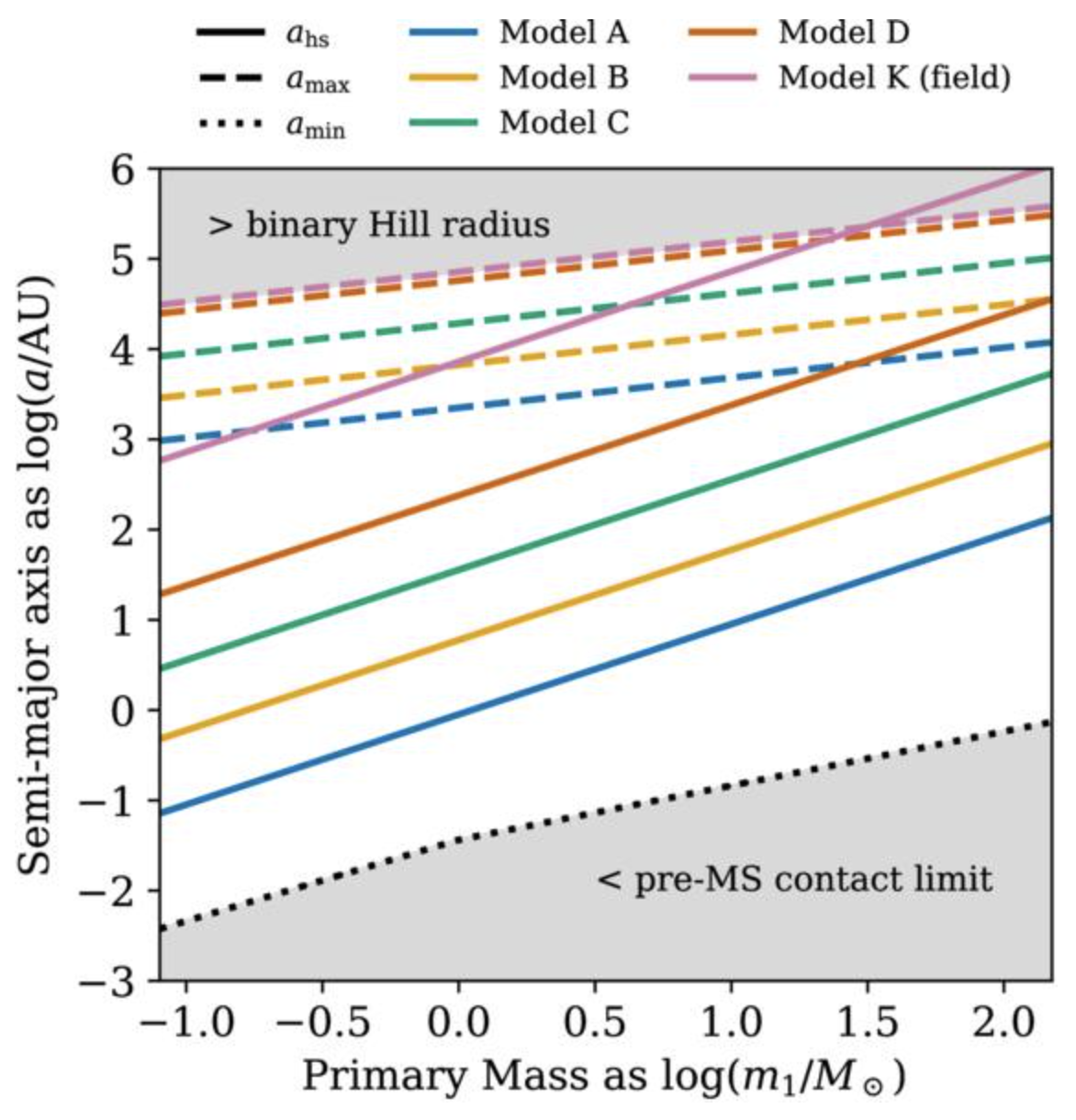
Map of the semi-major axis–primary mass parameter space for binary systems. Solid lines show the boundary between hard (below the line) and soft (above the line) binaries for a variety of models. Models A–K span a variety of cluster masses and virial radii (a proxy for cluster density). [O’Connor et al. 2026]

Globular clusters (GCs) are dense, ancient, gravitationally bound groups of stars. A team led by Christopher O’Connor at Northwestern University explored whether the lack of binary systems could be the result of some process unique to GCs. First, the team developed an analytical formalism to understand how binaries in a GC evolve depending on the binary stars’ masses, distance from each other, and interactions with other stars in the cluster. 

It turns out that the fate of a binary system depends on whether it is dynamically “hard” or “soft.” Hard binaries are generally tightly bound, and they tend to get “harder” from stellar flybys, which are common in a crowded cluster environment. Soft binaries are the opposite — they have much shorter lifetimes since encounters with other stars tend to loosen them. The team found that, assuming GCs have the same initial distribution of binaries as the solar neighborhood, the dissolution of soft binaries is sufficient to explain the present-day scarcity of binaries in GCs. 

Burning Away the Binaries

What actually tears the soft binaries apart? The answer is a process called “black hole burning.” As some of the most massive objects in a globular cluster, black holes in binary systems can transfer energy when they interact with passing stars. This influx of energy can excite soft binaries to the point of dissolution, the study shows. 

Black hole burning can also prevent core collapse in GCs. Left to itself, a cluster’s core gradually loses energy to its outskirts, causing the core to grow hotter and denser with stars. This leads to more dynamical interactions between stars that can then get flung from the core or enter new tight binaries. Black hole burning pumps energy back into the core and prevents this from happening. 

Putting the Theory to the Test

Plot that shows the number of black holes and total binary fraction in simulated globular clusters with time.

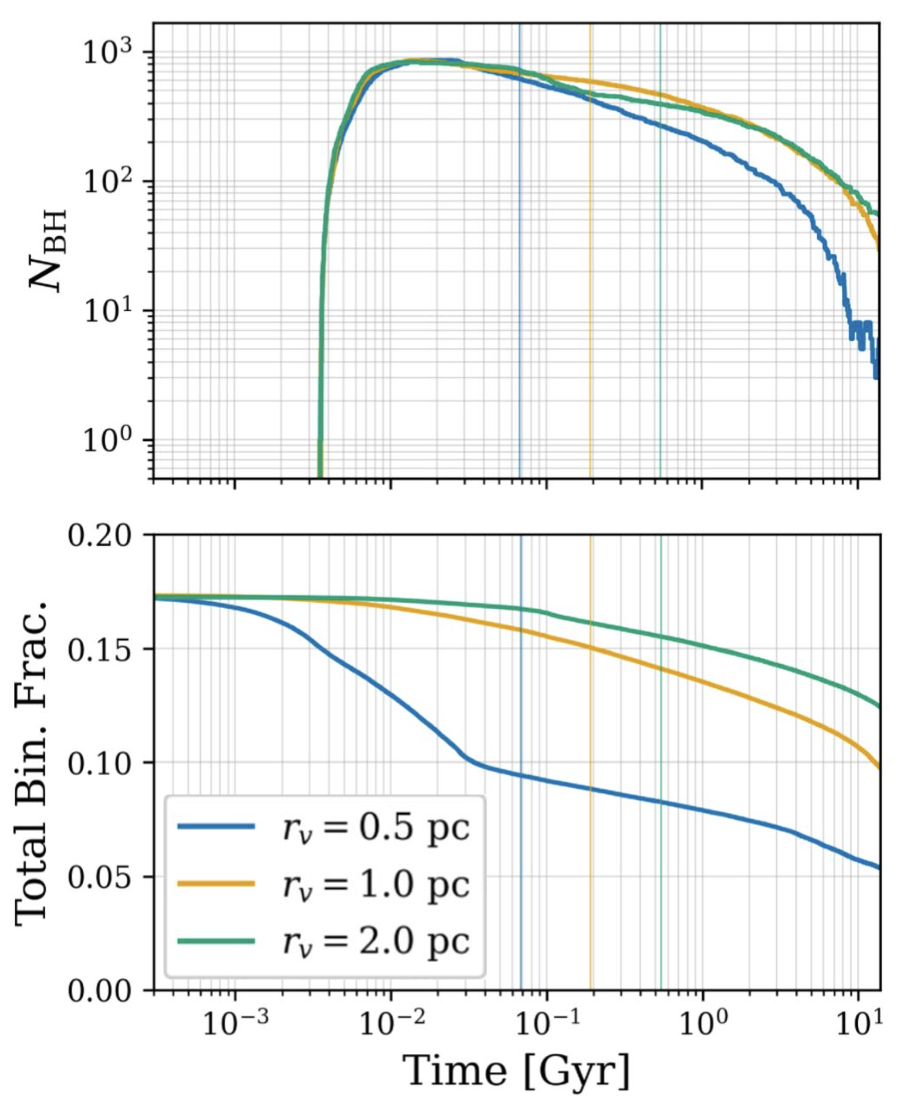
The total number of black holes in a cluster (top) and the binary fraction (bottom) as a function of time for three different cluster models. In the densest cluster (blue), binary dissolution starts early on, mainly driven by stellar collisions. For the other two models, binary dissolution mainly occurs after the number of black holes reaches its peak and black hole burning commences. [Adapted from O’Connor et al. 2026]

To validate their analytical results, the team performed N-body simulations of GC dynamics with the Cluster Monte Carlo code. They found that, in moderate-to-low-density clusters, the decline of binary systems is powered mainly by black hole burning. In more compact clusters, however, stellar collisions also play an important role in the dissolution of binary systems, and at earlier times than the onset of black hole burning.

In general, the final binary fractions of the simulated clusters agree with those predicted by the team’s analytical formalism. This further supports the theory that there is a universal initial binary distribution between galactic GCs and our solar neighborhood. Constraining this distribution is pivotal for refining dynamical models of GCs.

In short, GCs and the solar neighborhood likely started with the same amount of binary systems, and interstellar dynamics handled the rest. 

Citation

“A Common Origin for Binary Fractions in the Field and in Dense Clusters,” Christopher E. O’Connor et al 2026 ApJ 1009 L80. doi:10.3847/1538-4357/aea078

The post Catching the Culprit Behind Globular Clusters’ Disappearing Binaries appeared first on AAS Nova.

The Properties of Globular Clusters and Elqui Associated with the Sagittarius Dwarf Galaxy

13 October 2026 at 17:00

P. Wang et al 2026 AJ 172 102

After identifying a new globular cluster, HSC 61, belonging to the Sagittarius dwarf galaxy, researchers have mapped the stellar stream, determined its metallicity, and analyzed the Sagittarius merger event.

The post The Properties of Globular Clusters and Elqui Associated with the Sagittarius Dwarf Galaxy appeared first on AAS Nova.

Drawing Back the Curtain on Solar Spicules

13 October 2026 at 17:00

solar spicules

The Sun’s surface is peppered with spikes of plasma called spicules that appear to shift and twist over time. Recent simulations suggest a new explanation for the motion of solar spicules.

solar spicules

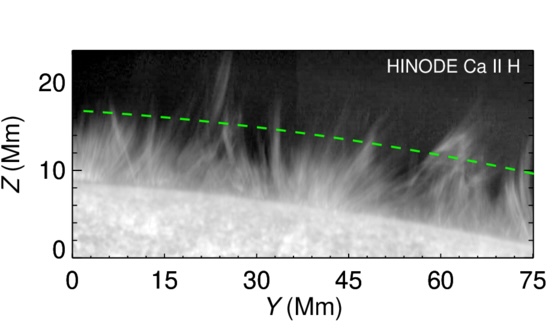
Solar spicules as seen by the Hinode mission. [Adapted from Dey et al. 2026]

Jets in Motion

Solar spicules are tiny jets of solar plasma that last just a few minutes. When viewed along the solar limb, spicules resemble blades of grass blowing in the wind. Observations show these structures moving in a variety of ways: twisting, shifting side to side, splitting, and joining together. Though spicules were first identified more than a century ago, where these motions come from is still up for debate.

In a recent research article, Sahel Dey (University of Newcastle; Indian Institute of Astrophysics; Indian Institute of Science) and collaborators performed 3D magnetohydrodynamics simulations to investigate the source of solar spicules’ motion. The team’s simulations encompassed a volume of 6,000 × 9,000 × 37,000 kilometers that stretched from beneath the visible surface of the Sun up to the lower region of the Sun’s outer atmosphere, or corona. In this region, they applied a uniform vertical magnetic field, mimicking the conditions within a coronal hole, where the Sun’s magnetic field streams outward into the solar system

simulated solar spicules

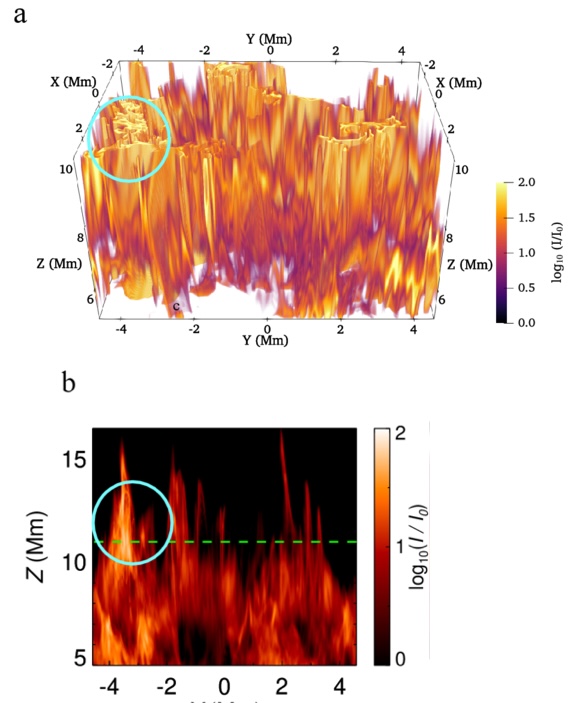
A) A three-dimensional view of simulated solar spicules, showing curtain-like structures. B) Intensity of synthetic emission from the spicules in panel A, integrated along the line of sight. The cyan circle indicates the same region in both panels. [Adapted from Dey et al. 2026]

Convection low in the simulation region generates slow magnetohydrodynamic waves, which create pockets of hot, upward-moving plasma and launch the spicules. When looking at the 3D structure of the spicules, Dey and collaborators found that they are not individual jets as they appear to be in photographs of the Sun. Instead, the sea of spicules creates an interconnected structure similar to a folded curtain.

Simulating Spicules

The jet-like appearance arises when this arrangement is viewed from the side; the team created synthetic images of their simulated spicules that show individual jet-like features. These “jets” have properties similar to those of real spicules, lasting just 5–10 minutes, journeying upward at 20–70 kilometers per second, and reaching heights of 6,000–16,000 kilometers.

These simulations clearly demonstrate that what appear to be individual jets can arise from curtain-like plasma structures. Dey and collaborators showed that this network of spicules evolves over time, buoyed upward from below by a series of shocks, pulled down gradually by gravity, and buffeted by adjacent plasma.

spicules and coronal swirling conduits

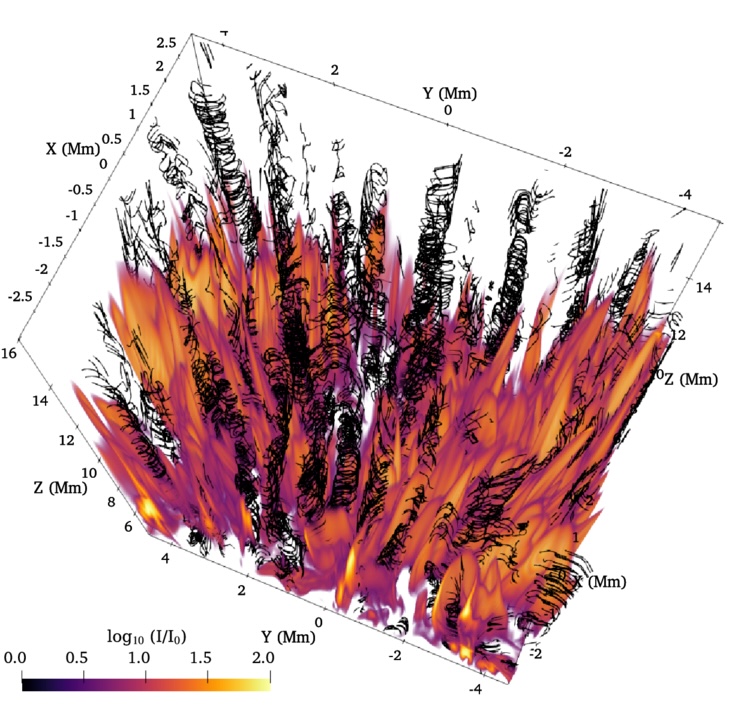
Three-dimensional view of spicules (purple–yellow regions) and coronal swirling conduits (represented by spiraling black lines). [Adapted from Dey et al. 2026]

The team showed that when spicules seem to rotate, merge, or split, these are largely apparent motions. For example, when two spicules appear to merge, this could be caused by different sections of a plasma curtain aligning along the line of sight. Some of the spicule rotation is due to what the authors term coronal swirling conduits: columns of rotating plasma interspersed within the network of spicules. These swirling plasma columns can transfer some of their motion to the spicules, especially when the spicules are falling back toward the solar surface.

This work demonstrates that a curtain-like configuration provides a viable explanation for the observed variety of spicule motions. Going forward, it will be critical to test this possibility further, as correctly interpreting the underlying structures of solar spicules is key to understanding how mass and energy are transferred to the solar corona.

Citation

“Solar Spicule Rotation Driven by Plasma Curtain–Vortex Interactions,” Sahel Dey et al 2026 ApJ 1008 132. doi:10.3847/1538-4357/ae8999

The post Drawing Back the Curtain on Solar Spicules appeared first on AAS Nova.

The Invisible Architecture Between the Stars

12 October 2026 at 17:00

NGC 2467

Editor’s Note: Astrobites is a graduate-student-run organization that digests astrophysical literature for undergraduate students. As part of the partnership between the AAS and astrobites, we occasionally repost astrobites content here at AAS Nova. We hope you enjoy this post from astrobites; the original can be viewed at astrobites.org.

Title: Phase-Dependent Magnetic Coherence in the Turbulent Interstellar Medium
Authors: Iryna S. Butsky et al.
First Author’s Institution: Stanford University
Status: Accepted to ApJ

The space between stars isn’t empty, because it’s threaded with magnetic fields that shape how gas moves and steer cosmic rays as they race across the galaxy. As a result, understanding how the magnetic field is structured within different components of the interstellar medium, specifically clouds of different temperatures, is a key part of understanding how the interstellar medium we see today takes shape.

Because magnetic fields are invisible, astronomers need tracers to reveal their structure. One such tracer is the emission from dust grains. Dust grains are not spherical, and a dust grain’s long axis tends to align at a right angle to the magnetic field, causing dust grains to emit light that vibrates in a particular direction. This is called polarized emission. If the magnetic field in a region is very ordered, the grains all align the same way, and a large fraction of their emitted light vibrates in the same direction, giving a high polarization fraction. This fraction is therefore used as a proxy for whether the field can maintain a consistent direction on large scales (an ordered/regular magnetic field).

Comparing the polarization fraction with other tracers of gas lets astronomers infer the field’s structure in the interstellar medium. Previous observations found that the polarization fraction correlates with the fraction of cold gas, but not with the total amount of gas along the line of sight. This suggests that the field is preferentially ordered within cold clouds rather than warm clouds. Curiously, this seemed to contradict other studies that found the field to be more ordered in the warm clouds. Such disagreements are where simulations become useful: because the true magnetic field is known in a simulation, astronomers can test which interpretation the observations actually support.

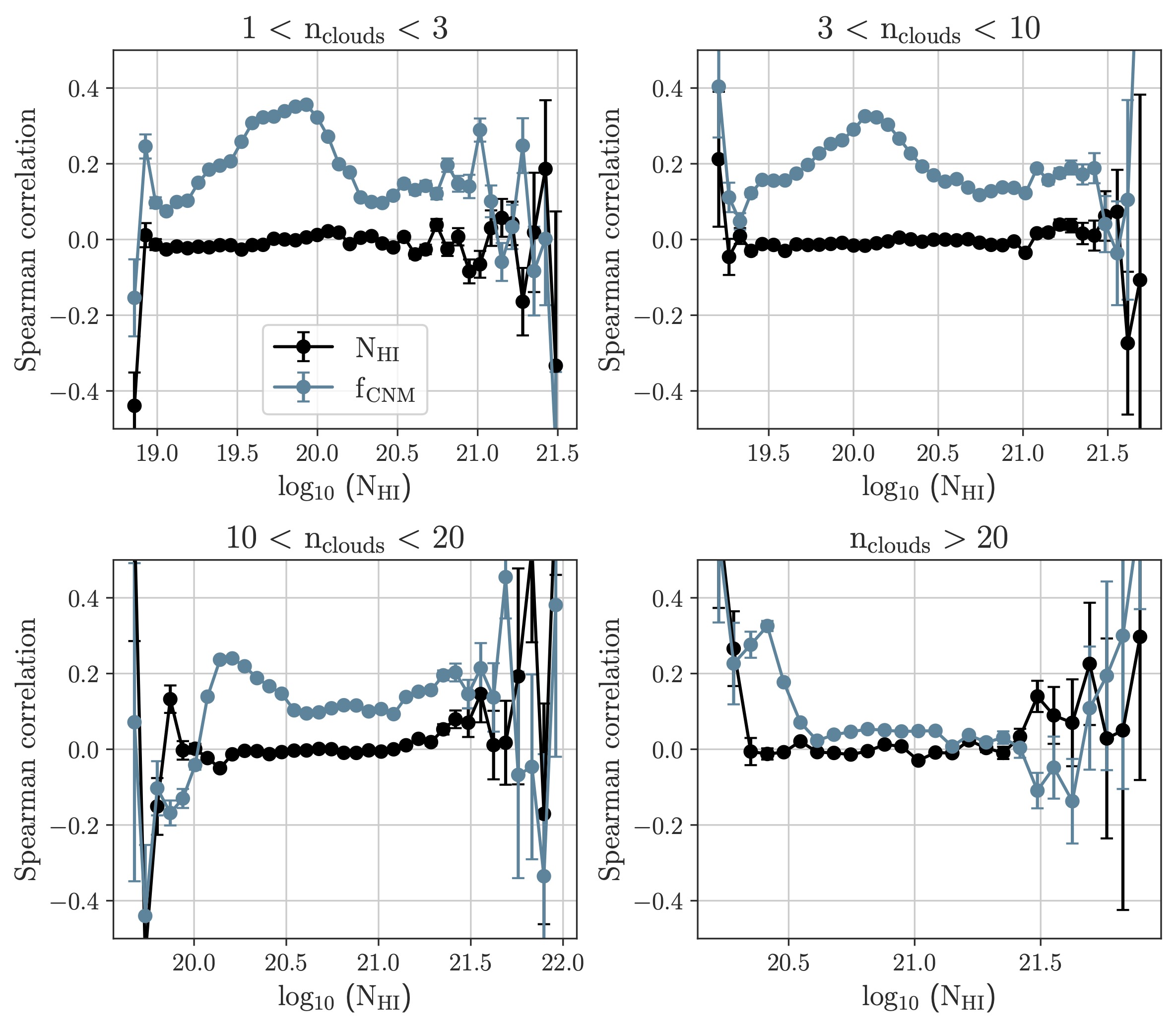
In this article, the authors use high-resolution numerical simulations to reproduce the relationship between polarization fraction and cold cloud fraction. They find that as long as the line of sight crosses fewer than about 20 clouds, the polarization fraction correlates with the cold cloud fraction, but not with the total neutral gas (Figure 1). This matches earlier observations, where the correlation shows up at high galactic latitudes, which point out of the galactic plane and therefore cross only a few cold structures. When too many clouds lie along the line of sight, each cloud carries an ordered field pointing in a different direction. Averaged together, these vibration directions cancel out, lowering the polarization fraction and washing the correlation away.

Plots showing the correlation between dust polarization fraction, the total gas amount, and the fraction of cold medium along the line of sight

Figure 1: Correlation between dust polarization fraction, the total gas amount (neutral hydrogen column density, NHI), and the fraction of cold medium along the line of sight (fCNM) for projections of different path lengths. The polarization fraction correlates with fCNM but not with NHI. The correlation disappears once many clouds lie along the line of sight (see lower-right panel). [Butsky et al., in press]

Distribution of the angle difference between the average magnetic field and the line of sight for cold and warm clouds

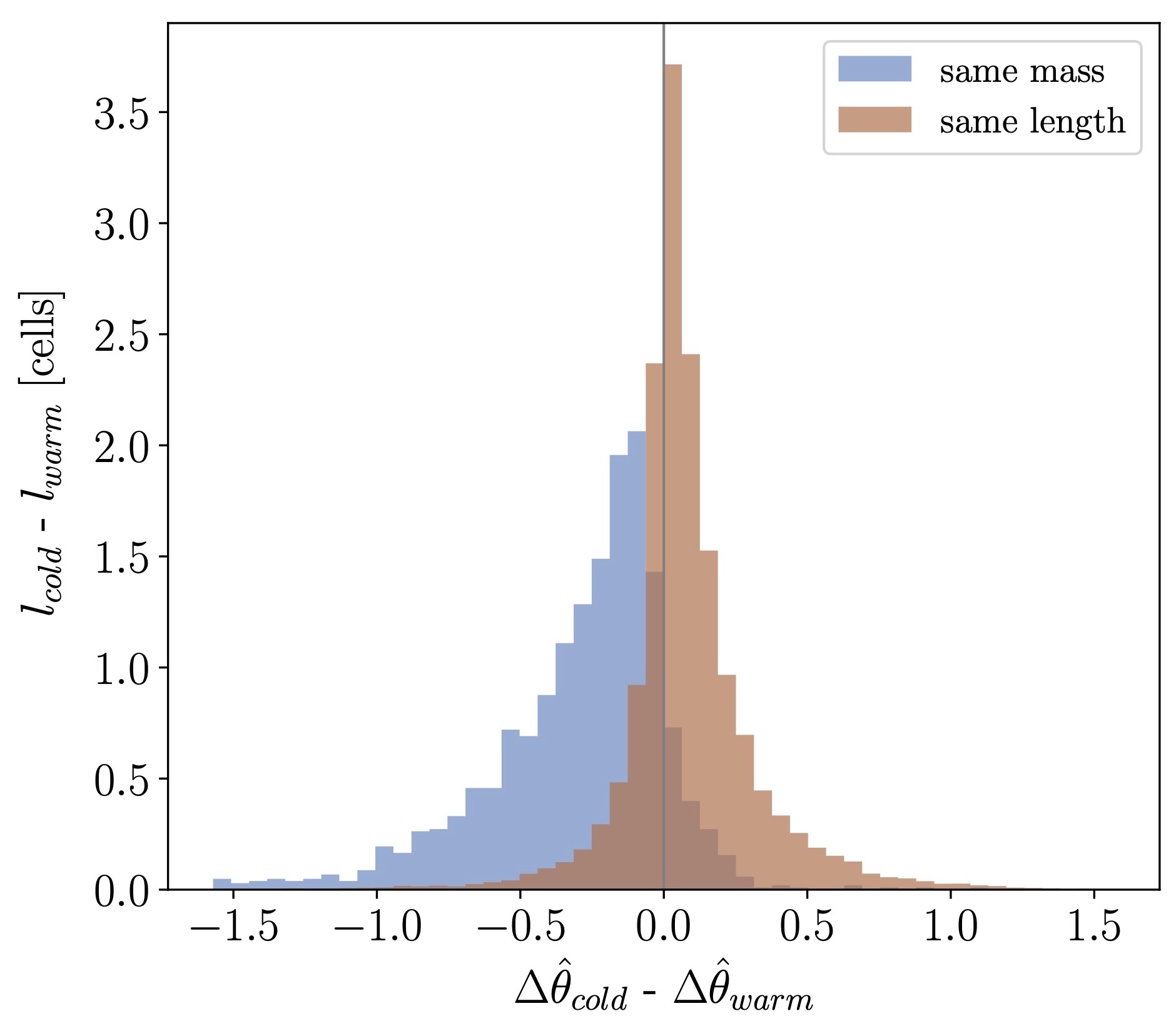
Figure 2: Distribution of the angle difference between the average magnetic field and the line of sight for cold and warm clouds, shown for clouds matched by mass and by length. A smaller angle difference means a more ordered field. At similar mass, cold clouds show a more ordered field; at similar length, the reverse holds. [Adapted from Butsky et al., in press]

Since the simulation reproduces the observational result, does it therefore agree with the conclusion that magnetic fields are genuinely more ordered in the cold neutral medium? The authors argue that the answer depends on how you measure “order.” Comparing the magnetic field direction in individual dense clouds, they find that cold clouds have more ordered fields when compared against warm clouds of similar mass, but the conclusion flips when comparing clouds of similar length (Figure 2).

This apparent paradox comes from the different nature of cold and warm clouds. Cold clouds are denser and more compact, occupying much smaller physical scales than warm clouds. So to match the length of a warm cloud, you have to string together several cold structures, sampling more of the field’s variation and making the cold gas look disordered. Measured per unit length, then, warm clouds appear more ordered. Measured per unit mass, cold clouds appear more ordered. Crucially, when we observe dust emission, we are naturally weighting by mass, so real observations effectively trace the polarization fraction per unit mass, the regime in which the cold clouds are the more coherent phase.

In the end, this work shows that the ordering of interstellar magnetic fields depends on both the gas phase and how we choose to measure it. Cold clouds carry more coherent fields per unit mass, which is exactly the quantity dust observations trace, resolving an apparent contradiction between earlier studies. It is a reminder that even our best observations come with hidden assumptions, and that simulations, where the true field is known, are essential for interpreting what the sky is really telling us.

Original astrobite edited by Viviana Cáceres.

About the author, Sandy Chiu:

I’m a PhD candidate at the University of Michigan, Ann Arbor. I’m interested in numerical simulations of cosmic rays feedback in galaxies and their comparison with observation.

The post The Invisible Architecture Between the Stars appeared first on AAS Nova.

Gelato: A Mission Concept for Comet Surface Sample Return

12 October 2026 at 17:00

Mallory J. Kinczyk et al 2026 Planet. Sci. J. 7 182

The Gelato mission would collect a sample from the surface of the comet 67P/Churyumov–Gerasimenko, gathering material that, unlike coma materials collected in previous missions, is relatively unprocessed.

The post Gelato: A Mission Concept for Comet Surface Sample Return appeared first on AAS Nova.

A Pulsar in a Rare Triple System

9 October 2026 at 17:00

triple-star system containing the pulsar PSR J0435+3233

Follow-up observations show that a recently discovered pulsar has two stellar companions, making it one of just a handful of millisecond pulsars known to be in triple-star systems.

An Unusual New Pulsar

Earlier this year, researchers reported the discovery of a pulsar with the Five-hundred-meter Aperture Spherical radio Telescope (FAST). The newfound pulsar, PSR J0435+3233, is a millisecond pulsar, rotating once every 3.2 milliseconds. What’s unique about this pulsar is how quickly it’s spinning down: its spin rate is decreasing roughly 100 times faster than other millisecond pulsars in our galaxy, suggesting an unusually strong magnetic field and the possibility of an exotic formation pathway.

The FAST observations also showed that the pulsar is not alone: it appears to be on an 8-day orbit with a white dwarf. Now, follow-up observations have revealed the pulsar’s membership in an intriguing stellar system.

From Radio to Gamma Rays

Zonglin Yang (National Astronomical Observatories, Chinese Academy of Sciences) and coauthors followed up on the discovery of PSR J0435+3233 using multiwavelength data from FAST, multiple optical and infrared observatories, and the Fermi Gamma-Ray Space Telescope.

optical image of the subgiant companion to PSR J0435+3233

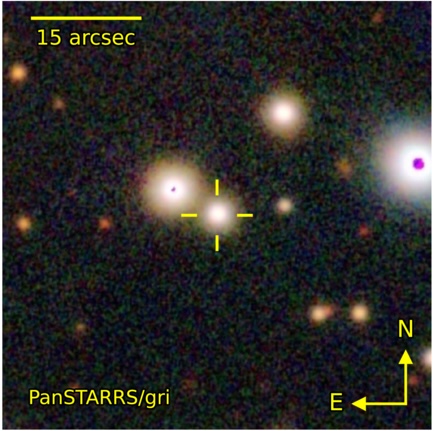
Visible-light image from PanSTARRS of the outer subgiant companion. [Adapted from Yang et al. 2026]

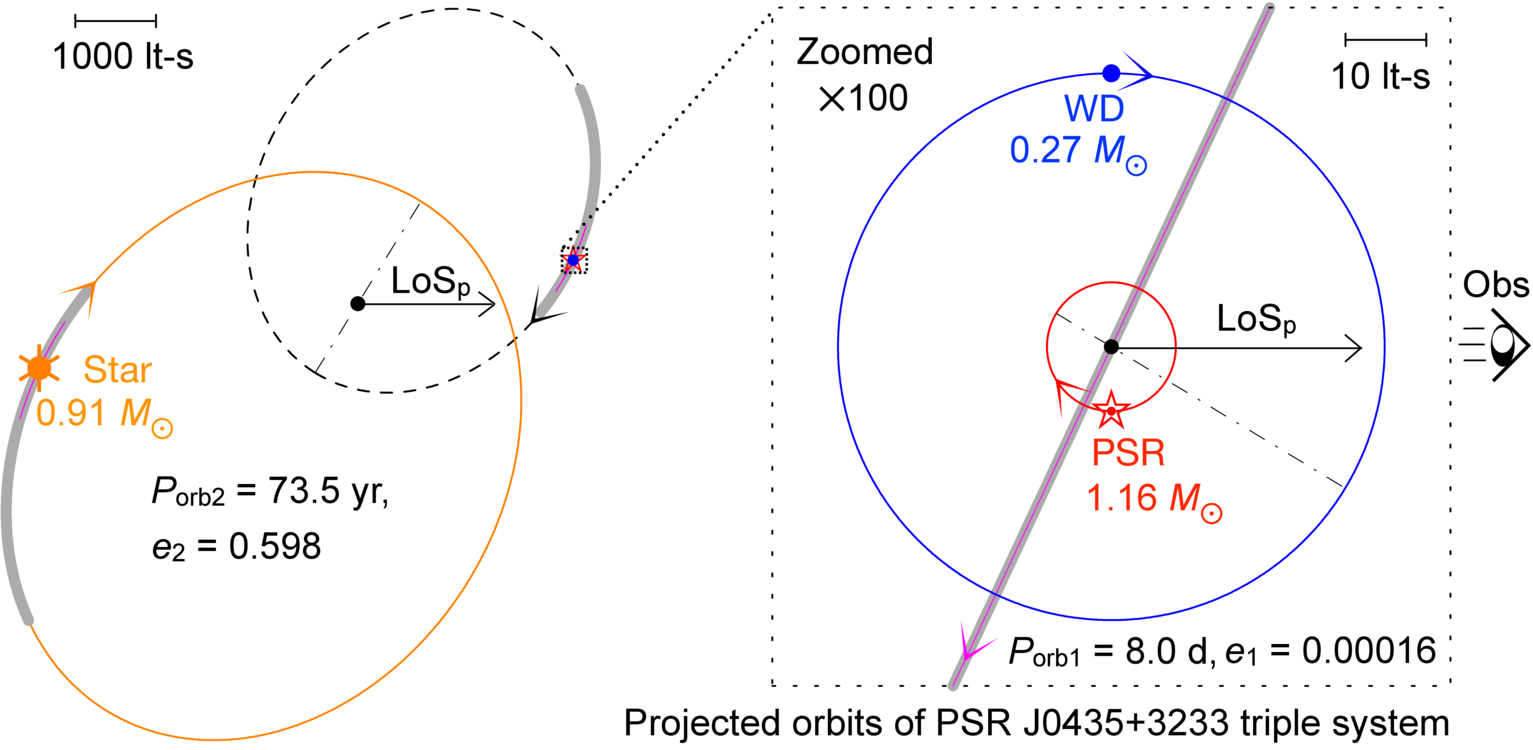
With this broad dataset, the team confirmed the identity of the pulsar’s white-dwarf companion, detected gamma-ray emission from the pulsar, and identified a second previously unknown companion, a subgiant star roughly as massive as the Sun. These three stars are arranged in a hierarchical triple: the pulsar and white dwarf orbit one another tightly, and the subgiant is a more distant companion, orbiting in decades rather than days. Current observations show that the orbits of the inner binary and the outer star are tilted relative to one another, either nearly perpendicularly or at about 54 degrees. While a triple system of three closely intertwined stars invites chaos, this configuration is stable long term.

Insights into Stellar Evolution

While it’s common to find millisecond pulsars in binary systems — in fact, many millisecond pulsars are thought to spin up to their incredible speeds via accretion from a stellar companion — it’s rare to discover them in triple systems. Because this system is isolated out in the field rather than crowded together with other stars in a dense cluster, Yang and collaborators suspect that the three stars have been together since birth, as opposed to being assembled dynamically later on.

projected orbits of PSR J0435+3233 and its two stellar companions

Projected orbits of the three stars in the system. Click to enlarge. [Yang et al. 2026]

The most massive star in the trio would have hurried through its main-sequence lifetime in less than 10 million years, culminating in a supernova. The remaining two members of the system would have had to withstand this explosion, which the team found is possible but not especially likely; the likelihood of the system coming unglued due to a star going supernova depends on how much of a “kick” the explosion gives the newborn pulsar, and even in a zero-kick scenario, the likelihood of the system remaining bound is only 35%. The future evolution of the system will be less dramatic. The outer star will eventually evolve into a white dwarf, undergoing a gentle transition that poses no threat to the stability of the system.

Triple-star systems are common among massive stars, but how this configuration affects stellar evolution is still being explored. This discovery offers a valuable opportunity to study dynamics and stellar evolution in a rare triple system.

Citation

“The PSR J0435+3233 Triple System,” Z. L. Yang et al 2026 ApJL 1010 L9. doi:10.3847/2041-8213/aeaa29

The post A Pulsar in a Rare Triple System appeared first on AAS Nova.

Testing Warm Dark Matter with Kinematics of the Smallest Galaxies

9 October 2026 at 17:00

M. Sten Delos et al 2026 ApJ 1006 125

The kinematics of small Milky Way satellites should differ depending on whether dark matter is warm or cold; current data constrain the mass of warm dark matter particles to >5.8 keV at 95% confidence.

The post Testing Warm Dark Matter with Kinematics of the Smallest Galaxies appeared first on AAS Nova.

EP250827b/SN 2025wkm: An X-Ray Flash-Supernova Powered by a Central Engine and Circumstellar Interaction

8 October 2026 at 17:00

Gokul P. Srinivasaragavan et al 2026 ApJL 1006 L36

Through modeling, researchers determined that a recently discovered supernova accompanied by an X-ray flash likely gave rise to a long-lived magnetar that may be surrounded by an accretion disk.

The post EP250827b/SN 2025wkm: An X-Ray Flash-Supernova Powered by a Central Engine and Circumstellar Interaction appeared first on AAS Nova.

Tilting WASP-12b Doesn’t Solve the Mystery of Its Inspiral

7 October 2026 at 20:59

Illustration of the exoplanet WASP-12 b.

In 3 million years or less, WASP-12b will tumble into its host star. It’s not surprising that the planet will meet its end this way, but it is surprising that it will happen so soon. New work tests a potential explanation for the planet’s rapid orbital decay.

Diagnosing a Doomed Planet

Roughly twice as wide as Jupiter and almost 50% more massive, exoplanet WASP-12b zips around its Sun-like stellar host every 1.09 days at a distance of just 0.023 au (3.4 million kilometers or 2.1 million miles). If placed in our solar system, WASP-12b would easily dethrone Mercury as the nearest planet to the Sun.

Observations show that WASP-12b’s already tiny orbit is shrinking, with each orbital period growing shorter at a rate of 29 milliseconds per year (Earth-year, that is). While we would expect the planet to slowly spiral inward due to tidal interactions with its star, it’s moving several orders of magnitude faster than predicted. The planet’s motion has so far defied all attempts to explain it, and now, a new research article by Caleb Lammers (Princeton University) and collaborators appears to topple yet another hypothesis for WASP-12b’s unexpectedly fast orbital decay.

A Tidy Tidal Explanation?

Previous work has proposed that WASP-12b’s rapidly shrinking orbit is due to obliquity tides, which could come into play if the planet had a nonzero obliquity, or axial tilt. Tidal dissipation generally works to keep close-in giant planets like WASP-12b from having a significant axial tilt. However, if you throw a second planet into the system, the companion can exert a torque that could force WASP-12b to remain tilted. This outside forcing, the hypothesis suggests, changes the orbital, spin, and tilt evolution of WASP-12b and ultimately pushes it toward its star far faster than expected without the tilt or the companion.

plot of mass versus orbital distance showing the radial velocity signal for each combination of parameters

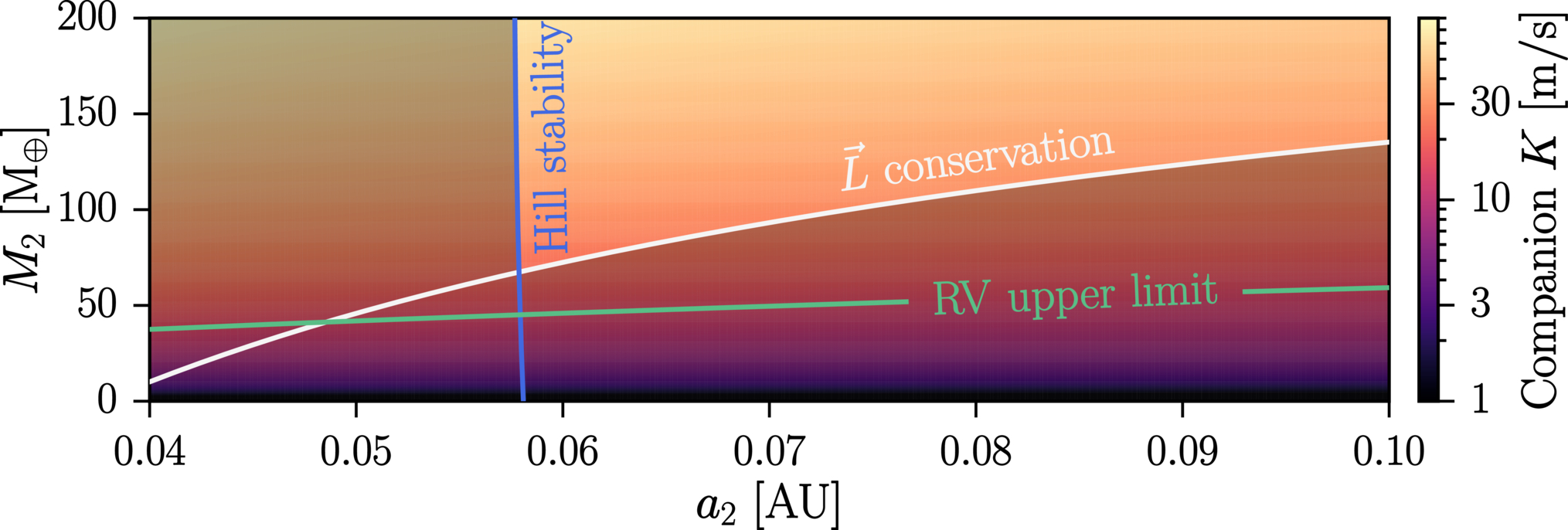
Constraints on the mass and orbital distance of the companion planet in the obliquity-tide scenario. The color shows the radial velocity signal associated with each combination of parameters. The green line shows the maximum radial velocity allowed by observations. Click to enlarge. [Lammers et al. 2026]

Lammers and coauthors examined this hypothesis by tracking how the angular momentum of a system containing both WASP-12b and a companion planet would evolve over time. As WASP-12b spirals inward, it loses angular momentum. For the planet’s lost angular momentum to be absorbed by the star and the companion planet — while maintaining a stable orbital configuration for both planets — the companion must orbit at least 0.06 au from the star and have a mass of at least 65 Earth masses.

The Mystery Persists

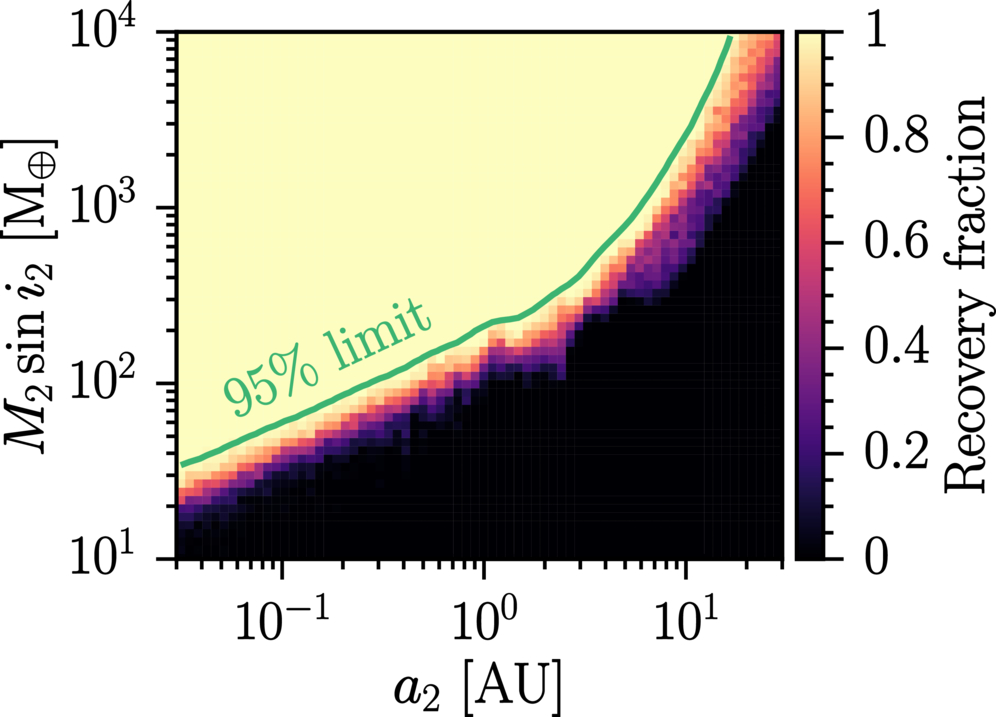
This companion mass and orbital distance are both larger than predicted by previous work, which had suggested that a 10–20-Earth-mass planet at 0.04 au would be sufficient to drive WASP-12b’s inward journey. Lammers and coauthors analyzed WASP-12’s radial velocity data for evidence of such a planet tugging on the star, but found none; only under extremely particular conditions could such a planet exist and not be detected in current data.

radial-velocity constraints on a second planet in the WASP-12 system

Radial velocity constraints on the properties of a hypothetical second planet in the WASP-12 system, obtained via injection-recovery tests. [Lammers et al. 2026]

Taking their calculations further, the team found it unlikely that this mechanism is at work in planetary systems in general, not just in the WASP-12 system. This leaves the mystery of WASP-12b’s rapid orbital decay wide open, and with only 3 million years to ponder it before the planet’s demise.

Citation

“The Mysterious Inspiral of WASP-12 b: Why Obliquity Tides Cannot Drive Orbital Decay,” Caleb Lammers et al 2026 ApJL 1009 L43. doi:10.3847/2041-8213/aea405

The post Tilting WASP-12b Doesn’t Solve the Mystery of Its Inspiral appeared first on AAS Nova.

Star Formation at the Periphery of a Molecular Superbubble: The Case of G12.79+0.43

7 October 2026 at 17:00

Arun Seshadri et al 2026 AJ 172 98

The molecular cloud complex G12.79+0.43 contains 82 young stellar object candidates; while this complex is spatially associated with a larger superbubble, it’s not yet clear if there is a causal association.

The post Star Formation at the Periphery of a Molecular Superbubble: The Case of G12.79+0.43 appeared first on AAS Nova.

❌